
Life, 1917-01-18 · page 22 of 40
Life — January 18, 1917 — page 22: what you’re looking at
What you’re looking at
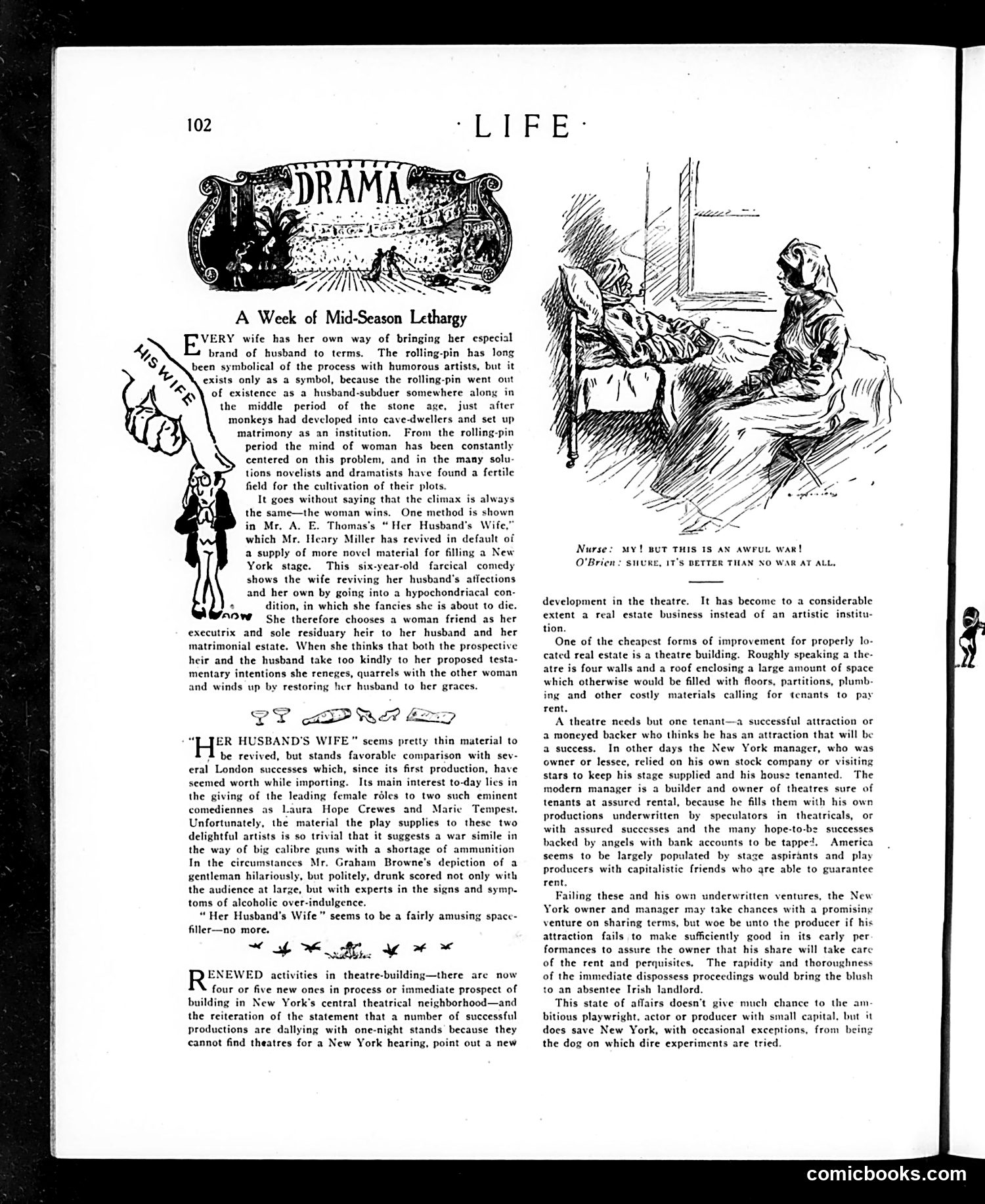
This page reviews "Her Husband's Wife," a six-year-old farce revived on the New York stage. The cartoon illustrates the play's premise: a wife feigns terminal illness to manipulate her husband's affections, naming a female friend as her heir to provoke jealousy. The husband ultimately submits, and she "wins" by restoring marital harmony. The sketch at top right shows a nurse and patient—O'Brien—joking that war is "better than no war at all," likely referencing the play's domestic "battle of wills" as metaphor. The satire critiques both the thin theatrical material and broader theater economics: successful plays struggle finding venues because theater owners now prioritize real estate development over artistic merit. The page suggests Broadway has become a real estate business where theaters are merely investment properties, not artistic institutions—a concern relevant to modern theater economics today.
📄 Transcribed text from this page (OCR, searchable)
Machine-transcribed from the original scan — historical spelling and the odd misread are preserved.
A Week of Mid-Season Lethargy VERY wife has her own way of bringing her especial brand of husband to terms. The rolling-pin has long been symbolical of the process with humorous artists, but it exists only as a symbol, because the rolling-pin went out of existence as a husband-subduer somewhere along in the middle period of the stone age, just after monkeys had developed into cave-dwellers and set up matrimony as an institution. From the rolling-pin period the mind of woman has been constantly centered on this problem, and in the many solu- tions novelists and dramatists have found a fertile field for the cultivation of their plots. It goes without saying that the climax is always the same—the woman wins. One method is shown in Mr. A. E. Thomas's “Her Husband's Wife,” which Mr. Heary Miller has revived in default of a supply of more novel material for filling a New York stage. This six-year-old farcical comedy shows the wife reviving her husband's atlections and her own by going into a hypochondriacal con- dition, in which she fancies she is about to die. AOWE She therefore chooses a woman friend as her executrix and sole residuary heir to her husband and her matrimonial estate. When she thinks that both the prospective heir and the husband take too kindly to her proposed testa- mentary intentions she reneges, quarrels with the other woman and winds up by restoring her husband to her graces. PS? PR? 425 ER HUSBAND'S WIFE” scems pretty thin material to be revived, but stands favorable comparison with sev- eral London successes which, since its first production, have seemed worth while importing. Its main interest to-day lies in the giving of the leading female rdles to two such eminent comediennes as Laura Hope Crewes and Marie Tempest. Unfortunately, the material the play supplies to these two delightful artists is so trivial that it suggests a war simile in the way of big calibre guns with a shortage of ammunition In the circumstances Mr. Graham Browne's depiction of a gentleman hilariously, but politely, drunk scored not only with the audience at large, but with experts in the signs and symp. toms of alcoholic over-indulgence. “Her Husband's Wife” seems to be a fairly amusing space- filler—no more. ah RL OO ENEWED activities in theatre-building—there are now four or five new ones in process or immediate prospect of building in New York’s central theatrical neighborhood—and the reiteration of the statement that a number of successful productions are dallying with one-night stands because they cannot find theatres for a New York hearing, point out a new Nurse: My! BUT THIS IS AN AWFUL War! O'Brien: suv IT'S BETTER THAN NO WAR AT ALL, development in the theatre. It has become to a considerable extent a real estate business instead of an artistic institu- tion. One of the cheapest forms of improvement for properly lo- cated real estate is a theatre building. Roughly speaking a the- atre is four walls and a roof enclosing a large amount of space which otherwise would be filled with floors, partitions, plumb- ing and other costly materials calling for tenants to pay rent. A theatre needs but one tenant—a successful attraction or a moneyed backer who thinks he has an attraction that will be a success. In other days the New York manager, who was owner or lessee, relied on his own stock company or visiting stars to keep his stage supplied and his hous: tenanted. The modern manager is a builder and owner of theatres sure of tenants at assured rental, because he fills them with his own productions underwritten by speculators in theatricals, or with assured successes and the many hope-to-bz successes backed by angels with bank accounts to be tapped. America seems to be largely populated by stage aspirants and play producers with capitalistic friends who gre able to guarantee iling these and his own underwritten ventures, the New York owner and manager may take chances with a promising venture on sharing terms, but woe be unto the producer if his attraction fails to make sufficiently good in its early per formances to assure the owner that his share will take care of the rent and perquisites. The rapidity and thoroughness of the immediate dispossess proceedings would bring the blush to an absentee Irish landlord. This state of affairs doesn’t give much chance to the am bitious playwright, actor or producer with small capital, but it does save New York, with occasional exceptions, from beir the dog on which dire experiments are tried. comicbooks.com