
Life, 1917-01-18 · page 10 of 40
Life — January 18, 1917 — page 10: what you’re looking at
What you’re looking at
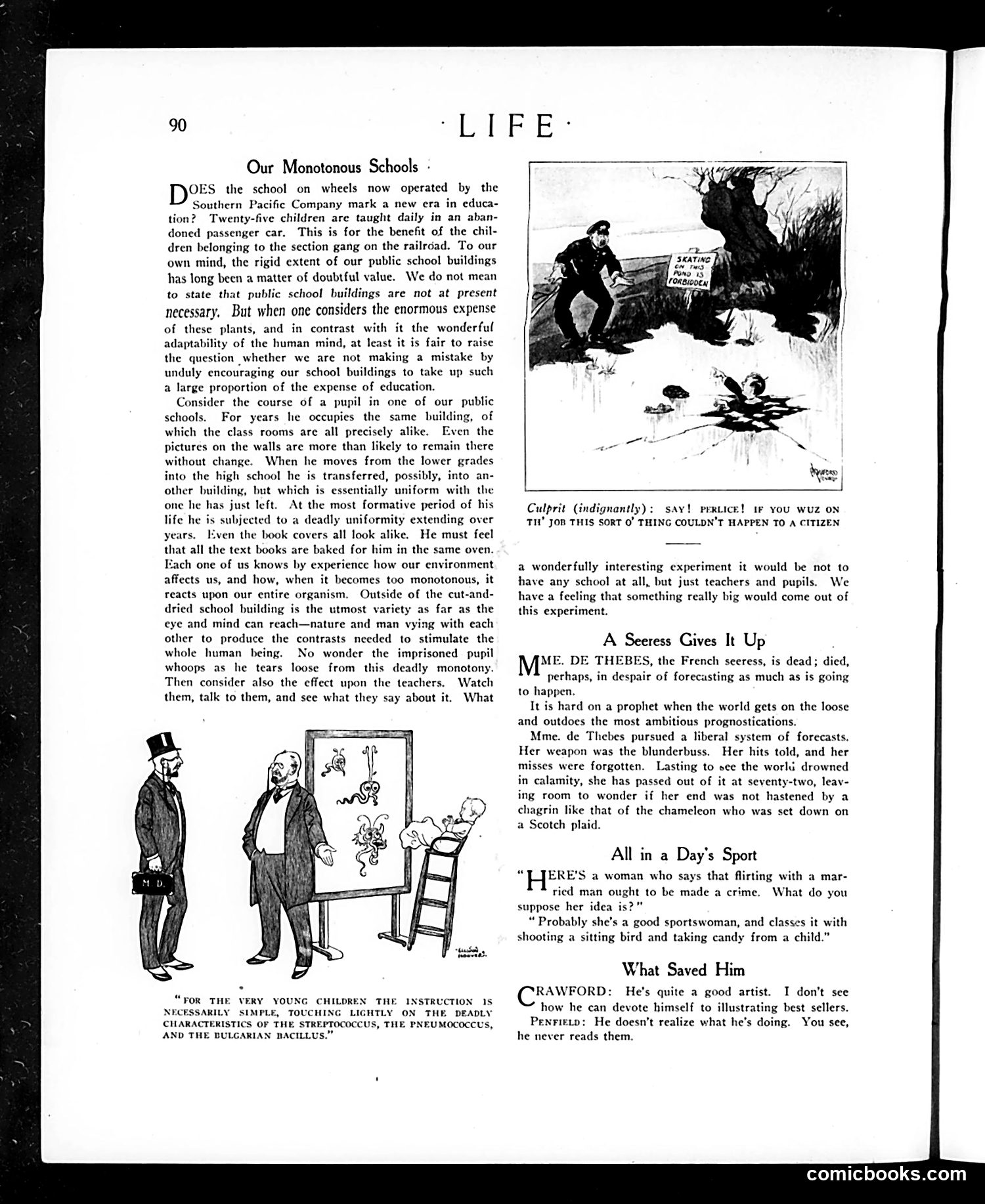
**Main Article: "Our Monotonous Schools"** This editorial criticizes rigid, uniform public school buildings as stifling to education. The author argues that identical classroom environments fail to stimulate children's development and suggests schools should encourage environmental variety to better engage students' minds. **Political Cartoon (bottom left):** Shows three men examining a child's drawing on a board. The caption states this instruction method is "necessarily simple, touching lightly on the deadly characteristics of the streptococcus, the pneumococcus, and the bulgarian bacillus." This appears to satirize overly technical, inappropriate science instruction for young children—teaching complex bacteriology to students incapable of understanding it. The other brief humor items on the page appear unrelated to political satire.
📄 Transcribed text from this page (OCR, searchable)
Machine-transcribed from the original scan — historical spelling and the odd misread are preserved.
"CVE E* Our Monotonous Schools OES the school on wheels now operated by the Southern Pacific Company mark a new era in educa- tion? Twenty-five children are taught daily in an aban- doned passenger car. This is for the benefit of the chil- dren belonging to the section gang on the railroad. To our own mind, the rigid extent of our public school buildings has long been a matter of doubtful value. We do not mean to state that public school buildings are not at present necessary, But when one considers the enormous expense of these plants, and in contrast with it the wonderful adaptability of the human mind, at least it is fair to raise the question whether we are not making a mistake by unduly encouraging our school buildings to take up such a large proportion of the expense of education. Consider the course of a pupil in one of our public schools. For years he occupies the same building, of which the class rooms are all precisely alike. Even the pictures on the walls are more than likely to remain there without chan When he moves from the lower grades into the high school he is transferred, possibly, into an- other building, but which is essentially uniform with the one he has just left. At the most formative period of his life he is subjected to a deadly uniformity extending over years. ven the book covers all look alike. He must feel that all the text books are baked for him in the same oven. tach one of us knows by experience how our environment affects us, and how, when it becomes too monotonous, it reacts upon our entire organism. Outside of the cut-and- dried school building is the utmost variety as far as the eye and mind can reach—nature and man vying with each other to produce the contrasts needed to stimulate the whole human being. No wonder the imprisoned pupil whoops as he tears loose from this deadly monotony. Then consider also the effect upon the teachers. Watch them, talk to them, and see what they say about it. What “FOR THE VERY YOUNG CHILDREN THE INSTRUCTION 15 NECESSARILY SIMPLE, TOUCHING LIGHTLY ON THE DEADLY CHARACTERISTICS OF THE STREPTOCOCCUS, THE PNEUMOCOCCUS, AND THE BULGARIAN BACILLUS.” Culprit (indignantly): say! pertice! iF you wuz oN TH’ JOB THIS SORT 0’ THING COULDN'T HAPPEN TO A CITIZEN a wonderfully interesting experiment it would be not to have any school at all, but just teachers and pupils. We have a feeling that something really big would come out of this experiment. A Seeress Gives It Up ME. DE THEBES, the French seeress, is dead; died, perhaps, in despair of forecasting as much as is going to happen, It is hard on a prophet when the world gets on the loose and outdoes the most ambitious prognostications. Mme. de Thebes pursued a liberal system of forecasts. Her weapon was the blunderbuss. Her hits told, and her misses were forgotten. Lasting to see the world drowned in calamity, she has passed out of it at seventy-two, leav- ing room to wonder if her end was not hastened by a chagrin like that of the chameleon who was set down on a Scotch plaid. All in a Day's Sport 'S a woman who says that flirting with a mar- What do you “LIER ried man ought to be made a crime. suppose her idea is?” “Probably she’s a good sportswoman, and classes it with shooting a sitting bird and taking candy from a child.” What Saved Him CRAWFORD: He's quite a good artist. I don't see how he can devote himself to illustrating best sellers. Penrittp: He doesn’t realize what he’s doing. You see, he never reads them. comicbooks.com