
A complete issue · 40 pages · 1916
Life — November 23, 1916
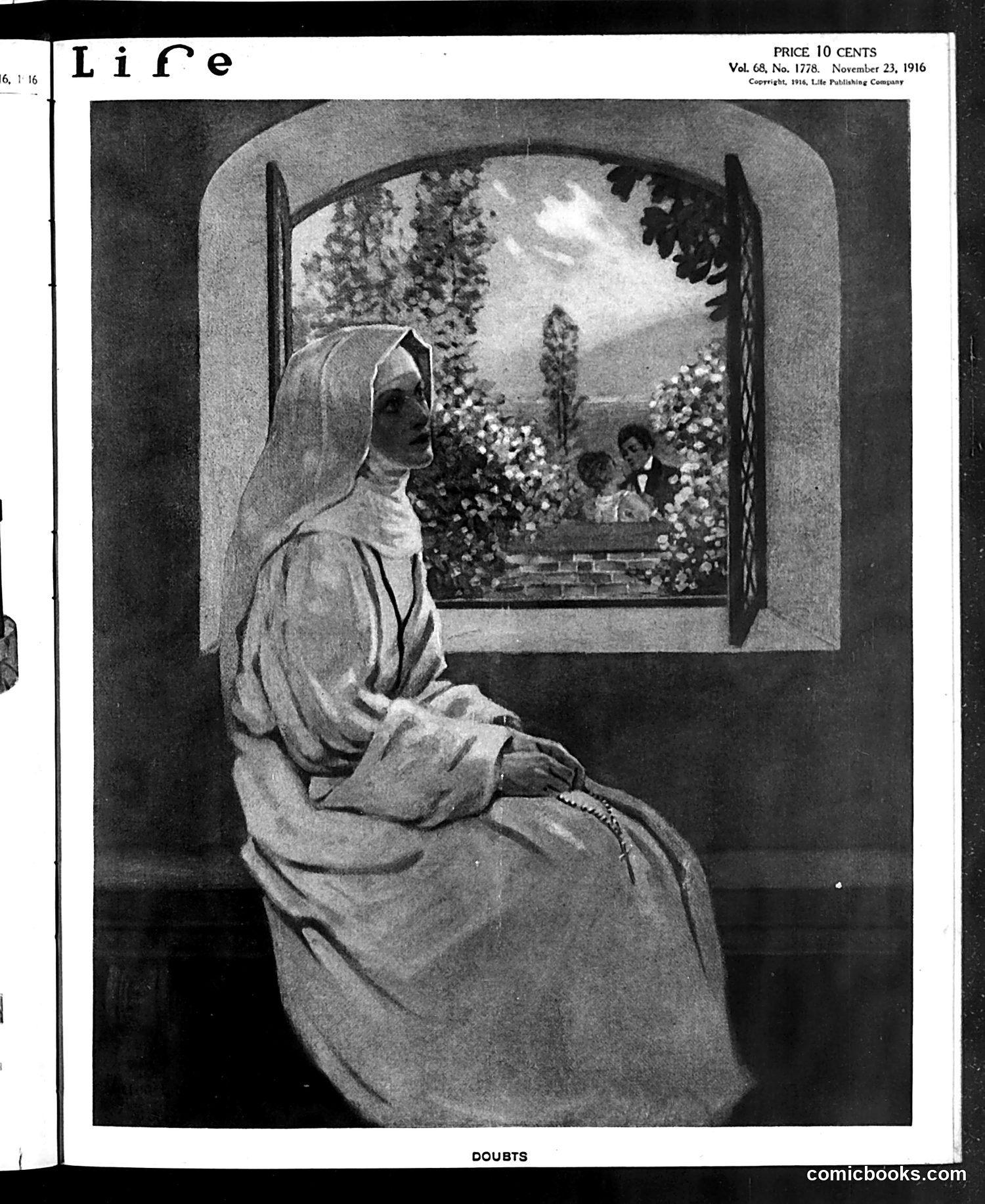
This cover illustration titled "Doubts" depicts a woman in contemplative pose gazing out a window at an idealized garden scene. The composition suggests inner uncertainty or anxiety about an external situation. Given the November 1916 date—just before the U.S. presidential election and amid ongoing World War I—this likely comments on American ambivalence about the conflict. The woman's wistful gaze contrasts sharply with the peaceful garden vista, suggesting doubt about whether America's peaceful aspirations could survive potential war involvement. The figure appears to represent the American public or American womanhood contemplating an uncertain national future, a common satirical device in Life magazine during this period of national debate over neutrality and military preparedness.
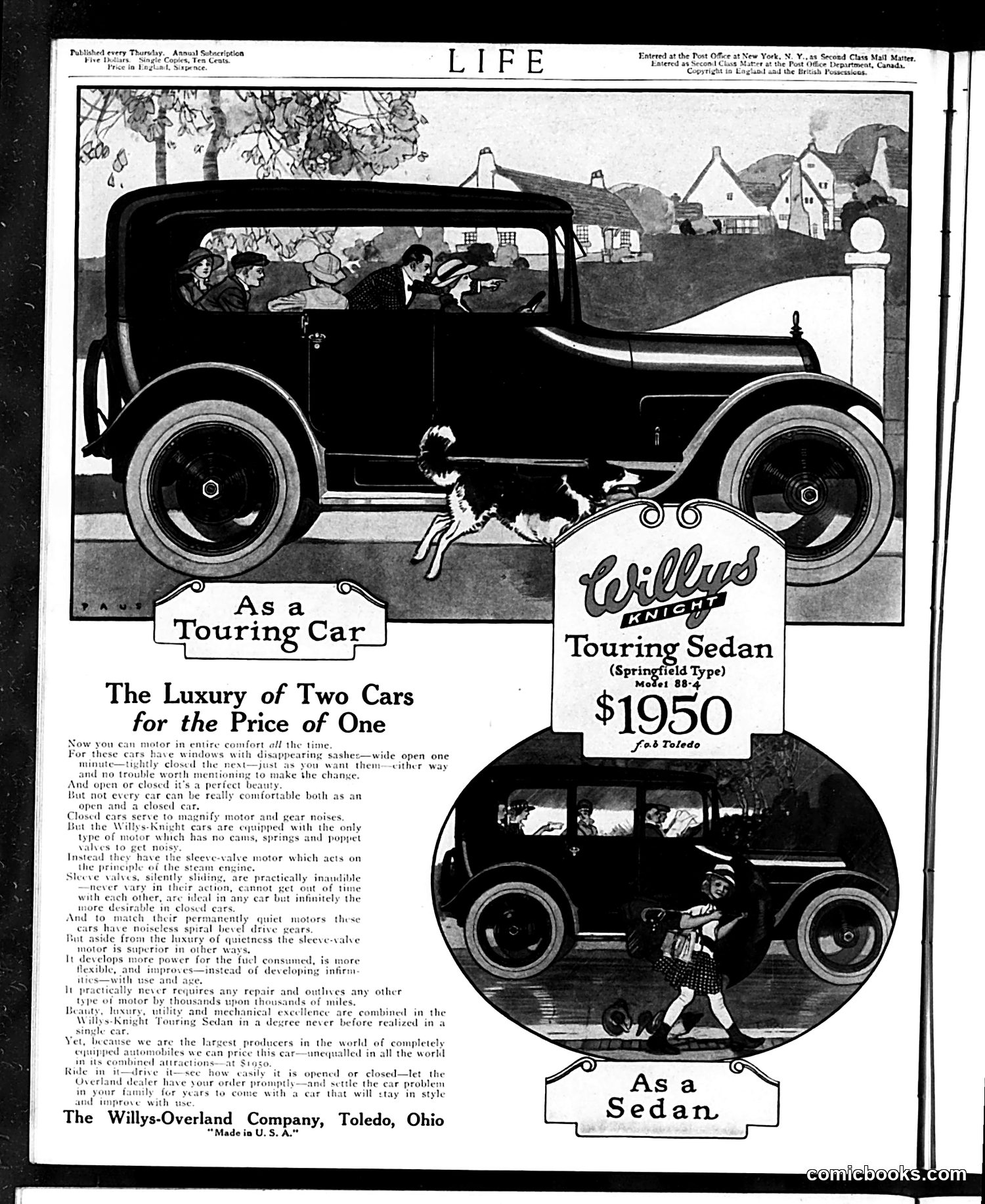
This page is **primarily an advertisement**, not political satire. It promotes the Willys-Knight Touring Sedan, priced at $1950 (f.o.b. Toledo). The ad compares two vehicle configurations—an open touring car and a closed sedan—arguing that buyers get "the luxury of two cars for the price of one." The illustration shows a dog chasing the open touring car, humorously suggesting the sedan's superiority by depicting the touring car as an undignified, exposed experience. The text emphasizes the sedan's mechanical advantages: sleeve-valve motors, noiseless spiral drive gears, and low maintenance needs. This is straightforward early automotive marketing, not satire. The dog appears as a comedic element highlighting the sedan's closed, protected design versus open-air motoring.
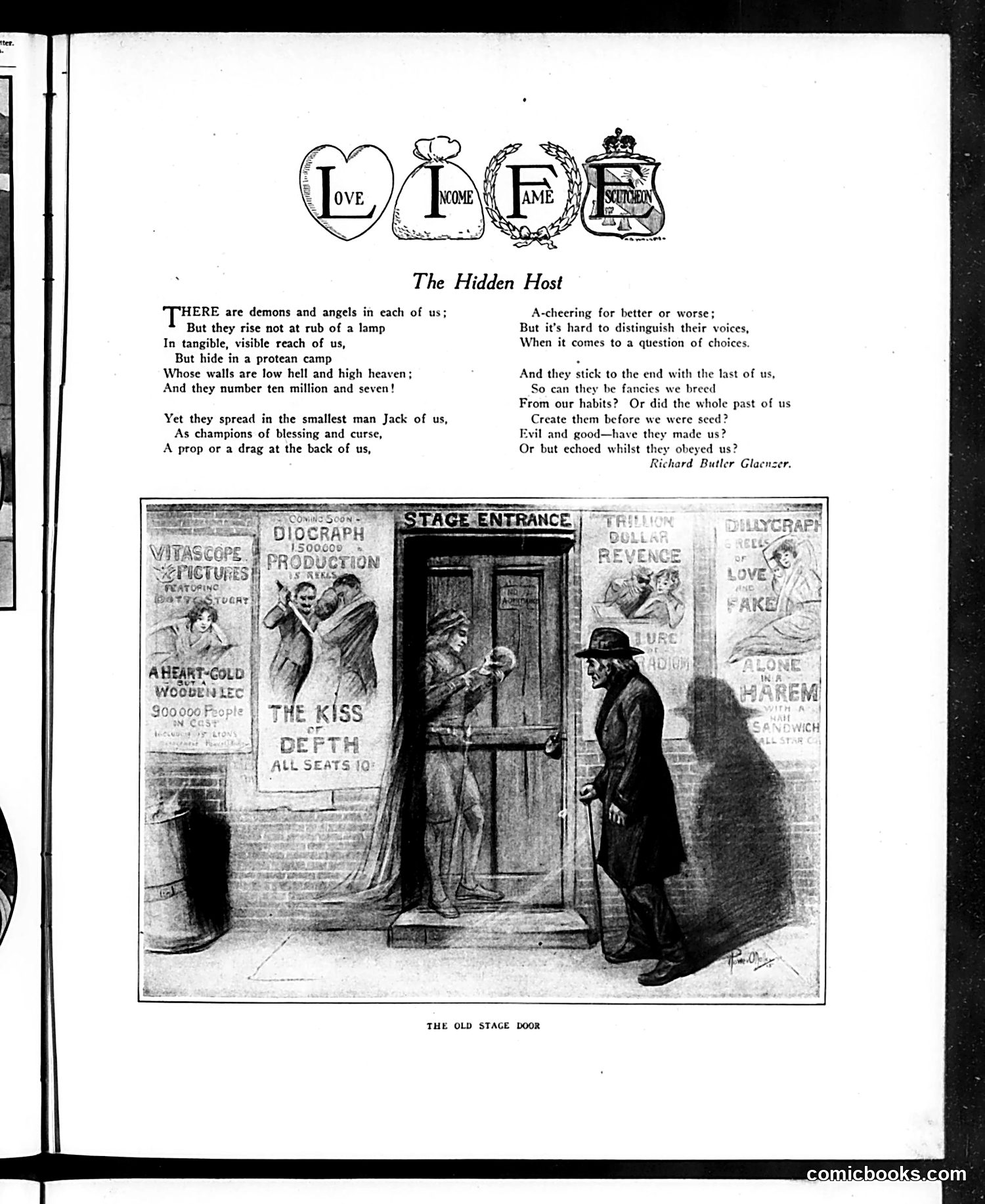
This page presents a poem by Richard Butler Glaenzer alongside an illustration titled "The Old Stage Door." The poem uses theatrical metaphor to explore human nature—the "demons and angels" within us that invisibly shape our character and choices, numbering "ten million and seven." The accompanying sketch depicts a stage entrance with theatrical posters advertising period films (visible titles include "The Kiss," "Revenge," "Love"). A well-dressed man in a bowler hat stands outside, apparently seeking entry, while a woman in period costume leans from the doorway. The satire appears to critique the theater world or perhaps broader questions about authenticity versus performance in society—the "hidden" influences that determine who we become, referenced in both the poem's title and the theatrical setting.
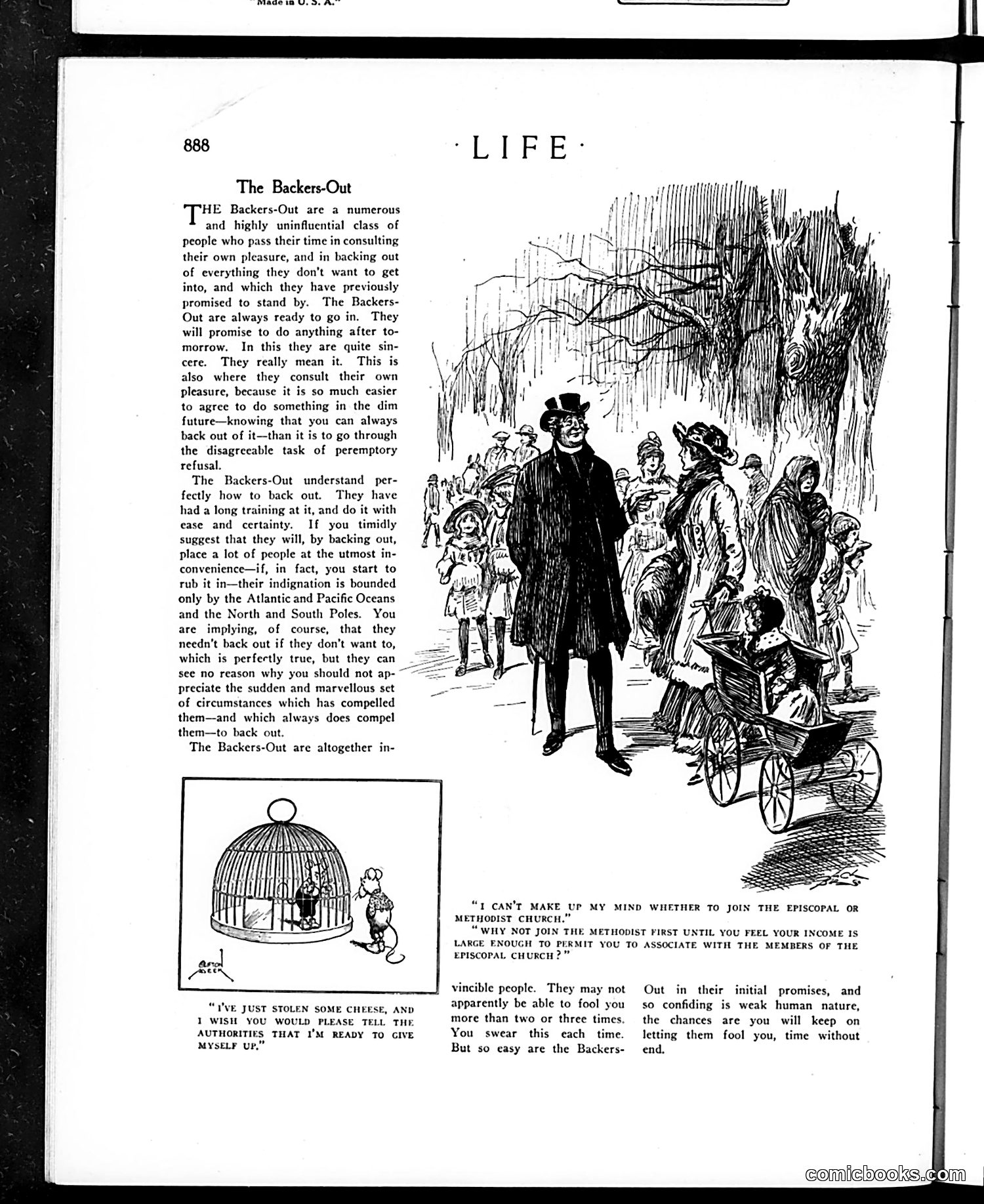
This page satirizes a common social type: people who enthusiastically commit to plans or promises but then cancel or back out. The article describes "Backers-Out" as insincere people who mean well initially but lack follow-through, particularly regarding social obligations they later regret. The main illustration shows a well-dressed man leading a group of common people, likely depicting how backers-out manipulate others into situations. The smaller cartoon shows a person in a bird cage, illustrating someone trapped by their own poor decisions. The dialogue examples mock backers-out's excuses—blaming income levels or church membership—to avoid commitments. The satire targets the broader human weakness of making promises without intending to keep them, a timeless social critique.
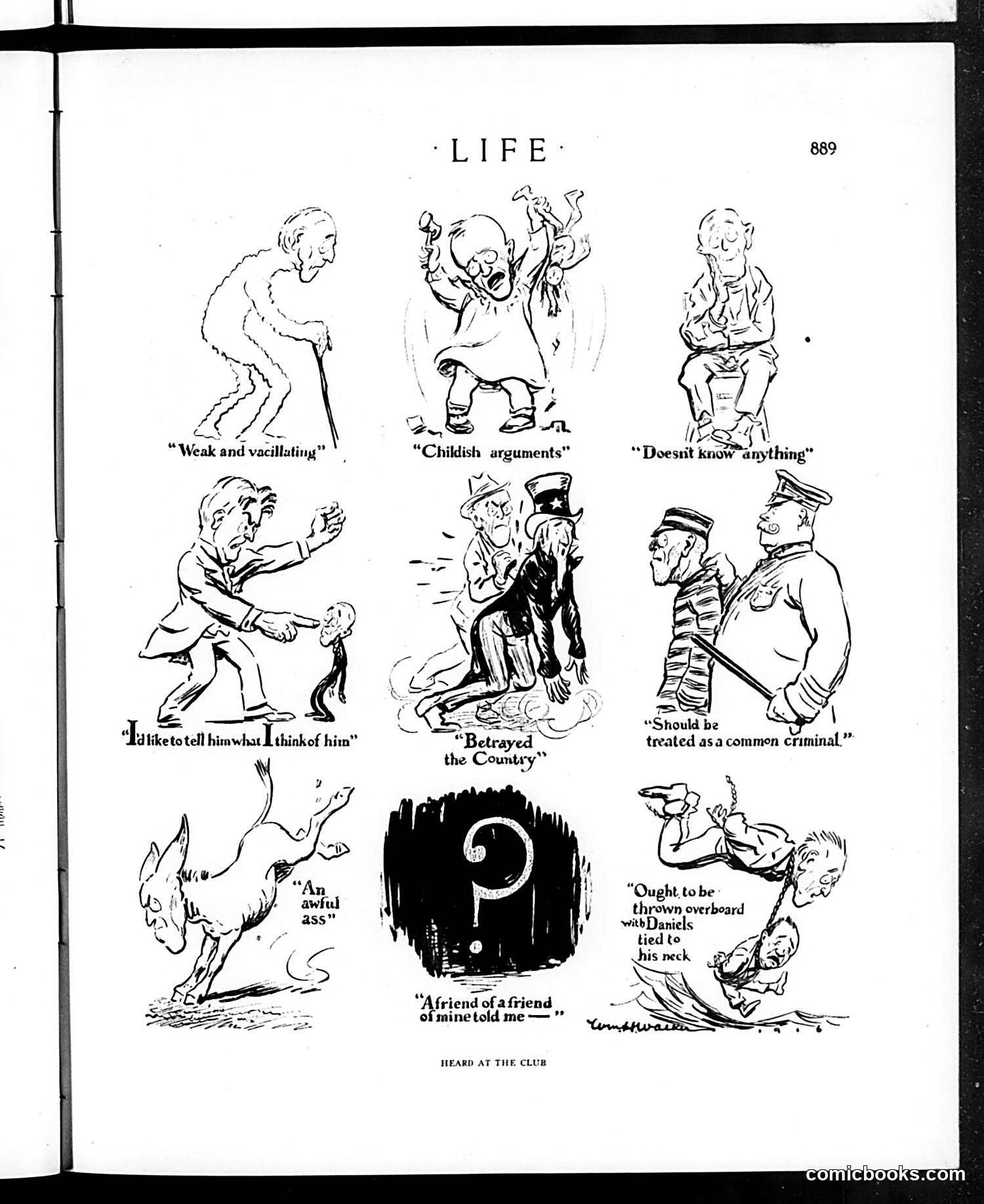
This satirical page titled "Life" presents nine character sketches mocking different political or public figures through exaggerated caricature. Each sketch is labeled with a critical descriptor: "Weak and vacillating," "Childish arguments," "Doesn't know anything," "I'd like to tell him what I think of him," "Betrayed the Country," "Should be treated as a common criminal," "An awful ass," and "Ought to be thrown overboard with Daniels tied to his neck." The specific identities remain unclear without additional context, but the references to "betraying the country," "Daniels" (possibly Secretary of the Navy Josephus Daniels), and calls for criminal treatment suggest these target prominent political figures from the World War I era. The overall tone condemns these individuals as incompetent, disloyal, or dangerously foolish leaders.
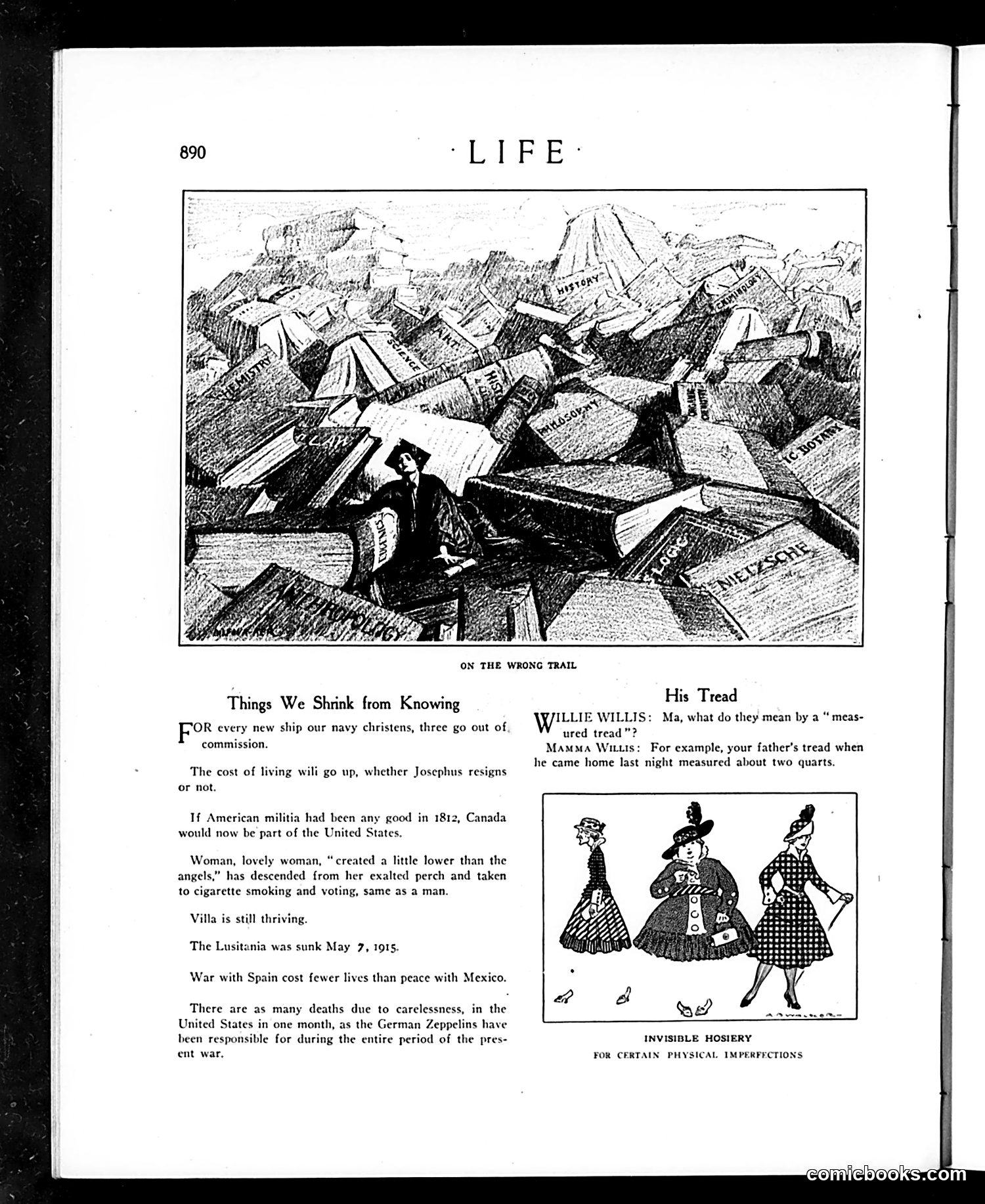
**Main Cartoon ("On the Wrong Trail"):** Depicts a man lost among towering books and papers labeled with various topics, with a mountain in the background. This satirizes people pursuing wrong or misguided intellectual paths—"shrinking from knowing." **"His Tread" Comic:** A dialogue between Willie Willis and his mother about what "measured tread" means. The mother explains using his father's drinking habits as an example ("measured about two quarts"), implying the father drinks regularly. The accompanying illustration shows three fashionably-dressed women. The caption "Invisible Hosiery for Certain Physical Imperfections" suggests this is an advertisement disguised as humor, promoting stockings that hide perceived flaws. **Left Column Satirical Notes:** Include commentary on naval commissions, cost of living, the 1912 sinking of the Lusitania, and wartime casualties—typical early WWI-era satirical barbs.
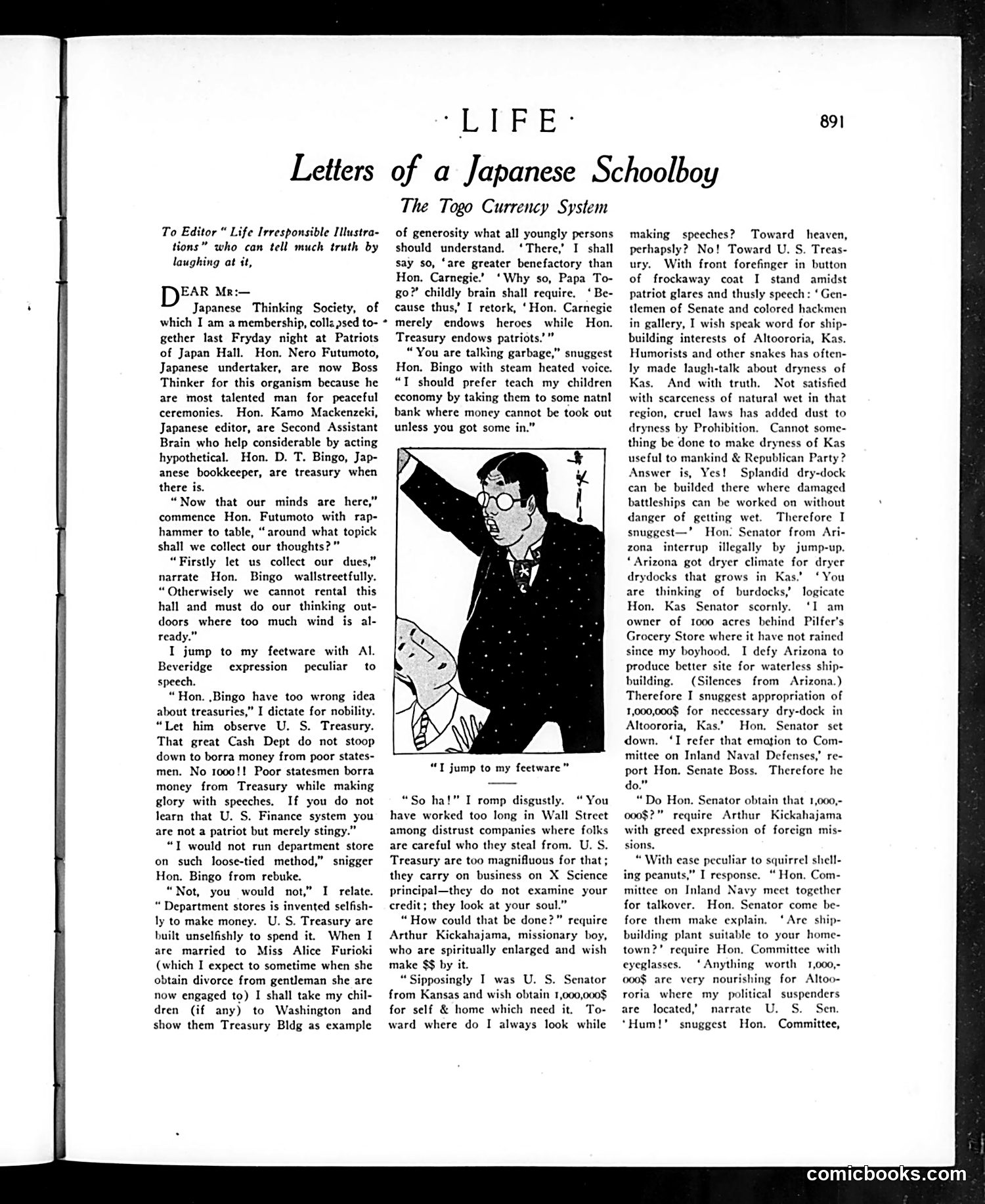
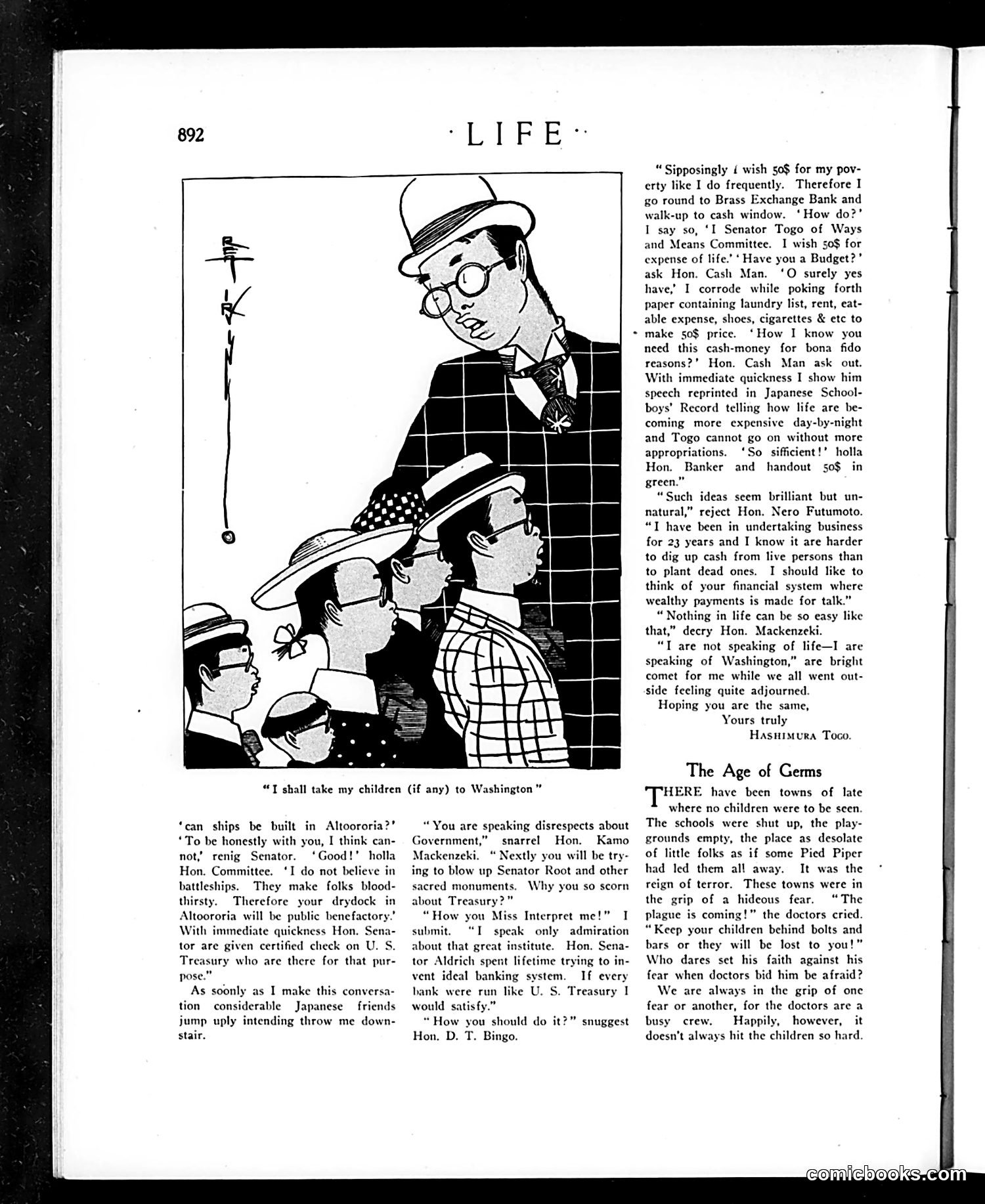
This satirical piece mocks Japanese financial practices through a fictional schoolboy's letters. The illustration shows a caricatured Japanese figure in formal dress, jumping enthusiastically. The satire targets what appears to be Japanese economic mismanagement, using the "schoolboy" device to present critiques as naive observations. References include: - **Hon. Bingo**: a fictional Japanese official representing Treasury/government - **U.S. Treasury/Finance System**: held up as superior to Japanese methods - **Department stores and credit schemes**: criticized as inherently dishonest The humor works by having the "innocent" schoolboy expose contradictions in Japanese economic claims—particularly that their system somehow builds character while U.S. methods don't. The piece satirizes both Japanese pretensions and American diplomatic relations with Japan during this era.
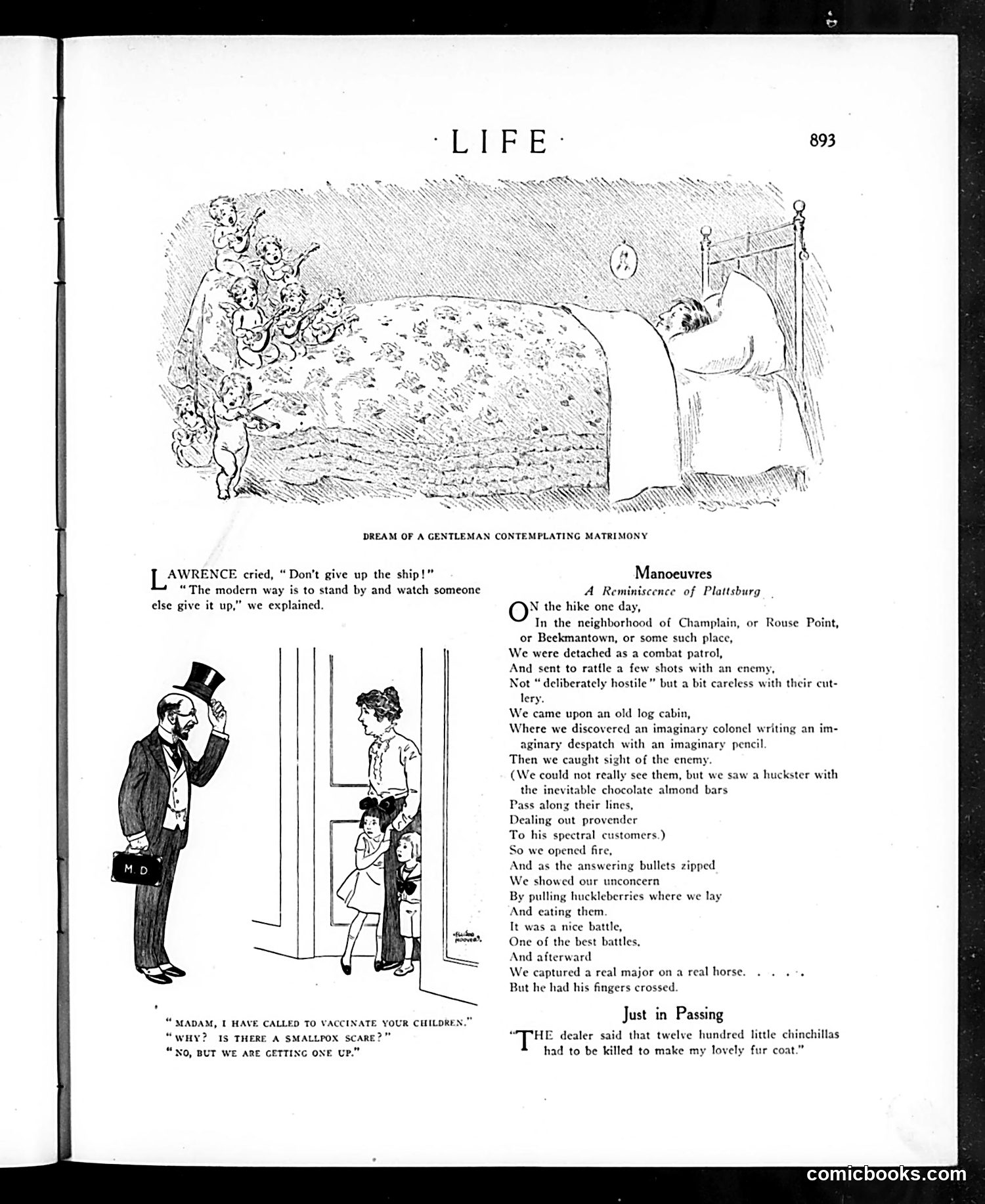
**Main Cartoon (top):** "Dream of a Gentleman Contemplating Matrimony" depicts a man in bed dreaming of cherubs and marriage, satirizing romantic idealization of marriage. **Middle Cartoon:** Shows a man with "MD" (doctor) on his bag speaking to a woman and children at a doorway. The dialogue parodies early 20th-century public health campaigns: the doctor announces he's come to vaccinate the children, the mother asks if there's a smallpox scare, and he responds they're "getting one up"—meaning they're vaccinating preemptively. This satirizes the shift toward preventative medicine and mandatory vaccination programs becoming normal practice. **Poems Below:** "Manoeuvres" and "Just in Passing" appear to be humorous verse commentary on contemporary topics—military maneuvers and a fur coat anecdote respectively.
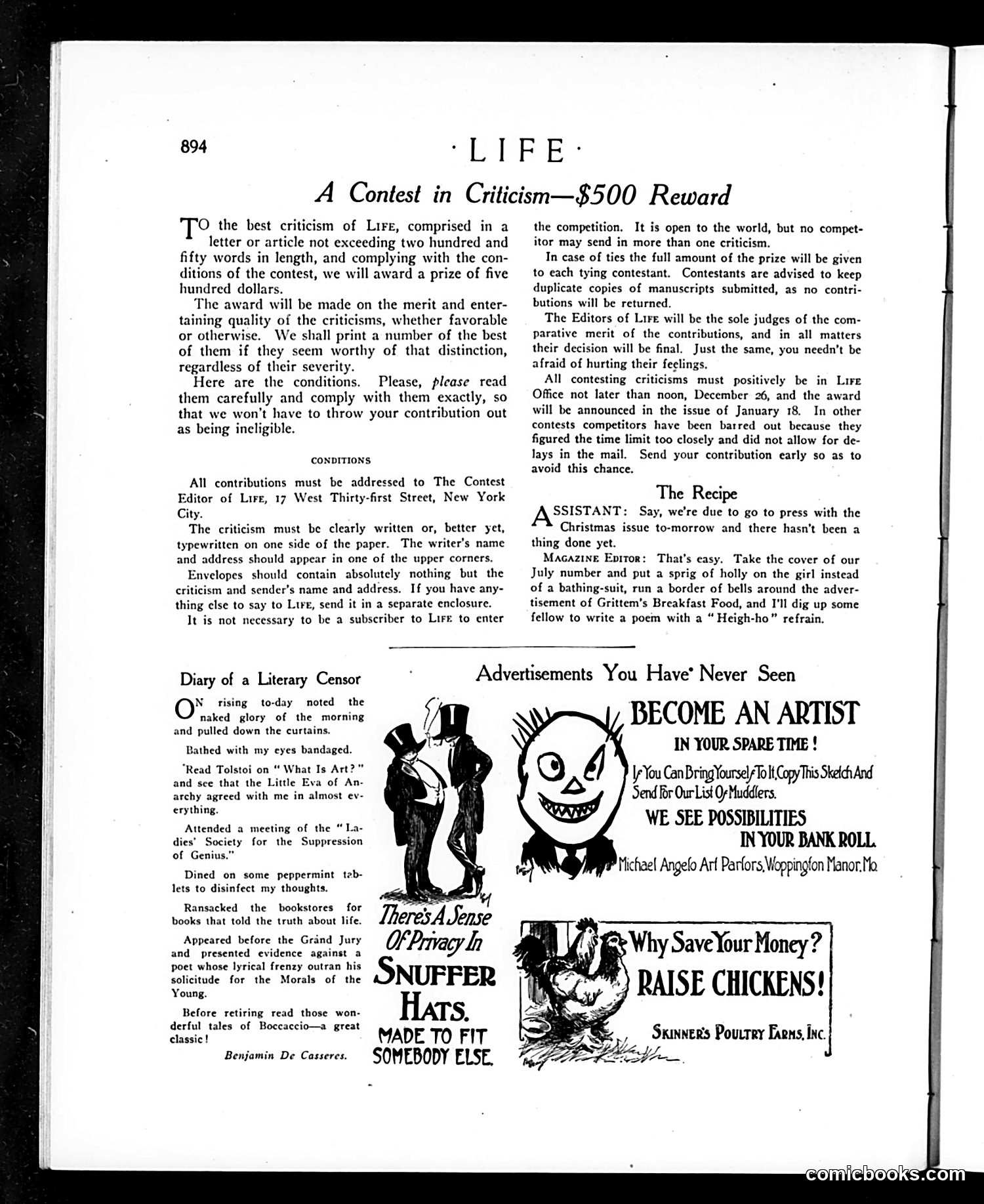
This page is primarily **advertisements and editorial content**, not political satire. The main features are: 1. **"A Contest in Criticism"** — Life magazine's $500 prize competition for readers to submit critical letters about Life itself (200-250 words maximum). The tone is self-referential humor about receiving criticism. 2. **"Diary of a Literary Censor"** — A humorous column by Benjamin De Casseres satirizing censorship and book banning. It mocks overzealous moral guardians who suppress literature on grounds of impropriety, referencing Tolstoy and Boccaccio as frequently-banned authors. 3. **Period advertisements** for unrelated products: art instruction courses, snuffer hats, and chicken farming—typical early 20th-century classified ads with exaggerated claims. The page reflects 1920s-era debates about artistic freedom versus censorship, presented through lighthearted satire rather than serious political commentary.
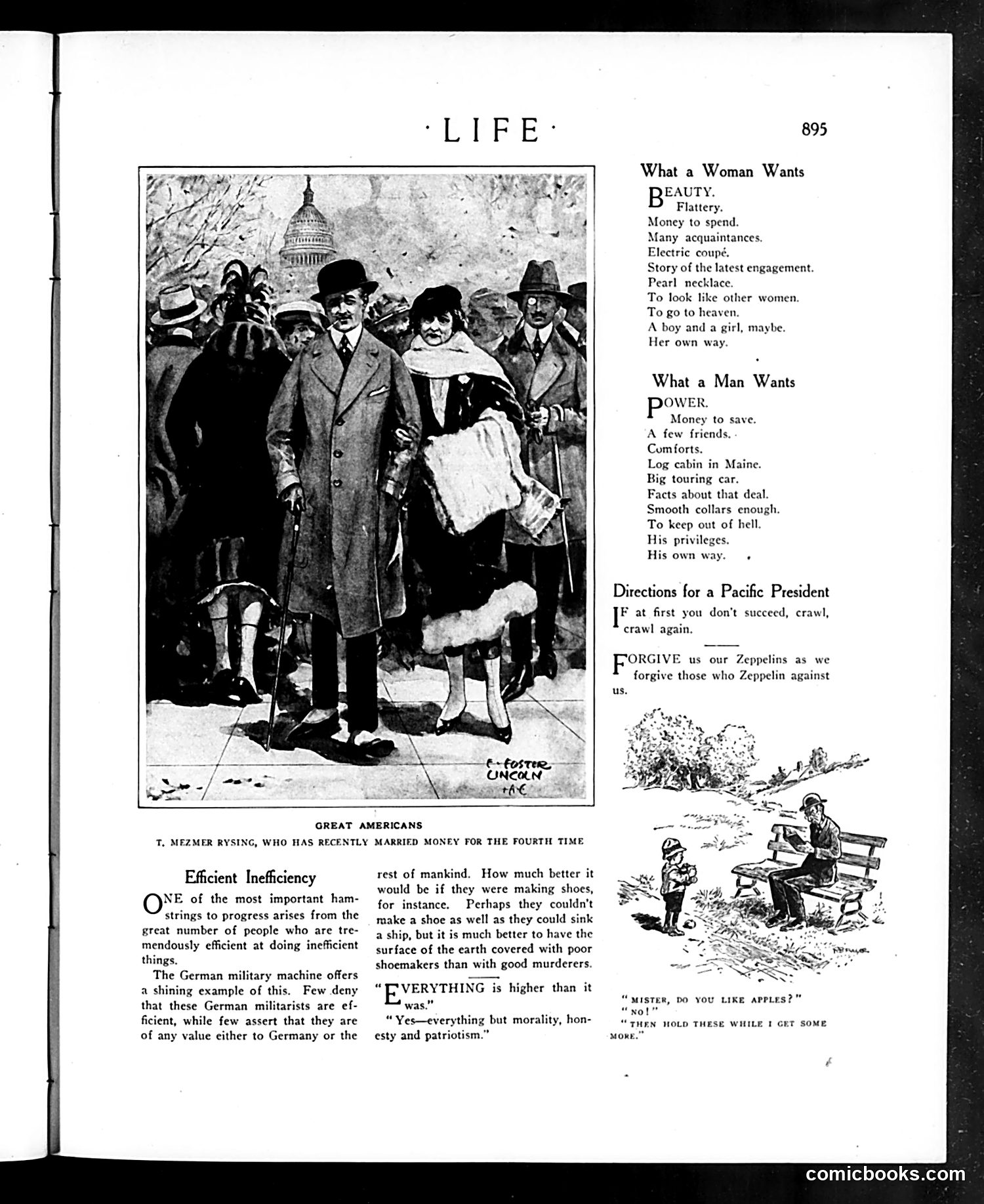
The main illustration shows a figure identified in the caption as "T. Mezmer Rysing, who has recently married money for the fourth time." The cartoon satirizes wealthy individuals who marry repeatedly for financial gain rather than love—a common satirical target in early 20th-century publications. The surrounding text lists contrasting wants of men versus women (beauty, flattery, power, money), followed by humorous commentary on efficiency and morality. A smaller cartoon depicts children and apples, with dialogue about theft ("Then hold these while I get some more"). The overall page mocks social hypocrisy: marrying for money while society preaches morality, and petty dishonesty among the young. The satire reflects period anxieties about materialism and declining values.
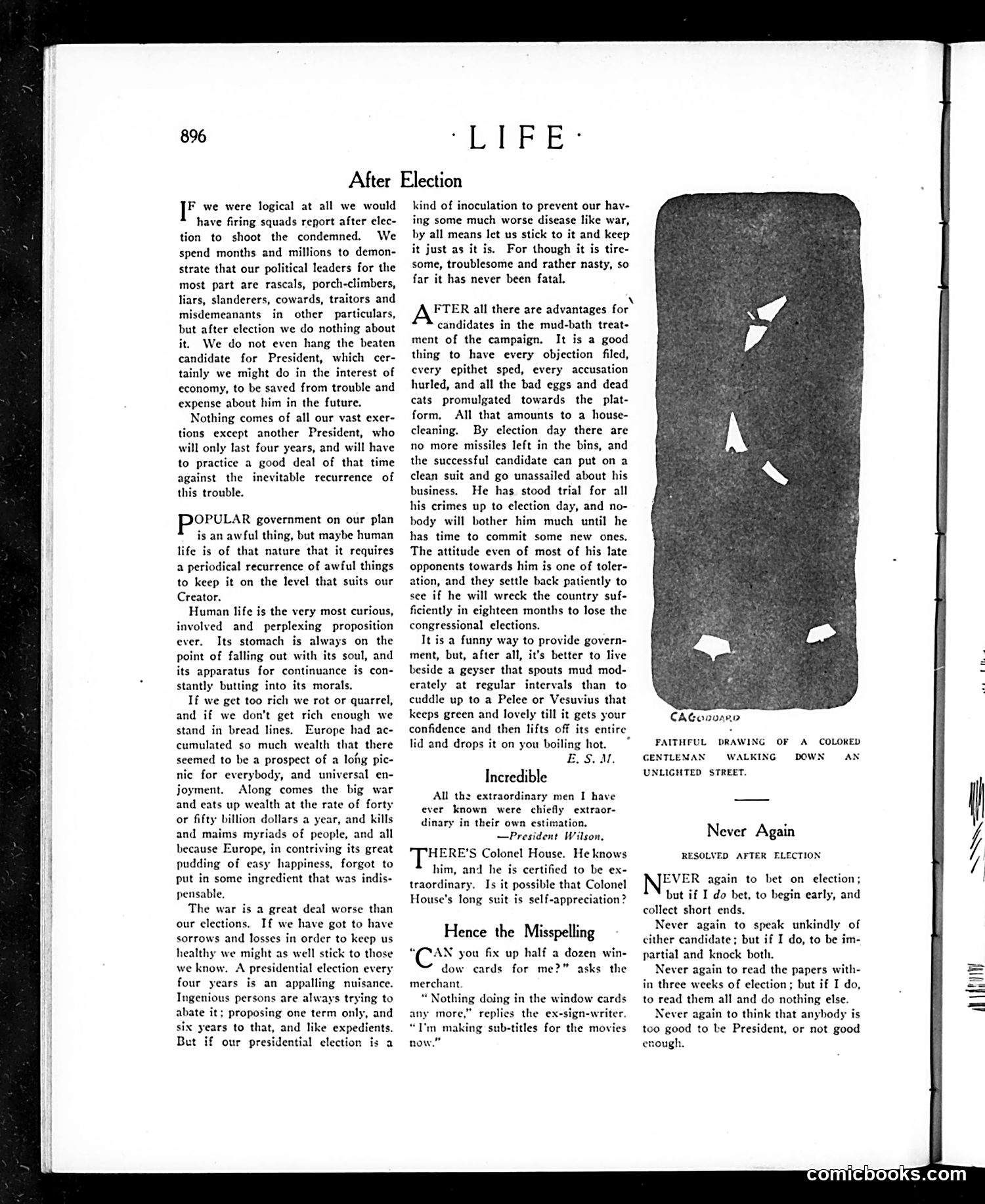
This page contains satirical essays and one illustration titled "Faithful Drawing of a Colored Gentleman Walking Down an Unlighted Street." The cartoon depicts a Black man walking at night, carrying what appears to be a large white object (possibly a bundle or package). The illustration's caption and title suggest satirical commentary on racial stereotypes—likely mocking contemporary assumptions or prejudices about Black men in urban settings after dark. The surrounding text discusses post-election behavior and political corruption, suggesting the cartoon may relate to broader social commentary about racial and class dynamics in early 20th-century America, though the specific satirical point remains somewhat unclear without additional context about when this was published and what contemporary events it references.
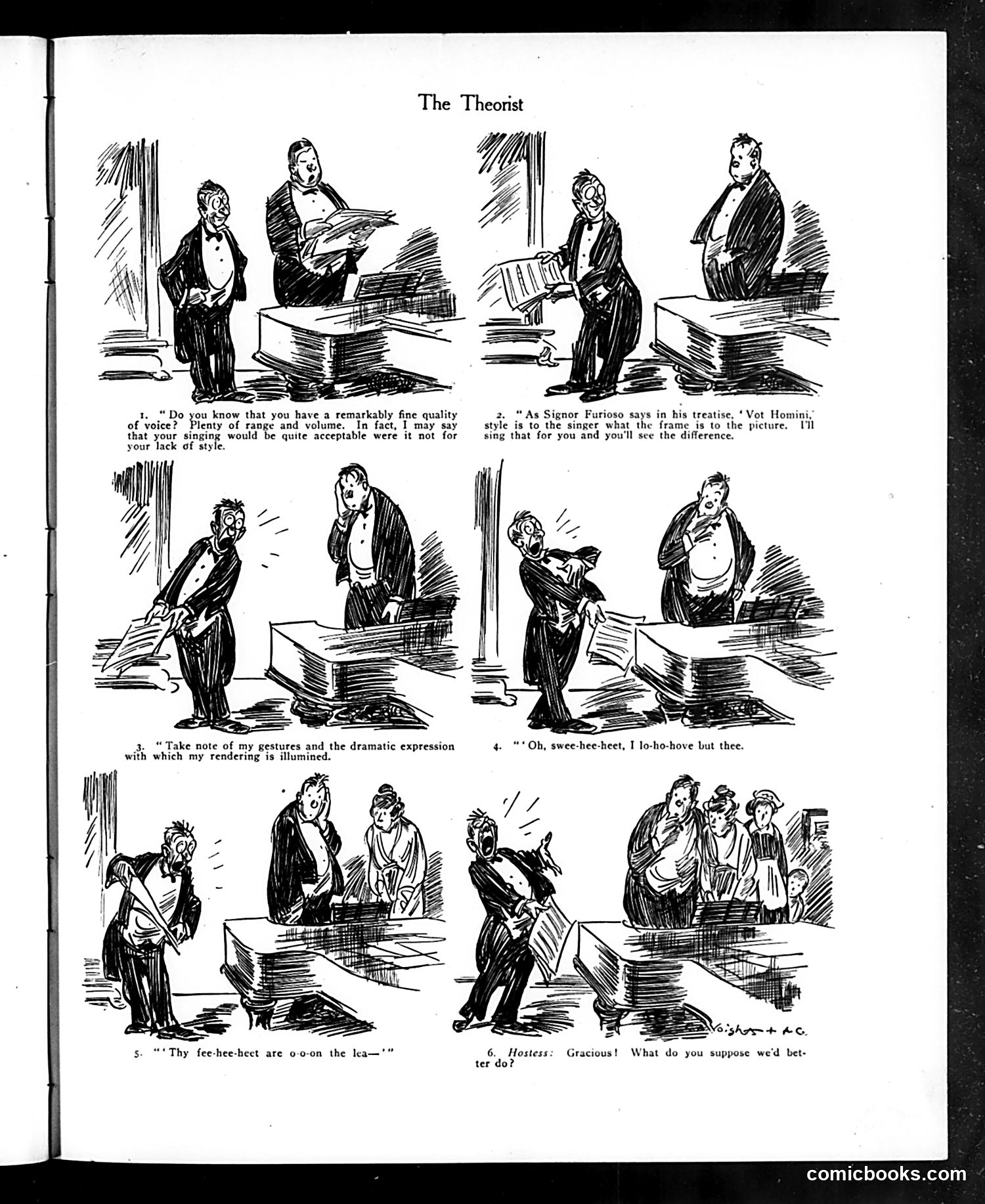
This six-panel satirical sequence mocks a pompous music theorist or vocal coach who lectures extensively about artistic technique using grandiose references (Signor Furioso, dramatic gestures, fee structure). The humor follows a classic pattern: the theorist pontificates about proper singing form, style, and performance nuance through panels 1-5, delivering increasingly elaborate theoretical explanations while surrounded by stacks of papers/treatises. In the final panel, the joke lands when hostesses ask "what do you suppose we'd better do?" - implying the theorist's actual singing performance was so dreadful that his theory bears no relation to practice. The satire targets pretentious experts who talk brilliantly about technique but cannot execute it themselves - a timeless target of satirical humor.
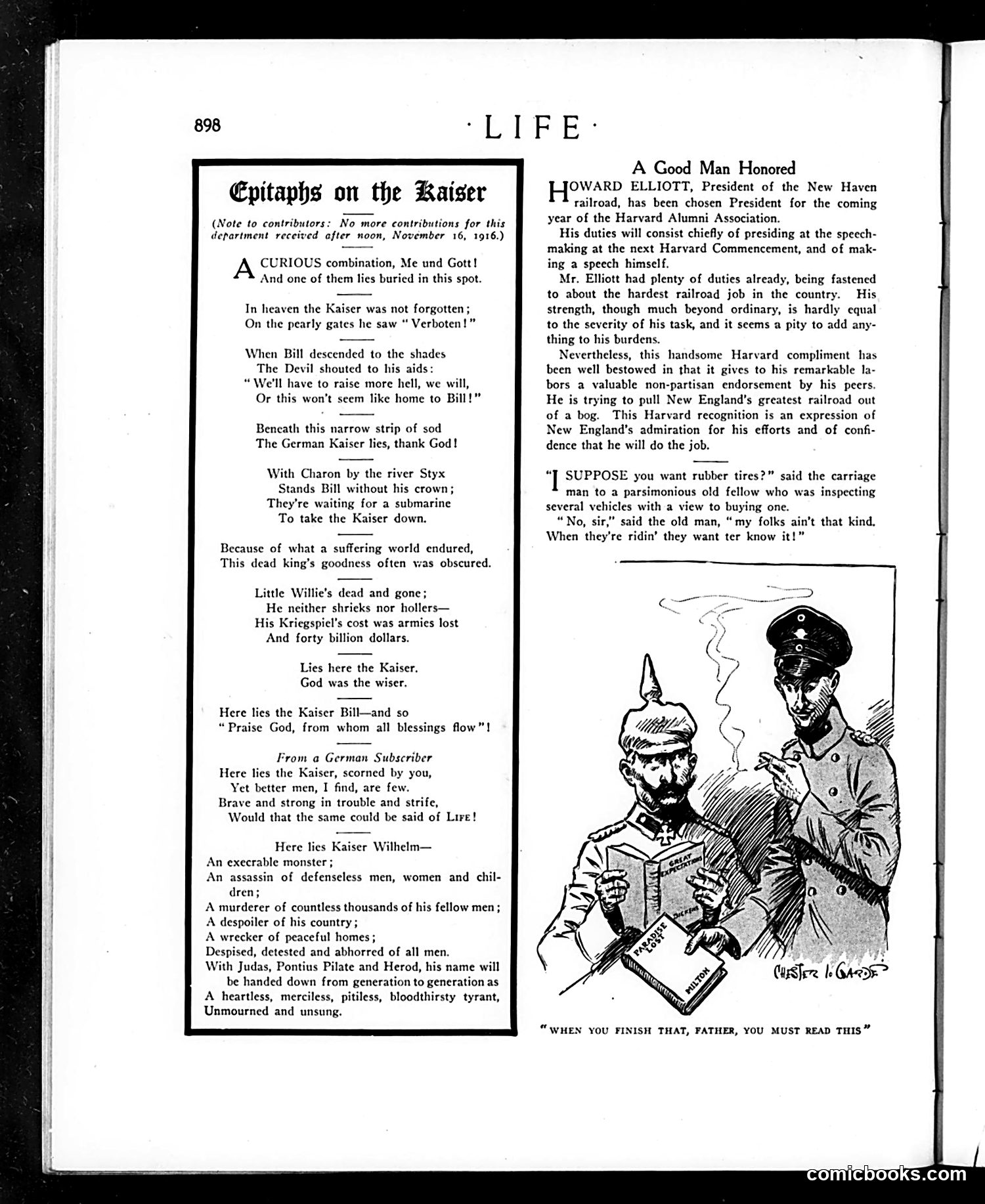
This page contains two distinct items from *Life* magazine (circa 1916, based on the note about contributions): **Left: "Epitaphs on the Kaiser"** — A poem viciously attacking Kaiser Wilhelm II of Germany, written during World War I. It catalogs his alleged crimes: starting the war, killing civilians, murdering soldiers, and destroying homes. The epithets ("execrable monster," "assassin," "bloodthirsty tyrant") reflect intense American anti-German propaganda of the era. **Right: "A Good Man Honored"** — An article praising Harvard railroad president Howard Elliott, elected to lead the Harvard Alumni Association. Below is a cartoon showing a German military officer (identifiable by the spiked Prussian helmet) instructing another figure to read propaganda, captioned "When you finish that, Father, you must read this"—likely satirizing German attempts to spread pro-war messaging. The page reflects deep American wartime hostility toward Germany.
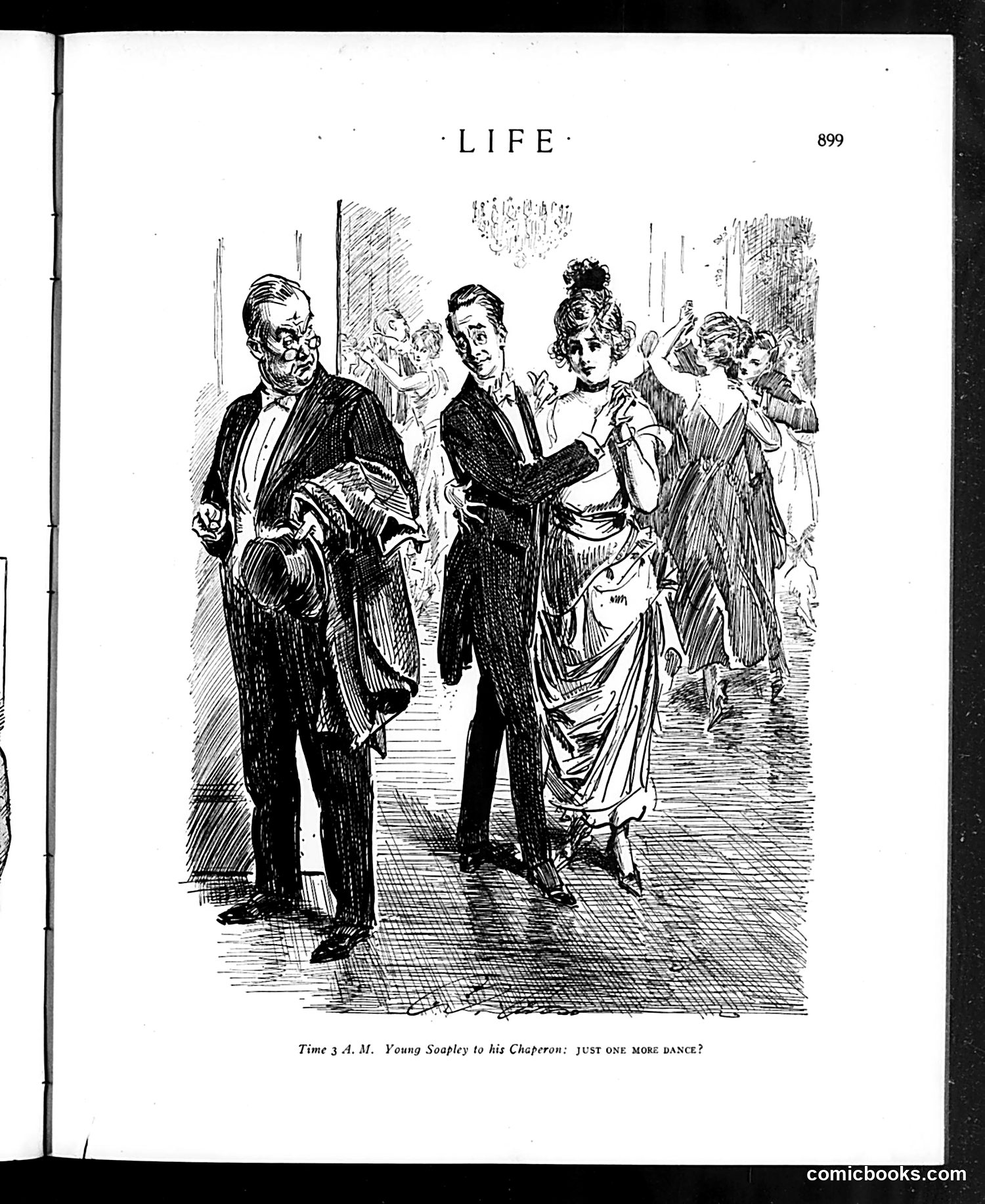
This is a satirical illustration from *Life* magazine titled "Time 3 A.M. Young Soapley to his Chaperon: JUST ONE MORE DANCE?" The cartoon depicts a social scene at what appears to be a formal ball or dance. A young man (identified as "Young Soapley") is requesting one additional dance from his female companion (his "chaperon"—likely an older woman serving as his social supervisor). The scene shows other dancers and party-goers in the background. The satire targets the social conventions of formal courtship and chaperonage in upper-class society. The joke appears to center on the young man's persistent, somewhat desperate plea for another dance despite the late hour (3 A.M.), suggesting either his eagerness or the tedium of such social rituals. The caption's phrasing emphasizes the repetitive nature of such requests at social events.
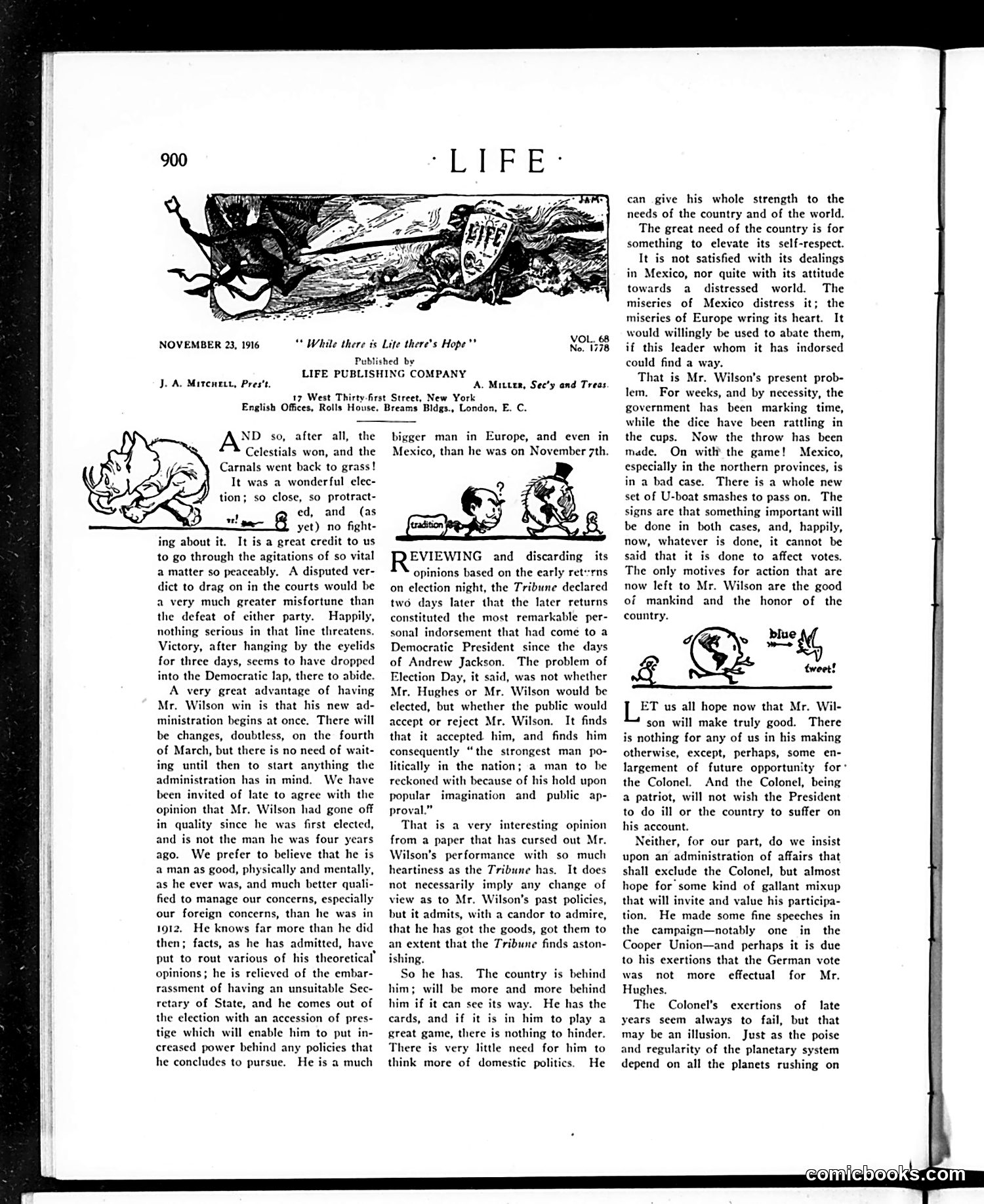
This page celebrates Woodrow Wilson's narrow re-election victory over Charles Evans Hughes on November 7, 1916. The cartoons show Wilson (depicted as the "bigger man") triumphing over his opponent—"Celestials won, and the Carnals went back to grass." The editorial praises Wilson's victory as a personal mandate, noting even hostile newspapers like the Tribune now acknowledge he is "the strongest man politically in the nation." Life argues Wilson's re-election gives him renewed authority and prestige, particularly internationally in Europe and Mexico. The piece emphasizes that Wilson can now pursue bold foreign policy without domestic political constraints, suggesting the electorate has endorsed his approach to Mexico's turmoil and Europe's war (WWI). The overall tone is congratulatory, positioning Wilson as strengthened and validated by the close election outcome.
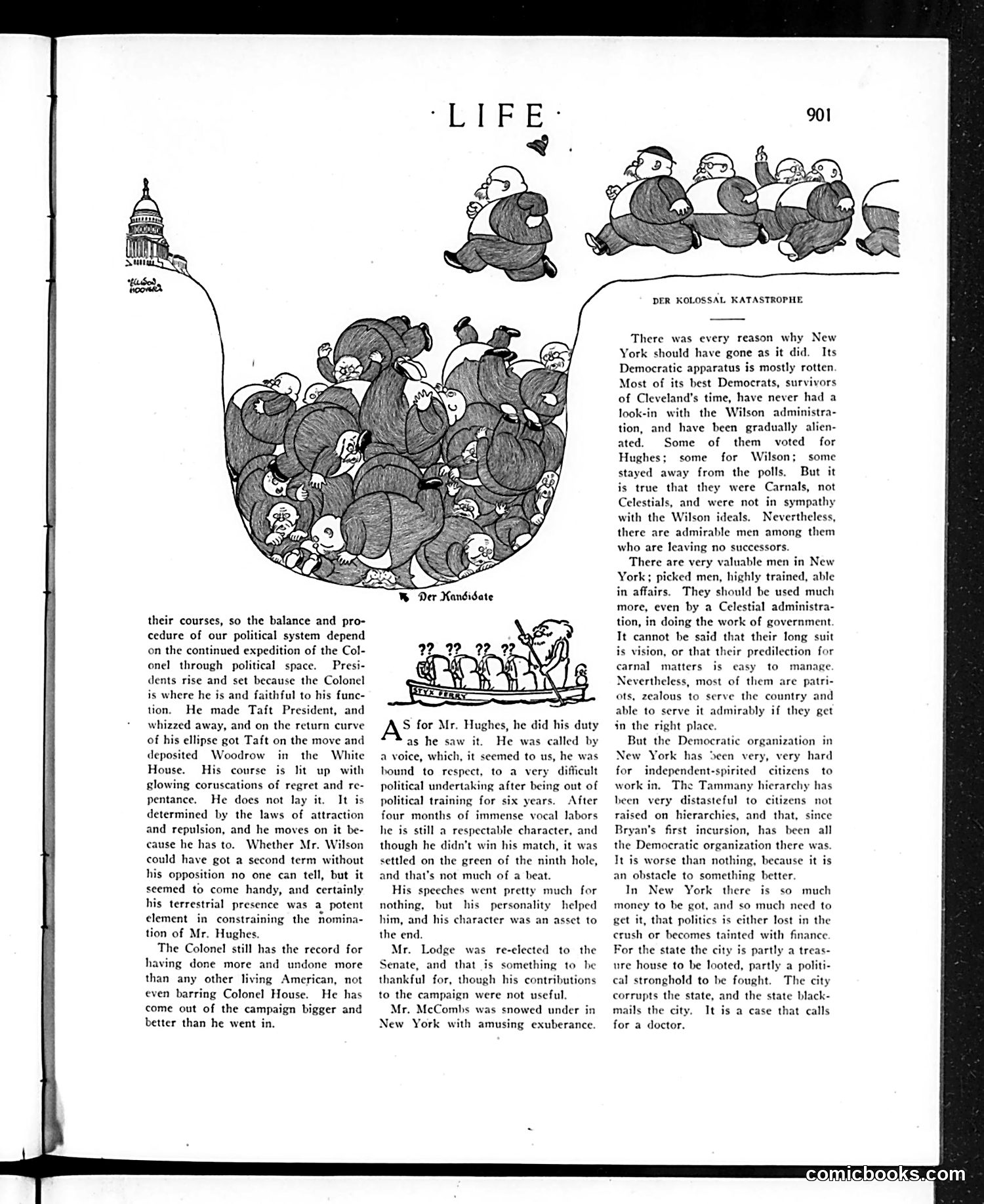
## The Cartoons **"Der Kandidate"** (lower left): Shows a massive spherical figure labeled "Der Kandidate" containing dozens of smaller figures—likely representing the chaotic Democratic political apparatus or party infrastructure. **"Der Kolossal Katastrophe"** (top right): Depicts figures tumbling or fleeing, labeled with the German phrase suggesting political disaster. ## Context This appears to be post-1916 election commentary. The text references Theodore Roosevelt as "the Colonel"—described as an orbiting force shaping American politics, having made Taft and Wilson presidents. It discusses Charles Evans Hughes's failed presidential campaign and critiques New York's Democratic organization, particularly **Tammany Hall** (the corrupt Democratic machine), as an obstacle to good governance. The satire targets Democratic Party dysfunction, machine politics, and the tension between idealistic ("Celestial") Wilsonian governance and practical ("carnal") Eastern establishment Democrats who felt alienated from the Wilson administration.
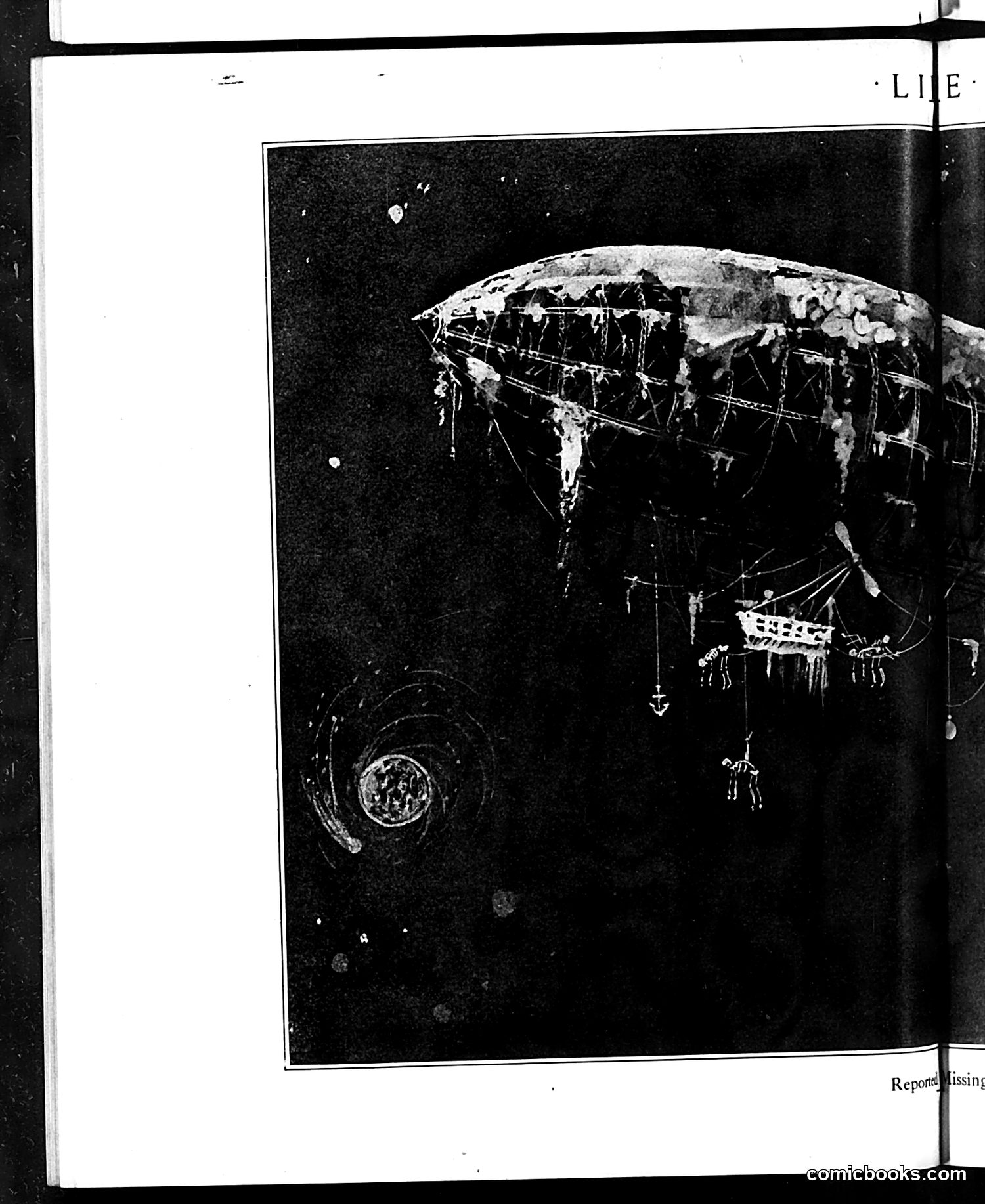
This page from *Life* magazine shows a technical diagram of what appears to be a large airship or dirigible, shown in cross-section with internal structural details, framework, and various mechanical components visible. The bottom left shows a circular detail, possibly an engine or propulsion system. The word "Reported Missing" appears at the bottom right, suggesting this is satirical commentary on a famous airship that disappeared or was lost. Without clearer text or date information visible, I cannot definitively identify which specific airship this references or the exact political/social context. The satire likely mocks either the airship's design, its operators, or contemporary anxieties about aviation technology and safety.
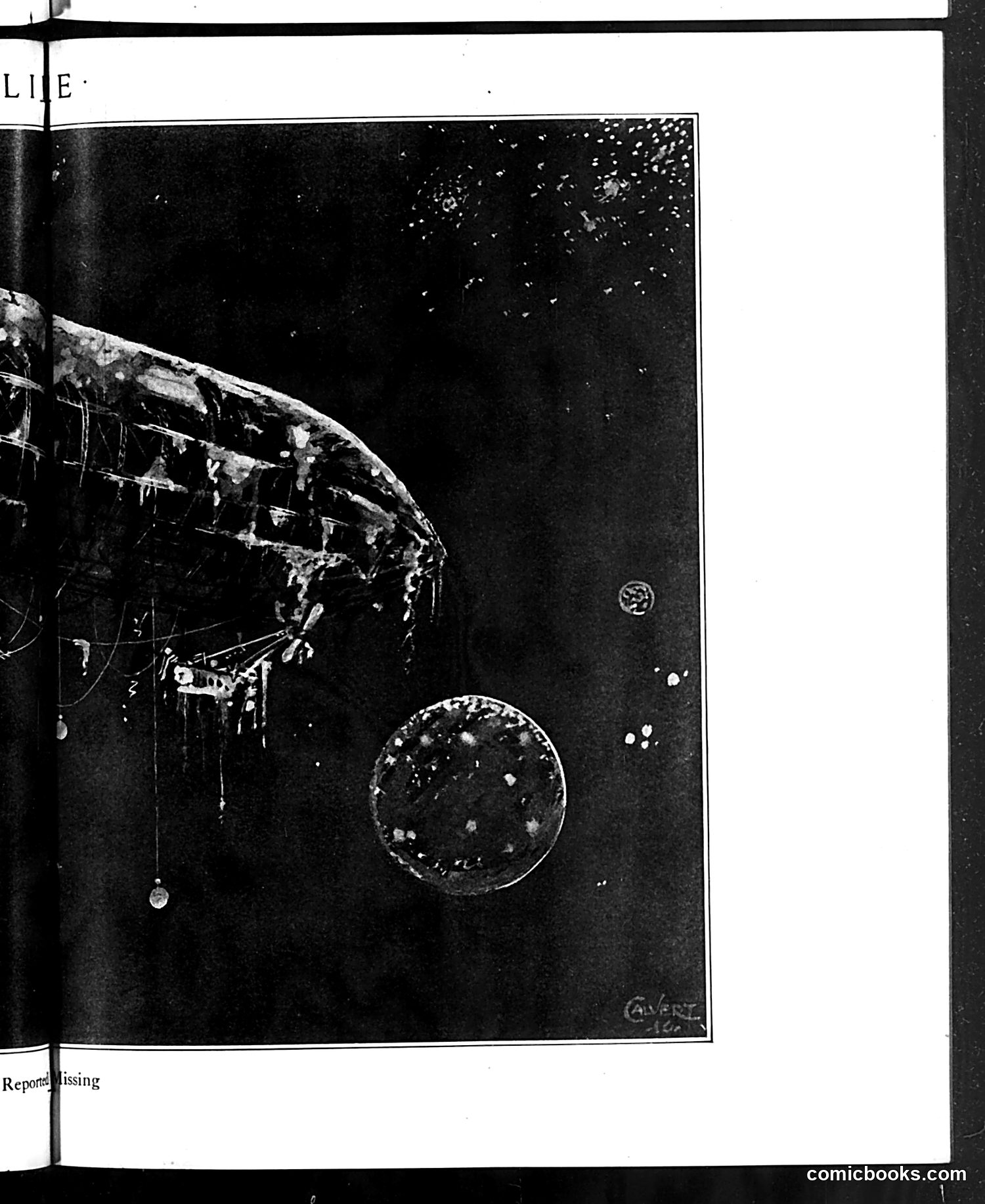
This page contains a black and white illustration signed "CESARE" (visible in lower right). The image shows what appears to be a celestial or astronomical scene: a detailed spherical body (possibly a planet or moon) in the center with surface features and craters, alongside an irregular, fragmented object in the upper left that resembles either a comet, asteroid, or damaged spacecraft with protruding elements. The OCR text is largely illegible characters, suggesting either severe scanning degradation or ornamental design elements rather than readable content. Without legible text context, I cannot definitively identify the specific political or social satire this cartoon intended. The astronomical imagery might reference space exploration or scientific discovery, but the exact satirical point remains unclear from the available information on this page.
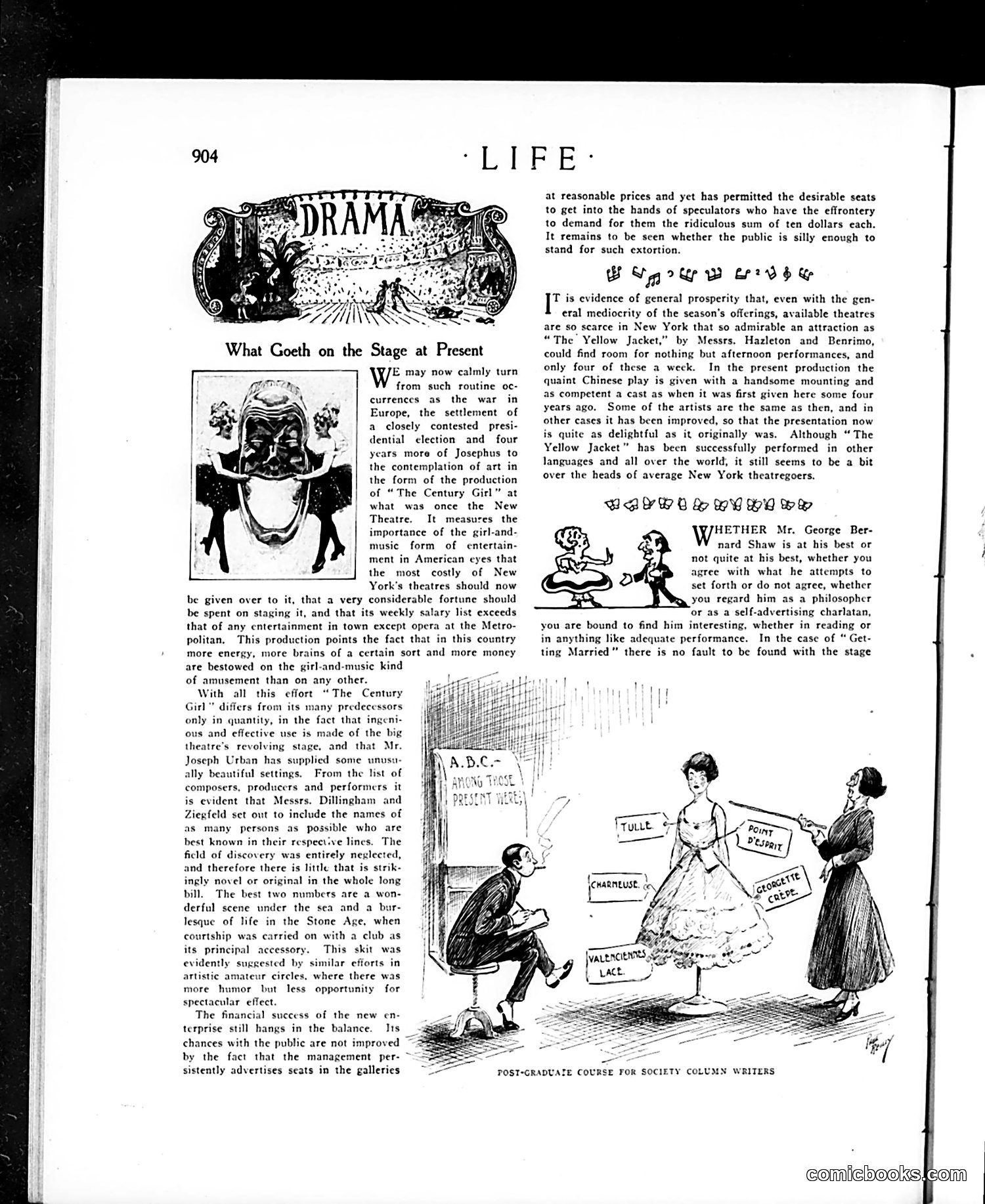
This page reviews New York theater productions circa 1915-1916. The main cartoon, titled "Post-Graduate Course for Society Column Writers," satirizes high society's superficial engagement with theater fashion. It depicts a man presenting a woman with fabric swatches labeled with luxury materials (tulle, point d'esprit, georgette crepe, valenciennes lace)—suggesting that society column writers focus primarily on what wealthy attendees wear rather than actual theatrical merit. The text criticizes "The Century Girl," an expensive musical revue notable mainly for its massive budget and star power, not originality. It mocks how speculators exploit ticket scarcity by reselling gallery seats at inflated prices. The page also discusses "The Yellow Jacket," a Chinese play, and references George Bernard Shaw's work, noting how Shaw generates interest regardless of agreement with his ideas. The cartoon's joke: society journalism reduces theater to fashion reporting, reducing art to mere costume display.
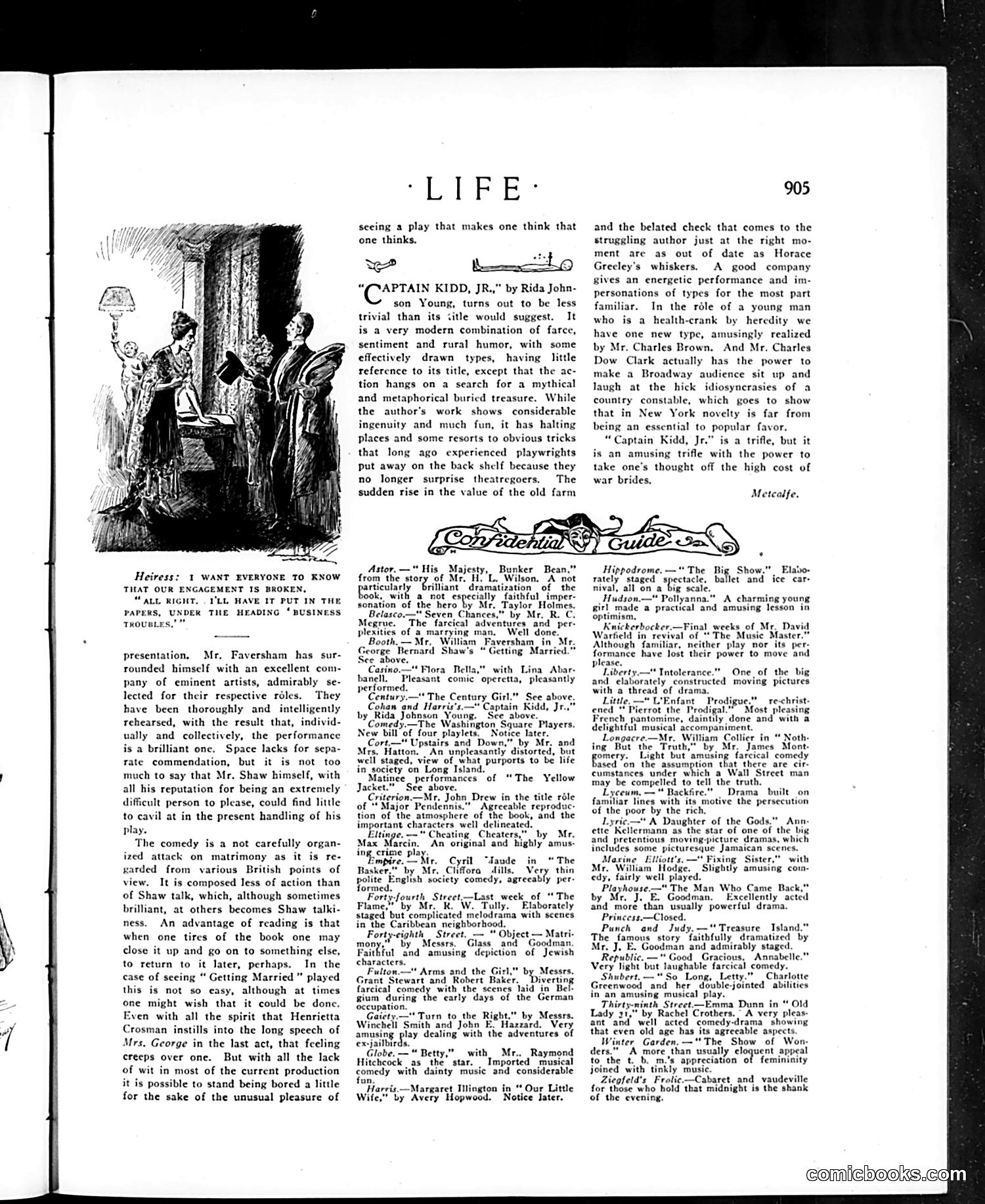
This page reviews contemporary Broadway productions from the early 20th century. The cartoon illustrates one review's central joke: **The Cartoon:** A wealthy heiress announces to a man (presumably her fiancé) that she wants their broken engagement publicized. He responds he'll place it in the newspaper under "Business Troubles"—implying an engagement to a woman is a *business problem*, not a romantic matter. **The Satire:** The joke mocks both high-society attitudes toward marriage as transactional rather than romantic, and the era's class-conscious newspaper categorization. By treating a broken engagement as "business trouble" rather than personal news, the cartoon satirizes how wealthy people viewed matrimony as a financial/social arrangement rather than an emotional commitment. **Context:** This aligns with the page's review of Shaw's play "Getting Married," which the critic notes is "a not carefully organized attack on matrimony as it is regarded from various British points of view"—suggesting contemporary anxiety about marriage's actual nature versus romantic ideals.
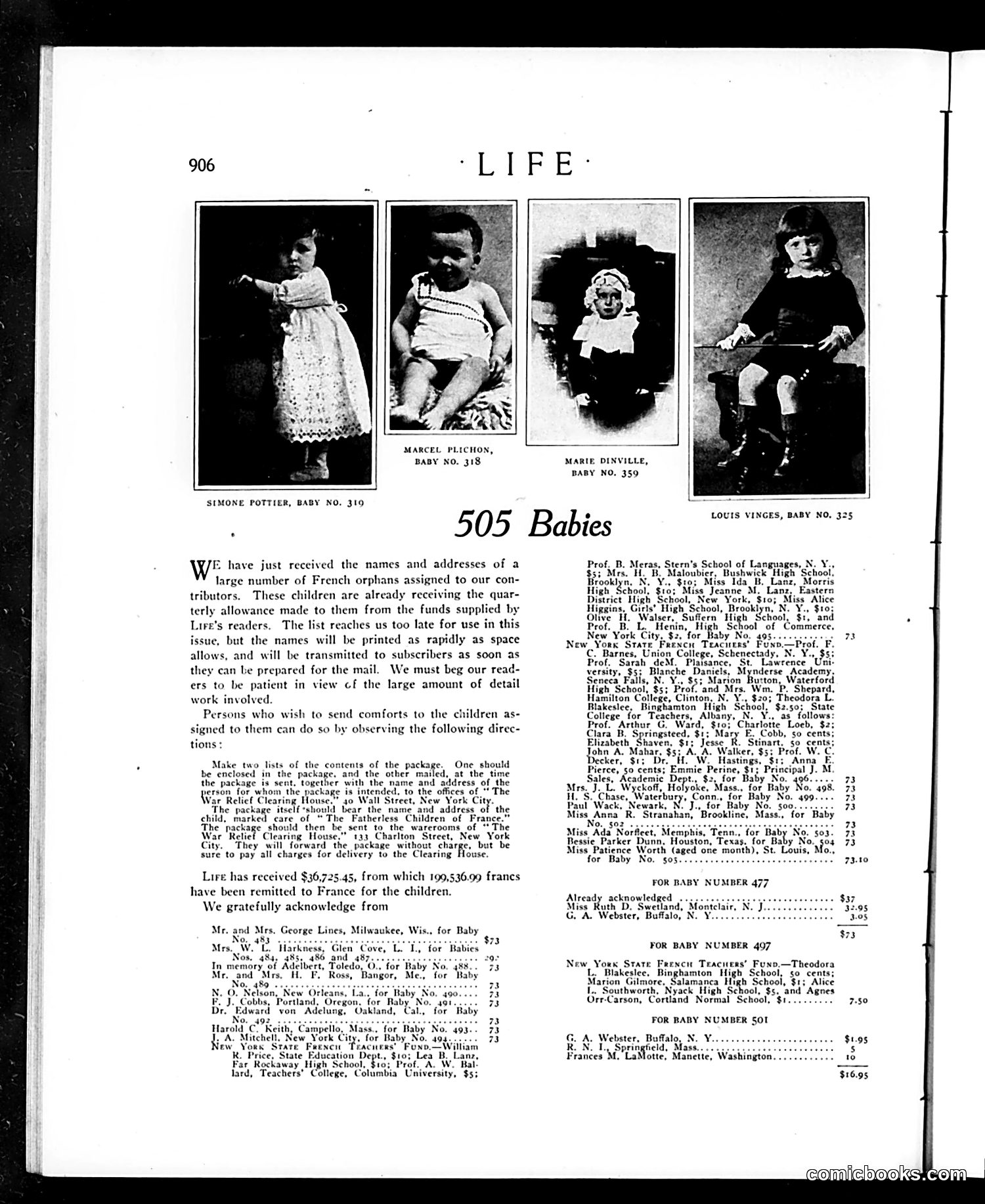
This page documents **Life magazine's fundraising initiative for French war orphans**, likely from World War I era. The four photographs show French children (numbered 319, 318, 359, and 325) who have been "assigned" to American donors through the magazine. The text explains the mechanics: Life readers contribute funds to support these orphans quarterly. The magazine publishes donor lists and instructions for sending care packages through "The War Relief Clearing House" and "The Fatherless Children of France" organization. The page itemizes donations received—ranging from $1 to $20—mostly from teachers and educators at American high schools and colleges. This reflects the organized, institutional nature of the relief effort. Rather than satire, this appears to be sincere charitable content: Life leveraging its readership to provide systematic aid to war-displaced European children. The numbered babies and detailed accounting emphasize the concrete, personal nature of the assistance.
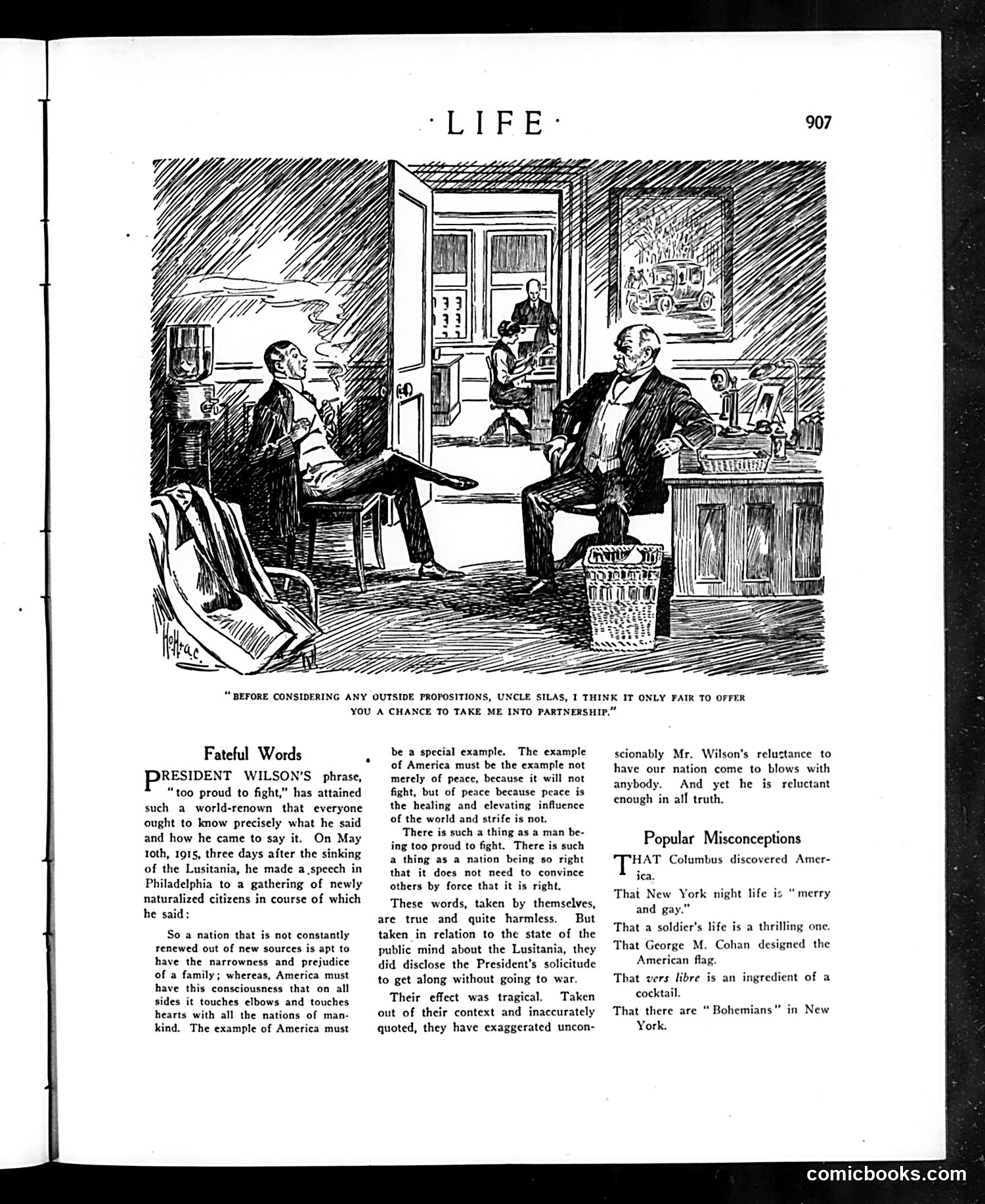
The cartoon depicts a business negotiation between two men in an office. The younger man (on the left) proposes a partnership to "Uncle Silas" (the older, established businessman on the right), offering him a chance to join before he considers outside propositions. The satire comments on American business tactics and self-interest: the younger man frames the partnership offer as a *favor* to Uncle Silas, when he's actually seeking his own advantage. The accompanying article discusses President Wilson's phrase "too proud to fight," made after the 1915 Lusitania sinking. Wilson's words, intended to express American moral superiority, were misquoted and exaggerated by the public to suggest cowardice. The article defends Wilson's actual position while acknowledging his genuine reluctance toward war—critiquing how context matters and how statements become distorted. Together, the page satirizes American attitudes: business opportunism and the gap between intended and received meaning in public discourse.
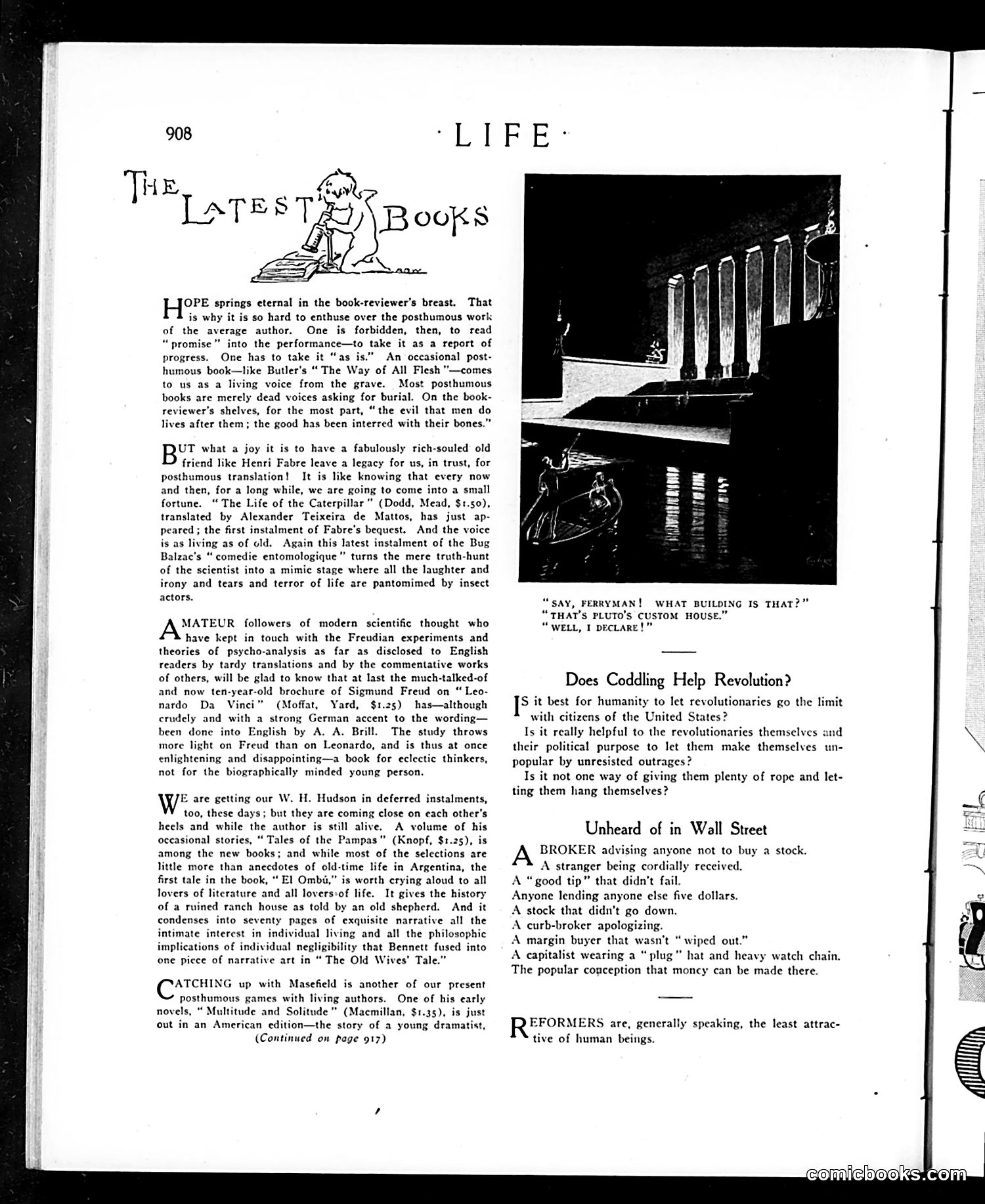
This page is primarily a **book review section** titled "The Latest Books," with a small cartoon inset. The **cartoon** (captioned "Say, ferryman! What building is that?" / "That's Pluto's custom house") uses classical mythology: Charon ferries a soul across the River Styx, pointing to a building in the underworld. "Pluto's custom house" is a pun—conflating Pluto (god of the underworld) with U.S. customs bureaucracy. The joke satirizes **excessive government regulation and red tape**, suggesting even the afterlife requires navigating bureaucratic procedures. The main text reviews recent books by Henri Fabre, Sigmund Freud, W.H. Hudson, and John Masefield—praising Fabre's entomological writings and criticizing Freud's Leonardo Da Vinci study as obscure. Below the reviews, a section titled "Does Coddling Help Revolution?" sarcastically questions whether lenient treatment of revolutionaries actually serves their cause—implying 1910s-era anxieties about radical movements and civil unrest.
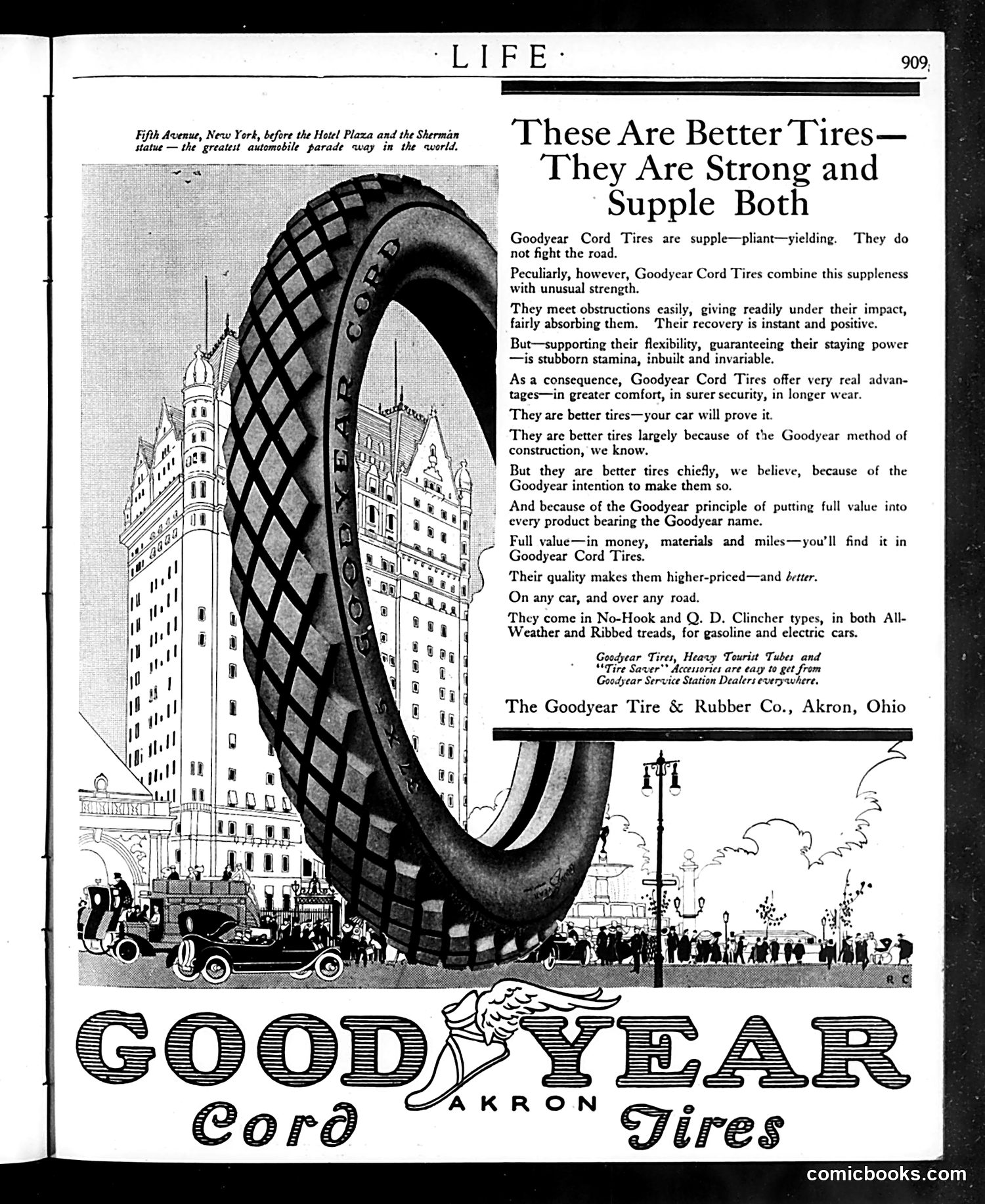
This is **not a political cartoon or satire**—it's a straightforward **Goodyear tire advertisement** from Life magazine (page 909). The image shows a giant tire dominating Fifth Avenue in New York City during what the caption describes as "the greatest automobile parade away in the world." Below are period automobiles and crowds of spectators. The gigantic tire serves as a visual spectacle to advertise Goodyear's "Cord Tires." The text is purely promotional, emphasizing that these tires combine "suppleness" with strength, offering comfort, security, and longevity. It lists product types and notes availability at Goodyear dealers. The only potentially noteworthy element is the scale of the tire display itself—using an enormous public monument to dominance on Fifth Avenue reflects early 20th-century automobile industry optimism and advertising's embrace of dramatic visual spectacle.
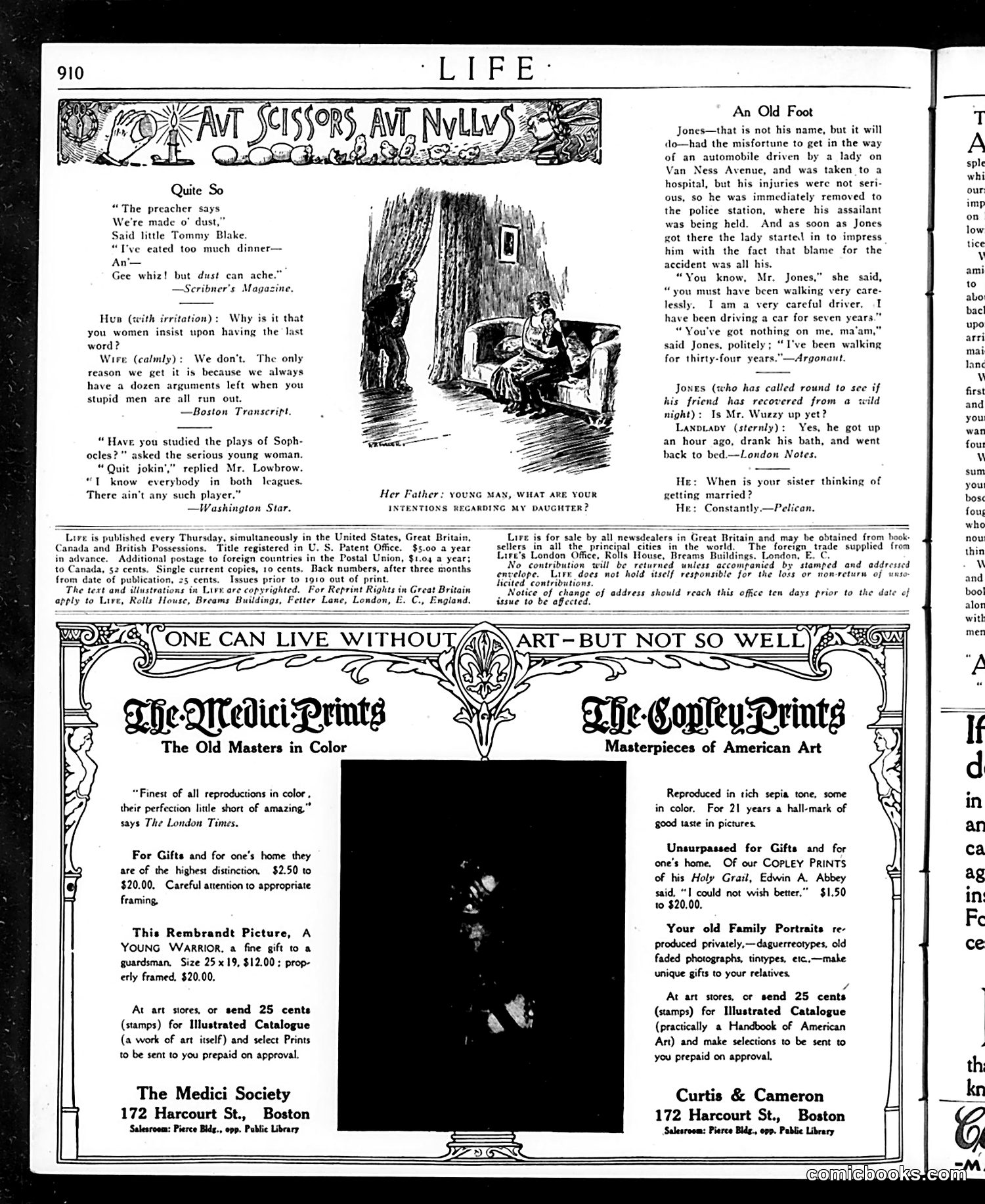
This page contains several short humorous anecdotes typical of early 20th-century American satirical magazines. The main cartoon appears to be the illustration of a couple in a hollow tree, likely accompanying one of the jokes about relationships or marriage. The humor centers on gender relations and social pretension. One joke mocks women for always having the "last word" in arguments—a common domestic stereotype. Another satirizes social climbing through a lowbrow character who confuses classical playwright Sophocles with baseball leagues, suggesting anti-intellectual attitudes among ordinary Americans. "An Old Foot" tells of a pedestrian hit by a female driver who blames him despite her seven years' driving experience; he counters that he's walked for thirty-four years. The joke plays on gender role expectations—suggesting women drivers are careless—and uses class humor about working-class versus leisure activities. The remainder is primarily **advertising** for art reproductions and prints, not editorial content.
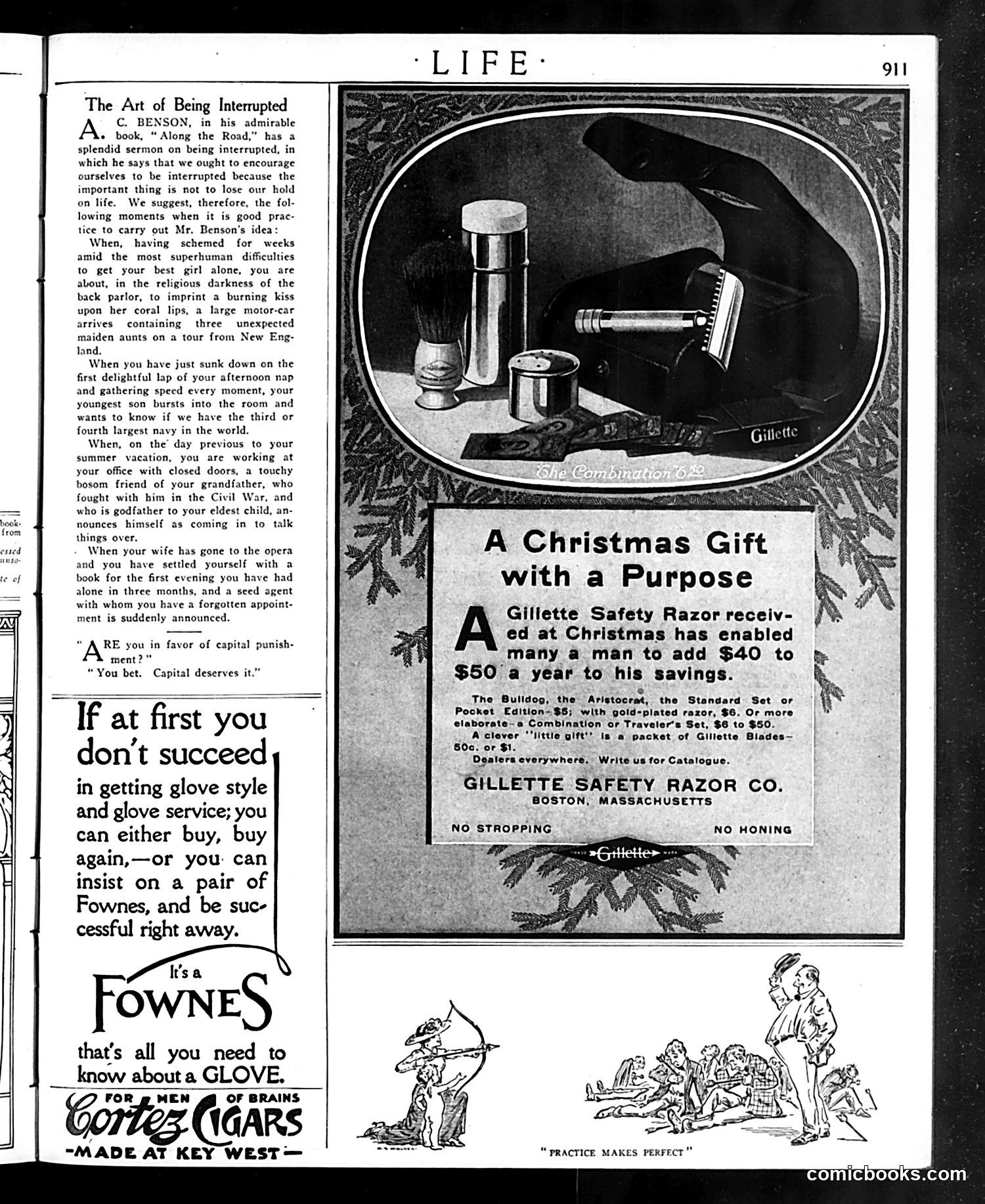
**Left Column - "The Art of Being Interrupted":** This is satirical advice based on C. Benson's book *Along the Road*. The humor presents deliberately absurd moments to practice "being interrupted" — ostensibly to maintain one's grip on life. Examples include: a romantic moment in a back parlor interrupted by unexpected maiden aunts arriving by motor-car; an afternoon nap disrupted by a son asking about naval rankings; a work meeting interrupted by your grandfather's old Civil War friend; and an evening of reading interrupted by a forgotten seed agent appointment. The satire mocks both Benson's philosophy and the petty domestic annoyances of middle-class life. **Right Side - Advertisements:** The page features ads for Gillette Safety Razors (marketed as a practical Christmas gift enabling savings of $40-50 yearly), Fownes gloves, and Cortez cigars. These are period advertisements, not satirical content. **Bottom illustration:** Shows a man instructing children with caption "Practice Makes Perfect" — unrelated to the text above.
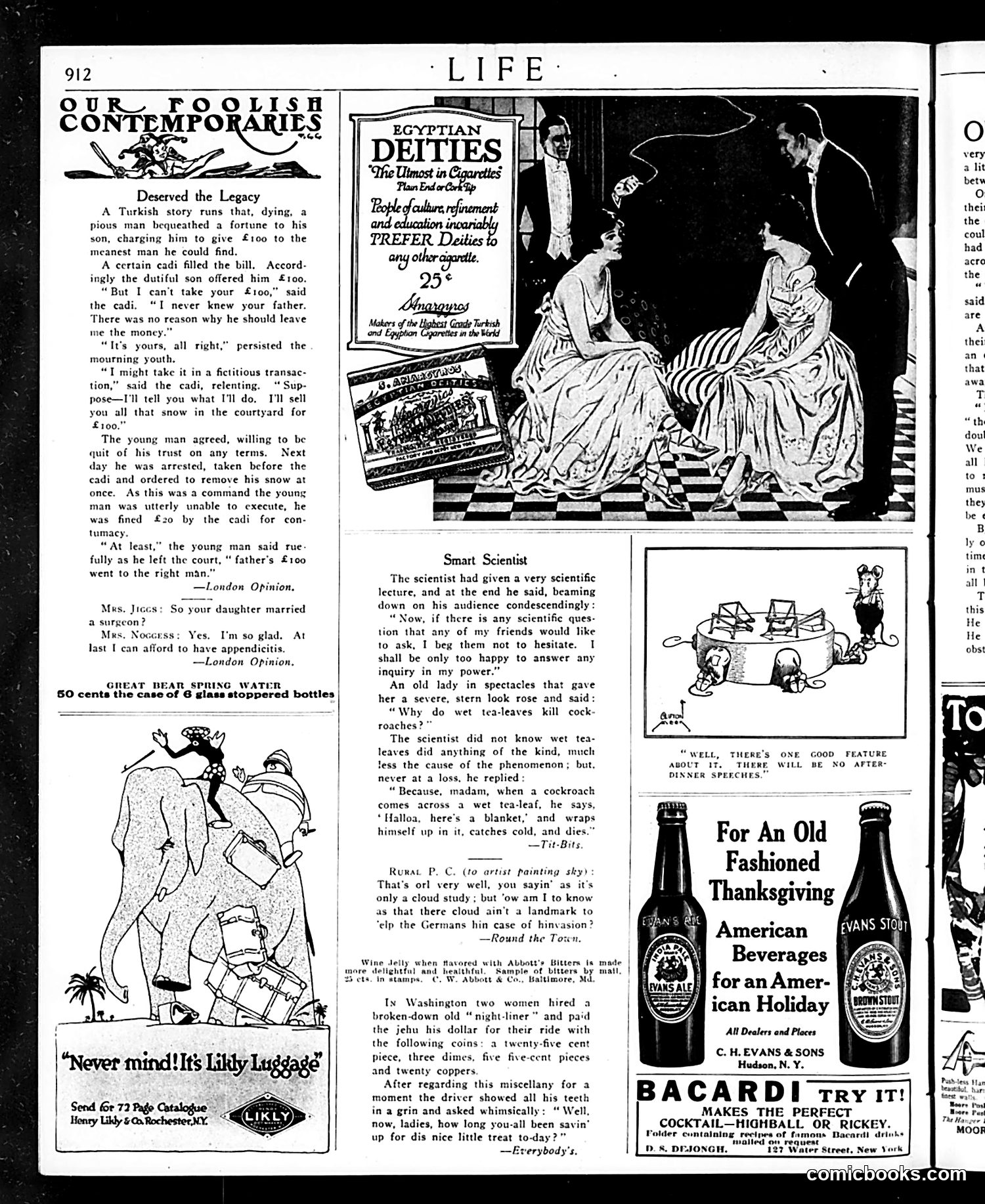
This page contains several satirical pieces typical of early-20th-century *Life* magazine humor: **"Deserved the Legacy"** is a Turkish folk tale about a corrupt judge (cadi) who exploits a young man's charitable obligation through a fraudulent scheme—selling him snow he cannot remove, then fining him for non-compliance. The satire targets legal corruption and sophistry. **"Smart Scientist"** mocks pompous intellectuals. A condescending lecturer claims expertise while confidently inventing nonsense when an elderly woman asks about wet tea-leaves killing cockroaches. The joke satirizes academic pretension and the gap between claimed knowledge and actual understanding. The remaining items are brief jokes about surgeons/medical costs and a cab driver's humorous reaction to being paid in small coins. **Visual elements** include period advertisements (Egyptian deities tonic, Bacardi rum, spring water) and cartoon illustrations typical of the era's satirical style. The page reflects *Life*'s editorial focus on mocking pomposity, fraud, and social pretension among elites and professionals.
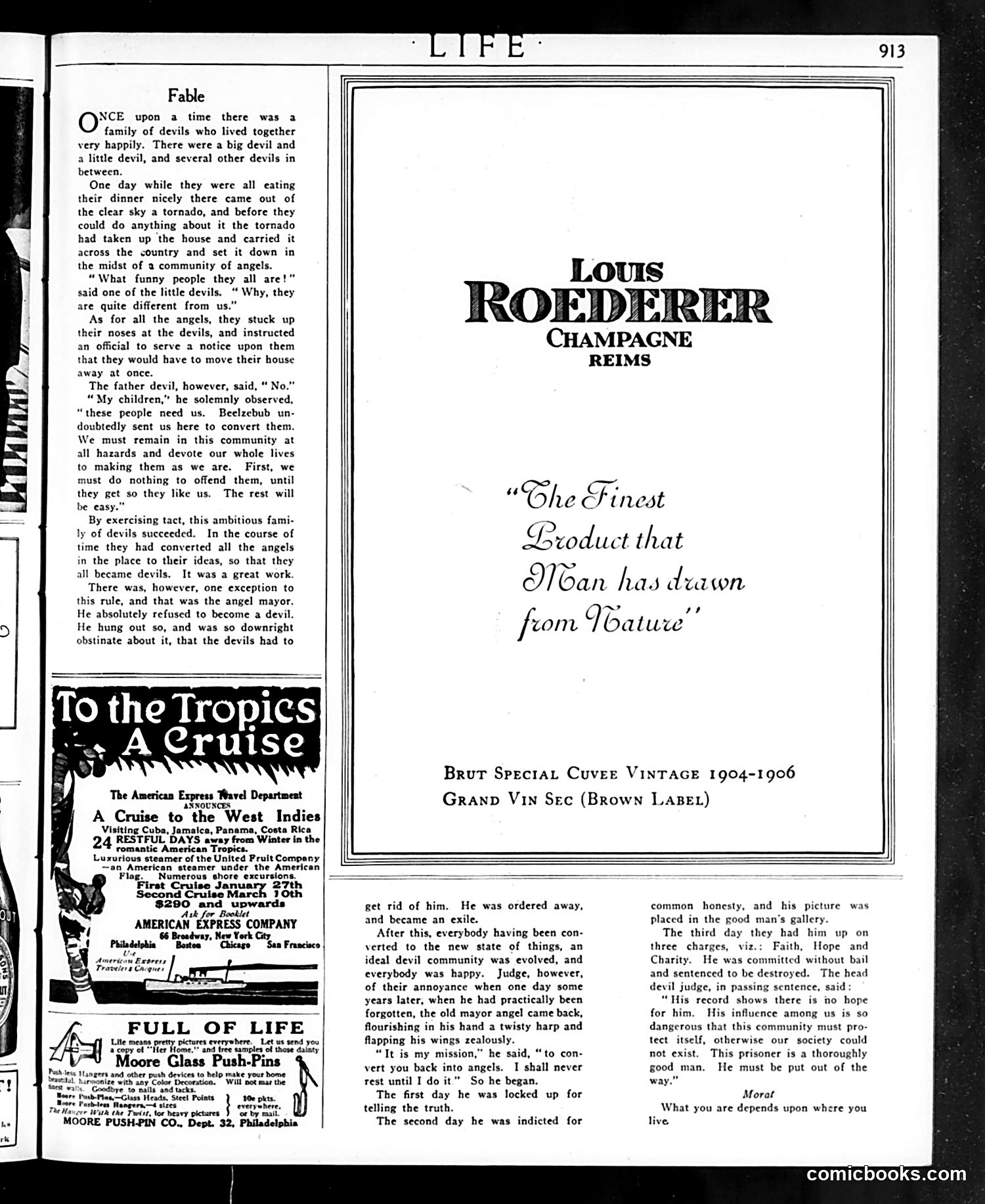
This allegorical tale satirizes the corrupting influence of immoral environments on virtuous people. The devils represent those with low moral standards; the angels represent the righteous. When devils infiltrate an angel community, they gradually convert everyone to their corrupt ways through patient, strategic deception—"exercising tact" until the angels willingly become like them. The angel mayor who resists represents principled integrity. When he returns years later attempting reform, he's imprisoned and sentenced to death for virtues (truth, honesty, faith, hope, charity) that society now views as dangerous threats. **The satire's message**: A community that abandons moral standards becomes hostile to goodness itself. The moral: "What you are depends upon where you live"—environment shapes character, for better or worse. This likely critiques social corruption, moral compromise in institutions, or the difficulty of reform once a society has become fundamentally compromised. The piece warns that incremental moral decline makes virtue itself seem threatening.
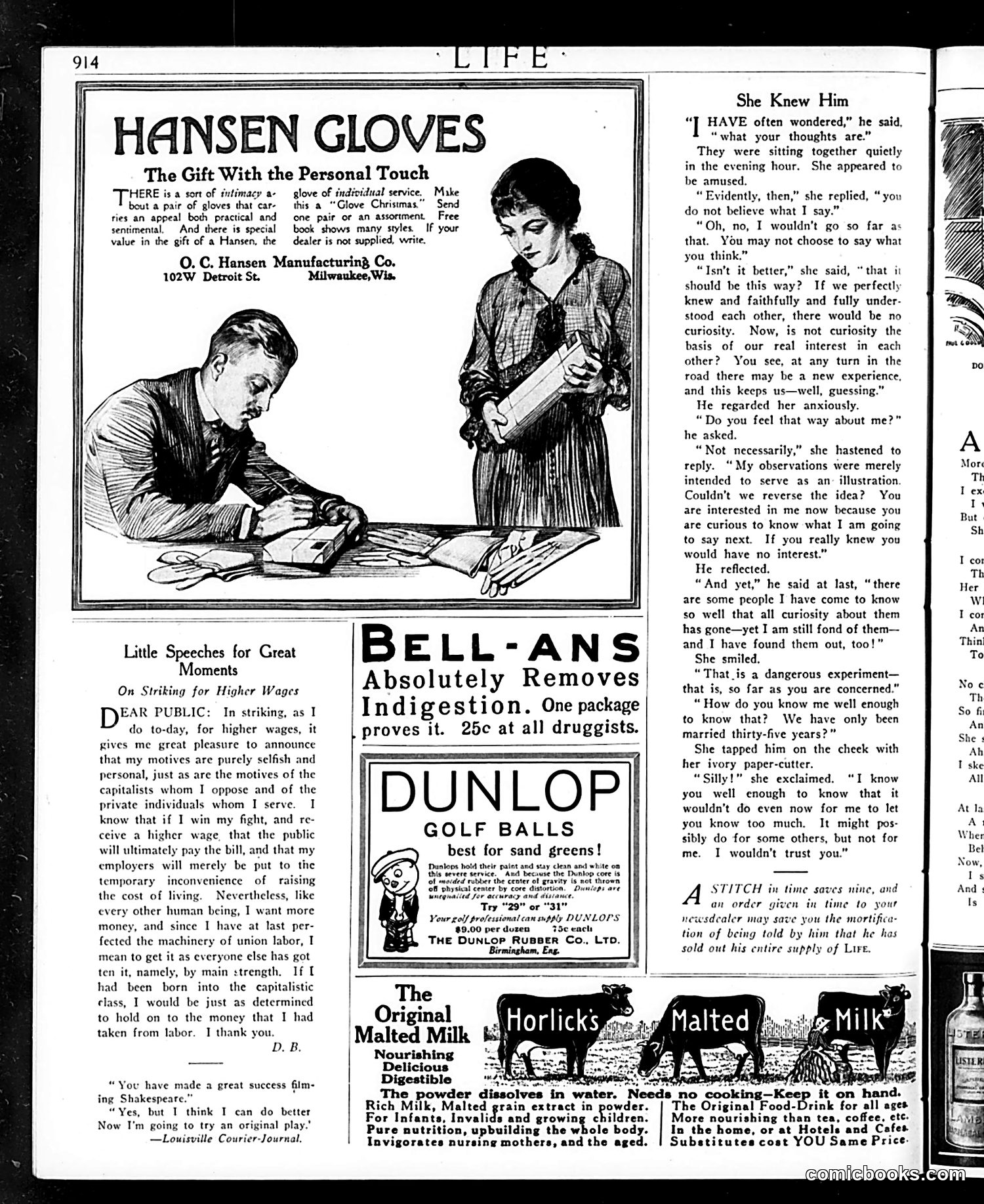
This page is primarily **advertisements interspersed with short humorous pieces**, typical of Life magazine's format. The main content includes: 1. **"Little Speeches for Great Moments"** — A satirical monologue by a striking worker (signed "D.B.") who cynically admits his wage demands are purely selfish, just as capitalists' motives are. He acknowledges the public will pay the cost and his employer faces inconvenience, but he's using union machinery to demand higher wages anyway. This mocks both labor strikers and capitalists by presenting them as morally equivalent and self-interested. 2. **"She Knew Him"** — A domestic comedy dialogue about a married couple where the wife suggests that *mystery and uncertainty* preserve romantic interest. She claims thirty-five years of marriage haven't let him know her too well, implying she deliberately withholds information. The humor derives from the wife's calculated emotional manipulation presented as relationship wisdom. The remaining content is **product advertising** (Hansen Gloves, Bell-Ans indigestion remedy, Dunlop golf balls, Horlicks Malted Milk).
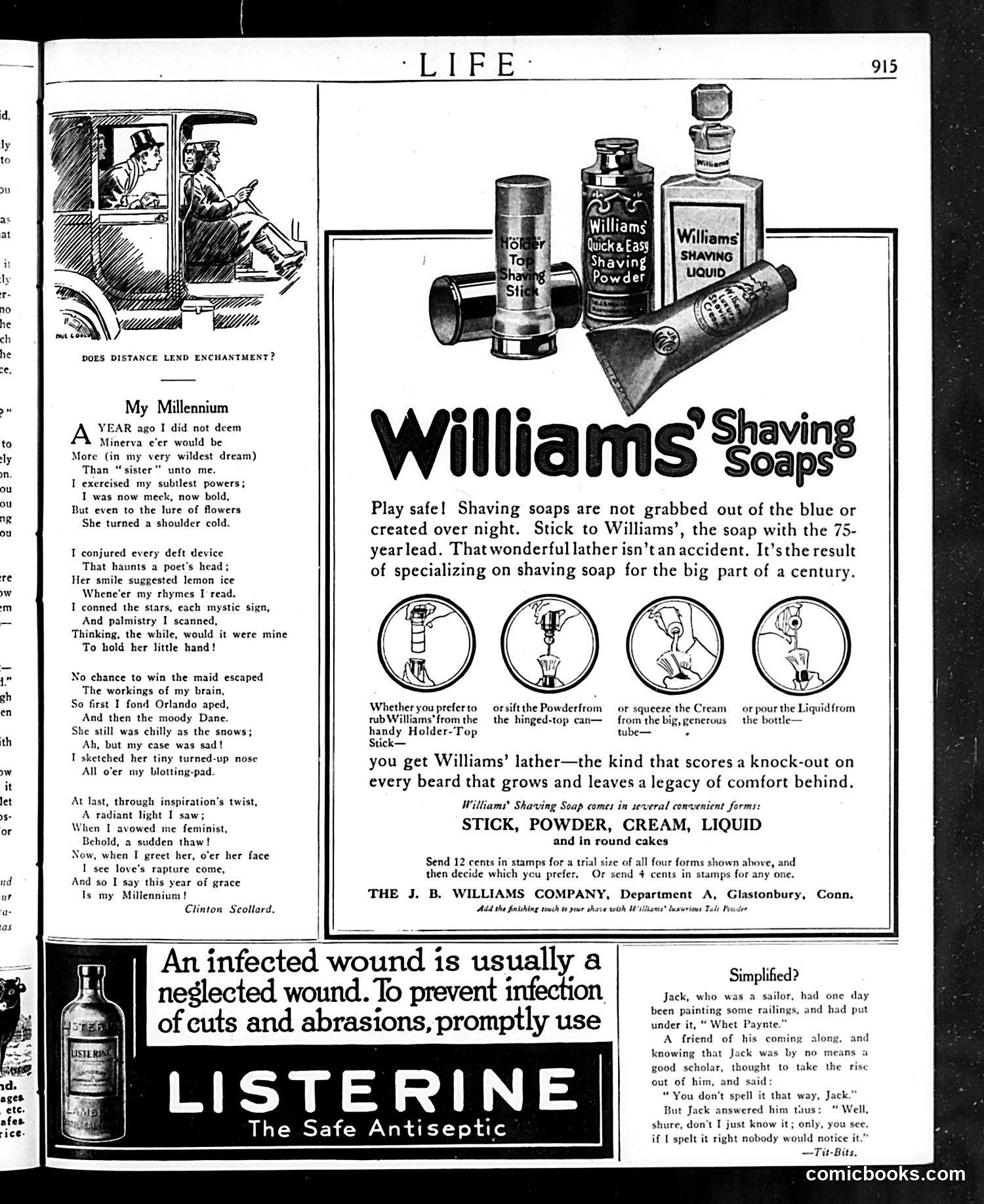
**The Cartoon ("Does Distance Lend Enchantment?")** This is a humorous poem by Clinton Scollard about a man pursuing an uninterested woman named Minerva. He exhausts romantic stratagems—poetry, mysticism, star-gazing, literary allusions (Orlando, Hamlet)—all rejected coldly. Only when he adopts feminist views does she suddenly reciprocate, leading him to declare this year his "Millennium." The satire mocks the fashionable turn-of-century trend of men adopting progressive feminist positions as a courtship strategy, suggesting it's merely another calculated romantic "device" rather than genuine conviction. The joke's irony: genuine belief matters less than results. **Lower Section** A brief humorous anecdote about a sailor named Jack who misspells "Paint" as "Paynte" on a railing. When corrected, he admits he deliberately misspells it so nobody notices the error—absurdist logic that plays on working-class wit. **Advertisements occupy most of the page** (Williams' Shaving Soap, Listerine).
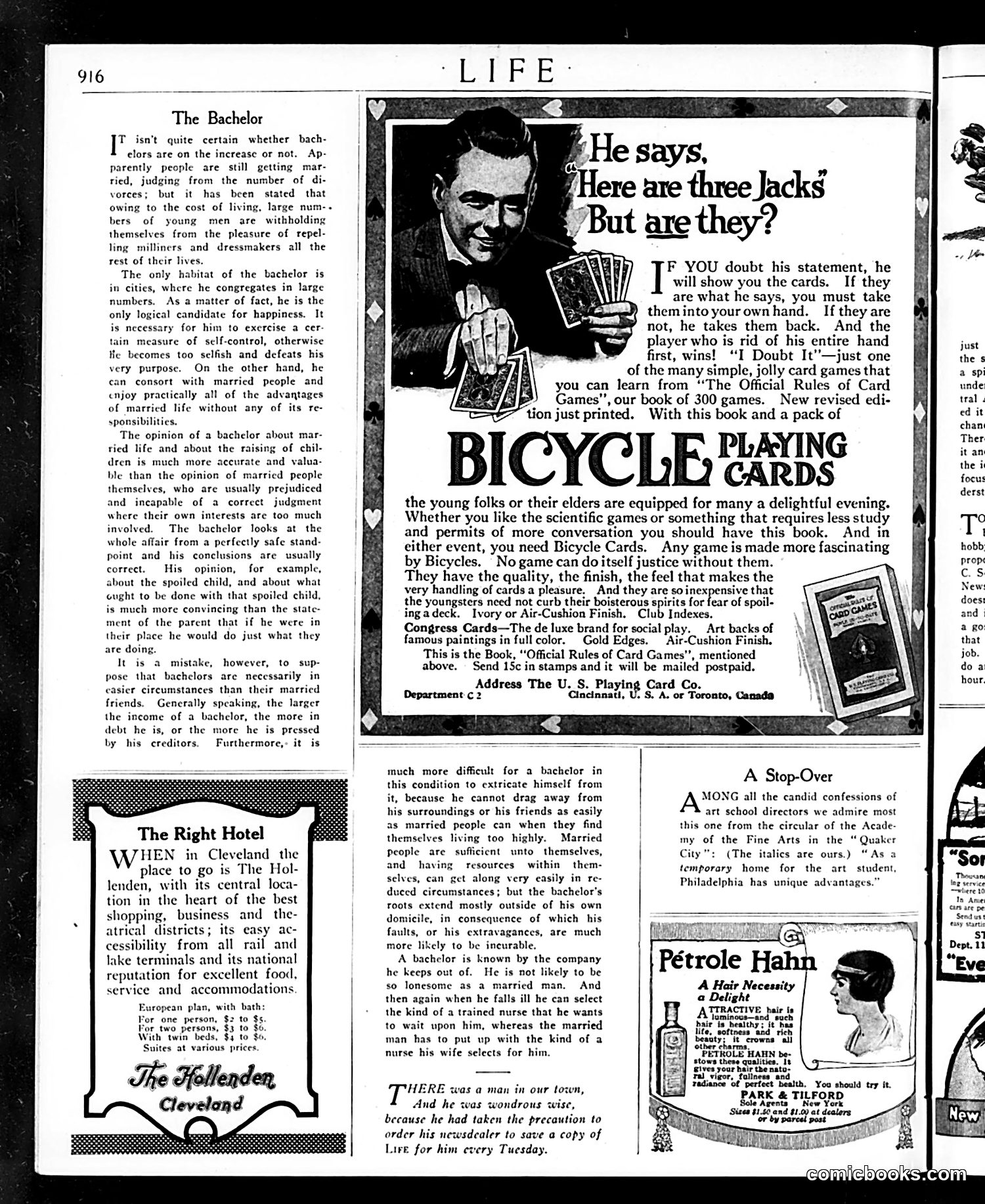
This page contains satirical commentary on bachelor life alongside period advertising. **"The Bachelor" essay** critiques bachelor philosophy cynically. It argues bachelors—concentrated in cities—are actually happier and better judges of marriage and child-rearing than married people, since they observe married life "from a perfectly safe standpoint" without personal stakes. The satire mocks bachelor self-righteousness: their opinions about "spoiled children" carry weight precisely because they bear no responsibility. The essay also notes bachelors often spend beyond their means despite higher incomes, undercutting their supposed superiority. **The Bicycle Playing Cards advertisement** dominates the center, featuring a man displaying cards with the tagline "Here are three jacks—But are they?" It's a visual pun on card games and deception, promoting the official rules book and card quality. **"The Right Hotel" and "Pétrole Hahn"** are standard period advertisements for Cleveland lodging and hair products. The page primarily satirizes bachelor pretension while functioning as advertising space, typical of Life's mixed editorial-commercial format.
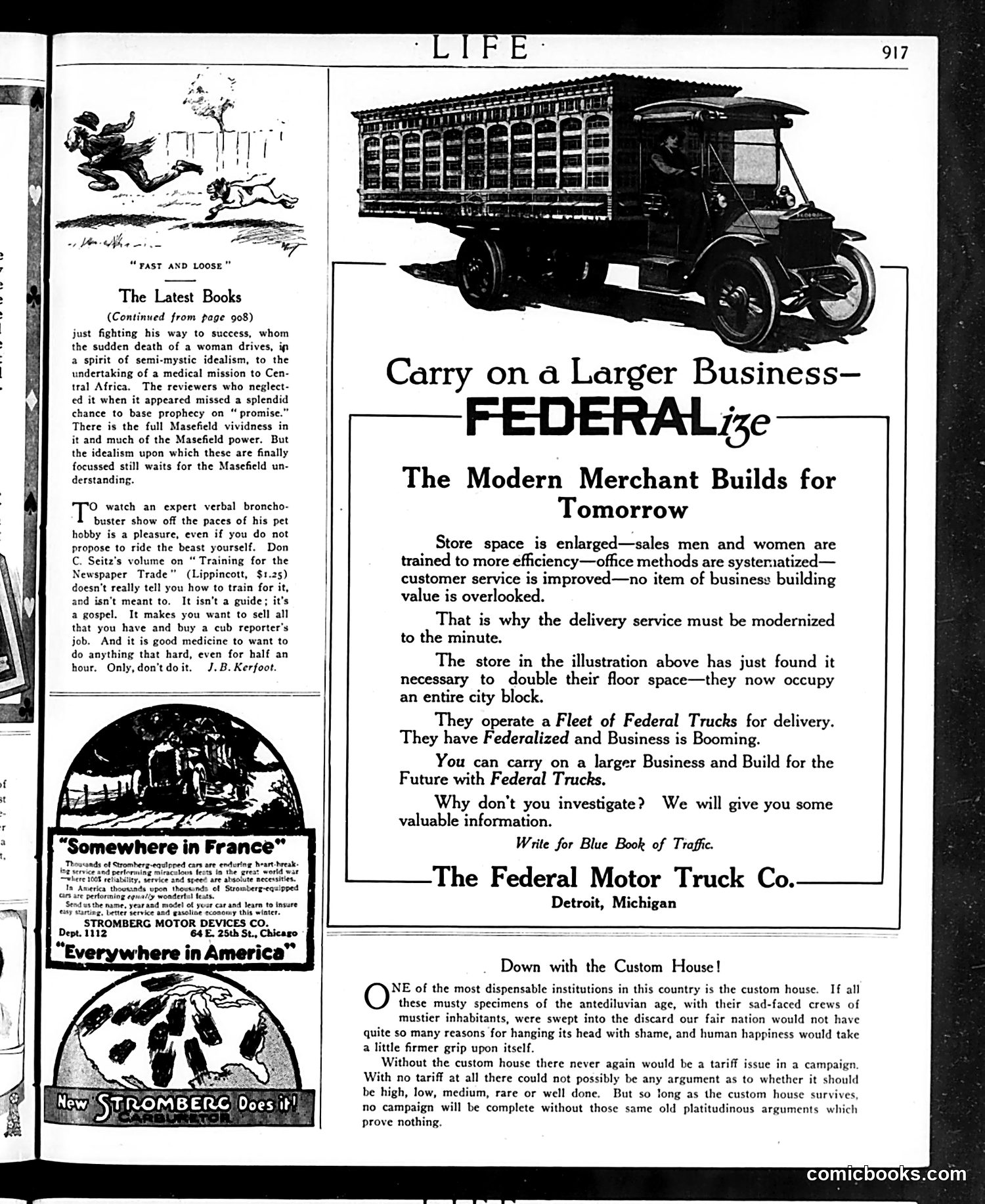
This page mixes book reviews, advertisements, and political commentary typical of Life's satirical format. **Left side** features book reviews, including commentary on works by John Masefield and Don C. Seitz about newspaper training. There are also ads for Stromberg motor devices emphasizing reliability during WWI and peacetime. **Center/right** contains a Federal Motor Truck Company advertisement celebrating modern business expansion and delivery fleet modernization—a straightforward commercial pitch. **Bottom section** titled "Down with the Custom House!" is the satirical commentary. It argues that U.S. customs houses are obsolete, "antediluvian" institutions whose only function is to fuel pointless tariff debates in political campaigns. The author suggests eliminating them would improve national happiness and eliminate repetitive, meaningless campaign arguments about tariff rates. This reflects early 20th-century free-trade sentiment and frustration with protectionist trade policy rhetoric that dominated American politics.
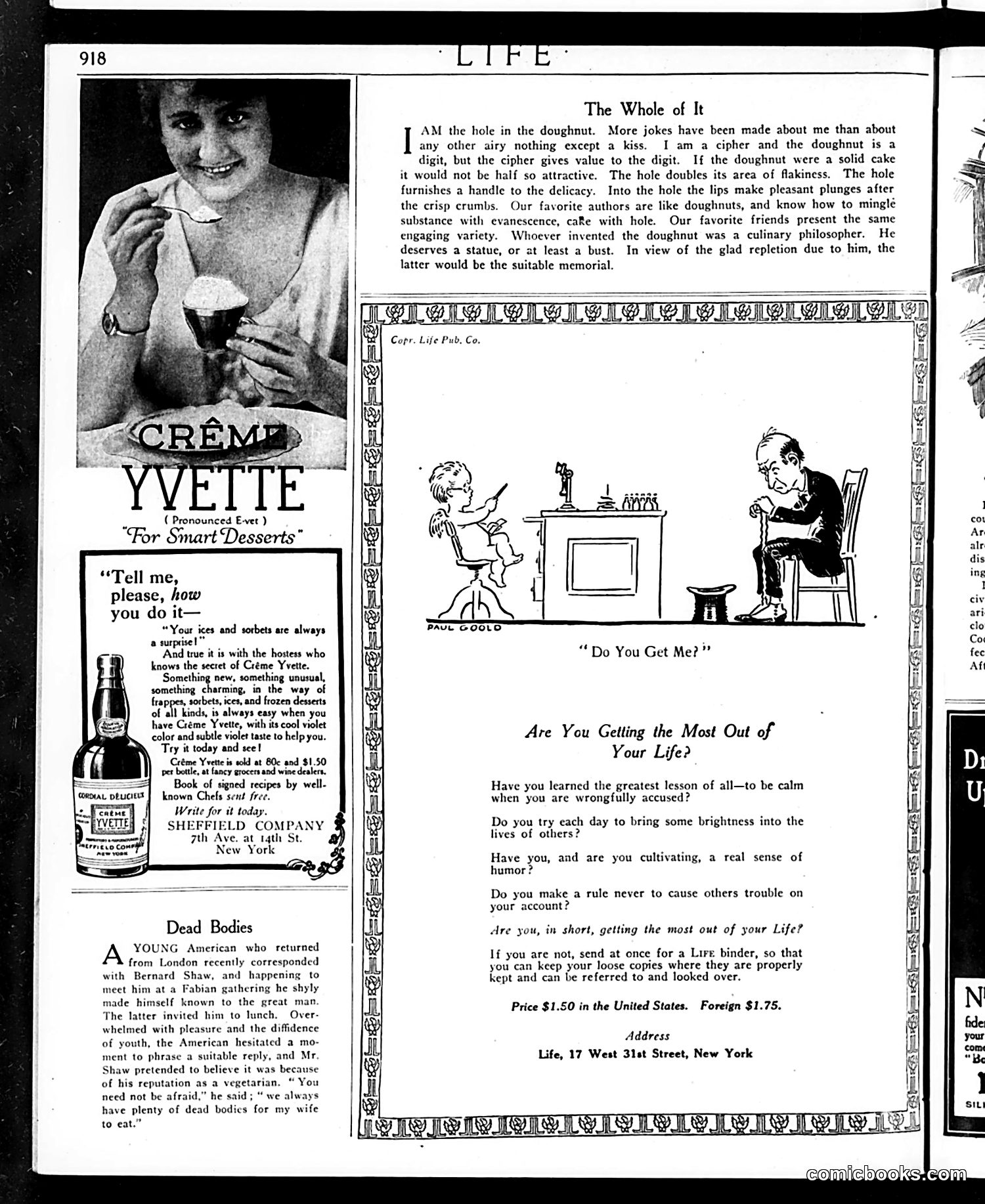
This page combines advertisements, humor pieces, and satirical content typical of Life magazine's format. **"The Whole of It"** is a whimsical philosophical essay personifying a doughnut hole—a cipher that gains value through contrast with the solid doughnut. It's a meditation on absence and emptiness having meaning, using doughnuts as metaphor for life's substance versus emptiness. **"Do You Get Me?"** is a cartoon showing a domestic dispute—a woman appears agitated while a man sits deflated in a chair, titled with a phrase suggesting miscommunication or failure to understand. **"Dead Bodies"** recounts an anecdote about Bernard Shaw, the famous Irish playwright and vegetarian. The humor derives from Shaw's wit: when an American visitor hesitantly greets him, Shaw sarcastically assures the nervous young man that despite his vegetarian reputation, he keeps "plenty of dead bodies" for his wife—a joke about his wife eating meat while he abstains. The page is primarily **advertising-driven**, featuring Crème Yvette liqueur prominently, with lighter satirical content interspersed.
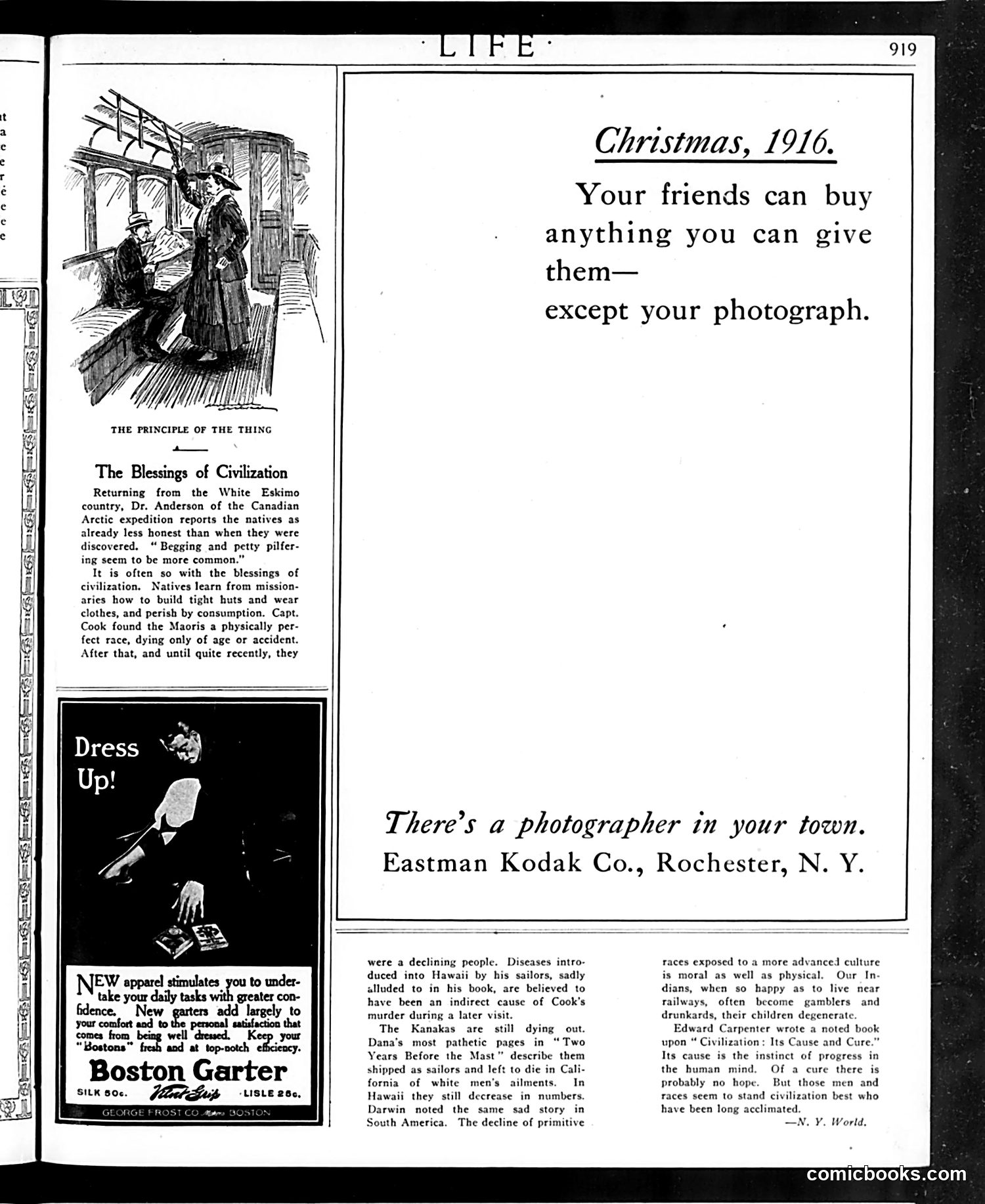
This page presents a satirical critique of colonialism and Western "civilization's" destructive impact on indigenous peoples. **The Cartoon's Argument:** The left column sarcastically catalogs how contact with Western civilization harms native populations. It cites Dr. Anderson's report that Canadian Eskimos became less honest after contact, and references historical examples: Captain Cook's sailors introduced diseases to Hawaii (allegedly contributing to Cook's murder); Maori populations declined after British contact; Hawaiian numbers continue falling; Pacific islanders died under Western labor conditions. **The Satire:** The piece ironically titles this litany "The Blessings of Civilization"—meaning the opposite. It argues that while missionaries teach natives to build houses and wear clothes, these "advances" bring consumption, disease, alcoholism, and moral decay rather than progress. **The Right-Side Advertisement:** Unrelated Kodak and Boston Garter ads occupy the page's other half, creating an ironic juxtaposition between the editorial's serious anti-colonial critique and commercial consumer culture promoting Western goods.
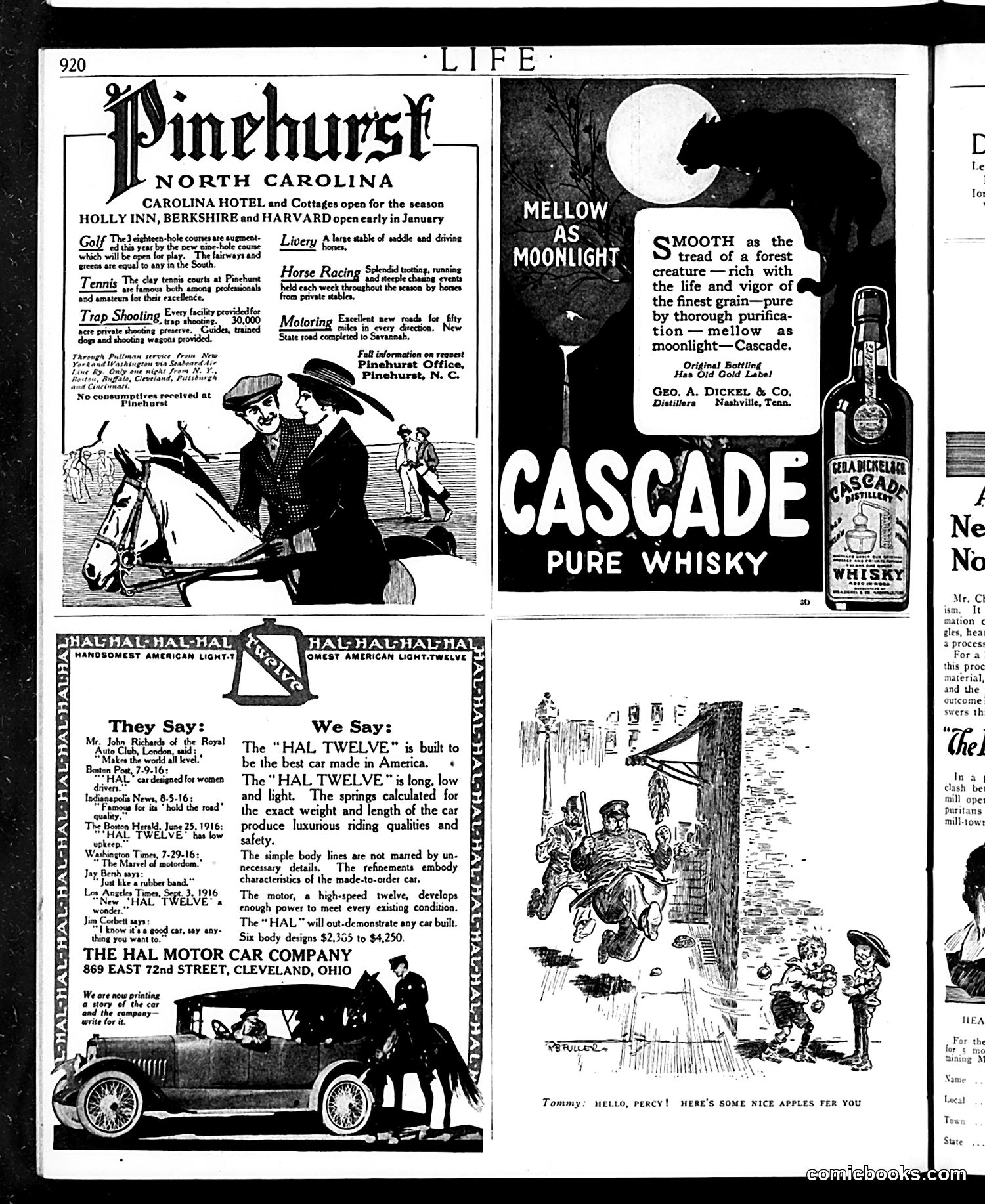
This page is primarily **advertising content** with one small cartoon. The advertisements promote: 1. **Pinehurst, North Carolina resort** — listing recreational activities (golf, tennis, horse racing, motoring) as tourist attractions 2. **Hal Motor Car** — features testimonials from celebrities (Jay Gould, Jim Corbett) praising the "Hal Twelve" automobile's quality and affordability ($2,355-$4,250) 3. **Cascade Whiskey** — uses poetic language ("mellow as moonlight") to market pure whiskey 4. **Small cartoon** (bottom): Shows a child offering apples to another child named Percy, captioned "Hello, Percy! Here's some nice apples fer you." This appears to be innocent children's humor, likely illustrating simple childhood generosity or mischief. The page reflects early 20th-century American consumer culture, emphasizing luxury goods, automobiles, and leisure travel for the affluent reader.
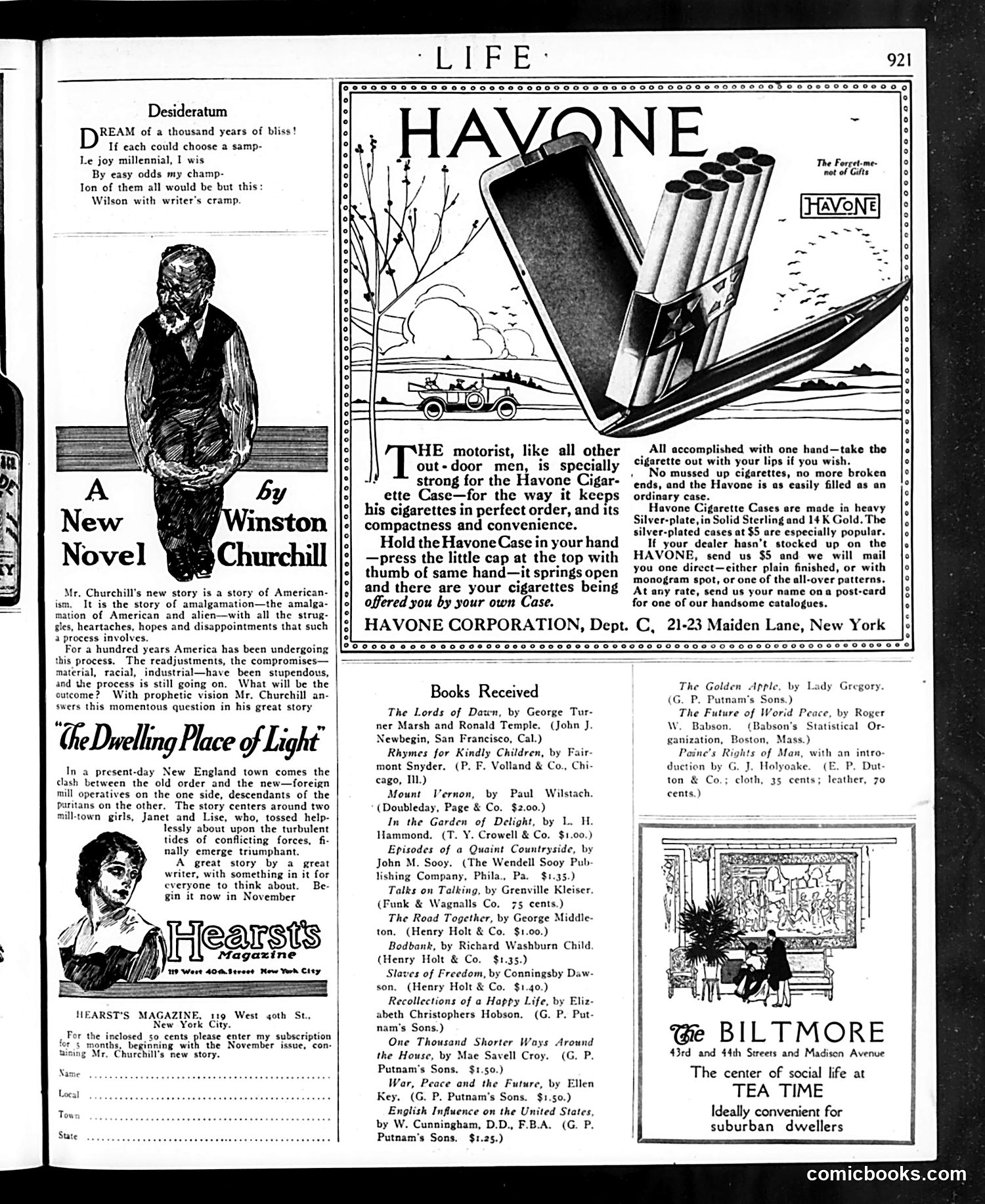
## The "Desideratum" Poem This brief satirical verse mocks President Woodrow Wilson by expressing a wish that he suffer from "writer's cramp"—meaning he'd be unable to write. This appears to be political criticism of Wilson's prolific output or policies during his presidency (likely WWI era). The humor lies in the exaggerated, almost absurd fantasy that preventing Wilson from writing would constitute "a thousand years of bliss." ## The Page's Main Content The page is primarily **advertising and book listings**, not editorial cartoons. The dominant advertisement is for Havone Cigarette Cases, featuring product illustrations and marketing copy. Below are lists of recently published books and subscription offers for Hearst's Magazine and Winston Churchill's serialized novel "The Dwelling Place of Light." **Political/satirical content is minimal**—limited to the Wilson jab—while the page functions mainly as a commercial and literary publication vehicle typical of Life magazine's format during this period.
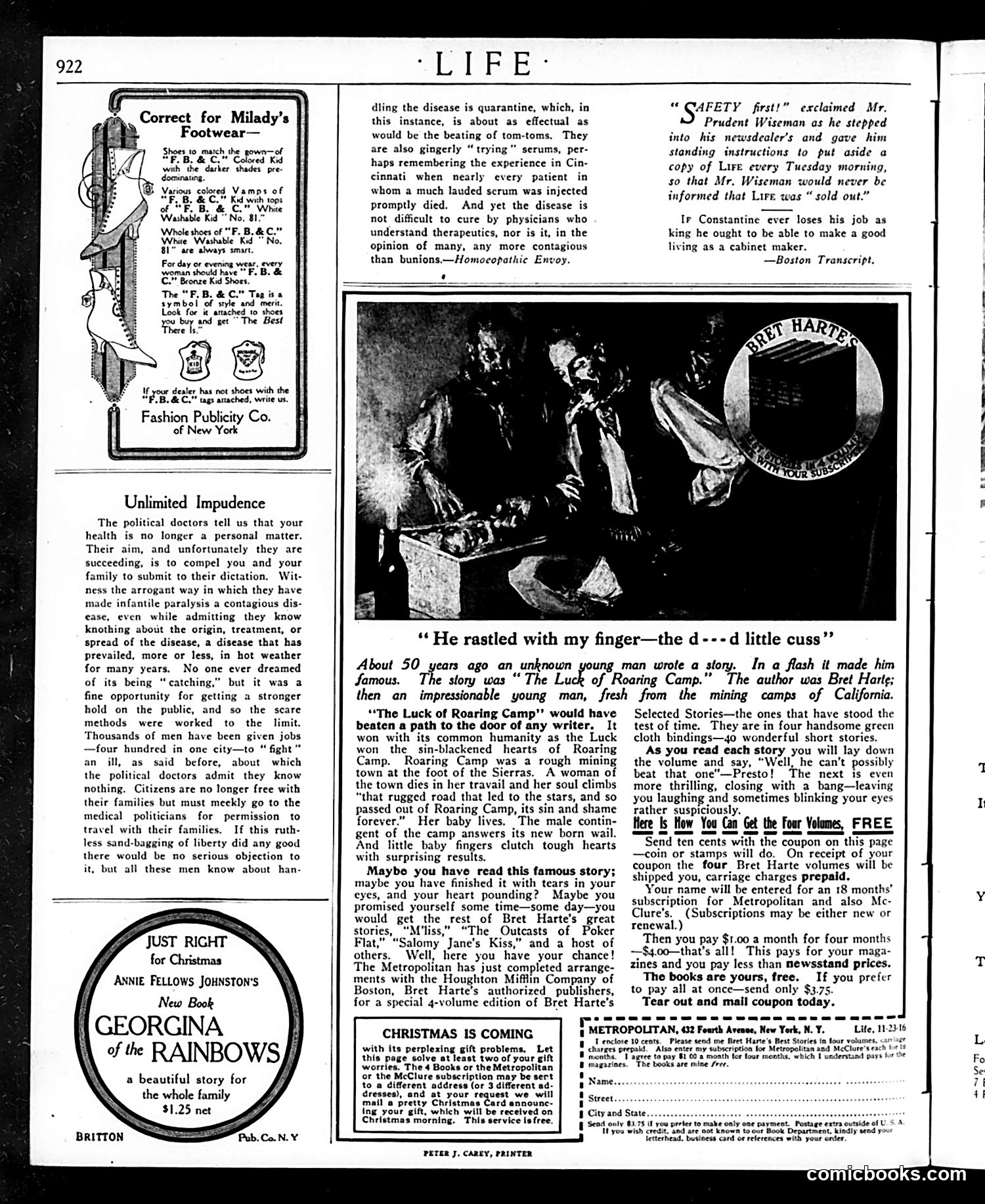
This page contains **political satire about medical overreach** during what appears to be an **infantile paralysis (polio) outbreak**—likely the 1916 epidemic that struck American cities. The main editorial piece, "Unlimited Impudence," attacks government health officials for declaring polio "contagious" without understanding its actual cause or spread. The author sarcastically criticizes them for creating public panic, manufacturing thousands of jobs to "fight" the disease, and compelling citizens to obey medical authorities against their will—comparing this to political doctors abusing power. The satire's point: **These officials admit ignorance yet demand absolute compliance**, which the writer views as authoritarian overreach masked as public health. The piece explicitly mocks quarantine measures and serum injections as ineffective while politicians exploit the crisis. The page also contains unrelated **advertising** for shoes and books, including Bret Harte stories—typical Life magazine filler.
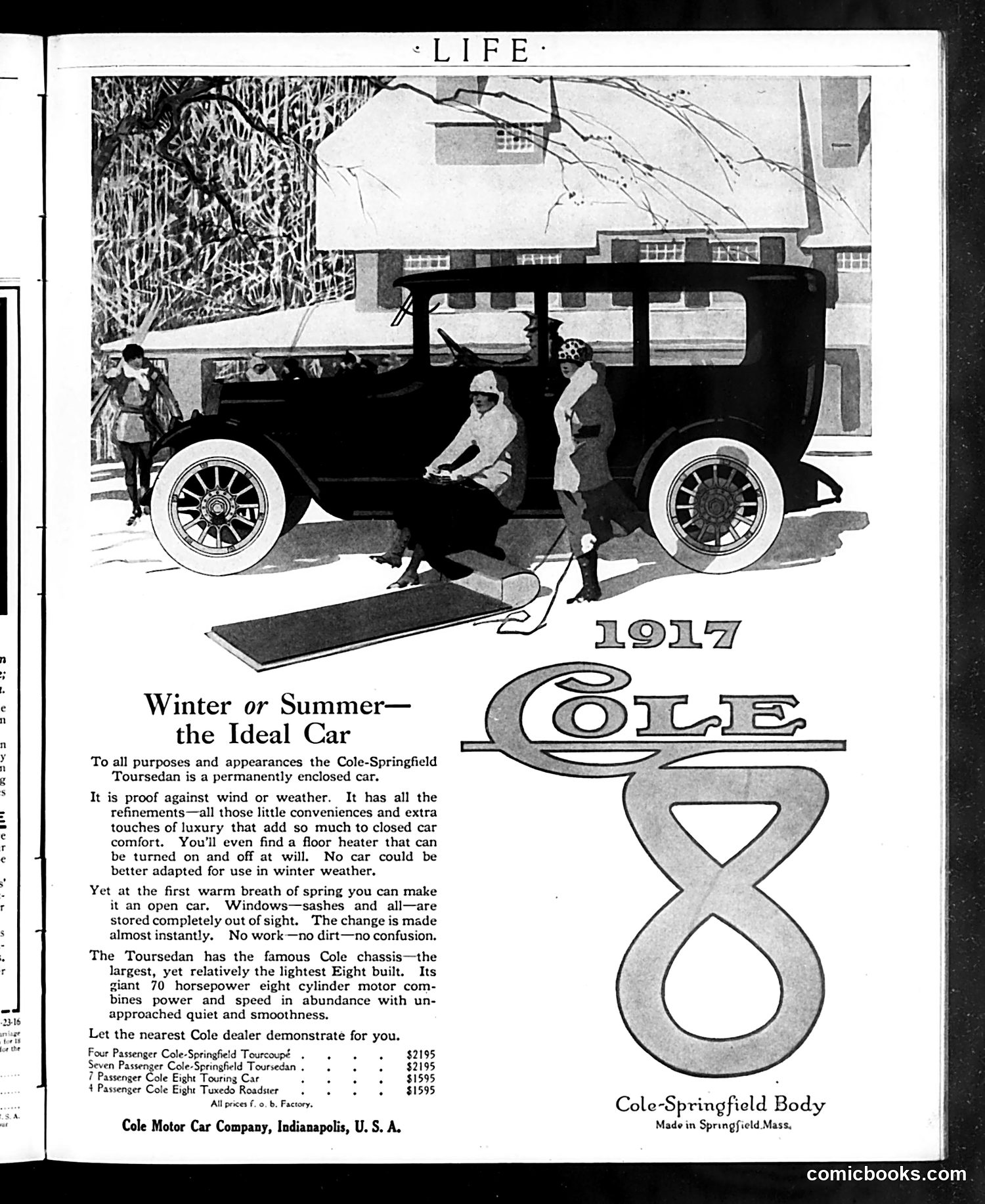
This is primarily a **product advertisement**, not political satire. It promotes the 1917 Cole-Springfield "Toursedan," a convertible automobile with a removable hard top. The key innovation being advertised is the car's convertible design: it functions as a fully enclosed, heated vehicle in winter but converts to an open-air car in warm weather by removing windows and roof panels "almost instantly" with "no work—no dirt—no confusion." The accompanying illustration shows well-dressed passengers demonstrating the vehicle's practical versatility. The marketing emphasizes luxury features (floor heater, smooth 70-horsepower engine) appealing to affluent buyers. For modern readers: this represents early automotive advertising targeting wealthy consumers, highlighting technological advancement and seasonal convenience as selling points when automobiles were expensive luxury goods, not mass-market transportation.
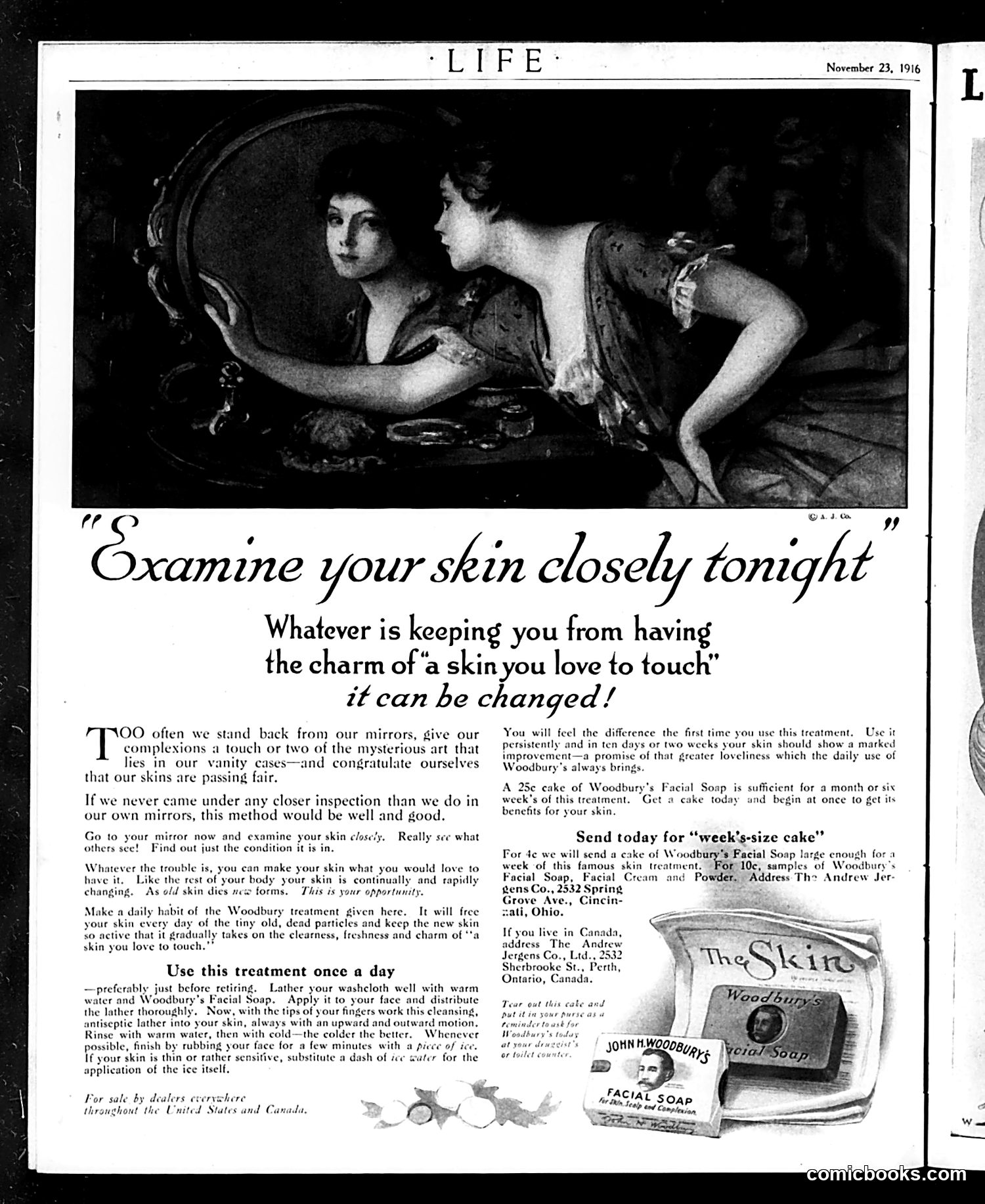
This is primarily a **beauty product advertisement** for Woodbury's Facial Soap, not political satire. The page shows no cartoon or commentary on current events. The image depicts two women examining skin in a mirror, illustrating the advertisement's message: consumers should scrutinize their complexion closely and use the daily Woodbury treatment to achieve "a skin you love to touch"—the product's famous slogan. The ad promotes a cleansing routine using warm water, lather, and ice to remove dead skin cells. This reflects **early 20th-century beauty marketing**, which relied heavily on insecurity and self-inspection to sell products. The language emphasizes continuous skin renewal and the promise that visible improvement would appear within two weeks. The inclusion of a Canadian address reflects the product's international availability during WWI.