
Life, 1916-11-23 · page 16 of 40
Life — November 23, 1916 — page 16: what you’re looking at
What you’re looking at
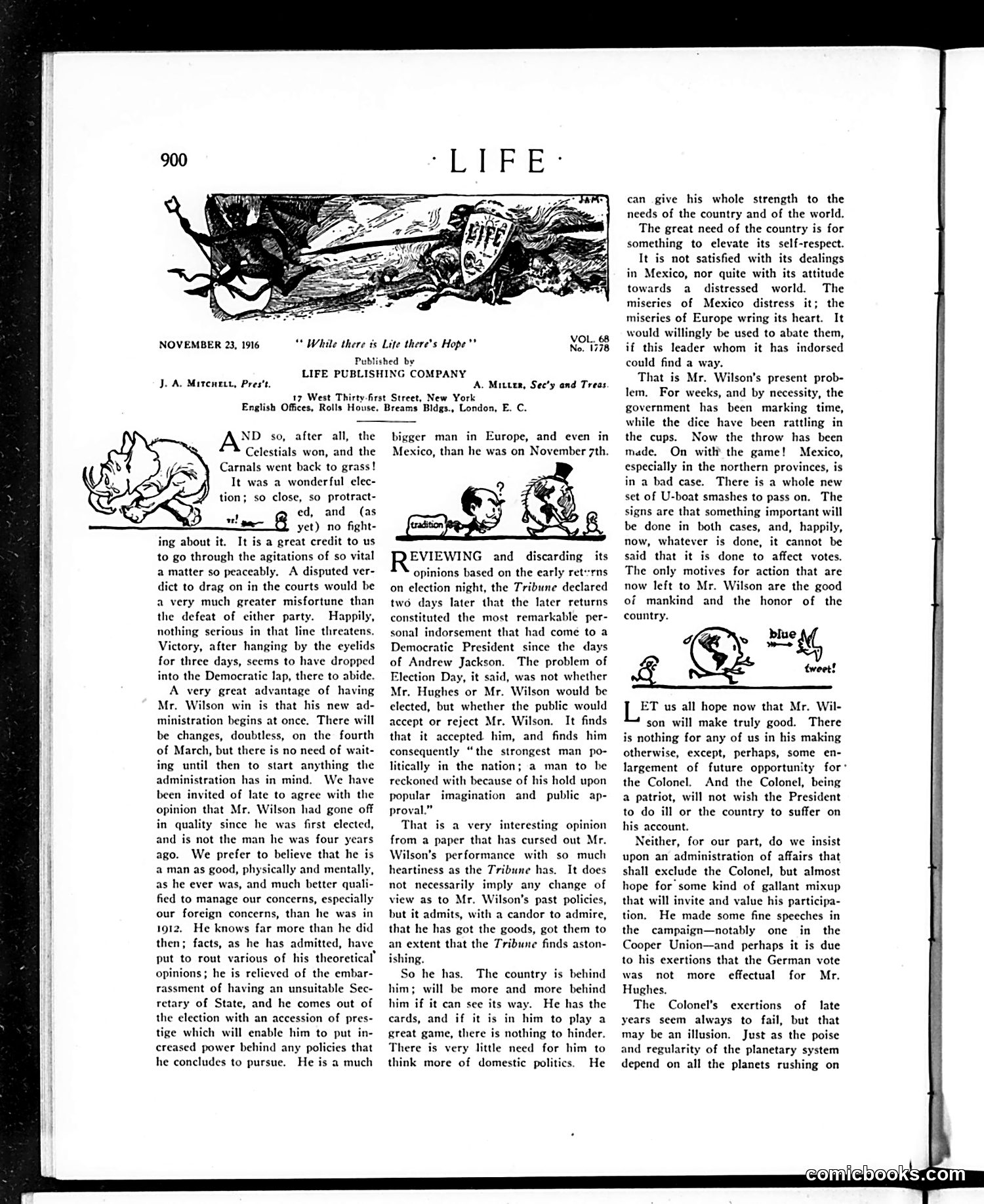
This page celebrates Woodrow Wilson's narrow re-election victory over Charles Evans Hughes on November 7, 1916. The cartoons show Wilson (depicted as the "bigger man") triumphing over his opponent—"Celestials won, and the Carnals went back to grass." The editorial praises Wilson's victory as a personal mandate, noting even hostile newspapers like the Tribune now acknowledge he is "the strongest man politically in the nation." Life argues Wilson's re-election gives him renewed authority and prestige, particularly internationally in Europe and Mexico. The piece emphasizes that Wilson can now pursue bold foreign policy without domestic political constraints, suggesting the electorate has endorsed his approach to Mexico's turmoil and Europe's war (WWI). The overall tone is congratulatory, positioning Wilson as strengthened and validated by the close election outcome.
📄 Transcribed text from this page (OCR, searchable)
Machine-transcribed from the original scan — historical spelling and the odd misread are preserved.
—2 NS te 8 NOVEMBER 23, 1916 “* While there ts Life there's Hope"* VOL. 68 No. 1778 Published by LIFE PUBLISHING COMPANY J. A. Mirenett, Pre A VD so, after all, the Celestials won, and the Carnals went back to grass! It was a wonderful elec- tion; so close, so protract- ed, and (as yet) no fight- ing about it. It is a great credit to us to go through the agi ns of so vital a matter so peaceably, A disputed ver- dict to drag on in the courts would be a very much greater misfortune than the defeat of either party. Happily, nothing serious in that line threaten: Victory, after hanging by the eyelid for three days, seems to have dropped into the Democratic lap, there to abide. A very great advantage of having Mr. Wilson win is that his new ad- ministration begins at once. There will be changes, doubtless, on the fourth of March, but there is no need of wait- ing until then to start anything the administration has in mind. We have been invited of late to agree with the opinion that Mr. Wilson had gone off in quality since he was first elected, and is not the man he was four years ago. We prefer to believe that he is a man as good, physically and mentally, as he ever was, and much better quali- fied to manage our concerns, especially our foreign concerns, than he was in He knows far more than he did 3 facts, as he has admitted, have put to rout various of his theoretical” opinions; he is relieved of the embar- rassment of having an unsuitable Sec- retary of State, and he comes out of the election with an accession of pres- tige which will enable him to put in- creased power behind any policies that he concludes to pursue. He is a much A. Mitttr, Sec’y and Treas. 17 West Thirty-first Street, New York English Offices, Rolls House, Breams Bldgs., London, E. C. bigger man in Europe, and even in Mexico, than he was on November 7th. EVIEWING and discarding its opinions based on the early ret-rns on election night, the Tribune declared two days later that the later returns constituted the most remarkable per- sonal indorsement that had come to a Democratic President since the days of Andrew Jackson. The problem of Election Day, it said, was not whether Mr. Hughes or Mr. Wilson would be elected, but whether the public would accept or reject Mr. Wilson. It finds that it accepted him, and finds him consequently “the strongest man po- litically in the nation; a man to be reckoned with because of his hold upon popular imagination and public ap- proval.” That is a very interesting opinion from a paper that has cursed out Mr. Wilson’s performance with so much heartiness as the Tribune has. It does not necessarily imply any change of view as to Mr. Wilson’s past policies, but it admits, with a candor to admire, that he has got the goods, got them to an extent that the Tribune finds aston- ishing. So he has. The country is behind him; will be more and more behind him if it can see its way. He has the cards, and if it is in him to play a great game, there is nothing to hinder. There is very little need for him to think more of domestic politics. He can give his whole strength to the needs of the country and of the world. The great need of the country is for something to elevate its self-respect. It is not satisfied with its dealings in Mexico, nor quite with its attitude towards a distressed world. The miseries of Mexico distress it; the miseries of Europe wring its heart. It would willingly be used to abate them, if this leader whom it has indorsed could find a way. That is Mr. Wilson’s present prob- lem. For weeks, and by necessity, the government has been marking time, while the dice have been rattling in the cups. Now the throw has been made. On with the game! Mexico, especially in the northern provinces, is in a bad case. There is a whole new set of U-boat smashes to pass on. The signs are that something important will be done in both cases, and, happily, now, whatever is done, it cannot be said that it is done to affect votes. The only motives for action that are now left to Mr. Wilson are the good of mankind and the honor of the country. EN =G g tweet ET us all hope now that Mr. Wil- son will make truly good. There is nothing for any of us in his making otherwise, except, perhaps, some en- largement of future opportunity for’ the Colonel. And the Colonel, being a patriot, will not wish the President to do ill or the country to suffer on his account. ‘ither, for our part, do we insist upon an administration of affairs that shall exclude the Colonel, but almost hope for’ some kind of gallant mixup that will invite and value his participa- tion. He made some fine speeches in the campaign—notably one in the Cooper Union—and perhaps it is due to his exertions that the German vote was not more effectual for Mr. Hughes. The Colonel's exertions of late years seem always to fail, but that may be an illusion. Just as the poise and regularity of the planetary system depend on all the planets rushing on