
Life, 1916-11-23 · page 17 of 40
Life — November 23, 1916 — page 17: what you’re looking at
What you’re looking at
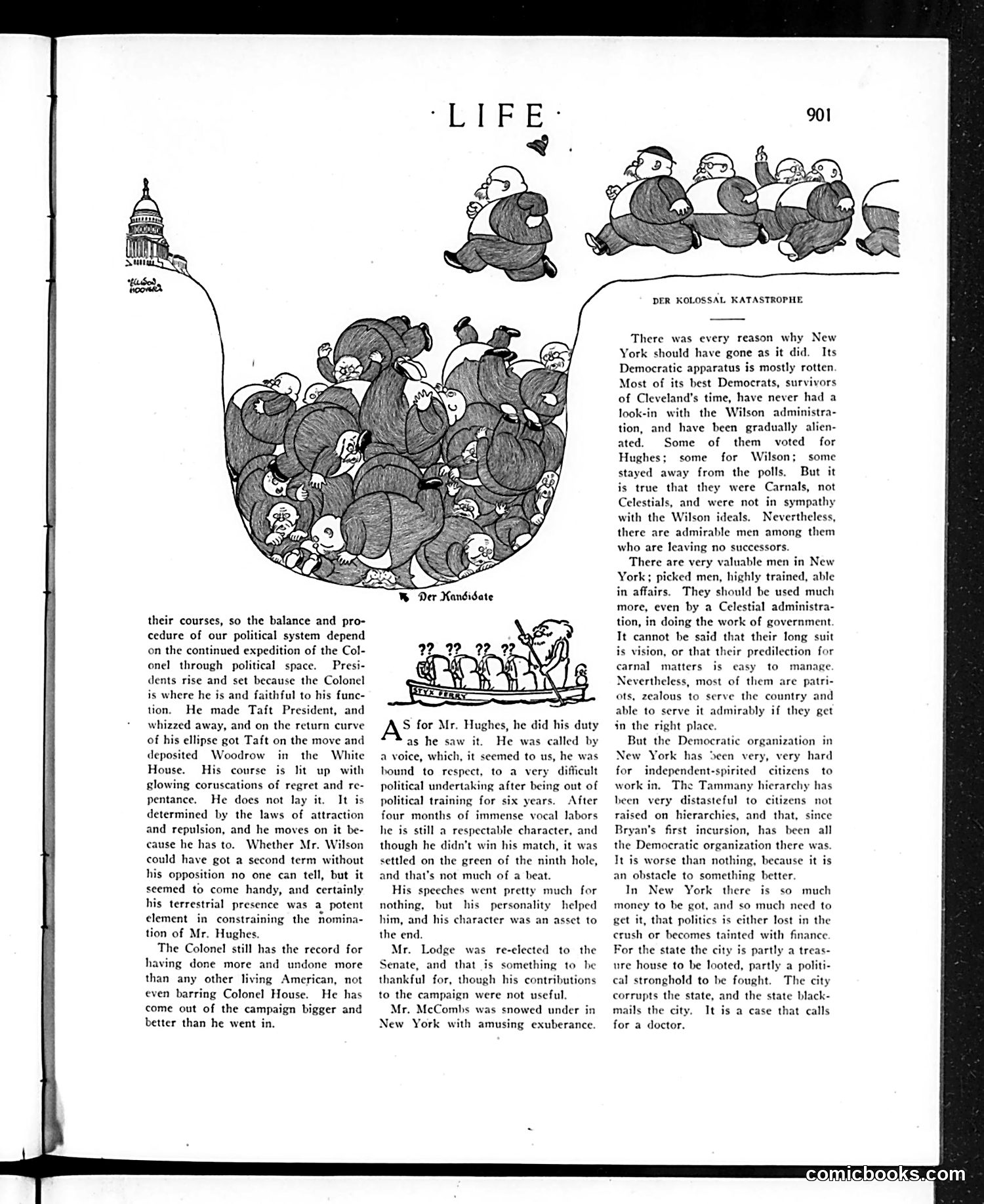
## The Cartoons **"Der Kandidate"** (lower left): Shows a massive spherical figure labeled "Der Kandidate" containing dozens of smaller figures—likely representing the chaotic Democratic political apparatus or party infrastructure. **"Der Kolossal Katastrophe"** (top right): Depicts figures tumbling or fleeing, labeled with the German phrase suggesting political disaster. ## Context This appears to be post-1916 election commentary. The text references Theodore Roosevelt as "the Colonel"—described as an orbiting force shaping American politics, having made Taft and Wilson presidents. It discusses Charles Evans Hughes's failed presidential campaign and critiques New York's Democratic organization, particularly **Tammany Hall** (the corrupt Democratic machine), as an obstacle to good governance. The satire targets Democratic Party dysfunction, machine politics, and the tension between idealistic ("Celestial") Wilsonian governance and practical ("carnal") Eastern establishment Democrats who felt alienated from the Wilson administration.
📄 Transcribed text from this page (OCR, searchable)
Machine-transcribed from the original scan — historical spelling and the odd misread are preserved.
their courses, so the balance and pro- cedure of our political system depend on the continued expedition of the Col- onel through political space. Presi- dents rise and set because the Colonel is where he is and faithful to his func- tion. He made Taft President, and whizzed away, and on the return curve of his ellipse got Taft on the move and deposited Woodrow in the White House. His course is lit up with glowing coruscations of regret and re- pentance. He does not lay it. It is determined by the laws of attraction and repulsion, and he moves on it be- cause he has to. Whether Mr. Wilson could have got a second term without his opposition no one can tell, but it seemed to come handy, and certainly his terrestrial presence was a potent element in constraining the nomina- tion of Mr. Hughes. The Colonel still has the record for having done more and undone more than any other living American, not even barring Colonel House. He has come out of the campaign bigger and better than he went in. S for Mr. Hughes, he did his duty as he saw it. He was called by a voice, which, it seemed to us, he was hound to respect, to a very difficult political undertaking after being out of political training for six years. After four months of immense vocal labors he is still a respectable character, and though he didn’t win his match, it was settled on the green of the ninth hole, and that’s not much of a beat. His speeches went pretty much for nothing, but his personality helped him, and his character was an asset to the end. Mr. Lodge was re-elected to the Senate, and that is something to be thankful for, though his contributions to the campaign were not useful. Mr. McCombs was snowed under in New York with amusing exuberance. DER KOLOSSAL KATASTROPHE There was every reason why New York should have gone as it did. Its Democratic apparatus is mostly rotten Most of its best Democrats, survivors of Cleveland's time, have never had a look-in with the Wilson administra tion, and have been gradually alien- ated. Some of them voted for Hughes; some for Wilson; some stayed away from the polls, But it is true that they were Carnals, not Celestials, and were not in sympathy with the Wilson ideals. Nevertheless, there are admirable men among them who are leaving no successors. There are very valuable men in New York; picked men, highly trained, able in affairs. They should be used much more, even by a Celestial administra- tion, in doing the work of government. It cannot be said that their long suit is vision, or that their predilection for carnal matters is easy to manage. Nevertheless, most of them are patri- ots, zealous to serve the country and able to serve it admirably if they get in the right place. But the Democratic organization in New York has Deen very, very hard for independent-spirited citizens to work in, The Tammany hierarchy has n very distasteful to citizens not raised on hierarchies, and that, since Bryan's first incursion, has been all the Democratic organization there was. It is worse than nothing, because it is an obstacle to something better. In New York there so much money to be got, and so much need to get it, that politics is either lost in the crush or becomes tainted with finance. For the state the city is partly a treas- ure house to be looted, partly a politi- cal stronghold to be fought. The city corrupts the state, and the state black- mails the city. It is a case that calls for a doctor.