
Life, 1916-11-23 · page 21 of 40
Life — November 23, 1916 — page 21: what you’re looking at
What you’re looking at
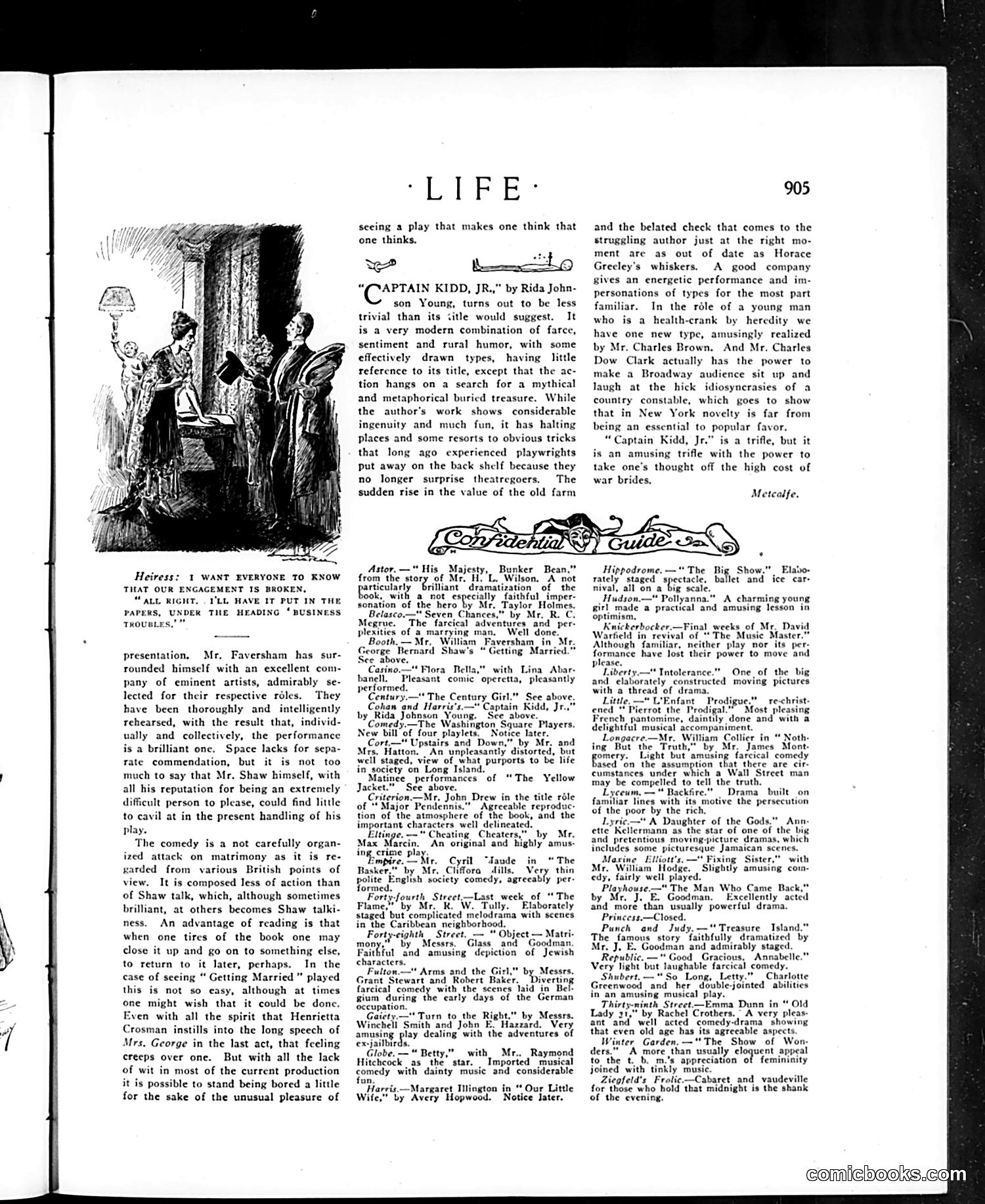
This page reviews contemporary Broadway productions from the early 20th century. The cartoon illustrates one review's central joke: **The Cartoon:** A wealthy heiress announces to a man (presumably her fiancé) that she wants their broken engagement publicized. He responds he'll place it in the newspaper under "Business Troubles"—implying an engagement to a woman is a *business problem*, not a romantic matter. **The Satire:** The joke mocks both high-society attitudes toward marriage as transactional rather than romantic, and the era's class-conscious newspaper categorization. By treating a broken engagement as "business trouble" rather than personal news, the cartoon satirizes how wealthy people viewed matrimony as a financial/social arrangement rather than an emotional commitment. **Context:** This aligns with the page's review of Shaw's play "Getting Married," which the critic notes is "a not carefully organized attack on matrimony as it is regarded from various British points of view"—suggesting contemporary anxiety about marriage's actual nature versus romantic ideals.
📄 Transcribed text from this page (OCR, searchable)
Machine-transcribed from the original scan — historical spelling and the odd misread are preserved.
Heiress: 1 WANT EVERYONE TO KNOW THAT OUR ENGAGEMENT IS BROKEN, “ALL RIGHT, I'LL HAVE IT PUT IN TH UNDER THE HEADING ‘BUSIN: TROUBLES.’ presentation, Mr, Faversham has sur- rounded himself with an excellent com- pany of eminent artists, admirably se- lected for their respective rdles. They have been thoroughly and intelligently rehearsed, with the result that, individ- ually and collectively, the performance is a brilliant one. Space lacks for sepa- rate commendation, but it is not too much to say that Mr. Shaw himself, with all his reputation for being an extremely difficult person to please, could find little to cavil at in the present handling of his play. The comedy is a not carefully organ- ized attack on matrimony as it is re- garded from various British points of view. It is composed less of action than of Shaw talk, which, although sometimes brilliant, at others becomes Shaw talki- An advantage of reading is that when one tires of the book one may close it up and go on to something else, to return to it later, perhaps. In the case of seeing “ Getting Married” played this is not so easy, although at times one might wish that it could be done. Even with all the spirit that Henrietta Crosman instills into the long speech of Mrs, George in the last act, that feeling creeps over one. But with all the lack of wit in most of the current production it is possible to stand being bored a little for the sake of the unusual pleasure of ness. “LIFE: seeing a play that makes one think that one thinks. “(APTAIN KIDD, JR,” by Rida John- son Young, turns out to be less trivial than its <itle would suggest. It is a very modern combination of farce, sentiment and rural humor, with some effectively drawn types, having little reference to its title, except that the ac- tion hangs on a search for a mythical and metaphorical buried treasure, While the author's work shows considerable ingenuity and much fun, it has halting places and some resorts to obvious tricks that long ago experienced playwrights put away on the back shelf because they no longer surprise theatregoers, The sudden rise in the value of the old farm Astor. —“ His Majesty, Bunker Bean,” from the story of Mr. H.'L. Wilson. A not particularly brilliant “dramatization "of | the Kk, with a not especially faithful imper- sonation of the hero by Me. Taylor, Holmes. Belasco.—" Seven. Chances,” by Mr. R. C. Megruc. The farcical adventures and per: plexities of a marrying man, Well done. Booth. — Mr. William Faversham in| Mr. George Bernard Shaw's “Getting Married.” Sce above, Casino." Flora Della," with Lina Abar- banell, Pleasant comic operetta, pleasantly performed. Century_—" The Century Girl.” Sce above. Cohan and Harris's.—" Captain Kidd, Jr, by Rida Johnson Young. See above. Comedy.—The Washington New bill of four playlets. Notice later. Cort.—" Upstairs and Down,” by Mr. and Mrs. Hatton. An unpleasantly distorted, but well staged, view of what purports to be life in society on Long Island. Matinee performances of “The Yellow Jacket.” See above. Criterion.—Mr, John Drew in the title réle of “Major Pendennis.” Agreeable reproduc- tion of the atmosphere of the book, and the important characters well delineated, Eltinge. —" Cheating Cheaters,” by Mr. Max Marcin. An original and highly amus: “faude in “The ing crime play: , ‘mpire.— Nir. Cyril asker.” by Mr. Cliffora ills. Very thin polite English society comedy, agreeably per- ormed. Forty-fourth Street-—Last week of The Flame,” by Mr, Ko W. Tully. Elaborately staged’ but complicated melodrama with scenes in the Caribbean neighborhood. : Forty-eighth | Street. — “ Object — Matri- pony by Messrs, Glass, and Goodman Faithful and amusing depiction of Jewish characters, Fulton.— Arms and the G Grant Stewart and Robert Ba farcical comed, ‘Square Players. by, Messrs, | Diverting with the scenes laid in Bel- gium during the early days of the German occupation. Gaicty.—* Turn to the Right.” by Messrs. Winchell Smith and John E. Hazzard. Very amusing play dealing with the adventures of ex-jailbirds, Globe. —“ Betty,” with Mr., Raymond Hitchcock as the’ star. _ Imported musical comedy with dainty music and considerable is.—Margaret Ilington in * Our Little by Avery Hopwood. Notice Jater. 905 and the belated check that comes to the struggling author just at the right mo- ment are as out of date as Horace Grecley’s whiskers. A good company gives an energetic performance and im- personations of types for the most part familiar. In the réle of a young man who is a health-crank by heredity we have one new type, amusingly realized by Mr. Charles Brown, And Mr. Charles Dow Clark actually has the power to make a Broadway audience sit up and laugh at the hick idiosyncrasies of a country constable, which goes to show that in New York novelty is far from being an essential to popular favor. aptain Kidd, Jr.” is a trifle, but it is an amusing trifle with the power to take one’s thought off the high cost of war brides. Metcalfe. Elabo- Hippodrome. —* The Big Show.” ice care rately staged spectacle, ballet and nival, all on a big scale. _Hudson.—" Pollyanna.” A charming youn| girl made a practical and amusing lesson in optimism, ‘nickerbocker.—Final weeks of Mr, David Warfield in revival of “* The Music Master.” Although familiar, neither play nor its per. formance have lost their power to move and please. Liberty.—" Intolerance.” | One of the big and elaborately constructed moving pictures with a thread of drama. Little. —" L'Enfant Prodigue." _ re-christ- ‘d Pierrot the Prodigal."” Most pleasing French pantomime, daintily done and with a delightful musical accompaniment. Longacre.—Mr. William Collier in “ Noth- ing But the Truth,” by. Mr. James Mont- omery. Light but ‘amusing farcical comedy Based ’on the assumption that there are cir cumstances under which a Wall Street. man may be compelled to tell the truth. Lyceum, —“ Backfire.” Drama built on familiar lines with its motive the persecution of the poor by the rich, Lyric.—" A Daughter of the Gods." A. ette Keilermann as the star of one of the big and pretentious moving-picture dramas, which includes some picturesque Jamaican scenes. Marine Elliott's, —" Fixing Sister,” with Mr. William Hodge. | Slightly amusing coim- edy, fairly well played. Playhouse.—" The Man Who Came Back, by Mr. J. E. Goodman. Excellently acted and more than usually powerful drama. Princess.—Closed. Punch and Judy. —‘ Treasure Island.” The famous story faithfully dramatized by Mr. J, E. Goodman and admirably staged Republic. —" Good Gracious, Annabelle.” Very light but laughable farcical comedy. Shubert. —“ So Long, Letty.” | Ch: Greenwood and her double-jointed abili in an amusing musical play. Thirty-ninth Street.—Emma Dunn in “ Old Lady 21,” by Rachel Crothers. A very pleas ant and well acted comedy-drama showing that even old age has its agreeable aspects. Winter Garden. —"'The Show of Won. ders.” A more than usually eloquent appeal to the t. b. m.'s appreciation of femininity joined with tinkly music Ziegfeld’s. Frotie.—Cabaret_ and vaudeville for those who hold that midnight is the shank of the evening. comichooks.