
Life, 1916-11-23 · page 35 of 40
Life — November 23, 1916 — page 35: what you’re looking at
What you’re looking at
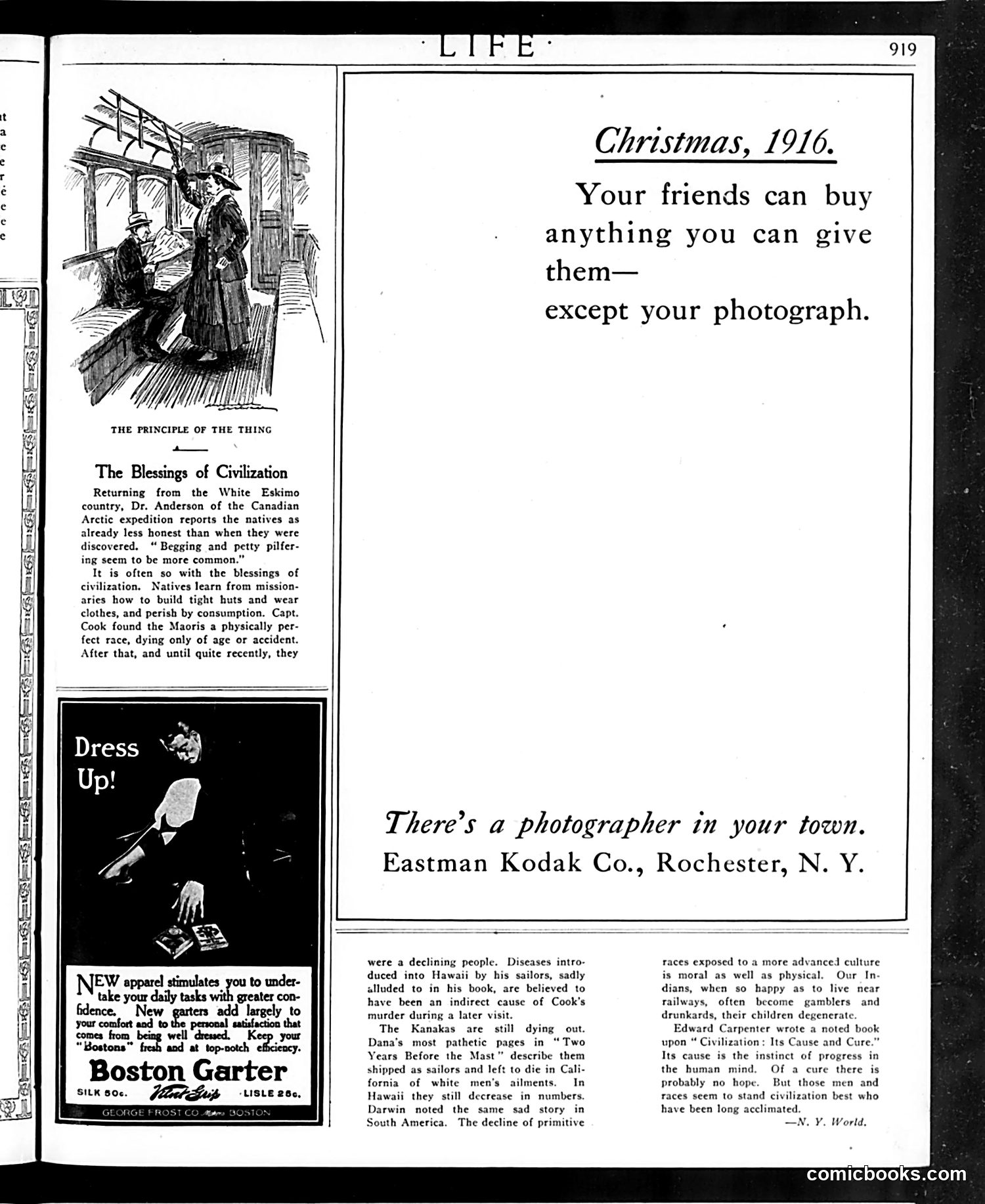
This page presents a satirical critique of colonialism and Western "civilization's" destructive impact on indigenous peoples. **The Cartoon's Argument:** The left column sarcastically catalogs how contact with Western civilization harms native populations. It cites Dr. Anderson's report that Canadian Eskimos became less honest after contact, and references historical examples: Captain Cook's sailors introduced diseases to Hawaii (allegedly contributing to Cook's murder); Maori populations declined after British contact; Hawaiian numbers continue falling; Pacific islanders died under Western labor conditions. **The Satire:** The piece ironically titles this litany "The Blessings of Civilization"—meaning the opposite. It argues that while missionaries teach natives to build houses and wear clothes, these "advances" bring consumption, disease, alcoholism, and moral decay rather than progress. **The Right-Side Advertisement:** Unrelated Kodak and Boston Garter ads occupy the page's other half, creating an ironic juxtaposition between the editorial's serious anti-colonial critique and commercial consumer culture promoting Western goods.
📄 Transcribed text from this page (OCR, searchable)
Machine-transcribed from the original scan — historical spelling and the odd misread are preserved.
| | f= as | AOE ae a= Ai Pers jSanevaoheatasten re Snes re 16 THE PRINCIPLE OF THE THING Je The Blessings of Civilization Returning from the White Eskimo country, Dr. Anderson of the Canadian Arctic expedition reports the natives as already less honest than when they were discovered. “Begging and petty pilfer- ing seem to be more common.” It is often so with the blessings of civilization, Natives learn from mission- aries how to build tight huts and wear clothes, and perish by consumption. Capt. Cook found the Maoris a physically per- fect race, dying only of age or accident. After that, and until quite recently, they Boston Garter Sik soc. SeSaifp “UISLE Bo, Christmas, 1916. Your friends can buy anything you can give them— except your photograph. There’s a photographer in your town. Eastman Kodak Co., Rochester, N. Y. were a declining people. Diseases intro- duced into Hawaii by his sailors, sadly alluded to in his book, are believed to have been an indirect cause of Cook's murder during a later visit. The Kanakas are still dying out. Dana’s most pathetic pages in “Two Years Before the Mast" describe them shipped as sailors and left to die in Cali- fornia of white men’s ailments. In Hawaii they still decrease in numbers. Darwin noted the same sad story in South America. The decline of primitive races exposed to a more advanced culture is moral as well as physical. Our In- dians, when so happy as to live near railways, often become gamblers and drunkards, their children degenerate. Edward Carpenter wrote a noted book upon “ Civilization: Its Cause and Cure.” Its cause is the instinct of progress in the human mind. Of a cure there is probably no hope. But those men and races seem to stand civilization best who have been long acclimated. —N. Y. World, comicbooks.com