
Life, 1916-11-23 · page 24 of 40
Life — November 23, 1916 — page 24: what you’re looking at
What you’re looking at
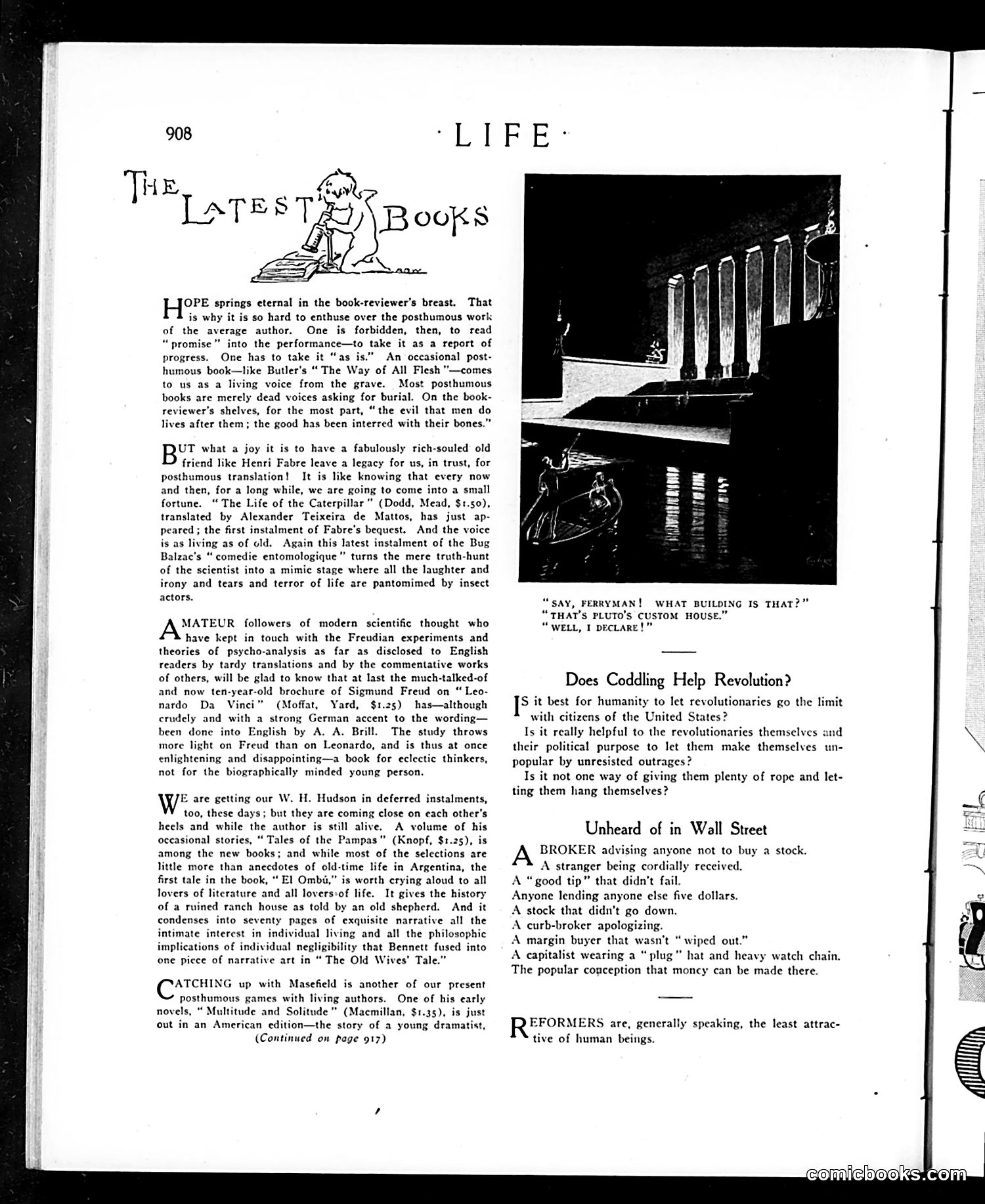
This page is primarily a **book review section** titled "The Latest Books," with a small cartoon inset. The **cartoon** (captioned "Say, ferryman! What building is that?" / "That's Pluto's custom house") uses classical mythology: Charon ferries a soul across the River Styx, pointing to a building in the underworld. "Pluto's custom house" is a pun—conflating Pluto (god of the underworld) with U.S. customs bureaucracy. The joke satirizes **excessive government regulation and red tape**, suggesting even the afterlife requires navigating bureaucratic procedures. The main text reviews recent books by Henri Fabre, Sigmund Freud, W.H. Hudson, and John Masefield—praising Fabre's entomological writings and criticizing Freud's Leonardo Da Vinci study as obscure. Below the reviews, a section titled "Does Coddling Help Revolution?" sarcastically questions whether lenient treatment of revolutionaries actually serves their cause—implying 1910s-era anxieties about radical movements and civil unrest.
📄 Transcribed text from this page (OCR, searchable)
Machine-transcribed from the original scan — historical spelling and the odd misread are preserved.
OPE springs eternal in the book-reviewer'’s breast. That is why it is so hard to enthuse over the posthumous work of the average author. One is forbidden, then, to read “promise” into the performance—to take it as a report of progress. One has to take it “as is.” An occasional post- humous book—like Butler's “The Way of All Flesh "—comes to us as a living voice from the grave. Most posthumous books are merely dead voices asking for burial. On the book- reviewer's shelves, for the most part, “the evil that men do lives after them; the good has been interred with their bones.” UT what a joy it is to have a fabulously rich-souled old iend like Henri Fabre leave a legacy for us, in trust, for posthumous translation! It is like knowing that every now and then, for a long while, we are going to come into a small fortune. “ The Life of the Caterpillar” (Dodd, Mead, $1.50), translated by Alexander Teixeira de Mattos, has just ap- peared ; the first instalment of Fabre’s bequest. And the voice is as living as of old. Again this latest instalment of the Bug Balzac’s “ comedie entomologique " turns the mere truth-hunt of the scientist into a mimic stage where all the laughter and irony and tears and terror of life are pantomimed by insect actors. MATEUR followers of modern scientific thought who have kept in touch with the Freudian experiments and theories of psycho-analysis as far as disclosed to English readers by tardy translations and by the commentative works of others, will be glad to know that at last the much-talked-of and now ten-year-old brochure of Sigmund Freud on “ Leo- nardo Da Vinci” (Moffat, Yard, $1.25) has—although crudely and with a strong German accent to the wording— been done into English by A. A. Brill. The study throws more light on Freud than on Leonardo, and is thus at once enlightening and disappointing—a book for eclectic thinkers, not for the biographically minded young person. W = are getting our W. H. Hudson in deferred instalments, too, these days; but they are coming close on each other's A volume of his occasional stories, “ Tales of the Pampas" (Knopf, $1.25), is among the new books; and while most of the selections are little more than anecdotes of old-time life in Argentina, the heels and while the author is still alive. first tale in the book, “ El Omba,” is worth crying aloud to all lovers of literature and all lovers:of life. It gives the history of a ruined ranch house as told by an old shepherd. And it condenses into seventy pages of exquisite narrative all the intimate interest in individual living and all the philosophic implications of individual negligibility that Bennett fused into one piece of narrative art in “ The Old Wives’ Tale.” ATCHING up with Masefield is another of our present posthumous games with living authors. One of his early novels, “ Multitude and Solitude” (Macmillan, $1.35), is just out in an American edition—the story of a young dramatist, (Continued on page 917) “SAY, FERRYMAN! WHAT BUILDING IS THAT?” “THAT'S PLUTO'S CUSTOM HOUSE.” “ WELL, I DECLARE!” Does Coddling Help Revolution? Is it best for humanity to let revolutionaries go the limit with citizens of the United States? Is it really helpful to the revolutionaries themselves and their political purpose to let them make themselves un- popular by unresisted outrages? Is it not one way of giving them plenty of rope and let- ting them hang themselves? Unheard of in Wall Street BROKER advising anyone not to buy a stock. A stranger being cordially received. A “good tip” that didn’t fail, Anyone lending anyone else five dollars. A stock that didn’t go down. A curb-broker apologizing. A margin buyer that wasn't “wiped out.” A capitalist wearing a “plug” hat and heavy watch chain. The popular conception that moncy can be made there. EFORMERS are, generally speaking, the least attrac- tive of human beings.