
A complete issue · 46 pages · 1916
Life — November 2, 1916
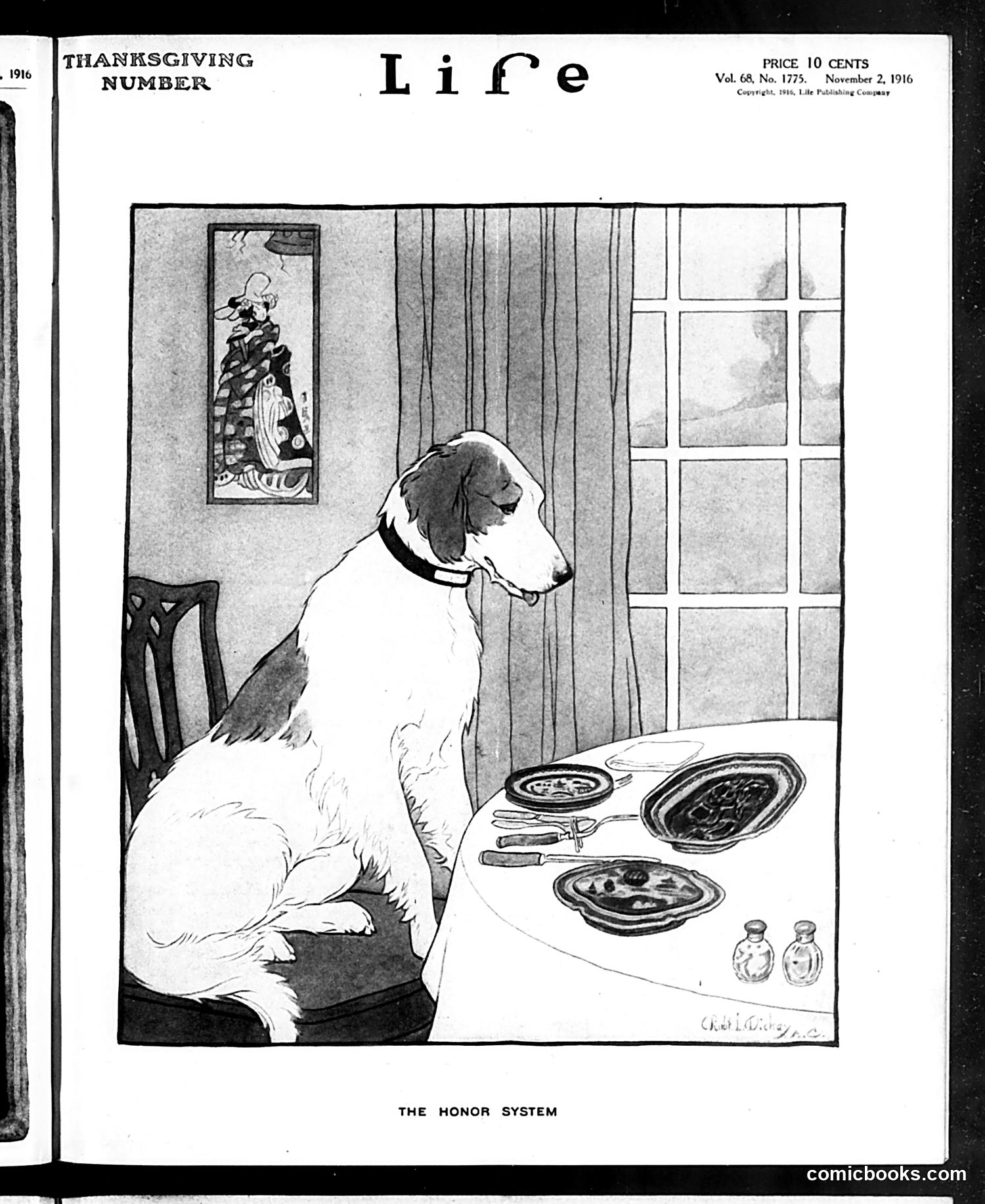
This Thanksgiving-themed cartoon satirizes the "honor system"—a practice where institutions trust individuals to behave ethically without supervision. The dog sitting at a dining table laden with Thanksgiving foods (turkey, side dishes, condiments) represents this principle being tested. The joke is darkly humorous: the dog faces a table of tempting food with no one watching, embodying the test of honor. The implication is cynical—that trusting someone (or in this case, an animal with basic instincts) to resist temptation when unsupervised is foolish. By 1916, American colleges and schools were debating honor systems as alternatives to proctored exams. This cartoon suggests such systems fail because self-restraint without oversight is unrealistic, whether applied to students or, humorously, dogs.
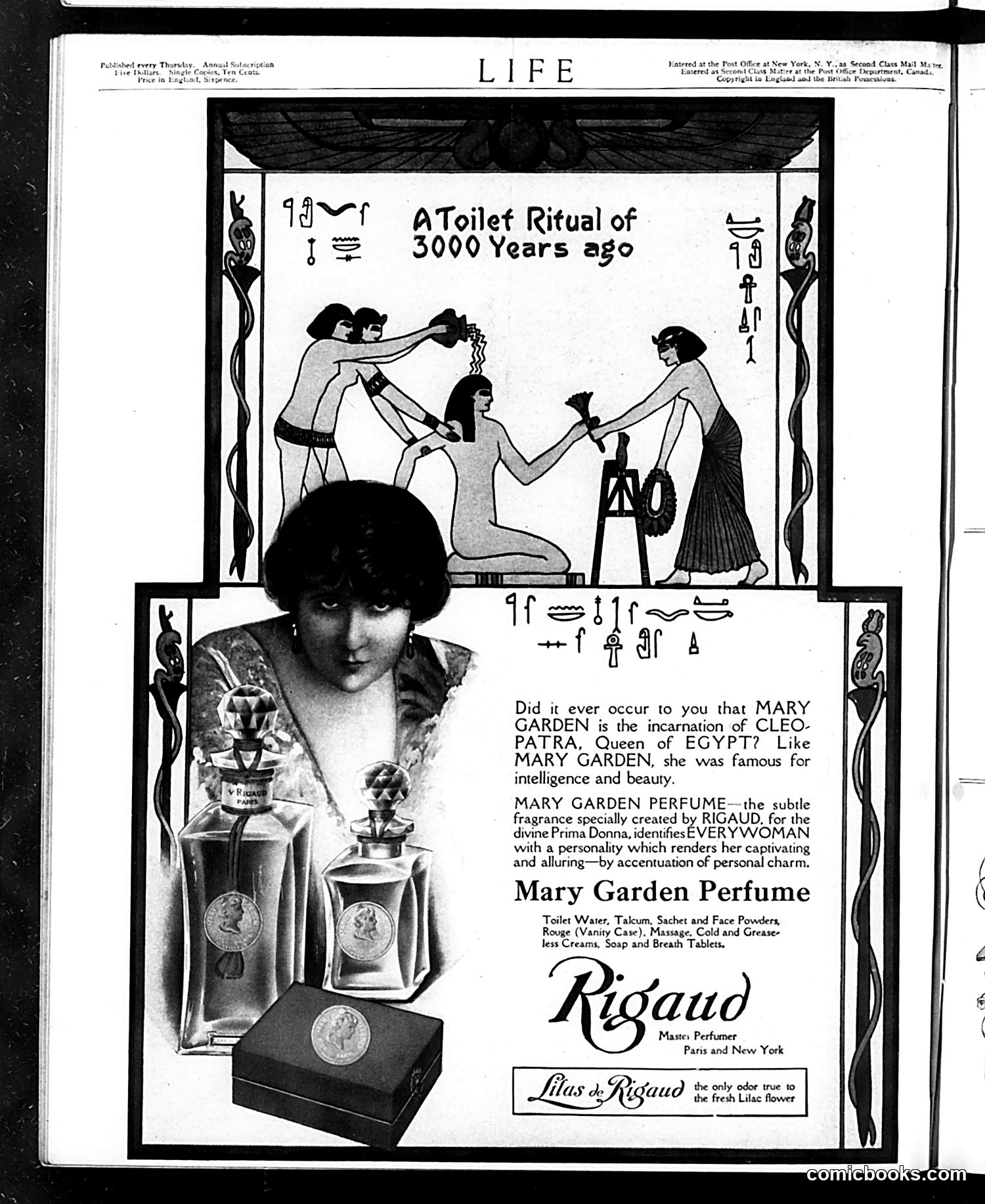
This page is primarily **a perfume advertisement**, not political satire. The top illustration titled "A Toilet Ritual of 3000 Years ago" depicts ancient Egyptian beauty practices in a humorous, stylized manner—showing figures applying cosmetics and using grooming tools with Egyptian hieroglyphics framing the scene. The advertisement below compares this ancient ritual to modern beauty standards by claiming Mary Garden (an actress/public figure) embodies the intelligence and beauty of **Cleopatra**. The ad suggests that using "Mary Garden Perfume" by Rigaud allows contemporary women to achieve similar allure. The satire is gentle: it humorously links vanity across millennia, implying that feminine beauty rituals are timeless. However, this is fundamentally a commercial pitch rather than political commentary.
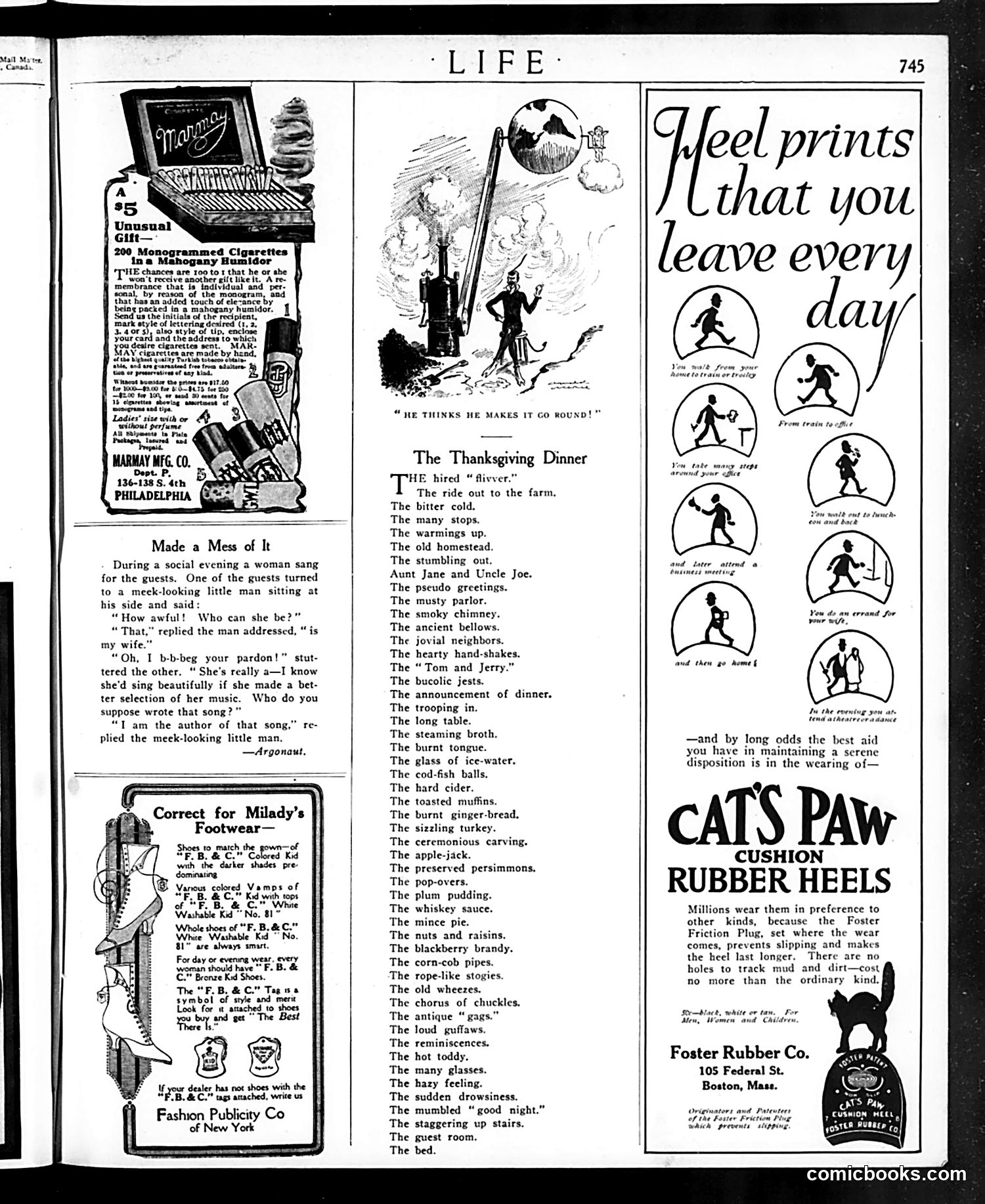
This page is primarily **advertising and humor content** rather than political satire. The main cartoon, "He Thinks He Makes It Go Round!" depicts a man cranking a device while others celebrate—likely satirizing someone's inflated sense of importance or control over events beyond their actual influence. The specific reference is unclear without additional context. **The Thanksgiving Dinner poem** is a humorous catalog of Thanksgiving elements, from the bird to the after-dinner chaos (drunkenness, staggering upstairs). It's gentle domestic satire about American holiday traditions. The remaining content consists of **product advertisements**: Marmay gift sets, F.B. & C. footwear, and Cat's Paw rubber heels. These represent typical early 20th-century magazine advertising, with the heels ad emphasizing durability and practicality for women.
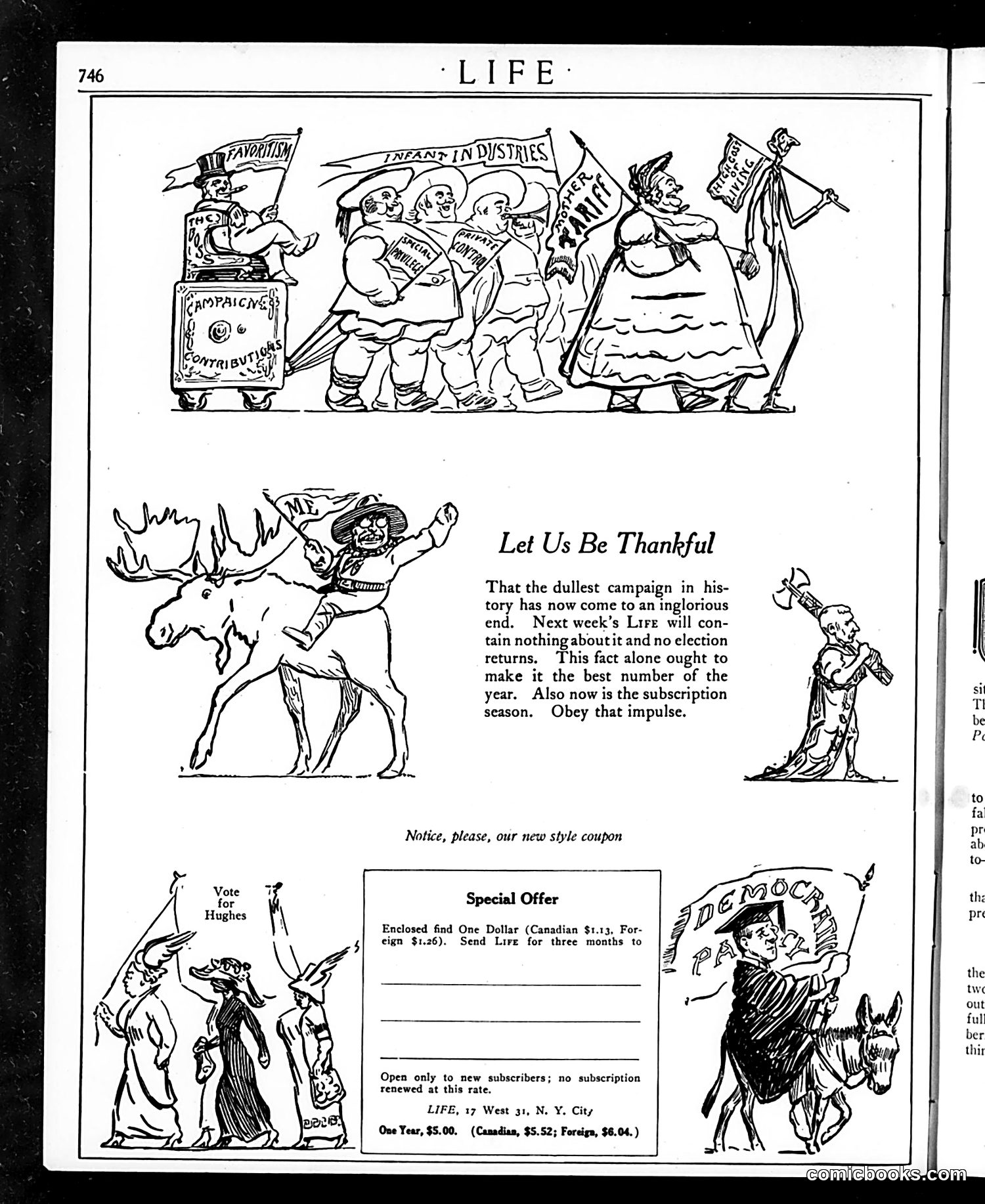
This Life magazine page satirizes the 1912 U.S. presidential campaign, which appears to be ending. The top cartoon depicts "Infant Industries" being pulled along by various interest groups wielding signs labeled "Tariff" and other protectionist demands—a critique of how political factions manipulated economic policy. The editorial "Let Us Be Thankful" celebrates that the "dullest campaign in history has come to an inglorious end," with relief that next week brings no election coverage. Political cartoons reference "Vote for Hughes" (likely Charles Evans Hughes, the Republican candidate), while another shows "Democracy" riding a donkey—common symbols for the Democratic Party. The page concludes with a subscription offer ($1 for three months), typical of period magazine advertising.
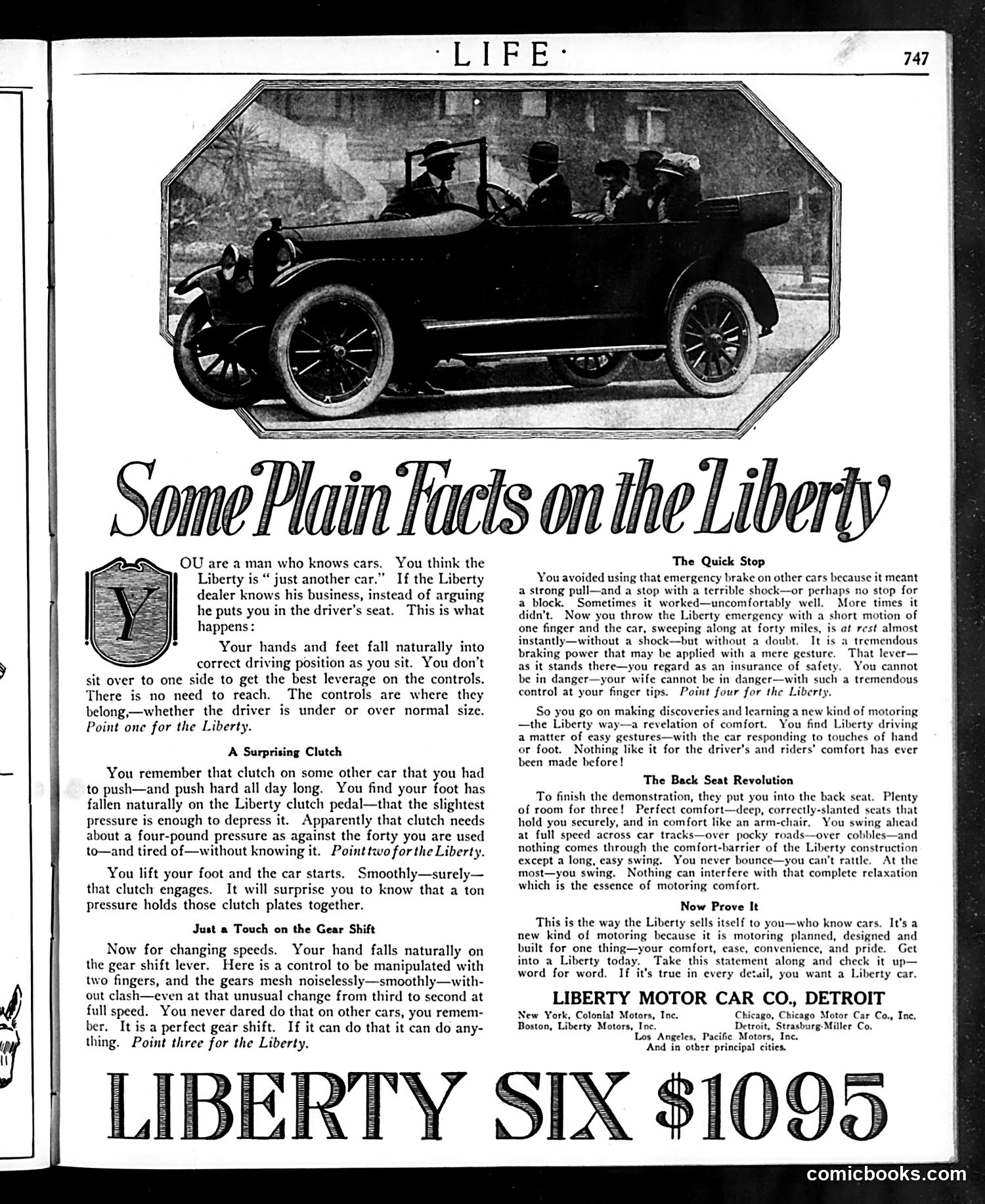
This page is primarily **advertising, not satire or political commentary**. It's a Liberty Motor Car Company advertisement for the Liberty Six automobile, priced at $1095. The image shows a touring car filled with well-dressed passengers. The text below uses a rhetorical device—addressing the reader as "a man who knows cars"—to highlight the Liberty's features: responsive clutch control, smooth gear shifting, and responsive braking. The repeated phrase "Point one/three for the Liberty" emphasizes competitive advantages. The final section, "Now Prove It," encourages readers to test-drive the vehicle themselves. There is no political satire or social commentary present. This is straightforward early-20th-century automotive marketing designed to appeal to knowledgeable car buyers through technical demonstration of the vehicle's handling characteristics.
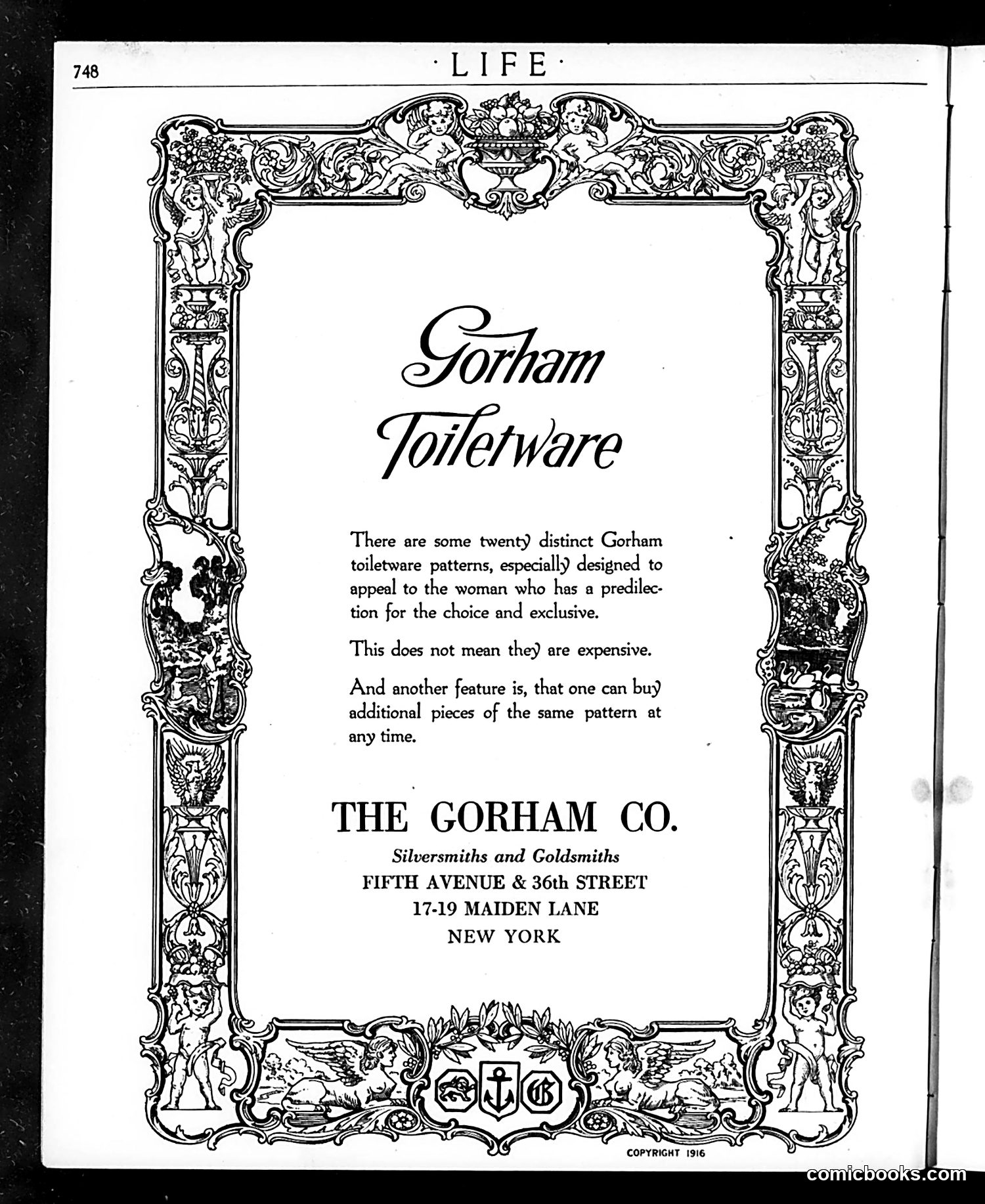
This page is **not a cartoon or satirical content**—it's a straightforward advertisement for The Gorham Company, a silversmith and goldsmith business located in New York. The ornate decorative border frames a product advertisement for Gorham Toiletware, highlighting that the company offers twenty distinct patterns designed for consumers with refined taste. The ad emphasizes affordability and the ability to purchase matching pieces later. The page appears in Life magazine (copyright 1916), but contains no political satire, caricature, or social commentary. It's simply a period luxury goods advertisement using elaborate Victorian-style ornamentation to convey elegance and exclusivity to Life's affluent readership.
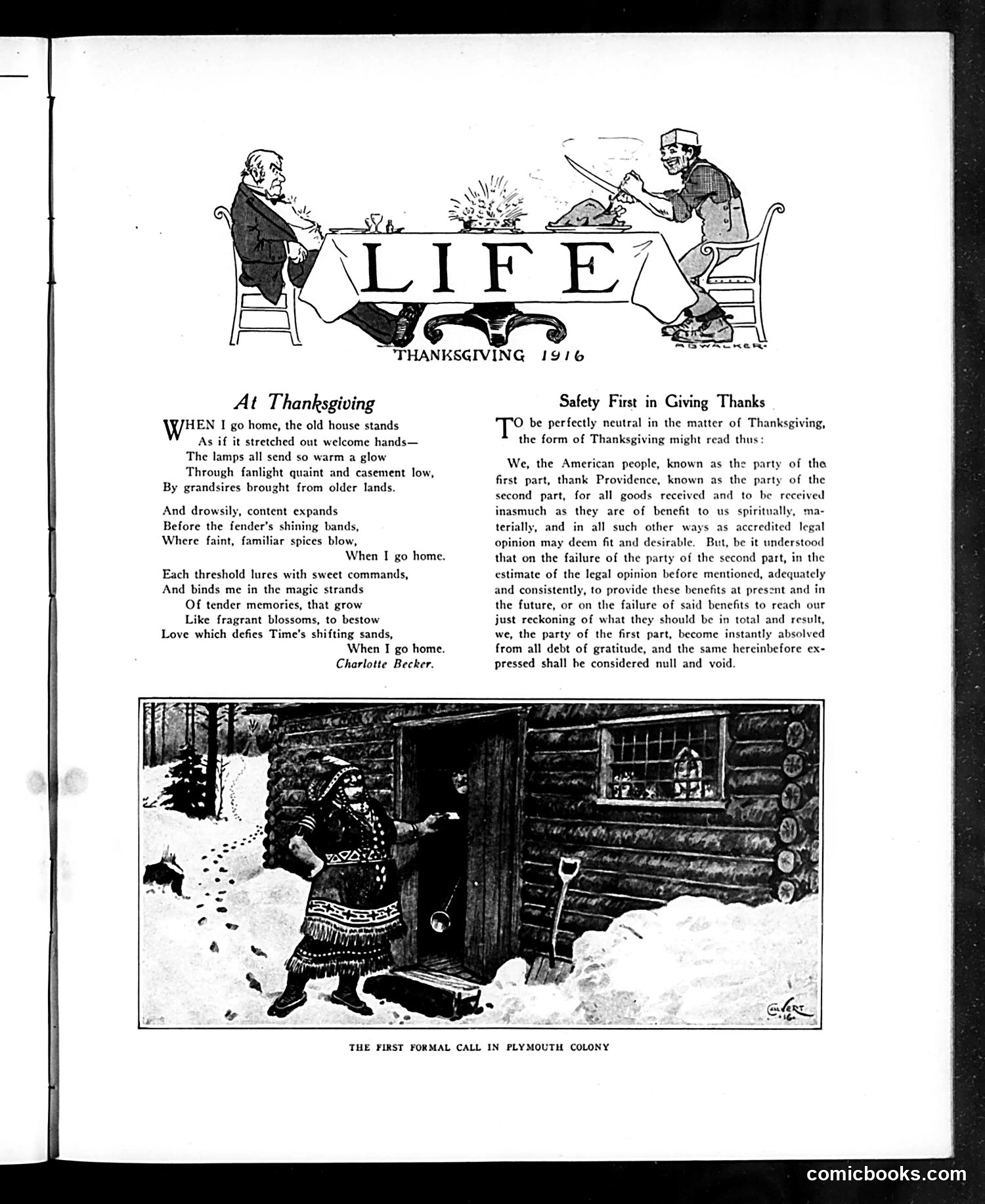
This page contains a Thanksgiving 1916 editorial feature. The top illustration shows two diners at a table labeled "LIFE," apparently arguing over the meal—likely satirizing contemporary political disagreement. The main article, "Safety First in Giving Thanks," discusses how Americans should express gratitude to Providence while remaining "perfectly neutral" about distributing benefits. The text addresses tensions between acknowledging divine providence versus material goods, suggesting debates about wealth distribution and charitable obligation. The poem "At Thanksgiving" by Charlotte Becker emphasizes nostalgic home values and family connections. The bottom illustration, "The First Formal Call in Plymouth Colony," appears to be historical satire, showing colonists in period dress interacting at a log cabin, likely commenting on mythologized American origins or Puritan history through comedic exaggeration.
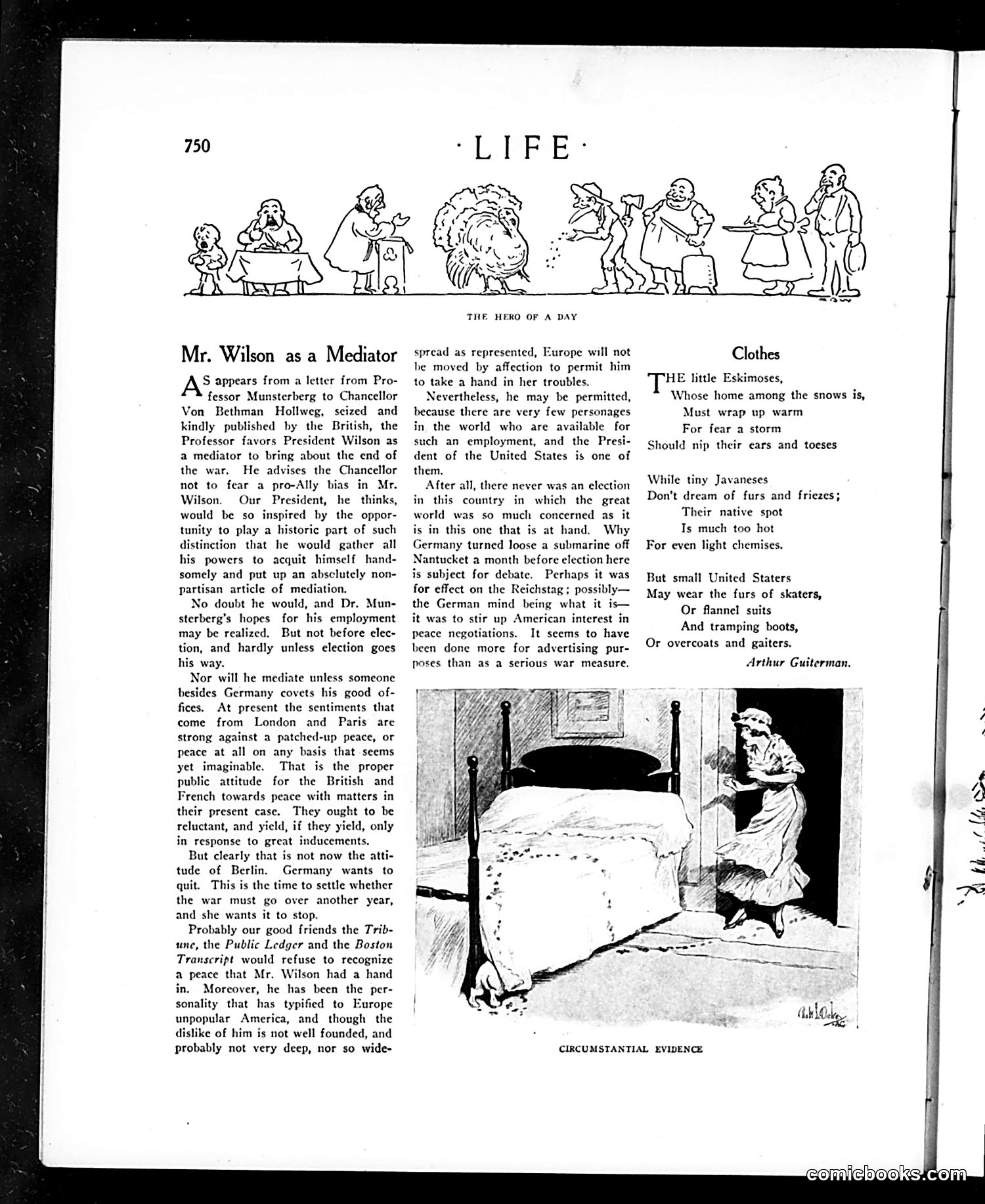
This page contains two distinct pieces: **Left column:** An article titled "Mr. Wilson as a Mediator" discusses President Wilson's potential role in peace negotiations to end World War I. The text debates whether Wilson could effectively mediate between Britain, France, and Germany, questioning his popularity in Europe and whether Germany would accept his involvement. **Right side:** A humorous poem titled "Clothes" by Arthur Guiterman describes how different groups (Eskimos, Javanese, and Americans) dress appropriately for their climates. **Bottom cartoon:** "Circumstantial Evidence" shows a woman discovering a muddy footprint on a bed, with a guilty-looking figure visible. This is a domestic humor cartoon playing on the implication of infidelity or impropriety—the "circumstantial evidence" being the unexplained dirt on the bedding.
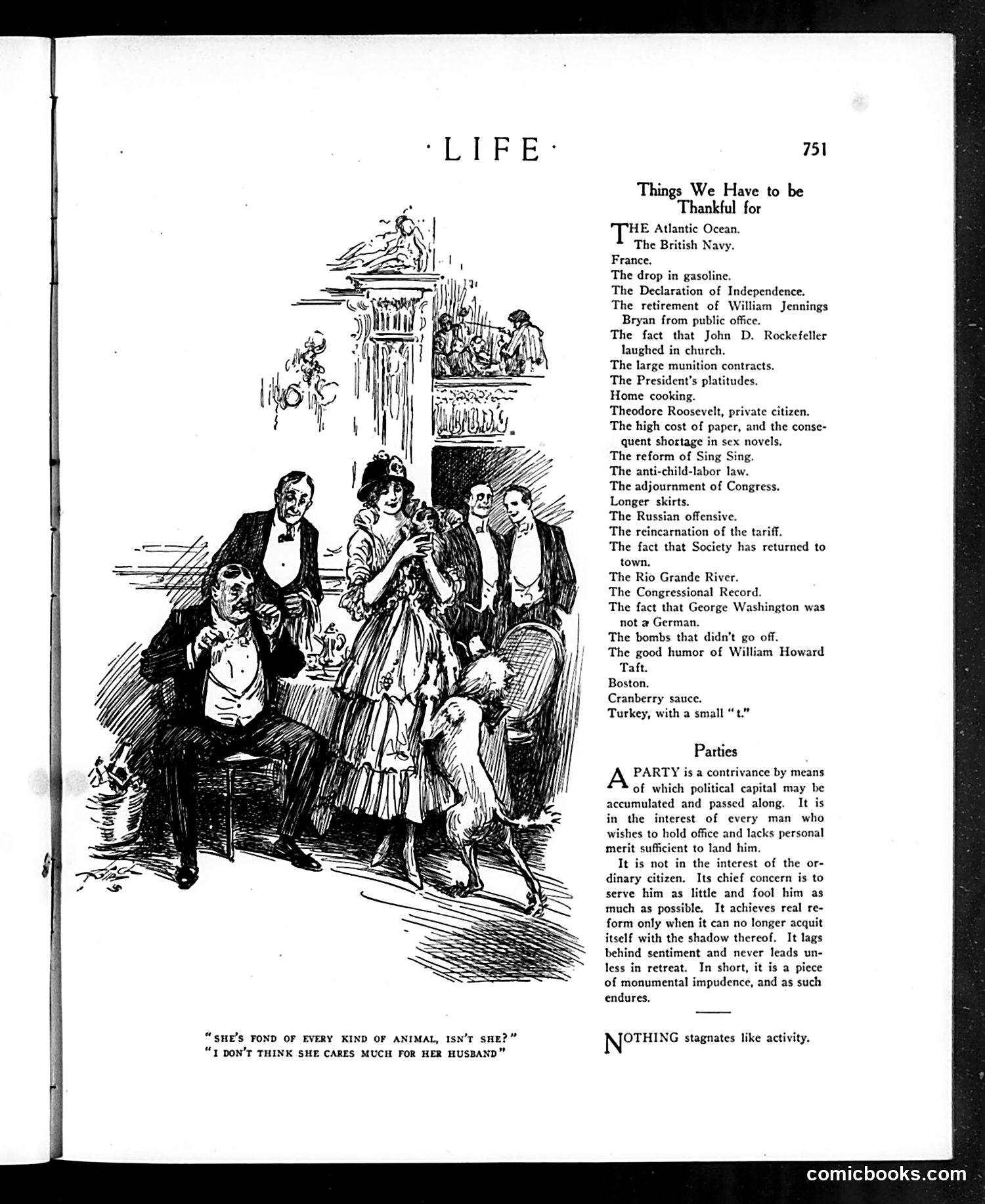
This Life magazine page satirizes early 20th-century American society. The main illustration depicts a fashionable woman surrounded by admiring men and a small dog at what appears to be a social gathering, with the caption: "She's fond of every kind of animal, isn't she? / I don't think she cares much for her husband." The joke mocks marriages where wives show more affection to pets and social companions than to their husbands—critiquing both aristocratic social pretense and marital disconnection. The accompanying article "Parties" defines political parties as mechanisms for accumulating power, describing them cynically as impudent and stagnant institutions that fool ordinary citizens while serving politicians' interests rather than reform. Together, these mock both high society superficiality and political hypocrisy.
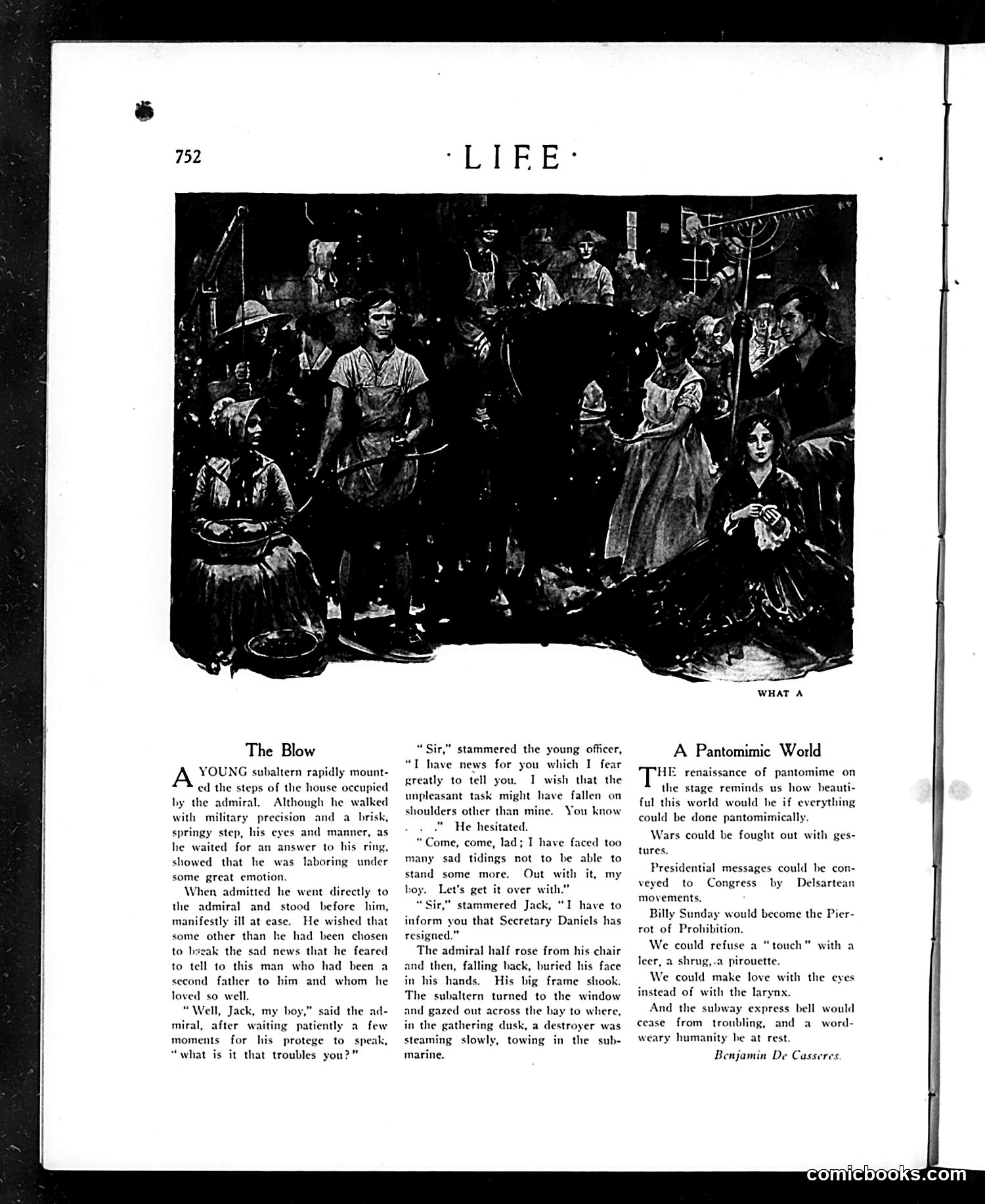
This page contains a narrative illustration titled "The Blow" depicting a military scene. A young subaltern (junior officer) delivers unwelcome news to an admiral—likely regarding a naval loss or tactical failure. The admiral's distressed reaction suggests the news concerns a significant wartime setback, possibly a ship or personnel loss. The right column, "A Pantomimic World" by Benjamin De Casseres, appears unrelated to the illustration—it's a philosophical essay about pantomime's potential as artistic medium, discussing how silent gestures could convey political messages or social commentary. The illustration's dramatic staging and the admiral's visible anguish suggest this depicts a real or plausible WWI-era naval incident, though specific context isn't identified.
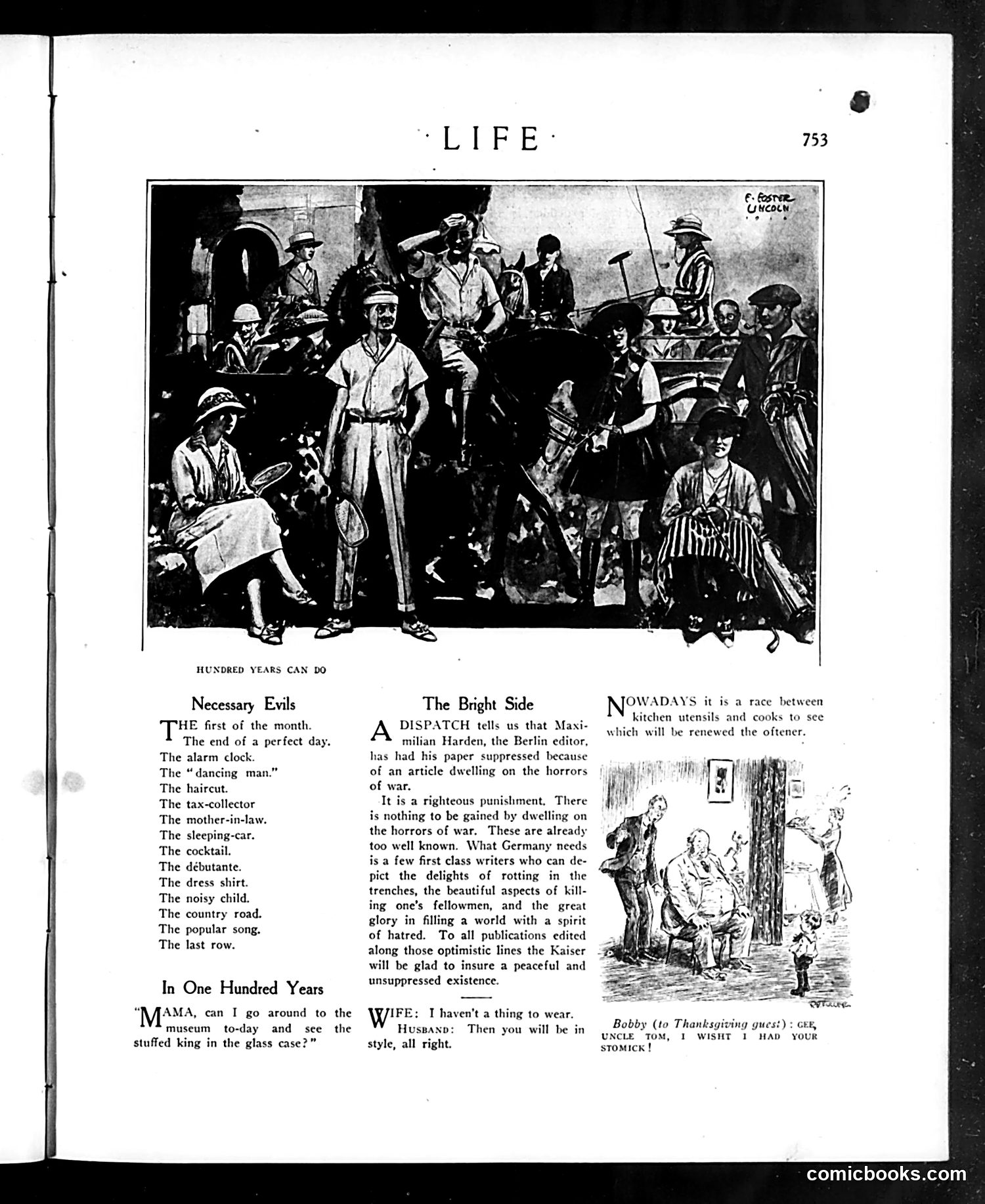
This page contains three satirical pieces from Life magazine (a date is not visible): **"Hundred Years Can Do"** lists "necessary evils" of modern life—alarm clocks, tax collectors, noisy children—suggesting society accepts annoyances as inevitable. **"The Bright Side"** discusses Maximilian Harden, a Berlin editor whose newspaper was suppressed. The piece sarcastically suggests Germany should hire optimistic writers to glorify war's "delights" rather than dwell on its horrors, praising the Kaiser's likely approval of such propaganda. **"In One Hundred Years"** is a domestic joke where a wife claims she'll have nothing to wear, then husband reassures her she'll be fashionable—a timeless marital exchange. The top illustration depicts what appears to be a carnival or fair scene with diverse crowds and period costumes, though its specific reference remains unclear from the visible text.
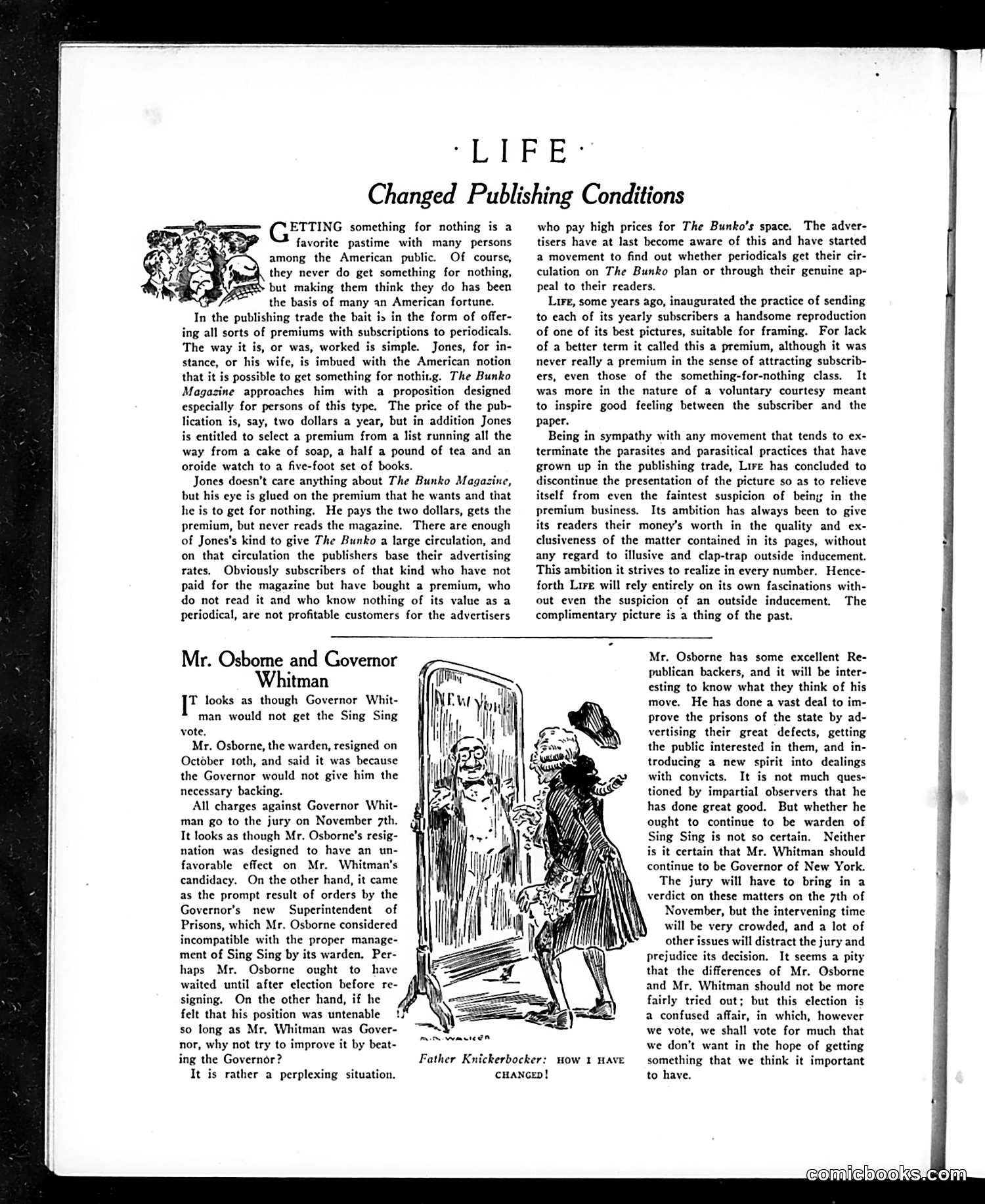
The cartoon depicts Father Knickerbocker (a personification of New York City, shown as an elderly Dutch figure) looking into a mirror at his transformed reflection. The accompanying article discusses Governor Whitman and Mr. Osborne's conflict over prison reform and the upcoming election. The satire suggests New York itself has undergone dramatic change—likely referring to political upheaval or shifts in governance. The mirror gag implies the city barely recognizes itself. Given the text's focus on Osborne's prison reforms and Whitman's political position, the cartoon critiques how political maneuvering and internal conflicts have fundamentally altered New York's character and governance, leaving even the city's symbolic representation stunned by the transformation.
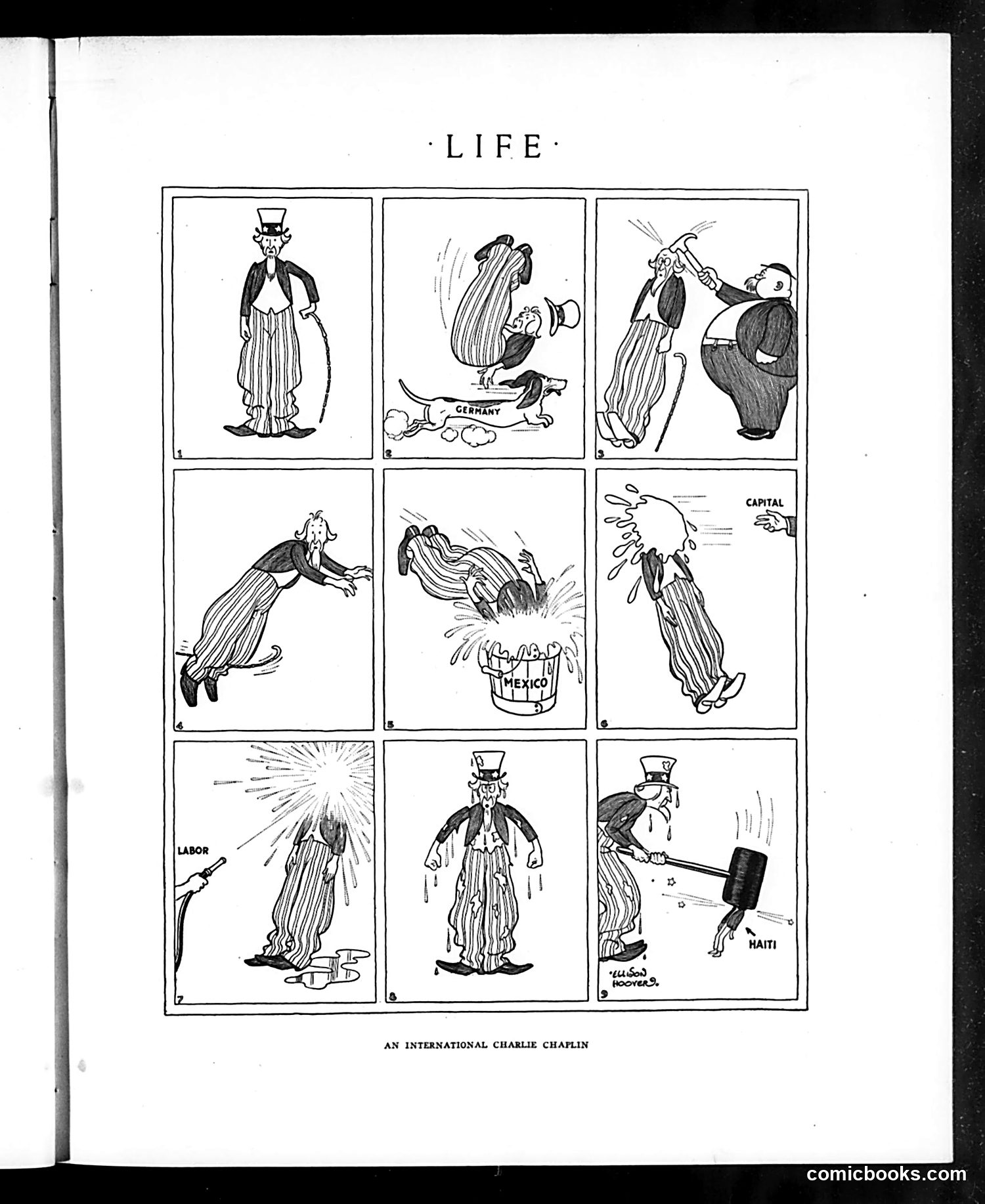
This nine-panel satirical comic titled "LIFE" depicts Lady Liberty (recognizable by her striped dress and crown) experiencing successive crises. The sequence shows her: 1. Standing peacefully at start 2. Being attacked over "Germany" 3. Fighting back against an aggressor 4. Collapsing from exhaustion 5. Caught in explosions over "Mexico" 6. Struck by "Capital" 7. Hit by "Labor" unrest 8. Weary and bloodied 9. Being beaten down by "Haiti" This appears to be anti-interventionist satire, suggesting America's Lady Liberty is being destroyed by foreign entanglements (Germany, Mexico, Haiti) combined with domestic turmoil (Capital vs. Labor conflicts). The cartoon critiques U.S. involvement in multiple conflicts simultaneously, showing Liberty as a victim of overextension rather than protector.
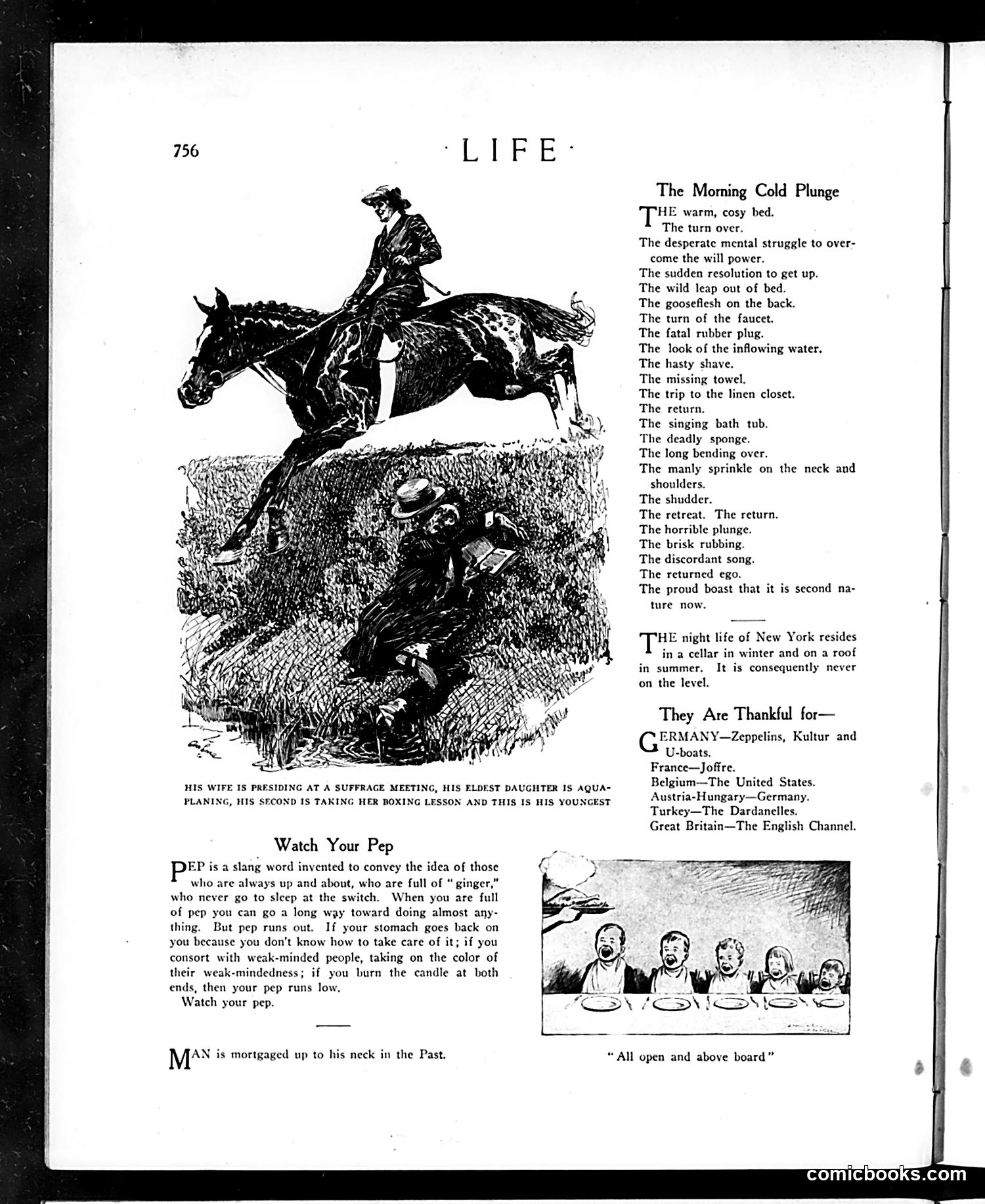
This page from *Life* magazine contains two satirical pieces: **"The Morning Cold Plunge"** is a humorous poem-illustration showing a man on horseback overlooking someone struggling in cold water. The list catalogs the miseries of morning routines—cold beds, difficult wake-ups, shaving, bathing—presented as a relatable complaint about daily discomfort. **"Watch Your Pep"** is a brief social commentary warning against losing energy and vitality. "Pep" was period slang for vigor. The text warns against laziness, weak associations, and self-indulgence, suggesting that maintaining one's drive requires discipline and careful habits. The bottom cartoon labeled "All open and above board" appears to show people at a dining table, likely satirizing some social or political hypocrisy about transparency. The page ends with "Man is mortgaged up to his neck in the Past"—a philosophical observation about how history constrains present life.
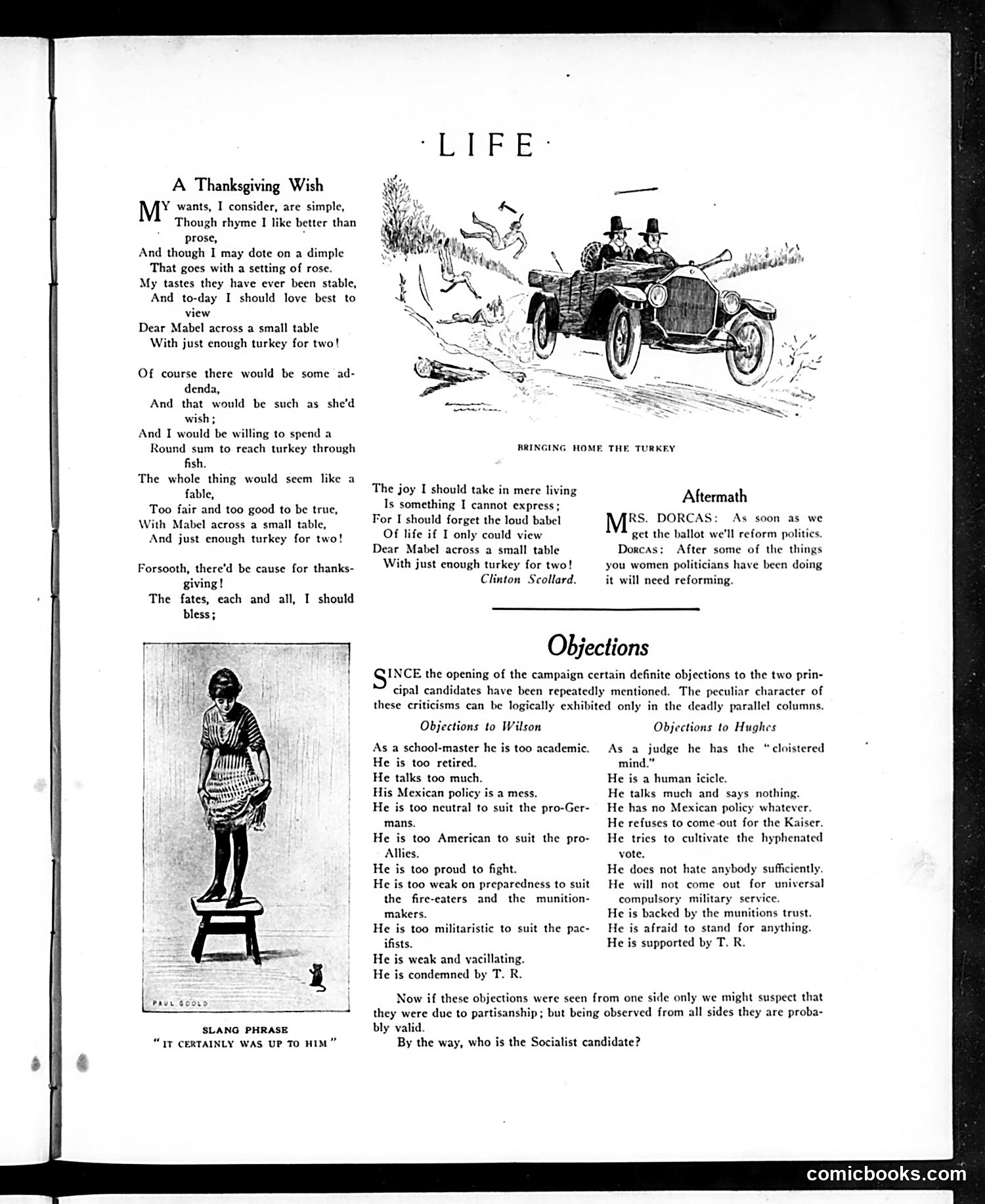
This page satirizes the 1916 U.S. presidential election, comparing candidates Wilson and Hughes. The "Objections" section lists contradictory criticisms leveled at each candidate from different political sides—Wilson attacked as both too academic and too American, Hughes as both indecisive and militaristic. The satire's point: both candidates face identical complaints from opposing factions, suggesting the criticisms reflect partisan bias rather than legitimate flaws. The upper poem "A Thanksgiving Wish" humorously expresses modest holiday desires (just turkey for two with a loved one), and the "Aftermath" dialogue mocks female politicians entering politics post-suffrage, suggesting their reform efforts will face resistance. The "Slang Phrase" cartoon depicts Lady Justice on a pedestal, captioned "It certainly was up to him"—likely referencing responsibility in the election.
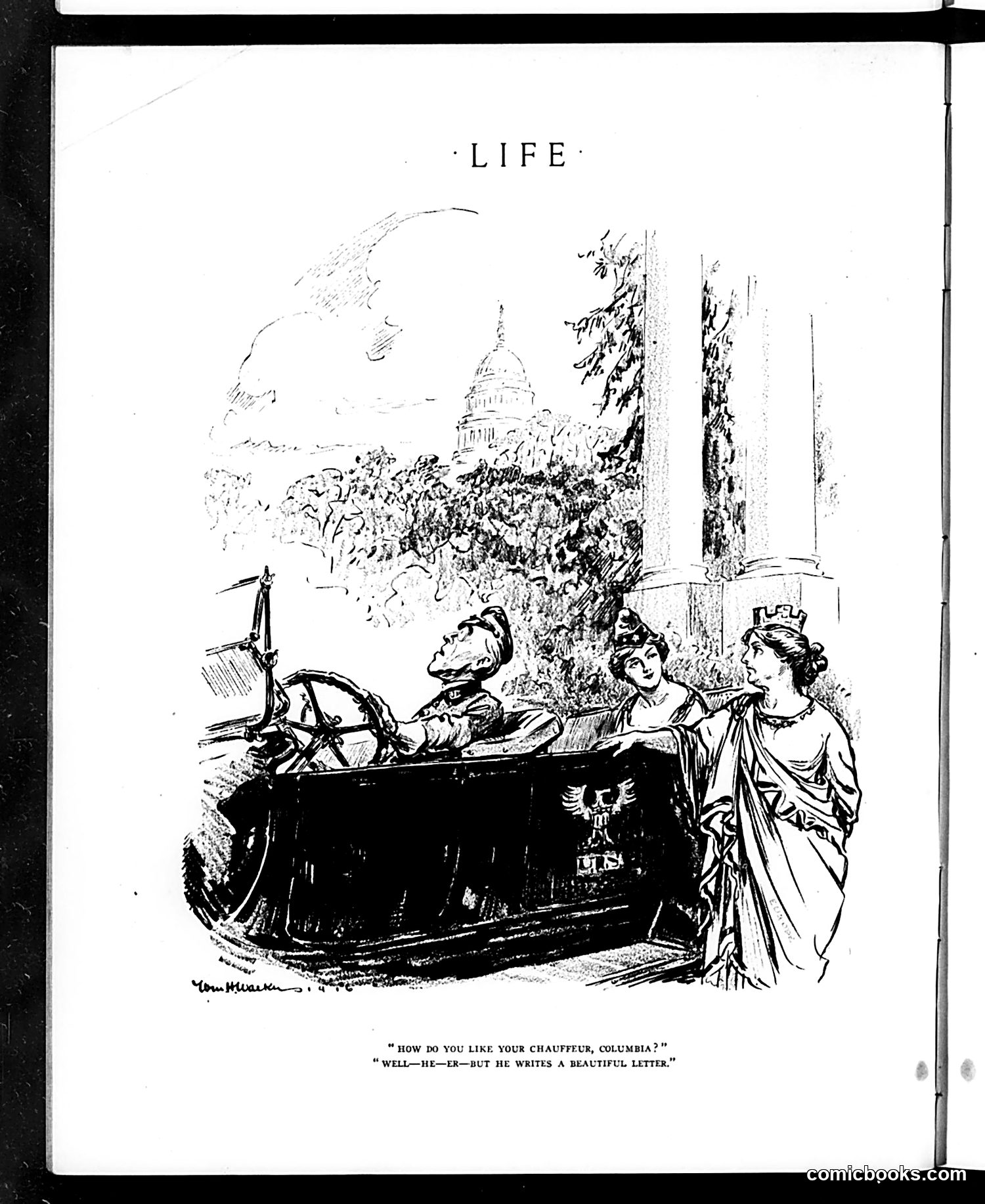
This is a satirical cartoon from Life magazine's "LIFE" section. The figure labeled "Columbia" (a female personification of America) is being asked about her chauffeur by an unseen questioner. She responds that while she has reservations about him ("Well—he—er—"), she appreciates that "he writes a beautiful letter." The joke appears to criticize a political figure serving as America's "driver" or leader—someone inadequate at the job itself but praised for eloquent communication or correspondence. Without dating information visible, the specific target is unclear, but the satire suggests a leader whose rhetoric or writing ability masks incompetence in actual governance. The Capitol building in the background confirms the political subject matter.
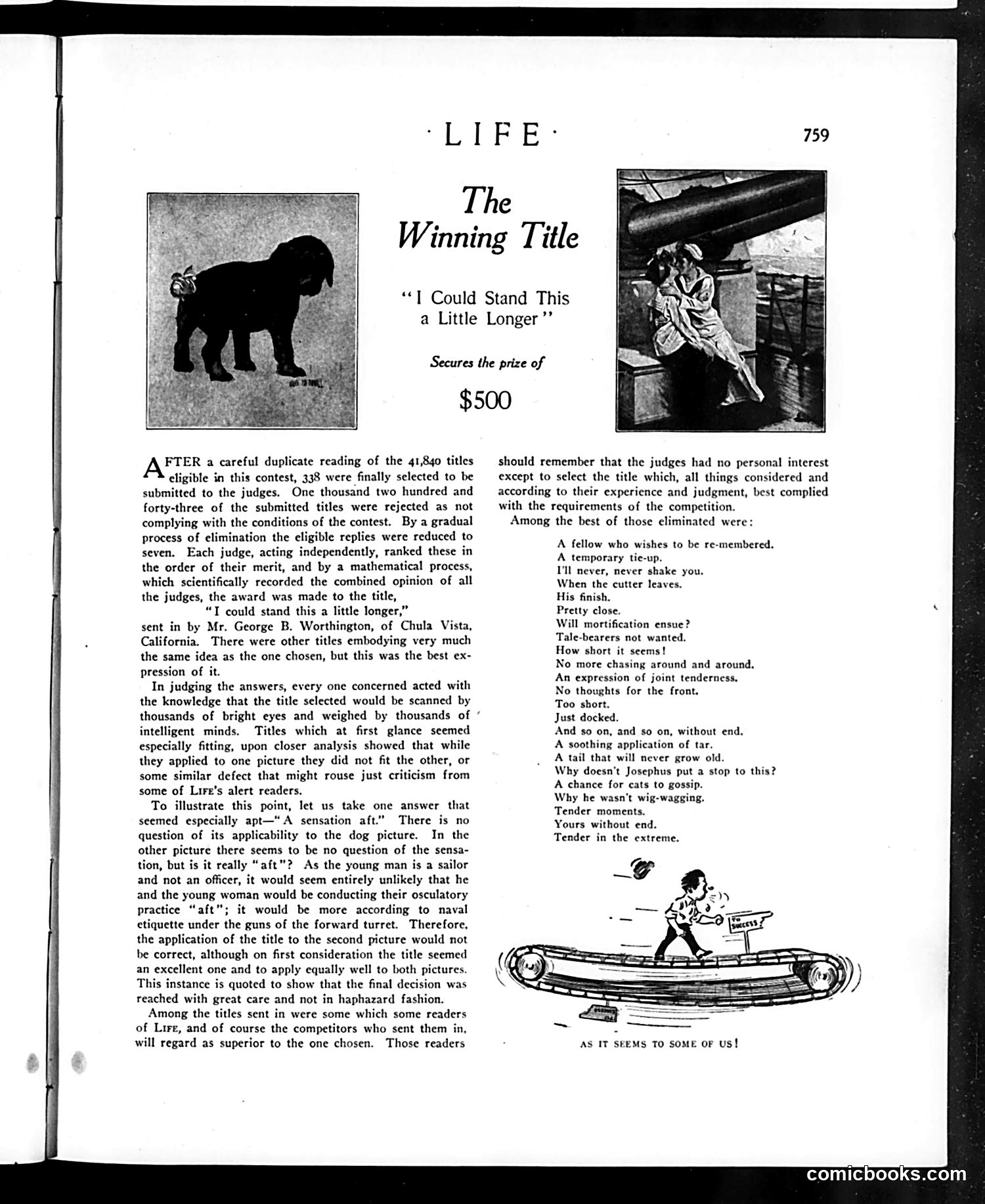
This page announces the winner of Life magazine's contest to caption two pictures with a single title. The winning entry, "I Could Stand This a Little Longer" by George B. Worthington, won $500. The two images appear to be: a dog in an uncomfortable position (left) and a sailor and woman kissing beneath a ship's gun turret (right). The article explains the rigorous judging process—from 41,840 entries reduced to seven finalists—emphasizing that judges carefully ensured titles applied equally well to both pictures. The example analyzed—"A sensation aft"—illustrates why precision mattered: while apt for the dog image, it's technically incorrect for the naval scene, since enlisted sailors wouldn't conduct romance "aft" (toward the stern) by naval etiquette. The cartoon at bottom shows a figure on a surfboard, captioned "As It Seems to Some of Us!"—likely satirizing readers who felt superior entries were overlooked.
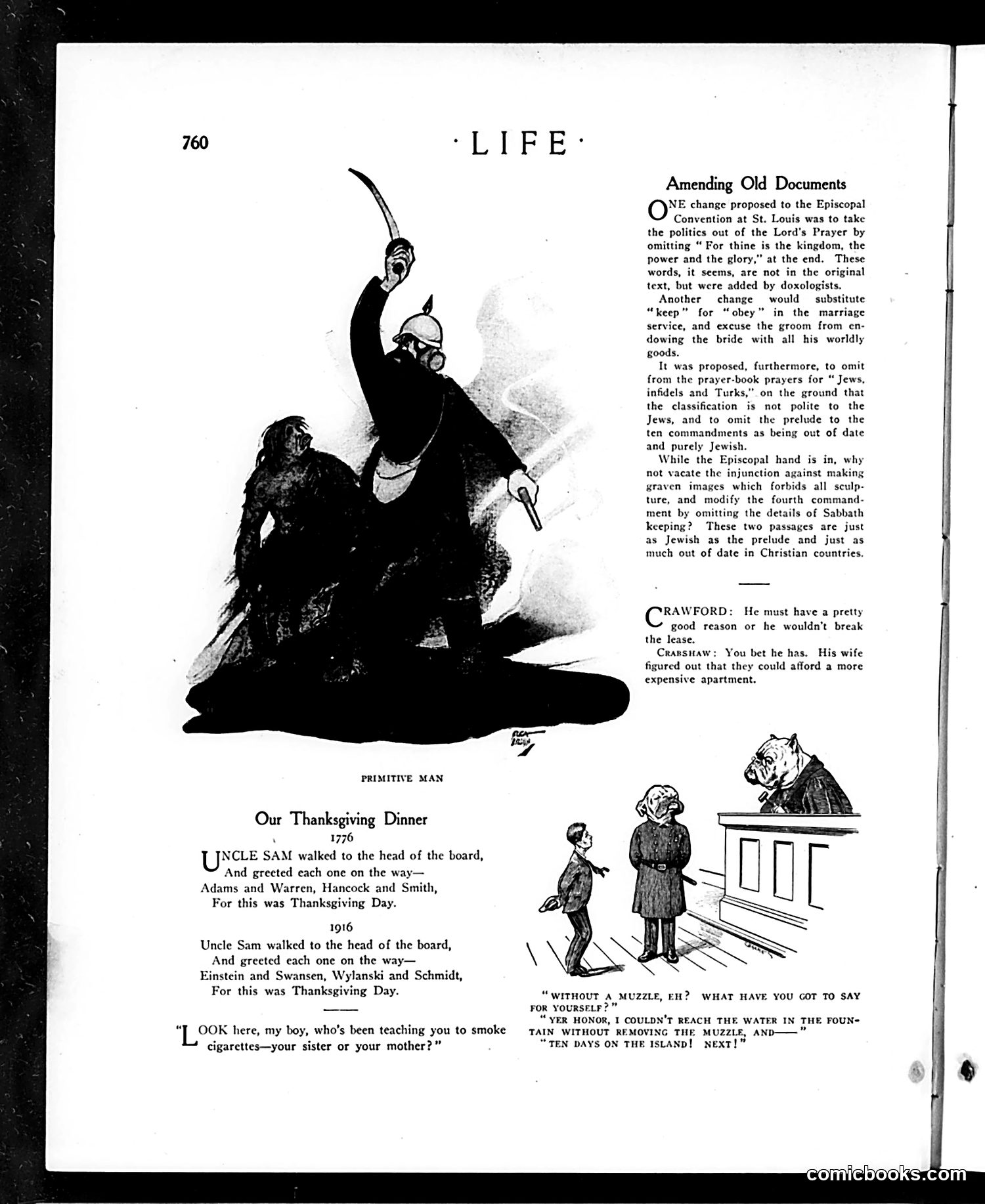
This page contains several satirical pieces reflecting early 20th-century American concerns: **"Amending Old Documents"** mocks proposed changes to the Episcopal Prayer Book, particularly the removal of religious language deemed "political" or "outdated." The satire suggests these edits—omitting references to Jewish practices, removing the doxology, softening marriage vows—represent misguided modernization that strips religious tradition of substance. **"Primitive Man"** (illustration) depicts a caveman with crude weapons, likely commenting on human nature's unchanging brutality. **"Our Thanksgiving Dinner"** contrasts 1776 (attended by American Founders: Adams, Warren, Hancock, Smith) with 1916 (attended by immigrants: Einstein, Swansen, Wylanski, Schmidt). This reflects contemporary anxiety about immigration and demographic change in America. **The bottom cartoon** shows a judge punishing someone for removing a muzzle to drink water—satirizing harsh, arbitrary justice toward the powerless. The overall theme: social/religious tradition under pressure from modernization and immigration.
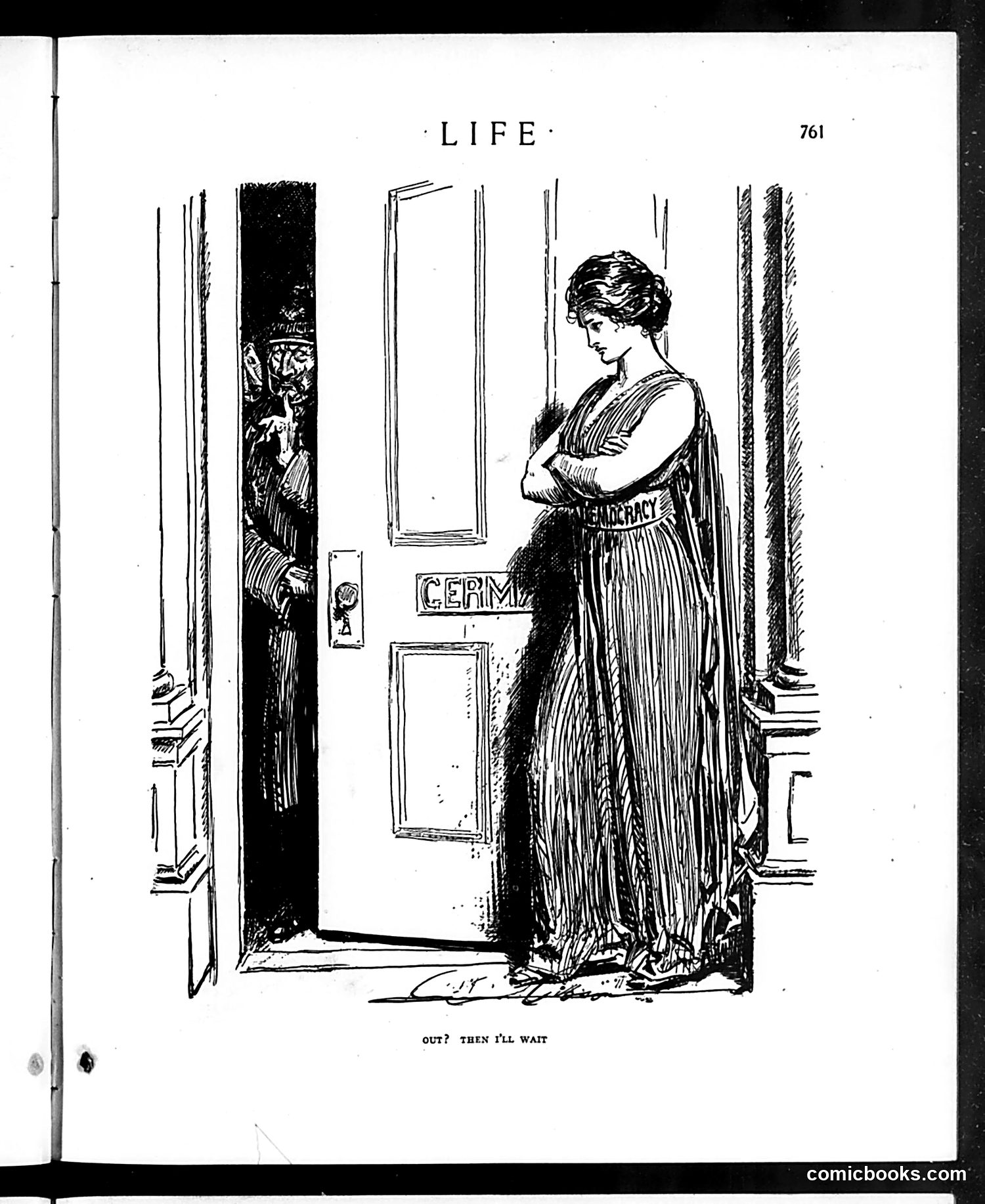
This is a satirical cartoon from *Life* magazine (page 761). It depicts a woman labeled "Democracy" standing outside a door marked "GERMACY" (likely "Germacy" — a pun on "Germany"), with her arms crossed. A sinister figure peers out from behind the door. The caption reads "OUT? THEN I'LL WAIT." The cartoon appears to critique German authoritarianism during the early 20th century, likely referencing tensions before or during World War I. Democracy is personified as a classical female figure, pointedly waiting outside while "Germacy" operates behind closed doors—suggesting that democratic values are excluded from German governance, which the cartoon portrays as secretive and ominous. The satire mocks German autocracy and its incompatibility with democratic principles.
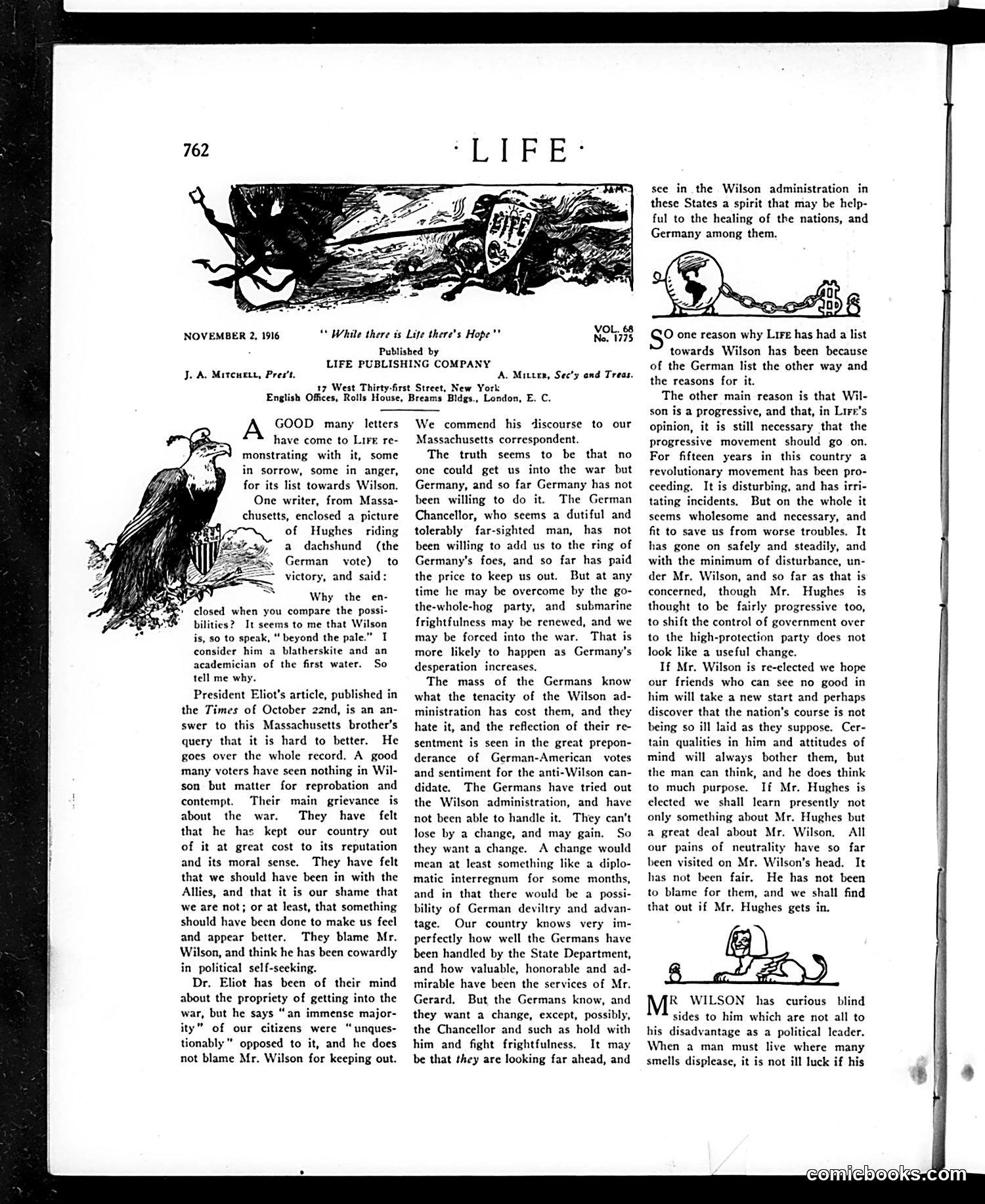
This page discusses the 1916 presidential election between incumbent Woodrow Wilson and Republican challenger Charles Evans Hughes. The editorial addresses reader complaints about Life's editorial stance favoring Wilson. **The cartoon** (top left) depicts Hughes riding a dachshund labeled as representing "the German vote"—a satirical reference to German-American voters' opposition to Wilson's policy of keeping America out of World War I. Germans resented Wilson's administration because it had effectively resisted German pressure and submarine warfare. **The editorial's argument**: While acknowledging that many Americans wanted the U.S. to enter the war on the Allies' side, the writer defends Wilson for respecting public opinion (which opposed entry). The piece notes German-Americans supported Hughes because they hoped a change in administration might mean diplomatic advantage for Germany. Life supports Wilson's cautious approach, suggesting his neutrality demonstrates wisdom that could help heal post-war nations. The underlying political division: interventionists versus isolationists, with German-American votes serving as a proxy for pro-German sympathies.
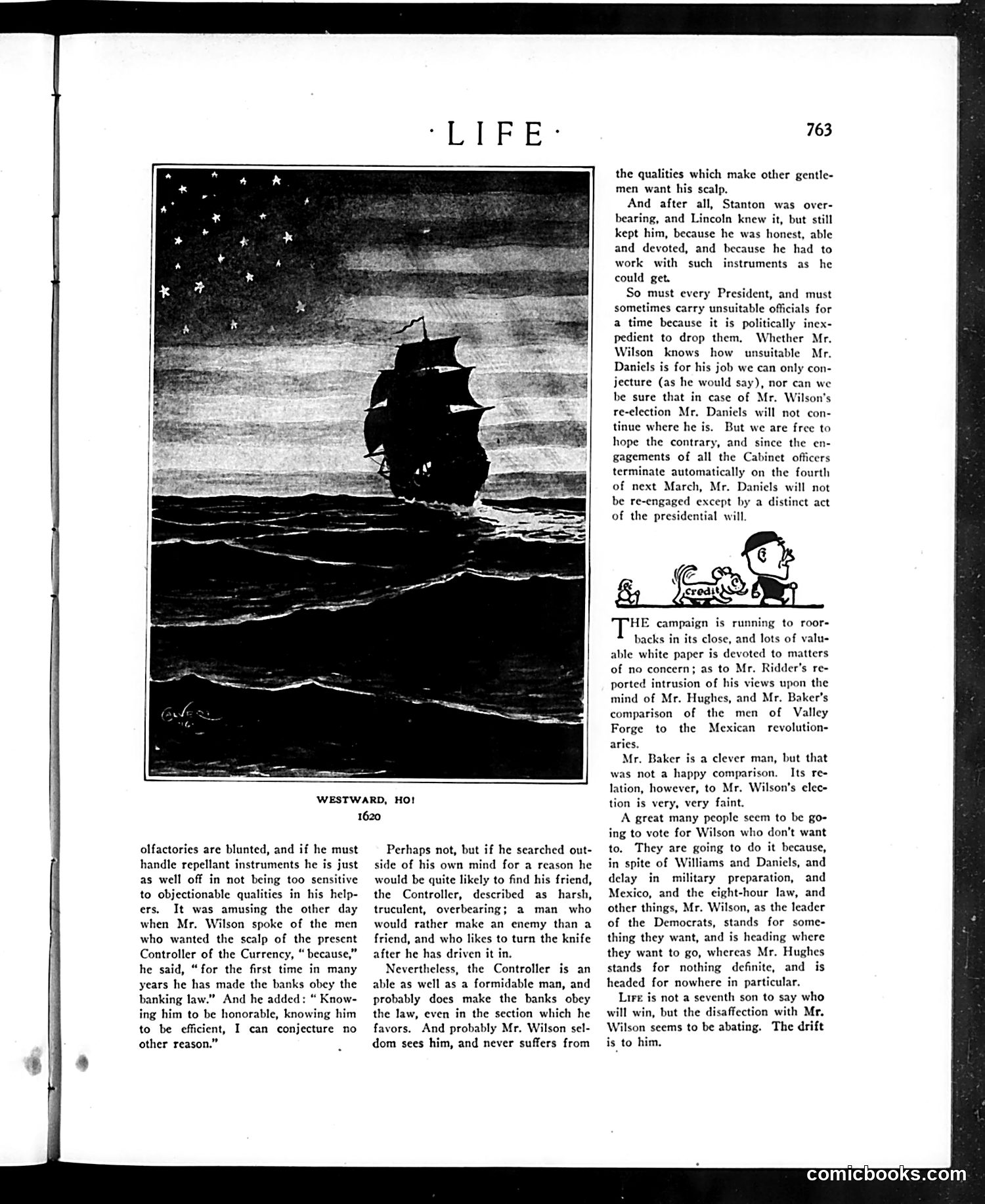
The main illustration, titled "Westward, Ho! 1620," depicts a sailing ship under stars, evoking American colonial/pioneer imagery. The accompanying text discusses President Wilson's Cabinet, specifically criticizing Secretary of the Navy Josephus Daniels as unsuitable for his position. The author argues Wilson keeps him despite complaints, comparing this to Lincoln retaining the abrasive Secretary of War Stanton because he was competent and loyal. The political commentary addresses the 1916 election campaign. It notes that despite dissatisfaction with Wilson's administration—citing poor military preparation, the Mexico situation, and the eight-hour labor law—many voters will support him over Republican challenger Charles Evans Hughes because Wilson at least represents Democratic principles and a clear direction, whereas Hughes offers nothing definite. The satire suggests voters are reluctantly backing Wilson not from enthusiasm but from lack of better alternatives, though the author predicts "the drift is to him" anyway.
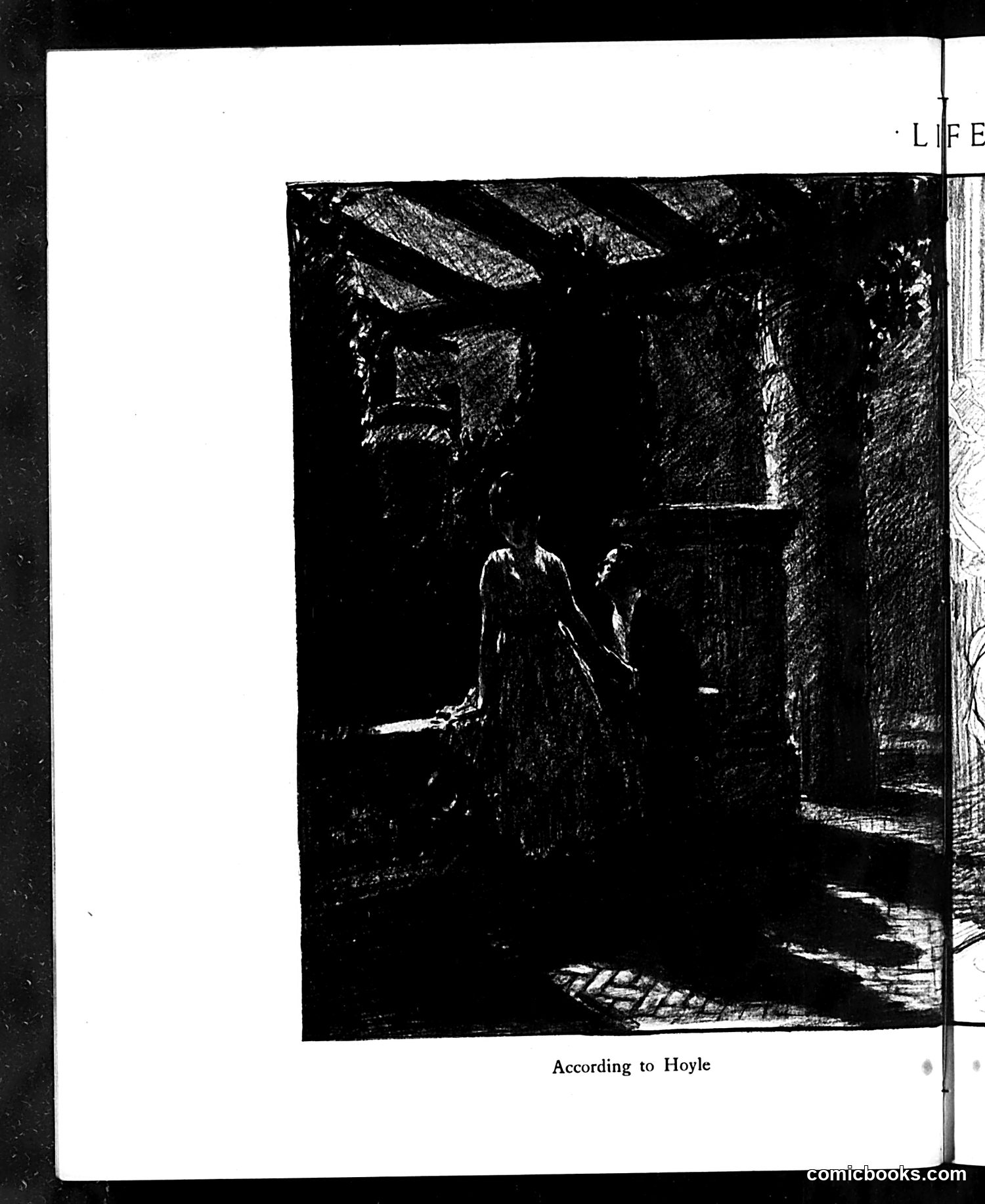
This appears to be a dramatic illustration (likely by artist Hoyle, given the caption) depicting a dark, shadowy interior scene. The image shows what seems to be a figure or figures in a confined, brick-walled space with exposed beams overhead—possibly a basement, cellar, or dungeon-like setting. Without additional context from the magazine's text or surrounding pages, the specific political or social satire isn't entirely clear from the image alone. The caption "According to Hoyle" is a period phrase meaning "by the rules" or "properly," suggesting the cartoon comments on how something is being done "correctly" according to established standards—though the grim setting implies ironic commentary on those standards themselves. The dramatic chiaroscuro lighting emphasizes the unsettling atmosphere.
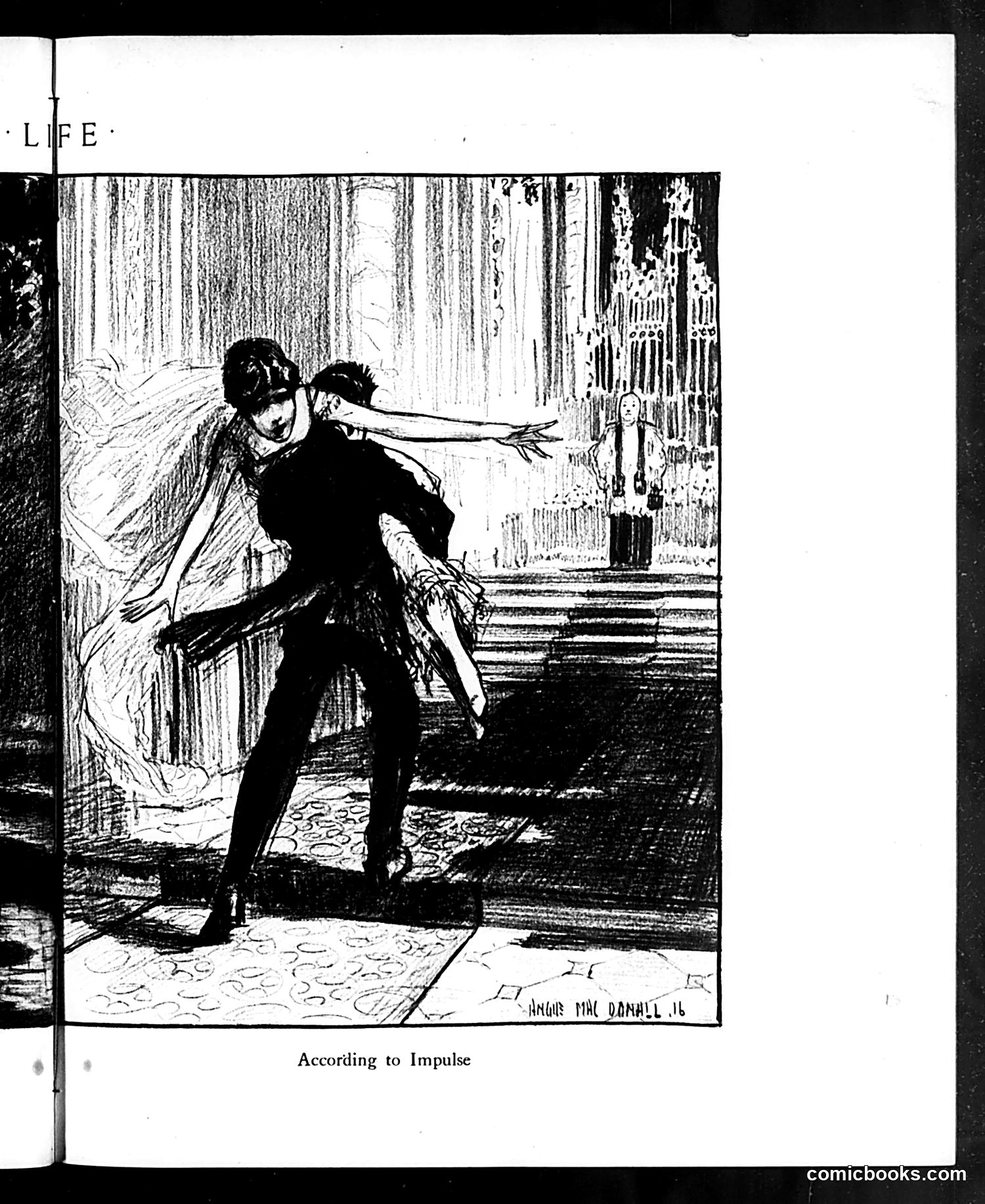
This illustration by Angus MacDonald Jr. depicts a dramatic scene in what appears to be a grand interior (possibly a cathedral or palace, given the architectural details). A woman in dark clothing gestures expressively toward a standing figure in the background, while she herself appears to be in motion or mid-gesture. The title "According to Impulse" suggests satire about acting on sudden emotional urges rather than deliberation. Without additional context from Life magazine's contemporary issues, the specific social or political reference remains unclear. The theatrical composition and dramatic body language suggest commentary on impulsive human behavior—possibly romantic, social, or behavioral impulses. The formal setting contrasts with the emotional intensity of the scene, which may be the satirical point.
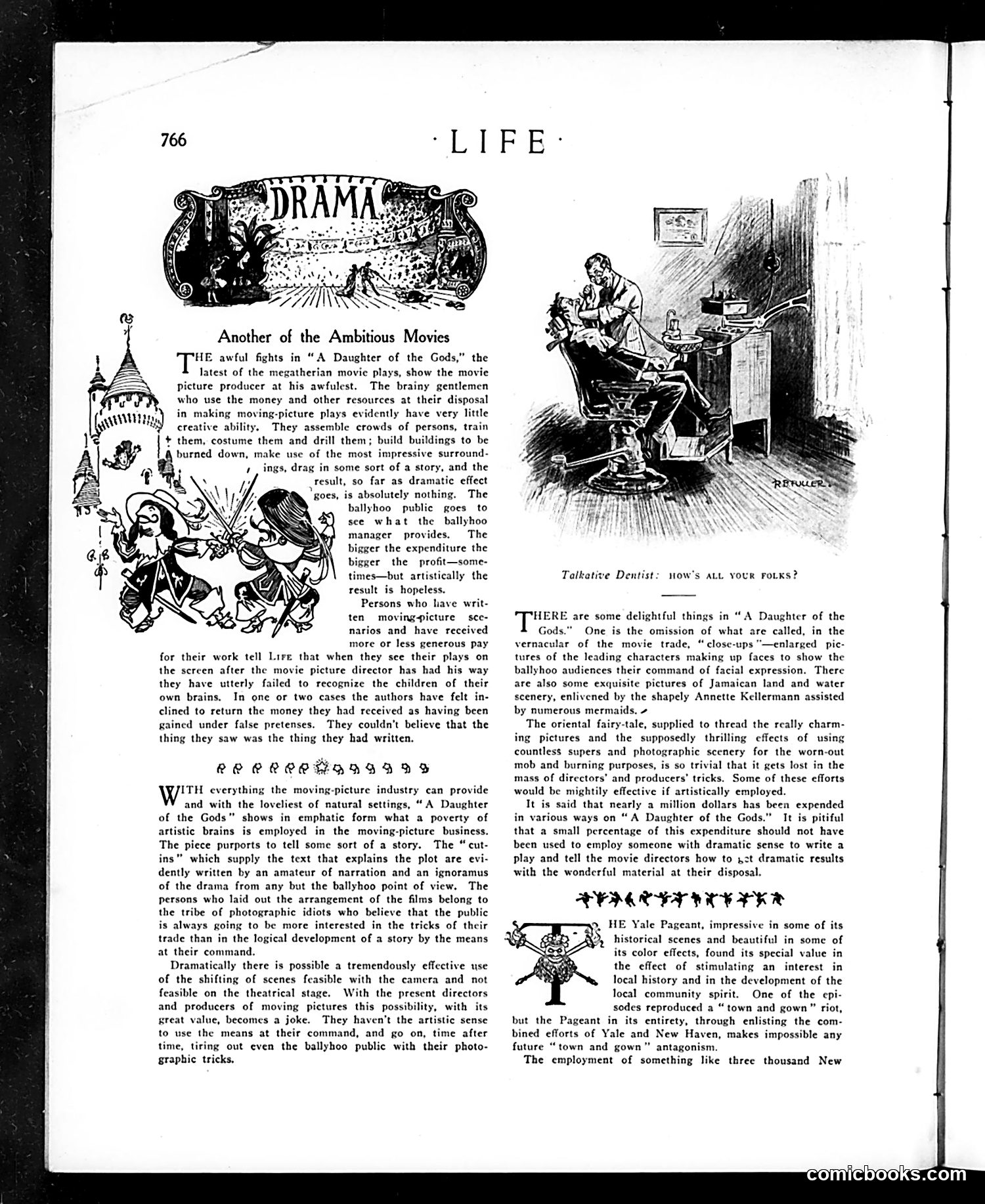
This 1915 *Life* magazine article satirizes the film industry's wasteful approach to moviemaking, specifically critiquing "A Daughter of the Gods." **The Satire's Point:** Despite massive budgets, elaborate sets, crowds, and expensive star Annette Kellermann, major film producers lack artistic vision. The article argues they confuse spectacle—burning buildings, photographic "tricks," and technical showiness—with storytelling. **Key Complaints:** - Screenwriters' original scripts become unrecognizable after directors rework them - Intertitles are amateurish and poorly written - Directors prioritize camera tricks over narrative logic - The film wastes a million dollars on production values while neglecting to hire someone with actual dramatic talent **The Cartoon:** Shows a dentist asking "How's all your folks?"—a mundane social greeting, likely illustrating the article's point that even trivial dialogue receives more care than the film's narrative. **Context:** This reflects early cinema's growing pains, when industry money men treated filmmaking as a commercial spectacle rather than an art form.
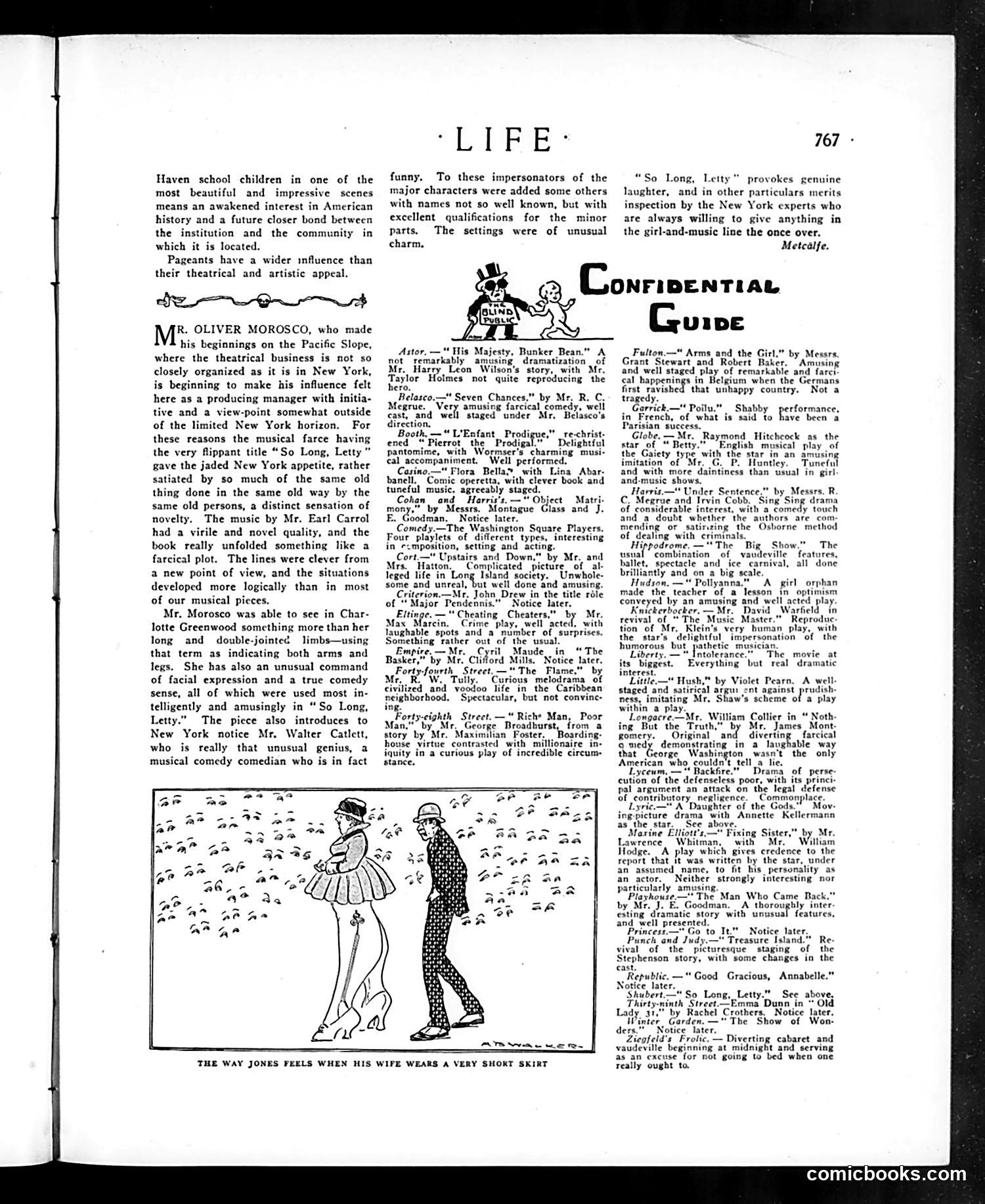
This cartoon satirizes early 1920s fashion anxieties about women's hemlines. The illustration shows a man (labeled "Jones") with an exaggerated, uncomfortable posture—legs splayed awkwardly, body contorted—while his fashionably dressed wife walks beside him in a notably short skirt (visible by the era's standards). The humor targets masculine embarrassment and social anxiety about changing women's fashion. As hemlines rose during this period, conservative men worried about propriety and public perception. The cartoon mocks this discomfort by literalizing it: Jones's body physically contorts in distress at his wife's modern dress. The page itself reviews theatrical productions, making this fashion commentary a humorous sidebar reflecting contemporary social tensions about women's clothing and changing gender norms in post-WWI America.
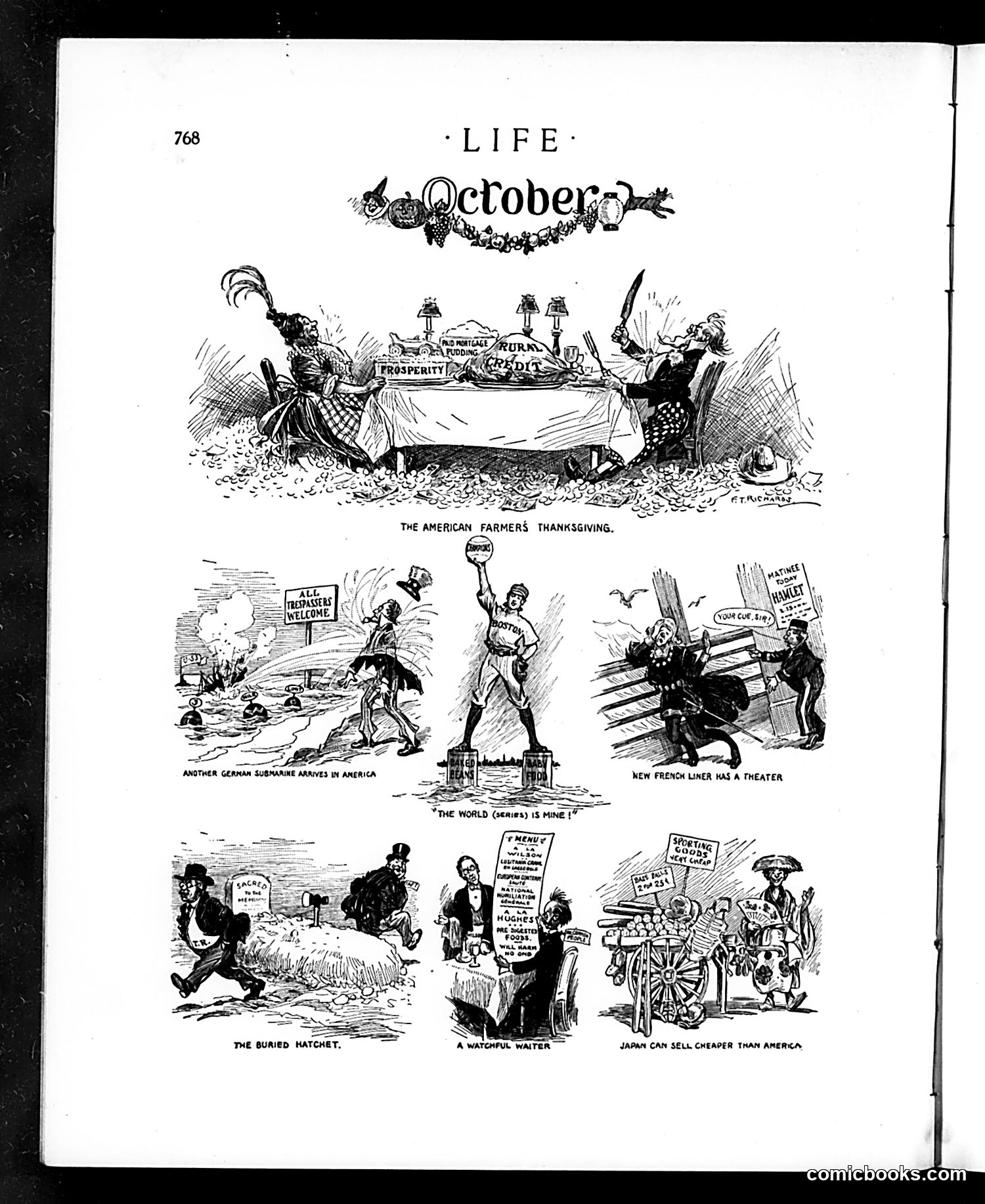
This page presents satirical cartoons addressing WWI-era American concerns. "The American Farmers' Thanksgiving" depicts prosperity amid war. "Another German Submarine Arrives in America" mocks German naval threats to U.S. commerce. "The World (Germs) Is Mine!" shows militaristic ambition. "The Buried Hatchet" likely references peace negotiations. "A Waterfowl Waiter" appears to be social satire. "New French Liner Has a Theater" comments on French naval activities. "Japan Can Sell Cheaper Than America" expresses anxiety about post-war economic competition from Japan—a rising industrial power threatening American manufacturing dominance. The cartoons reflect wartime patriotism mixed with concerns about foreign economic and military competition.
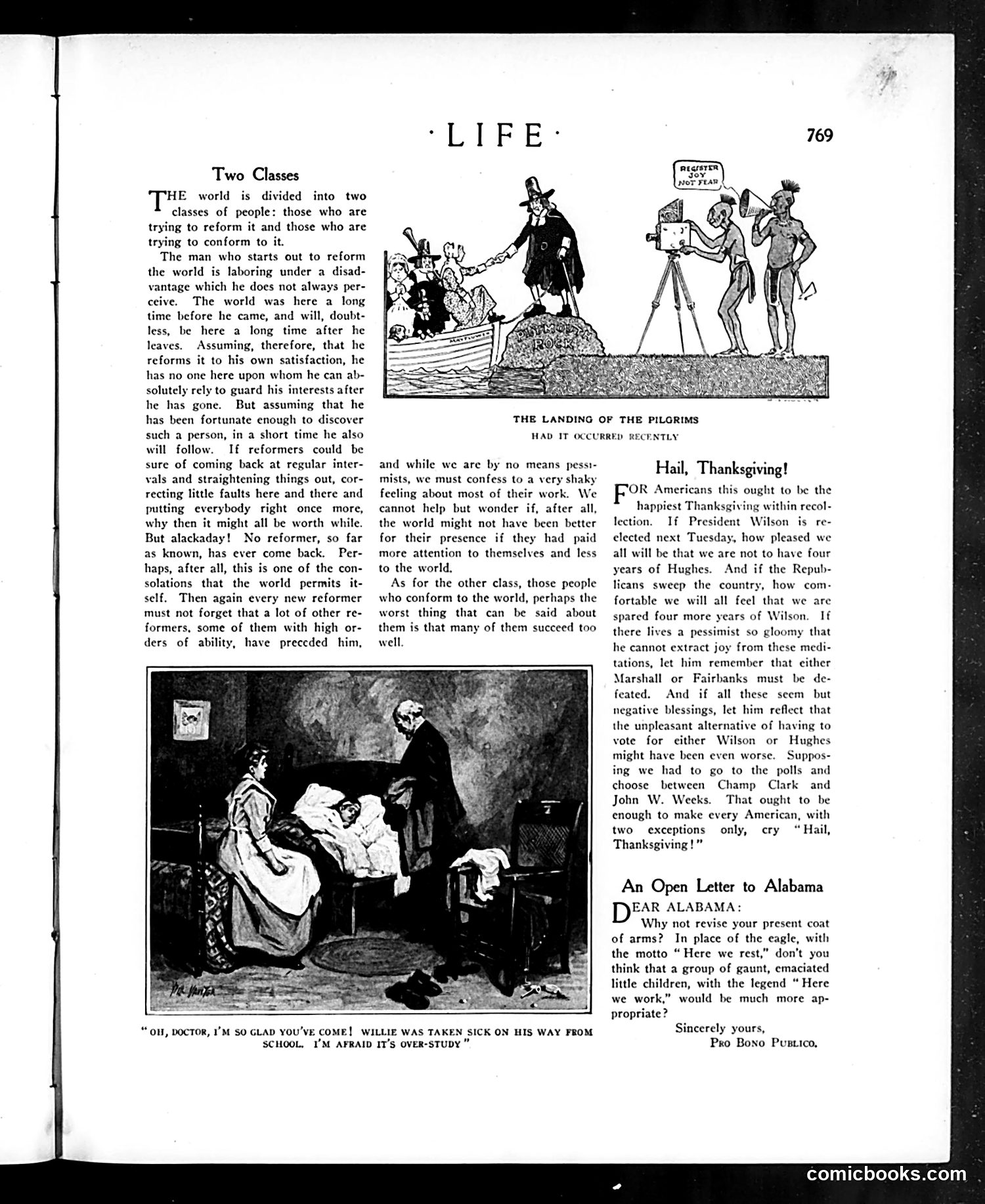
This page contains three distinct satirical pieces from an early 20th-century American magazine: **"Two Classes"** essay argues that reformers are ultimately futile—they labor to improve the world but leave no permanent guardians of their work, and many predecessors have failed similarly. The conformists, meanwhile, succeed "too well" at accepting things as they are. **"The Landing of the Pilgrims"** cartoon (top) appears to satirize modern Thanksgiving by showing pilgrims being filmed by a movie camera—likely mocking commercialization or media spectacle around the holiday. **"Hail, Thanksgiving!"** celebrates the 1916 election by suggesting Americans should be grateful *regardless* of outcome (Wilson or Hughes winning), since any alternative would be worse. It names real political figures (Marshall, Fairbanks, Champ Clark, John W. Weeks). **"An Open Letter to Alabama"** criticizes child labor practices in the state, sarcastically suggesting Alabama replace its state seal's eagle with starving children working, highlighting industrial exploitation of minors. The page reflects Progressive-era concerns: political cynicism, labor exploitation, and the tension between reform and acceptance.
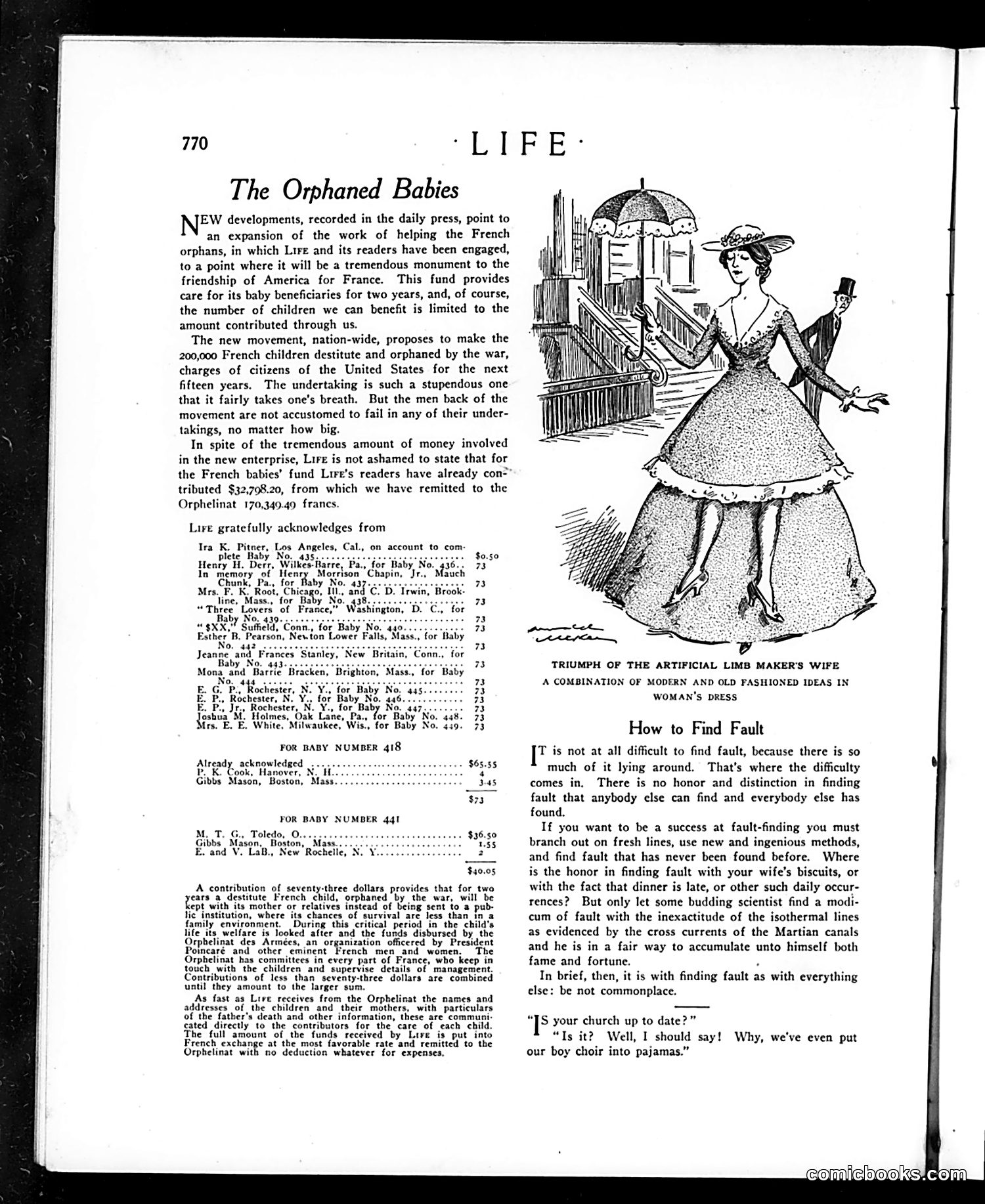
This page documents Life magazine's fundraising campaign for French war orphans following World War I. The illustrated figure shows a fashionable American woman—likely representing the magazine's affluent readership—displaying her charitable identity through modern dress combining contemporary and traditional elements (captioned "Triumph of the Artificial Limb Maker's Wife"). The text announces an expansion of Life's orphan-sponsorship program: readers have already contributed over $32,000 to care for French children orphaned by the war. The magazine appeals for continued donations ($73 per child for two years of care), listing individual contributors by name and baby number. Life emphasizes that funds go directly to the French Orphelinat organization with "no deduction whatever for expenses"—addressing potential donor concerns about administrative overhead. The satire is gentle: wealthy American women are portrayed as fashionable yet genuinely philanthropic, their vanity channeled toward worthy humanitarian purposes supporting America's French allies.
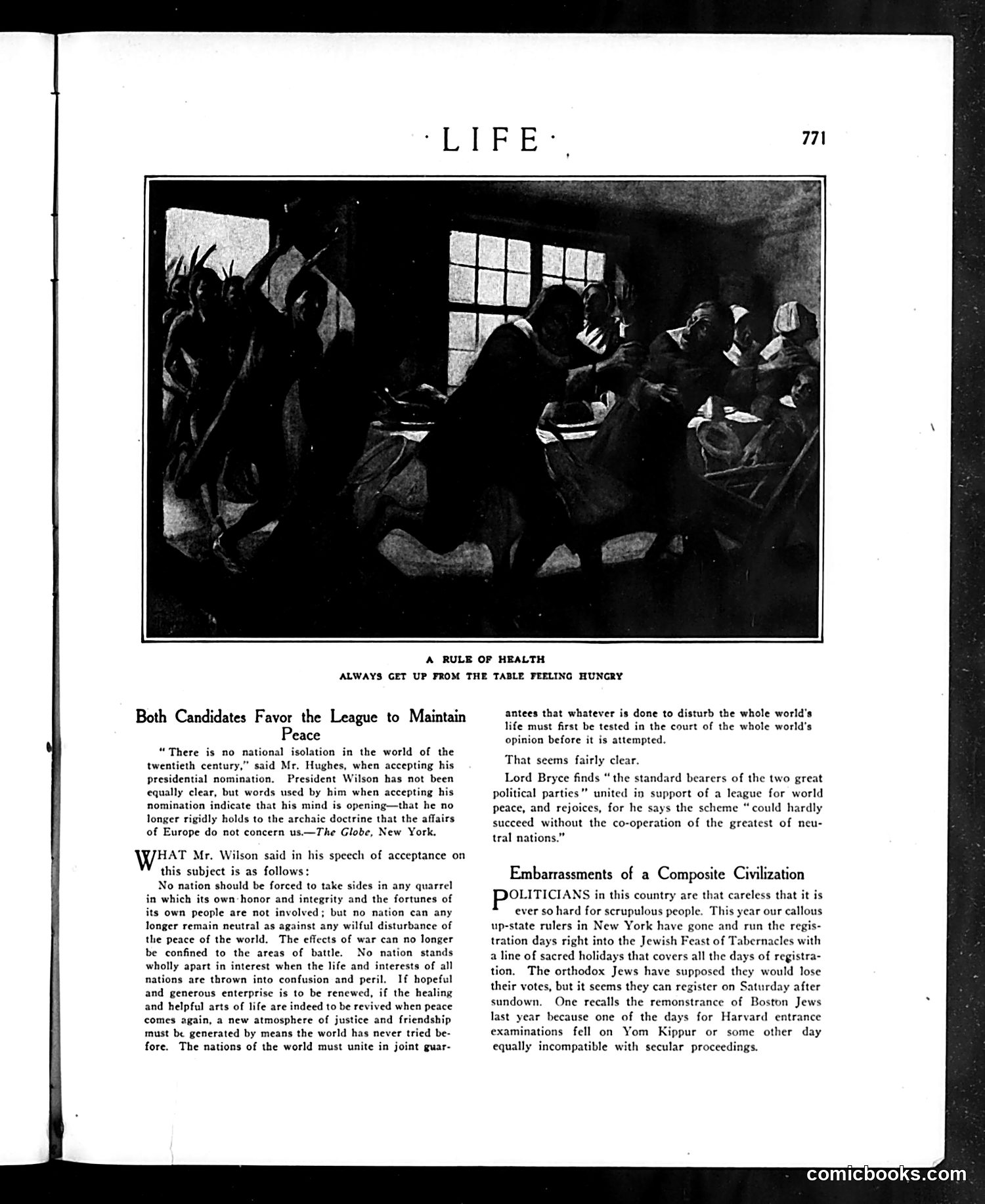
The top illustration depicts a heated political debate or confrontation in an indoor setting, likely representing the 1916 presidential campaign discourse on America's isolationism versus international involvement. The text below addresses both 1916 presidential candidates—Wilson and Hughes—both endorsing a League to Maintain Peace, marking a shift from strict isolationism. The article notes Wilson's acceptance speech clarified that while nations shouldn't be forced into foreign quarrels, they can no longer remain neutral during global disturbances. The lower section satirizes New York politicians for scheduling voter registration during the Jewish Feast of Tabernacles, forcing Orthodox Jews to choose between religious observance and voting rights. This highlights the awkward conflicts arising from America's "composite civilization"—a diverse society where secular government scheduling conflicts with religious communities' sacred observances. The satire targets governmental insensitivity to minority religious practices.
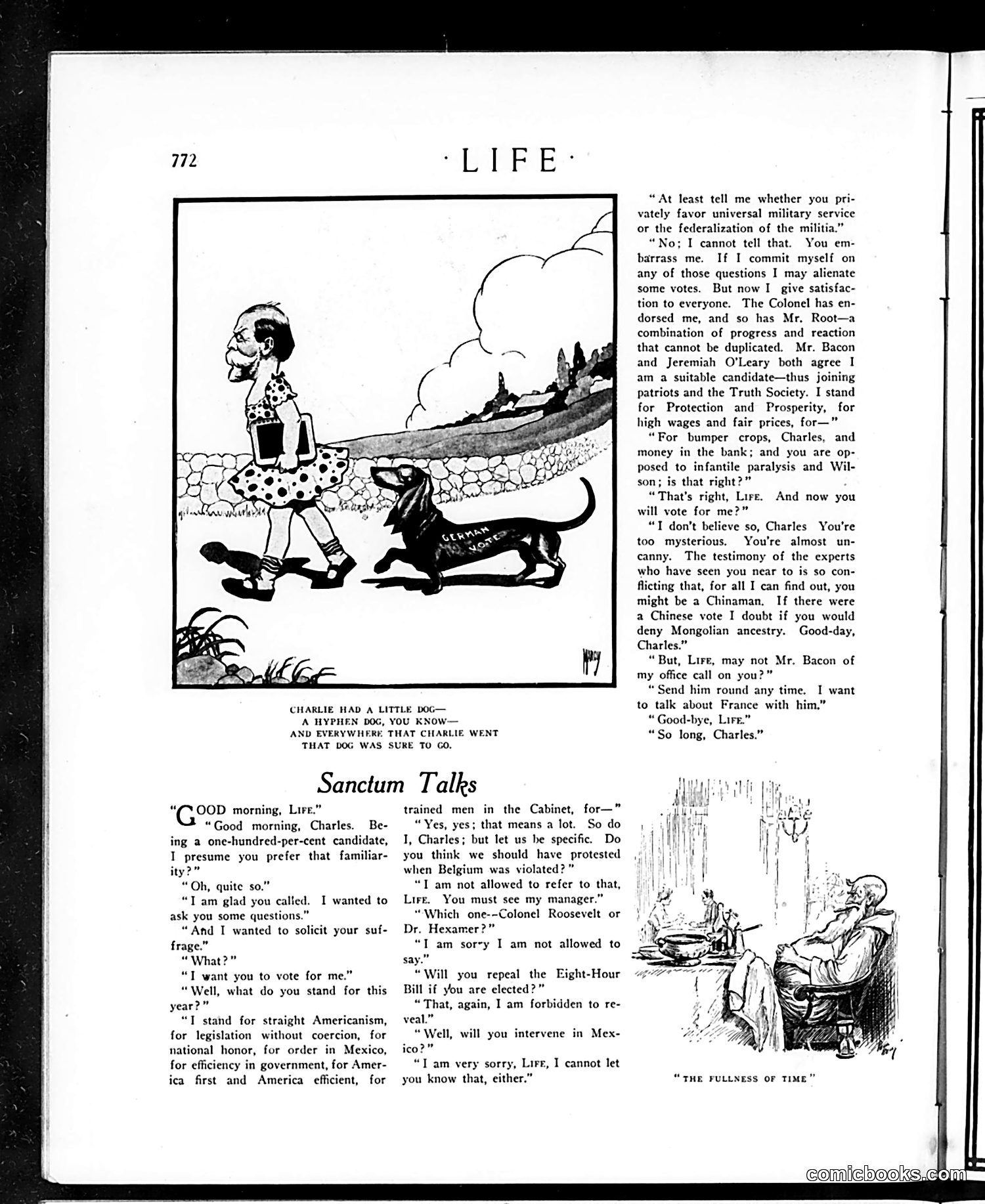
This is political satire mocking a vague, evasive political candidate (named Charles). The cartoon shows him as a hyphenated figure—literally split—suggesting divided loyalties or inconsistency. In "Sanctum Talks," the candidate refuses to take clear positions on major issues: Belgium's violation (WWI context), the Eight-Hour Bill, Mexico intervention, and military service. He claims his managers (Roosevelt and Root) forbid him from speaking, yet boasts of endorsements from contradictory groups—"patriots and the Truth Society," suggesting he's appealing to everyone without committing to anything. The satire's point: Charles represents a hollow, poll-testing politician who adopts whatever positions keep voters happy rather than advocating genuine principles. The joke culminates when "Lire" (the interviewer) suggests Charles might secretly be Chinese—implying his identity itself is so mysterious and changeable as to be unknowable. The page likely dates to a 1912 or 1916 presidential election, satirizing weak or opportunistic candidates.
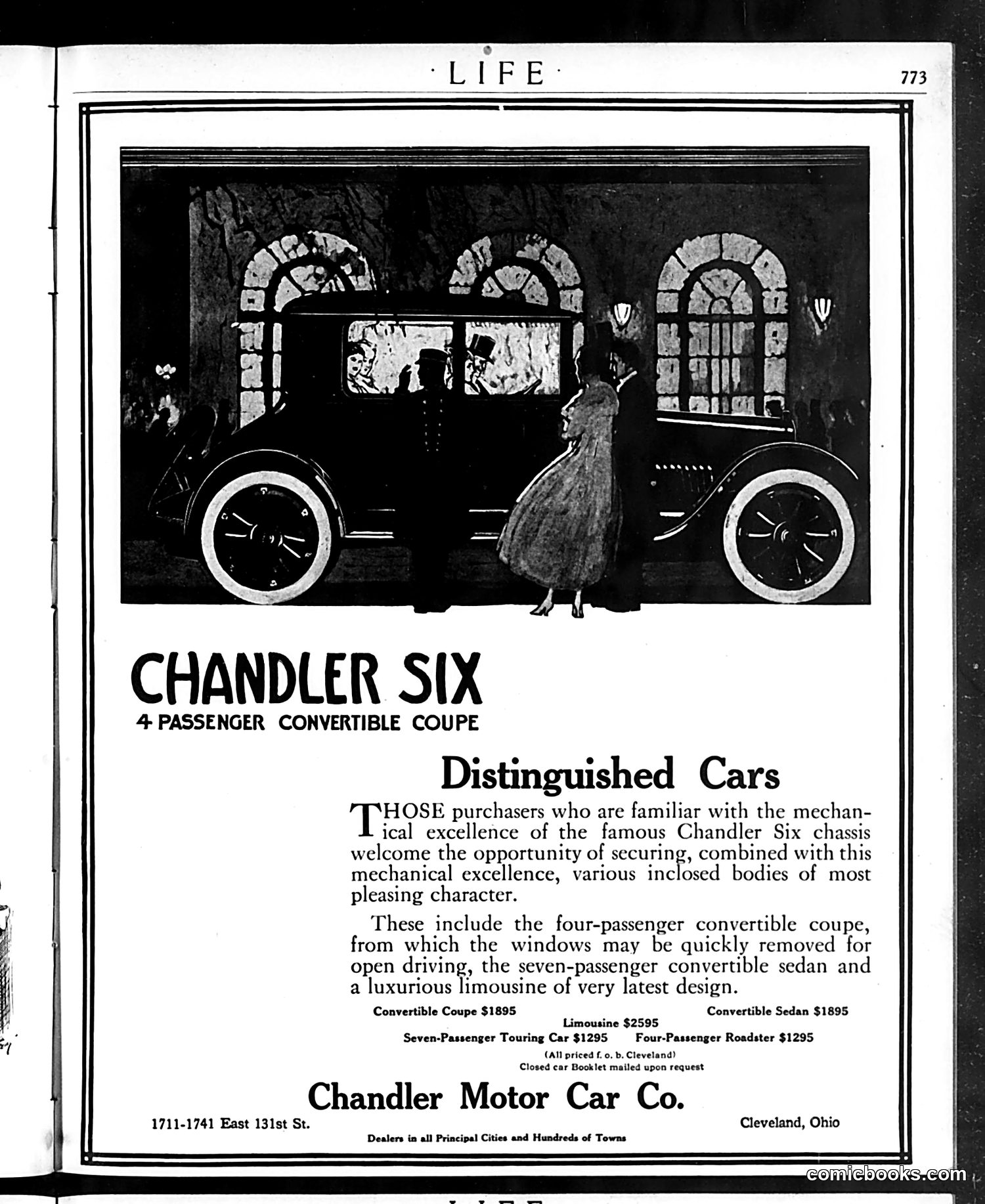
This page from *Life* magazine is a straightforward car advertisement for the Chandler Six automobile. The illustration shows an elegantly dressed woman admiring a convertible coupe parked outside an upscale building with arched windows, emphasizing the vehicle's luxury appeal to wealthy consumers. The ad highlights the Chandler Six's mechanical reliability combined with various body styles—convertible coupe, sedan, limousine, and touring car—with prices ranging from $1,295 to $2,595. The copy targets purchasers already familiar with the brand's reputation for engineering excellence. There is no political cartoon or satire here. It's a period advertisement reflecting 1920s automotive marketing that positioned cars as luxury status symbols for the affluent. The Chandler Motor Car Company was based in Cleveland, Ohio.
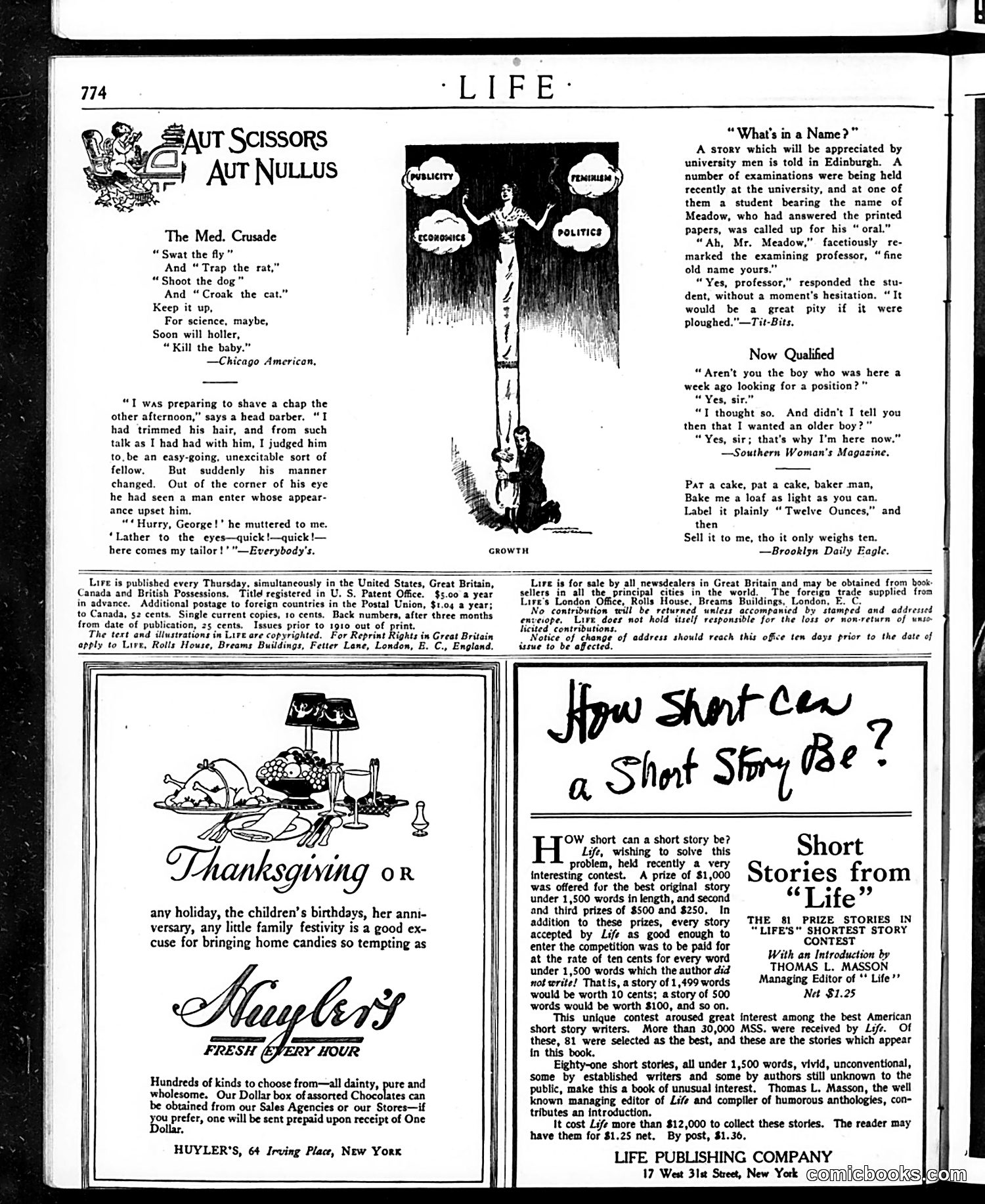
This page from *Life* magazine contains several satirical pieces: **"The Med. Crusade"** (top left): A poem mocking excessive medical/scientific authority. It sardonically suggests that if society keeps killing animals in the name of science ("Swat the fly," "Shoot the dog"), eventually someone will advocate "Kill the baby"—critiquing the logic of unrestrained scientific experimentation. **The barber anecdote**: A humorous story where a customer becomes anxious upon seeing someone enter the shop, frantically demanding quick service. The joke's punchline is missing in the OCR, but appears designed as casual humor about mistaken identity or social anxiety. **"What's in a Name?"**: A university joke playing on a student named Meadow being asked about his "fine old name"—the student quips it would be "a great pity if it were ploughed," making a pun on the farming context of his surname. **The bakery poem**: Social satire about consumer fraud—bakers labeling loaves "Twelve Ounces" while actually selling ten-ounce loaves. The page is primarily **humorous content and advertising**, not overtly political satire.
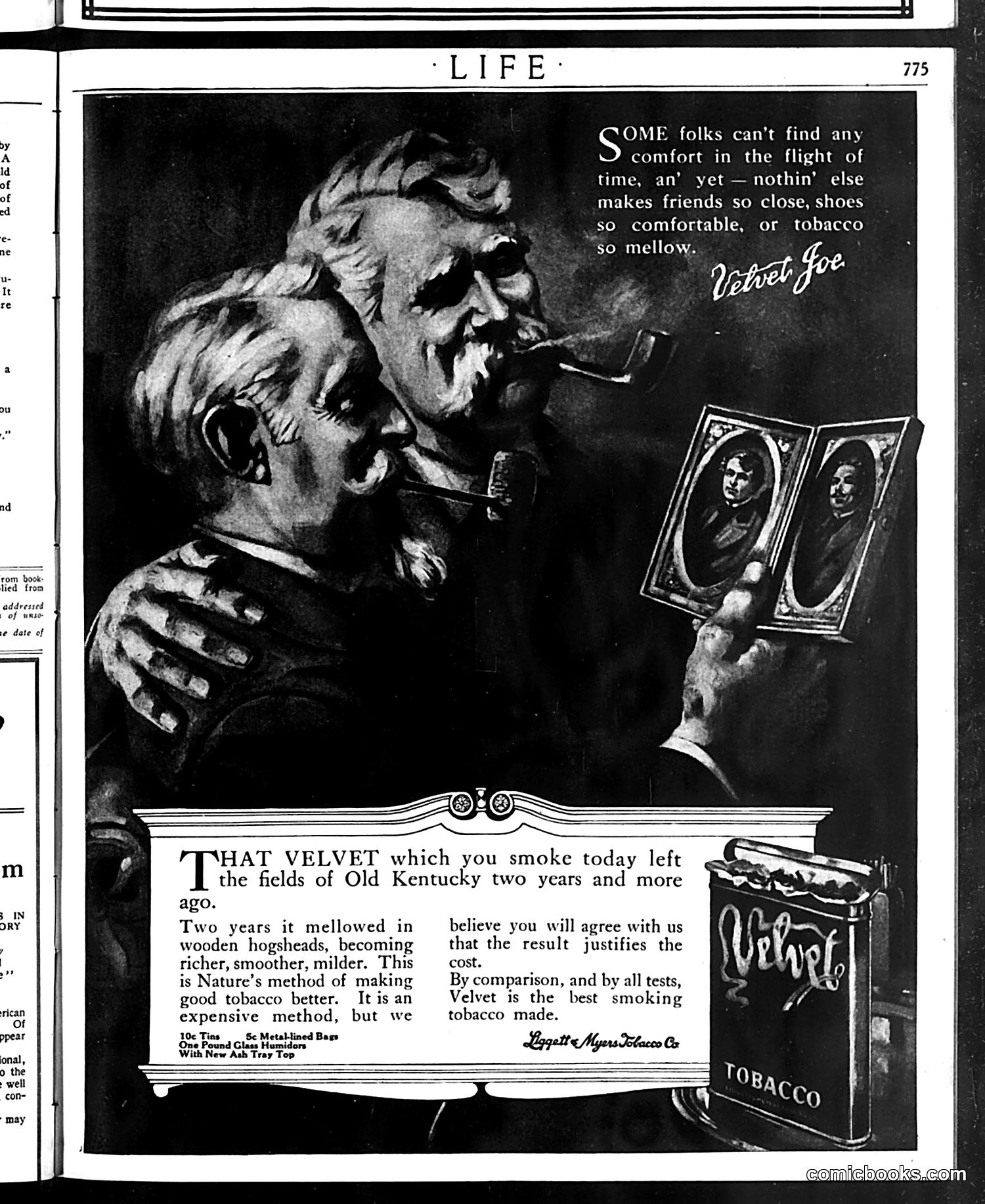
This is a **tobacco advertisement**, not political satire. It appears in *Life* magazine (page 775) promoting Velvet brand smoking tobacco. The ad features two men—likely representing aging friends or companions—examining photographs together while smoking. The imagery suggests nostalgia and the comfort of long friendship. The advertisement's central claim is that Velvet tobacco improves with age: tobacco aged two years in wooden barrels becomes "richer, smoother, milder" through a natural mellowing process. The copy argues this expensive aging method justifies the product's cost. The quote at top, attributed to "Velvet Joe," uses colloquial language to connect tobacco with timeless comforts: close friendships, comfortable shoes, and mellow flavor. This represents early-to-mid 20th-century advertising before health warnings were required, explicitly marketing tobacco's supposed quality and the virtue of patience in production.
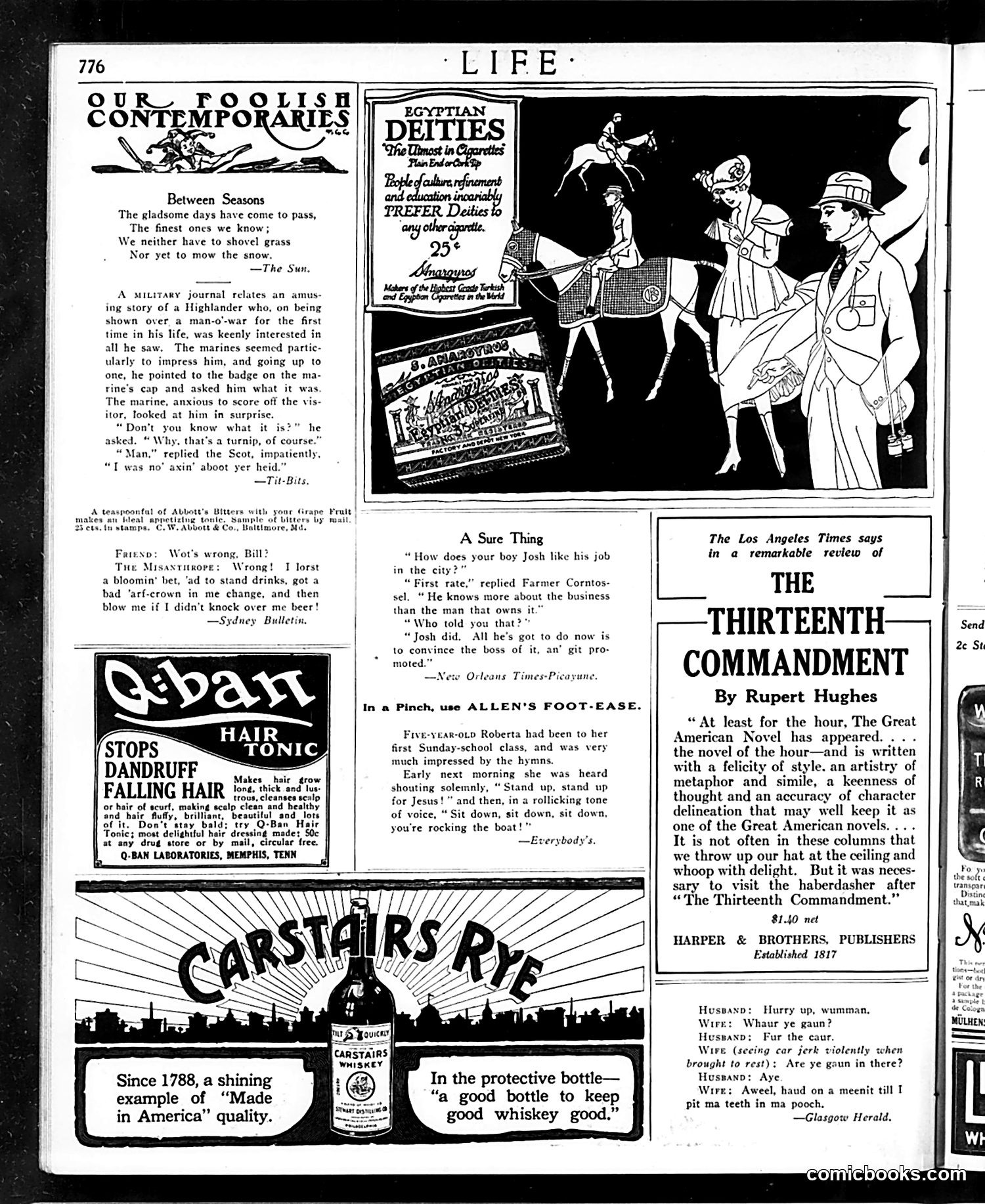
This page contains primarily **humorous anecdotes and advertisements** rather than political cartoons. The content includes: **Humor pieces:** - A joke about a Scottish Highland soldier misunderstanding a marine's cap badge as a "turnip" - A story about a farmer's son who brags he knows his boss's business better than the boss himself - An anecdote about a five-year-old girl mixing hymn singing with playground rhymes ("Sit down, sit down, you're rocking the boat!") - A Scottish dialect joke about a wife removing her false teeth before entering a moving streetcar **The satire is gentle and universal:** poking fun at Scottish accents/misunderstandings, rural naïveté, childish behavior, and marital dynamics—common targets in early 20th-century humor magazines. **Advertisements dominate:** promoting hair tonic, foot powder, whiskey, and Rupert Hughes's novel *The Thirteenth Commandment*. The page functions primarily as a humor-and-advertising vehicle rather than political commentary.
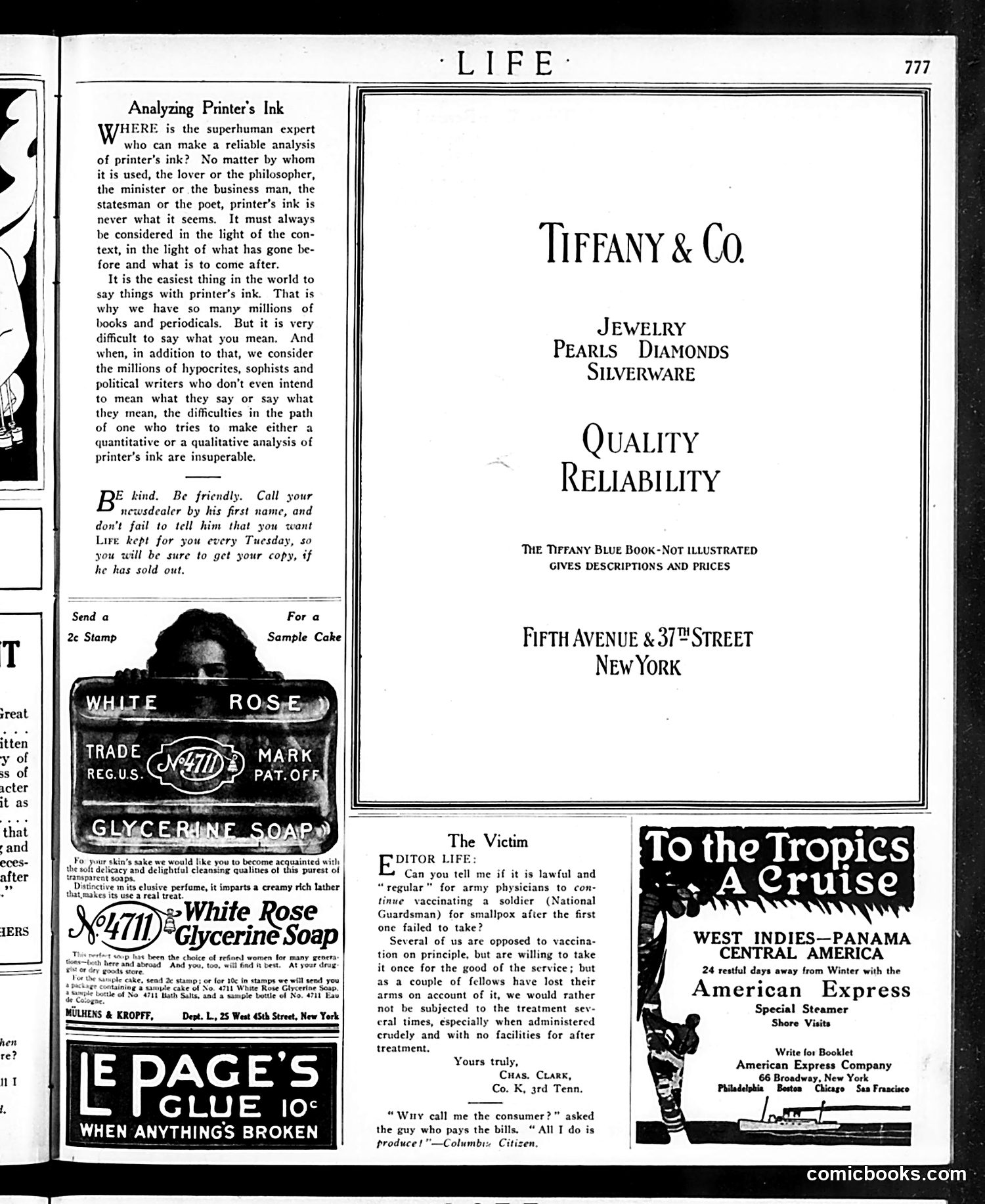
This page is primarily **advertisements and reader correspondence**, not political satire. The dominant content includes: **Main Features:** - A lengthy editorial essay titled "Analyzing Printer's Ink" critiquing the unreliability of written communication—how words in print can obscure rather than clarify meaning, especially from "hypocrites, sophists and political writers." - A reader's letter ("The Victim") from a National Guardsman questioning whether the military can legally revaccinate soldiers for smallpox multiple times, citing cases of arm loss from adverse reactions. **Advertisements:** Tiffany & Co., White Rose Glycerine Soap, Le Page's Glue, and American Express cruise lines dominate the page. **The Satire:** The placement of anti-vaccination concerns alongside an essay about deceptive language suggests irony—the soldier's genuine health fears are embedded in a page about how "printer's ink" obscures truth, while commercial messaging surrounds him.
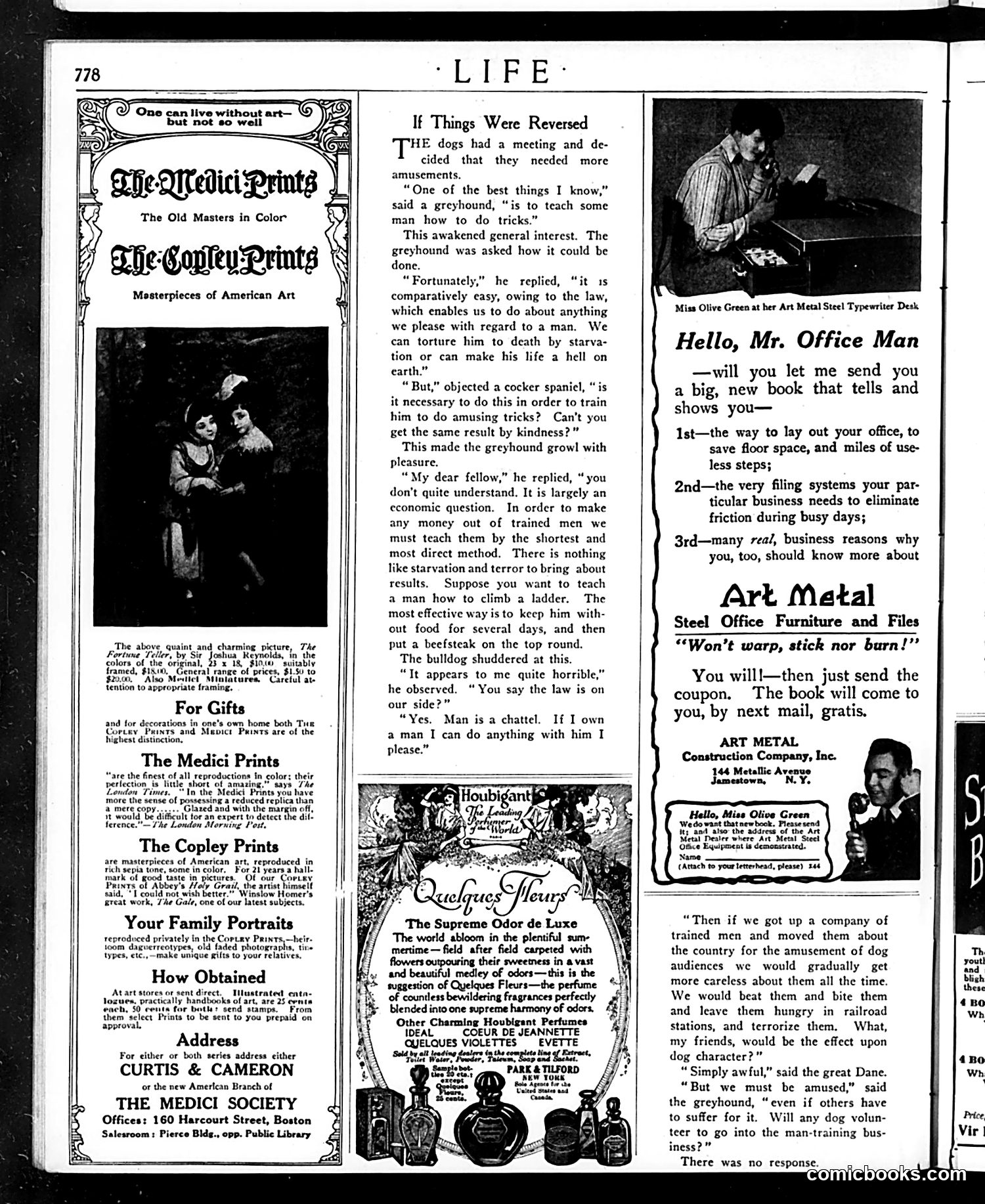
This satirical fable inverts the social hierarchy: dogs debate training humans through starvation and terror, just as humans train animals. A greyhound explains that since "man is a chattel" under law, dogs can exploit human labor cheaply and brutally for profit. The satire critiques early 20th-century labor conditions and class exploitation. By having animals casually discuss starving workers to maximize profit, the piece exposes the dehumanizing logic of industrial capitalism—treating laborers as property to be controlled through deprivation rather than incentive. A cocker spaniel's gentle objection ("Can't you get results by kindness?") is dismissed as economically naive, mocking the era's capitalist arguments that brutal conditions were necessary efficiency. The humor works through role-reversal: making readers uncomfortable imagining humans subjected to the exploitation they accepted as normal for the working class and animals. It's a pointed critique of labor practices and the legal systems that enabled them.
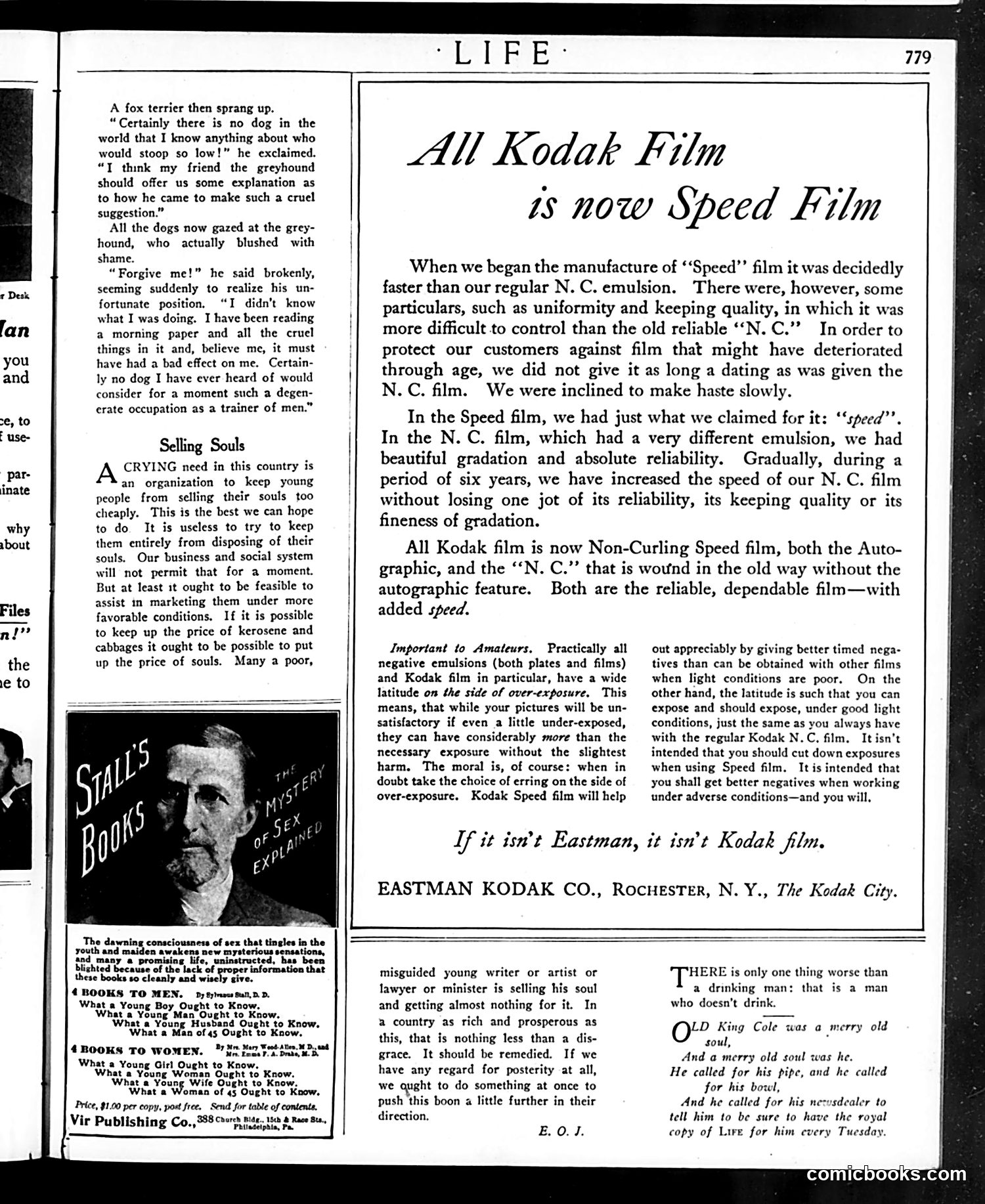
This page contains a satirical story and advertisements typical of early 20th-century Life magazine. **The Narrative Story** ("Selling Souls"): A fictional dialogue where dogs discuss a greyhound who suggested training humans as a profession. The fox terrier expresses shock, and the greyhound—having read disturbing newspaper content—apologizes, ashamed of the degenerate idea. The story's moral critique: society permits people to "sell their souls" through degrading work, so reformers should at least ensure fair compensation rather than attempt prohibition. **The Advertisements**: The page includes ads for Kodak Speed Film (emphasizing improved photographic technology) and "Vir Publishing" books about sexual education for different life stages—reflecting early 20th-century anxieties about youth, sex education, and moral guidance. **The Satire**: The talking dogs story satirizes both media's corrupting influence and capitalism's commodification of human labor and dignity. The adjacent sex-education book ads reinforce concerns about protecting youth morality in an increasingly commercialized society.
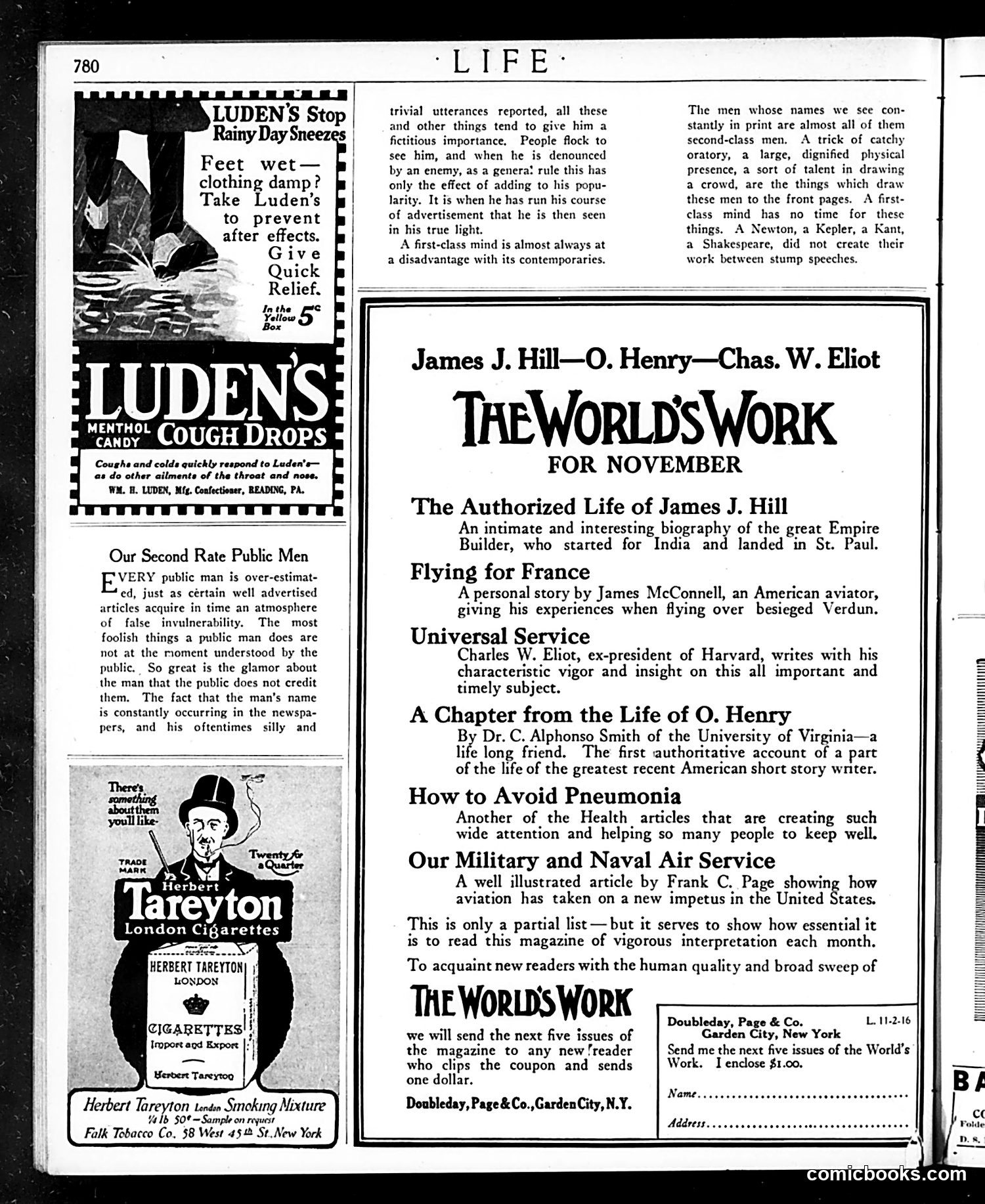
This page is primarily **advertising and promotional content** rather than editorial satire. The main elements are: ## Editorial Section A brief essay titled "Our Second Rate Public Men" argues that constantly publicized politicians and public figures are typically second-rate intellects. The author contends that truly first-class minds (Newton, Kepler, Shakespeare) don't waste time on self-promotion and speechmaking. The piece criticizes how media repetition creates false impressiveness around mediocre public figures. ## Advertisements The page features **two major product ads**: - **Luden's Cough Drops** (top left) - targeting rainy weather ailments - **Herbert Tareyton London Cigarettes** (bottom left) - a smoking mixture ## Magazine Promotion The bulk of the page promotes **The World's Work** magazine's November issue, listing upcoming articles on James J. Hill, aviation during WWI (Verdun), Charles W. Eliot on universal service, O. Henry biography, pneumonia prevention, and U.S. air service developments. The page reflects early-20th-century Life as a general-interest publication combining satirical commentary with commercial content and magazine cross-promotion.
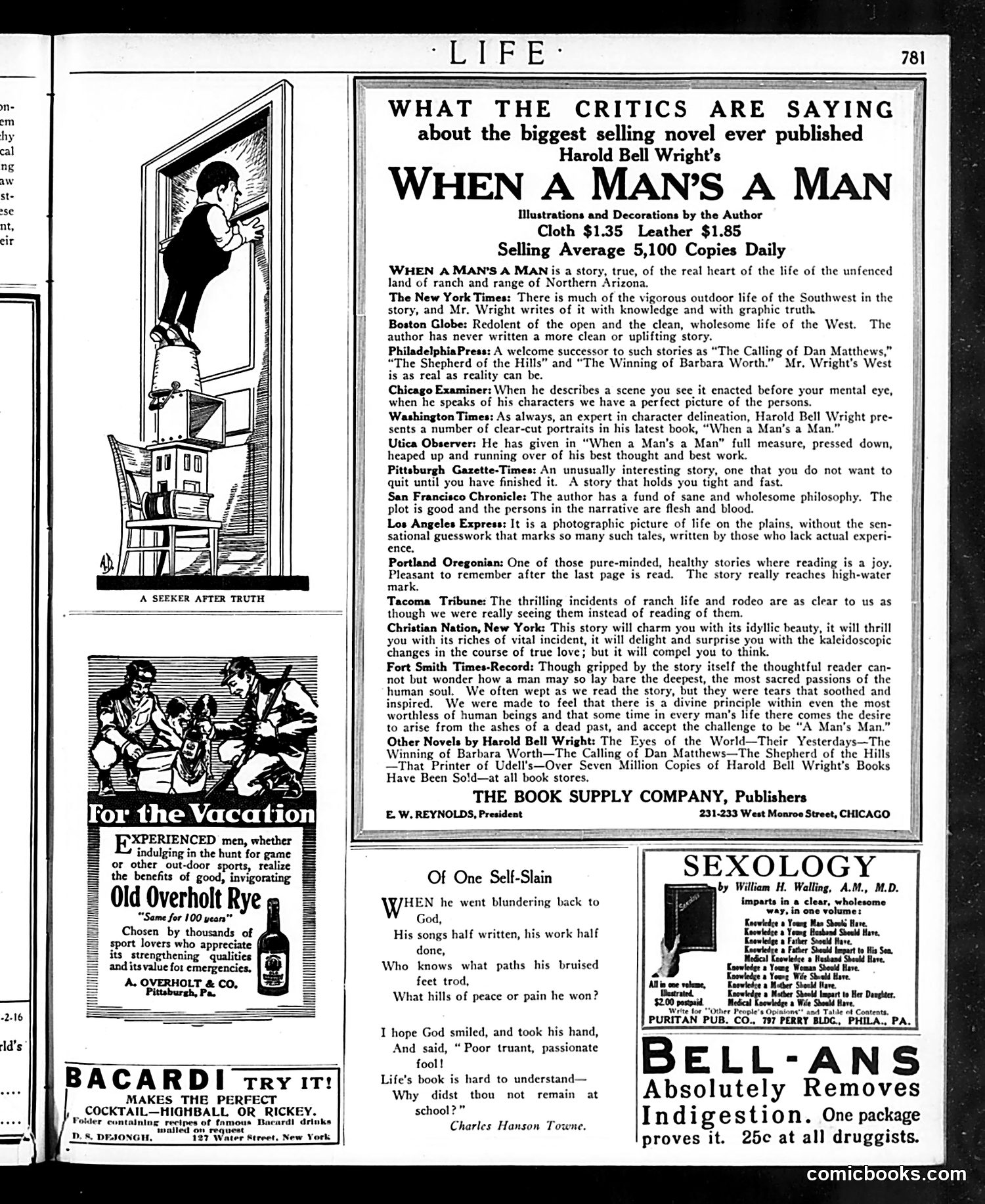
This page is primarily **advertising and book promotion**, not political satire. The dominant content is a full-page advertisement for Harold Bell Wright's novel *When a Man's a Man*, featuring glowing reviews from major newspapers praising its authentic depiction of Western ranch life and moral uplift. The left sidebar contains a small illustration labeled "A Seeker After Truth" showing a figure peering through a window—likely a visual metaphor for the novel's themes of seeking truth and understanding human nature. Below are unrelated advertisements: an Old Overholt Rye whiskey ad ("For the Vacation"), a Bacardi cocktail ad, and advertisements for Sexology and Bell-Ans digestive aids. The page reflects early 20th-century publishing marketing and consumer culture, with no evident political commentary or satire.
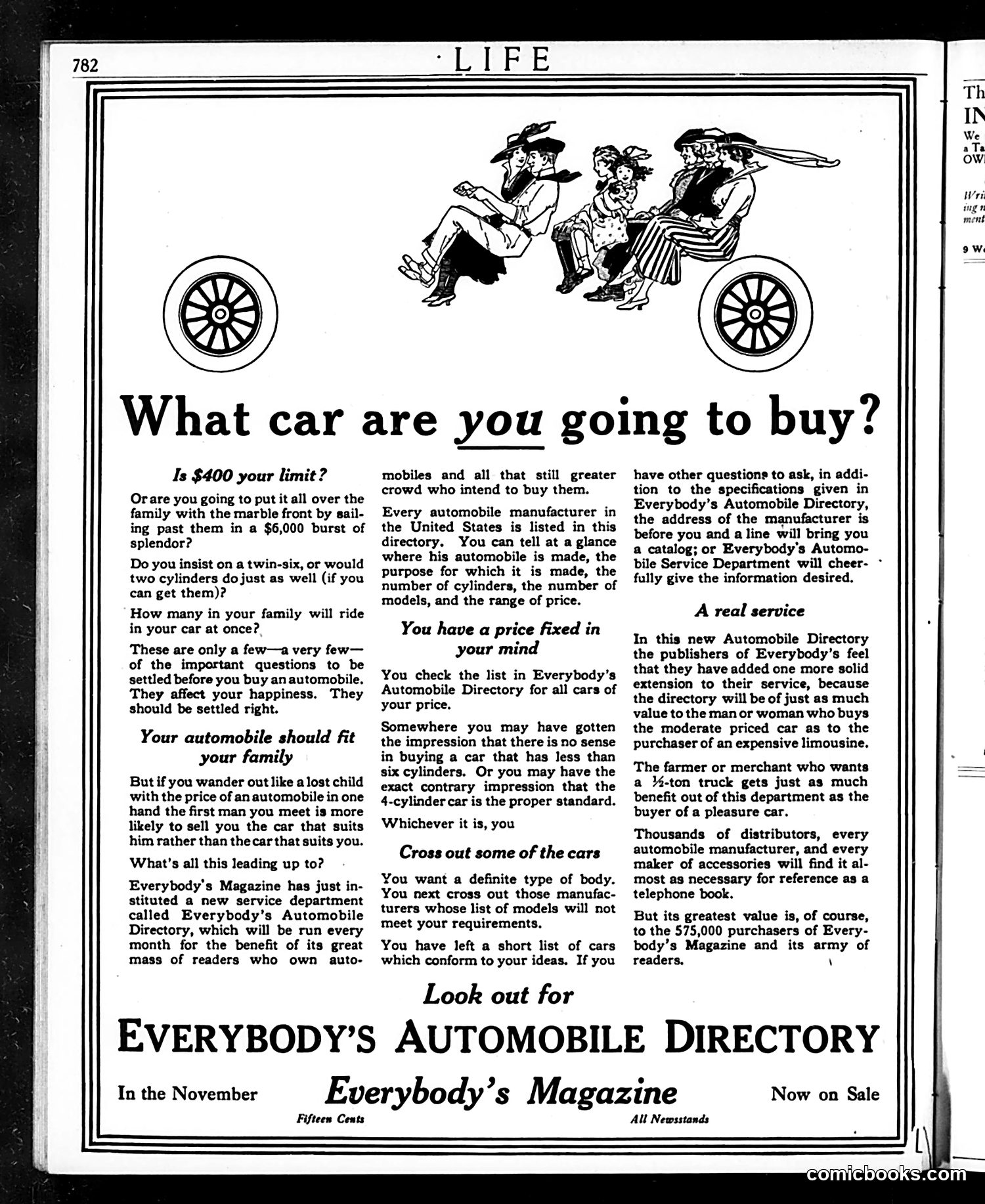
This is a **full-page advertisement** promoting "Everybody's Automobile Directory," a new service feature in Everybody's Magazine (November issue, price 15 cents). **The cartoon** at the top shows three well-dressed men in a car—a humorous illustration of potential car buyers, not political satire. **The pitch**: The ad addresses a genuine problem for early automotive consumers—the overwhelming choice and aggressive salesmanship in a rapidly expanding car market. It positions the directory as a rational decision-making tool, helping buyers match their budget ($400–$6,000), family size, and preferences (cylinder count, body type) against available models. **The social context**: This reflects the 1920s auto boom when car-buying involved genuine uncertainty about competing manufacturers, specs, and prices. The directory promised to democratize information, benefiting both wealthy buyers and modest-income customers ("the farmer or merchant"). **Not satire**—this is earnest advertising dressed in editorial language, targeting Life magazine's affluent readership while claiming to serve "575,000" magazine subscribers.
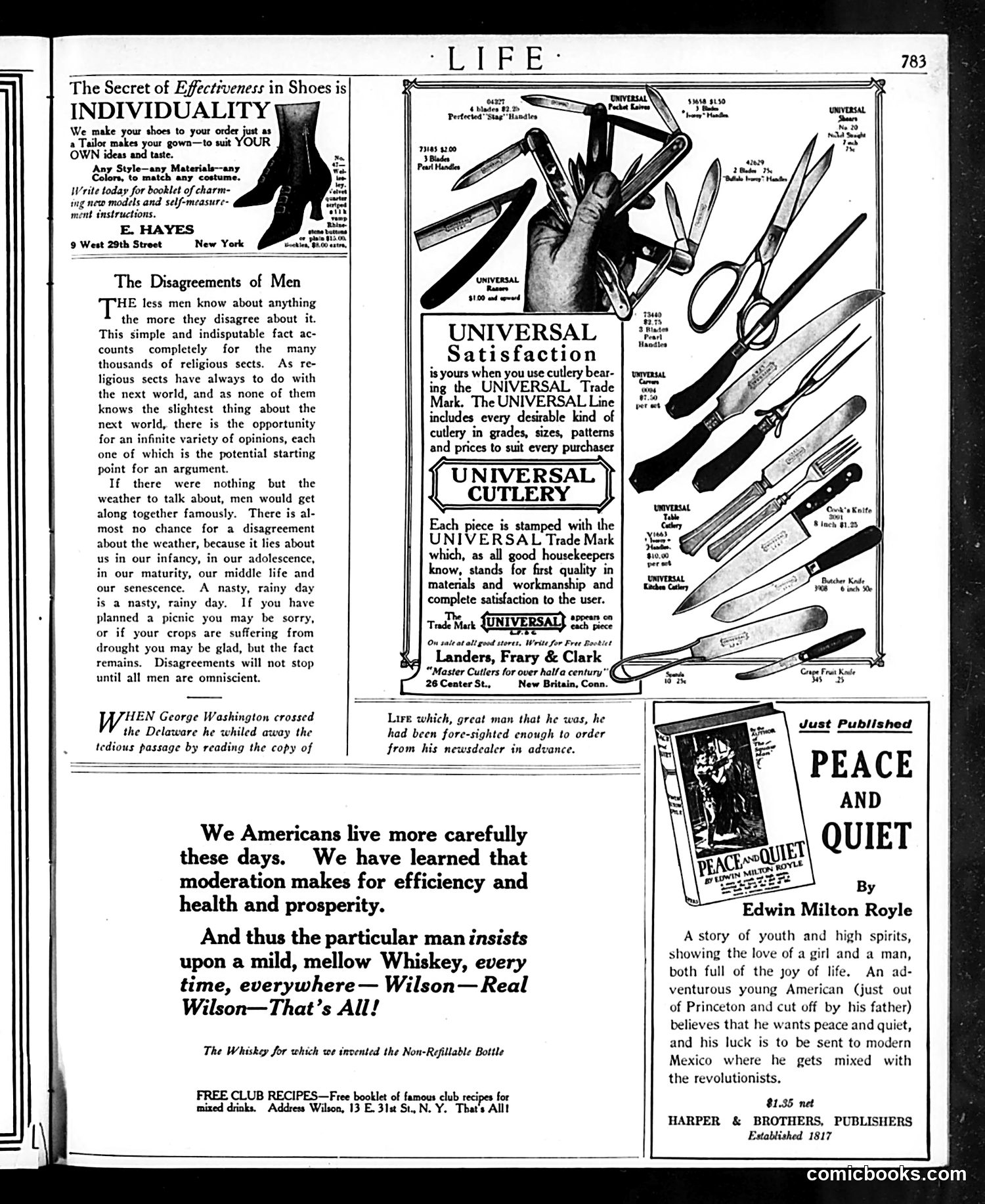
This page is primarily **advertising** with one satirical essay. The main content includes: **"The Disagreements of Men"** — A humorous essay arguing that human disagreement stems from ignorance. It claims people disagree most about things they know least about (like religion and the afterlife), whereas observable facts like weather produce consensus. The essay includes a joke about George Washington reading *Life* magazine while crossing the Delaware, presenting the magazine as so essential that even the Founding Father would have ordered it in advance — a self-promotional gag typical of 1920s advertising. **The Advertisements** dominate: E. Hayes shoes, Universal Cutlery, Wilson Whiskey (notably emphasizing the "Non-Refillable Bottle," likely a Prohibition-era reference to prevent black-market refilling), and a book promotion for *Peace and Quiet* by Edwin Milton Royle. The whiskey ad's emphasis on "moderation" and "efficiency" reflects post-Prohibition attitudes circa the 1920s.
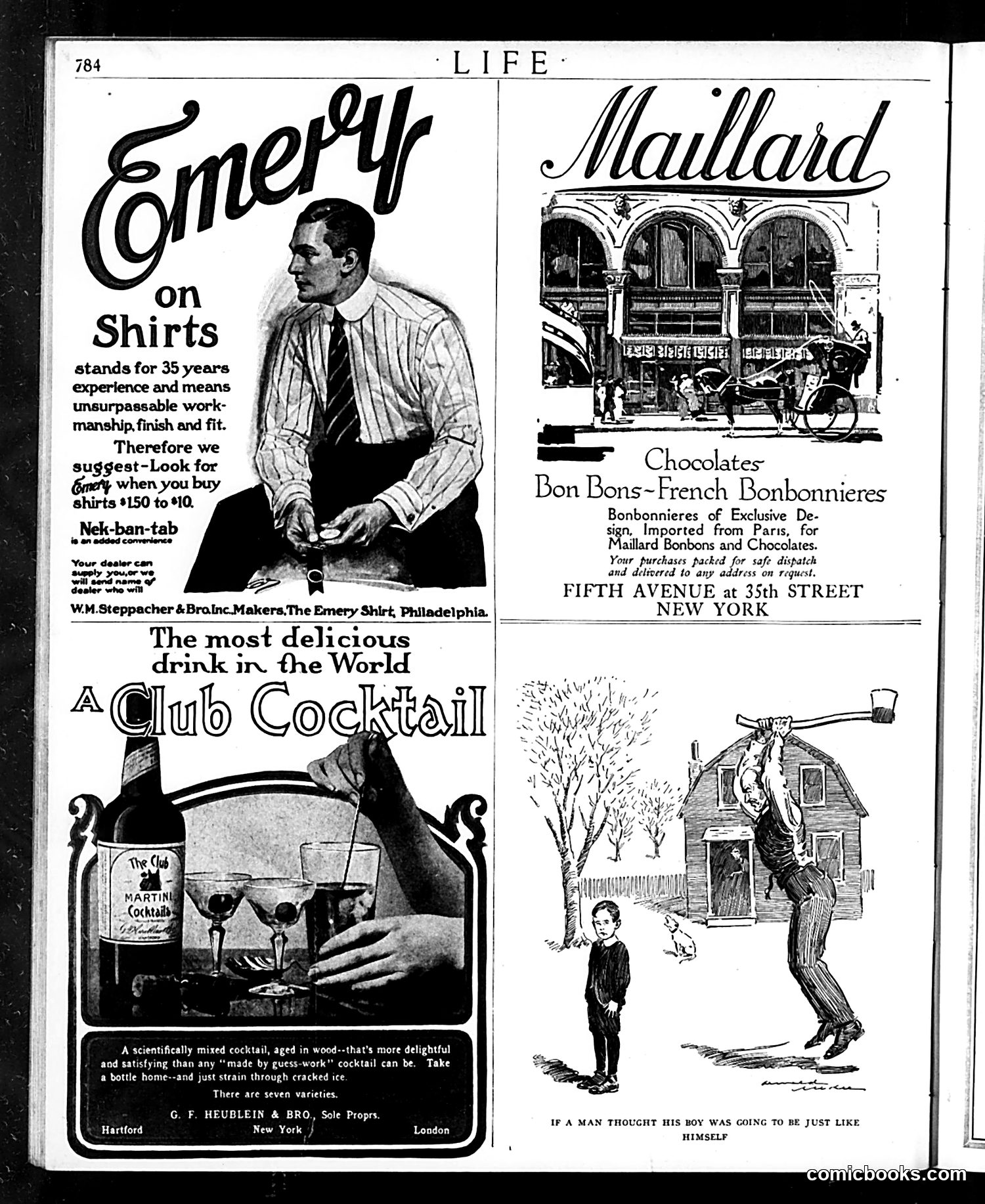
This is primarily a **advertising page** from an early 20th-century Life magazine, not political satire. The page contains four separate advertisements: 1. **Emery Shirts**: Markets quality menswear, emphasizing 35 years of craftsmanship and fit for the middle-to-upper class ($1.50-$10 price range). 2. **Maillard Chocolates**: Promotes imported French bonbons sold at a Fifth Avenue Manhattan location, targeting wealthy consumers. 3. **Club Cocktail**: Advertises pre-mixed, aged cocktails by Heublein & Brothers—a premium spirit product positioning itself as superior to homemade versions. 4. **Bottom cartoon**: A humorous domestic scene showing a father with a rope/lasso, apparently joking about wanting his son to become a cowboy or adventurer rather than follow the father's conventional path. The caption suggests parental anxiety about children's independence and aspirations. The page reflects early-1900s consumer culture targeting affluent urban audiences through sophisticated product positioning and gentle domestic humor.
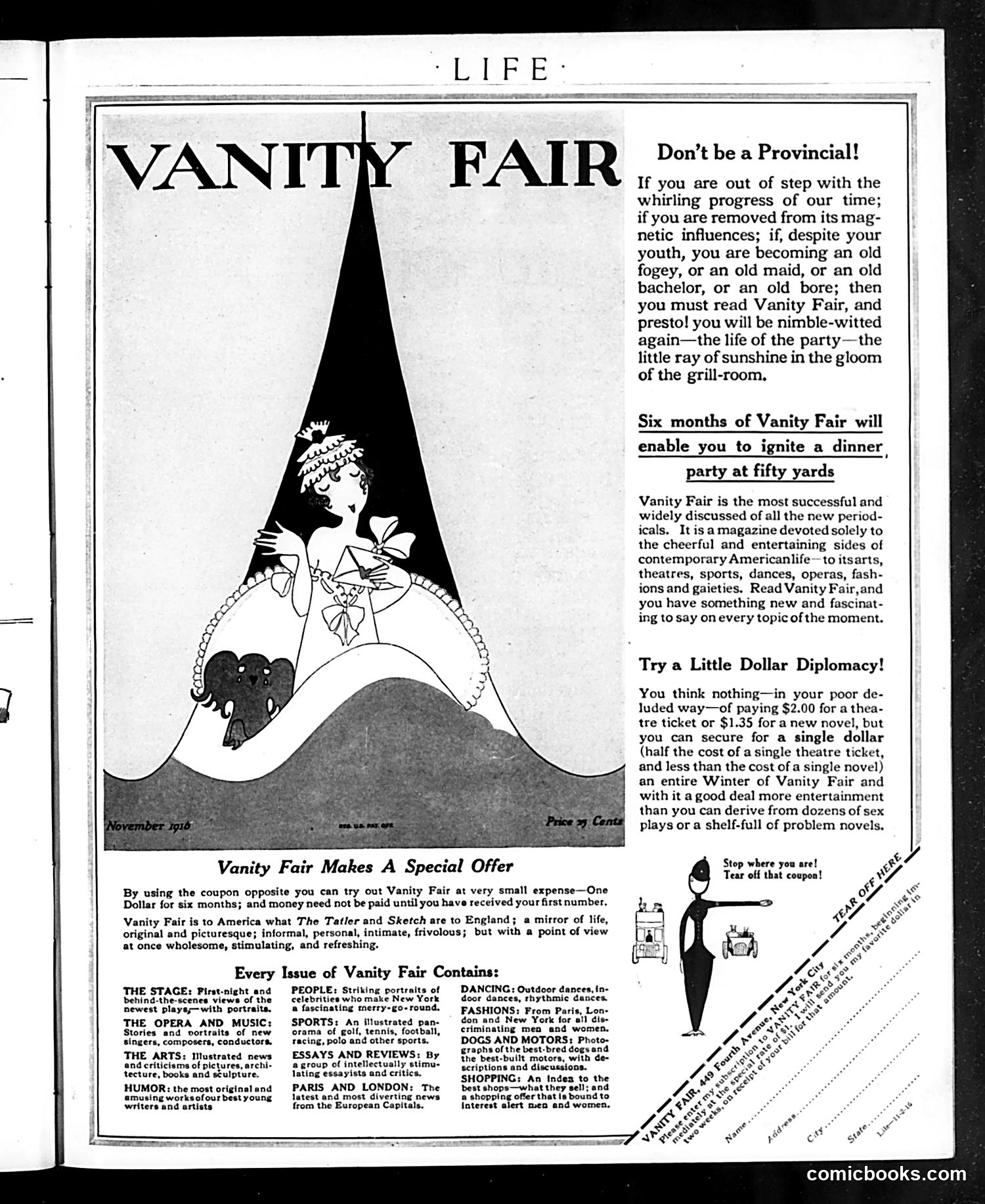
This is primarily a **magazine advertisement**, not a political cartoon. It promotes *Vanity Fair*, an American satirical periodical modeled on British publications like *The Tatler*. The central illustration depicts a stylized, fashionable woman in an elegant gown—representing the magazine's target audience of sophisticated, urbane readers. The advertisement uses **social shaming as its sales pitch**: readers who aren't keeping up with current trends risk becoming "old fogey," "old maid," or "old bore." Subscribing to *Vanity Fair* promises to make one witty and socially accomplished ("the life of the party"). The "**Dollar Diplomacy**" section cleverly positions the $1 six-month subscription as an economical alternative to theatre tickets or novels—offering more entertainment value while signaling cultural sophistication to one's peers. The satire here targets middle-class anxiety about appearing outdated or provincial during this period of rapid social change.
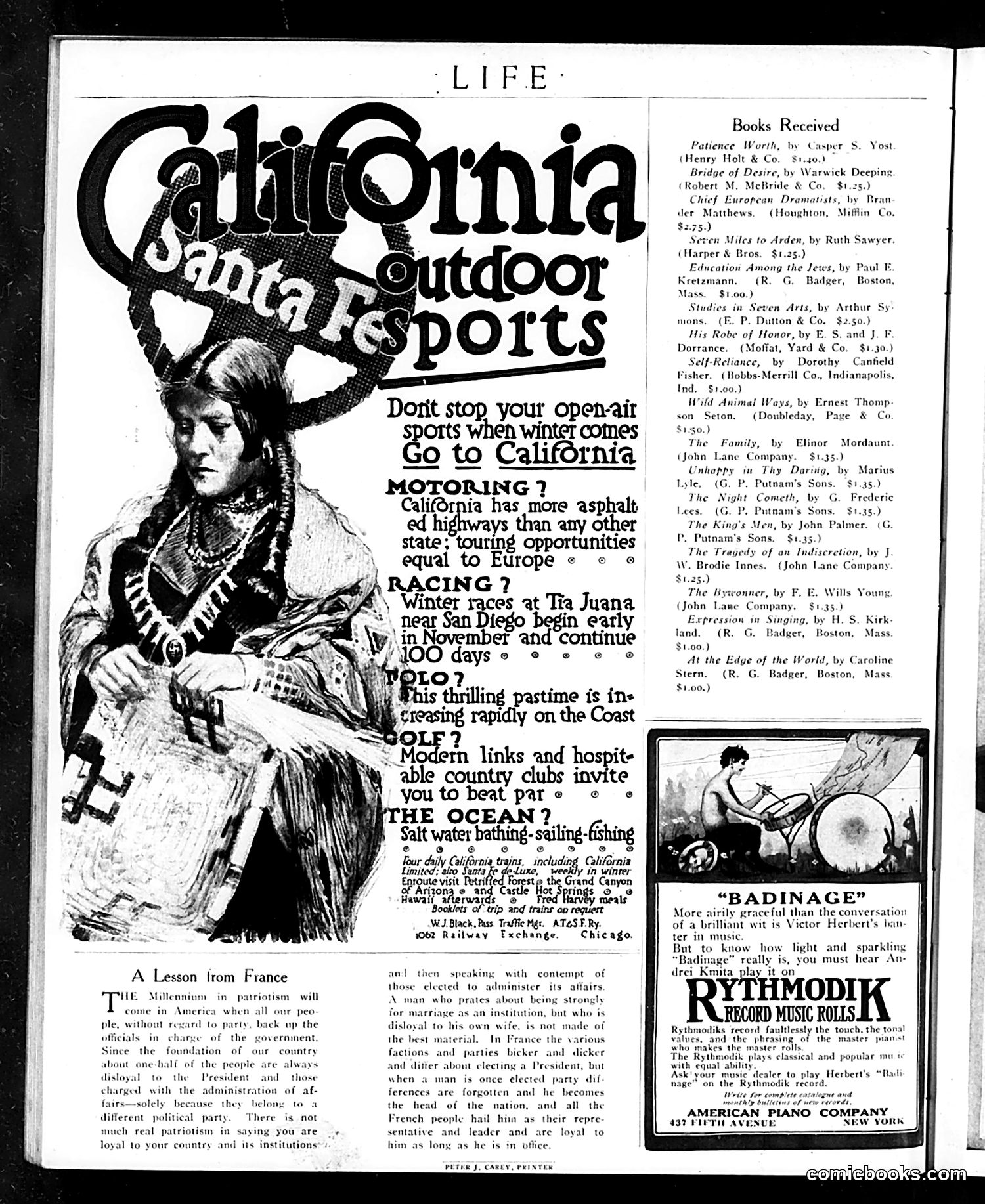
This page contains two distinct elements: **Main Advertisement (Left):** A promotional piece encouraging Americans to visit California for winter sports. It features a Native American figure and lists outdoor activities—motoring, racing at Tijuana, polo, golf, ocean bathing—framing California as a year-round destination rivaling Europe. **"A Lesson from France" (Center/Right):** A political editorial arguing that American patriotism is compromised by partisan loyalty. The author contrasts this with France, where citizens unite behind their elected president regardless of party affiliation. The piece criticizes Americans who claim patriotism while remaining "disloyal" to sitting presidents simply because they belong to opposing parties—comparing this hypocrisy to disloyalty in marriage. **Context:** This appears to address early 20th-century partisan divisions, suggesting the editorial writer believes Americans should transcend party politics to support their government's leadership, much as the French do. The remaining content consists of book advertisements and a music roll advertisement for Victor Herbert's "Badinage."
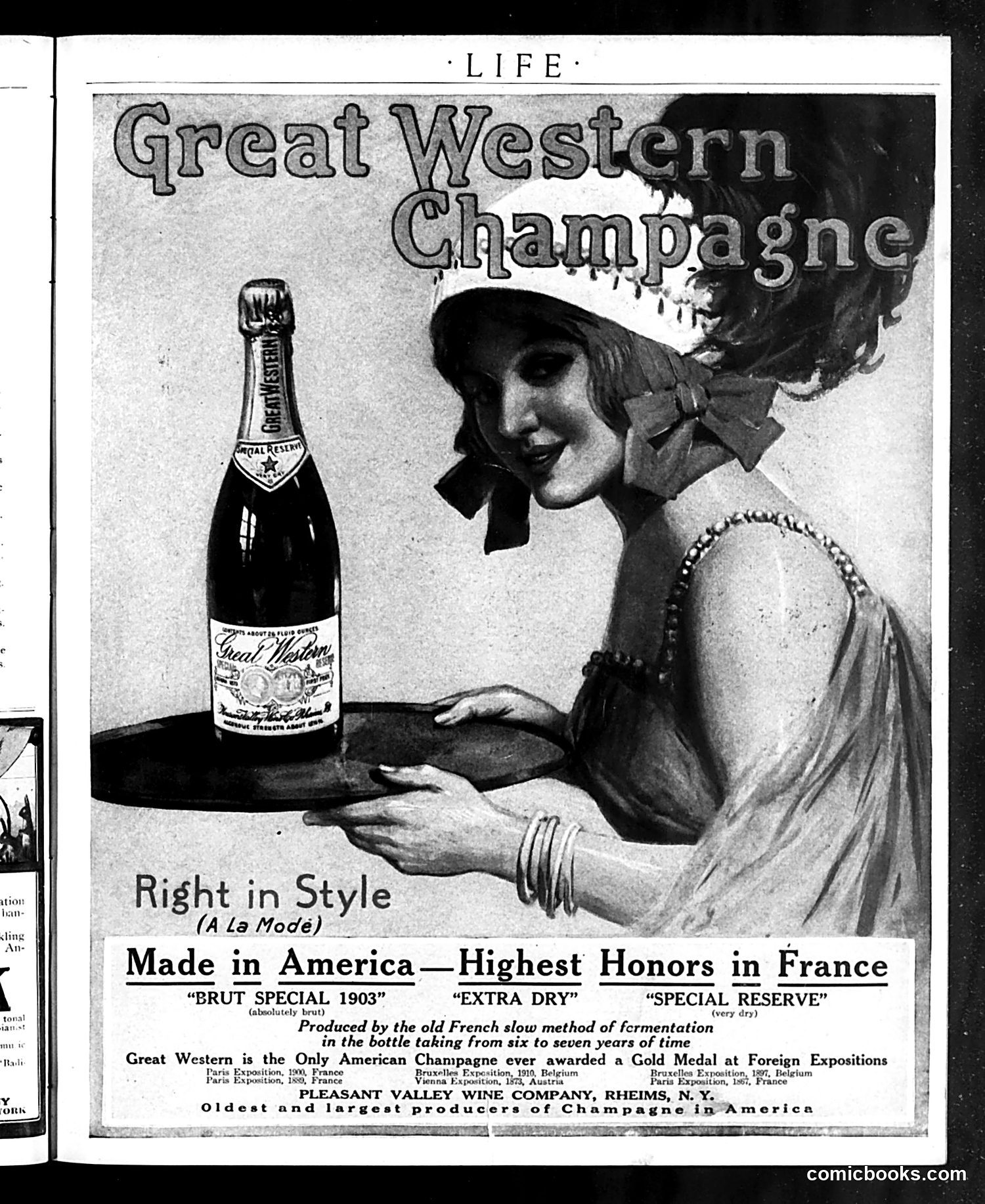
This is a **product advertisement**, not satire or political commentary. It promotes Great Western Champagne, made by Pleasant Valley Wine Company in Rheims, New York. The image features a fashionable woman in 1920s styling—cloche hat, pearl necklace, and elegant dress—positioned beside a champagne bottle. The ad's appeal is aspirational: it emphasizes that this American-made champagne earned "Gold Medals" at prestigious European expositions (Paris 1889, Brussels 1910, Vienna 1873), positioning it as worthy of European approval. The tagline "Right in Style (A La Mode)" reinforces this marketing strategy: American consumers could purchase sophisticated French-style champagne without importing it. The ad exploits post-WWI American confidence and growing consumer culture, suggesting that American products could match European prestige and elegance.
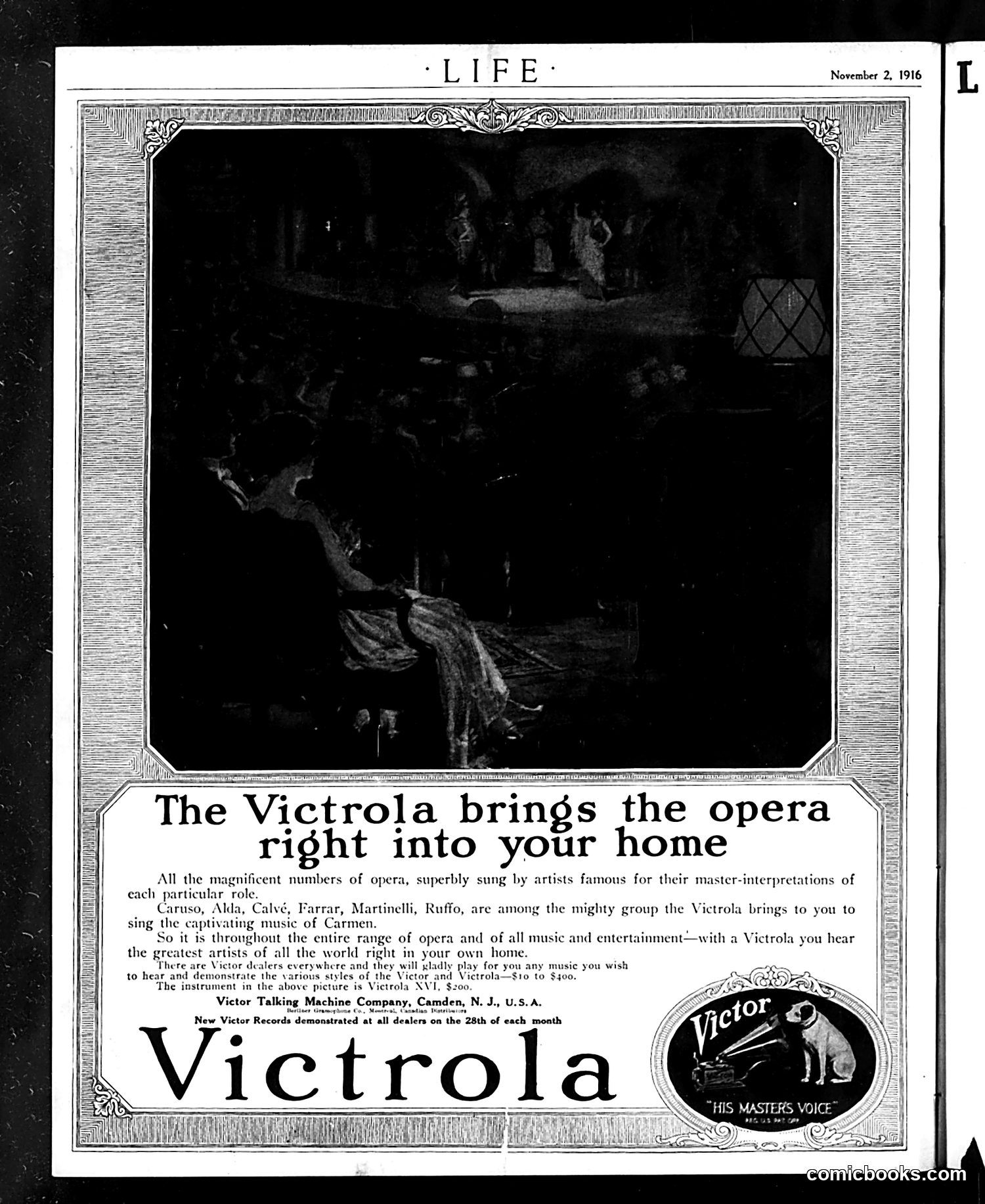
This is **a Victrola phonograph advertisement**, not a political cartoon. It appeared in *Life* magazine on November 2, 1916. The ad promotes the Victrola as a home entertainment device that brings opera performances into ordinary households. It names famous opera singers of the era—Caruso, Gigli, Farrar, Martinelli, and Ruffo—whose recordings could be played on the machine. The advertisement emphasizes that listeners can now hear "the greatest artists of all the world right in your own home." The dark photograph shows what appears to be an interior scene, likely meant to evoke an intimate home listening experience. The "His Master's Voice" logo (featuring the famous dog listening to a phonograph) appears at bottom right. This represents early 20th-century consumer culture: selling the Victrola as a luxury item that democratizes access to high-culture entertainment (opera) previously available only to the wealthy who could attend live performances. The price started at $15.