
Life, 1916-11-02 · page 28 of 46
Life — November 2, 1916 — page 28: what you’re looking at
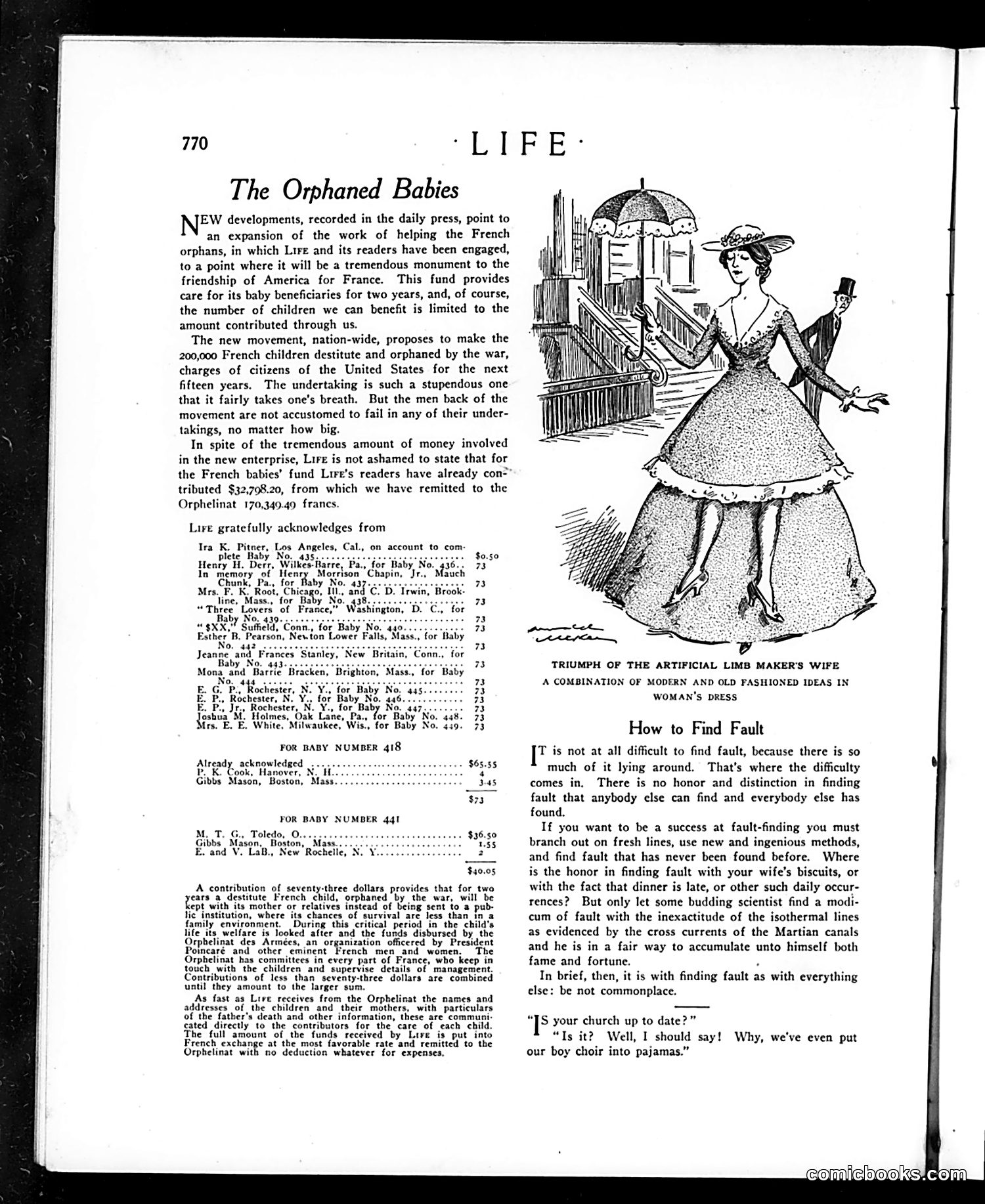
What you’re looking at
This page documents Life magazine's fundraising campaign for French war orphans following World War I. The illustrated figure shows a fashionable American woman—likely representing the magazine's affluent readership—displaying her charitable identity through modern dress combining contemporary and traditional elements (captioned "Triumph of the Artificial Limb Maker's Wife"). The text announces an expansion of Life's orphan-sponsorship program: readers have already contributed over $32,000 to care for French children orphaned by the war. The magazine appeals for continued donations ($73 per child for two years of care), listing individual contributors by name and baby number. Life emphasizes that funds go directly to the French Orphelinat organization with "no deduction whatever for expenses"—addressing potential donor concerns about administrative overhead. The satire is gentle: wealthy American women are portrayed as fashionable yet genuinely philanthropic, their vanity channeled toward worthy humanitarian purposes supporting America's French allies.
📄 Transcribed text from this page (OCR, searchable)
Machine-transcribed from the original scan — historical spelling and the odd misread are preserved.
The Orphaned Babies NEW developments, recorded in the daily press, point to an expansion of the work of helping the French orphans, in which Lire and its readers have been engaged, to a point where it will be a tremendous monument to the friendship of America for France. This fund provides care for its baby beneficiaries for two years, and, of course, the number of children we can benefit is limited to the amount contributed through us. The new movement, nation-wide, proposes to make the 200,000 French children destitute and orphaned by the war, charges of citizens of the United States for the next fifteen years. The undertaking is such a stupendous one that it fairly takes one’s breath. But the men back of the movement are not accustomed to fail in any of their under- takings, no matter how big. In spite of the tremendous amount of money involved in the new enterprise, Lire is not ashamed to state that for the French babies’ fund Lire’s readers have already con? tributed $32,798.20, from which we have remitted to the Orphelinat 170,349.49 francs. Live gratefully acknowledges from Ira K. Pitner, Los Angeles, Cal., on account to com: plete Baby No. 435. wees 7 Henry H. Derr, Wilkes-iarre, Pa., for Baby, No. 436. In memory of Henry Morrison Chapin, Jr., Mauch Chunk, Pa., for Baby No. 437.. Root, Chicago, Il. and C.D. Trwin, Brook- ¢, Mass., for Baby No. 438. “Three Lovers of France,” Washington, D. Baby No. 439. XX," Suffield, Conn., for Baby No. 440 i Esther B. Pearson, Newton Lower Falls, Mass., for Haby No. 442. ses Jeanne and. Frances’ Stanley, ‘New Britain, Conn..’ for Baby No. 44 vases Mong and Barrie Bracken, Brighton, Mass.. for Baby No. 444. oe E. G. P., Rochester, } for’ Baby ‘No. 445 E. P., Rochester, N. Y., for Baby No. 446, E, P., Jr., Rochester, N. Y., for Baby joshua M. Holmes, Oak Lane, Pa., for Baby 448. Mrs. E. E. White, Milwaukee, Wis., for Baby No. 449. 0. $47 FOR BABY NUMBER 418 Already acknowledged P. K. Cook, Hanover, No Hi Gibbs Mason, Boston, Mass. FOR BABY NUMBER 441 . G.. Toledo, 0. bs” Mason, Boston, 5 15S and V, LaB., New Rochelle, $40.05 A contribution of seventy-three dollars provides that for two Zeats a, destitute, French child, “orphaned by the war, will be kept with its mother or relatives instead of being sent to a pub- lic institution, where its chances of survival are less than In a family environment. During this critical period in the child's life its welfare is looked after and the funds disbursed by the Orphelinat des Armées, an organization officered by President Poincaré and other eminent French men and women, The Orphelinat has committees in every part of France, who keep in touch with the children and supervise details of’ management. Contributions of less than seventy-three dollars are combined until they amount to the larger sum. As fast as Live receives from the Orphelinat the names and addresses of the children and their mothers, with particulars of the father’s death and other information, these are communi- gated directly to the contributors for the care of each child. The full amount of the funds received by Lire is put into French exchange at the most favorable rate and remitted to the Orphelinat with no deduction whatever for expenses. TRIUMPH OF THE ARTIFICIAL LIMB MAKER'S WIFE A COMBINATION OF MODERN AND OLD FASHIONED IDEAS IN WOMAN'S DRESS How to Find Fault i is not at all difficult to find fault, because there is so much of it lying around. That's where the difficulty comes in. There is no honor and distinction in finding fault that anybody else can find and everybody else has found. If you want to be a success at fault-finding you must branch out on fresh lines, use new and ingenious methods, and find fault that has never been found before. Where is the honor in finding fault with your wife’s biscuits, or with the fact that dinner is late, or other such daily occur- rences? But only let some budding scientist find a modi- cum of fault with the inexactitude of the isothermal lines as evidenced by the cross currents of the Martian canals and he is in a fair way to accumulate unto himself both fame and fortune. . In brief, then, it is with finding fault as with everything else: be not commonplace. “TS your church up to date?” “Is it? Well, I should say! our boy choir into pajamas.” Why, we've even put