
Life, 1916-11-02 · page 8 of 46
Life — November 2, 1916 — page 8: what you’re looking at
What you’re looking at
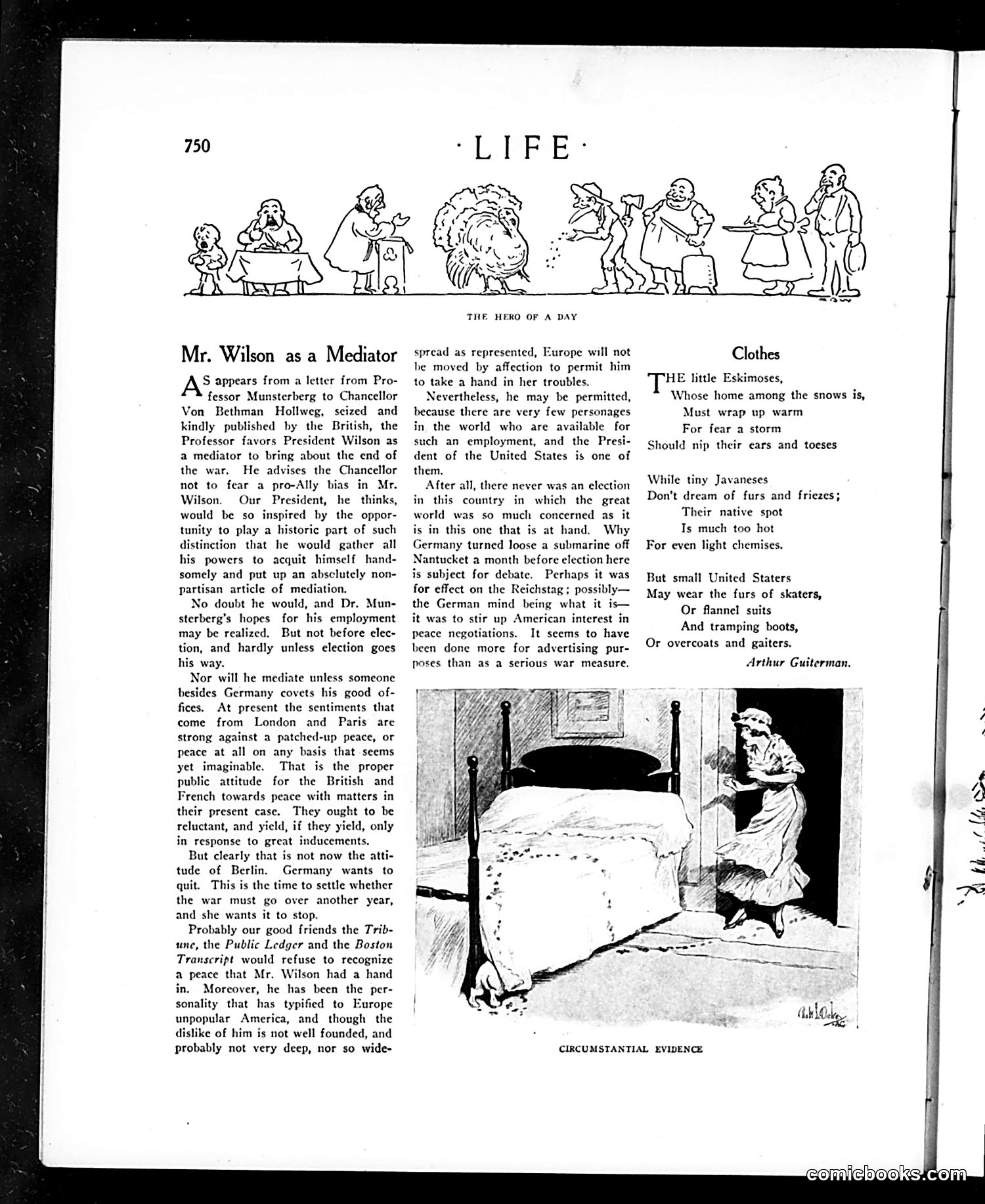
This page contains two distinct pieces: **Left column:** An article titled "Mr. Wilson as a Mediator" discusses President Wilson's potential role in peace negotiations to end World War I. The text debates whether Wilson could effectively mediate between Britain, France, and Germany, questioning his popularity in Europe and whether Germany would accept his involvement. **Right side:** A humorous poem titled "Clothes" by Arthur Guiterman describes how different groups (Eskimos, Javanese, and Americans) dress appropriately for their climates. **Bottom cartoon:** "Circumstantial Evidence" shows a woman discovering a muddy footprint on a bed, with a guilty-looking figure visible. This is a domestic humor cartoon playing on the implication of infidelity or impropriety—the "circumstantial evidence" being the unexplained dirt on the bedding.
📄 Transcribed text from this page (OCR, searchable)
Machine-transcribed from the original scan — historical spelling and the odd misread are preserved.
Mr. Wilson as a Mediator S appears from a letter from Pro- fessor Munsterberg to Chancellor Von Bethman Hollweg, seized and kindly published by the British, the Professor favors President Wilson as a mediator to bring about the end of the war. He advises the Chancellor not to fear a pro-Ally bias in Mr. Wilson. Our President, he thinks, would be so inspired by the oppor- tunity to play a historic part of such distinction that he would gather all his powers to acquit himself hand- somely and put up an absclutely non- partisan article of mediation, No doubt he would, and Dr. Mun- sterberg’s hopes for his employment may be realized. But not before elec- tion, and hardly unless election goes his way. Nor will he mediate unless someone besides Germany covets his good of- fices. At present the sentiments that come from London and Paris are strong against a patched-up peace, or peace at all on any basis that seems yet imaginable. That is the proper public attitude for the British and French towards peace with matters in their present case. They ought to be reluctant, and yield, if they yield, only in response to great inducements, But clearly that is not now the atti- tude of Berlin. Germany wants to quit. This is the time to settle whether the war must go over another year, and she wants it to stop. Probably our good friends the Trib- tune, the Public Ledger and the Boston Transcript would refuse to recognize a peace that Mr. Wilson had a hand Morcover, he has been the per- typified to Europe unpopular America, and though the dislike of him is not well founded, and probably not very deep, nor so wide- THE HERO OF A DAY spread as represented, Europe will not he moved by affection to permit him to take a hand in her troubles. Nevertheless, he may be permitted, because there are very few personages in the world who are available for such an employment, and the Presi- dent of the United States is one of them, After all, there never was an election in this country in which the great world was so much concerned as it is in this one that is at hand. Why Germany turned loose a submarine off Nantucket a month before election here is subject for debate. Perhaps it was for effect on the Reichstag; possibly— the German mind being what it is— it was to stir up American interest in peace negotiations. It seems to have been done more for advertising pur- poses than as a serious war measure. Clothes HE little Eskimoses, Whose home among the snows is, Must wrap up warm For fear a storm Should nip their ears and toeses While tiny Javaneses Don't dream of furs and friezes; Their native spot Is much too hot For even light chemises. But small United Staters May wear the furs of skaters, Or flannel suits And tramping boots, Or overcoats and gaiters. Arthur Guiterman. CIRCUMSTANTIAL EVIDENCE