
Life, 1916-11-02 · page 29 of 46
Life — November 2, 1916 — page 29: what you’re looking at
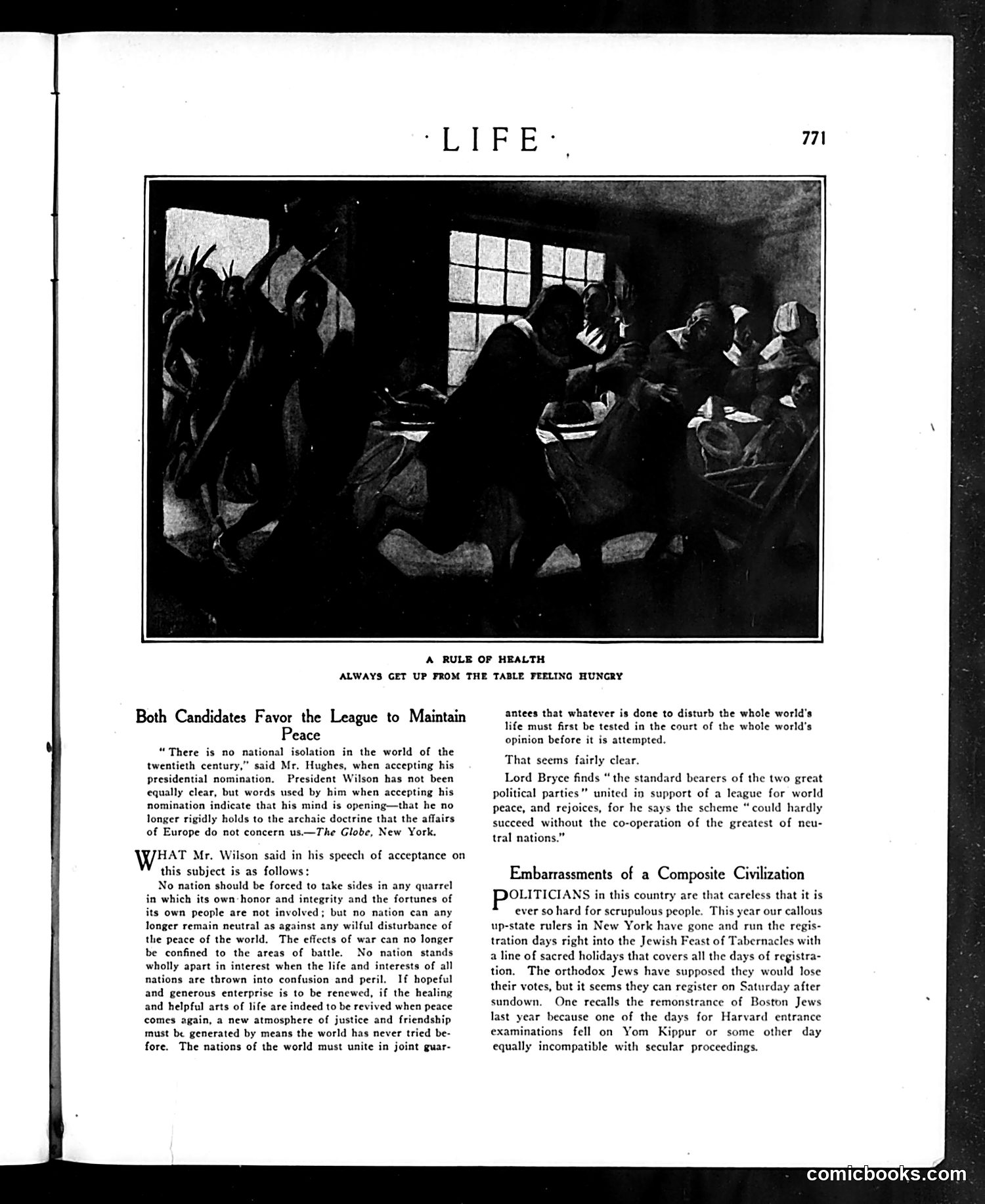
What you’re looking at
The top illustration depicts a heated political debate or confrontation in an indoor setting, likely representing the 1916 presidential campaign discourse on America's isolationism versus international involvement. The text below addresses both 1916 presidential candidates—Wilson and Hughes—both endorsing a League to Maintain Peace, marking a shift from strict isolationism. The article notes Wilson's acceptance speech clarified that while nations shouldn't be forced into foreign quarrels, they can no longer remain neutral during global disturbances. The lower section satirizes New York politicians for scheduling voter registration during the Jewish Feast of Tabernacles, forcing Orthodox Jews to choose between religious observance and voting rights. This highlights the awkward conflicts arising from America's "composite civilization"—a diverse society where secular government scheduling conflicts with religious communities' sacred observances. The satire targets governmental insensitivity to minority religious practices.
📄 Transcribed text from this page (OCR, searchable)
Machine-transcribed from the original scan — historical spelling and the odd misread are preserved.
A RULE OF HEALTH ALWAYS GET UP FROM THE TABLE FEELING HUNGRY Both Candidates Favor the League to Maintain Peace “There is no national isolation in the world of the twentieth century,” said Mr, Hughes, when accepting his presidential nomination. President Wilson has not been equally clear, but words used by him when accepting his nomination indicate that his mind is opening—that he no longer rigidly holds to the archaic doctrine that the affairs of Europe do not concern us—The Globe, New York. HAT Mr. Wilson said in his speech of acceptance on this subject is as follows: No nation should be forced to take sides in any quarrel in which its own honor and integrity and the fortunes of its own people are not involved; but no nation can any longer remain neutral as against any wilful disturbance of the peace of the world. The effects of war can no longer be confined to the areas of battle. No nation stands wholly apart in interest when the life and interests of all nations are thrown into confusion and peril. If hopeful and generous enterprise is to be renewed, if the healing and helpful arts of life are indeed to be revived when peace comes again, a new atmosphere of justice and friendship must be generated by means the world has never tried be- fore. The nations of the world must unite in joint guar- antees that whatever is done to disturb the whole world’s life must first be tested in the court of the whole world’s opinion before it is attempted. That seems fairly clear. Lord Bryce finds “the standard bearers of the two great political parties” united in support of a league for world peace, and rejoices, for he says the scheme “could hardly succeed without the co-operation of the greatest of neu- tral nations.” Embarrassments of a Composite Civilization POLITICIANS in this country are that careless that it is ever so hard for scrupulous people. This year our callous up-state rulers in New York have gone and run the re; tration days right into the Jewish Feast of Tabernacles with a line of sacred holidays that covers all the days of registra- tion, The orthodox Jews have supposed they would lose their votes, but it seems they can register on Saturday after sundown. One recalls the remonstrance of Boston Jews last year because one of the days for Harvard entrance examinations fell on Yom Kippur or some other day equally incompatible with secular proceedings. comicbooks.com