
Life, 1916-11-02 · page 12 of 46
Life — November 2, 1916 — page 12: what you’re looking at
What you’re looking at
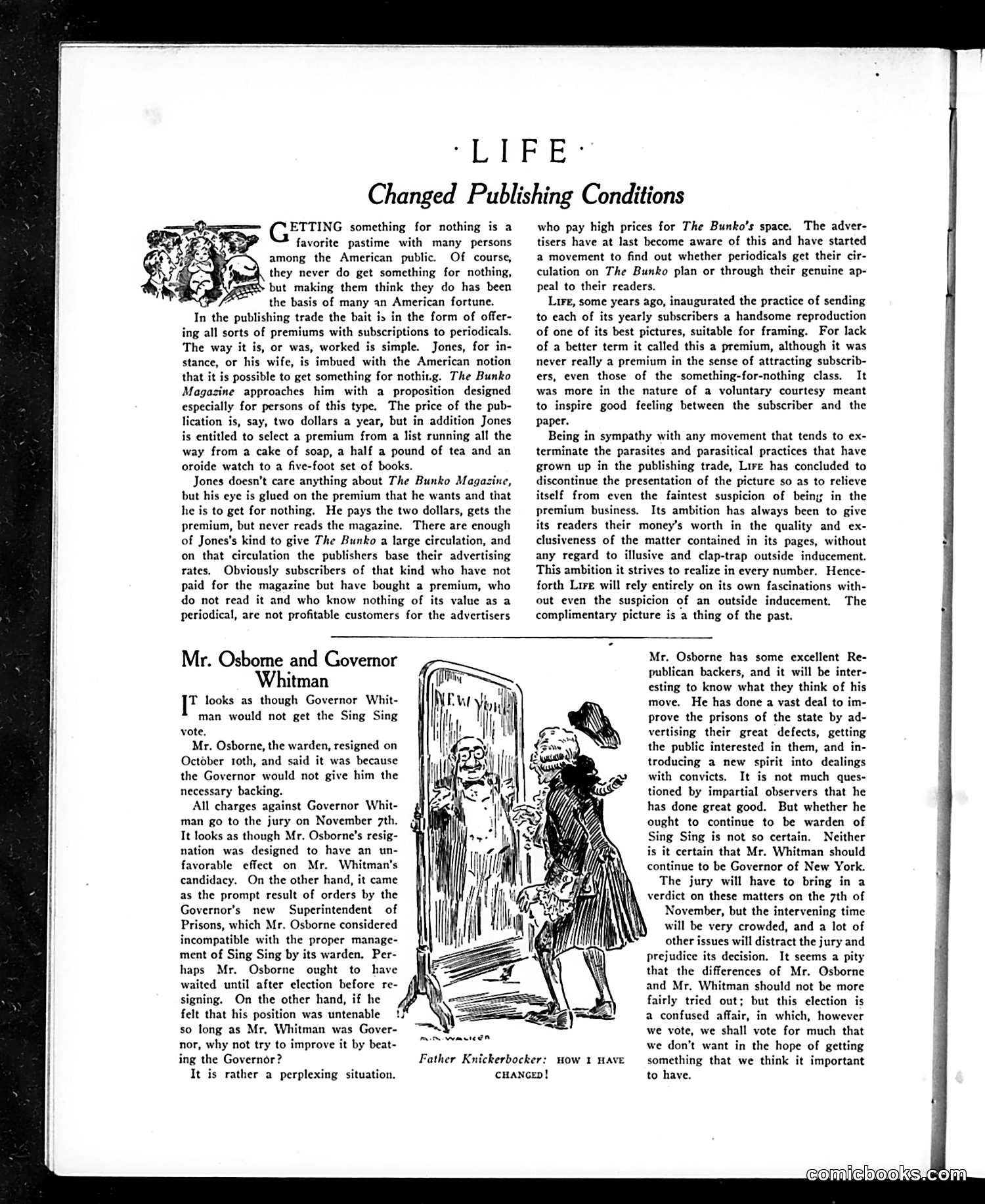
The cartoon depicts Father Knickerbocker (a personification of New York City, shown as an elderly Dutch figure) looking into a mirror at his transformed reflection. The accompanying article discusses Governor Whitman and Mr. Osborne's conflict over prison reform and the upcoming election. The satire suggests New York itself has undergone dramatic change—likely referring to political upheaval or shifts in governance. The mirror gag implies the city barely recognizes itself. Given the text's focus on Osborne's prison reforms and Whitman's political position, the cartoon critiques how political maneuvering and internal conflicts have fundamentally altered New York's character and governance, leaving even the city's symbolic representation stunned by the transformation.
📄 Transcribed text from this page (OCR, searchable)
Machine-transcribed from the original scan — historical spelling and the odd misread are preserved.
Changed Publishing Conditions ETTING something for nothing is a favorite pastime with many persons among the American public. Of course, they never do get something for nothing, but making them think they do has been the basis of many an American fortune. In the publishing trade the bait is in the form of offer- ing all sorts of premiums with subscriptions to periodicals. The way it is, or was, worked is simple. Jones, for in- stance, or his wife, is imbued with the American notion that it is possible to get something for nothing. The Bunko Magazine approaches him with a proposition designed especially for persons of this type. The price of the pub- lication is, say, two dollars a year, but in addition Jones is entitled to select a premium from a list running all the way from a cake of soap, a half a pound of tea and an oroide watch to a five-foot set of books. Jones doesn’t care anything about The Bunko Magazine, but his eye is glued on the premium that he wants and that he is to get for nothing. He pays the two dollars, gets the premium, but never reads the magazine. There are enough of Jones's kind to give The Bunko a large circulation, and on that circulation the publishers base their advertising rates, Obviously subscribers of that kind who have not paid for the magazine but have bought a premium, who do not read it and who know nothing of its value as a periodical, are not profitable customers for the advertisers who pay high prices for The Bunko’s space. The adver- tisers have at last become aware of this and have started a movement to find out whether periodicals get their cir- culation on The Bunko plan or through their genuine ap- peal to their readers. Lire, some years ago, inaugurated the practice of sending to each of its yearly subscribers a handsome reproduction of one of its best pictures, suitable for framing. For lack of a better term it called this a premium, although it was never really a premium in the sense of attracting subscrib- ers, even those of the something-for-nothing class. It was more in the nature of a voluntary courtesy meant to inspire good feeling between the subscriber and the Paper. Being in sympathy with any movement that tends to ex- terminate the parasites and parasitical practices that have grown up in the publishing trade, Lire has concluded to discontinue the presentation of the picture so as to relieve itself from even the faintest suspicion of being in the premium business. Its ambition has always been to give its readers their money’s worth in the quality and ex- clusiveness of the matter contained in its pages, without any regard to illusive and clap-trap outside inducement. This ambition it strives to realize in every number. Hence- forth Lire will rely entirely on its own fascinations with- out even the suspicion of an outside inducement. The complimentary picture is a thing of the past. Mr. Osbome and Govemor Whitman a looks as though Governor Whit- man would not get the Sing Sing vote, Mr. Osborne, the warden, resigned on October roth, and said it was because the Governor would not give him the necessary backing. All charges against Governor Whit- man go to the jury on November 7th. It looks as though Mr. Osborne's resig- nation was designed to have an un- favorable effect on Mr. Whitman's candidacy. On the other hand, it came as the prompt result of orders by the Governor's new Superintendent of Prisons, which Mr. Osborne considered incompatible with the proper manage- ment of Sing Sing by its warden, Per- haps Mr. Osborne ought to have waited until after election before re- signing. On the other hand, if he felt that his position was untenable so long as Mr, Whitman was Gover- nor, why not try to improve it by beat- ing the Governor? It is rather a perplexing situation. mo weer Father Knickerbocker: How 1 HAVE CHANGE! Mr. Osborne has some excellent Re- publican backers, and it will be inter- esting to know what they think of his move. He has done a vast deal to im- prove the prisons of the state by ad- vertising their great defects, getting the public interested in them, and in- troducing a new spirit into dealings with convicts. It is not much ques- tioned by impartial observers that he has done great good. But whether he ought to continue to be warden of Sing Sing is not so cert Neither is it certain that Mr. Whitman should continue to be Governor of New York. The jury will have to bring in a verdict on these matters on the 7th of November, but the intervening time will be very crowded, and a lot of other issues will distract the jury and prejudice its decision. It seems a pity that the differences of Mr. Osborne and Mr. Whitman should not be more fairly tried out; but this election is a confused affair, in which, however we vote, we shall vote for much that we don’t want in the hope of getting something that we think it important ! to have,