
Life, 1916-11-02 · page 25 of 46
Life — November 2, 1916 — page 25: what you’re looking at
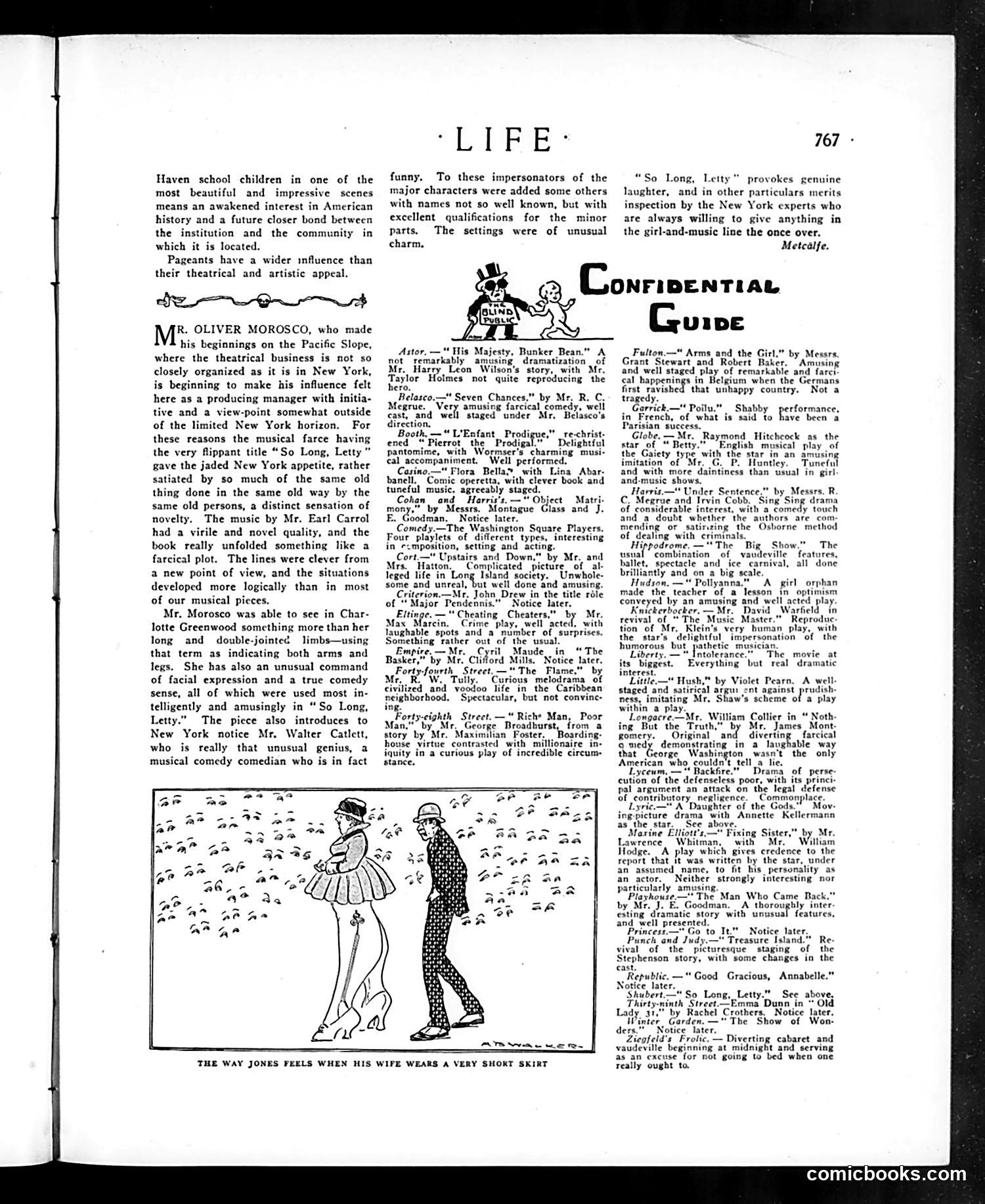
What you’re looking at
This cartoon satirizes early 1920s fashion anxieties about women's hemlines. The illustration shows a man (labeled "Jones") with an exaggerated, uncomfortable posture—legs splayed awkwardly, body contorted—while his fashionably dressed wife walks beside him in a notably short skirt (visible by the era's standards). The humor targets masculine embarrassment and social anxiety about changing women's fashion. As hemlines rose during this period, conservative men worried about propriety and public perception. The cartoon mocks this discomfort by literalizing it: Jones's body physically contorts in distress at his wife's modern dress. The page itself reviews theatrical productions, making this fashion commentary a humorous sidebar reflecting contemporary social tensions about women's clothing and changing gender norms in post-WWI America.
📄 Transcribed text from this page (OCR, searchable)
Machine-transcribed from the original scan — historical spelling and the odd misread are preserved.
Haven school children in one of the most beautiful and impressive scenes means an awakened interest in American history and a future closer bond between the institution and the community in which it is located. Pageants have a wider influence than their theatrical and artistic appeal. SR ee Gt R. OLIVER MOROSCO, who made his beginnings on the Pacific Slope, where the theatrical business is not so closely organized as it is in New York, is beginning to make his influence felt here as a producing manager with initia- tive and a view-point somewhat outside of the limited New York horizon. For these reasons the musical farce having the very flippant title “So Long, Letty” gave the jaded New York appetite, rather satiated by so much of the same old thing done in the same old way by the same old persons, a distinct sensation of novelty. The music by Mr. Earl Carrol had a virile and novel quality, and the book really unfolded something like a farcical plot. The lines were clever from a new point of view, and the situations developed more logically than in most of our musical pieces. Mr. Morosco was able to see in Char- lotte Greenwood something more than her long and double-jointed limbs—using that term as indicating both arms and legs. She has also an unusual command of facial expression and a true comedy sense, all of which were used most in- telligently and amusingly in “So Long, Letty.” The piece also introduces to New York notice Mr. Walter Catlett, who is really that unusual genius, a musical comedy comedian who is in fact “iL DIRRE* funny, To these impersonators of the major characters were added some others with names not so well known, but with excellent qualifications for the minor parts, The settings were of unusual charm, 767 “So Long, Letty” provokes genuine laughter, and in other particulars merits inspection by the New York experts who are always willing to give anything in the girl-and-music line the once over. Metcalfe. Conr: DENTIAL Astor, —“ His Majesty, Bunker Bean.” A not remarkably amusing dramatization of Mr. Hay Leon Wilson's story, with Mr. Taylor Holmes not quite reproducing the ero. Relasco.—" Seven Chances.” by Mr. R. C. Megrue. Very amusing farcical comedy, well cast, and well staged under Mr, Belasco’s direction, Booth. —“ L'Enfant_ Prodigue, ened “Pierrot. the Prodigal.” Delightful pantomime, with Wormser's charming musi- cal accompaniment. Well performed. Casino,—“ Flora Bella with Lina Abar- banell. Comic operetta, with clever book and tuneful music, agreeably staged. Cohan and Harris's. —“ Object Matri- mony,” by Messrs. Montague Glass and J. E. Goodman. Notice later. Comedy.—The Washington Square Players. Four playlets of different types, interesting in ecmposition, setting and acting. Cort.—" Upstairs and Down,” by Mr. and Mrs. Hatton. Complicated picture of al- leged life in Long Island society. Unwhole- some and unreal, but well done and amusing. Criterion.—Mr. John, Drew in the title réle of “Major Pendennis.” Notice later. Eltinge. —“ Cheating Cheaters,” by Mr. Max Marcin. Crime play, well ‘acted, with laughable spots and a number of surprises. Something rather out of the usual. Empire. — Mr. UP ial Maude in The Basker,” by Mr. Clifford Mills, Notice later. Forty-fourth Street. —“ The Flame,” by Mr, R. W. Tully. Curious melodrama of civilized and voodoo life in the Caribbean neighborhood. Spectacular, but not convine- ing. Forty-cighth Street. —" Riche Man, Poor Man,” by Mr. George Broadhurst, from a story by Mr. Maximilian Foster. Boarding: house virtue contrasted with millionaire in- iquity in a curious play of incredible circum- re-christ- THE WAY JONES FEELS WHEN HIS WIFE WEARS A VERY SHORT SKIRT Guive Fulton. —“ Arms and the Girl,” by Messrs. Grant Stewart and Robert Baker. Amusing and well staged play of remarkable and fare! cal happenings in Belgium when the Germans first ravished that unhappy country. Not a tragedy. Garrick —" Poilu." | Shabby performance, of what is said to have been a \ccess. Mr. Raymond Hitchcock as the Betty.” “English musical play of the Gaiety tyne with the star in an amusing imitation of Mr. G. P. Huntley. Tuneful and with more daintiness than usual in girl and-music shows, Harris.—" Under Sentence.” by_Messrs. R C, Megrae and Irvin Cobb. Sing Sing drama of considerable interest, with a comedy touch and a doubt whether the authors are com- mending or satirzing the Osborne method of dealing with criminals. Hippodrome.—‘The Big Show." The usual combination of vaudeville features, ballet, spectacle and. ice carnival, all done brilliantly and on a big scale. Hudson, —“ Pollyanna.” A girl orphan made the teacher of a lesson in optimism conyeyed by an amusing and well acted play. Knickerbocker. — Mr. David Warfield in revival of “The Music Master.” Reproduc- tion of Mr. Klein's very human. play, with the star's delightful impersonation of the humorous but pathetic musician. Liberty. —“ Intolerance.” The movie at its biggest. Everything but real dramatic interest. Little. —" Hush,” by Violet Pearn. A well- staged and satirical argu: ont against prudish- ness, imitating Mr. Shaw's scheme of a play within a play. . Longacre.—Mr. William Collier in “ Noth- ing But the Truth,” by Mr. James Mont- gomery. Original ’ and diverting | farcical gq medy demonstrating in a laughable way that George Washington wasn't the only American who, couldn't tell a lie. Lyceum, —** Backfire.” Drama of perse- cution of the defenseless poor, with its princi- pal argument an attack on the legal defense of contributory negligence. Commonplace. Lyric.—" A Daughter of the Gods.” Mov- ingpicture drama with Annette Kellermann as the star. Sec above. Marine Eltiott’s—" Fixing Sister," by Mr. Lawrence’ Whitman, with Mr.” William Tiodge. A play which gives credence to the report that it was written by the star, under an assumed name, to fit bis personality as an actor, Neither strongly interesting nor particularly amusing. Playhouse—* The Man Who Came Back.” by Mr. J. E. Goodman. A thoroughly inter esting dramatic story with unusual features, and well presented. Princest.—" Go to It." Notice late Punch and Judy.—* Treasure Island. vival of the picturesque staging of Stephenson story, with some changes in the cast. Good Gracious, Annabelle.” Republic. — Notice later. Shubert.—" So Long, Letty.” See above. Thirty-ninth Street.—Emma Dunn in “ Old Lady 31,” by Rachel Crothers. Notice later. Winter Garden. —" The Show of Won: ders.” Notice later. Zieofeld's Frolic. — Diverting cabaret and vaudeville beginning at midnight and serving as an excuse for not going to bed when one really ought to comicbooks.com