
Life, 1916-11-02 · page 20 of 46
Life — November 2, 1916 — page 20: what you’re looking at
What you’re looking at
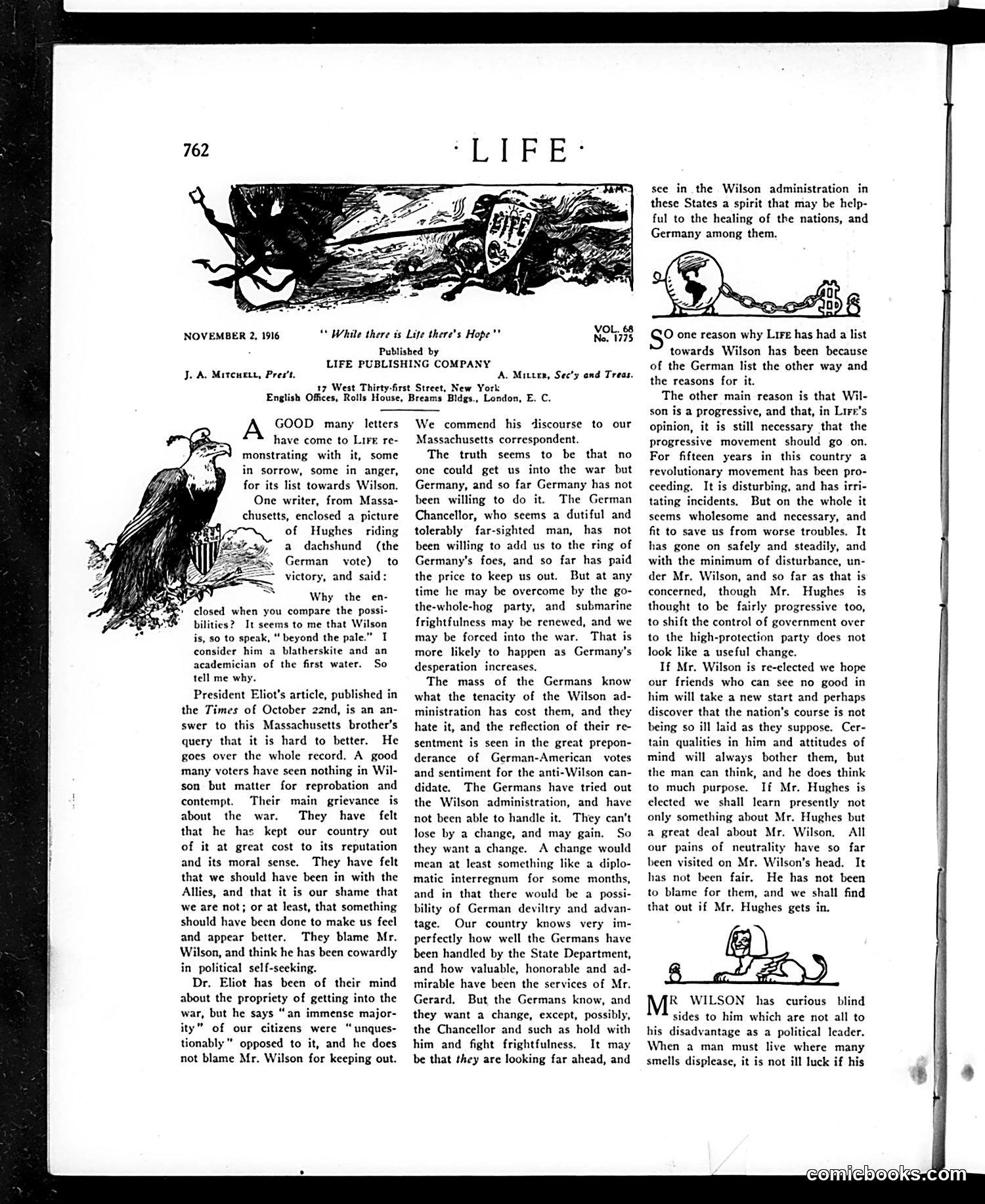
This page discusses the 1916 presidential election between incumbent Woodrow Wilson and Republican challenger Charles Evans Hughes. The editorial addresses reader complaints about Life's editorial stance favoring Wilson. **The cartoon** (top left) depicts Hughes riding a dachshund labeled as representing "the German vote"—a satirical reference to German-American voters' opposition to Wilson's policy of keeping America out of World War I. Germans resented Wilson's administration because it had effectively resisted German pressure and submarine warfare. **The editorial's argument**: While acknowledging that many Americans wanted the U.S. to enter the war on the Allies' side, the writer defends Wilson for respecting public opinion (which opposed entry). The piece notes German-Americans supported Hughes because they hoped a change in administration might mean diplomatic advantage for Germany. Life supports Wilson's cautious approach, suggesting his neutrality demonstrates wisdom that could help heal post-war nations. The underlying political division: interventionists versus isolationists, with German-American votes serving as a proxy for pro-German sympathies.
📄 Transcribed text from this page (OCR, searchable)
Machine-transcribed from the original scan — historical spelling and the odd misread are preserved.
NOVEMBER 2, 1916 “* While there is Life there's Hope"" Published by LIFE PUBLISHING COMPANY J. A. Mitcnett, Pres’t. A. Mitttr, Sec’y and Treas. 7 West Thirty-first Street, New York English Offices, Rolls House, Breams Bldgs., London, E. C. A GOOD many letters have come to Lire re- monstrating with it, some in sorrow, some in anger, for its list towards Wilson. One writer, from Massa- chusetts, enclosed a picture of Hughes riding a dachshund (the German vote) to victory, and said: Why the en- closed when you compare the possi- bilities? It seems to me that Wilson is, so to speak, “ beyond the pale.” I consider him a blatherskite and an academician of the first water. So tell me why. President Eliot's article, published in the Times of October 22nd, is an an- swer to this Massachusetts brother’s query that it is hard to better. He goes over the whole record. A good many voters have seen nothing in Wil- son but matter for reprobation and contempt. Their main grievance is about the war. They have felt that he has kept our country out of it at great cost to its reputation and its moral sense. They have felt that we should have been in with the Allies, and that it is our shame that we are not; or at least, that something should have been done to make us feel and appear better, They blame Mr. Wilson, and think he has been cowardly in political self-seeking. Dr. Eliot has been of their mind about the propriety of getting into the war, but he says “an immense major- ity” of our citizens were “unques- tionably opposed to it, and he does not blame Mr. Wilson for keeping out. We commend his discourse to our Massachusetts correspondent. The truth seems to be that no one could get us into the war but Germany, and so far Germany has not been willing to do it. The German Chancellor, who seems a dutiful and tolerably far-sighted man, has not been willing to add us to the ring of Germany's foes, and so far has paid the price to keep us out. But at any time he may be overcome by the go- the-whole-hog party, and submarine frightfulness may be renewed, and we may be forced into the war. That is more likely to happen as Germany's desperation increases. The mass of the Germans know what the tenacity of the Wilson ad- ministration has cost them, and they hate it, and the reflection of their re- sentment is seen in the great prepon- derance of German-American votes and sentiment for the anti-Wilson can- didate. The Germans have tried out the Wilson administration, and have not been able to handle it. They can't lose by a change, and may gain. So they want a change. A change would mean at least something like a diplo- matic interregnum for some months, and in that there would be a possi bility of German deviltry and advan- tage. Our country knows very im- perfectly how well the Germans have been handled by the State Department, and how valuable, honorable and ad- mirable have been the services of Mr. Gerard. But the Germans know, and they want a change, except, possibly, the Chancellor and such as hold with him and fight frightfulness. It may be that they are looking far ahead, and sce in the Wilson administration in these States a spirit that may be help- ful to the healing of the nations, and Germany among them. s° one reason why Lire has had a list towards Wilson has been because of the German list the other way and the reasons for it. The other main reason is that Wil: son is a progressive, and that, in Lire’ opinion, it is still necessary that the progressive movement should go on. For fifteen years in this country a revolutionary movement has been pro- ceeding. It is disturbing, and has irri- tating incidents. But on the whole it seems wholesome and necessary, and fit to save us from worse troubles. It has gone on safely and steadily, and with the minimum of disturbance, un- der Mr. Wilson, and so far as that is concerned, though Mr. Hughes is thought to be fairly progressive too, to shift the control of government over to the high-protection party does not look like a useful change. If Mr. Wilson is re-elected we hope our friends who can see no good in him will take a new start and perhaps discover that the nation’s course is not being so ill laid as they suppose. Cer- tain qualities in him and attitudes of mind will always bother them, but the man can think, and he does think to much purpose. If Mr. Hughes is elected we shall learn presently not only something about Mr. Hughes but a great deal about Mr. Wilson, All our pains of neutrality have so far been visited on Mr. Wilson’s head. It has not been fair. He has not been to blame for them, and we shall find that out if Mr. Hughes gets in. R WILSON has curious blind sides to him which are not all to his disadvantage as a political leader. When a man must live where many smells displease, it is not ill luck if his