
Life, 1916-11-02 · page 9 of 46
Life — November 2, 1916 — page 9: what you’re looking at
What you’re looking at
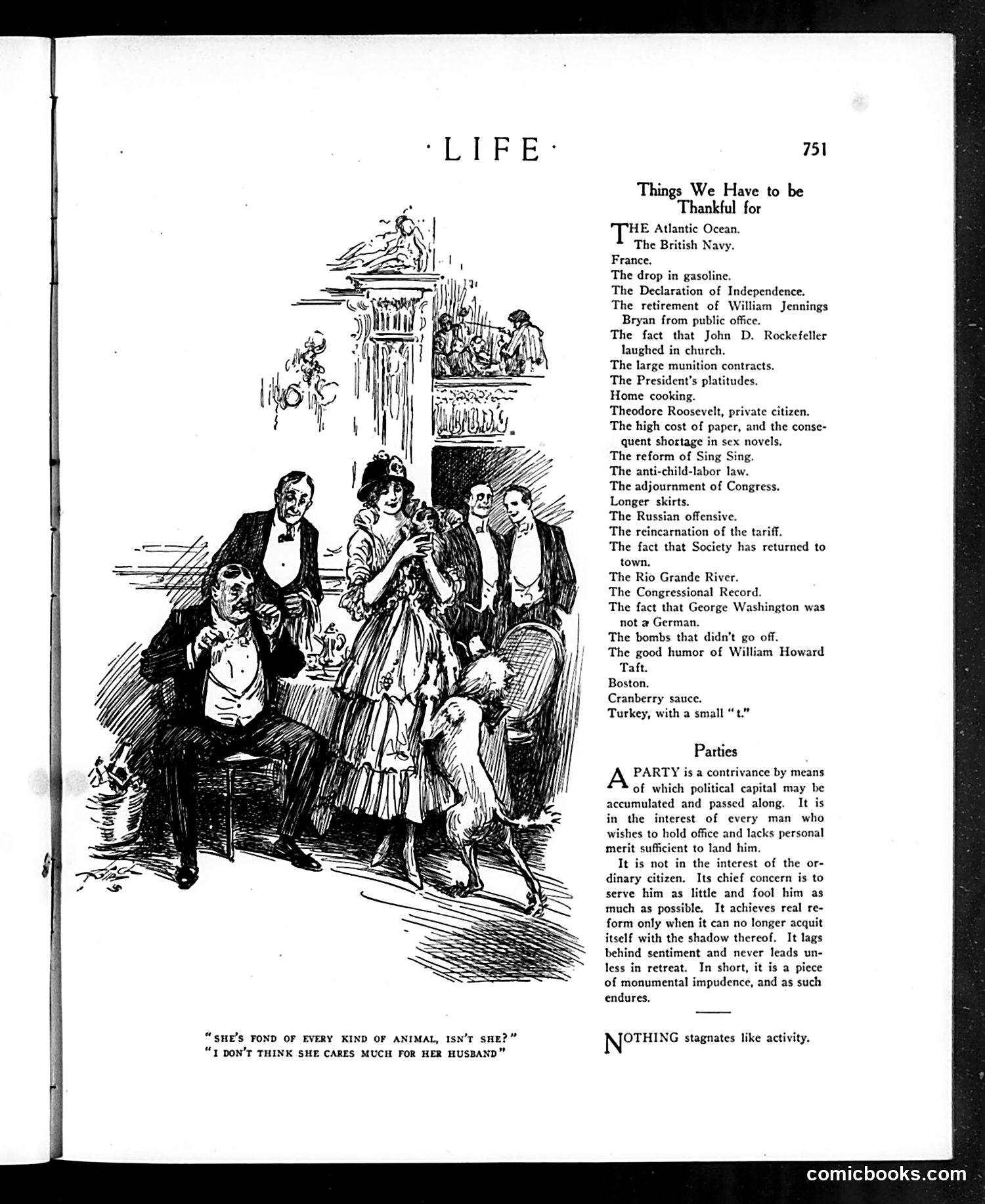
This Life magazine page satirizes early 20th-century American society. The main illustration depicts a fashionable woman surrounded by admiring men and a small dog at what appears to be a social gathering, with the caption: "She's fond of every kind of animal, isn't she? / I don't think she cares much for her husband." The joke mocks marriages where wives show more affection to pets and social companions than to their husbands—critiquing both aristocratic social pretense and marital disconnection. The accompanying article "Parties" defines political parties as mechanisms for accumulating power, describing them cynically as impudent and stagnant institutions that fool ordinary citizens while serving politicians' interests rather than reform. Together, these mock both high society superficiality and political hypocrisy.
📄 Transcribed text from this page (OCR, searchable)
Machine-transcribed from the original scan — historical spelling and the odd misread are preserved.
751 Things We Have to be Thankful for HE Atlantic Ocean. The British Navy. France. The drop in gasoline. The Declaration of Independence. The retirement of William Jennings Bryan from public office. The fact that John D. Rockefeller laughed in church. The large munition contracts. The President's platitudes. Home cooking. Theodore Roosevelt, private citizen. The high cost of paper, and the conse- quent shortage in sex novels. The reform of Sing Sing. The anti-child-labor law. The adjournment of Congress, Longer skirts. The Russian offensive. The reincarnation of the tariff. The fact that Society has returned to town. The Rio Grande River. The Congressional Record. The fact that George Washington was not a German. The bombs that didn’t go off. The good humor of William Howard Taft. Boston. Cranberry sauce. Turkey, with a small “t.” Parties PARTY is a contrivance by means of which political capital may be accumulated and passed along. It is in the interest of every man who wishes to hold office and lacks personal merit sufficient to land him. It is not in the interest of the or- dinary citizen. Its chief concern is to serve him as little and fool him as much as possible. It achieves real re- form only when it can no longer acquit itself with the shadow thereof. It lags behind sentiment and never leads un- less in retreat. In short, it is a piece of monumental impudence, and as such endures, “SHE’S FOND OF EVERY KIND OF ANIMAL, ISN’T SHE?” NOTHING stagnates like activity. “1 DON’T THINK SHE CARES MUCH FOR HER HUSBAND” comicbooks.com