
Life, 1916-11-02 · page 37 of 46
Life — November 2, 1916 — page 37: what you’re looking at
What you’re looking at
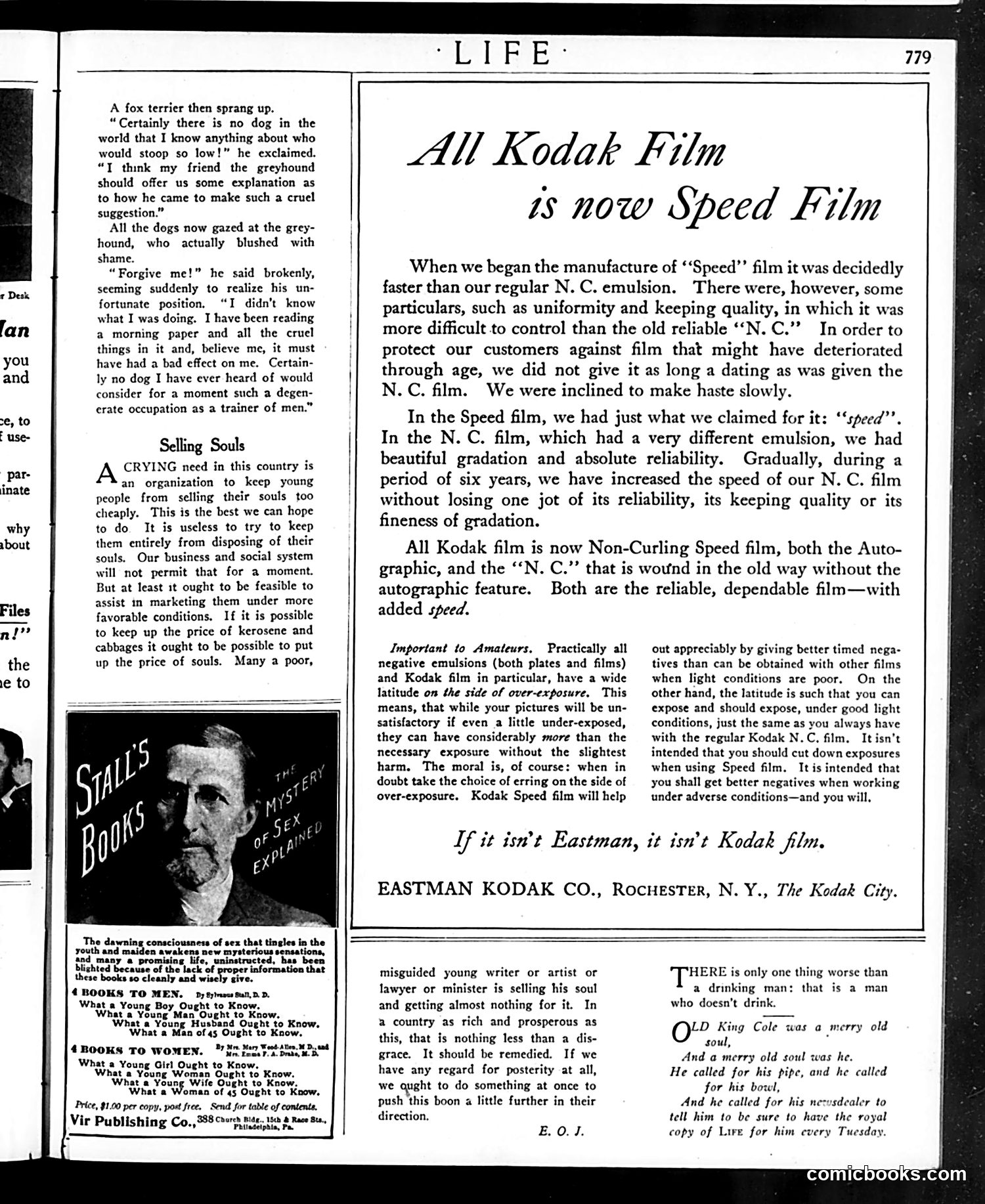
This page contains a satirical story and advertisements typical of early 20th-century Life magazine. **The Narrative Story** ("Selling Souls"): A fictional dialogue where dogs discuss a greyhound who suggested training humans as a profession. The fox terrier expresses shock, and the greyhound—having read disturbing newspaper content—apologizes, ashamed of the degenerate idea. The story's moral critique: society permits people to "sell their souls" through degrading work, so reformers should at least ensure fair compensation rather than attempt prohibition. **The Advertisements**: The page includes ads for Kodak Speed Film (emphasizing improved photographic technology) and "Vir Publishing" books about sexual education for different life stages—reflecting early 20th-century anxieties about youth, sex education, and moral guidance. **The Satire**: The talking dogs story satirizes both media's corrupting influence and capitalism's commodification of human labor and dignity. The adjacent sex-education book ads reinforce concerns about protecting youth morality in an increasingly commercialized society.
📄 Transcribed text from this page (OCR, searchable)
Machine-transcribed from the original scan — historical spelling and the odd misread are preserved.
A fox terrier then sprang up. “Certainly there is no dog in the world that I know anything about who would stoop so low!” he exclaimed. “I think my friend the greyhound should offer us some explanation as to how he came to make such a cruel suggestion.” All the dogs now gazed at the grey- hound, who actually blushed with shame. “Forgive me!” he said brokenly, seeming suddenly to realize his un- fortunate position, “I didn’t know what I was doing. I have been reading a morning paper and all the cruel things in it and, believe me, it must have had a bad effect on me. Certain- ly no dog I have ever heard of would consider for a moment such a degen- erate occupation as a trainer of men.” Selling Souls A CRYING need in this country is an organization to keep young people from selling their souls too cheaply. This is the best we can hope to do It is useless to try to keep them entirely from disposing of their souls, Our business and social system will not permit that for a moment. But at least it ought to be feasible to assist in marketing them under more favorable conditions. If it is possible to keep up the price of kerosene and cabbages it ought to be possible to put up the price of souls. Many a poor, The dawning consciousness of sex that tingles in the youth and maid these books so cleanly and wisel 4 BOOKS TO MEN. 0; 8120 9un,D.D. What a Young Boy Ought to Know. Ww ‘Young Man Ought to Know, at a Young Husband Ought to Know, ‘What a Man of 45 Ought to Know. 4BOOKS To womEN. "Erie yb What a Young Girl Ought to Know. ‘What a Young Woman Ought to Know. ‘What a Youn Ought to Know. ‘What a Woman of 45 Ought to Know, Price, $1.00 per copy, post free, Send for table of contents, Vir Publishing Co.,398c%ry, nite, ssh 8 Rave Bu, AM Kodak Film as now Speed Film When we began the manufacture of ‘‘Speed”’ film it was decidedly faster than our regular N. C. emulsion. There were, however, some particulars, such as uniformity and keeping quality, in which it was more difficult to control than the old reliable ‘‘N.C.”’ In order to protect our customers against film that might have deteriorated through age, we did not give it as long a dating as was given the N.C. film. We were inclined to make haste slowly. In the Speed film, we had just what we claimed for it: ‘‘speed’’. In the N.C. film, which had a very different emulsion, we had beautiful gradation and absolute reliability. Gradually, during a period of six years, we have increased the speed of our N. C. film without losing one jot of its reliability, its keeping quality or its fineness of gradation. All Kodak film is now Non-Curling Speed film, both the Auto- graphic, and the ‘‘N. C.’”’ that is wound in the old way without the autographic feature. Both are the reliable, dependable film—with added speed. out appreciably by giving better timed nega- tives than can be obtained with other films when light conditions are poor, On the other hand, the latitude is such that you can expose and should expose, under good light conditions, just the same as you always have with the regular Kodak N.C, film. It isn’t intended that you should cut down exposures when using Speed film. It is intended that you shall get better negatives when working under adverse conditions—and you will, Important to Amateurs, Practically all negative emulsions (both plates and films) and Kodak film in particular, have a wide latitude on the side of over-exposure, This means, that while your pictures will be un- satisfactory if even a little under-exposed, they can have considerably more than the necessary exposure without the slightest harm. The moral is, of course: when in doubt take the choice of erring on the side of over-exposure. Kodak Speed film will help If it isn’t Eastman, it isn’t Kodak film. EASTMAN KODAK CO., Rocuester, N. Y., The Kodak City. HERE is only one thing worse than a drinking man: that is a man misguided young writer or artist or lawyer or minister is selling his soul and getting almost nothing for it. In who doesn’t drink. a country as rich and prosperous as LD King Cole was a merry old this, that is nothing less than a dis- soul, . grace. It should be remedied. If we And a merry old soul was he. have any regard for posterity at all, He called for his pipe, and he called we aught to do something at once to for his bowl, push this boon a little further in their And ke called for his nevvsdealer to direction. tell him to be sure to have the royal EB. 0. J. copy of Lire for him every Tuesday.