
Life, 1916-11-02 · page 24 of 46
Life — November 2, 1916 — page 24: what you’re looking at
What you’re looking at
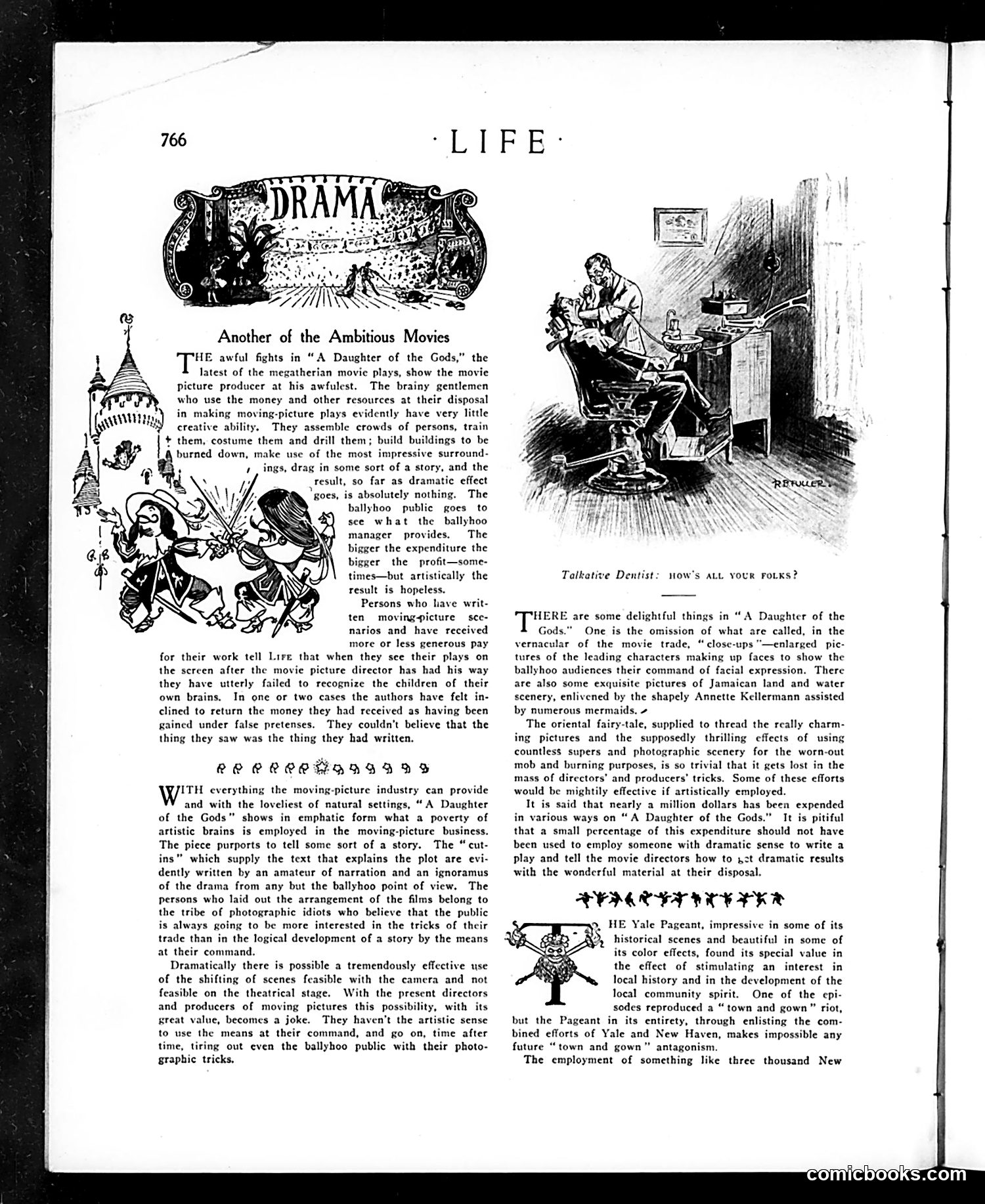
This 1915 *Life* magazine article satirizes the film industry's wasteful approach to moviemaking, specifically critiquing "A Daughter of the Gods." **The Satire's Point:** Despite massive budgets, elaborate sets, crowds, and expensive star Annette Kellermann, major film producers lack artistic vision. The article argues they confuse spectacle—burning buildings, photographic "tricks," and technical showiness—with storytelling. **Key Complaints:** - Screenwriters' original scripts become unrecognizable after directors rework them - Intertitles are amateurish and poorly written - Directors prioritize camera tricks over narrative logic - The film wastes a million dollars on production values while neglecting to hire someone with actual dramatic talent **The Cartoon:** Shows a dentist asking "How's all your folks?"—a mundane social greeting, likely illustrating the article's point that even trivial dialogue receives more care than the film's narrative. **Context:** This reflects early cinema's growing pains, when industry money men treated filmmaking as a commercial spectacle rather than an art form.
📄 Transcribed text from this page (OCR, searchable)
Machine-transcribed from the original scan — historical spelling and the odd misread are preserved.
Another of the Ambitious Movies HE awful fights in “A Daughter of the Gods,” the latest of the megatherian movie plays, show the movie Picture producer at his awfulest. The brainy gentlemen who use the money and other resources at their disposal in making moving-picture plays evidently have very little creative ability, They assemble crowds of persons, train + them, costume them and drill them; build buildings to be burned down, make use of the most impressive surround- 1. ings, drag in some sort of a story, and the result, so far as dramatic effect ‘goes, is absolutely nothing. The ballyhoo public goes to see what the ballyhoo manager provides. The bigger the expenditure the bigger the profit—some- times—but artistically the result is hopeless. Persons who lave writ- ten movingsicture sce- narios and have received more or less generous pay for their work tell Lire that when they see their plays on the screen after the movie picture director has had his way they have utterly failed to recognize the children of their own brains. In one or two cases the authors have felt in- clined to return the money they had received as having been gained under false pretenses. They couldn't believe that the thing they saw was the thing they had written. RR CREPHARIS 9D ITH everything the moving-picture industry can provide and with the loveliest of natural settings, “A Daughter of the Gods” shows in emphatic form what a poverty of artistic brains is employed in the moving-picture business. The piece purports to tell some sort of a story. The “ cut- ins" which supply the text that explains the plot are evi- dently written by an amateur of narration and an ignoramus of the drama from any but the ballyhoo point of view. The persons who laid out the arrangement of the films belong to the tribe of photographic idiots who believe that the public is always going to be more interested in the tricks of their trade than in the logical development of a story by the means at their command. Dramatically there is possible a tremendously effective use of the shifting of scenes feasible with the camera and not feasible on the theatrical stage. With the present directors and producers of moving pictures this possibility, with its great value, becomes a joke. They haven't the artistic sense to use the means at their command, and go on, time after time, tiring out even the ballyhoo public with their photo- graphic tricks, Talkative Dentist: sow's ALL YouR FOLKS? HERE are some delightful things in “A Daughter of the Gods.” One is the omission of what are called, in the vernacular of the movie trade, “close-ups "—enlarged pic- tures of the leading characters making up faces to show the ballyhoo audiences their command of facial expression. There are also some exquisite pictures of Jamaican land and water scenery, enlivened by the shapely Annette Kellermann assisted by numerous mermaids. + The oriental fairy-tale, supplied to thread the really charm- ing pictures and the supposedly thrilling effects of using countless supers and photographic scenery for the worn-out mob and burning purposes, is so trivial that it gets lost in the mass of directors’ and producers’ tricks. Some of these efforts would be mightily effective if artistically employed. It is said that nearly a million dollars has been expended in various ways on “A Daughter of the Gods.” It is pitiful that a small percentage of this expenditure should not have been used to employ someone with dramatic sense to write a play and tell the movie directors how to 4:t dramatic results with the wonderful material at their disposal. PERRET PEK EKER , HE Yale Pageant, impressive in some of its &, historical scenes and beautiful in some of its color effects, found its special value in the effect of stimulating an interest in local history and in the development of the local community spirit. One of the epi- sodes reproduced a “town and gown” riot, but the Pageant in its entirety, through enlisting the com- bined efforts of Yale and New Haven, makes impossible any future “town and gown” antagonism. The employment of something like three thousand New