
A complete issue · 42 pages · 1916
Life — October 19, 1916
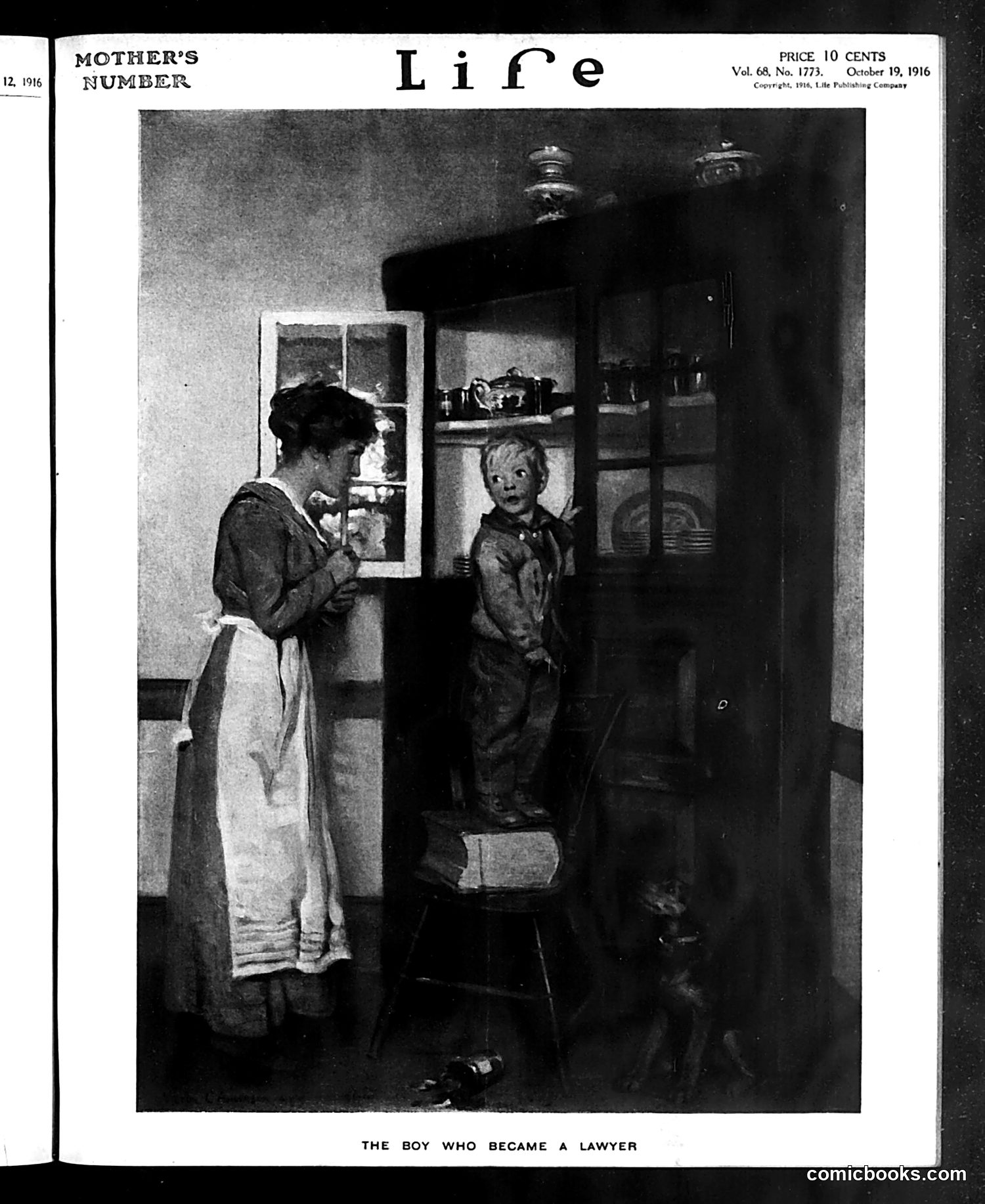
This appears to be a satirical illustration rather than a political cartoon. The image shows a domestic scene: a woman (likely a mother) standing in a doorway with a young boy, suggesting a narrative about childhood ambition or parental guidance. The caption "The Boy Who Became a Lawyer" implies social commentary about class mobility or professional aspiration in early 20th-century America. Given *Life* magazine's satirical nature, this likely mocks either: - The pretensions of working-class families seeking upward mobility through education - Stereotypes about lawyers or the legal profession - The gap between childhood dreams and adult reality Without additional context or accompanying text, the specific satirical target remains unclear, though it appears to comment on American social expectations and professional aspiration circa 1916.
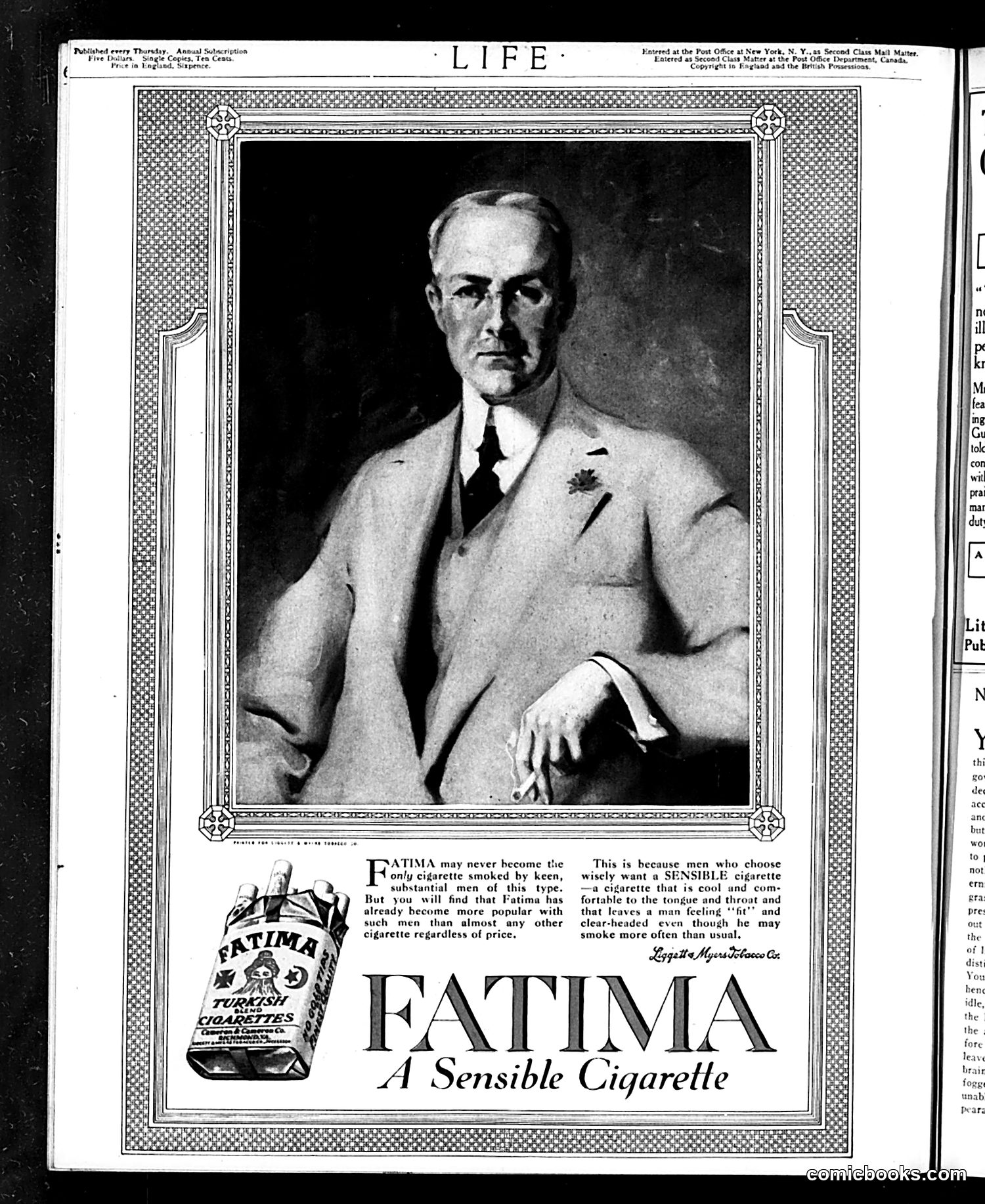
This page is primarily a **cigarette advertisement for Fatima brand**, not political satire. It features a portrait photograph of a distinguished-looking man in formal attire (identity unclear from the image alone) alongside marketing copy. The ad's pitch emphasizes that Fatima cigarettes are "sensible"—appealing to men who want cigarettes that are "good and comfortable to the tongue and throat." This reflects early 20th-century advertising strategy: positioning a product as rational and health-conscious rather than merely indulgent. The "Life" magazine masthead indicates this is from the satirical publication, but this particular page serves as paid advertising content rather than editorial satire or commentary.
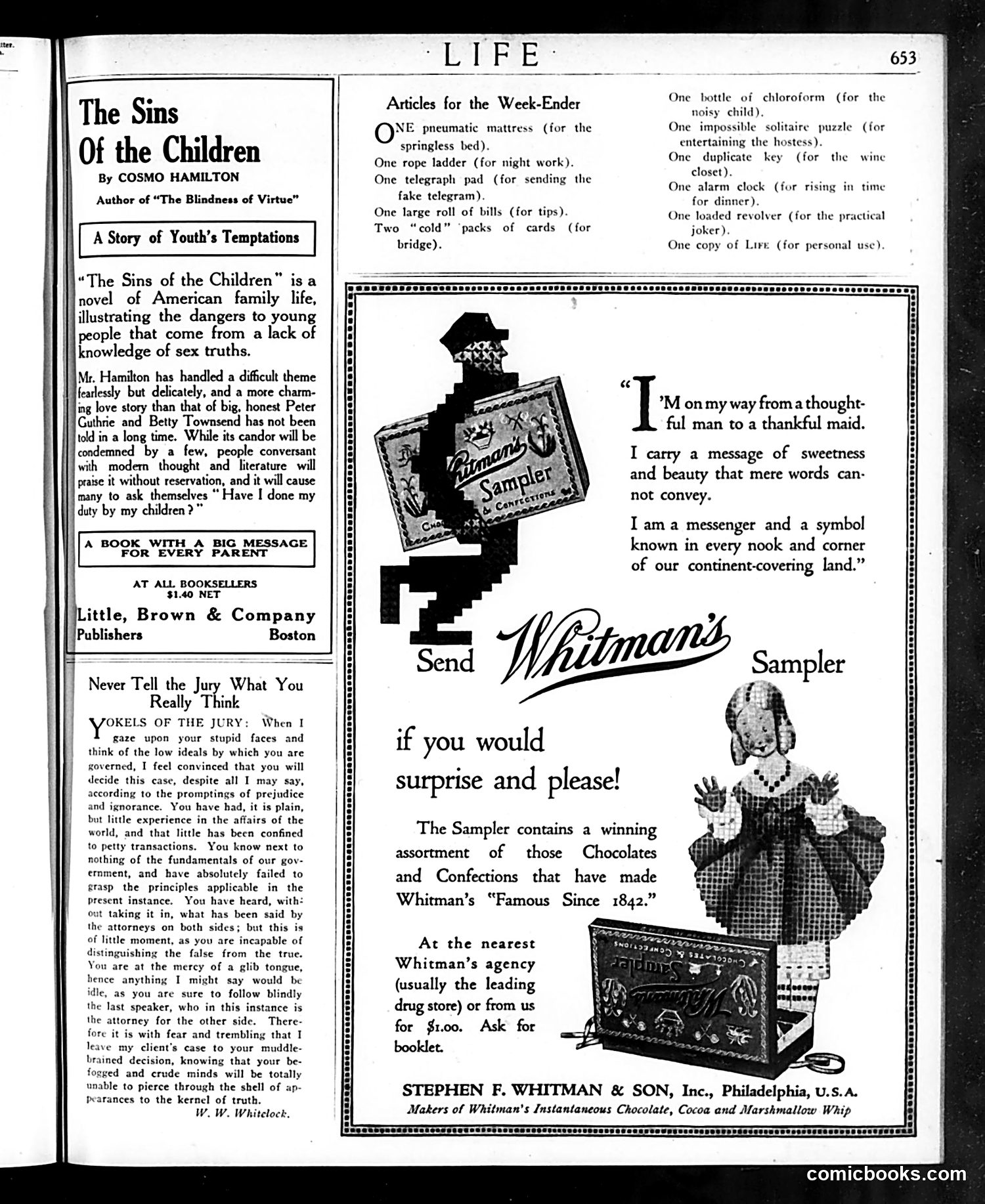
This page is **primarily advertising**, not political satire. The dominant content is a Whitman's Sampler chocolate advertisement featuring a stylized figure in colonial dress delivering a romantic message about being "a messenger and a symbol known in every nook and corner of our continent-covering land." The left column contains two distinct items: a book advertisement for "The Sins of the Children" by Cosmo Hamilton (addressing youth and sexual knowledge), and a brief satirical piece titled "Never Tell the Jury What You Really Think" by W.W. Whitlock, which mocks jurors' tendency toward prejudice and ignorance. The Whitman's ad and the satirical text are unrelated—they simply share page space in this vintage magazine layout.
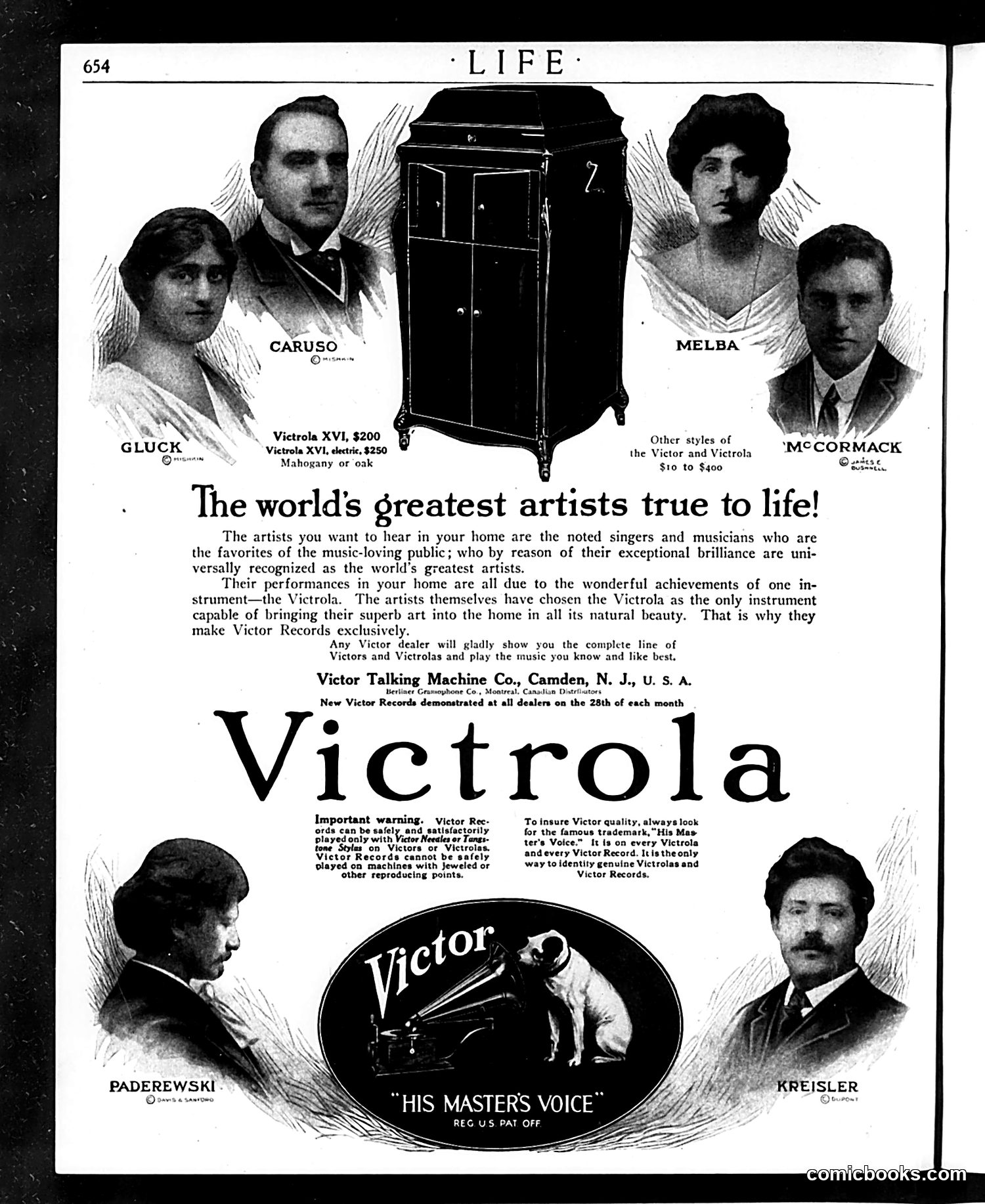
This page is primarily **advertising, not satire or political commentary**. It's a Victrola phonograph advertisement from the Victor Talking Machine Co. (Camden, N.J.). The ad features portraits of five famous opera singers and musicians of the era—Caruso, Melba, Gluck, McCormack, Paderewski, and Kreisler—presented as endorsers. The central claim is that these "world's greatest artists" chose the Victrola as superior for reproducing their performances at home. The famous "His Master's Voice" trademark (dog listening to gramophone) appears at bottom center. This is straightforward product promotion leveraging celebrity endorsement, not political satire. The names and images serve to establish the Victrola's prestige and fidelity.
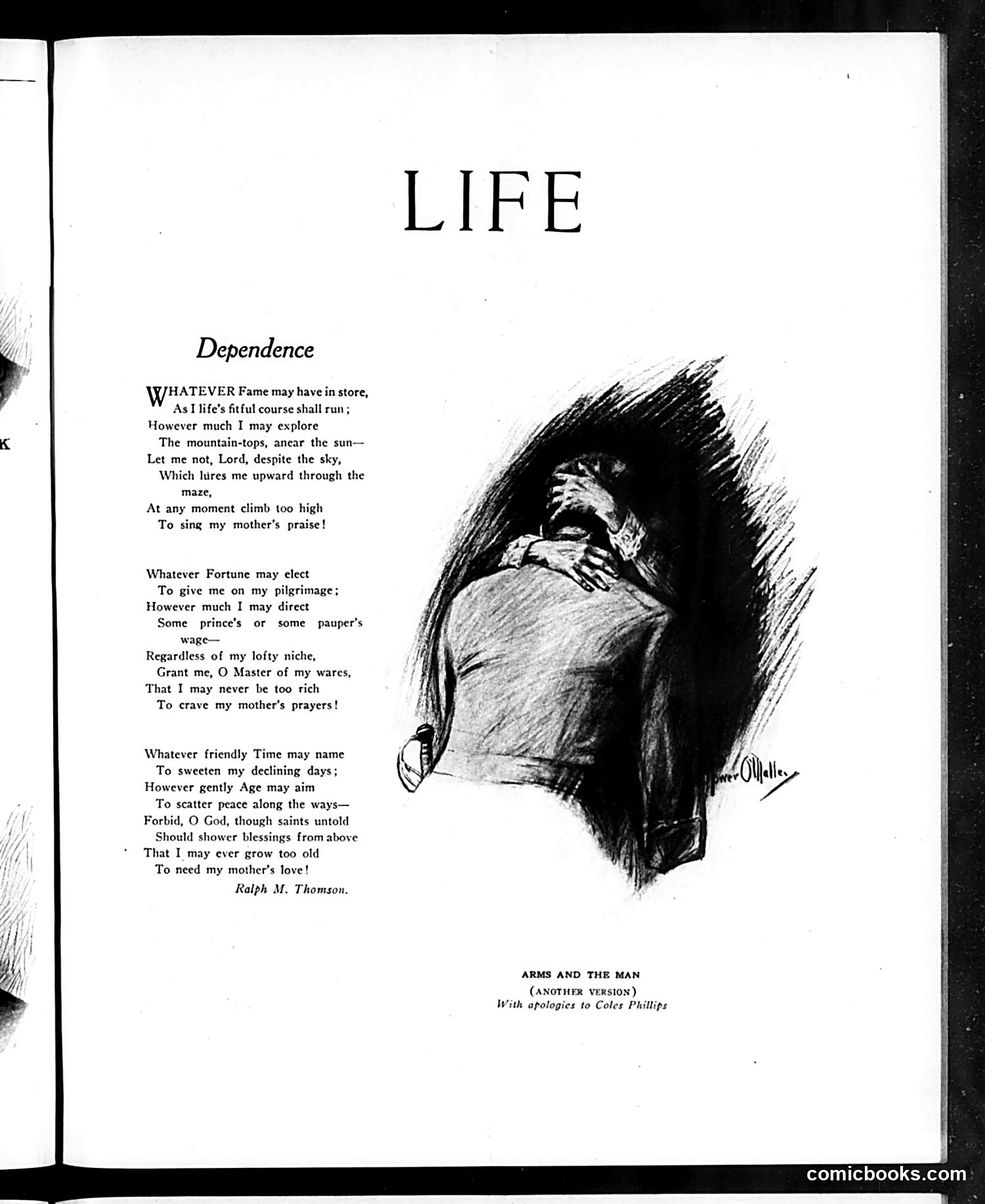
This page features a poem titled "Dependence" by Ralph M. Thomson, accompanied by a sketch of a child nestled in an adult's protective embrace. The poem expresses a child's unwavering emotional dependence on their mother throughout life's journey. Regardless of fame, fortune, or worldly achievement, the speaker pledges their deepest need remains their mother's love, prayers, and emotional support—even into old age. The accompanying illustration reinforces this theme, depicting vulnerability and comfort. The final note references "Arms and the Man (Another Version)" with apologies to Cole Phillips, likely alluding to both Shaw's play and the classical Aeneid opening. This sentimental content reflects early 20th-century Life magazine's mix of satirical humor and genuine pathos about universal human experiences.
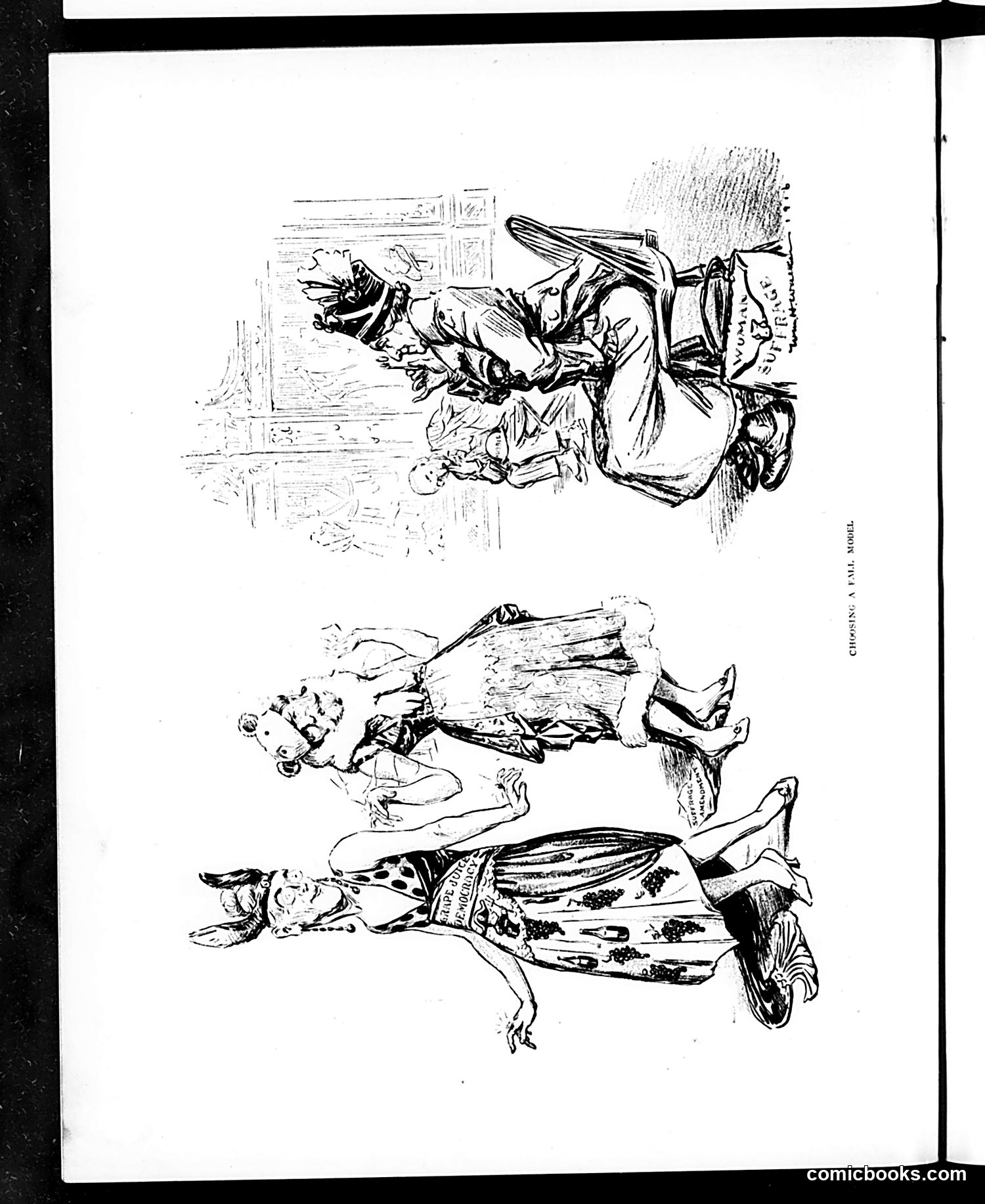
This page appears to contain three separate satirical sketches, though the OCR text is unclear and doesn't match the visible content. The top illustration shows figures in what appears to be an interior scene with exaggerated, caricatured features typical of late 19th/early 20th century political satire. The middle and bottom sketches depict individual figures in period dress and poses. Without clearer OCR text or legible captions identifying the subjects, I cannot definitively state who these figures represent or what specific political/social events are being satirized. The artistic style and format suggest commentary on contemporary personalities or situations from Life magazine's era, but identifying the precise references would require either clearer text or additional historical documentation. The sketches demonstrate Life's characteristic use of exaggeration and caricature for satirical effect, but the specific targets remain unclear from this image alone.
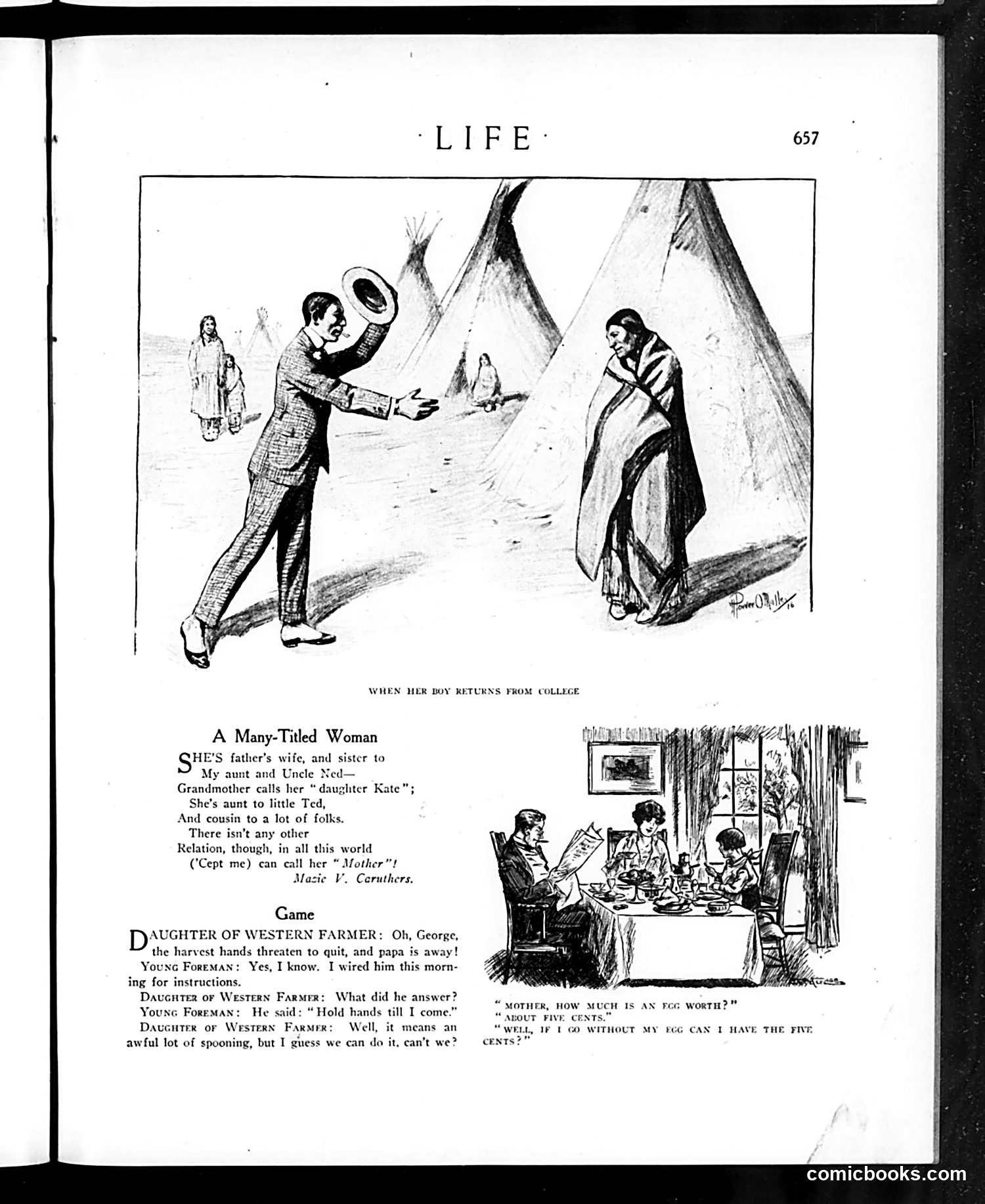
This page contains two unrelated humorous pieces: **Top cartoon ("When Her Boy Returns from College"):** Shows a well-dressed man visiting a Native American encampment. The satire appears to target absurd romantic or adventurous behavior—possibly mocking a college-educated man's naive or inappropriate conduct upon returning home. **Bottom section ("A Many-Titled Woman" and "Game"):** The poem humorously catalogs a woman's various family relations—wife, sister, aunt, grandmother, cousin—satirizing how a woman's identity is defined entirely through male-centered family roles. The "Game" dialogue between a Western Farmer's daughter and a young foreman jokes about labor shortcuts and wages, with the punchline involving an egg's cost (five cents), likely poking fun at rural economics or labor disputes of the era. Both pieces use domestic/rural humor typical of early 20th-century satire.
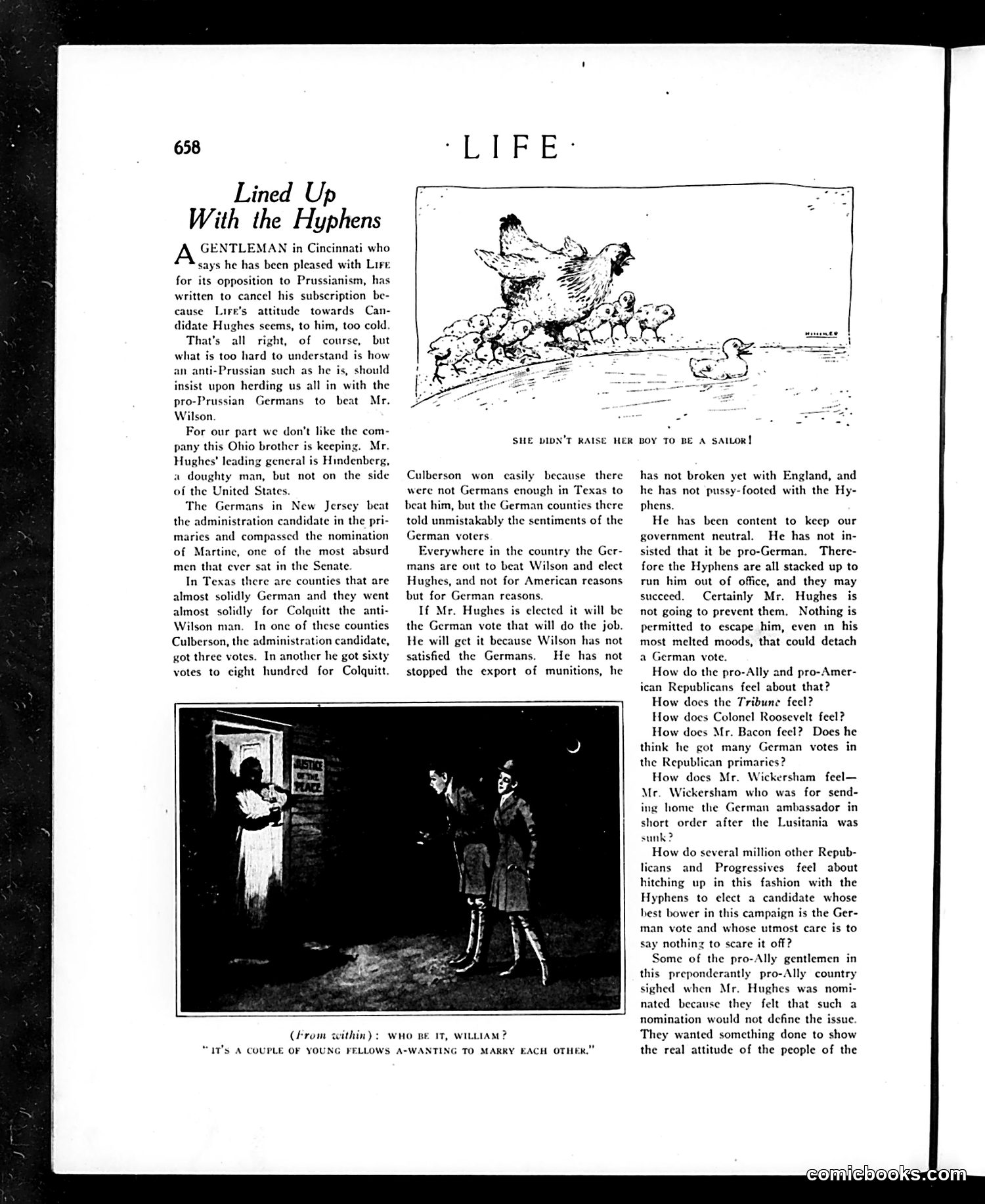
This page criticizes Charles Evans Hughes' 1916 presidential campaign against Woodrow Wilson. The text attacks Hughes for allegedly being pro-German and appealing to German-American voters rather than supporting American interests. **Top cartoon**: Shows a hen (representing Hughes) refusing to raise her chick as a sailor—satirizing Hughes' stance on military preparedness versus Wilson's position. **Bottom cartoon**: Depicts two young men wanting to "marry each other," suggesting Hughes and the German-American voting bloc are in an inappropriate political alliance. The article argues that German voters support Hughes not for American reasons, but because he hasn't satisfied German ambitions (like stopping munitions exports). The satire mocks Republicans for courting German-American voters while claiming to oppose German interests.
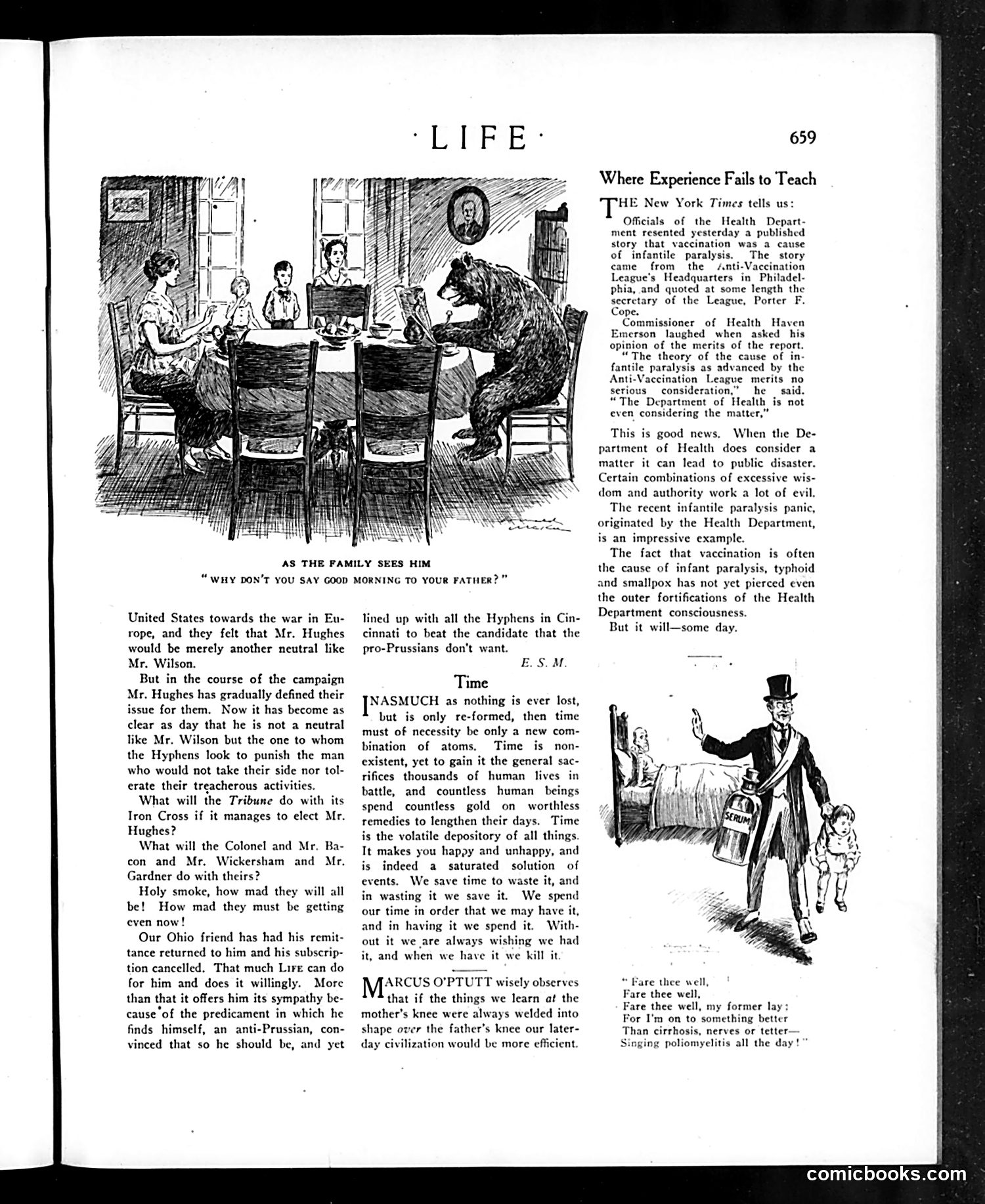
The top cartoon, captioned "Why Don't You Say Good Morning to Your Father?", depicts a family dinner scene where an animal (likely a bear, possibly representing Germany or Prussian militarism) sits at the table. This satirizes German-American relations during WWI era—the "father" appears to represent America's traditional alignment, while the presence of the beast suggests tension over whether America should remain neutral or choose sides. The bottom cartoon shows a figure labeled "BERLIN" dancing with a child, captioned with verses about "cirrhosis, nerves or tetter." This likely mocks German propaganda or influence on American youth/public opinion. Both cartoons reflect pre-WWI American debate over neutrality and anti-German sentiment, using animal and personification imagery to satirize international political tensions.
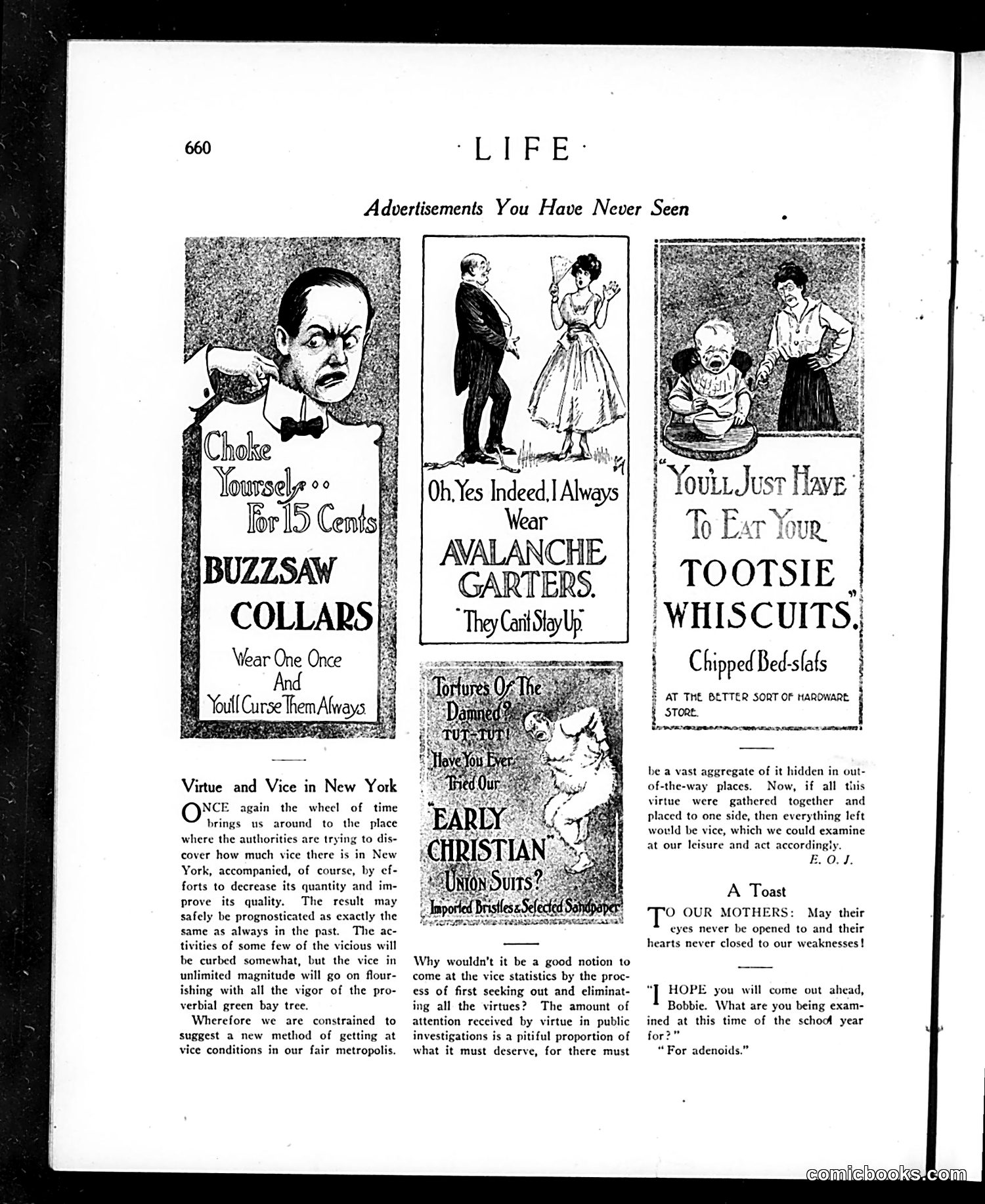
This page is primarily **advertisements disguised as humorous cartoons**, a satirical format Life magazine used to mock absurd product claims and social pretensions. The three fake ads mock: 1. **Buzzsaw Collars** — suggests wearing them causes perpetual cursing, satirizing uncomfortable men's fashion 2. **Avalanche Garters** — jokes that they won't stay up, mocking unreliable men's accessories 3. **Tootsie Whiscuits** — absurdly claims you must eat them or face "chipped bed-slats," nonsensically linking food to furniture damage The lower ad mocks **Early Christian Union Suits** (long underwear), playing on religious virtue-signaling in consumer products. The accompanying article critiques New York vice conditions and moral reform efforts, suggesting authorities should systematically eliminate vice rather than piecemeal enforcement. The satire targets both actual social problems and the exaggerated claims of commercial products exploiting consumer anxieties.
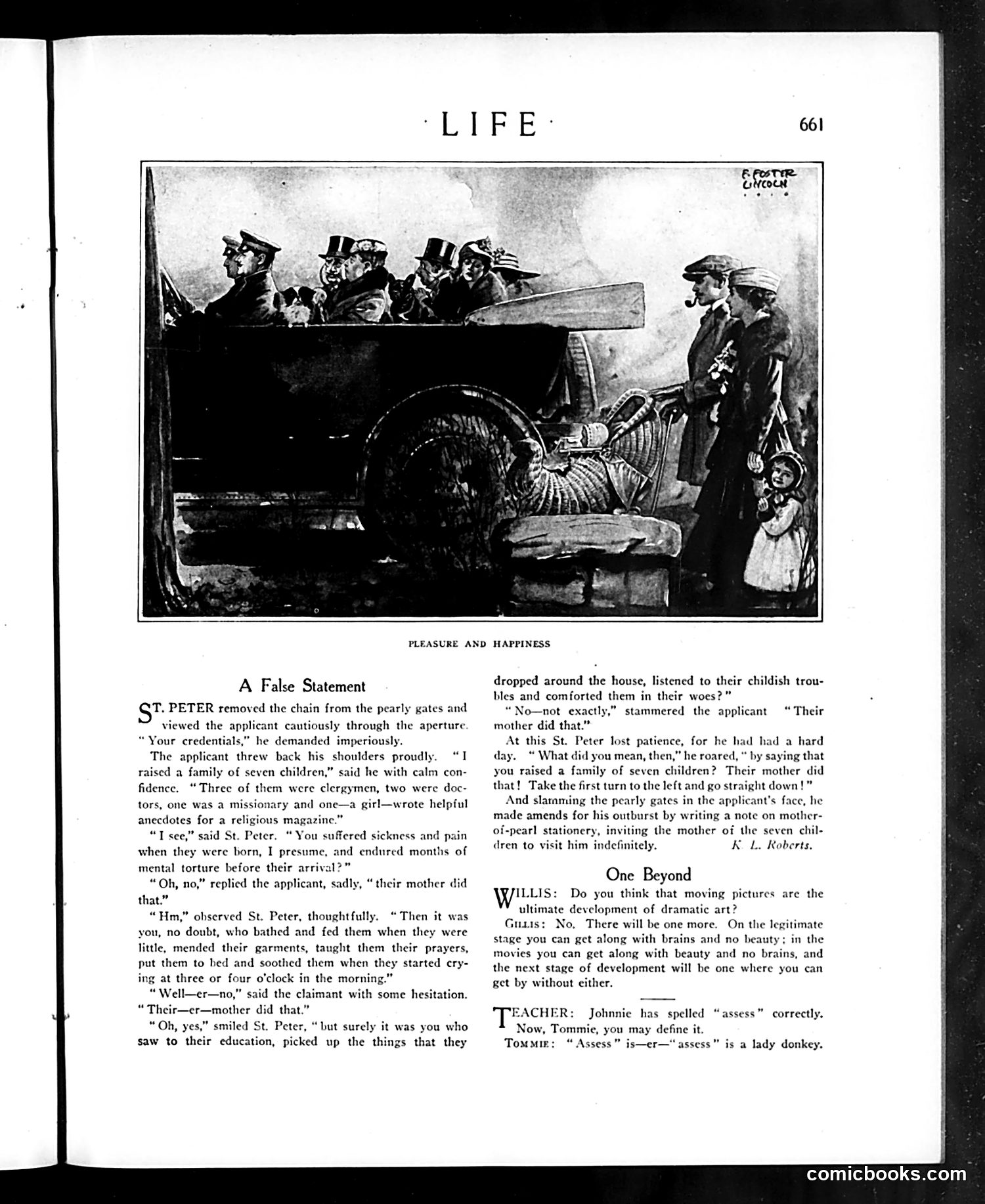
This page contains a satirical story about **St. Peter at the gates of heaven**, not a political cartoon. The illustration shows St. Peter confronting a woman who claims to have raised seven children with difficulty. The satire targets **dishonest claims about parenthood**. When the woman insists her children suffered greatly before arriving in heaven, St. Peter accuses *her* of actually raising them—implying she's taking credit for work she didn't do. He sarcastically suggests she "bathed and fed them" and "picked up the things that they dropped." The joke mocks people who exaggerate their hardships or take false credit. The byline credits **K.L. Roberts** as the author. Below are unrelated humor snippets about moving pictures and a spelling lesson.
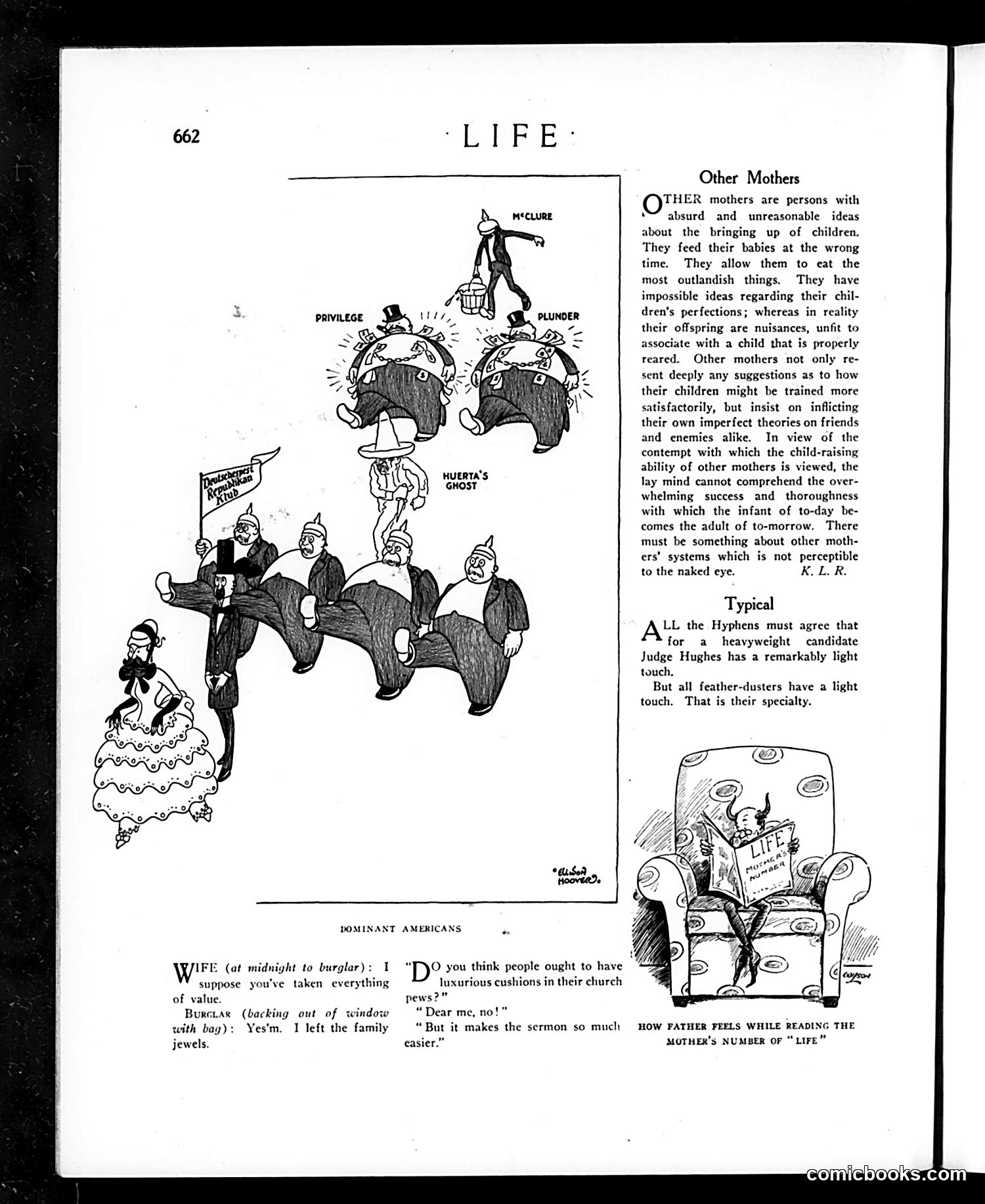
The main cartoon satirizes American political dominance through caricature. Labeled figures include "McClure," "Privilege," and "Plunder" riding on two large heads labeled "Huerta's Ghost"—likely referencing Mexican political instability. The composition suggests wealthy American interests (represented by the riding figures) exploiting or controlling foreign affairs, possibly relating to U.S. interventionism in Mexico. The text section titled "Other Mothers" mocks overly permissive parenting—mothers with "absurd and unreasonable ideas" who feed children poorly and reject proper discipline. This reflects early 20th-century anxieties about modern child-rearing practices. A brief joke about church cushions appears at bottom. The overall page targets American foreign policy aggression and changing domestic values through humor.
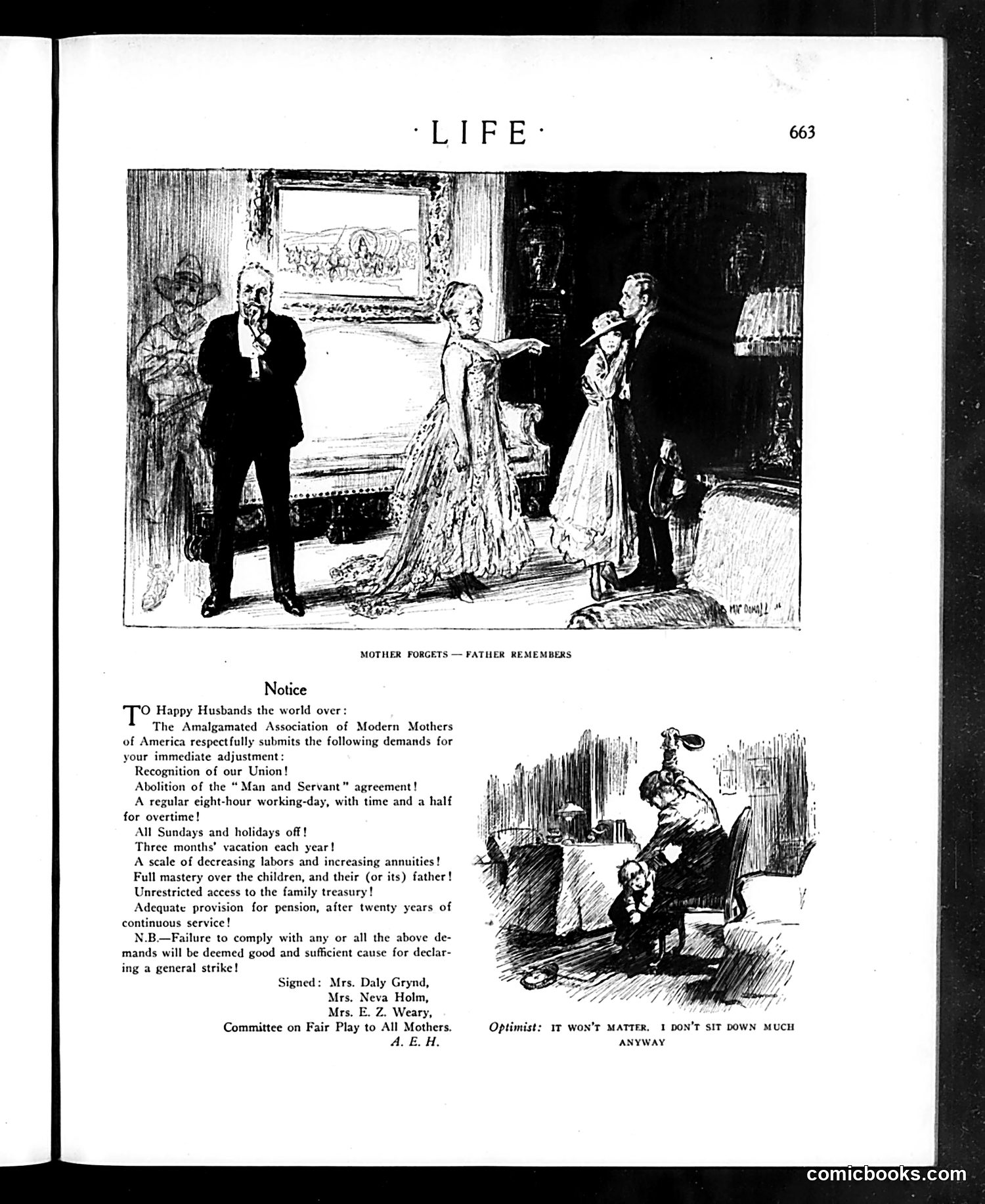
The page contains two distinct pieces of satire: **Top cartoon ("Mother Forgets—Father Remembers"):** Shows a domestic scene where a woman in an elaborate gown appears to be leaving or being introduced to guests, while a man observes. The title suggests irony about parental memory—likely commenting on class pretension or social climbing where mothers forget their humble origins. **Bottom section:** A "Notice to Happy Husbands" from the fictional "Amalgamated Association of Modern Mothers" satirizes feminist labor demands of the era (likely 1910s-1920s), including: eight-hour workdays, Sundays off, three-month vacations, pension rights, and "full mastery over children." The accompanying cartoon shows a harried man at a sink, with the caption "Optimist: it won't matter. I don't sit down much anyway"—mocking husbands' domestic servitude.
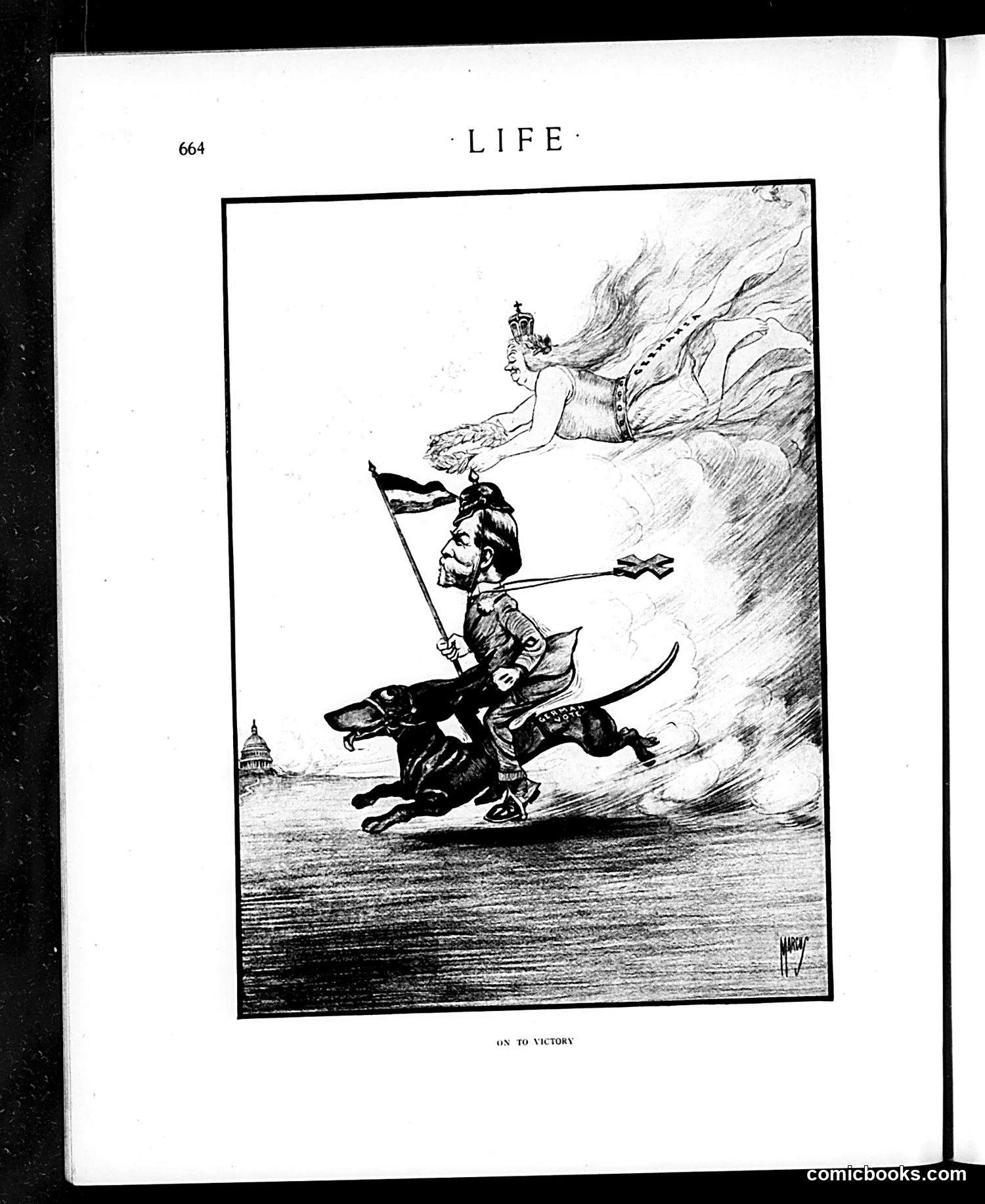
This political cartoon depicts a military figure on horseback carrying a flag, riding toward what appears to be the U.S. Capitol building visible in the background. Above, a classical female figure (likely representing Liberty or Victory) gestures downward approvingly from the clouds. The cartoon's title, "On to Victory," suggests this celebrates military success or an upcoming triumph. The composition—with the mounted soldier charging forward under divine approval—employs classical propaganda imagery common in wartime satire. Without knowing the specific publication date, the exact military campaign referenced remains unclear. However, the style and allegorical elements suggest this comments on American military ambition or leadership, using patriotic imagery that Life magazine would satirize or endorse depending on editorial stance.
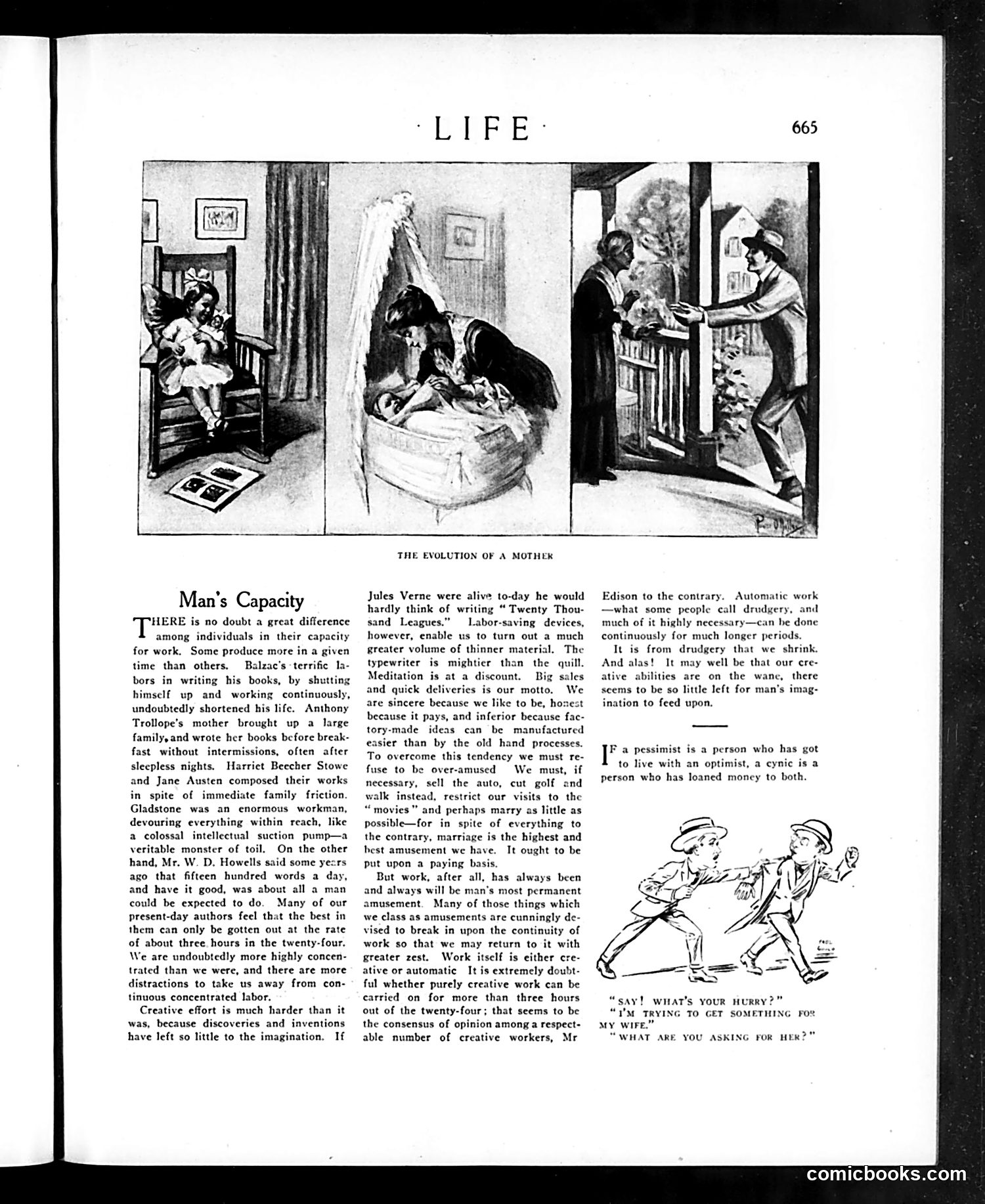
This page contains two distinct elements: **Top section:** "The Evolution of a Mother" - a three-panel illustration showing a woman's changing domestic role over time, from playful interaction with children to exhausted caregiving to greeting a departing man at a gate. **Main article:** "Man's Capacity" discusses productivity and work habits, arguing men can accomplish more in less time than women. It references Jules Verne, Thomas Edison, and Harriet Beecher Stowe, debating whether creative work can sustain beyond three hours daily. **Bottom cartoon:** Two men discuss personal matters, with one asking the other why he's "trying to get something for my wife" while asking "what are you asking for her?" - an apparent joke about marital economics or gift-giving. The page reflects early-20th-century gender attitudes regarding work capacity and domestic roles.
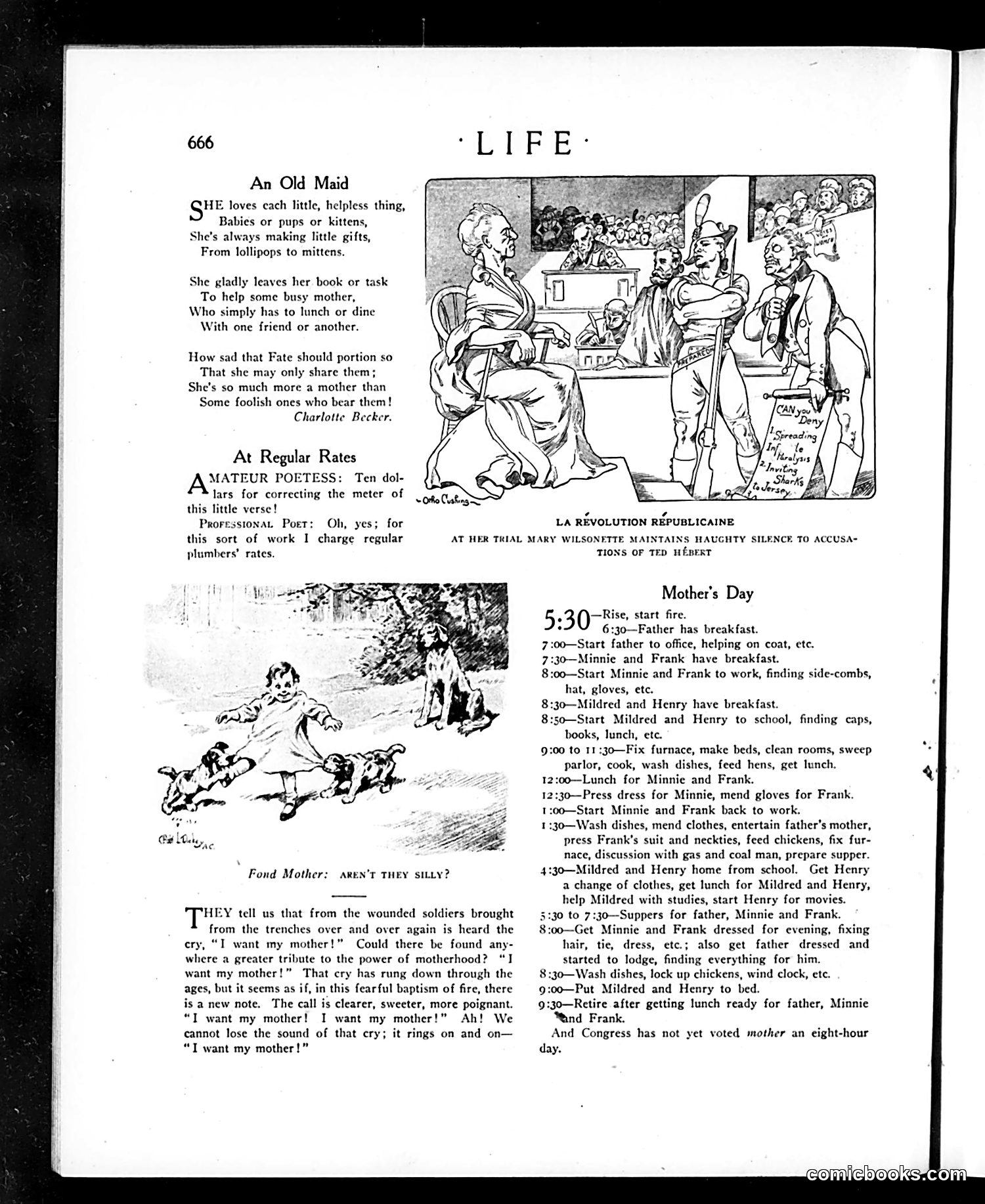
This page uses multiple formats to critique mothers' undervalued labor. **"An Old Maid"** (poem by Charlotte Becker) ironically praises unmarried women who nurture others' children, suggesting they embody motherhood better than biological mothers—a subtle critique of motherhood's low social status. **"At Regular Rates"** is a humor piece mocking amateur poets; a professional charges "plumbers' rates" for correcting verse, suggesting menial work pricing. **"Fond Mother"** shows a woman watching children play, likely commenting on parental naiveté. **The centerpiece: "Mother's Day"** presents a detailed, ironic schedule documenting a mother's exhausting 5:30 AM to 9:30 PM routine—cooking, cleaning, childcare, mending, and endless servicing of family members. **The punchline** states Congress hasn't yet voted mothers an eight-hour workday, sarcastically highlighting that mothers work vastly longer hours than any industrial worker while receiving no legal protection or recognition. The WWI reference ("wounded soldiers...I want my mother!") emphasizes mothers' emotional and physical importance while society denies them basic labor rights.
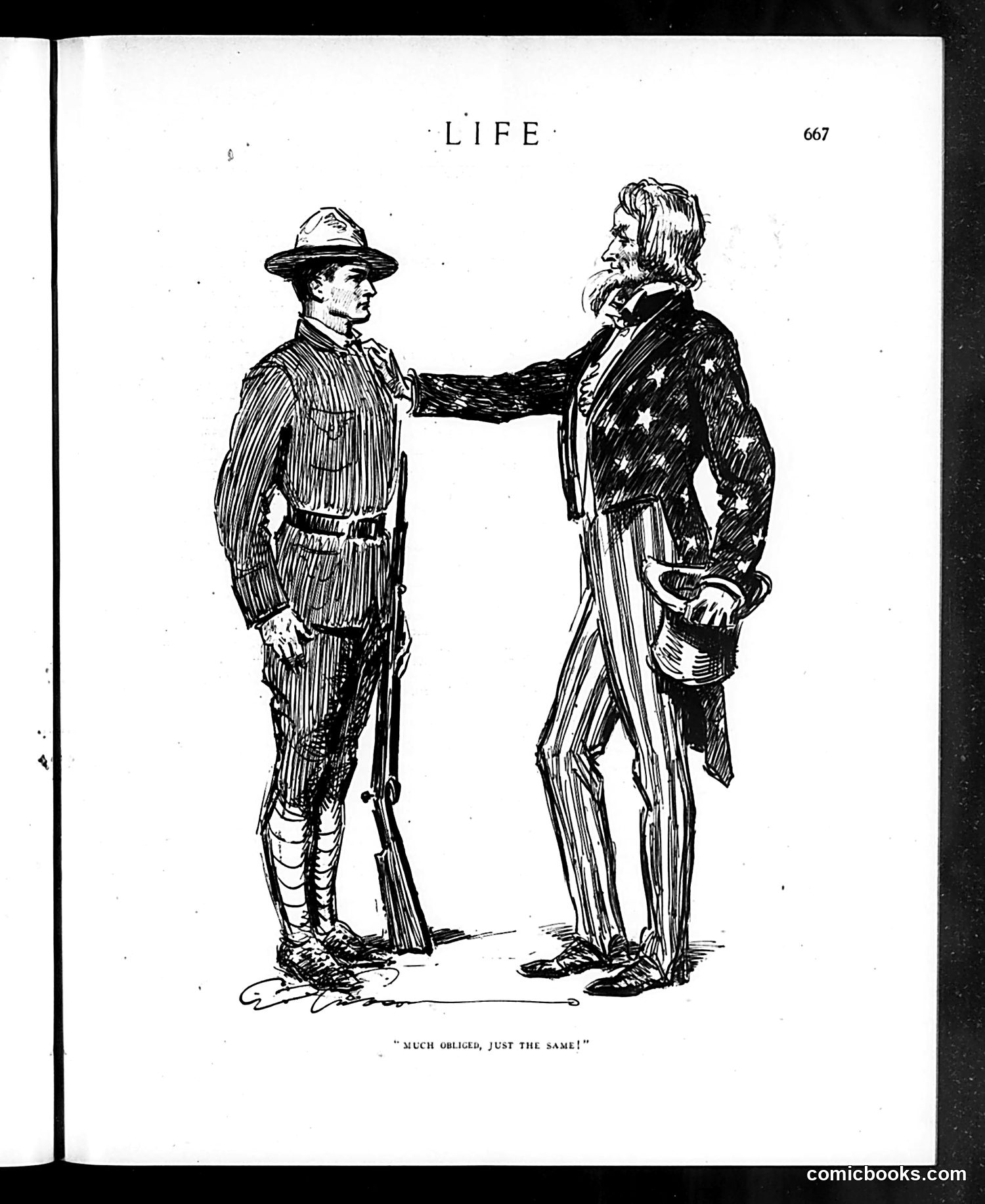
This Life magazine cartoon depicts two military figures in conversation, with the caption "MUCH OBLIGED, JUST THE SAME!" **Visual Elements:** - Left figure: A soldier in campaign uniform with wide-brimmed hat and rifle - Right figure: A high-ranking officer in dress uniform with stars (General) and sword **Interpretation:** The cartoon appears to satirize military hierarchy and protocol during America's armed service era. The soldier's courteous but somewhat awkward interaction with a superior officer—and the general's hand on the soldier's shoulder—suggests commentary on the formalities and class distinctions within military ranks. The caption's tone implies the soldier is politely declining something, perhaps an offer or order, in an ironic or humorous way that subverts typical military deference. Without specific dating or additional context, the exact historical reference remains unclear, though the uniforms suggest early-to-mid 20th century American military.
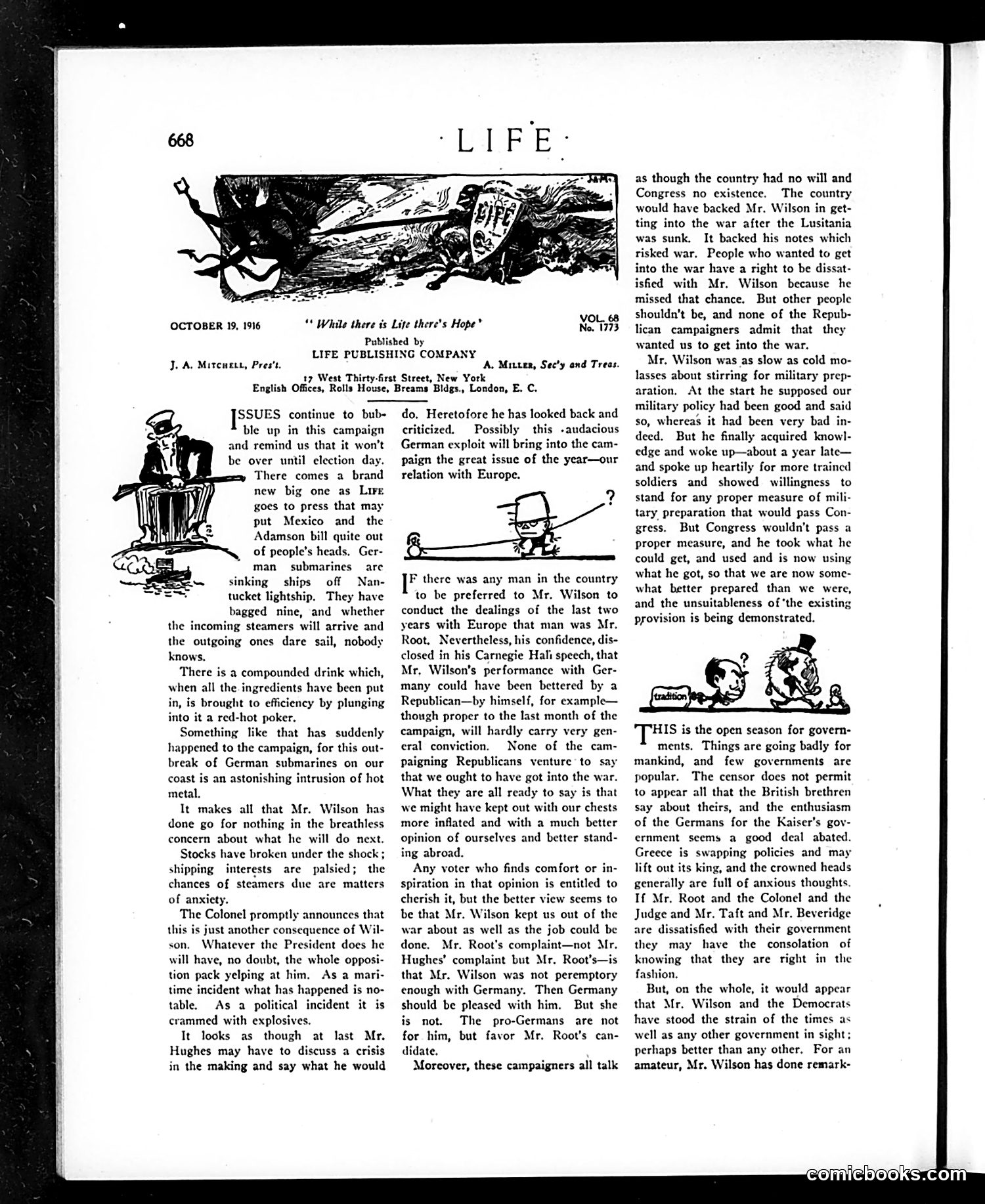
This page satirizes the 1916 presidential campaign between incumbent Democrat Woodrow Wilson and Republican challenger Charles Evans Hughes, set against the backdrop of World War I. The cartoons (left side) depict a figure emerging from a trash can labeled with campaign issues (Mexico, the Adamson bill) being suddenly disrupted—representing how German submarine attacks off the American coast have unexpectedly dominated the election narrative. The text critiques Republican attacks on Wilson's foreign policy. It notes that while Republicans (particularly Elihu Root) claim Wilson handled Germany insufficiently, they simultaneously deny wanting America to enter the war. The satire highlights this contradiction: Republicans want credit for tougher diplomacy without accepting responsibility for advocating war entry. The article defends Wilson's neutrality stance, arguing he kept America out of war "about as well as the job could be done" and that Congress—not just the President—shares responsibility for policy decisions. The submarine crisis, the author suggests, finally forces Hughes to offer concrete alternatives rather than mere criticism.
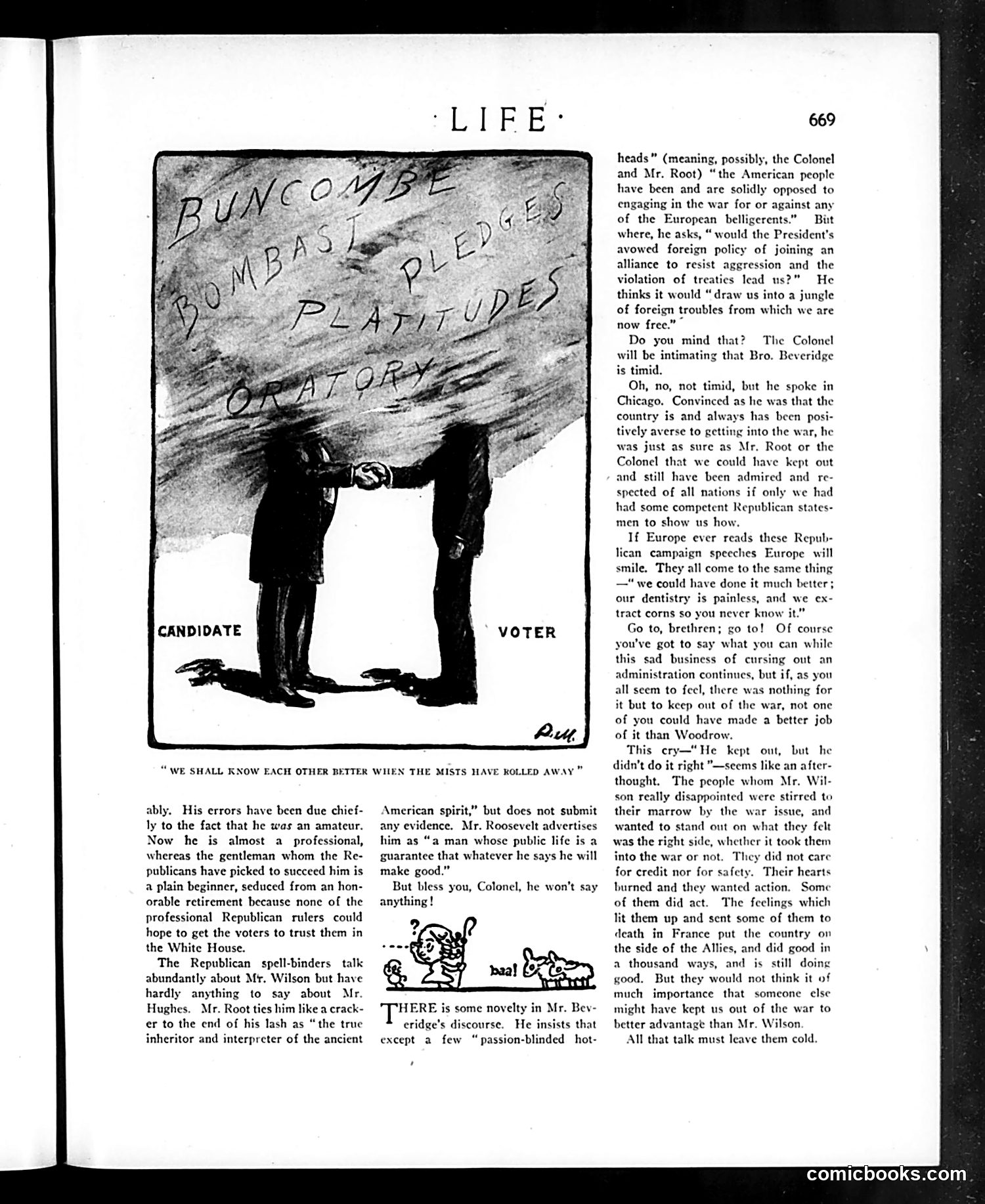
This Life magazine page satirizes the Republican Party's 1916 presidential campaign strategy against incumbent Democrat Woodrow Wilson. **The cartoon** depicts a "Candidate" and "Voter" shaking hands beneath a banner reading "Buncombe Embassies Pledges Platitudes Oratory"—mocking Republican campaign rhetoric as empty promises. The caption "We shall know each other better when the mists have rolled away" suggests the voter won't understand what Republicans actually stand for until later. **The text critiques** Republican speakers (including Theodore Roosevelt and Elihu Root) who attack Wilson's wartime policies while offering no substantive alternative. The author notes their central complaint—"He kept out [of WWI], but he didn't do it right"—rings hollow since Republicans themselves admit staying neutral was correct. The satire suggests Republicans are merely opportunistically attacking Wilson's execution rather than proposing genuinely different policies, making their campaign intellectually dishonest.
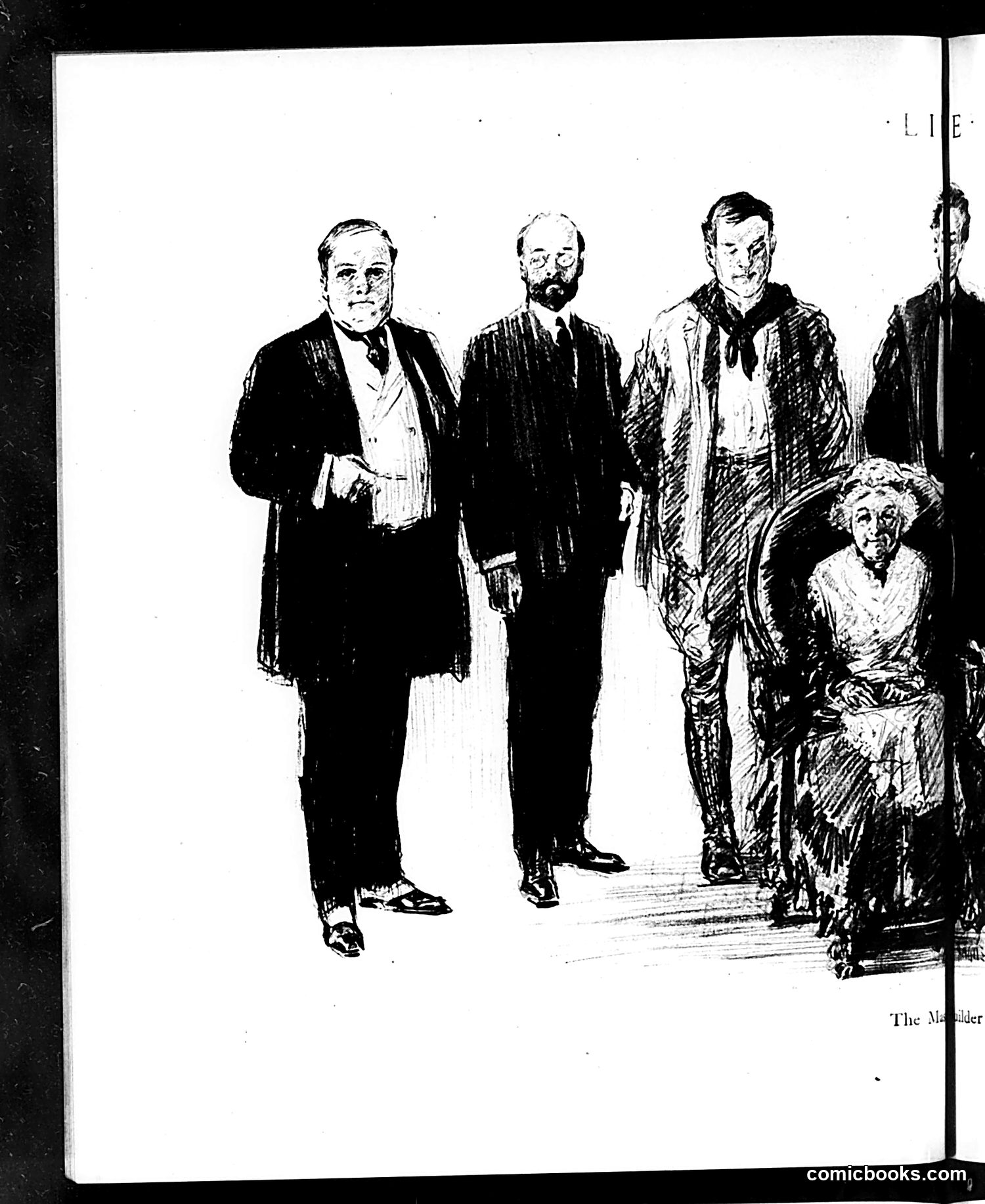
This appears to be an illustration titled "The Misdoer" showing five figures in what seems to be an official or legal setting. Four men in formal attire stand in the background—appearing as authority figures or officials—while a seated woman in lighter clothing sits separately on the right, somewhat isolated from the group. The OCR text is illegible, preventing identification of the specific political or social reference. Without caption text or clear context, I cannot definitively explain what misdeed is being satirized or which historical figures these represent. The composition suggests a judgment or accusation scene, but the particular satire's target and point remain unclear from the image alone.
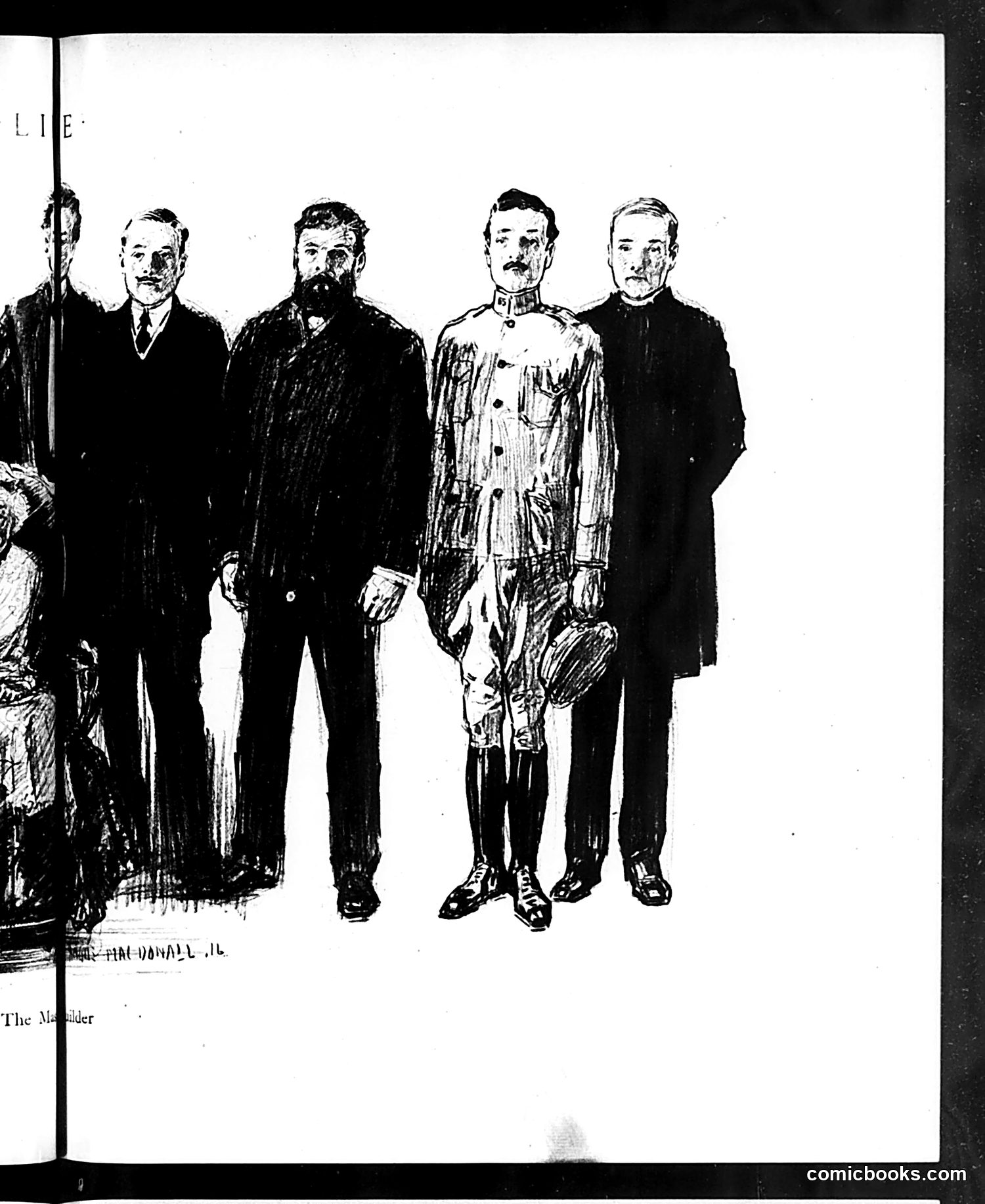
This sketch depicts five men standing in a line, drawn in a style typical of early 20th-century Life magazine satire. The figure second from right wears a distinctive military uniform with buttons and high collar, while the others wear dark civilian suits. One figure on the far left appears to hold a spear or staff. The OCR text is too corrupted to identify the specific individuals or political context. Without legible caption text, I cannot determine which public figures are being caricatured or what contemporary political/social issue this satirizes. The style and presentation suggest commentary on political or military leadership, but the specific point of the satire remains unclear from the image alone. To properly explain this cartoon's meaning, a clearer text source or publication date would be necessary.
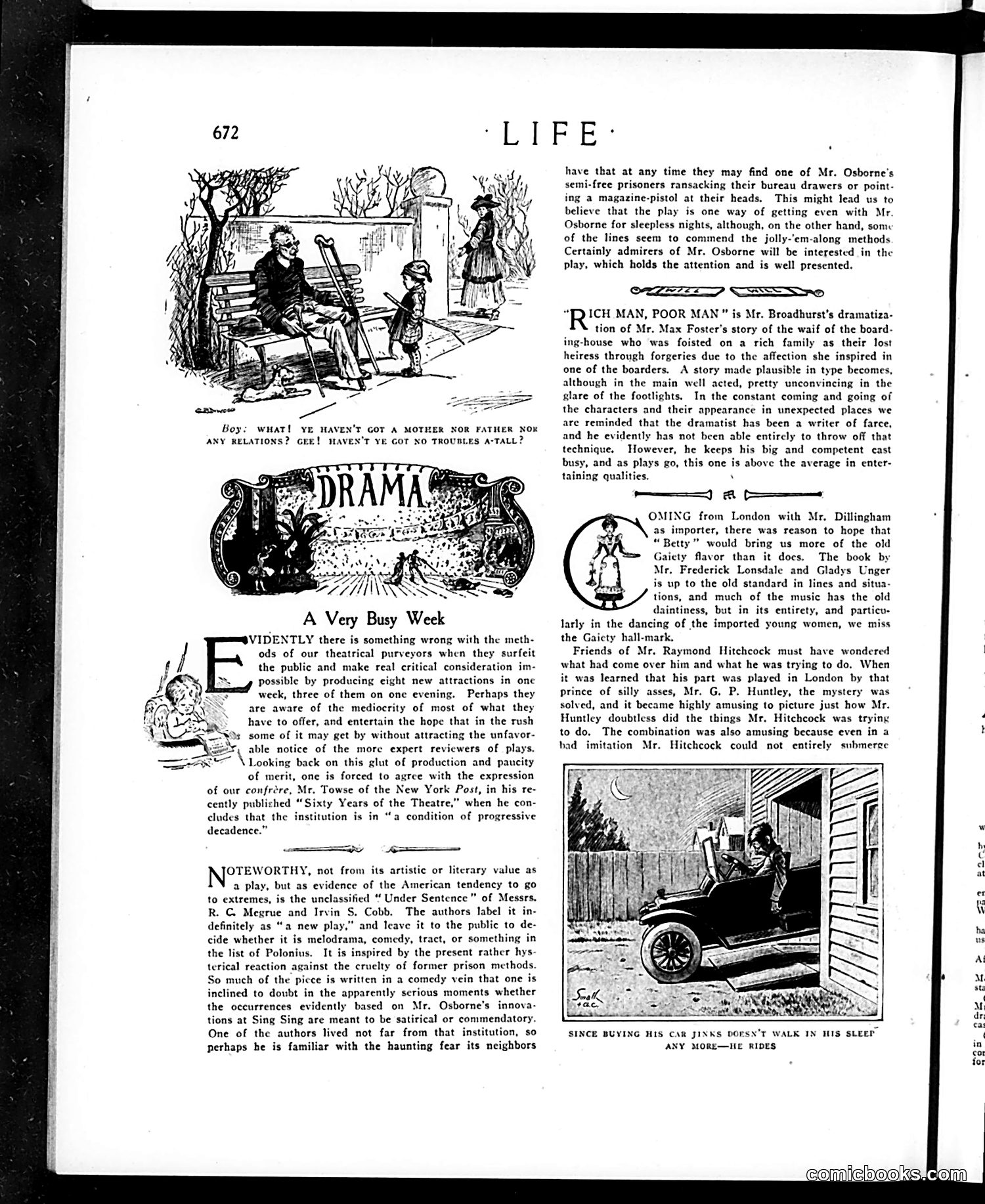
This page contains theater criticism from Life magazine, satirizing Broadway's production practices and reviewing several plays. **"A Very Busy Week"** - The opening critique attacks theaters for flooding the market with eight new productions simultaneously, suggesting this mediocrity-masking strategy prevents proper critical review. The critic cites theater historian Towse's assessment that the theatrical institution faces "progressive decadence." **The cartoon** (top left) depicts a poor orphan boy being questioned about his family relations—likely illustrating themes from one of the reviewed plays about class and family status. **Play Reviews:** - **"Under Sentence"** - About prison reform, inspired by Mr. Osborne's controversial "semi-free prisoner" innovations at Sing Sing prison. Critics note neighbors feared escaped convicts. The satire questions whether the play mocks or endorses Osborne's methods. - **"Rich Man, Poor Man"** - Criticizes an adaptation that works better on page than stage. - **"Betty"** - Imported from London's Gaiety Theatre, deemed less charming than the original. The overall tone mocks theatrical excess and derivative entertainment.
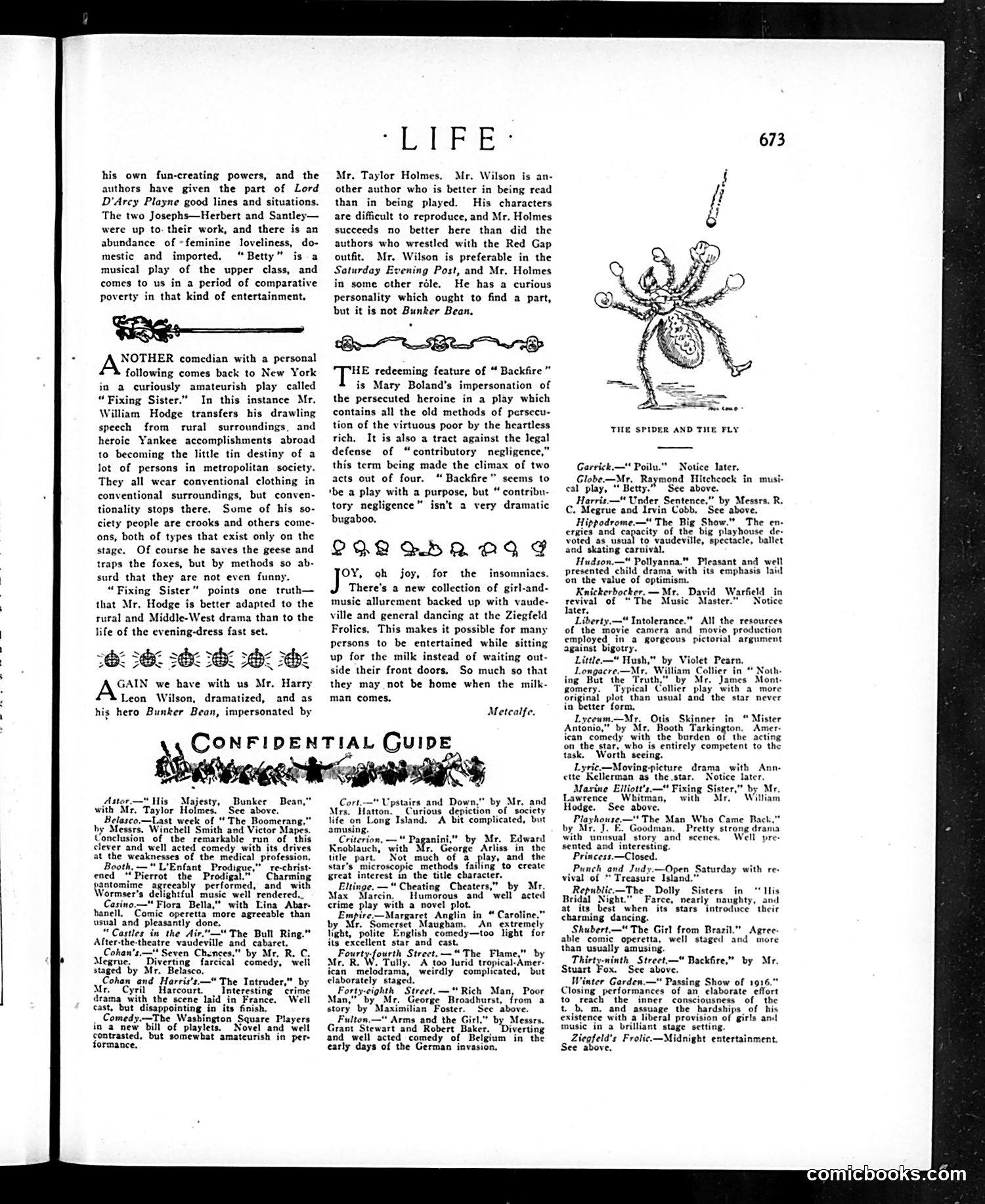
This page from *Life* magazine reviews current Broadway productions. The main cartoon depicts a spider catching a fly—a visual metaphor for the theatrical reviews themselves, which are humorously portrayed as predatory commentary on performers. The text critiques several plays and actors of the era. William Hodge is faulted for attempting urban society comedy when he excels at rural roles; Harry Leon Wilson's *Bunker Bean* is judged "better in being read than in being played"; and Mary Boland's *Backfire* is dismissed for making "contributory negligence" (a legal term) its dramatic climax—an absurdly undramatic subject. The reviews reveal *Life*'s satirical stance: evaluating theatrical merit while mocking both plays with weak plots and performers miscast in unsuitable genres. The *Confidential Guide* listing below provides capsule reviews of New York productions.
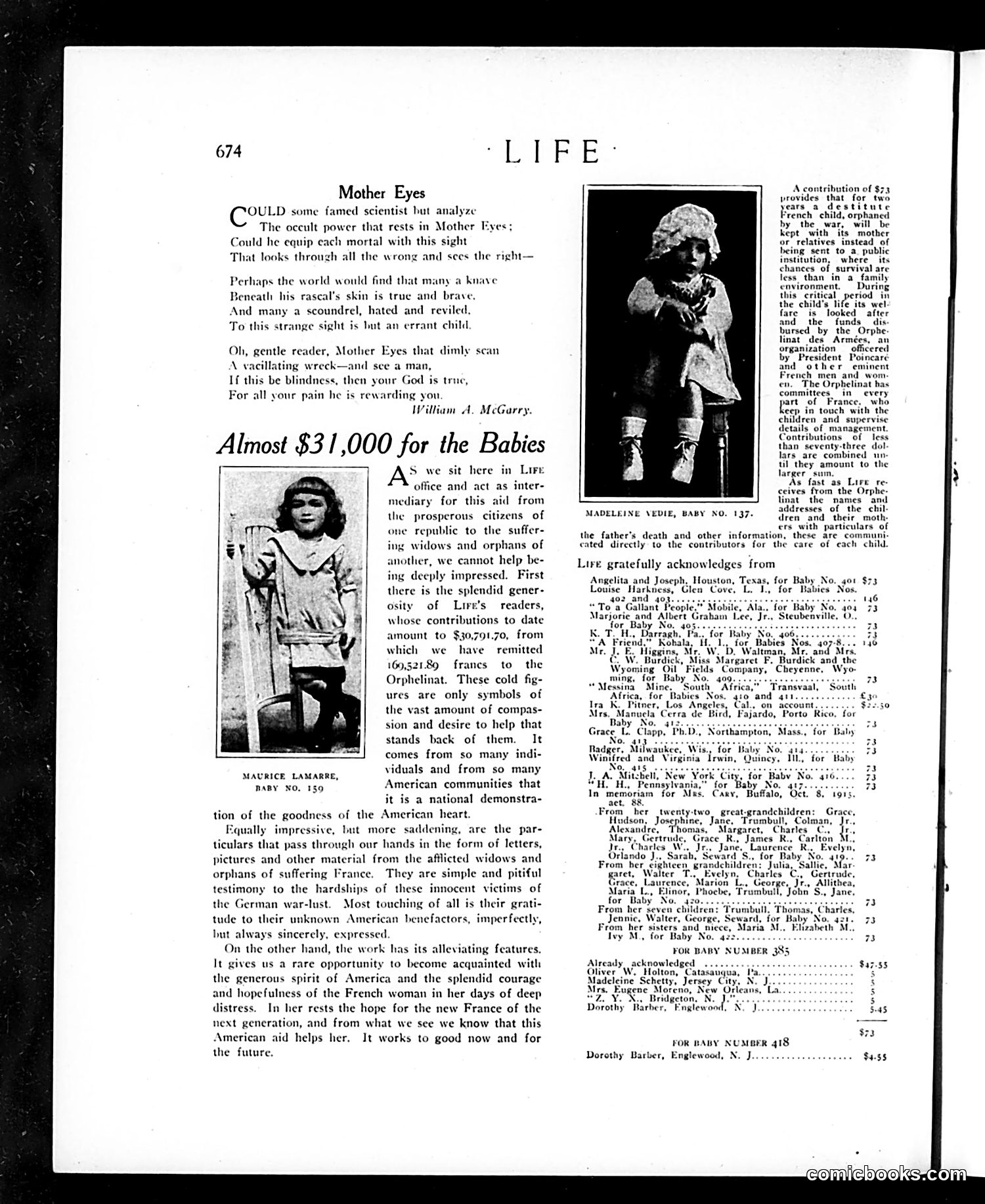
This page combines poetry and fundraising for French war orphans during World War I. The poem "Mother Eyes" by William A. McGarry uses sentimental language about a mother's ability to see goodness in people ("see the right") despite appearances, to emotionally appeal for charitable donations. The centerpiece is a fundraising update for "Life" magazine's orphan-support program. It reports nearly $31,000 collected and features photographs of beneficiary children (Baby No. 137, Maurice Lamarre as Baby No. 159). The extensive list of contributors shows widespread American charitable engagement. The article frames donations as a "national demonstration of the goodness of the American heart," positioning financial support as both patriotic and morally uplifting—helping France's "new generation" while boosting American self-image during wartime. This reflects early-20th-century philanthropic appeals mixing sentiment with national pride.
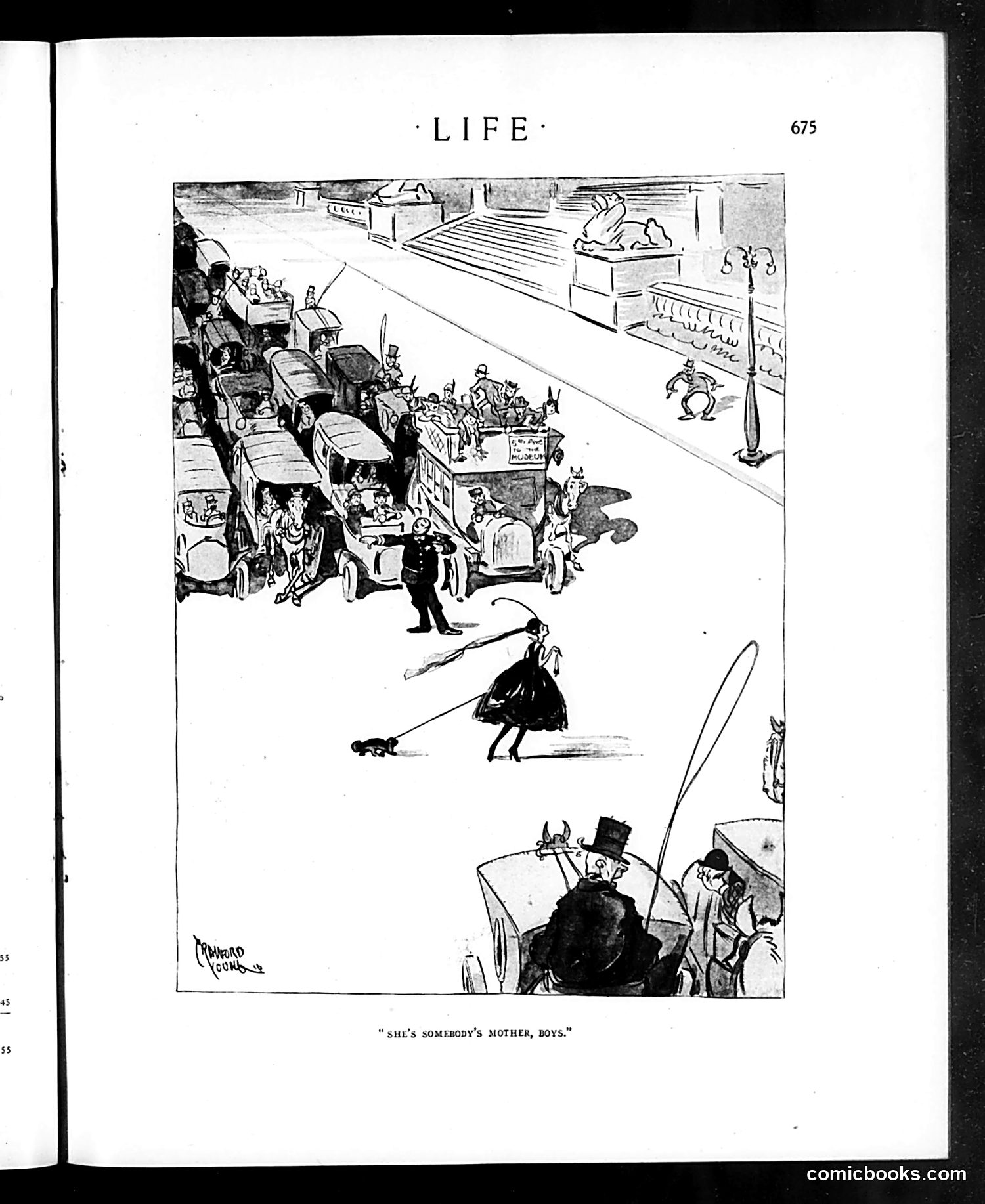
This is a single-panel cartoon by Cesare (signed lower left), depicting a chaotic traffic scene with multiple automobiles congested together. A woman in the foreground walks a small dog while holding an umbrella, seemingly indifferent to the automotive gridlock behind her. The caption reads: "SHE'S SOMEBODY'S MOTHER, BOYS." The satire appears to mock both reckless drivers and urban traffic conditions. The phrase suggests the woman deserves respect and caution because she's "somebody's mother"—a common appeal to male chivalry of the era. The joke likely critiques how drivers treat pedestrians, implying that recognizing someone's maternal status should command basic courtesy on crowded city streets. This reflects early-twentieth-century anxieties about automobile safety and urban congestion.
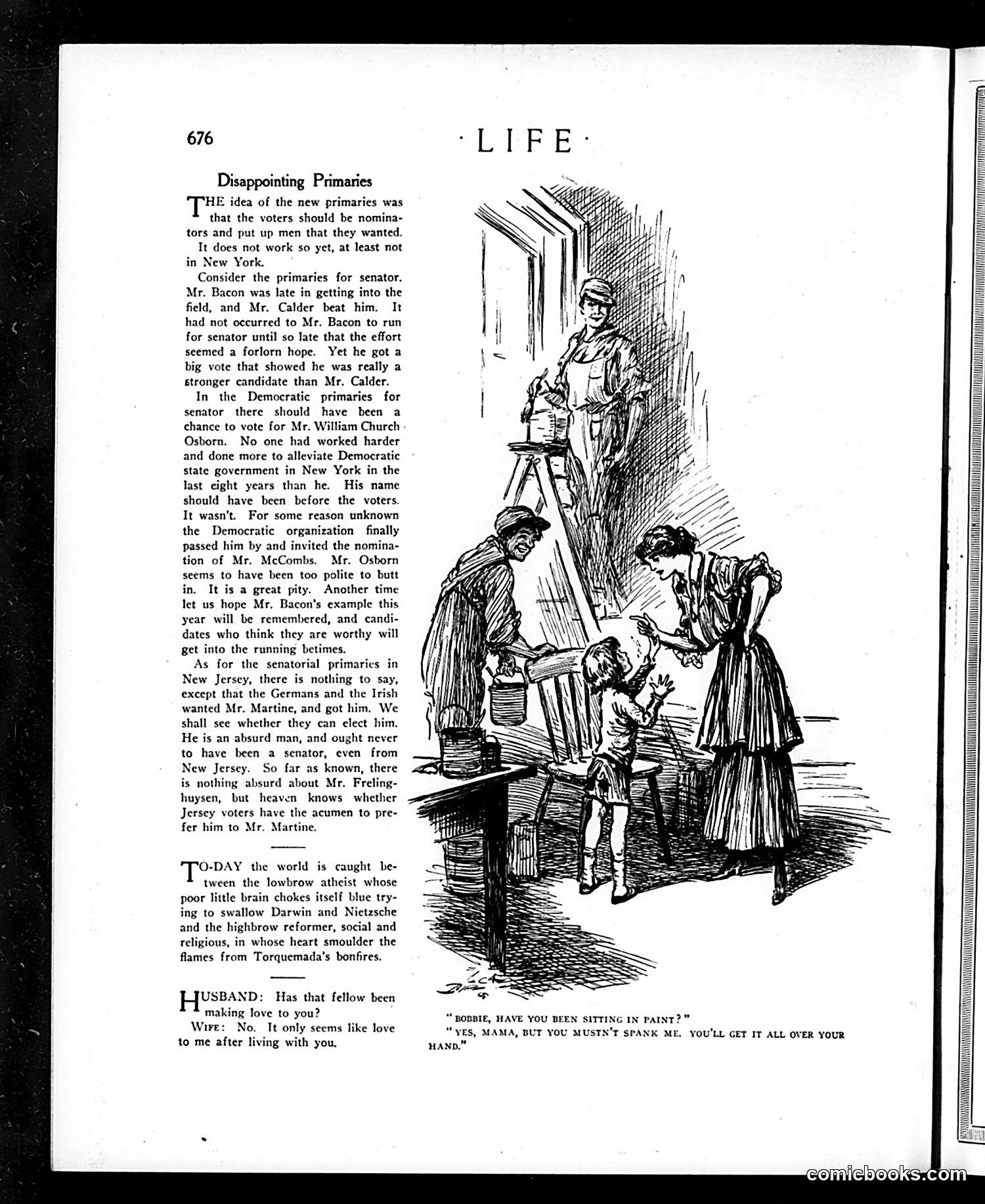
This page critiques the disappointing results of New York's primary election system. The text argues that while primaries were meant to let voters nominate their preferred candidates, the system failed: strong candidates like Bacon and Osborn were overlooked due to late entries or organizational neglect, while weaker choices like Calder and McCombs prevailed. The central illustration depicts a child sitting in wet paint while adults (including the mother) react in dismay—a visual metaphor for messy political consequences. The caption's joke plays on the child's innocence: the mess spreads regardless of punishment. Below this is a brief dialogue between husband and wife mocking marital discord, presented as topical commentary rather than plot. The page reflects early 20th-century frustration with primary election mechanics in New York politics, suggesting that organizational politics still trumped genuine voter preference despite reform intentions.
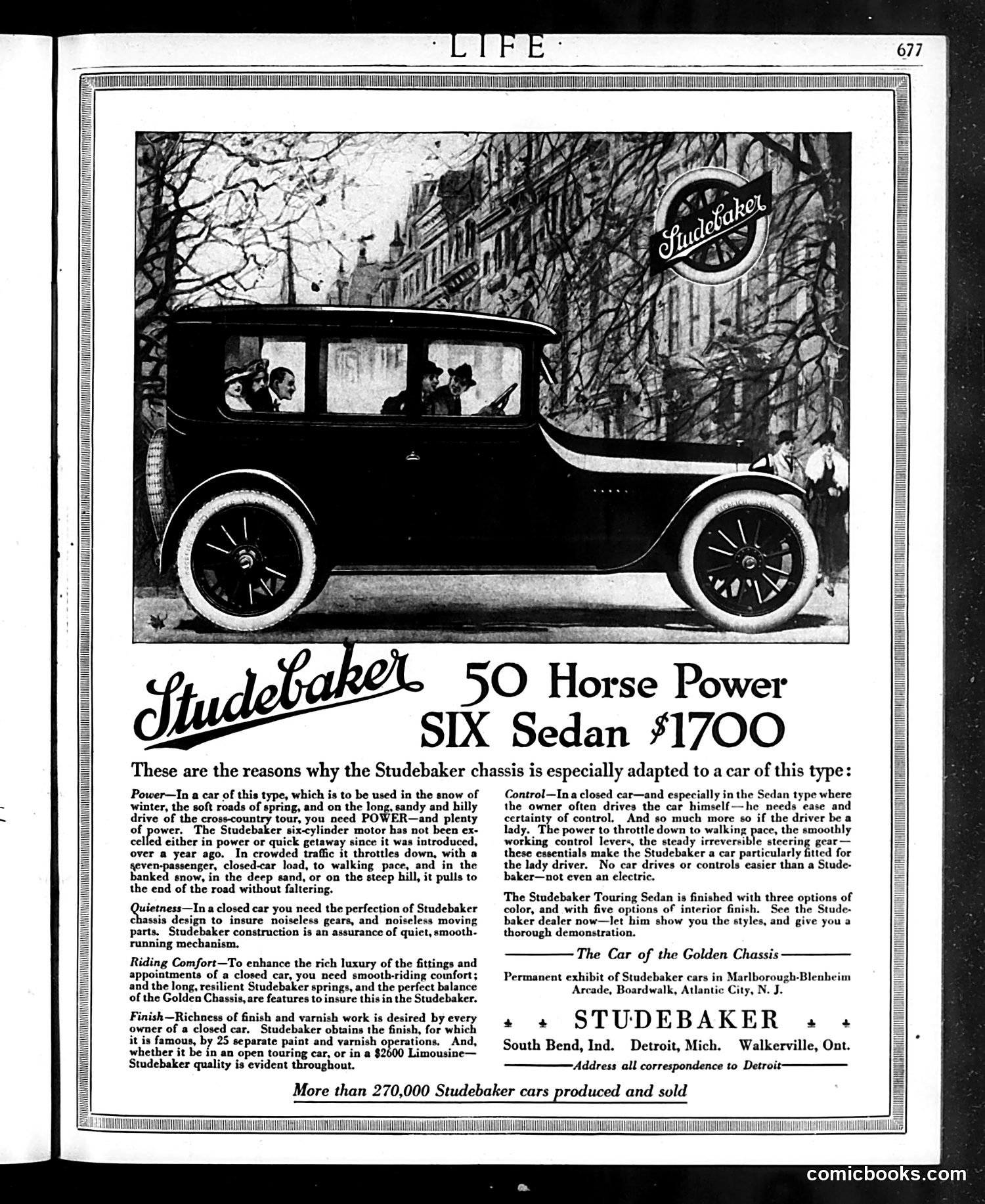
This is **not a cartoon or satire page**—it's a straightforward automobile advertisement for the Studebaker 50 Horse Power Six Sedan, priced at $1,700. The image shows a side-profile photograph of the vehicle with passengers visible through windows, positioned on a European street with period architecture. The ad emphasizes practical features: engine power for winter/rough roads, quiet operation, riding comfort, quality finish (25 paint operations), and ease of control—notably addressing female drivers as an intended market ("if the driver be a lady"). The "Golden Chassis" branding and claims of "more than 270,000 Studebaker cars produced and sold" serve as status markers. References to exhibition locations (Atlantic City's Marlborough-Blenheim Arcade) suggest marketing to affluent audiences. This represents early automotive advertising's focus on mechanical reliability and luxury appointments, with the unusual inclusion of gender-specific selling points regarding vehicle control.
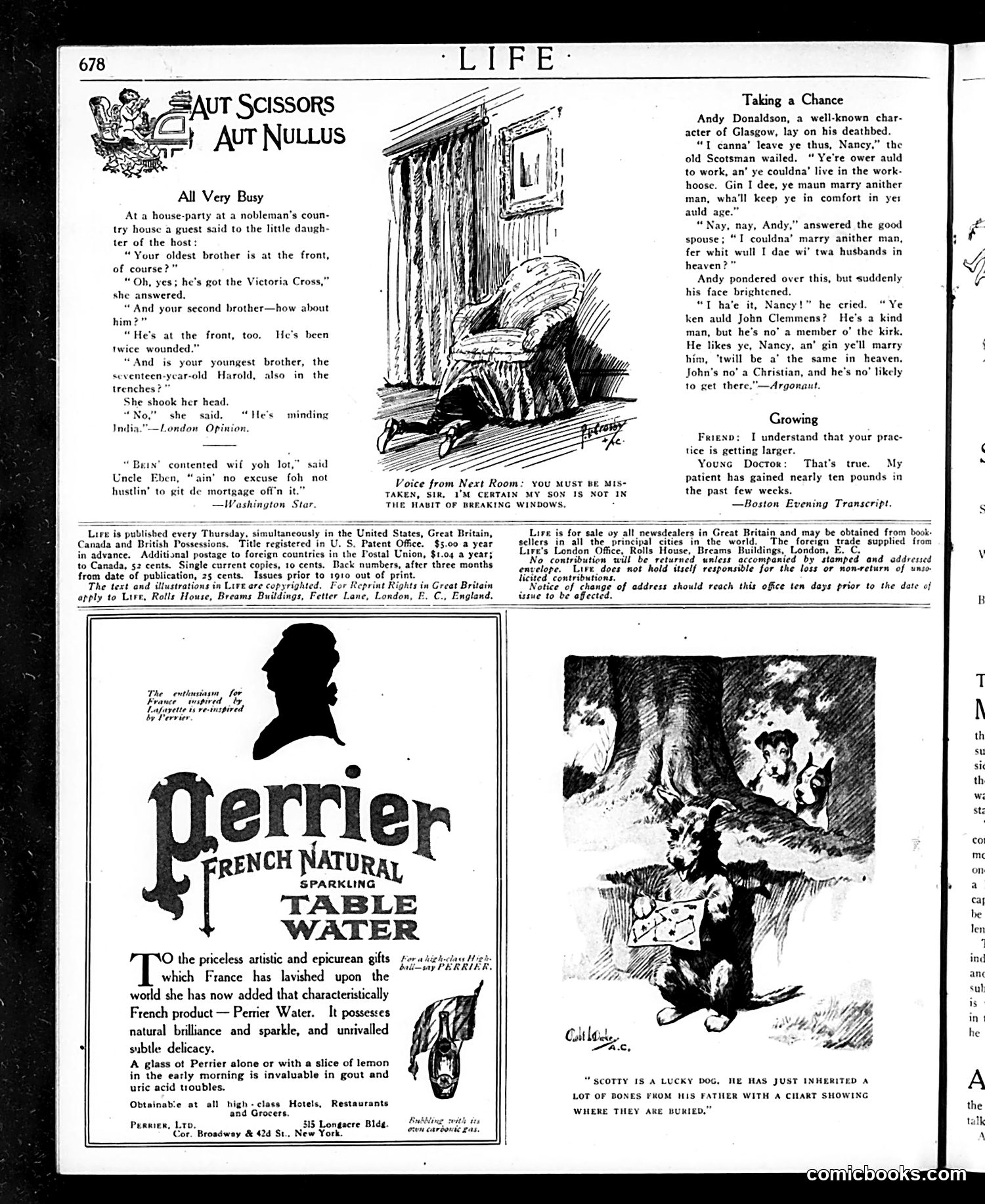
This page contains three short humorous pieces satirizing World War I British society: **"All Very Busy"** jokes about military service priorities. A nobleman's daughter reveals her three brothers' statuses: the oldest has the Victoria Cross (Britain's highest military honor), the second is twice-wounded at the front, but the youngest—seventeen-year-old Harold—stays home "minding India" (managing colonial affairs). The satire mocks how maintaining the empire was considered equally important to fighting the war. **"Taking a Chance"** is a Scottish dialect joke about a dying man's practicality. Andy worries his widow cannot remarry respectably in heaven if still married. His solution: marry a non-Christian so the marriage won't "count" in the afterlife. The humor relies on Scottish working-class pragmatism clashing with religious logic. **"Growing"** is a doctor's joke: when a friend congratulates him on expanding practice, the young doctor reveals his patient gained ten pounds—implying the patient is getting sicker/needier, thus more lucrative. The page also contains a Perrier water advertisement and publishing information for *Life* magazine.
This page from *Life* magazine contains several short humorous pieces typical of early 20th-century American satire: **"It Didn't Follow"** is a joke about semantic absurdity: a customer complains a "chicken pie" contains no chicken. The waiter's logic—that a "dog biscuit" contains no dog—exposes the illogical naming convention. The satire targets either poor restaurant quality or linguistic pedantry. **The plumber anecdote** mocks an apprentice's casual excuse for disappearing during work ("getting ma hair cut"), with the Scots-dialect punchline suggesting the boss questions whether hair actually grows that quickly. **"Ecclesiastical Discrimination"** jokes about frontier poverty: a rural town mayor warns an incoming preacher they must haul water twelve miles, implying the congregation is too poor to support him properly. These are primarily **working-class humor** and **social commentary on service industries, labor, and rural conditions**—typical of *Life's* satirical stance. No specific political figures or events are referenced; the satire targets general human foolishness and social contradictions.
This satirical story ridicules the concept of absolute honesty in social situations. A woman asks three male friends to assess her age truthfully. The first two flatter her (claiming she looks 20 and 25, respectively). The third, valuing "truth" above all, suggests she won't see thirty—implying she looks much older. The woman rejects him furiously, despite requesting candor, revealing the hypocrisy: people claim to want honesty but actually prefer comforting lies. The final line—the third man wondering what would happen if he'd *actually* told the truth—drives home the joke: brutal honesty destroys friendships. The title "How to End War" suggests this is satirizing peace negotiations or diplomatic discourse circa WWI-era, implying that demanding absolute truth without tact destroys human relations, just as rigid honesty might sabotage peace efforts. The cartoon critiques naive idealism about truth-telling as a social solution.
**"Improving Old Methods"** (left column): This is political satire mocking voting complexity. The author uses sarcastic irony to critique American ballots, suggesting they're already absurdly complicated—"a hundred (or is it a thousand?) feet long"—and ironically proposes making them *even more* confusing. The joke targets proportional representation advocates, suggesting their system would make voting incomprehensibly complex. The satire implies that ordinary citizens can barely understand current ballots, let alone more elaborate voting schemes. **"When Nature Turns Outlaw"** (main article with lightning photograph): This is an advertorial for American Telephone and Telegraph Company. It argues that nature's disasters (storms, floods, earthquakes) demonstrate humanity's dependence on telephone infrastructure. The piece celebrates the Bell System's resilience and redundancy, positioning AT&T as civilization's protector against natural chaos. The dramatic King Lear quotation establishes the tone of nature as destructive force requiring technological mastery. The right column advertises Owen Johnson's novel *The Woman Gives*.
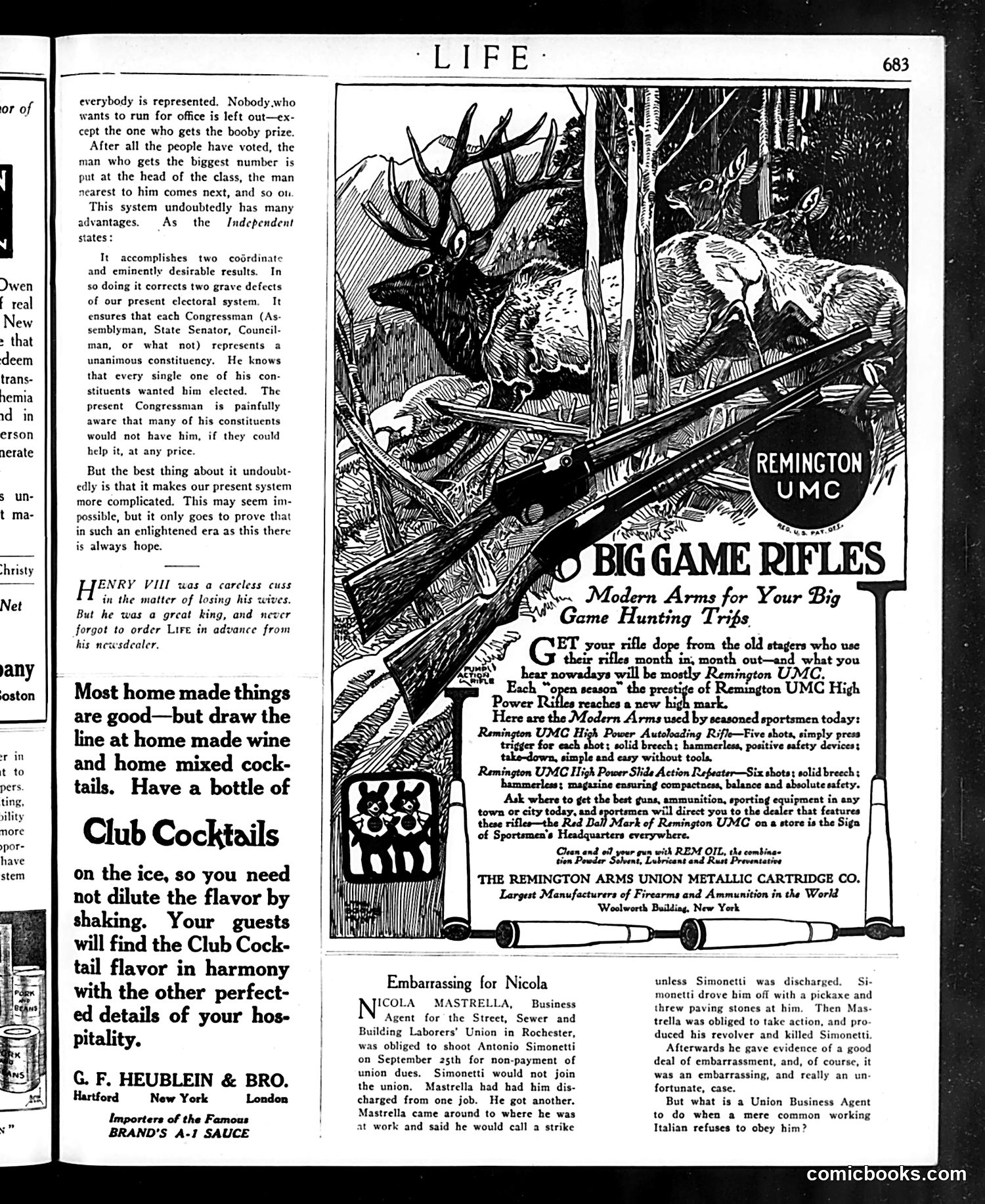
This page contains political satire and advertisements rather than traditional cartoons. **The Electoral System Satire (top left):** The text mocks a proposed voting reform—likely ranked-choice or proportional representation voting. Life sarcastically praises it for making the electoral system "more complicated," suggesting the reformers' good intentions ironically produce absurdity. The satire argues that while the system ensures representatives have unanimous support, this "improvement" merely demonstrates that even enlightened eras produce unnecessary complexity. **"Embarrassing for Nicola" (bottom):** This brief item reports on a shooting in Rochester where union business agent Nicola Mastrella killed worker Antonio Simonetti for refusing to join the union and resisting union pressure. The piece's tone is darkly ironic—Life treats lethal coercion as merely "embarrassing," sardonically asking "what is a Union Business Agent to do?" This critiques union strongarming tactics and corruption during labor movement conflicts of the era. The advertisements (Remington rifles, Club Cocktails, Henry VIII reference) occupy the remaining space.
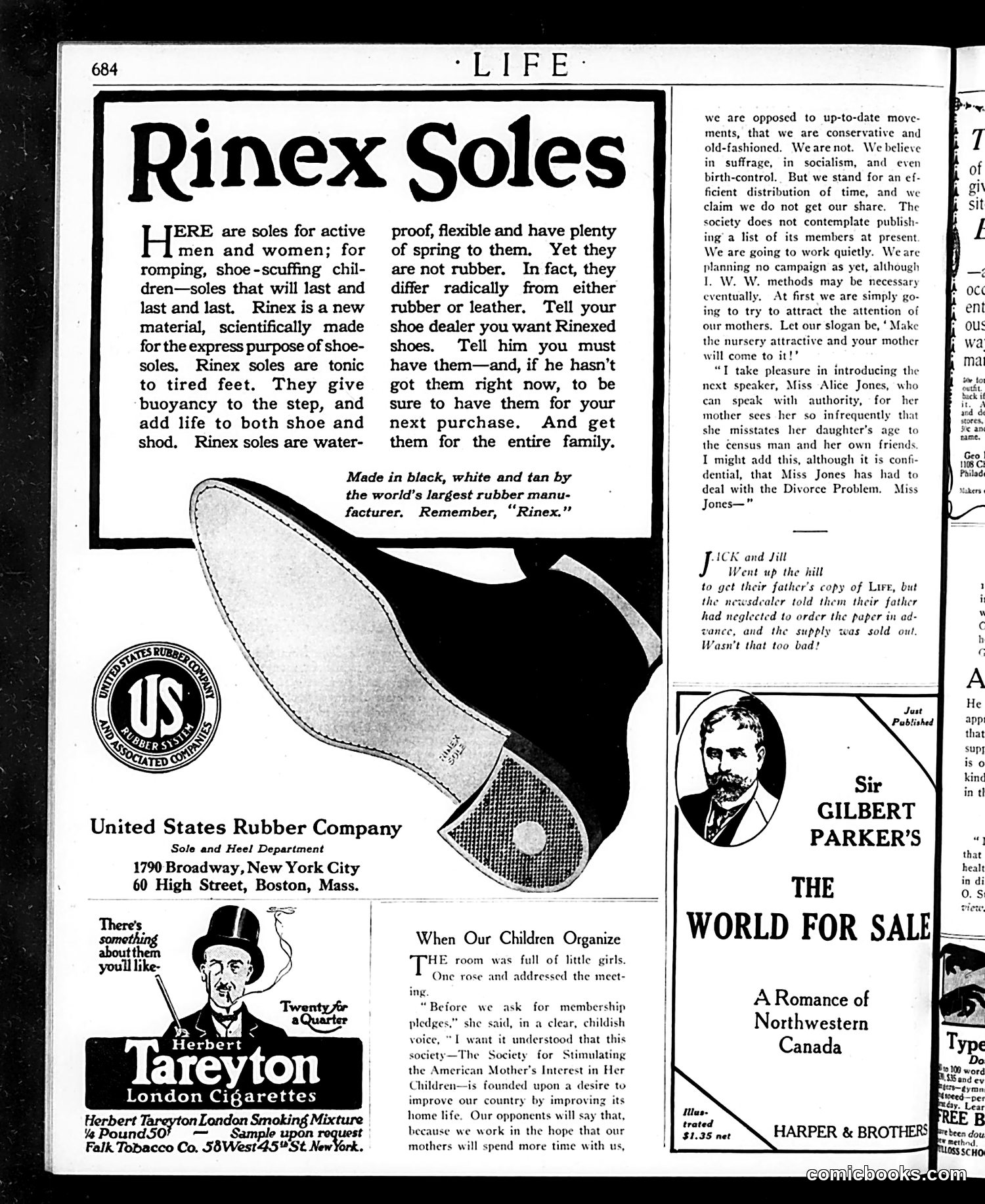
This page is predominantly **advertising** with satirical content interspersed. The main advertisement promotes **Rinex Soles**, a new synthetic shoe sole material made by the United States Rubber Company—claiming superiority over rubber or leather for durability and comfort. The satire appears in "**When Our Children Organize**," which mocks a children's organization called "The Society for Stimulating the American Mother's Interest in Her Children." The piece ridicules mothers' neglect of their children by having a young girl formally present the group's platform, which ironically supports modern causes (suffrage, socialism, birth-control) while complaining mothers ignore their kids. The joke is the contradiction: the group claims to be progressive yet exists solely to demand parental attention. The final satirical item, "**Jack and Jill**," jokes that a newsdealer couldn't fulfill a newspaper order—a lighthearted jab at poor service. Other advertisements include Herbert Tareyton cigarettes and Sir Gilbert Parker's novel *The World for Sale*.
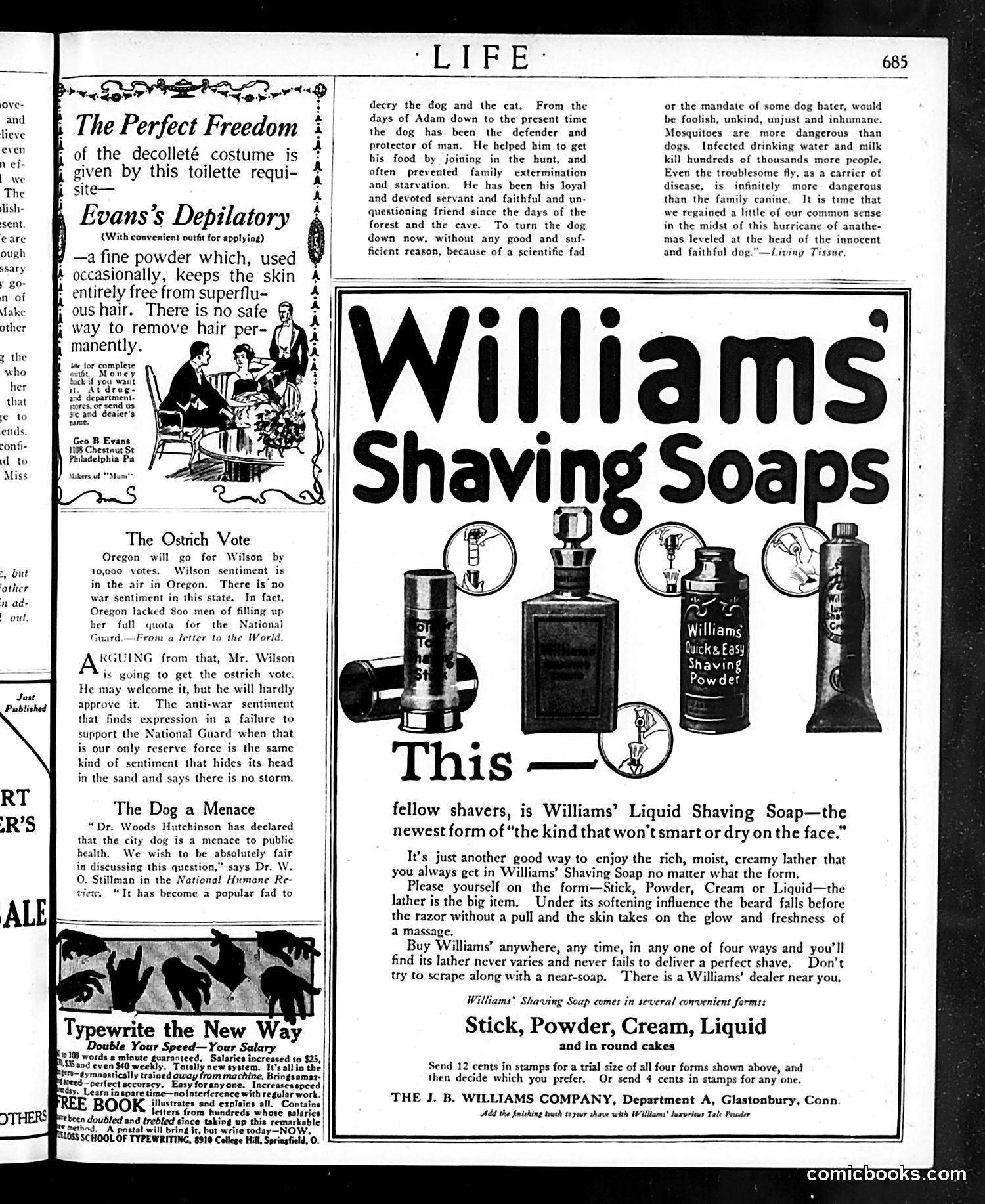
This page from *Life* magazine (appears to be from 1916, based on Wilson reference) mixes satirical commentary with period advertisements. **The political satire:** "The Ostrich Vote" mocks Oregon's anticipated support for President Wilson based on anti-war sentiment. The "ostrich" metaphor suggests these voters are burying their heads in sand—ignoring legitimate national defense needs like filling National Guard quotas. The writer criticizes this pacifist stance as dangerously naive. **Social commentary:** "The Dog a Menace" defends dogs against contemporary criticism, arguing they're less dangerous than mosquitoes and contaminated water. This appears to counter a health movement blaming urban dogs for public health problems. **Advertisements:** The page includes typical period ads for hair removal powder, typewriter training, and shaving products—reflecting early 20th-century consumer culture and gendered beauty standards. The overall tone is satirical and conservative, defending traditional values (dogs, preparedness) against what the magazine viewed as misguided modern fads and isolationist politics.
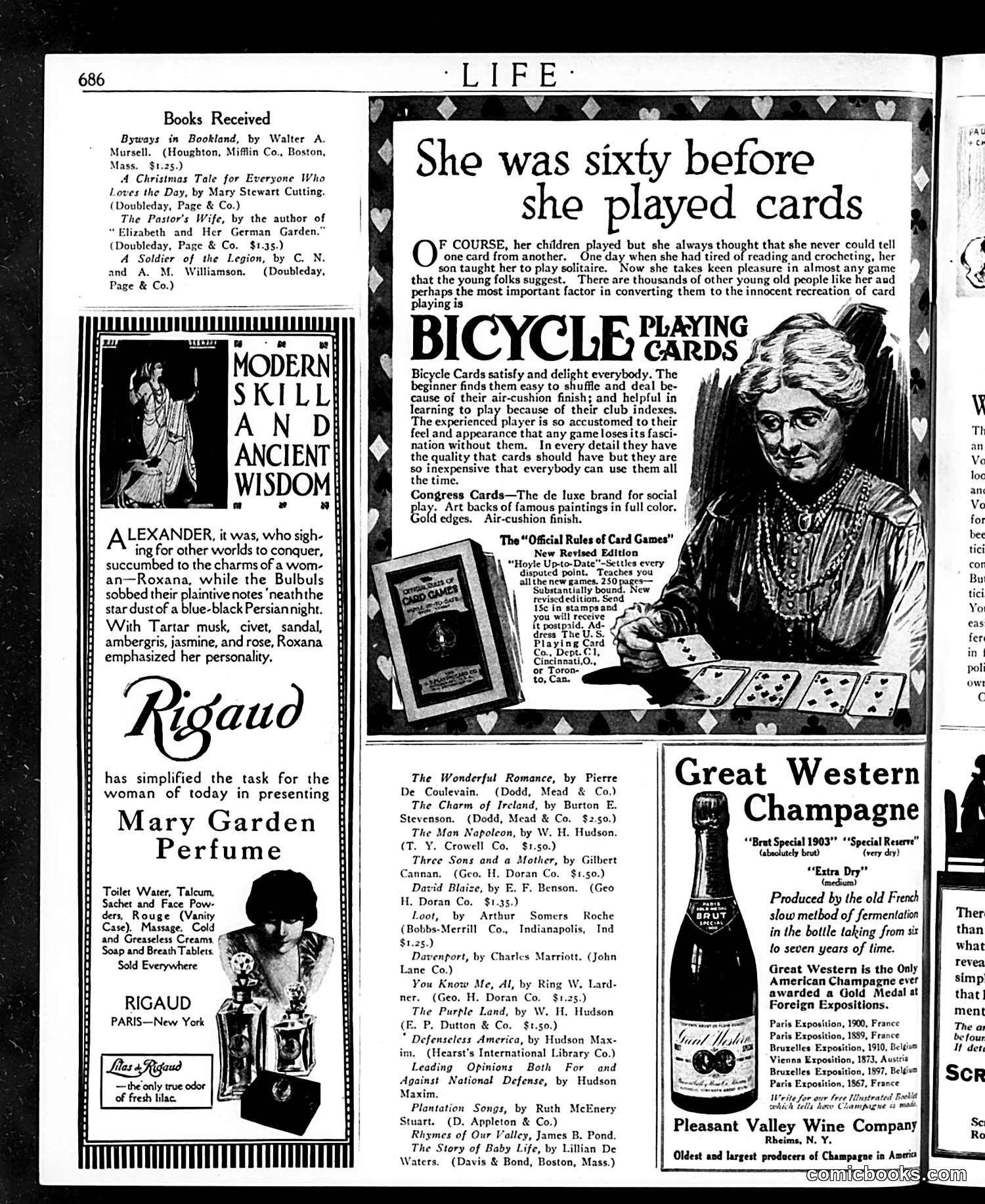
This page is primarily **advertising and book reviews** rather than political satire. The main content features: **Central Advertisement:** A large ad for Bicycle Playing Cards, using a narrative hook about a 60-year-old woman learning card games. The copy appeals to elderly readers by positioning card-playing as wholesome entertainment that keeps "young old people" mentally active and socially engaged. **Left Column:** A Rigaud perfume ad featuring classical imagery (Alexander the Great and Roxana), romanticizing women's use of luxury fragrances. **Right Column:** Great Western Champagne advertisement emphasizing its American production and gold medal awards. **Top Section:** "Books Received"—a straightforward list of recent publications, including works by Ring Lardner and Hudson Maxim. There is **no political cartoon or satire** visible. The page reflects early 20th-century advertising targeting middle and upper-class consumers with leisure goods, combined with literary reviews for educated readers.
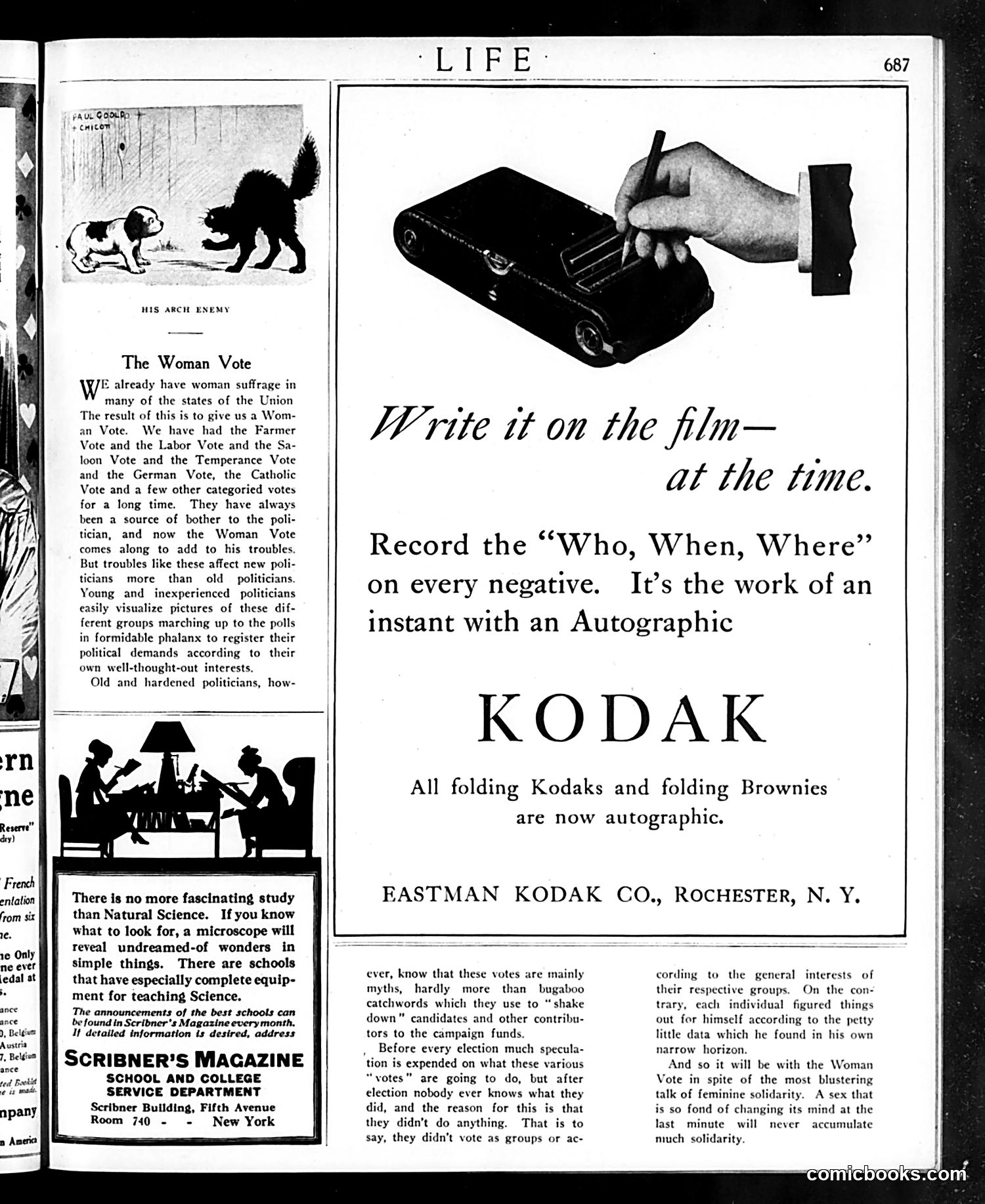
This satirical article mocks politicians' anxiety about newly enfranchised women voters. The cartoon "His Arch Enemy" depicts a small dog confronting a larger, aggressive cat—likely representing politicians' exaggerated fear of the "Woman Vote" as a unified political force. The text argues that while politicians nervously anticipate women voting as a coordinated bloc (like existing "Farmer Vote," "Labor Vote," etc.), this fear is overblown. The author claims these categorical voting groups are largely mythical—used mainly for campaign fundraising rather than actual political action. The satire's point: politicians unnecessarily panic about women's voting power, when historical experience shows no demographic group actually votes as a monolith. The author dismissively suggests women especially won't maintain solidarity, characterizing them as indecisive ("so fond of changing its mind"), thereby undercutting his own argument about the meaninglessness of group voting categories.
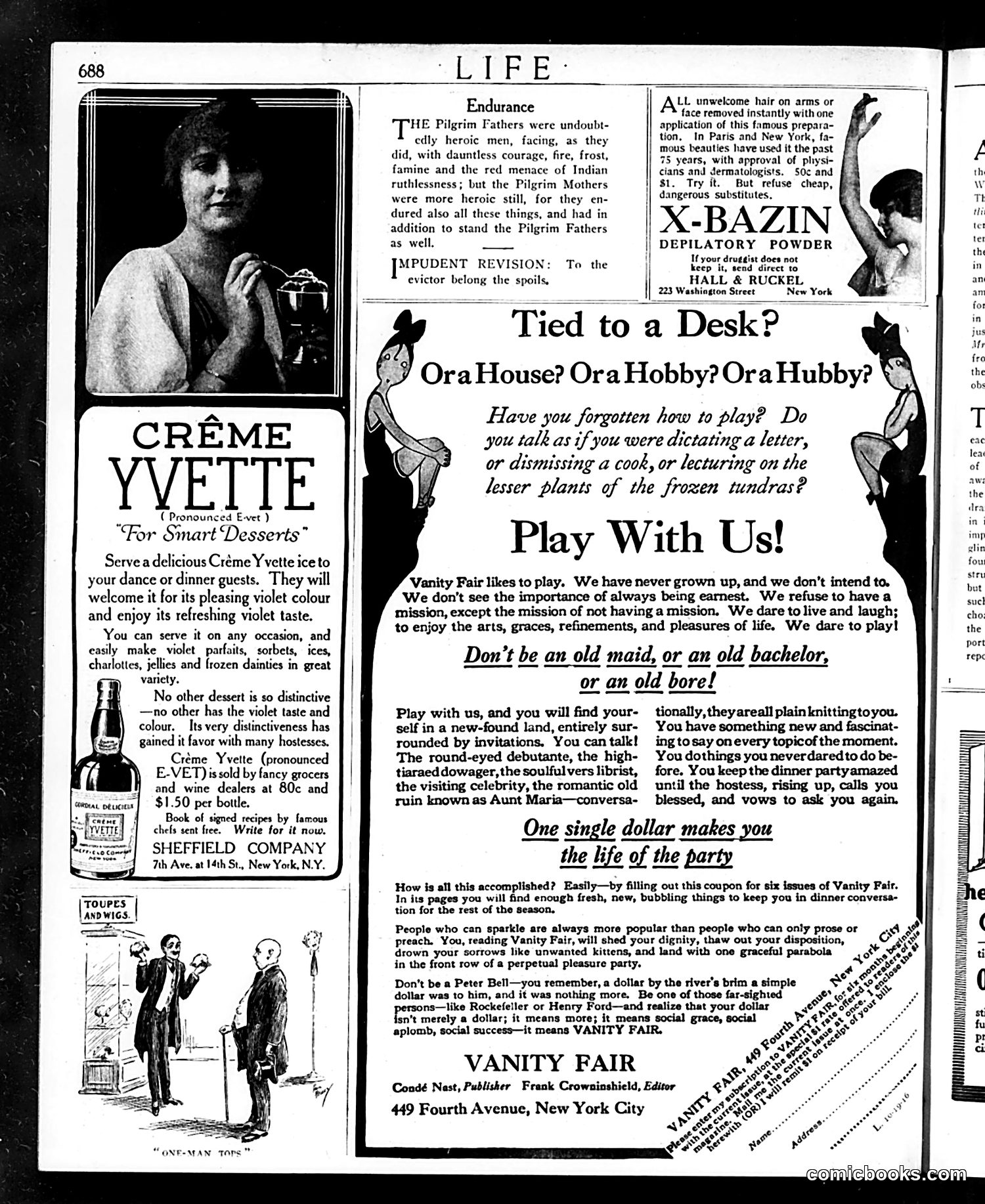
This page primarily features **advertising** rather than editorial cartoons. The main content is a Vanity Fair magazine subscription advertisement ("Play With Us!") positioned centrally, flanked by product ads for Crème Yvette dessert and X-Bazin depilatory powder. The small editorial content includes a brief satirical piece titled "Endurance," which presents a tongue-in-cheek observation: while Pilgrim Fathers faced hardship colonizing America, Pilgrim Mothers were "more heroic still" because they endured those same hardships *plus* having to tolerate the Pilgrim Fathers themselves. This is gentle domestic satire, poking fun at married life. The Vanity Fair ad uses social pressure and aspiration as sales tactics, warning readers against being "old maid[s]," "old bachelor[s]," or "old bore[s]"—suggesting the magazine offers sophistication, wit, and social popularity. The ad reflects 1920s consumer culture values emphasizing youth, urbanity, and leisure.
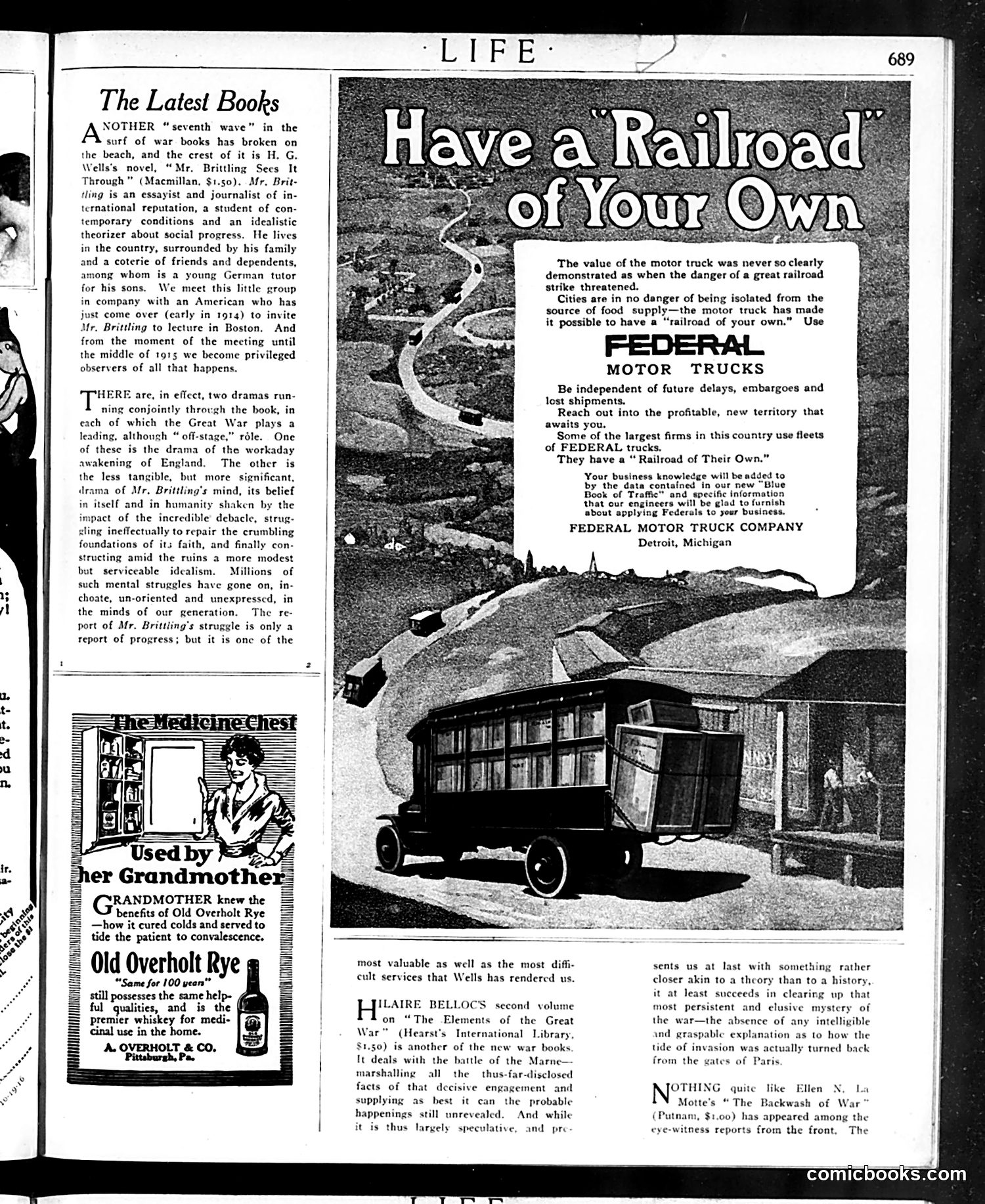
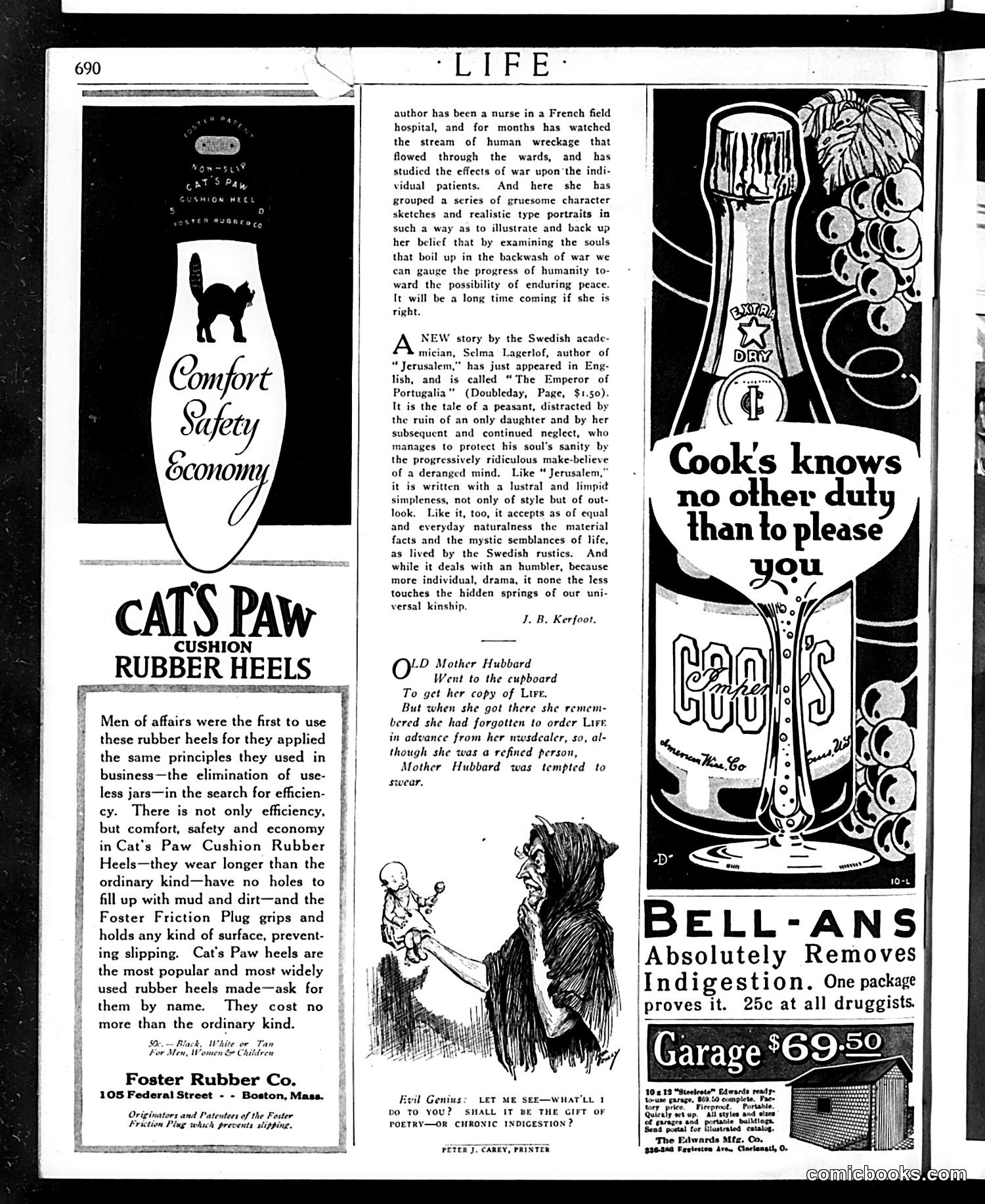
This page mixes advertisements with literary content and one small political cartoon. The main cartoon (bottom center) shows an "Evil Genius" offering Mother Hubbard a choice between "the gift of poetry—or chronic indigestion?" It's a gentle jab at Life magazine itself: the joke is that readers forgot to subscribe to Life in advance, so Mother Hubbard can't get her copy. The cartoon humorously presents this subscription failure as a demonic curse. The page otherwise features ads for Cat's Paw rubber heels, Bell-Ans indigestion remedy, and a prefabricated garage. Literary content discusses a Swedish author's novel about peasant life and a nurse's wartime observations. The cartoon's satire is self-promotional rather than political—Life is joking about its own circulation while advertising subscription reliability.
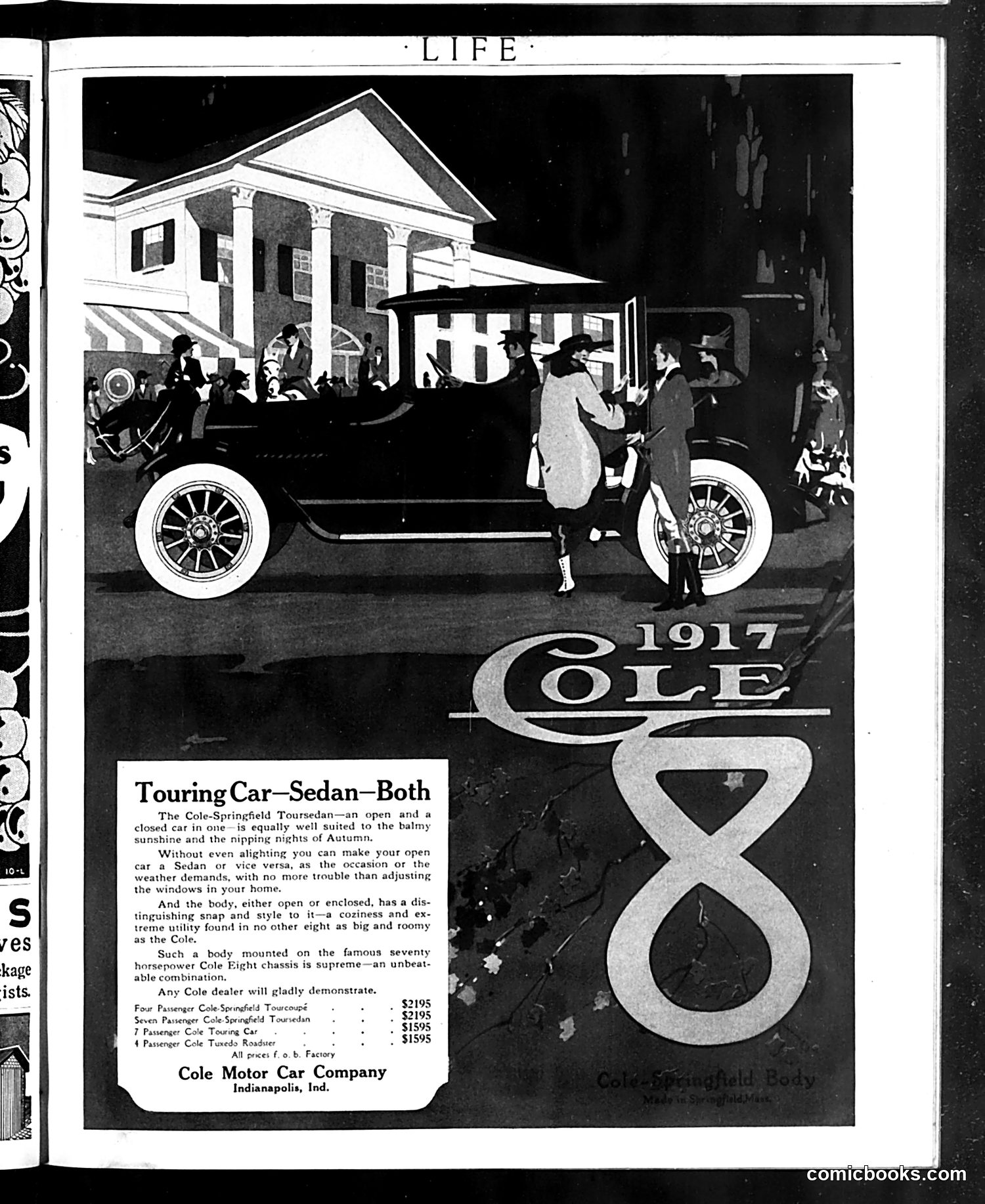
This page is primarily **automobile advertising**, not political satire or comics. It advertises the 1917 Cole automobile, specifically the "Cole-Springfield Toursedan"—a convertible car with a removable roof that could function as either an open touring car or enclosed sedan. The advertisement emphasizes the vehicle's versatility for changing weather conditions and highlights its styling and comfort. The illustration shows well-dressed passengers using the car in front of a classical mansion, appealing to affluent buyers. Prices range from $1,595 to $2,195 (substantial sums in 1917). The Cole Motor Car Company, based in Indianapolis, Indiana, is promoting what appears to be a genuine technological feature of their vehicle—the ability to convert between open and closed configurations without stopping to adjust windows manually. There is no political cartoon or satire present on this page.
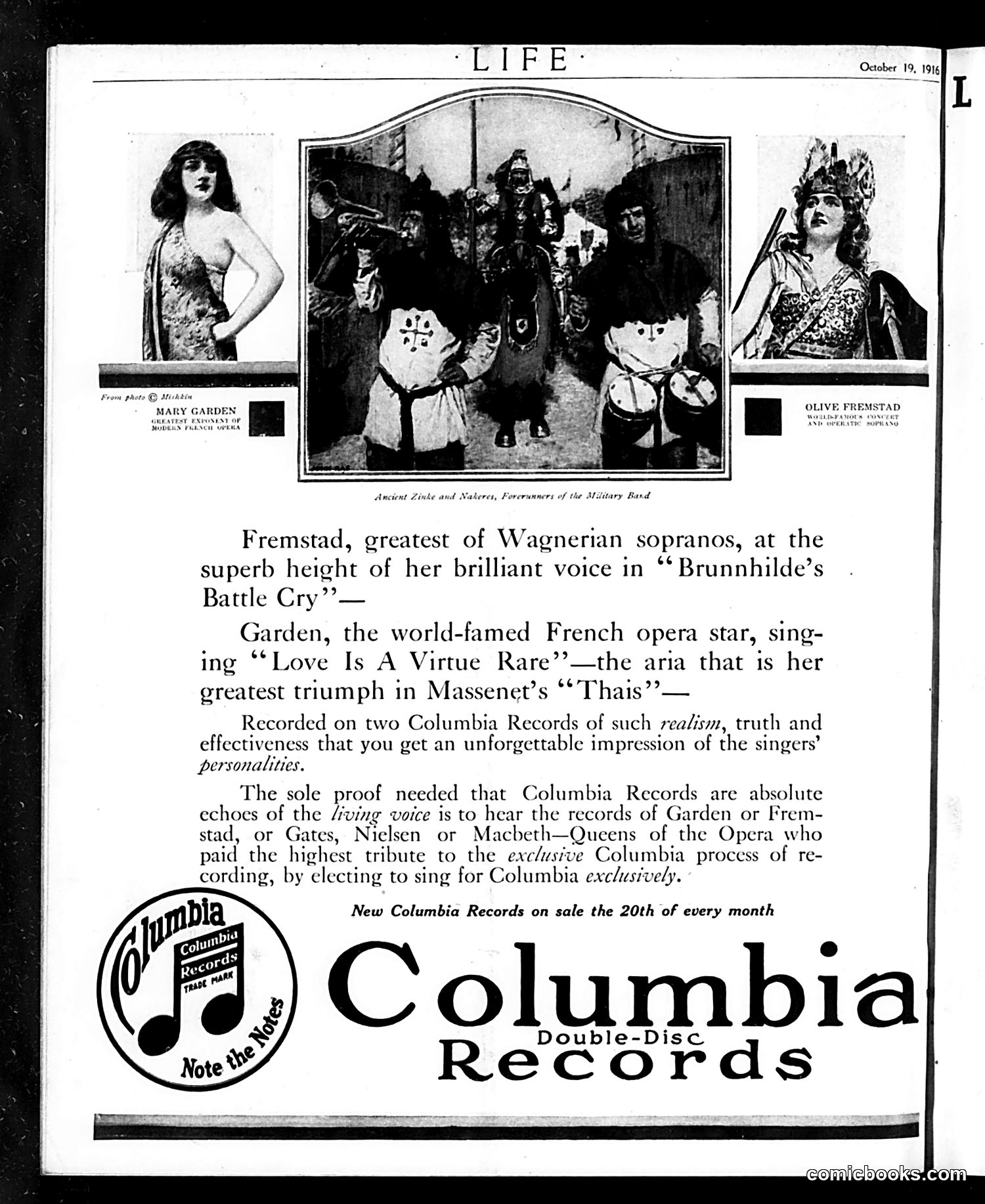
This is primarily a **Columbia Records advertisement** rather than political satire. It features three photographs of famous opera singers framing a central historical illustration. **The figures identified:** - **Mary Garden** (left): World-renowned French opera star - **Olive Fremstad** (right): Greatest Wagnerian soprano of the era - **Center image**: Labeled "Ancient Zinke and Nakeres, Forerunners of the Military Band"—a historical reference to early musical instruments/performers **The advertisement's point:** Columbia Records' superior recording technology captures these prestigious opera singers with such "realism, truth and effectiveness" that listeners experience the singers' personalities authentically. The juxtaposition of ancient musicians with modern operatic stars suggests recording technology represents progress in preserving the human voice. **For modern readers:** This showcases early 20th-century celebrity endorsement marketing—major cultural figures (opera stars) lending prestige to a commercial product. The historical framing device implies technology connects us across time to genuine artistry.