
Life, 1916-10-19 · page 32 of 42
Life — October 19, 1916 — page 32: what you’re looking at
What you’re looking at
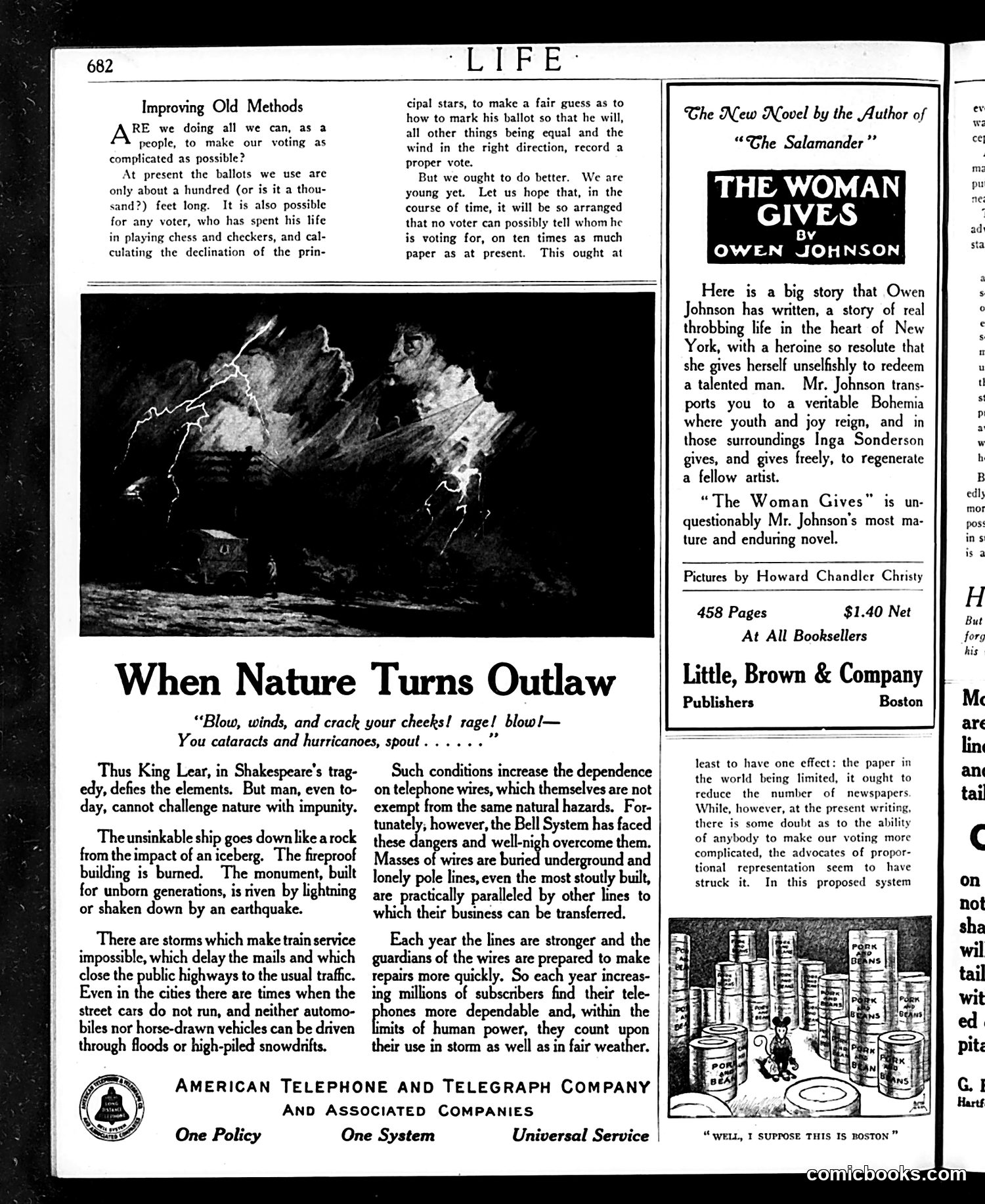
**"Improving Old Methods"** (left column): This is political satire mocking voting complexity. The author uses sarcastic irony to critique American ballots, suggesting they're already absurdly complicated—"a hundred (or is it a thousand?) feet long"—and ironically proposes making them *even more* confusing. The joke targets proportional representation advocates, suggesting their system would make voting incomprehensibly complex. The satire implies that ordinary citizens can barely understand current ballots, let alone more elaborate voting schemes. **"When Nature Turns Outlaw"** (main article with lightning photograph): This is an advertorial for American Telephone and Telegraph Company. It argues that nature's disasters (storms, floods, earthquakes) demonstrate humanity's dependence on telephone infrastructure. The piece celebrates the Bell System's resilience and redundancy, positioning AT&T as civilization's protector against natural chaos. The dramatic King Lear quotation establishes the tone of nature as destructive force requiring technological mastery. The right column advertises Owen Johnson's novel *The Woman Gives*.
📄 Transcribed text from this page (OCR, searchable)
Machine-transcribed from the original scan — historical spelling and the odd misread are preserved.
i ag Ld al oid Improving Old Methods RE we doing all we can, as a people, to make our voting as complicated as possible? At present the ballots we use are only about a hundred (or is it a thou- sand?) feet long. It is also possible for any voter, who has spent his life in playing chess and checkers, and cal- culating the declination of the prin- cipal stars, to make a fair guess as to how to mark his ballot so that he will, all other things being equal and the wind in the right direction, record a Proper vote. But we ought to do better. We are young yet. Let us hope that, in the course of time, it will be so arranged that no voter can possibly tell whom he is voting for, on ten times as much paper as at present. This ought at When Nature Turns Outlaw “Blow, winds, and crack your cheeks! rage! blow!— You cataracts and hurricanoes, spout......” Thus King Lear, in Shakespeare's trag- edy, defies the elements. But man, even to- day, cannot challenge nature with impunity. The unsinkable ship goes down like a rock from the impact of an iceberg. The fireproof building is bumed. The monument, built for unborn generations, is riven by lightning or shaken down by an earthquake. There are storms which make train service impossible, which delay the mails and which close the public highways to the usual traffic. Even in the cities there are times when the street cars do not run, and neither automo- biles nor horse-drawn vehicles can be driven through floods or high-piled snowdnifts. Such conditions increase the dependence on telephone wires, which themselves are not exempt from the same natural hazards. For- tunately, however, the Bell System has faced these dangers and well-nigh overcome them, Masses of wires are buried underground and lonely pole lines, even the most stoutly built, are practically paralleled by other lines to which their business can be transferred. Each year the lines are stronger and the guardians of the wires are prepared to make | tepairs more quickly. So each year increas- ing millions of subscribers find their tele- | Eases more dependable and, within the imits of human power, they count upon their use in storm as well as in fair weather. AMERICAN TELEPHONE AND TELEGRAPH COMPANY AND ASSOCIATED COMPANIES One System Universal Service The New Novel by the Author of “Che Salamander ”’ THE WOMAN GIVES OWEN JOHNSON Here is a big story that Owen Johnson has written, a story of real throbbing life in the heart of New York, with a heroine so resolute that she gives herself unselfishly to redeem a talented man. Mr. Johnson trans- ports you to a veritable Bohemia where youth and joy reign, and in those surroundings Inga Sonderson gives, and gives freely, to regenerate a fellow artist. “The Woman Gives” is un- questionably Mr. Johnson's most ma- ture and enduring novel. Pictures by Howard Chandler Christy 458 Pages $1.40 Net At All Booksellers Little, Brown & Company Publishers Boston least to have one effect: the paper in the world being limited, it ought to reduce the number of newspapers. While, however, at the present writii there is some doubt as to the ability of anybody to make our voting more complicated, the advocates of propor- tional representation seem to have struck it. In this proposed system wa