
Life, 1916-10-19 · page 23 of 42
Life — October 19, 1916 — page 23: what you’re looking at
What you’re looking at
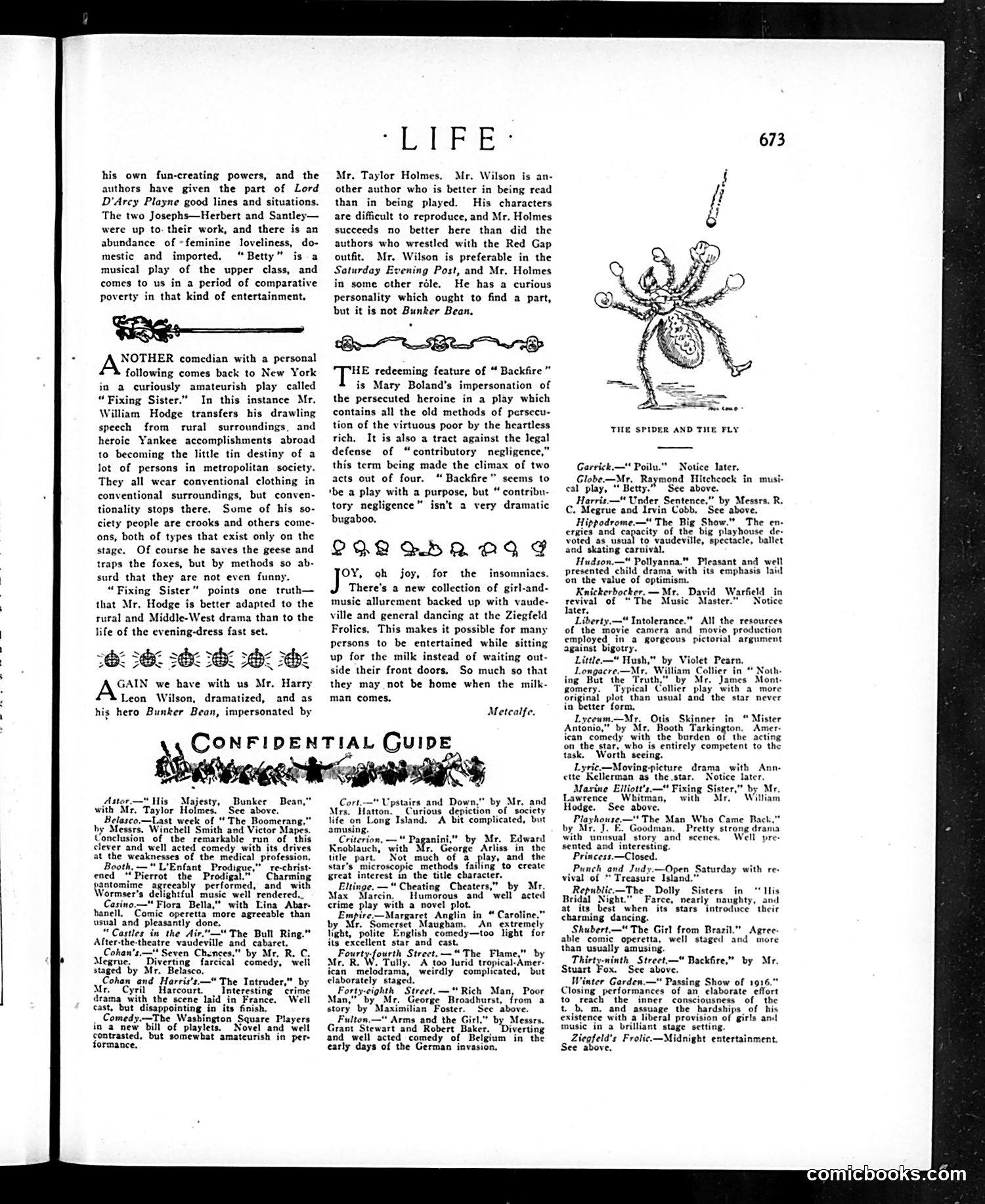
This page from *Life* magazine reviews current Broadway productions. The main cartoon depicts a spider catching a fly—a visual metaphor for the theatrical reviews themselves, which are humorously portrayed as predatory commentary on performers. The text critiques several plays and actors of the era. William Hodge is faulted for attempting urban society comedy when he excels at rural roles; Harry Leon Wilson's *Bunker Bean* is judged "better in being read than in being played"; and Mary Boland's *Backfire* is dismissed for making "contributory negligence" (a legal term) its dramatic climax—an absurdly undramatic subject. The reviews reveal *Life*'s satirical stance: evaluating theatrical merit while mocking both plays with weak plots and performers miscast in unsuitable genres. The *Confidential Guide* listing below provides capsule reviews of New York productions.
📄 Transcribed text from this page (OCR, searchable)
Machine-transcribed from the original scan — historical spelling and the odd misread are preserved.
his own fun-creating powers, and the authors have given the part of Lord D'Arcy Playne good lines and situations. The two Josephs—Herbert and Santley— were up to. their work, and there is an abundance of ~feminine loveliness, do- mestic and imported. “Betty” is a musical play of the upper class, and comes to us in a period of comparative poverty in that kind of entertainment. g-—— OTHER comedian with a personal following comes back to New York in a curiously amateurish play called “ Fixing Sister In this instance Mr. William Hodge transfers his drawling speech from rural surroundings, and heroic Yankee accomplishments abroad to becoming the little tin destiny of a lot of persons in metropolitan society. They all wear conventional clothing in conventional surroundings, but conven- tionality stops there. Some of his so- ciety people are crooks and others come- ons, both of types that exist only on the stage, Of course he saves the geese and traps the foxes, but by methods so ab- surd that they are not even funny, “Fixing Sister" points one truth— that Mr. Hodge is better adapted to the rural and Middle-West drama than to the life of the evening-dress fast set. GAIN we have with us Mr. Harry Leon Wilson, dramatized, and as hig hero Bunker Bean, impersonated by “LATE ® Mr. Taylor Holmes. Mr. Wilson is an- other author who is better in being read than in being played. His characters are difficult to reproduce, and Mr. Holmes succeeds no better here than did the authors who wrestled with the Red Gap outfit, Mr. Wilson is preferable in the Saturday Evening Post, and Mr. Holmes in some other réle. He has a curious personality which ought to find a part, but it is not Bunker Bean, BA SRS 'HE redeeming feature of “ Backfire” is Mary Boland’s impersonation of the persecuted heroine in a play which contains all the old methods of persecu- tion of the virtuous poor by the heartless rich, It is also a tract against the legal defense of “contributory negligence,” this term being made the climax of two acts out of four. “ Backfire” seems to ‘be a play with a purpose, but “ contribu- tory negligence” isn’t a very dramatic bugaboo, 2OAl2 GbR AG? OY, oh joy, for the There's a new collection of girl-and- music allurement backed up with vaude- ville and general dancing at the Ziegfeld Frolics. This makes it possible for many persons to be entertained while sitting up for the milk instead of waiting out- side their front doors, So much so that they may not be home when the mil man comes, insomniacs. Metcalfe. CONFIDENTIAL GUIDE Astor —* His Bunker Bean,” with Mr, Taylor Holmes. See above. Belasco.—Last week of “ The Boomerang,” by Messrs. Winchell Smith and Victor Mapes. Conclusion of the remarkable run of this clever and well acted comedy with its drives at the weaknesses of the medical profession. L’Enfant_ Prodigu: re-christ- ‘ierrot the Prodigal.” Charmi hantomime agreeably performed, and. with Wormser’s deli je well ‘rendered Casino. — th Lina Abar- hanell, Comic operetta more agreeable than usual and pleasantly done. “Castles in the Air."—" The Bull Ring.” After-the-theatre vaudeville and cabaret. Cohan's.—'* Seven Chances.” by Mr. R. C. Megrue. Diverting farcical comedy, well staged by Mr. Belasco. Cohan and Harris's“ The Totrader,” by Mr. Cyril Harcourt. Interesting crime drama with the scene laid in France. cast, but ppointing in its finish. Comedy.—The Washington Square Players in a new of playlets. Novel and well contrasted, but somewhat amateurish in per> formance, Majesty, Cort. Mrs. Hatton. life on Long Island. amusing. Criterion, — “Upstairs and Down,” by Mr. and Curious depiction of society A bit complicated, but J" by Mr. Edward h Mr. George Arliss in the tile ‘part.’ Not much of a. play, and the star's microscopic methods failing’ to create interest in the title character. nge.— “Cheating Cheaters,” by Mr. Max Marcin, — Humorous and ‘well’ acted crime play with a novel plot. Ewpire—Margaret Anglin in, “ Caroline,” by Mr. Somerset Maugham. An extremely light, polite English comedy—too light for its excellent star and cast. Fourtyfourth Street. — "The Flam Mr, R. W. Tully. A too lurid tropical-Amer- ican melodrama, weirdly complicated, but elaborately. staged. Forty-eighth Street, —“ Rich Man, Poor Man,” by Mr. George Broadhurst, from a story by in Foster. See above. Fulton.— Arms and the Girl.” by Messrs. Grant Stewart and Robert Baker. Diverting and well acted comedy of Belgium in the early days of the German invasion. THE SPIDER AND THE FLY Garrick. —"' Poilu." Notice later. . Raymond Hitchcock in musi- See above. is." Under Sentence,” by Messrs. R. C. Megrue and Irvin Cobb, ‘See above. Hippodrome.—" The Big Show." The en- ergies and capacity of the big playhouse de- voted as usual to vaudeville, spectacle, ballet and skating carnival. Hudson.— Pollyanna.” Pleasant and well presented child drama with its emphasis laid on the value of optimism. Knickerbocker. — Mr. David revival of “The Music Master later. “Intolerance.” All the resources of the movie camera and movie production employed in a gorgeous pictorial argument against bigotry. Little —" Hush,” by Violet Pearn. Longacre. iam Collier in “ Noth. ing But the Truth,” by Mr. James Mont. ry. Typical Collier play ‘with a more inal plot than usual and the star never ter form. Lyceum—Mr. Otis Skinner in“ Mister Antonio,” by Mr. Booth Tarkington, Amer- ican comedy with the burden of the acting on the star, who is entirely competent to the task. Worth seeing, Lyric.—Moving-picture drama with Ann- ete Kellerman as the.star. Notice later. Marine Elliott's —" Fi ister,” by Mr Lawrence Whitman, with Mr." Will Hodge. See above. Playhouse.—' The Man Who Came R: by Mr. J. E. Goodman. Pretty strong dr: with unusual story and scenes, Well pr sented and interesting. Princess.—Closed. Punch and Judy.—Open Saturday with re- vival of * Treasure Island.” Republic—The Dolly Sisters in Bridal Night.” Farce, nearly naughty, at its best when its stars introduce ‘their charming da Shubert—" The Girl from Brazil." Agree- able comic operetta, well staged and more than usually amusing. Thirty-ninth_ Street.—" Backfire,” by Mr. Stuart Fox. See above. _ Winter Garden.—" Passing Show of 1916." Closing performances of an elaborate effort to reach the inner consciousness of the t. bm. and assuage the hardships of his existence with a liberal provision of girls and music in a brilliant stage setting. Ziegfeld’s Frolic.—Midnight entertainment. See above.