
Life, 1916-10-19 · page 22 of 42
Life — October 19, 1916 — page 22: what you’re looking at
What you’re looking at
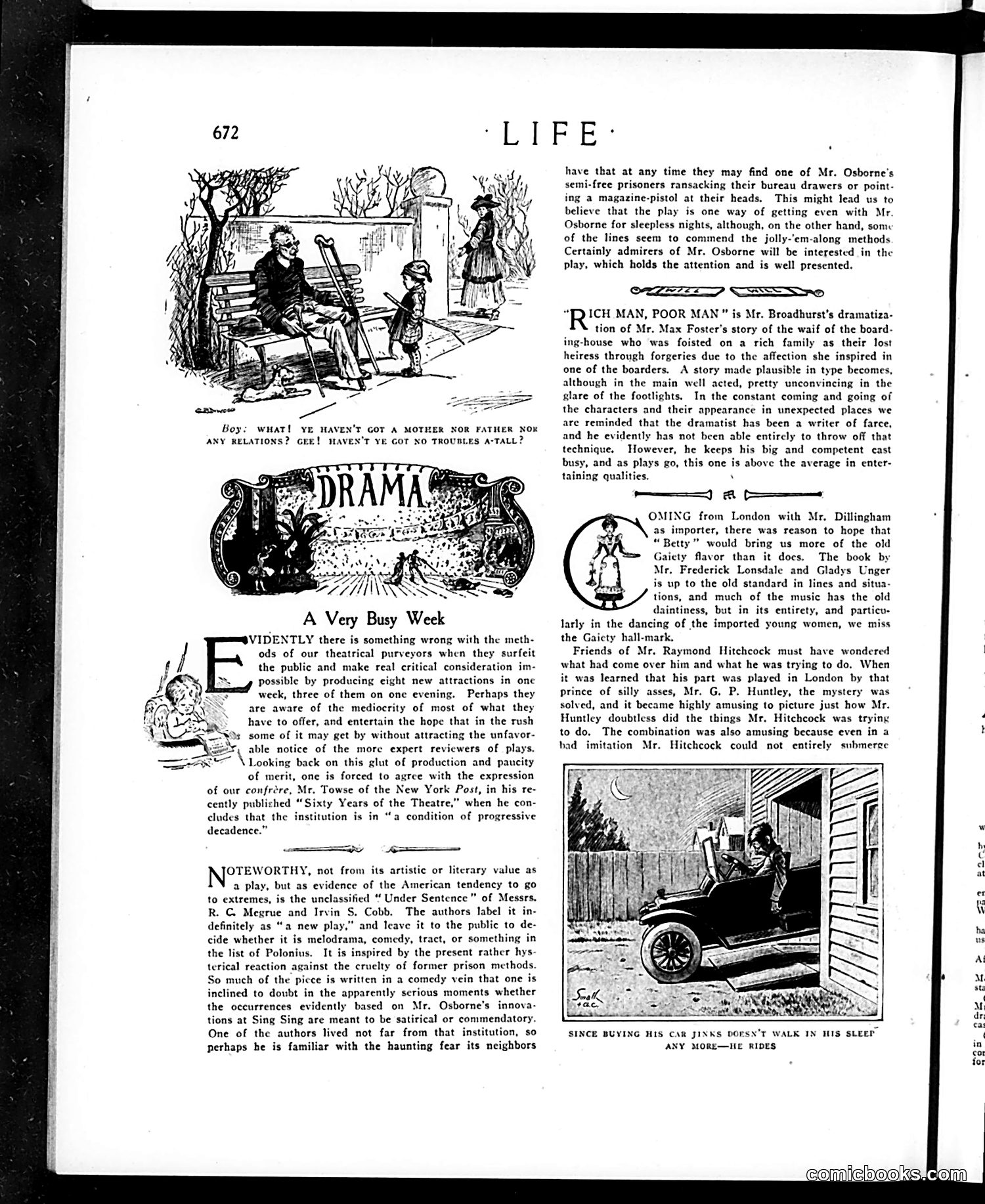
This page contains theater criticism from Life magazine, satirizing Broadway's production practices and reviewing several plays. **"A Very Busy Week"** - The opening critique attacks theaters for flooding the market with eight new productions simultaneously, suggesting this mediocrity-masking strategy prevents proper critical review. The critic cites theater historian Towse's assessment that the theatrical institution faces "progressive decadence." **The cartoon** (top left) depicts a poor orphan boy being questioned about his family relations—likely illustrating themes from one of the reviewed plays about class and family status. **Play Reviews:** - **"Under Sentence"** - About prison reform, inspired by Mr. Osborne's controversial "semi-free prisoner" innovations at Sing Sing prison. Critics note neighbors feared escaped convicts. The satire questions whether the play mocks or endorses Osborne's methods. - **"Rich Man, Poor Man"** - Criticizes an adaptation that works better on page than stage. - **"Betty"** - Imported from London's Gaiety Theatre, deemed less charming than the original. The overall tone mocks theatrical excess and derivative entertainment.
📄 Transcribed text from this page (OCR, searchable)
Machine-transcribed from the original scan — historical spelling and the odd misread are preserved.
Boy: what! ye WAVEN'T GOT A MOTHER NOR ANY RELATIONS? GEE! HAVEN'T YE GOT NO TROUD: A Very Busy Week \VIDENTLY there is something wrong with the meth- ods of our theatrical purveyors when they surfeit the public and make real critical consideration im- BS possible by producing eight new attractions in one week, three of them on one evening. Perhaps they are aware of the mediocrity of most of what they have to offer, and entertain the hope that in the rush =. some of it may get by without attracting the unfavor- “x, able notice of the more expert reviewers of plays. \ Looking back on this glut of production and paucity { of merit, one is forced to agree with the expression { of our confrére, Mr. Towse of the New York Post, in his re- : cently published “Sixty Years of the Theatre,” when he con- cludes that the institution is in “a condition of progressive decadence.” RY — OTEWORTHY, not from its artistic or literary value as a play, but as evidence of the American tendency to go to extremes, is the unclassified “' Under Sentence” of Messrs. R. G Megrue and Irvin S. Cobb. The authors label it in- definitely as “a new play,” and leave it to the public to de- cide whether it is melodrama, comedy, tract, or something in the list of Polonius. It is inspired by the present rather hys- terical reaction against the cruelty of former prison methods. So much of the picce is written in a comedy vein that one is inclined to doubt in the apparently scrious moments whether the occurrences evidently based on Mr. Osborne's innova- tions at Sing Sing are meant to be satirical or commendatory. One of the authors lived not far from that institution, so perhaps he is familiar with the haunting fear its neighbors ‘LIFE? have that at any time they may find one of Mr. Osborne's semi-free prisoners ransacking their bureau drawers or point- ing a magazine-pistol at their heads. This might lead us to believe that the play is one way of getting even with Mr. Osborne for sleepless nights, although, on the other hand, some of the lines seem to commend the jolly-‘em-along methods Certainly admirers of Mr. Osborne will be interested in the play, which holds the attention and is well presented. O22 SSS so “DQ ICH MAN, POOR MAN" is Mr. Broadburst’s dramatiza- tion of Mr. Max Foster's story of the waif of the board- ing-house who was foisted on a rich family as their lost heiress through forgeries due to the affection she inspired in one of the boarders. A story made plausible in type becomes, although in the main well acted, pretty unconvincing in the glare of the footlights. In the constant coming and going of the characters and their appearance in unexpected places we are reminded that the dramatist has been a writer of farce, and he evidently has not been able entirely to throw off that technique, However, he keeps his big and competent cast busy, and as plays go, this one is above the average in enter- taining qualities. ‘ ——)J a OMING from London with Mr. Dillingham as importer, there was reason to hope that “ Betty" would bring us more of the old Gaiety flavor than it docs, The book by Mr, Frederick Lonsdale and Gladys Unger is up to the old standard in lines and situa- tions, and much of the music has the old daintiness, but in its entirety, and particu- larly in the dancing of the imported young women, we miss the Gaicty hall-mark, Friends of Mr. Raymond Hitchcock must have wondered what had come over him and what he was trying to do, When it was learned that his part was played in London by that prince of silly asses, Mr. G. P. Huntley, the mystery was solved, and it became highly amusing to picture just how Mr. Huntley doubtless did the things Mr. Hitchcock was trying to do. The combination was also amusing because even in a bad itation Mr. Hitchcock could not entirely submerge SINCE BUYING HIS CAR JINKS DOSN'T WALK IN HIS SLEEP ANY MORE—HE RIDES