
Life, 1916-10-19 · page 16 of 42
Life — October 19, 1916 — page 16: what you’re looking at
What you’re looking at
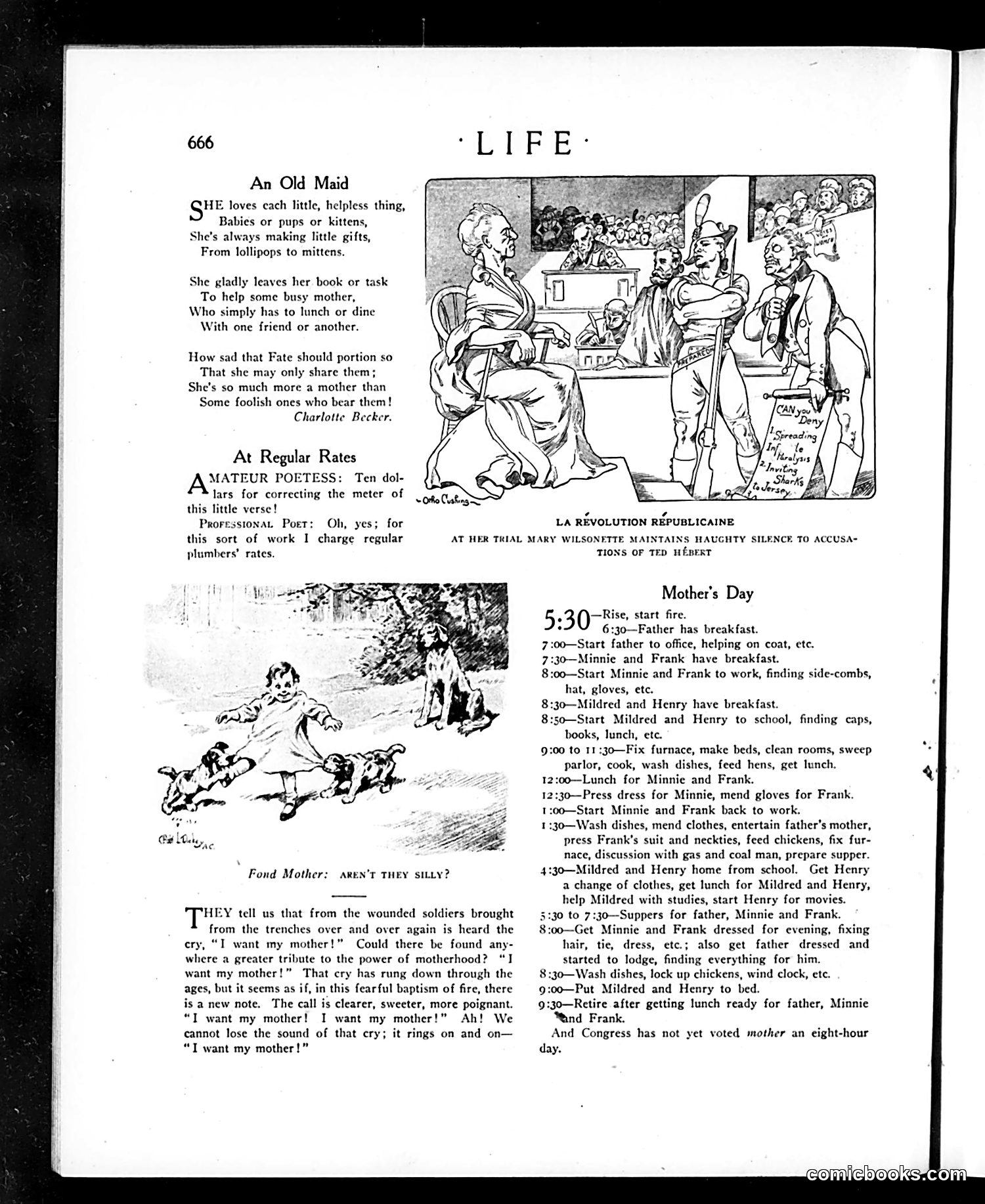
This page uses multiple formats to critique mothers' undervalued labor. **"An Old Maid"** (poem by Charlotte Becker) ironically praises unmarried women who nurture others' children, suggesting they embody motherhood better than biological mothers—a subtle critique of motherhood's low social status. **"At Regular Rates"** is a humor piece mocking amateur poets; a professional charges "plumbers' rates" for correcting verse, suggesting menial work pricing. **"Fond Mother"** shows a woman watching children play, likely commenting on parental naiveté. **The centerpiece: "Mother's Day"** presents a detailed, ironic schedule documenting a mother's exhausting 5:30 AM to 9:30 PM routine—cooking, cleaning, childcare, mending, and endless servicing of family members. **The punchline** states Congress hasn't yet voted mothers an eight-hour workday, sarcastically highlighting that mothers work vastly longer hours than any industrial worker while receiving no legal protection or recognition. The WWI reference ("wounded soldiers...I want my mother!") emphasizes mothers' emotional and physical importance while society denies them basic labor rights.
📄 Transcribed text from this page (OCR, searchable)
Machine-transcribed from the original scan — historical spelling and the odd misread are preserved.
666 An Old Maid HE loves cach little, helpless thing, Babies or pups or kittens, She's always making little gifts, From lollipops to mittens. She gladly leaves her book or task To help some busy mother, Who simply has to lunch or dine With one friend or another. How sad that Fate should portion so That she may only share them; She's so much more a mother than Some foolish ones who bear them! Charlotte Becker. At Regular Rates MATEUR POETESS: Ten dol- lars for correcting the meter of this little verse! ProressionaL Poet: Oh, yes; for this sort of work I charge regular plumbers’ rates. Otho Cusking Fond Mother: Axen’t THEY SILLY? HEY tell us that from the wounded soldiers brought from the trenches over and over again is heard the ery, “I want my mother!” Could there be found any- where a greater tribute to the power of motherhood? “I want my mother!” That cry has rung down through the ages, but it seems as if, in this fearful baptism of fire, there is a new note. The call is clearer, sweeter, more poignant. “I want my mother! I want my mother!” Ah! We cannot lose the sound of that cry; it rings on and on— “T want my mother!” a a LA REVOLUTION REPUBLICAINE AT HER TRIAL MARY WILSONETTE MAINTAINS HAUGHTY SILENCE TO ACCUSA- TIONS OF TED HEBERT Mother's Day 5:30 Rise: start fire. = 6:30—Father has breakfast. 7:00—Start father to office, helping on coat, etc. 7:30—Minnie and Frank have breakfast. 8:00—Start Minnie and Frank to work, finding side-combs, hat, gloves, etc. 8:30—Mildred and Henry have breakfast. 8:so—Start Mildred and Henry to school, finding caps, books, lunch, etc. 9:00 to 11:30—Fix furnace, make beds, clean rooms, sweep parlor, cook, wash dishes, feed hens, get lunch, 12:00—Lunch for Minnie and Frank. 12:30—Press dress for Minnie, mend gloves for Frank. 1:00—Start Minnie and Frank back to work. 1:30—Wash dishes, mend clothes, entertain father’s mother, press Frank's suit and neckties, feed chickens, fix fur- nace, discussion with gas and coal man, prepare supper. 4:30—Mildred and Henry home from school. Get Henry a change of clothes, get lunch for Mildred and Henry, help Mildred with studies, start Henry for movies. 5:30 to 7:30—-Suppers for father, Minnie and Frank. 8:00—Get Minnie and Frank dressed for evening, fixing hair, tie, dress, etc.; also get father dressed and started to lodge, finding everything for him. 8 :30—Wash dishes, lock up chickens, wind clock, etc. 9:00—Put Mildred and Henry to bed. 9:30—Retire after getting lunch ready for father, Minnie “and Frank. And Congress has not yet voted mother an eight-hour day.