
Life, 1916-10-19 · page 18 of 42
Life — October 19, 1916 — page 18: what you’re looking at
What you’re looking at
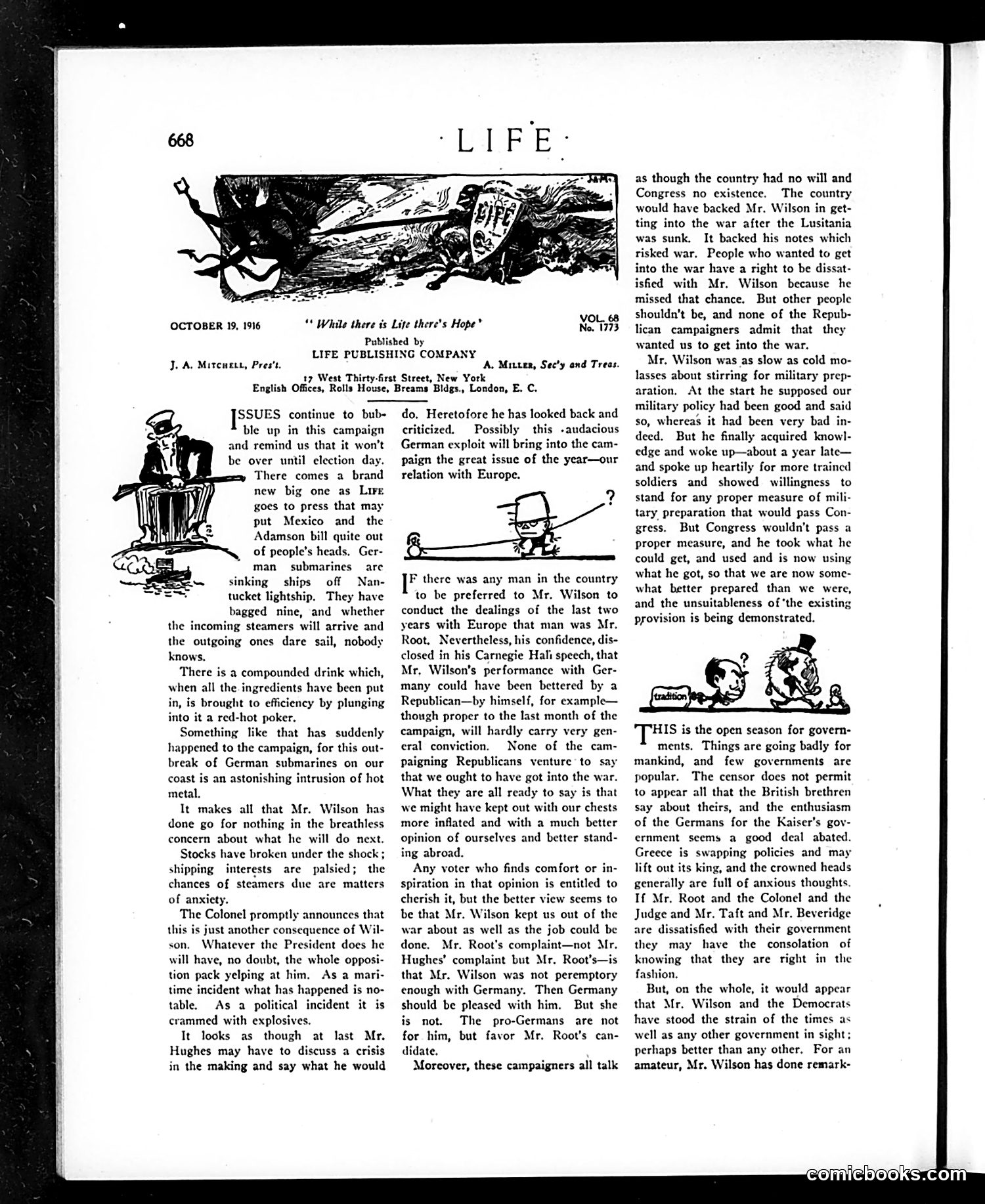
This page satirizes the 1916 presidential campaign between incumbent Democrat Woodrow Wilson and Republican challenger Charles Evans Hughes, set against the backdrop of World War I. The cartoons (left side) depict a figure emerging from a trash can labeled with campaign issues (Mexico, the Adamson bill) being suddenly disrupted—representing how German submarine attacks off the American coast have unexpectedly dominated the election narrative. The text critiques Republican attacks on Wilson's foreign policy. It notes that while Republicans (particularly Elihu Root) claim Wilson handled Germany insufficiently, they simultaneously deny wanting America to enter the war. The satire highlights this contradiction: Republicans want credit for tougher diplomacy without accepting responsibility for advocating war entry. The article defends Wilson's neutrality stance, arguing he kept America out of war "about as well as the job could be done" and that Congress—not just the President—shares responsibility for policy decisions. The submarine crisis, the author suggests, finally forces Hughes to offer concrete alternatives rather than mere criticism.
📄 Transcribed text from this page (OCR, searchable)
Machine-transcribed from the original scan — historical spelling and the odd misread are preserved.
OCTOBER 19, 1916 “* While there ts Life there's Hope” VOL. 68 No, 1773 Published by LIFE PUBLISHING COMPANY J. A. Mitcurit, Pres't. A. Muitez, Sec’y ond Treas. t7 West Thirty-first Street, New York English Offices, Rolls House, Breams Bldgs., London, E. C. SSUES continue to bub- ble up in this campaign and remind us that it won't be over until election day. There comes a brand new big one as Lire goes to press that may put Mexico and the Adamson bill quite out of people’s heads. Ger- man submarines are sinking ships off Nan- tucket lightship, They have bagged nine, and whether the incoming steamers will arrive and the outgoing ones dare sail, nobody knows, There is a compounded drink which, when all the ingredients have been put in, is brought to efficiency by plunging into it a red-hot poker, Something like that has suddenly happened to the campaign, for this out- break of German submarines on our coast is an astonishing intrusion of hot metal. It makes all that Mr. Wilson has done go for nothing in the breathless concern about what he will do next. Stocks have broken under the shock ; shipping interests are palsied; the chances of steamers due are matters of anxiety. The Colonel promptly announces that this is just another consequence of Wil- son. Whatever the President docs he will have, no doubt, the whole oppo: tion pack yelping at him, As a mari time incident what has happened is no- table. As a political incident it is crammed with explosives. It looks as though at last Mr. Hughes may have to discuss a crisis in the making and say what he would do, Heretofore he has looked back and criticized. Possibly this -audacious German exploit will bring into the cam- paign the great issue of the year—our relation with Europe. 2 F there was any man in the country to be preferred to Mr. Wilson to conduct the dealings of the last two years with Europe that man was Mr. Root, Nevertheless, his confidence, dis- closed in his Carnegie Hali speech, that Mr, Wilson's performance with Ger- many could have been bettered by a Republican—by himself, for example— though proper to the last month of the campaign, will hardly carry very gen- eral conviction. None of the cam- paigning Republicans venture to say that we ought to have got into the war. What they are all ready to say is that we might have kept out with our chests more inflated and with a much better opinion of ourselves and better stand- ing abroad. Any voter who finds comfort or in- spiration in that opinion is entitled to cherish it, but the better view seems to be that Mr. Wilson kept us out of the war about as well as the job could be done. Mr. Root's complaint—not Mr. Hughes’ complaint but Mr. Root’s—is that Mr. Wilson was not peremptory enough with Germany. Then Germany should be pleased with him. But she is not. The pro-Germans are not for him, but favor Mr. Root’s can- didate, Moreover, these campaigners all talk as though the country had no will and Congress no existence. The country would have backed Mr. Wilson in get- ting into the war after the Lusitania was sunk. It backed his notes which risked war. People who wanted to get into the war have a right to be dissat- isfied with Mr. Wilson because he missed that chance. But other people shouldn't be, and none of the Repub- lican campaigners admit that they wanted us to get into the war. Mr. Wilson was as slow as cold mo- lasses about stirring for military prep- aration, At the start he supposed our military policy had been good and said so, whereas it had been very bad in- deed. But he finally acquired knowl- edge and woke up—about a year late— and spoke up heartily for more trained soldiers and showed willingness to stand for any proper measure of mili- tary preparation that would pass Con- gress. But Congress wouldn't pass a proper measure, and he took what he could get, and used and is now using what he got, so that we are now some- what better prepared than we were, and the unsuitableness of ‘the existing provision is being demonstrated. THs is the open season for govern- ments, Things are going badly for mankind, and few governments are popular. The censor does not permit to appear all that the British brethren say about theirs, and the enthusiasm of the Germans for the K; ernment seems a good d Greece is swapping policies and may lift out its king, and the crowned heads generally are full of anxious thoughts. If Mr. Root and the Colonel and the Judge and Mr. Taft and Mr. Beveridge are dissatisfied with their government they may have the consolation of knowing that they are right in the fashion, But, on the whole, it would appear that Mr. Wilson and the Democrats have stood the strain of the times as well as any other government in sight; perhaps better than any other. For an amateur, Mr. Wilson has done remark-