
Life, 1916-10-19 · page 15 of 42
Life — October 19, 1916 — page 15: what you’re looking at
What you’re looking at
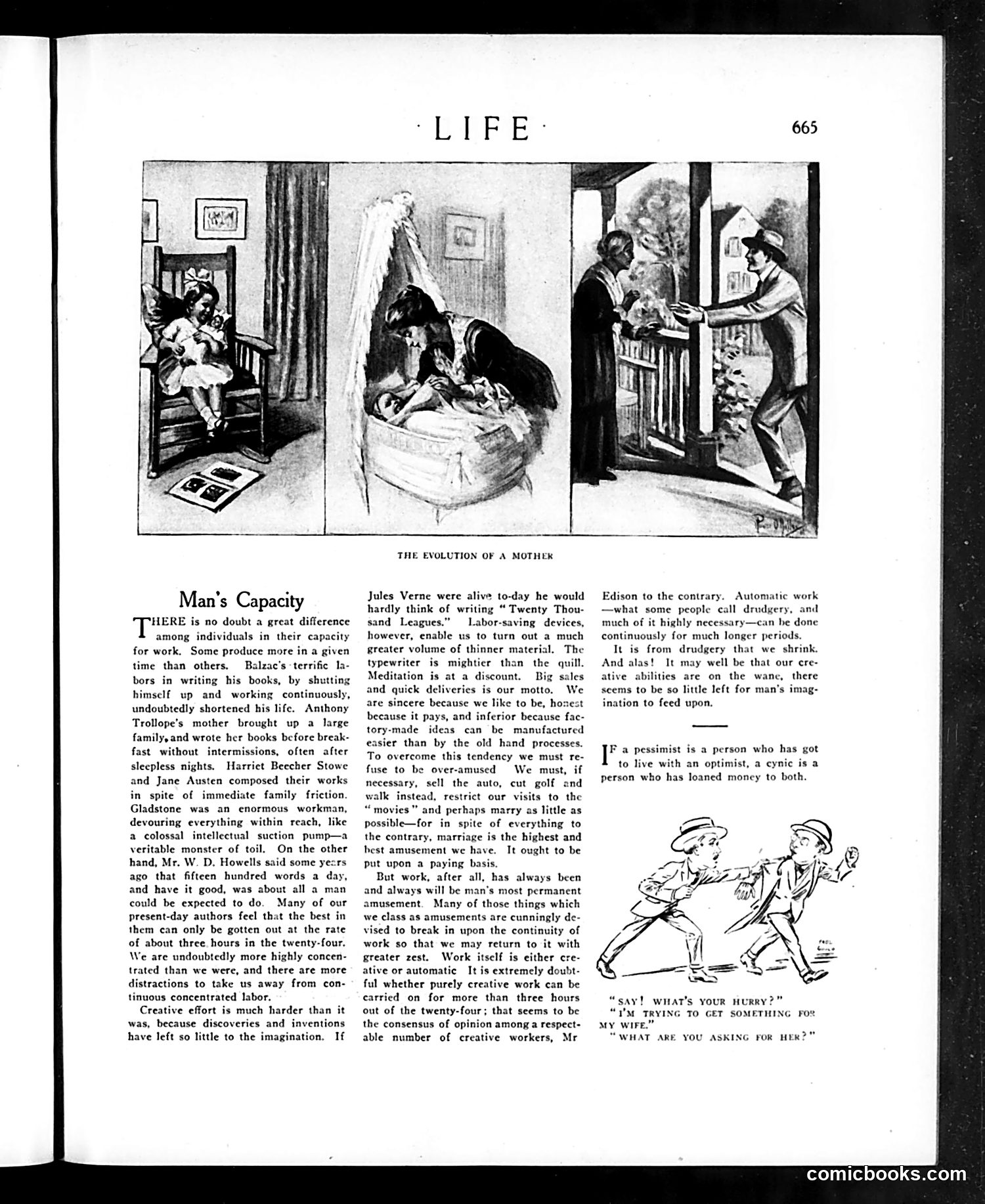
This page contains two distinct elements: **Top section:** "The Evolution of a Mother" - a three-panel illustration showing a woman's changing domestic role over time, from playful interaction with children to exhausted caregiving to greeting a departing man at a gate. **Main article:** "Man's Capacity" discusses productivity and work habits, arguing men can accomplish more in less time than women. It references Jules Verne, Thomas Edison, and Harriet Beecher Stowe, debating whether creative work can sustain beyond three hours daily. **Bottom cartoon:** Two men discuss personal matters, with one asking the other why he's "trying to get something for my wife" while asking "what are you asking for her?" - an apparent joke about marital economics or gift-giving. The page reflects early-20th-century gender attitudes regarding work capacity and domestic roles.
📄 Transcribed text from this page (OCR, searchable)
Machine-transcribed from the original scan — historical spelling and the odd misread are preserved.
: : Man's Capacity HERE is no doubt a great difference among individuals in their capacity for work. Some produce more in a given time than others. Balzac’s ‘terrific la- bors in writing his books, by shutting himself up and working continuously, undoubtedly shortened his life. Anthony Trollope’s mother brought up a large family, and wrote her books before break- fast without intermissions, often after sleepless nights. Harriet Beecher Stowe and Jane Austen composed their works in spite of immediate family friction. Gladstone was an enormous workman, devouring everything within reach, like a colossal intellectual suction pump—a veritable monster of toil. On the other hand, Mr. W. D. Howells said some yezrs ago that fifteen hundred words a d; and have it good, was about all a man could be expected to do. Many of our present-day authors feel that the best in them can only be gotten out at the rate of about three hours in the twenty-four. We are undoubtedly more highly concen- trated than we were, and there are more distractions to take us away from con- tinuous concentrated labor. Creative effort is much harder than it was, because discoveries and inventions have left so little to the imagination. If THE EVOLUTION OF A MOTHEK Jules Verne were alive to-day he would hardly think of writing “Twenty Thou- sand Leagues.” Labor-saving devices, however, enable us to turn out a much greater volume of thinner material. The typewriter is mightier than the quill. Meditation is at a discount. Big sales and quick deliveries is our motto. We are sincere because we like to be, honest because it pays, and inferior because fac- tory-made ideas can be manufactured easier than by the old hand processes. To overcome this tendency we must re- fuse to be over-amused We must, if necessary, sell the auto, cut golf and walk instead, restrict our its to the “movies” and perhaps marry as little as possible—for in spite of everything to the contrary, marriage is the highest and hest amusement we have. It ought to be Put upon a paying basis. But work, after all, has always been and always will be man's most permanent amusement. Many of those things which we class as amusements are cunningly de- vised to break in upon the continuity of work so that we may return to it with greater zest. Work itsclf is either cr ative or automatic It is extremely doubt- ful whether purely creative work can be carried on for more than three hours out of the twenty-four; that seems to be the consensus of opinion among a respect- able number of creative workers, Mr Edison to the contrary. Automatic work —what some people call drudgery, and much of it highly necessary—can be done continuously for much longer periods. It is from drudgery that we shrink. And alas! It may well be that our ere- ative abilities are on the wane, there scems to be so little left for man’s imag- ination to feed upon. F a pessimist is a person who has got to live with an optimist, a cynic is a person who has loaned money to both. WHAT's YOUR HURRY?” TO GET SOMETHING Fo® “say! “aM MY WIFE. “WHAT ARE YOU ne” ASKING FOR HE comicbooks.com