
Life, 1916-10-19 · page 19 of 42
Life — October 19, 1916 — page 19: what you’re looking at
What you’re looking at
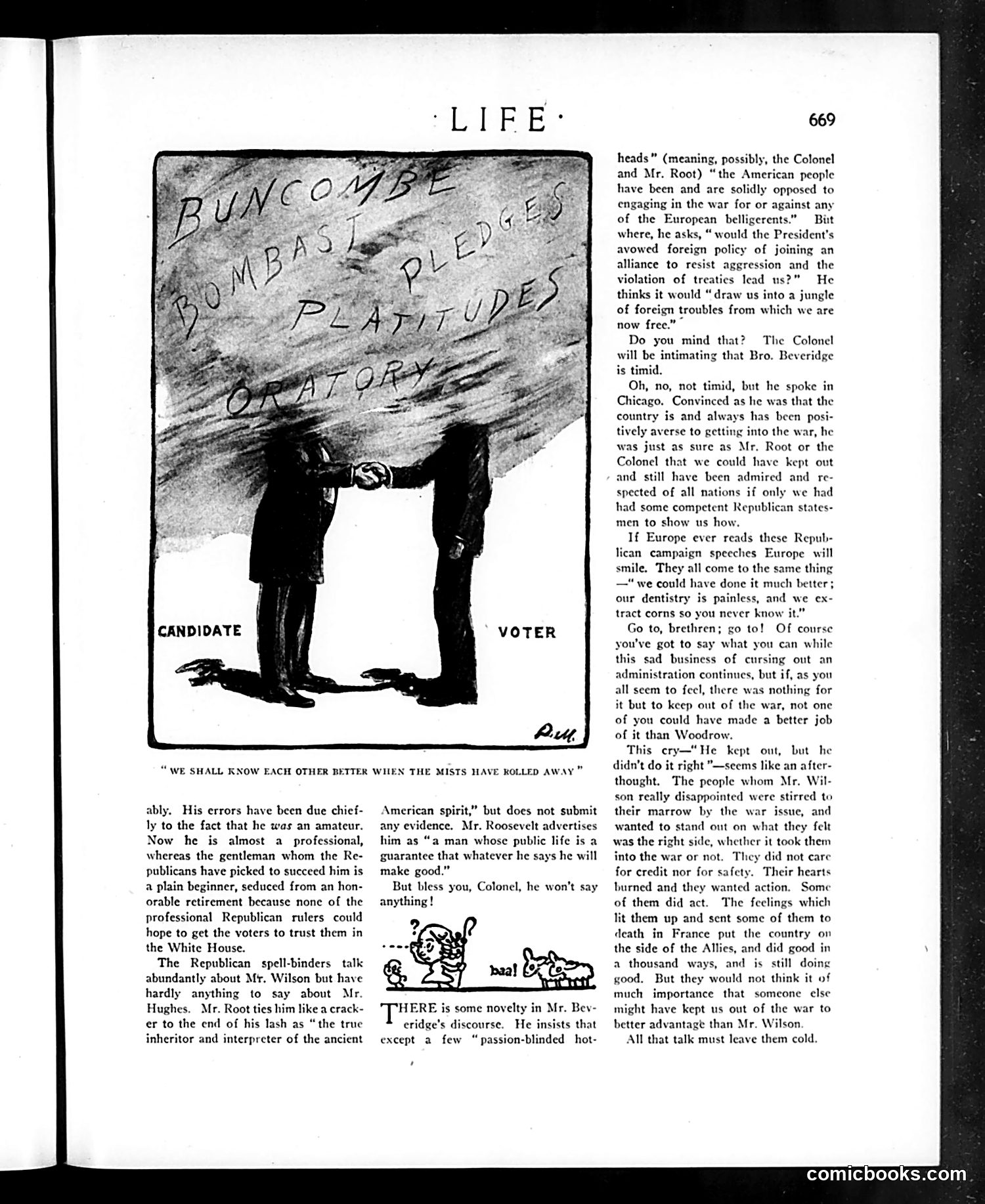
This Life magazine page satirizes the Republican Party's 1916 presidential campaign strategy against incumbent Democrat Woodrow Wilson. **The cartoon** depicts a "Candidate" and "Voter" shaking hands beneath a banner reading "Buncombe Embassies Pledges Platitudes Oratory"—mocking Republican campaign rhetoric as empty promises. The caption "We shall know each other better when the mists have rolled away" suggests the voter won't understand what Republicans actually stand for until later. **The text critiques** Republican speakers (including Theodore Roosevelt and Elihu Root) who attack Wilson's wartime policies while offering no substantive alternative. The author notes their central complaint—"He kept out [of WWI], but he didn't do it right"—rings hollow since Republicans themselves admit staying neutral was correct. The satire suggests Republicans are merely opportunistically attacking Wilson's execution rather than proposing genuinely different policies, making their campaign intellectually dishonest.
📄 Transcribed text from this page (OCR, searchable)
Machine-transcribed from the original scan — historical spelling and the odd misread are preserved.
“WE SHALL KNOW EACH OTHER BETTER WHEN THE MISTS HAVE ROLLED AWAY” ably. His errors have been due chief- ly to the fact that he was an amateur. Now he is almost a_ professional, whereas the gentleman whom the Re- publicans have picked to succeed him is a plain beginner, seduced from an hon- orable retirement because none of the professional Republican rulers could hope to get the voters to trust them in the White House. The Republican spell-binders talk abundantly about Mr. Wilson but have hardly anything to say about Mr. Hughes. Mr. Root ties him like a crack- er to the end of his lash as “the true inheritor and interpreter of the ancient American spirit,” but does not submit any evidence. Mr. Roosevelt advertises him as “a man whose public life is a guarantee that whatever he says he will make good.” But bless you, Colonel, he won't say anything! HERE is some novelty in Mr. Bev- eridge’s discourse. He insists that except a few “passion-blinded hot- 669 heads” (meaning, possibly, the Colonel and Mr. Root) “the American people have been and are solidly opposed to engaging in the war for or against any of the European belligerents.” Bit where, he asks, “ would the President's avowed foreign policy of joining an alliance to resist aggression and the violation of treatics lead us?" He thinks it would “draw us into a jungle of foreign troubles from which we are now free.” ” Do you mind that? The Colonel will be intimating that Bro. Beveridge is timid. Oh, no, not timid, but he spoke in Chicago. Convinced as he was that the country is and always has been posi- tively averse to getting into the war, he was just as sure as Mr. Root or the Colonel that we could have kept out and still have been admired and re- spected of all nations if only we had had some competent Republican states- men to show us how. If Europe ever reads these Repub- lican campaign speeches Europe will smile. They all come to the same thing —“ we could have done it much better; our dentistry is painless, and we ex- tract corns so you never know it.” Go to, brethren; go to! Of course you've got to say what you can while this sad business of cursing out an administration continues, but if, as you all seem to feel, there was nothing for it but to keep out of the war, not one of you could have made a better job of it than Woodrow. This cry—“He kept out, but he didn't do it right "—seems like an after- thought. The people whom Mr. Wil- son really disappointed were stirred to their marrow by the war issue, and wanted to stand out on what they felt was the right side, whether it took them into the war or not. They did not care for credit nor for safety. Their hearts burned and they wanted action. Some of them did act. The feelings which lit them up and sent some of them to death in France put the country on the side of the Allies, and did good in a thousand ways, and is still doing good. But they would not think it of much importance that someone else might have kept us out of the war to better advantage than Mr. Wilson. All that talk must leave them cold. comicbooks.com