
A complete issue · 48 pages · 1916
Life — May 11, 1916
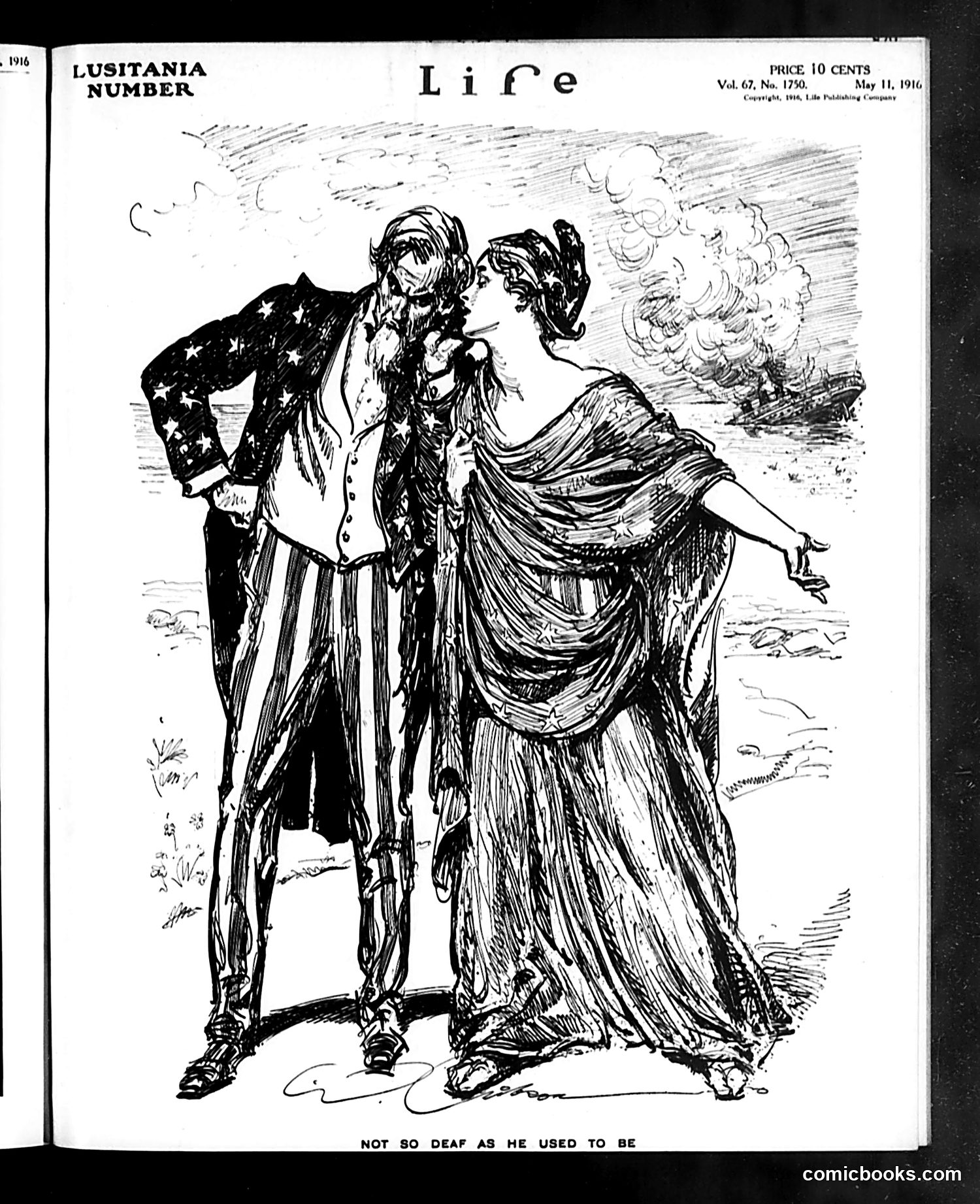
This satirical cartoon references the sinking of the RMS Lusitania, a British passenger liner torpedoed by a German U-boat on May 7, 1915, killing nearly 1,200 people, including 128 Americans. The image depicts Uncle Sam (personified America, identified by his starred jacket) with Lady Liberty. The caption "NOT SO DEAF AS HE USED TO BE" suggests America is finally listening to calls for intervention after the Lusitania tragedy. The burning ship visible in the background reinforces this reference. The cartoon criticizes American reluctance to enter World War I despite the attack on civilians. By 1916, pro-intervention sentiment was growing in American media and public opinion, making this magazine's satirical pressure on the U.S. government timely political commentary.
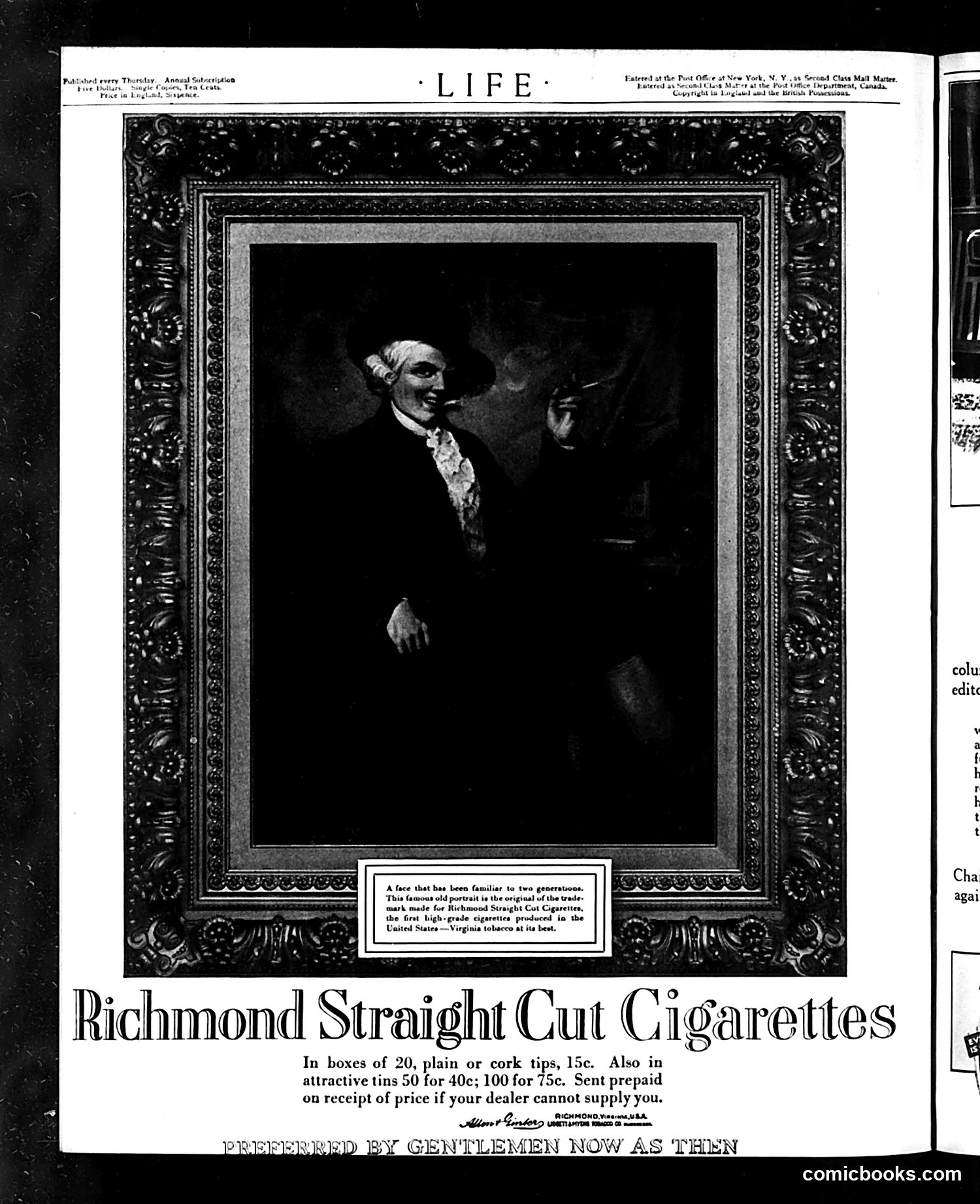
This page is primarily a **cigarette advertisement**, not political satire. The image shows a historical portrait in an ornate frame with a caption indicating it depicts "the original of the trade-mark made for Richmond Straight Cut Cigarettes" and notes the brand has been "preferred by Gentlemen now as then." The advertisement leverages **historical prestige and tradition** to market the product, suggesting the cigarette brand has maintained quality across generations. The phrase "Preferred by Gentlemen Now as Then" appeals to masculine sophistication and established respectability. The portrait itself appears to be a classical 18th or 19th-century gentleman, though the specific identity isn't stated in the visible text. The ornate framing emphasizes luxury and heritage marketing—common advertising tactics of the era.
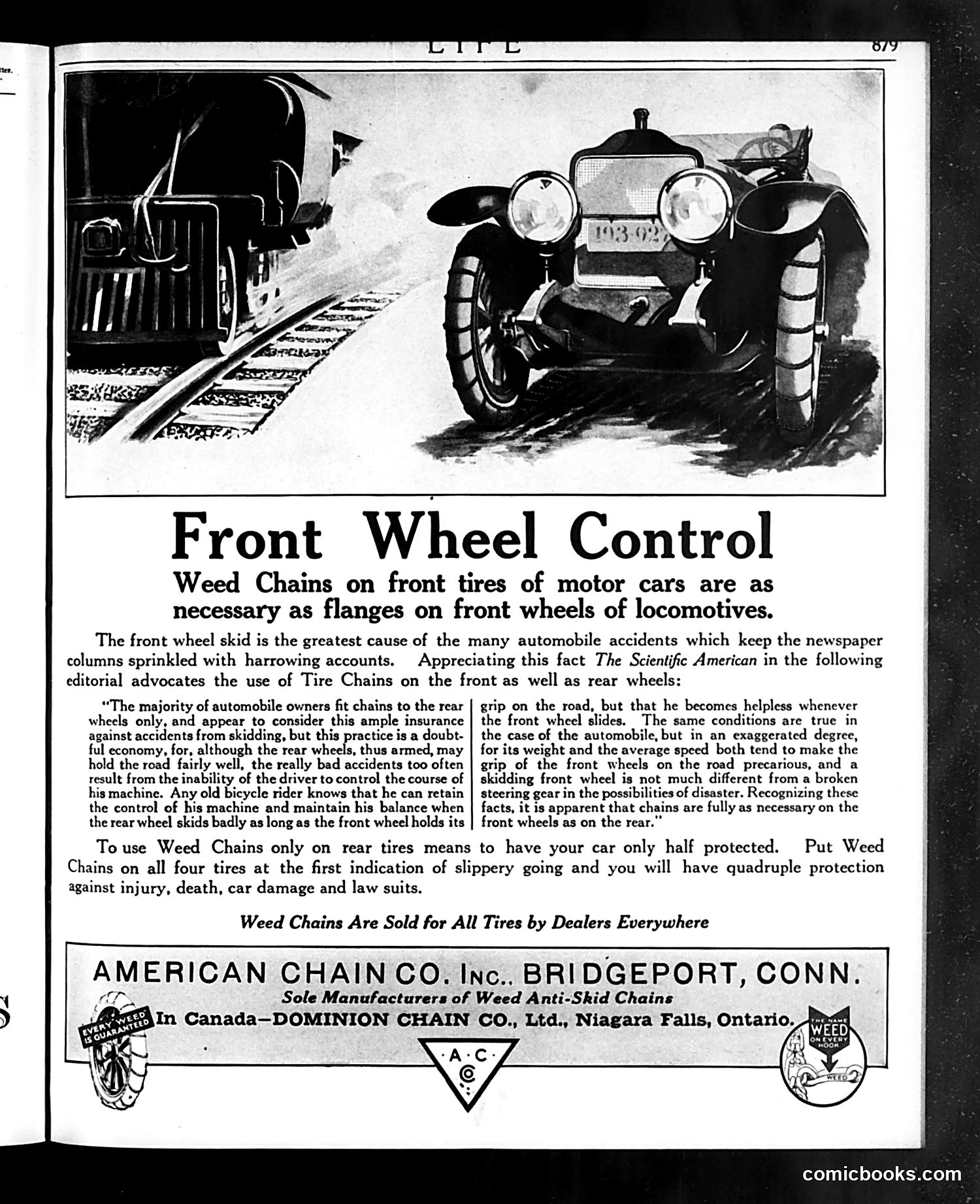
This is primarily a **product advertisement** for Weed Chains—tire chains for automobiles—rather than political satire. The page argues that chains should be installed on **all four tires**, not just rear wheels as was common practice. The advertisement compares front-wheel skidding to train wheel problems, warning that front-wheel skids caused many automobile accidents. It positions chains as safety equipment comparable to bicycle riders' need for wheel control. The imagery shows a locomotive (left) and an early automobile (right), contrasting established rail technology with newer automotive safety needs. The manufacturer—American Chain Co., Bridgeport, Connecticut—uses this editorial-style argument (attributed to *Scientific American*) to promote their product as essential for accident prevention.
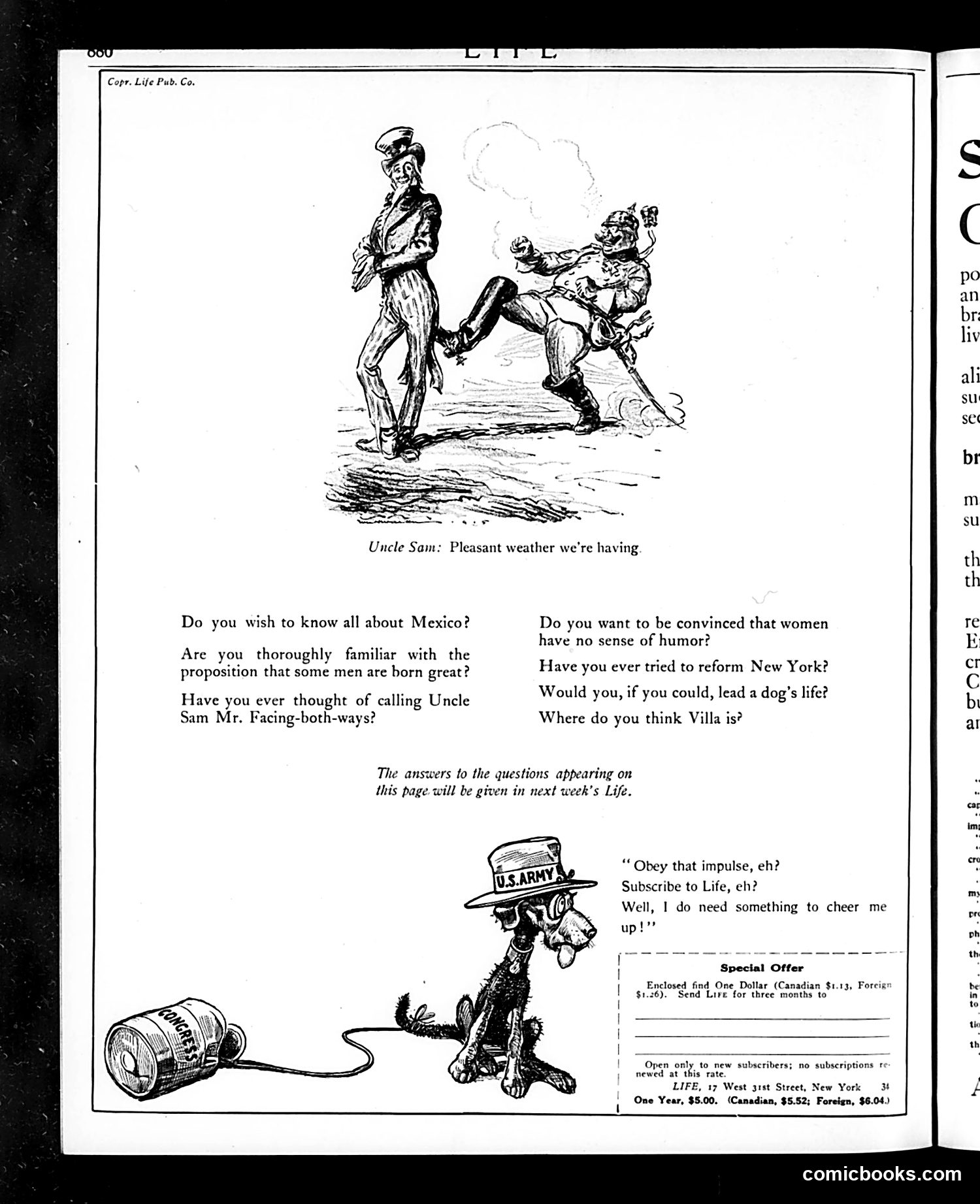
The top cartoon depicts "Uncle Sam" (representing the United States government) being kicked by a figure representing Mexico. The caption reads "Pleasant weather we're having"—a darkly ironic understatement, likely referencing U.S.-Mexico tensions or military conflict, possibly related to Pancho Villa's raids or broader border instability during the Mexican Revolution era. Below are quiz questions posed to readers on topics including Mexico, greatness, Uncle Sam, and Villa's location—suggesting contemporary political debate about American foreign policy in Mexico. The lower cartoon shows Uncle Sam (depicted as a donkey) being "cheered up" by a subscription offer to Life magazine itself—a humorous self-promotion using the patriotic Uncle Sam figure. The page functions as both political commentary and advertisement.
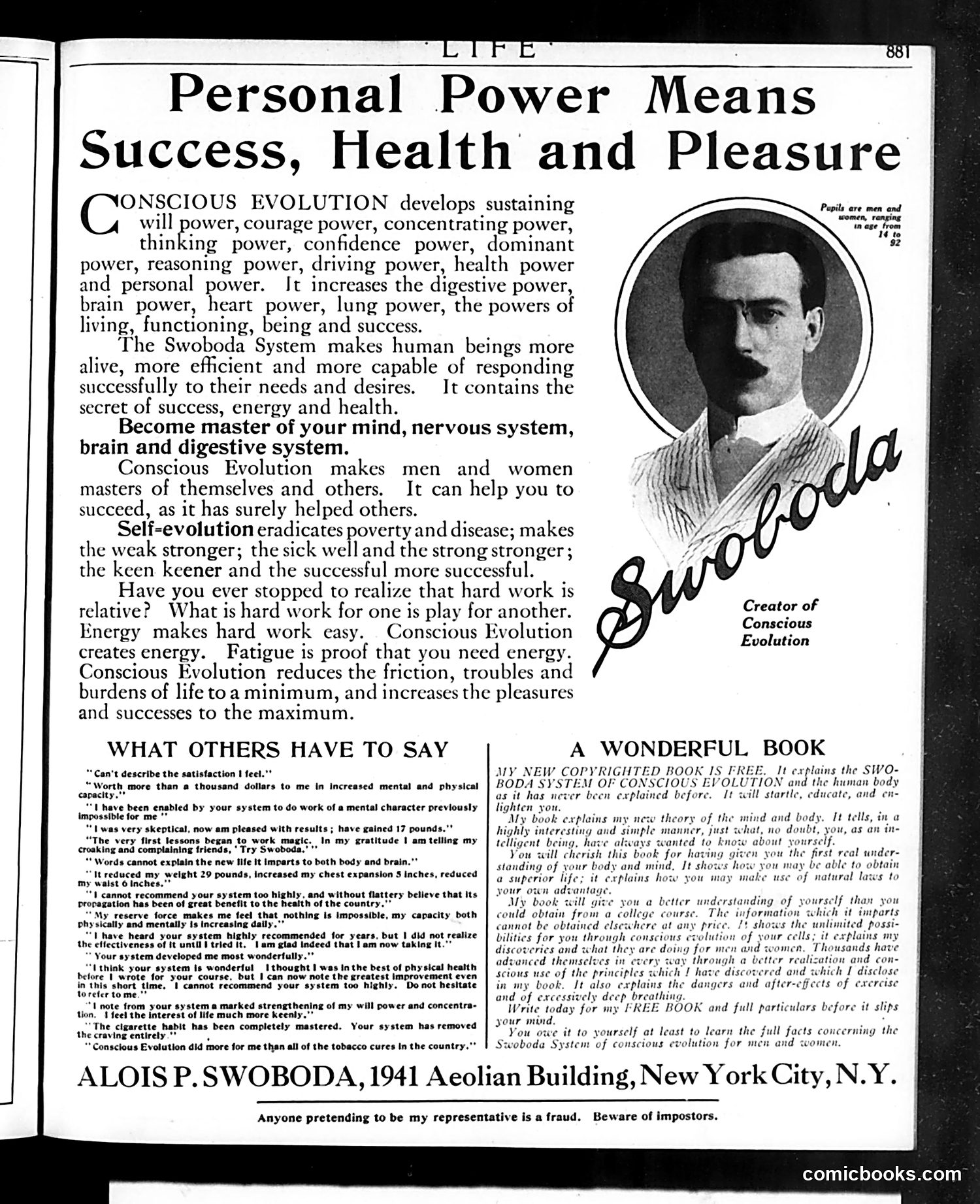
This page is **not a cartoon or satire** — it's a straightforward **advertisement** for the "Swoboda System of Conscious Evolution," a self-help program from 1941. The content promotes Alois P. Swoboda's system claiming to develop mental and physical powers, increase efficiency, and cure poverty and disease. The portrait shows Swoboda himself, positioned as the creator/authority figure. The testimonials ("What Others Have To Say") use common early 20th-century advertising rhetoric: dramatic health claims, weight loss, increased mental capacity, and success stories. The text promises readers they can become "master of yourself" and achieve success like others have. This represents typical **pre-FDA regulation wellness marketing**, blending pseudoscientific language with aspirational claims about self-improvement — a genre that persists today in different forms.
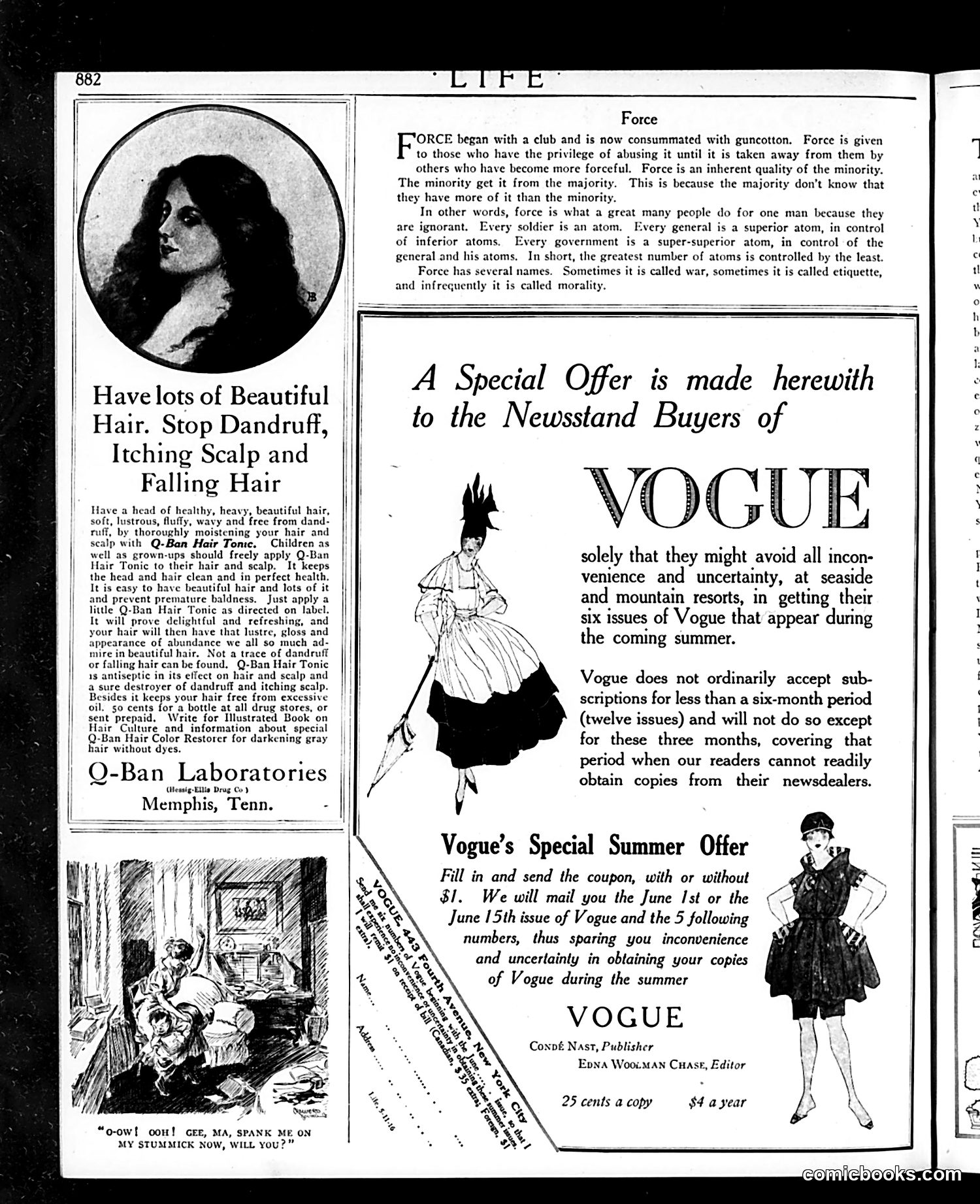
This page consists primarily of **advertisements**, not political satire: 1. **Q-Ban Hair Tonic ad** (left): Promotes a product to treat dandruff, itching scalp, and hair loss. The circular portrait shows a man's head in profile. The small cartoon below depicts domestic humor ("O-ow! ooh! Gee, Ma, spank me on my stummick now, will you?") — likely suggesting the product stings or tingles when applied, presented as comedic. 2. **"Force" essay** (top right): A philosophical piece about force, power, and control in society — not satirical commentary, but rather editorial content reflecting period attitudes about hierarchy and atoms. 3. **Vogue magazine special offer** (center-right): An advertisement for summer subscriptions to Vogue magazine, with fashion illustrations typical of the era. The page contains **no significant political cartoons or satire** to analyze.

This page contains **no political cartoons**. Instead, it features: 1. **An obituary** for Miss Vera Yuceless, describing her elaborate debutante party—a satirical piece mocking the extravagance of wealthy society families. The humor lies in detailing absurd luxuries like imported orchids and refrigerated igloos for her formal introduction. 2. **A Resinol Soap advertisement** with a photograph claiming the product beautifies skin and treats various conditions. 3. **"The Biltmore" hotel advertisement** promoting New York's social venue. 4. **"Non-Committal"** — a brief humorous anecdote about a Cabinet Minister's vague responses to war questions, poking fun at political evasiveness. The page is primarily **social satire and advertising** rather than political cartooning.
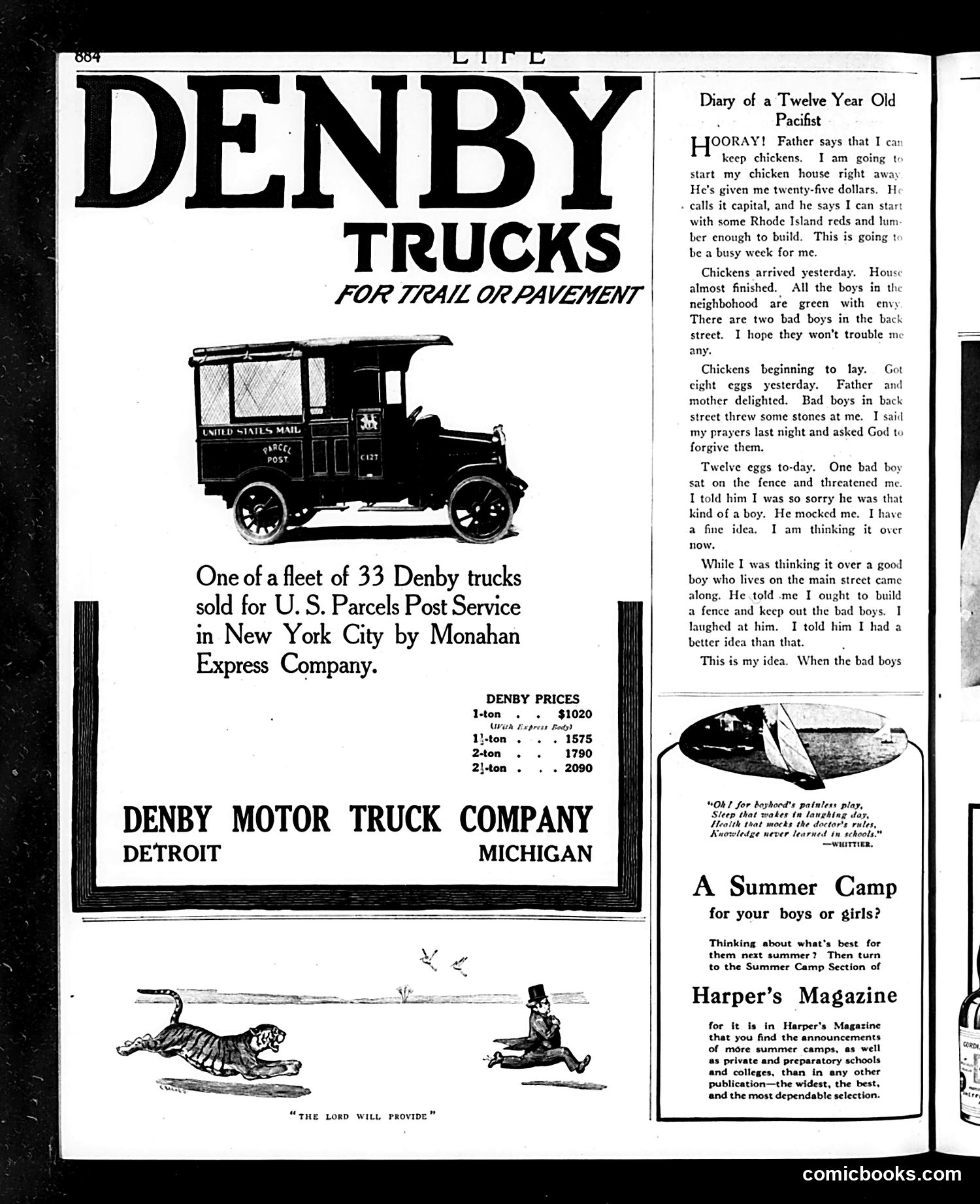
This page is primarily **commercial advertising** rather than political satire. The left side features a full-page ad for **Denby Motor Trucks**, manufactured in Detroit, Michigan. It shows one of 33 trucks sold to the U.S. Parcels Post Service in New York City, with pricing information for different tonnage capacities ($1020-$2090). The right side contains a diary entry from "A Twelve Year Old Pacifist" describing childhood experiences with chickens and neighborhood boys, plus an advertisement for **Harper's Magazine** promoting their summer camp listings. The only cartoon elements are small illustrations at bottom—a tiger and a figure—accompanying the caption "The Lord Will Provide," appearing unrelated to the main content.
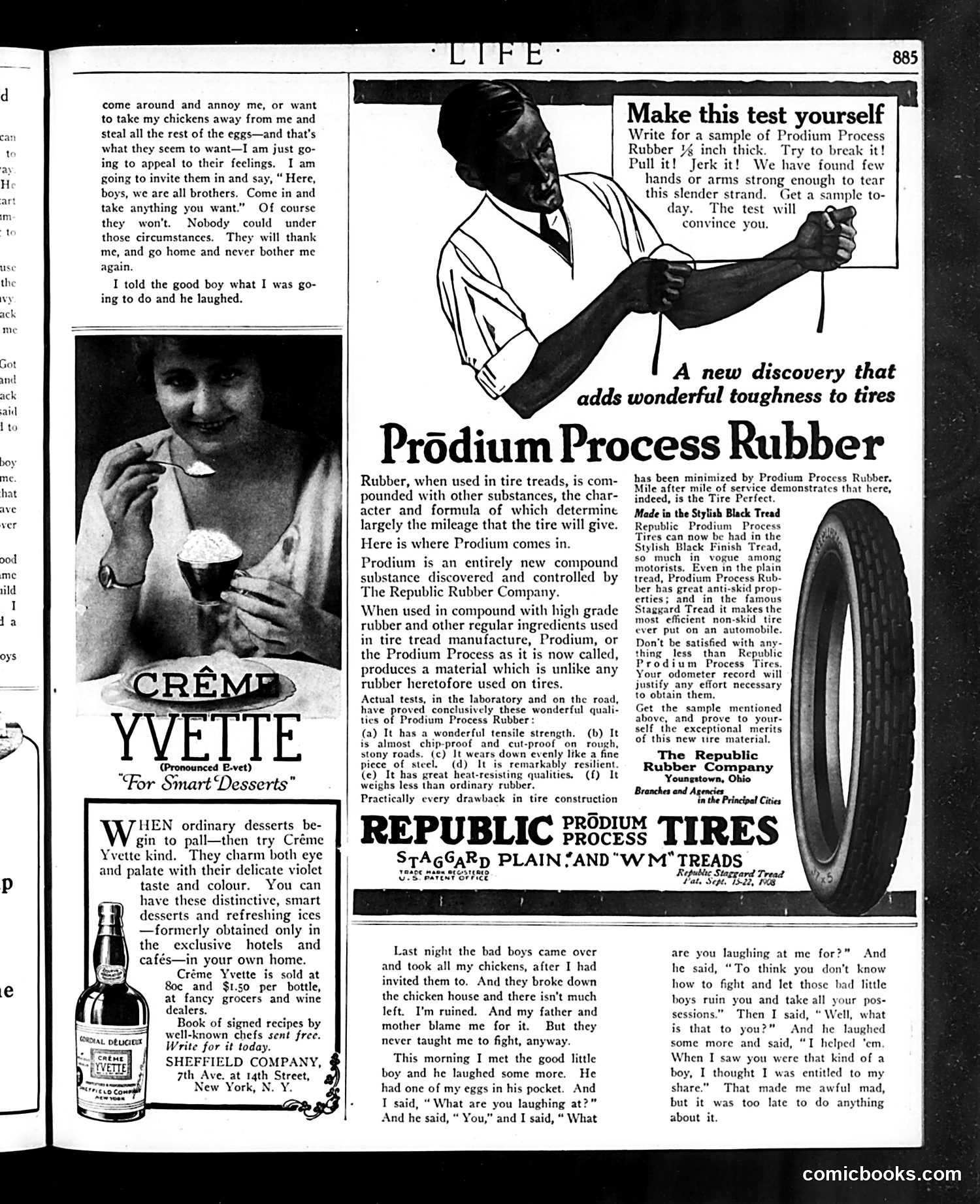
This page contains **advertisements, not political satire**. On the left is an ad for **Crème Yvette**, a liqueur marketed as enabling "smart desserts" for home entertaining—positioning an exclusive product formerly available only in hotels as now accessible to consumers. The dominant right-side advertisement promotes **Republic Prodium Process Tires**, featuring a man demonstrating tire durability. The ad emphasizes a "new discovery" compound that adds toughness to tires, claiming advantages like chip-proof construction and resilience. This is straightforward product marketing highlighting manufacturing innovation. Below both ads runs narrative text about boys stealing chickens—unrelated story content typical of Life's miscellaneous page layout. **No political cartoons or satire appear on this page.** It's a commercial advertising section from the magazine.
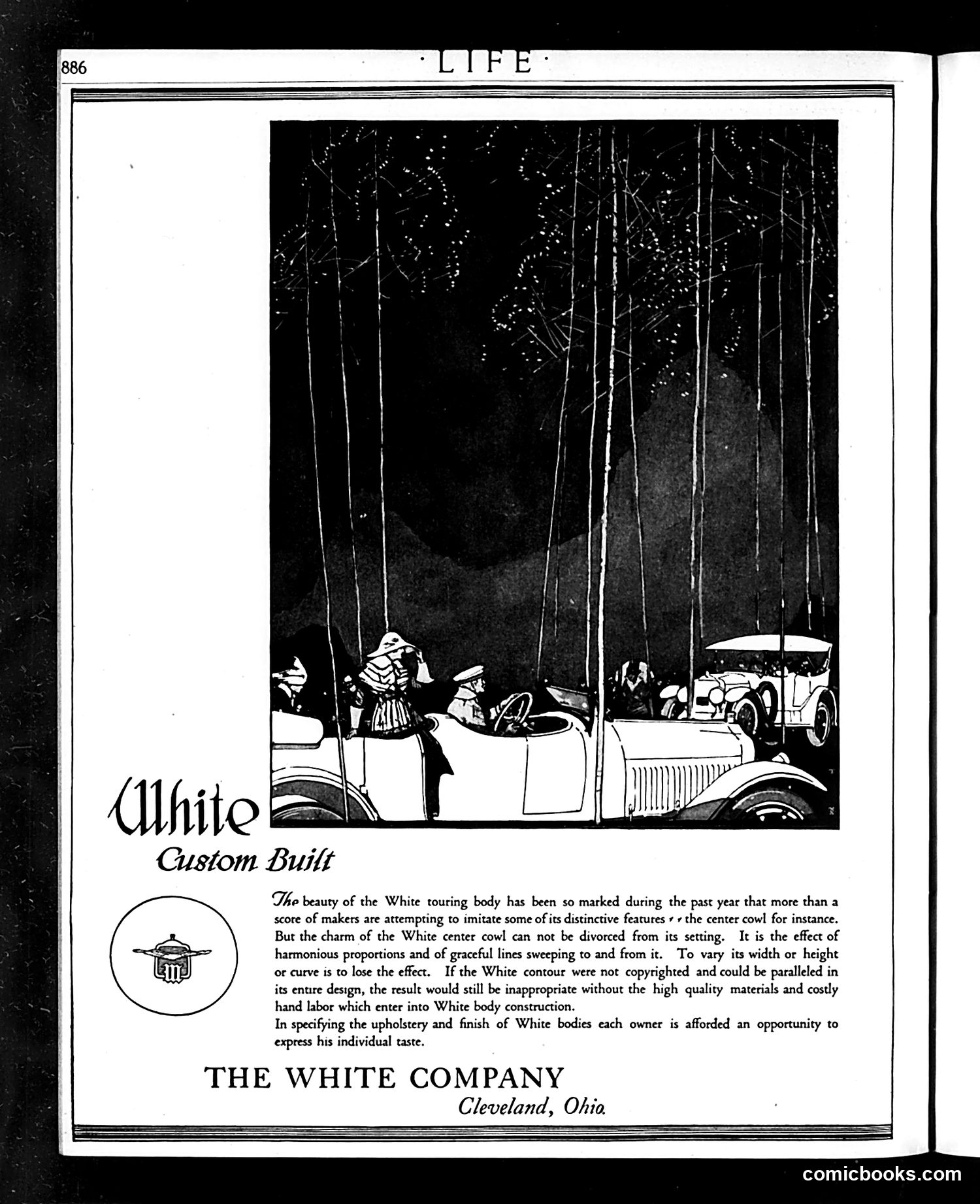
This is a **White Motor Company automobile advertisement**, not political satire. The page depicts an elegant 1920s scene: well-dressed passengers in a custom-built White touring car, parked among tall trees with other vehicles visible. A chauffeur operates the vehicle. The ad emphasizes that White's "center cowl" (hood design) cannot be imitated—it's protected by copyright. The copywriting stresses how the car's graceful proportions and high-quality materials distinguish it from competitors. The humor is subtle, playing on wealthy motorists' desire to display status through exclusive automotive design. The nighttime forest setting suggests leisure and luxury travel accessible only to the affluent. This is straightforward period advertising, not satirical commentary on social issues or politics.
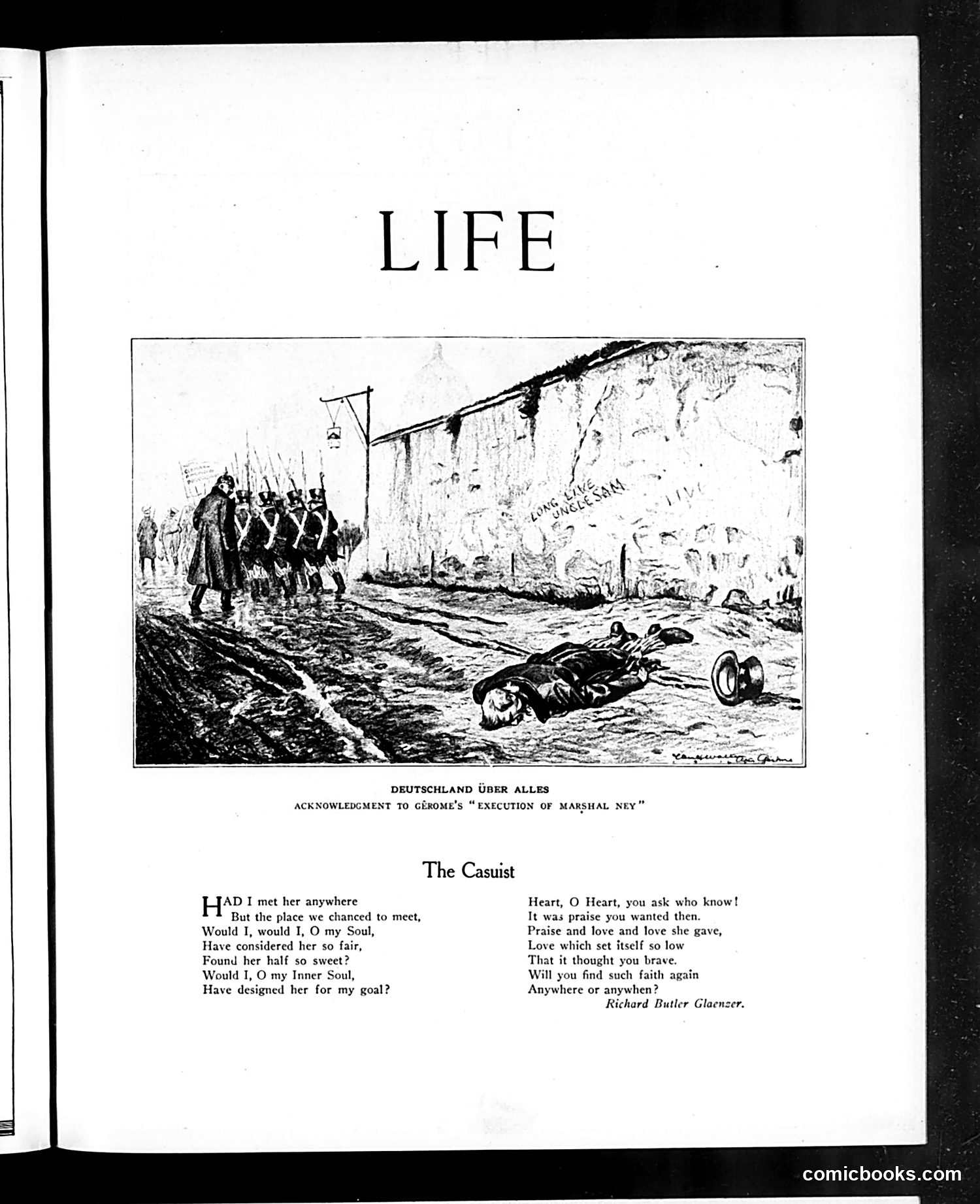
The page depicts the aftermath of World War I. The engraving shows German soldiers marching past the body of a fallen soldier, with a note identifying it as "Deutschland Über Alles"—acknowledging Gérome's painting "Execution of Marshal Ney." The accompanying poem, "The Casualist" by Richard Butler Glaenzer, meditates on romantic love and loss. The speaker asks whether meeting a beloved woman was "designed for my goal," questioning if their love survives death or separation. The juxtaposition is pointed: the grandiose German nationalism ("Deutschland Über Alles") contrasts sharply with the poem's intimate, questioning meditation on personal love—suggesting that military ambition and nationalist fervor destroy individual human connection and meaning.
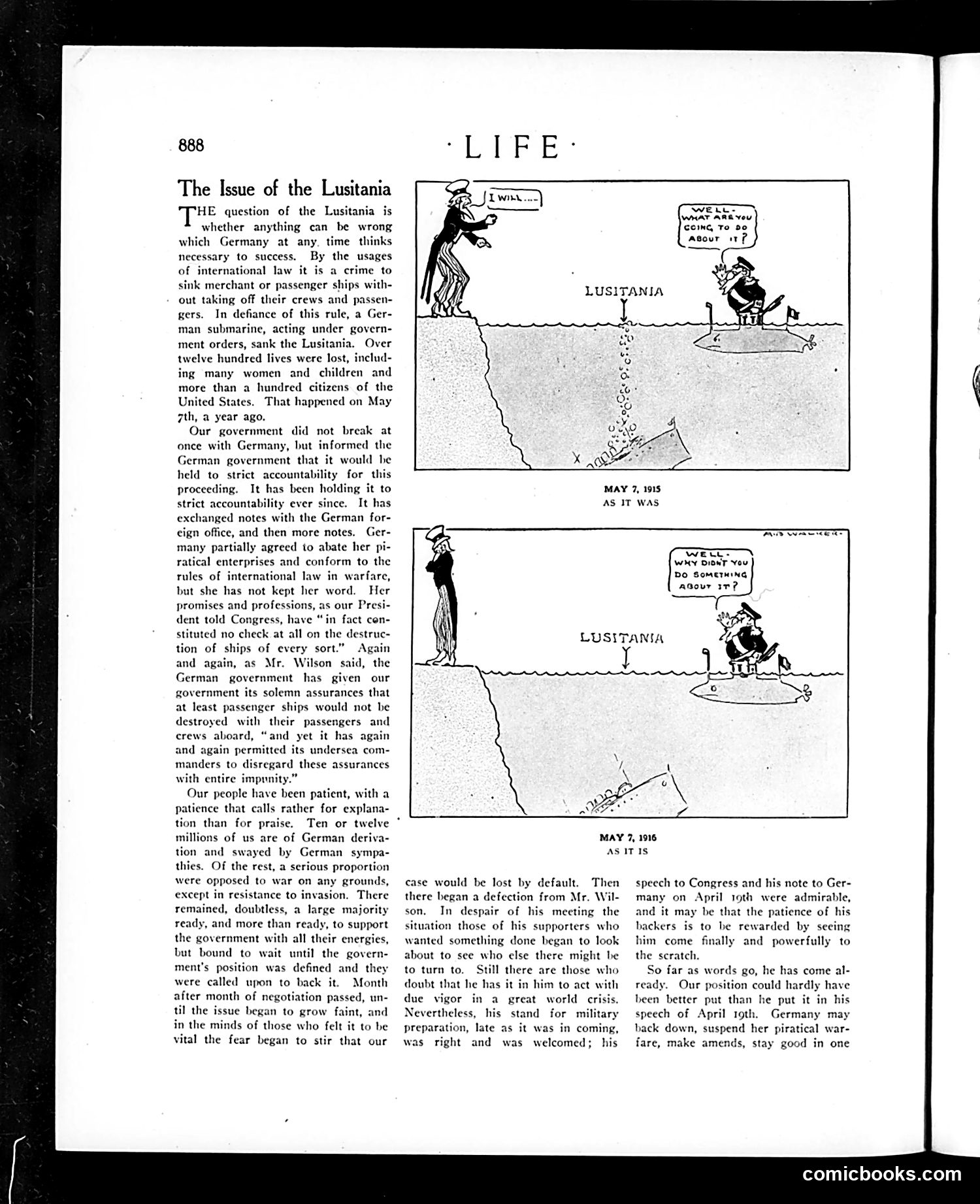
This page discusses Germany's May 7, 1915 sinking of the RMS Lusitania, a British passenger ship that killed over 1,200 people, including 128 American citizens. The two cartoons use dark humor to critique the situation's progression. The first (May 7, 1915) shows Lady Liberty asking Germany's U-boat commander what he's doing; he dismissively responds "I sink." The second (May 7, 1916) depicts Liberty again, now asking why he didn't do "something about it"—with the U-boat captain still present, implying America took no meaningful action for a full year. The accompanying text details the U.S. government's diplomatic complaints to Germany without breaking relations, criticizing the administration's patience while American lives were lost.
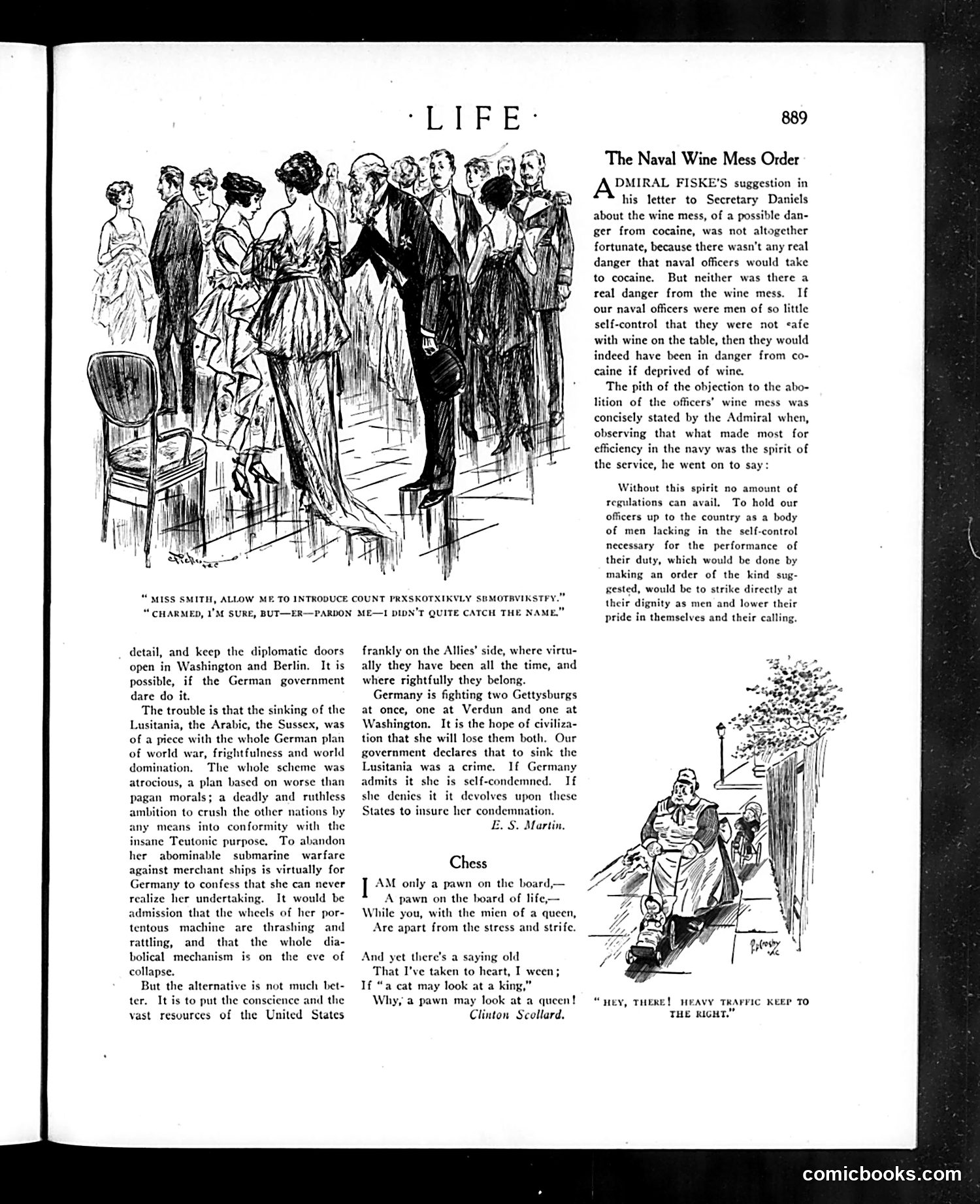
**Top Illustration:** A formal diplomatic reception scene captioned with a joke about introducing "Count Przysotxikivkly Simotryiksvsky" — a deliberately unpronounceable Russian name. The humor mocks difficulty pronouncing Russian names during WWI diplomatic dealings. **Main Articles:** - "The Naval Wine Mess Order" discusses Admiral Fiske's letter proposing to eliminate officers' wine rations, arguing naval discipline shouldn't require alcohol deprivation. - An essay on submarine warfare and the Lusitania sinking critiques German military strategy. **"Chess" Poem:** Clinton Scollard's verse uses chess metaphors for life's struggles. **Bottom Cartoon:** Shows heavy traffic with caption "Hey there! Heavy traffic keep to the right" — appears to comment on wartime civilian regulation or traffic management.
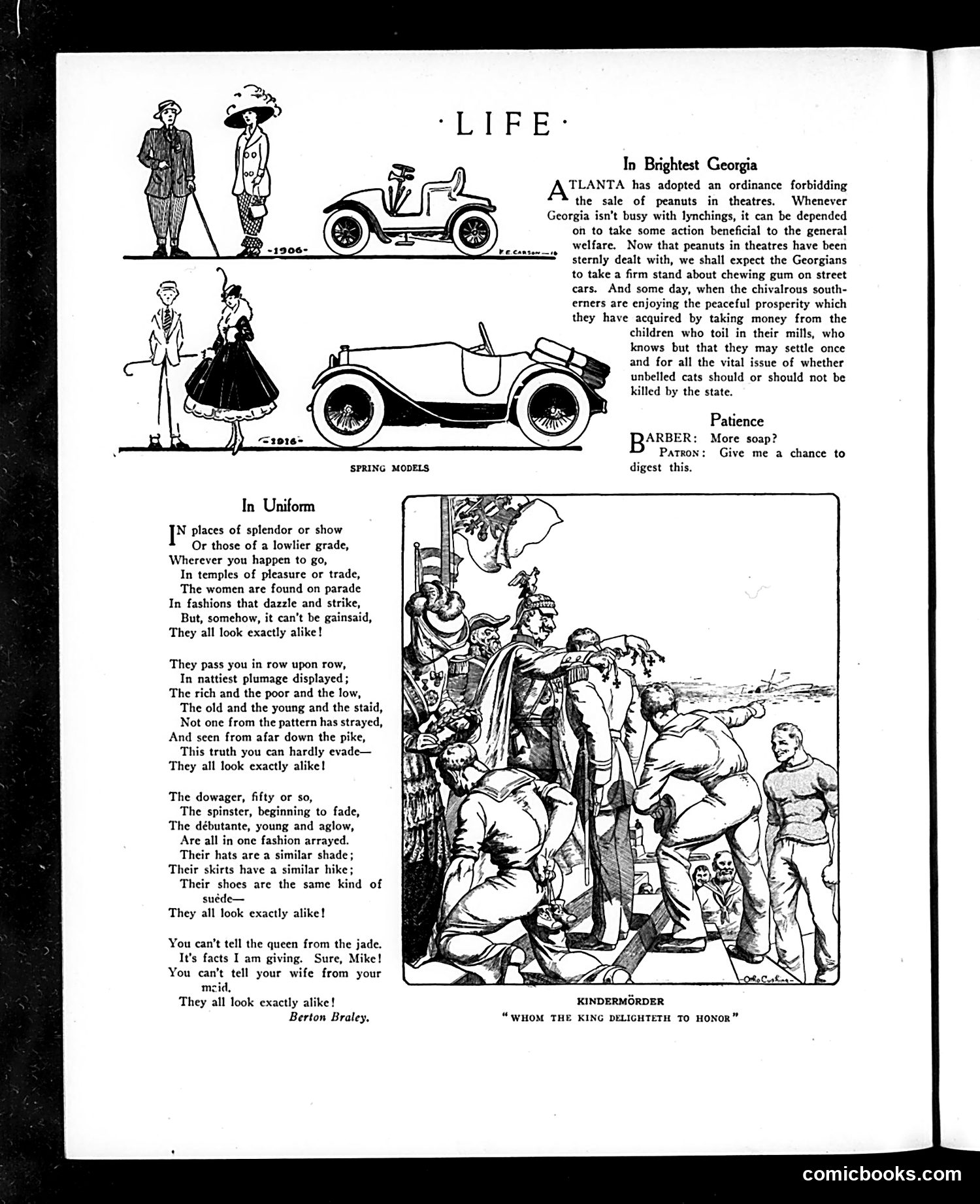
This Life magazine page contains three satirical pieces about early 1900s social life: **"Spring Models"** shows fashion evolution through 1904 and 1918—women's clothing became more practical and less ornate over time, satirizing fashion trends. **"In Brightest Georgia"** mocks Georgia's peanut ban in theaters, sarcastically suggesting wealthy Southerners will soon worry about "unbelled cats" being killed by the state—absurd extrapolation of government regulation into daily life. **"In Uniform"** by Berton Braley is a poem satirizing how uniforms make everyone look identical, using examples from wealthy to poor classes. The point: status and rank become invisible when everyone wears the same outfit. **Kindermörder illustration** depicts a historical scene ("whom the king delighteth to honor"), showing pageantry and military ceremony—likely contrasting with the uniform poem's theme about appearance versus reality.
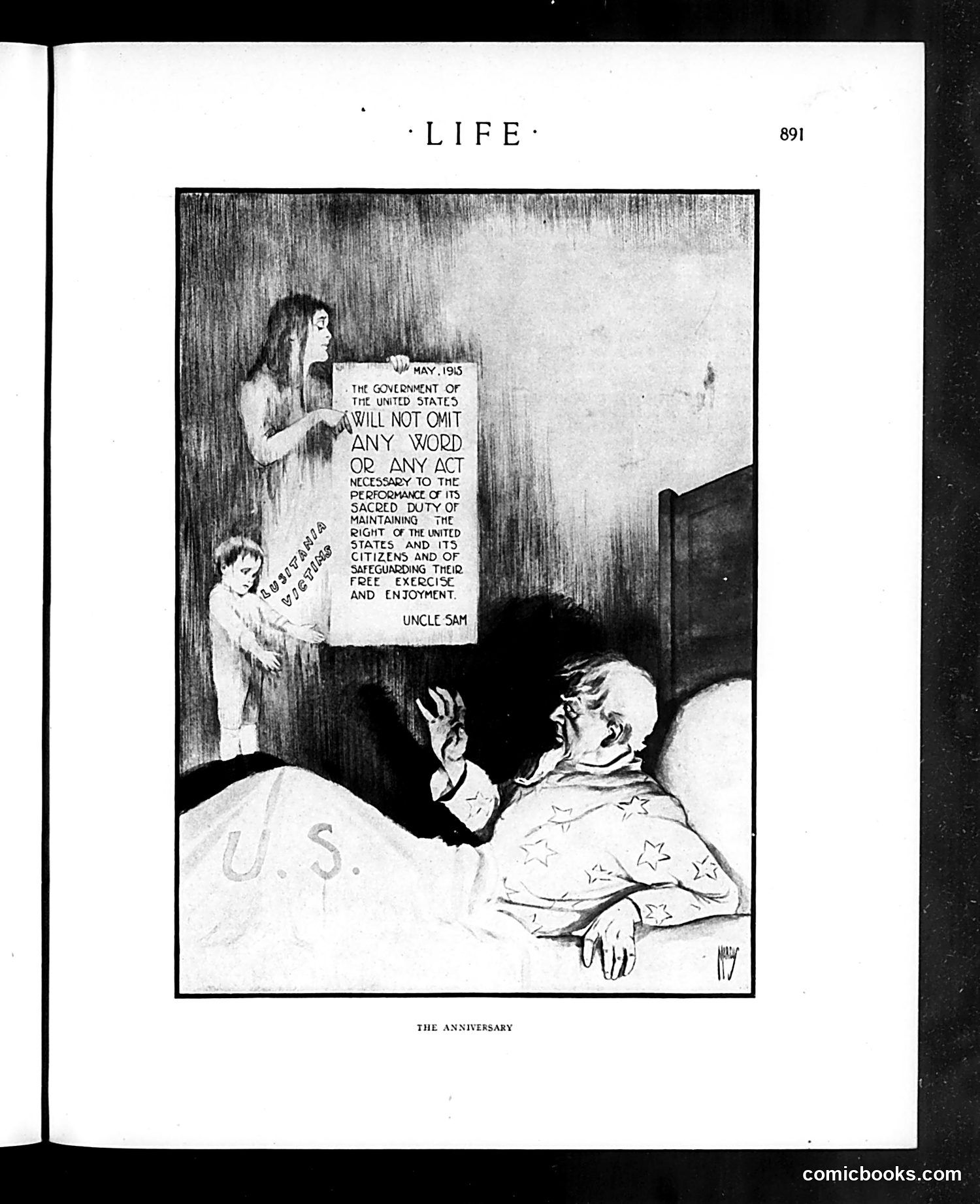
This cartoon satirizes a May 1903 government proclamation. Uncle Sam (the bearded figure representing the U.S. government, marked "U.S.") lies in bed while Lady Liberty holds up an official statement. The document declares the government "will not omit any word or any act necessary" to protect American rights and freedoms. The satire is cynical: Uncle Sam appears ill or sleeping, suggesting the government is inactive or ineffectual despite its grand proclamation. The contrast between Liberty's hopeful gesture and Uncle Sam's apparent incapacity mocks the gap between the government's stated commitments to protecting liberty and its actual performance. The title "The Anniversary" likely references a previous failure or unfulfilled promise from a year prior.
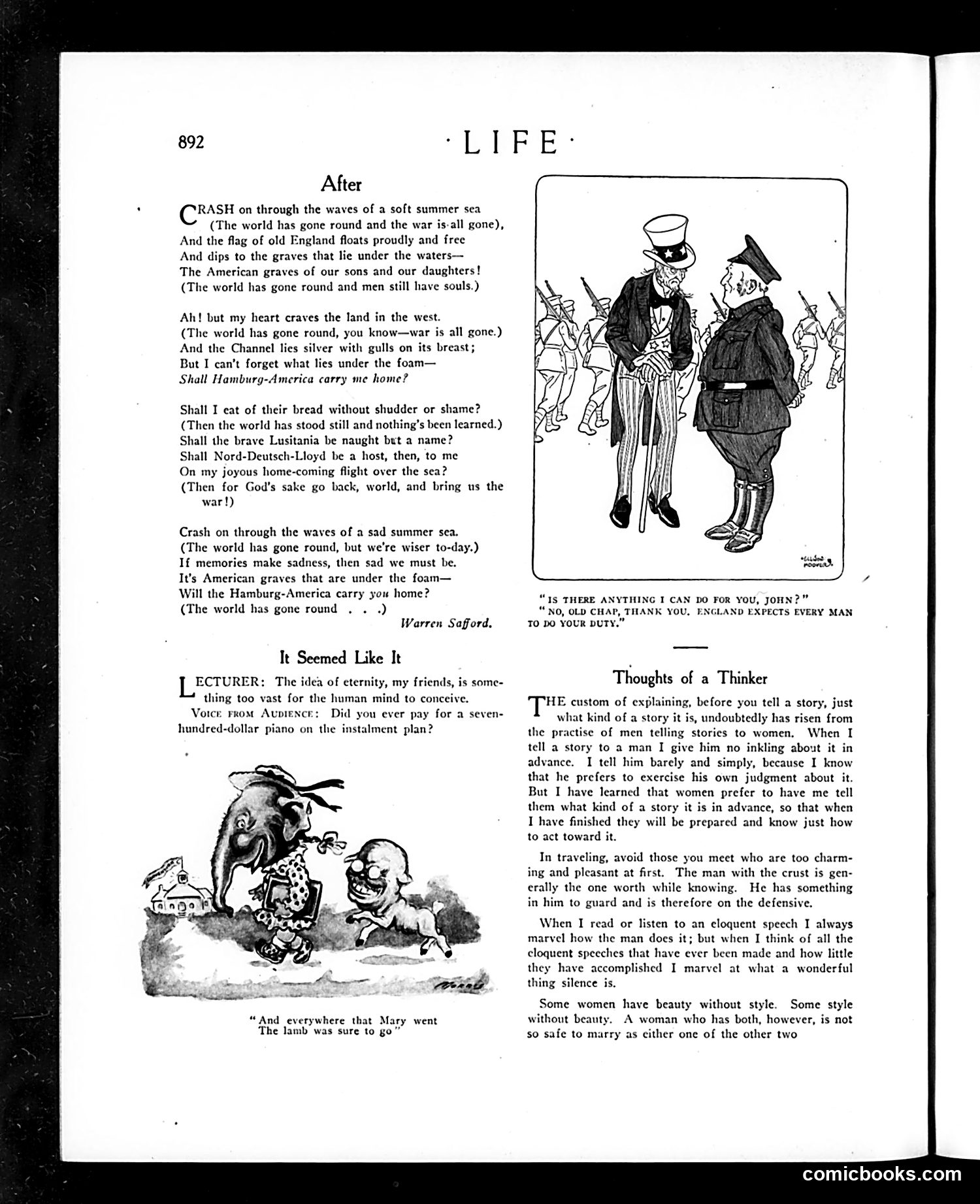
This page contains WWI-era satire addressing post-war reconciliation with Germany. **"After" Poem (Warren Safford):** A bitter meditation on American casualties in WWI. The speaker wrestles with the moral impossibility of reconciliation—specifically, accepting passage home on German shipping lines (Hamburg-America, Nord-Deutsch-Lloyd) after witnessing the sinking of the Lusitania (a British liner torpedoed by Germany in 1915, killing American passengers). The repeated refrain "the world has gone round" suggests the war's end should bring closure, but the poem insists memory and justice matter more than comfort. **Top Cartoon:** Two British military figures converse. One (appearing to be a superior officer) asks John if there's anything he can do. John's response echoes Lord Kitchener's famous WWI recruitment poster: "England Expects Every Man to Do Your Duty"—implying continued sacrifice is expected even after armistice. **Lower Section:** Unrelated humorous pieces about eternity, storytelling conventions, and observations on character and beauty. The page reflects post-WWI American attitudes toward German reparations and the psychological difficulty of moving past wartime atrocities.
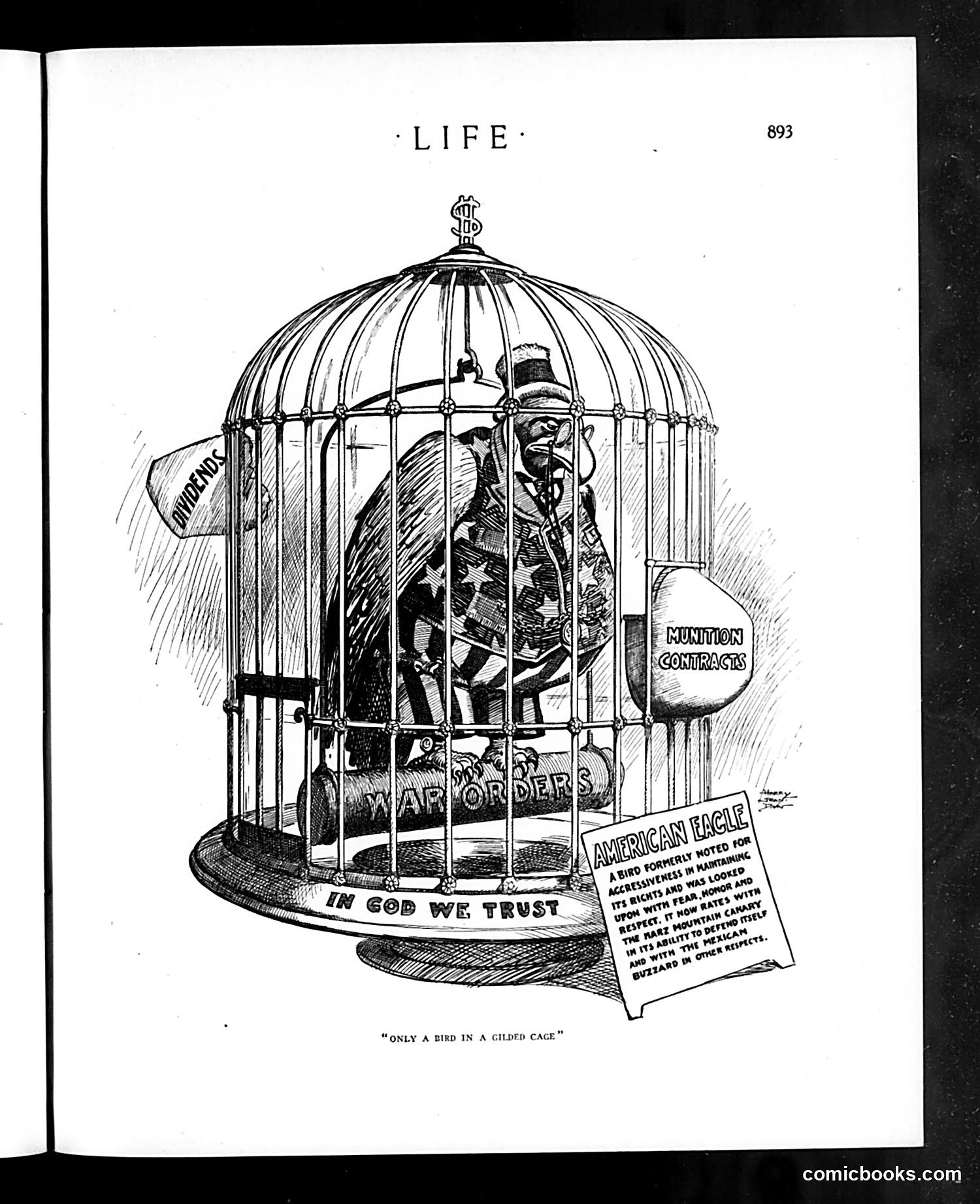
This is a satirical cartoon critiquing American militarism and war profiteering. A military officer (representing the U.S. military establishment) is caged like a bird, symbolizing constraint or entrapment. The cage's labels—"Munition Contracts," "Dividends," and "In God We Trust"—suggest the military is controlled by financial interests and weapons manufacturers rather than serving the public good. The reference to "Only a Bird in a Gilded Cage" (a popular 1900 song about being trapped by wealth) reinforces this critique. The attached note defines the "American Eagle," traditionally a symbol of American freedom, as a bird "accustomed to perches" and dependent on contracts—mocking how military power serves corporate profit rather than national defense. This reflects early-to-mid 20th century isolationist and anti-war sentiment opposing military-industrial interests.
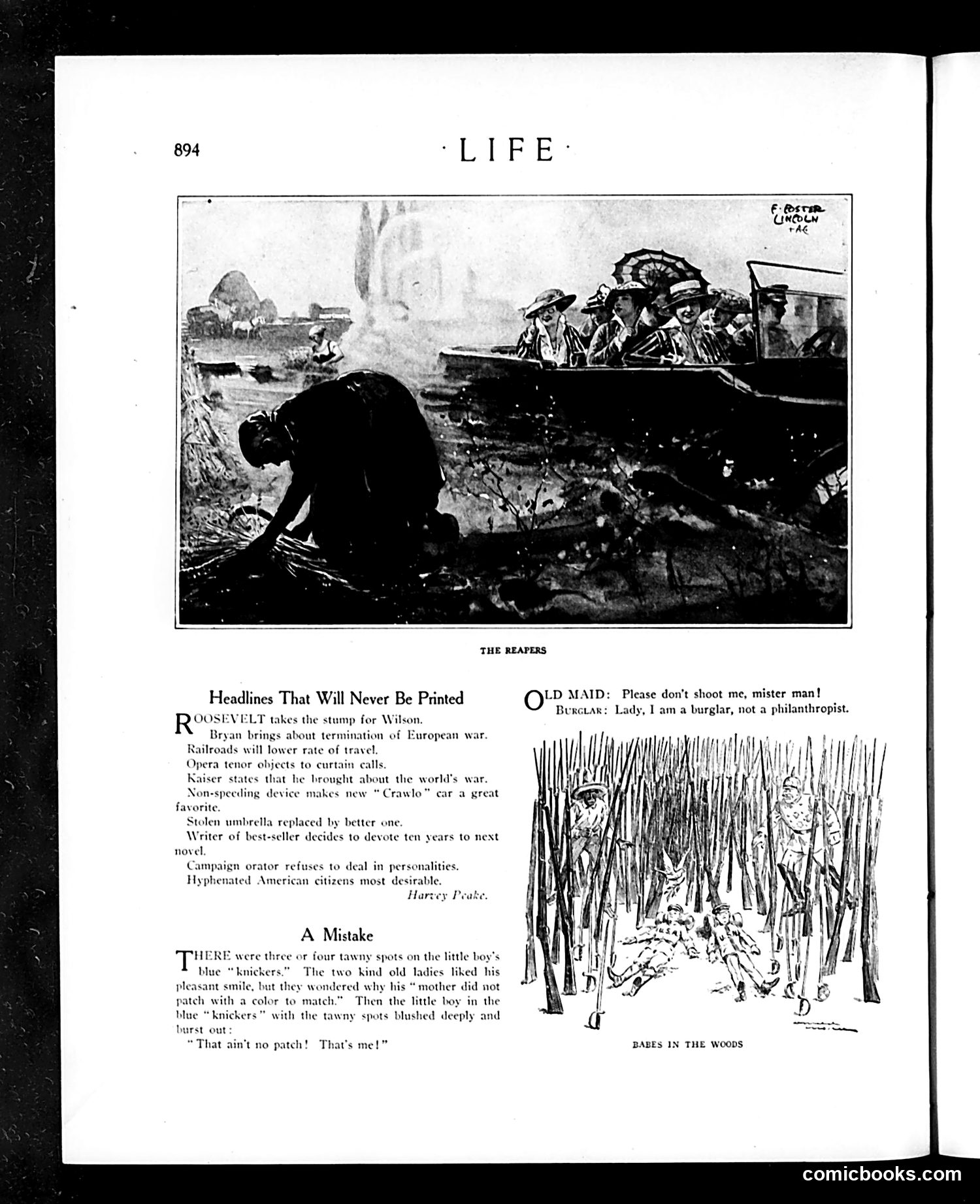
This page contains two distinct sections of humor: **"Headlines That Will Never Be Printed"** is political satire listing absurdly impossible scenarios—clearly mocking early 1900s American politics and society. References include Roosevelt campaigning for Wilson (rivals), Bryan ending European war (impossibly optimistic), and the Kaiser admitting responsibility for WWI (obviously false). The joke is that these things are so contrary to reality or human nature they could never happen. **"A Mistake"** is a gentler, non-political anecdote about a boy with brown freckles on his blue pants. Two elderly women assume his mother neglected to patch the spots matching the fabric, but the boy reveals they're actually his own skin—freckles, not holes. The humor derives from the women's embarrassed realization of their assumption. The accompanying illustrations support these jokes: the top shows what appears to be a WWI-era scene, while the bottom depicts the boy with two women in a wooded setting.
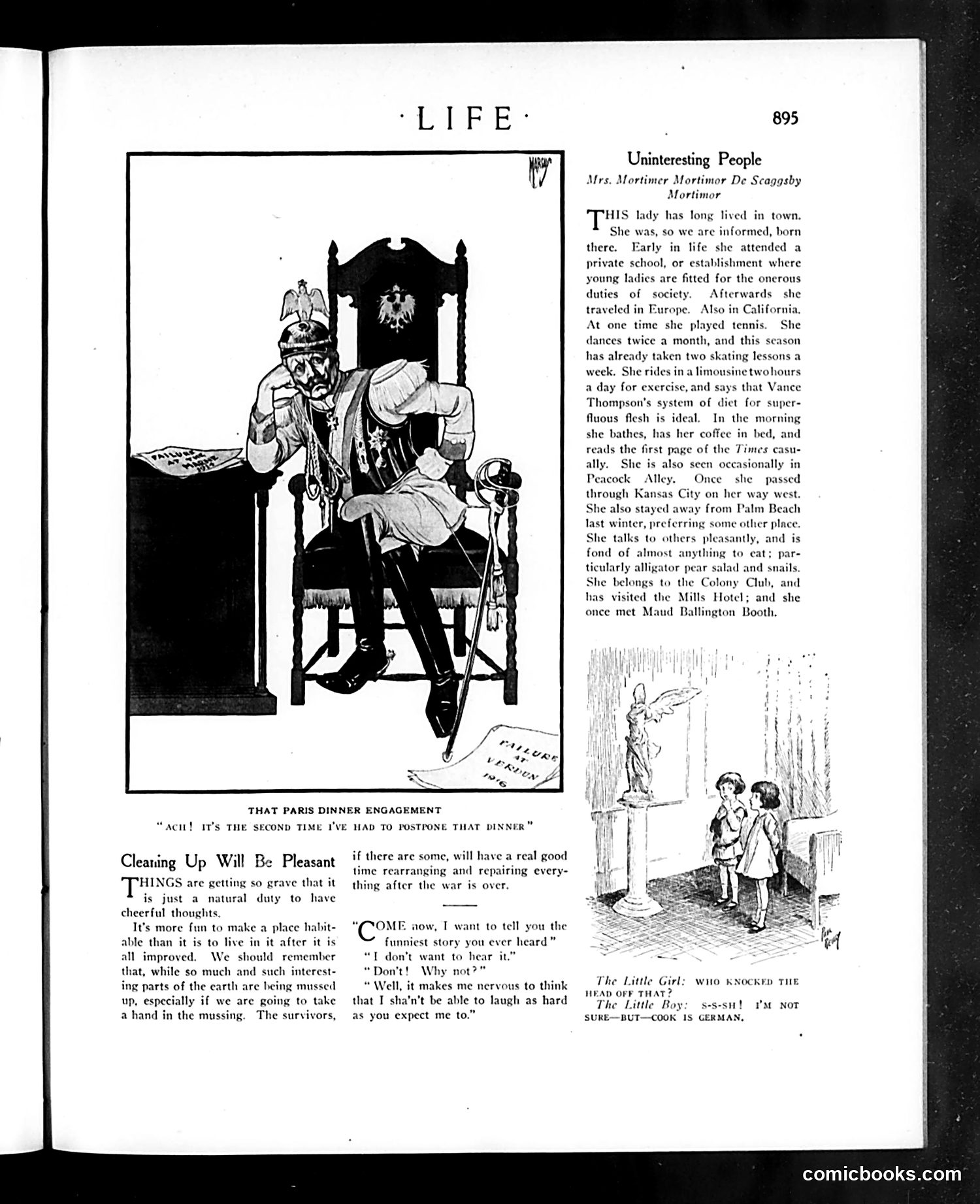
This page contains satirical social commentary typical of Life's humor. **"Uninteresting People"** profiles Mrs. Mortimer De Scaggsby, mocking upper-class society women. The satire lies in listing superficial activities—tennis, skating lessons, limousine rides, diet regimens—presented as though remarkable. References to exclusive venues (Colony Club, Mills Hotel, Peacock Alley) and her encounters with minor celebrities emphasize the tedium of wealthy idle life. The humor targets the emptiness of high-society existence. **"That Paris Dinner Engagement"** cartoon shows a military figure postponing dinner, satirizing wartime disruptions to social plans—a jab at society's triviality during WWI. **"Cleaning Up Will Be Pleasant"** and "The Little Girl" dialogue are brief humor pieces about post-war reconstruction and a child's anxiety about laughing on cue. The final exchange about the cook being German reflects WWI-era suspicion of German nationals, a timely social anxiety of the period. Overall, the page mocks upper-class superficiality and wartime social anxieties through gentle satire.
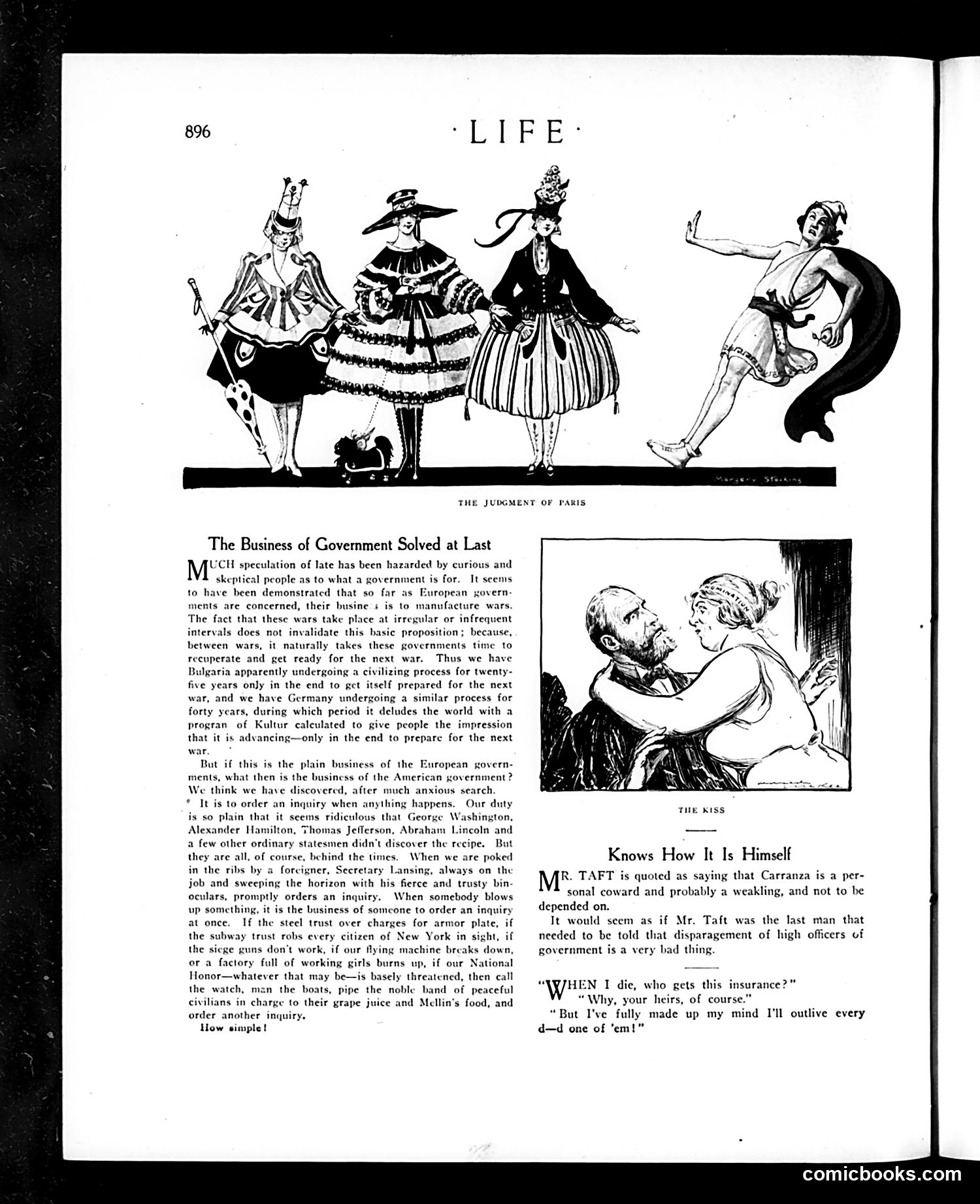
**"The Judgment of Paris" (top cartoon):** This classical allusion depicts four figures in elaborate dress competing for attention—likely representing European nations or their leaders vying for power and influence before World War I. The mythological reference suggests their rivalry will lead to conflict. **"The Business of Government Solved at Last" (main article):** This satire argues that European governments exist solely to manufacture wars, while the American government's actual purpose is merely to order inquiries into problems rather than solve them. It mocks Secretary Lansing and the Taft administration for endless investigations instead of action—whether regarding trusts, infrastructure failures, or diplomatic disputes with Mexico (Carranza is referenced). **"The Kiss" and "Knows How It Is Himself":** A brief jab at former President Taft, suggesting his criticism of Mexican general Carranza is hypocritical given Taft's own questionable leadership record. The page reflects Progressive Era frustration with government ineffectiveness and mounting pre-WWI tensions in Europe.
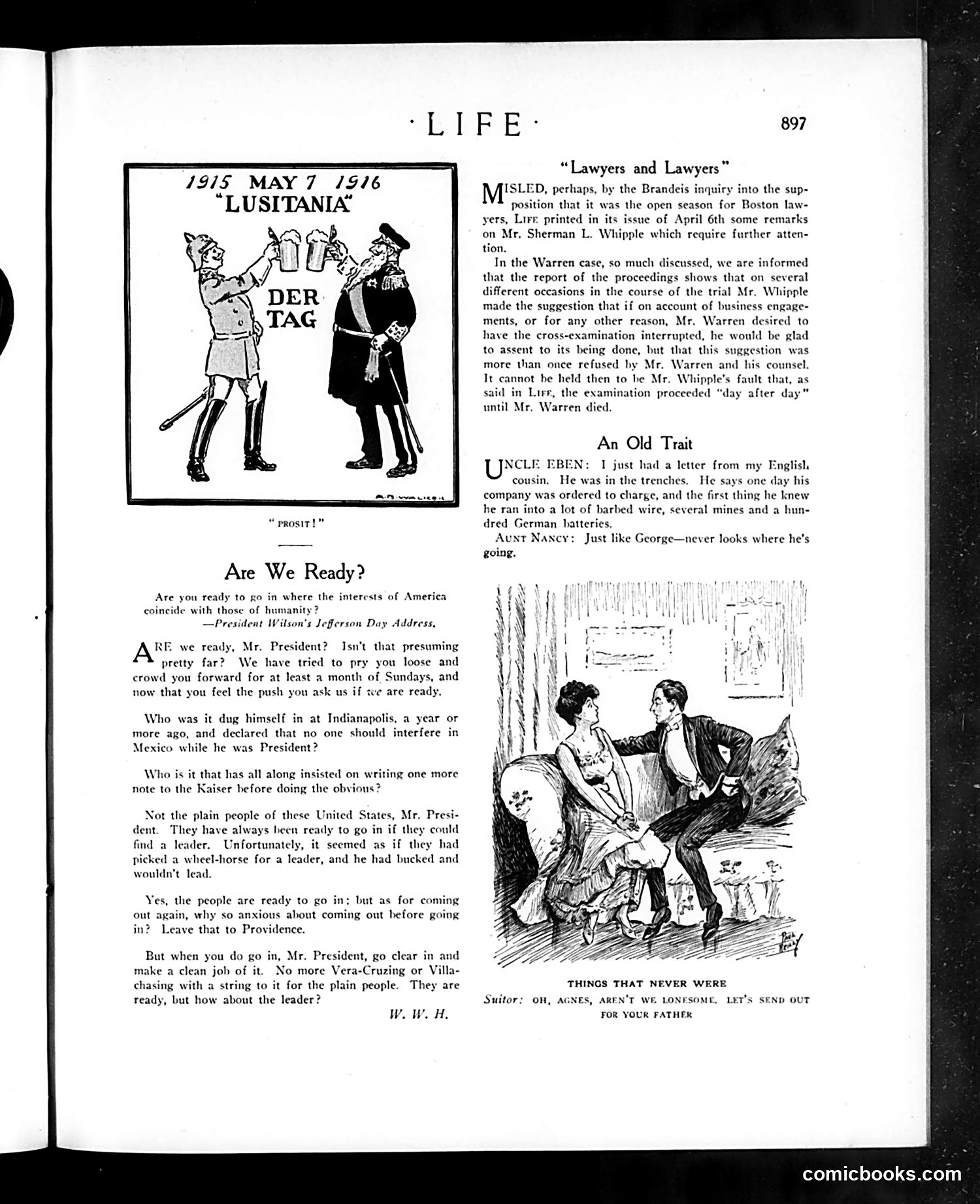
## The Lusitania Cartoon The top image references the 1915 sinking of the RMS Lusitania by German U-boat, which killed nearly 1,200 people including Americans. The cartoon shows a German officer toasting ("Prosit!") with an American, satirizing American ambivalence toward entering World War I despite this attack. ## "Are We Ready?" Editorial This piece criticizes President Wilson for asking Americans "are we ready?" to enter the war, when the public has been eager to intervene while Wilson hesitated. The author sarcastically recalls Wilson's 1914 non-intervention stance on Mexico and his repeated diplomatic notes to Germany ("one more note to the Kaiser") rather than military action. The critique suggests Wilson is an ineffectual leader who has held back the nation's willingness to fight. ## "An Old Trait" & "Things That Never Were" These brief humor pieces use family anecdotes—one about a soldier charging blindly into German defenses, another about a lonely suitor—to make light of wartime confusion and domestic life during the conflict. The page overall urges decisive American military intervention in WWI.
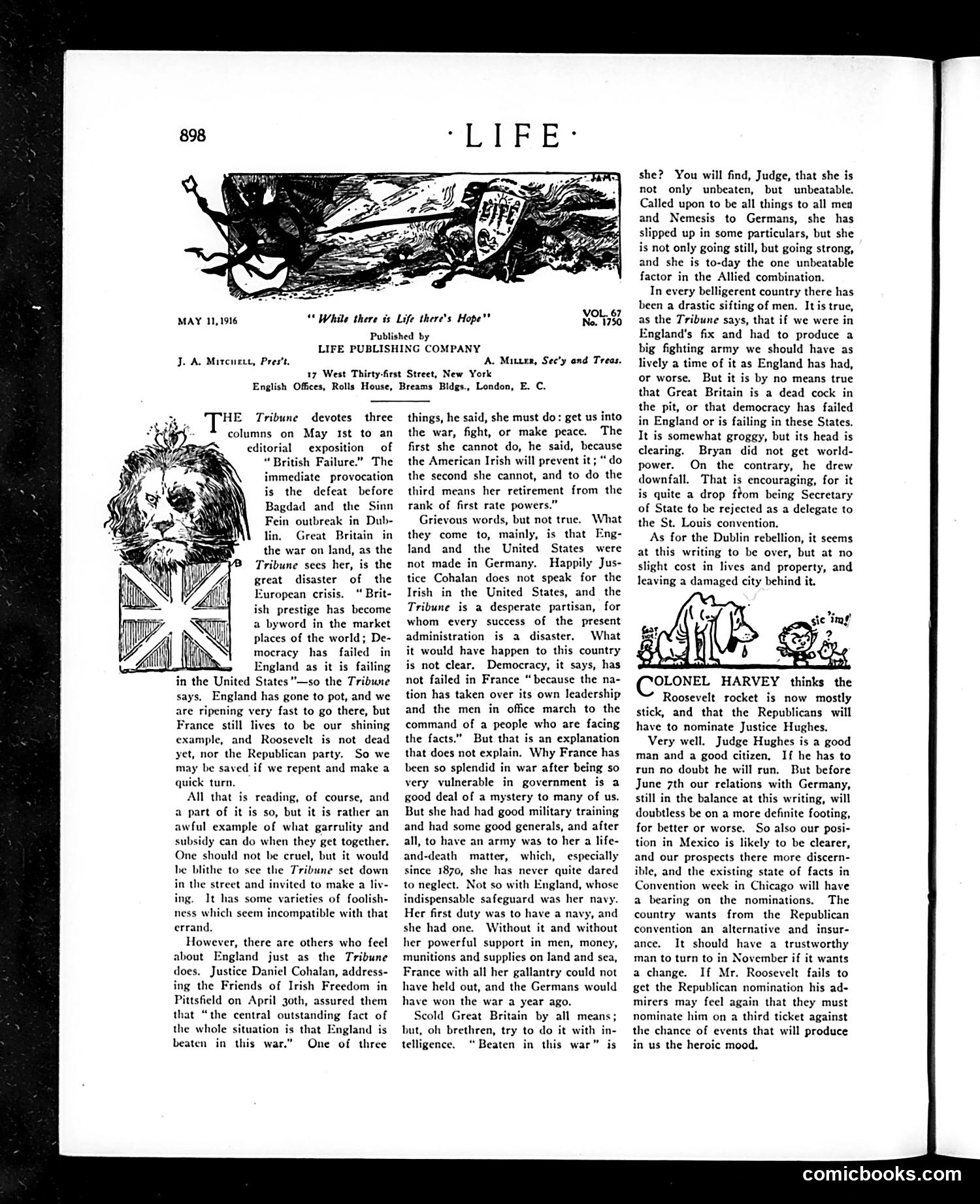
This page critiques Irish-American and anti-British sentiment during World War I. The editorial attacks Justice Daniel Cohalan, who publicly declared Britain was "beaten" in the war and could not win without either entering American involvement or making peace. Life's editors defend Britain, arguing that despite setbacks (the Bagdad defeat, the Easter Rising in Dublin), Britain remains "unbeatable" and crucial to the Allied cause. They mock the *Tribune* newspaper for similar anti-British rhetoric, suggesting such criticism reflects partisan politics rather than clear thinking. The satire targets what the editors see as defeatist propaganda and Irish-American obstruction of U.S. aid to Britain. The page argues Britain's navy remains indispensable and that France could not have survived without British support—therefore, condemning Britain while praising France is logically inconsistent. The editors frame pro-Irish-independence voices as undermining the Allied war effort.
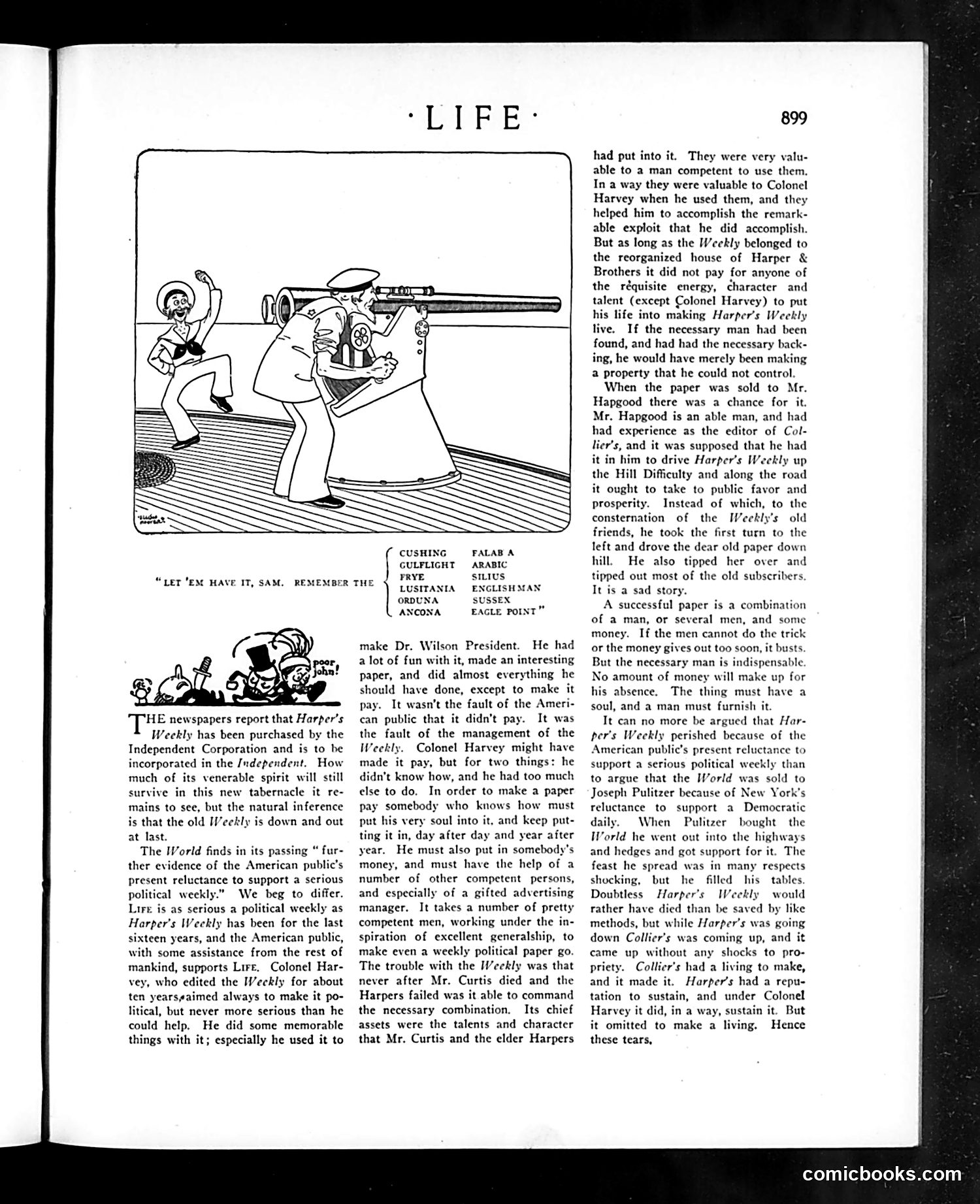
This is **Life magazine's editorial commentary** on Harper's Weekly's demise—not a cartoon but a serious political essay. **The Context:** Harper's Weekly, a venerable 19th-century publication, has been purchased and absorbed by the Independent Corporation. Life argues this represents not public disinterest in serious political weeklies, but rather **management failure**. **Key Arguments:** - Colonel Harvey edited it for ~10 years, making it interesting and even helping elect President Wilson, but couldn't make it financially viable - After Curtis died and the Harper brothers' company declined, no competent manager had the energy and authority to revitalize it - When sold to Hapgood (an editor from Collier's), he mismanaged it, losing subscribers and ultimately driving it "down hill" **The Satire's Point:** Life defends serious political journalism's viability—arguing that **Harper's Weekly failed not because Americans won't support such papers, but because incompetent leadership destroyed it**. The phrase "Let 'em have it, Sam" (accompanying a naval illustration) appears to emphasize the need for forceful, competent direction. This is essentially a postmortem defending political magazines' importance while critiquing specific editorial failures.
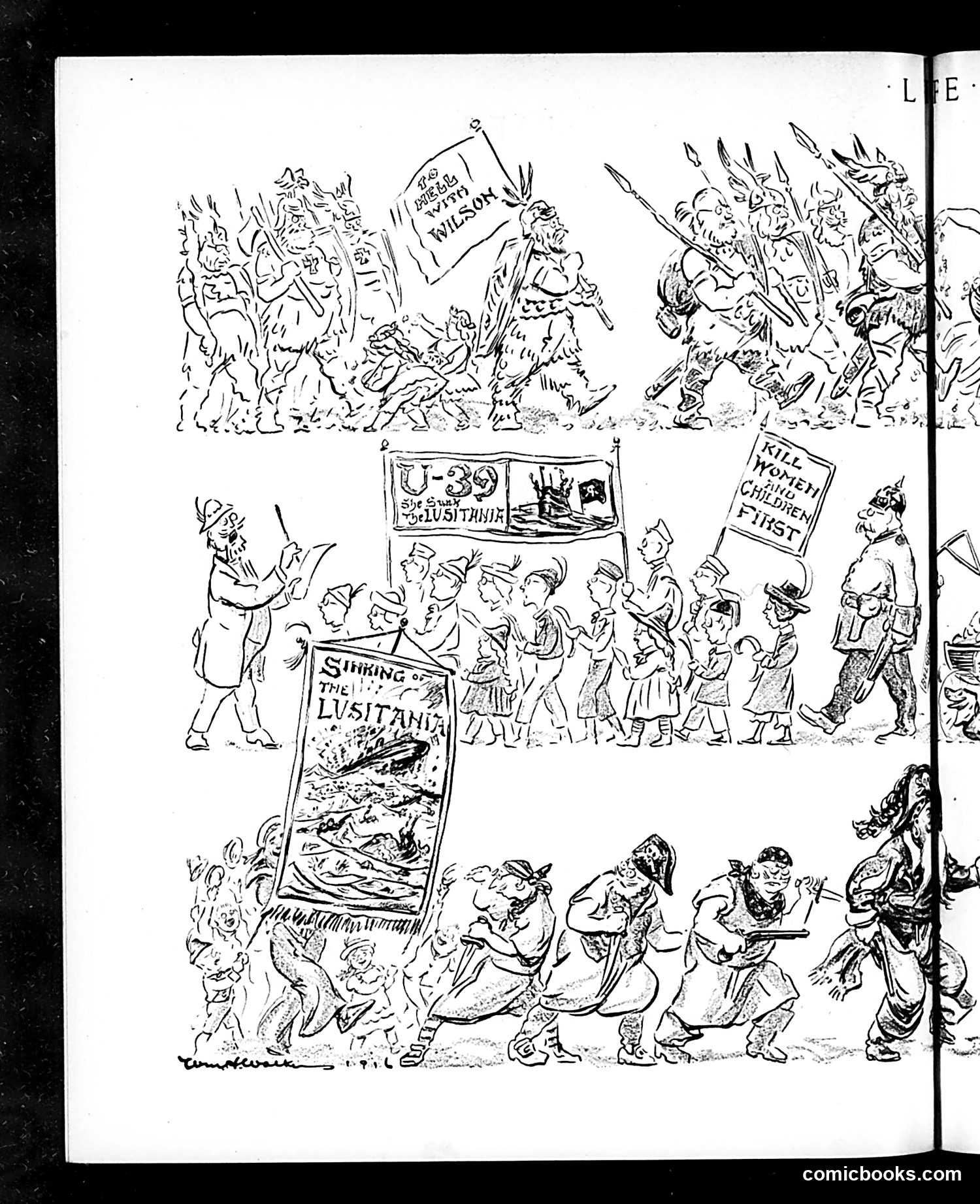
This Life magazine cartoon satirizes pro-war propaganda and militarism during World War I. The top panel shows armed soldiers marching with a "Wilson" flag, depicting military mobilization. The middle section displays propaganda posters including "U-39" (referencing German submarines) and "Sinking of the Lusitania" (the 1915 ship attack that killed civilians). The bottom panel shows civilians—including children—being marched along carrying these same propaganda posters, with one sign reading "Kill Women and Children First." The cartoon appears to criticize how war propaganda manipulates ordinary people and children into supporting military violence by sensationalizing atrocities. The juxtaposition suggests the cartoonist viewed such propaganda as dehumanizing and morally troubling, mocking how patriotic messaging could override humanitarian concerns.
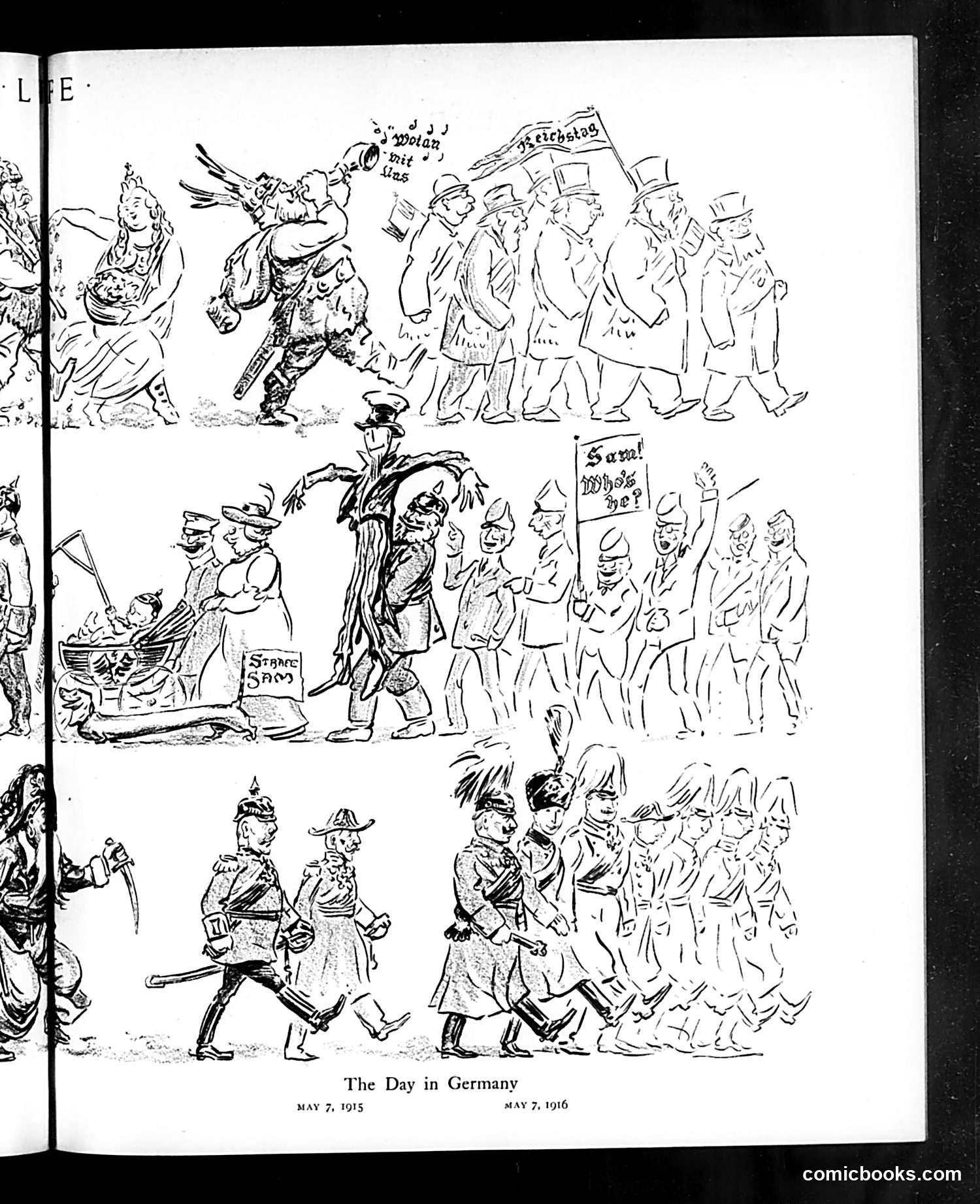
This political cartoon compares German society on two dates exactly one year apart: May 7, 1915 and May 7, 1916. The page depicts four separate scenes showing German military and civilian life, with soldiers, officials, and civilians in various poses and activities. The cartoon appears to satirize the condition of Germany during World War I, likely commenting on how the nation's situation—military, economic, or morale-related—changed (or didn't change) between these two dates. The repeated imagery of military formations and officials suggests commentary on militarization or the persistence of wartime conditions. Without clearer text legibility, the specific satirical point comparing the two dates remains unclear, but the structure clearly invites readers to observe what has (or hasn't) changed in Germany over that year.
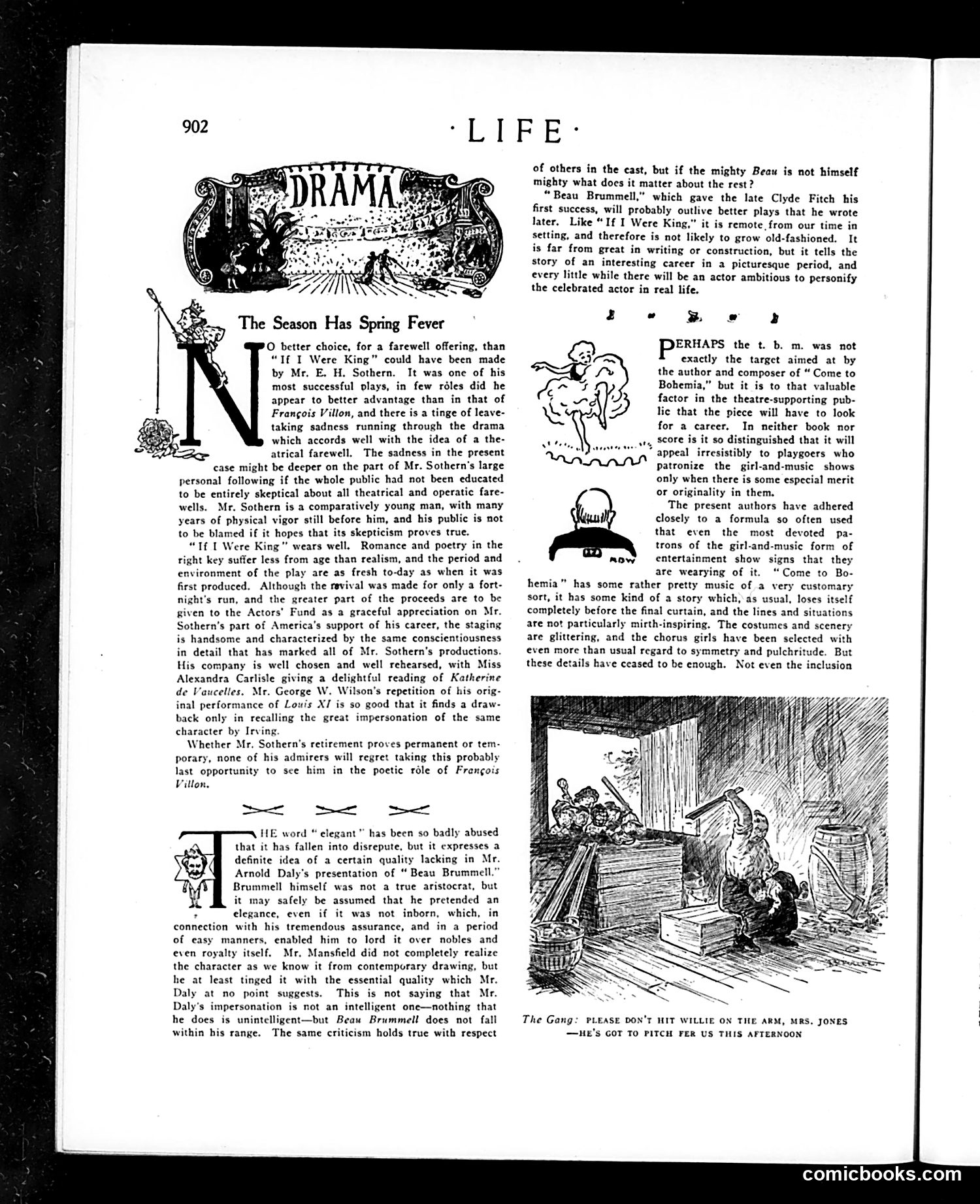
This page reviews theatrical productions from the early 1900s. The main drama section discusses actor E. H. Sothern's farewell performance in "If I Were King," praising the production's romanticism and period setting while noting skepticism about theatrical "retirements" (actors often returned). The lower section critiques Arnold Daly's performance as "Beau Brummell," arguing he lacks the essential quality of "elegance" that defined the historical figure—Brummell's pretended aristocratic refinement and assurance. The critic suggests Daly's intelligent acting simply doesn't suit this particular character, contrasting him unfavorably with an earlier portrayal by (likely) Richard Mansfield. The cartoon at bottom (captioned "The Gang") appears to be unrelated theatrical humor, showing characters in what seems a comedic situation. The satire targets acting choices and character interpretation rather than political content—typical for Life magazine's drama criticism of this era.
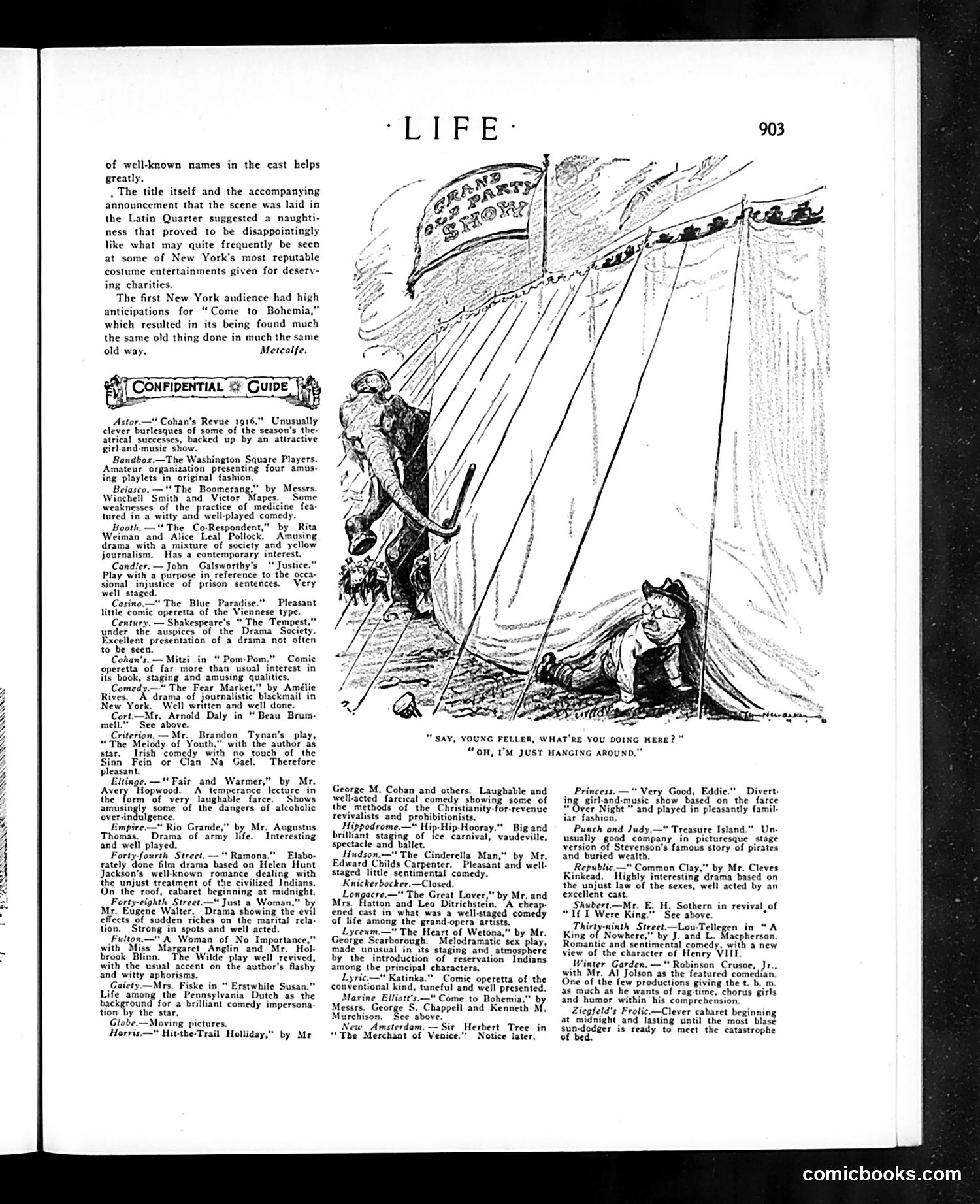
The main illustration depicts a figure clinging to ropes or rigging, apparently from a ship or circus tent. The caption reads: "Say, young feller, what're you doing here?" / "Oh, I'm just hanging around." This is a visual pun—the humor derives from the literal interpretation of "hanging around" (idling about) versus the figure's precarious position literally *hanging* from ropes. It's a simple joke playing on double meaning of the phrase. The page itself is primarily a theater review guide ("Confidential Guide") covering Broadway productions of the era—plays, operettas, and films. The reviews are brief, witty assessments of current shows. The opening text discusses disappointment with "Come to Bohemia," suggesting audiences expected bohemian naughtiness but found conventional entertainment instead. The cartoon functions as light visual humor amid serious theatrical criticism—typical of *Life* magazine's satirical approach.
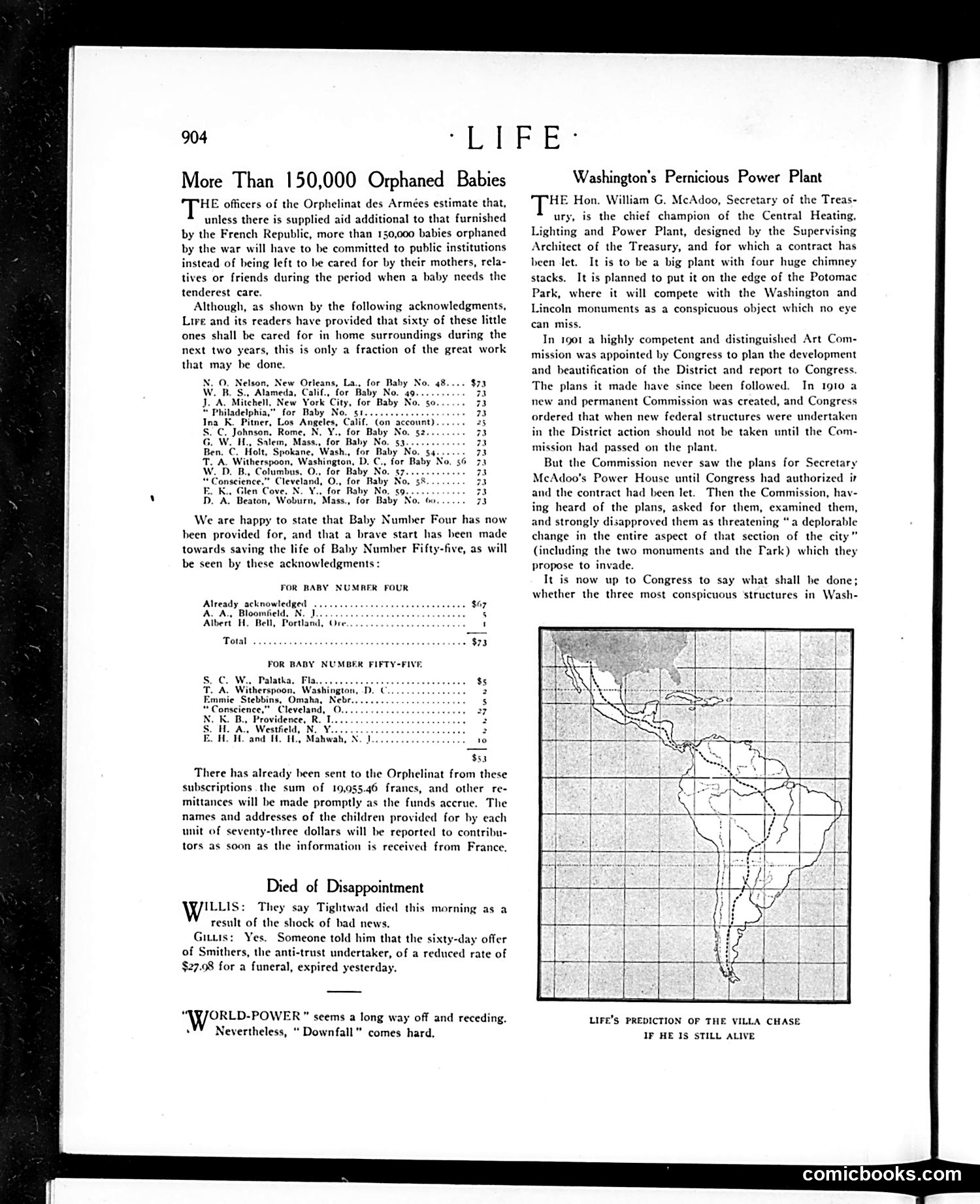
This page contains two separate articles from *Life* magazine (a satirical publication): **1. Orphaned Babies Appeal:** A fundraising effort for French war orphans (WWI era, based on "war" reference). *Life* readers are asked to sponsor 60+ orphaned babies at $73 each. The article lists donor names and amounts, celebrating progress toward this humanitarian goal. **2. Washington's Power Plant Controversy:** Secretary of the Treasury William G. McAdoo champions a new central heating/power plant for Washington, D.C., designed to be placed near the Potomac Park—where it would visually compete with the Washington and Lincoln monuments. The satire criticizes McAdoo for bypassing the Art Commission, which was legally required to approve new federal structures in the District. The point: McAdoo's industrial plant would disfigure the nation's most sacred monuments through governmental negligence or arrogance. **3. Minor Humor Items:** Brief jokes about a character named "Tightwad" dying from shock, and a reference to "World-Power" declining while "Downfall" approaches—likely topical political commentary unclear without additional context.
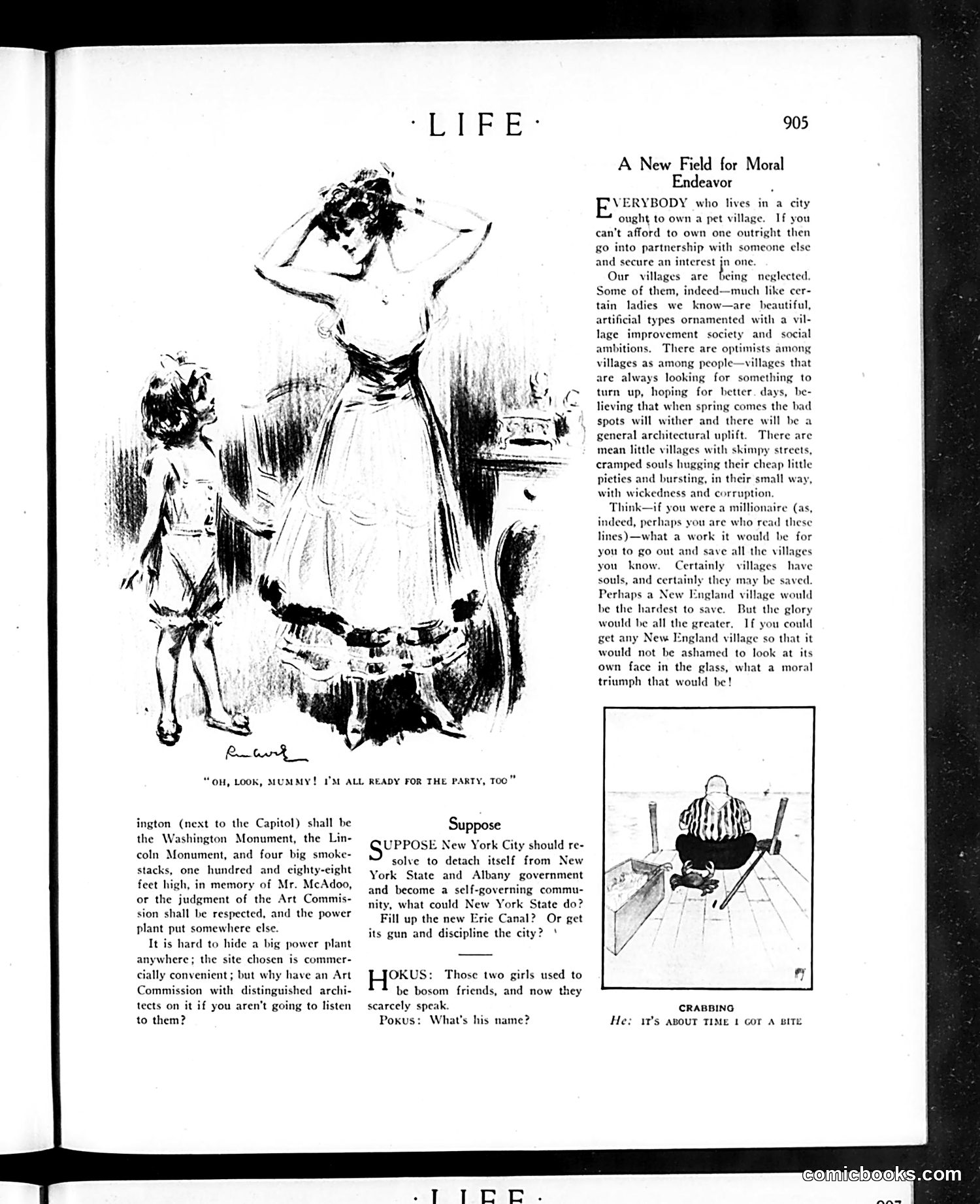
This page contains three distinct pieces: **Main Illustration**: A sketch of a well-dressed woman and child, captioned "Oh, look, mummy! I'm all ready for the party, too"—a humorous domestic scene with no apparent political content. **"A New Field for Moral Endeavor"**: An editorial essay proposing that wealthy urbanites adopt neglected villages as a moral project, comparing villages to women needing improvement. It specifically references New England villages as particularly challenging cases. This is gentle social satire about civic responsibility and uplift movements. **"Suppose"**: A brief hypothetical about New York City separating from New York State—likely contemporary political commentary, though context is unclear without dating this issue. **Bottom cartoon**: Shows a figure fishing, captioned "Crabbing—He: it's about time I got a bite," a straightforward pun on fishing for crabs versus romantic pursuit. The page mixes whimsy with mild social criticism typical of Life's satirical approach.
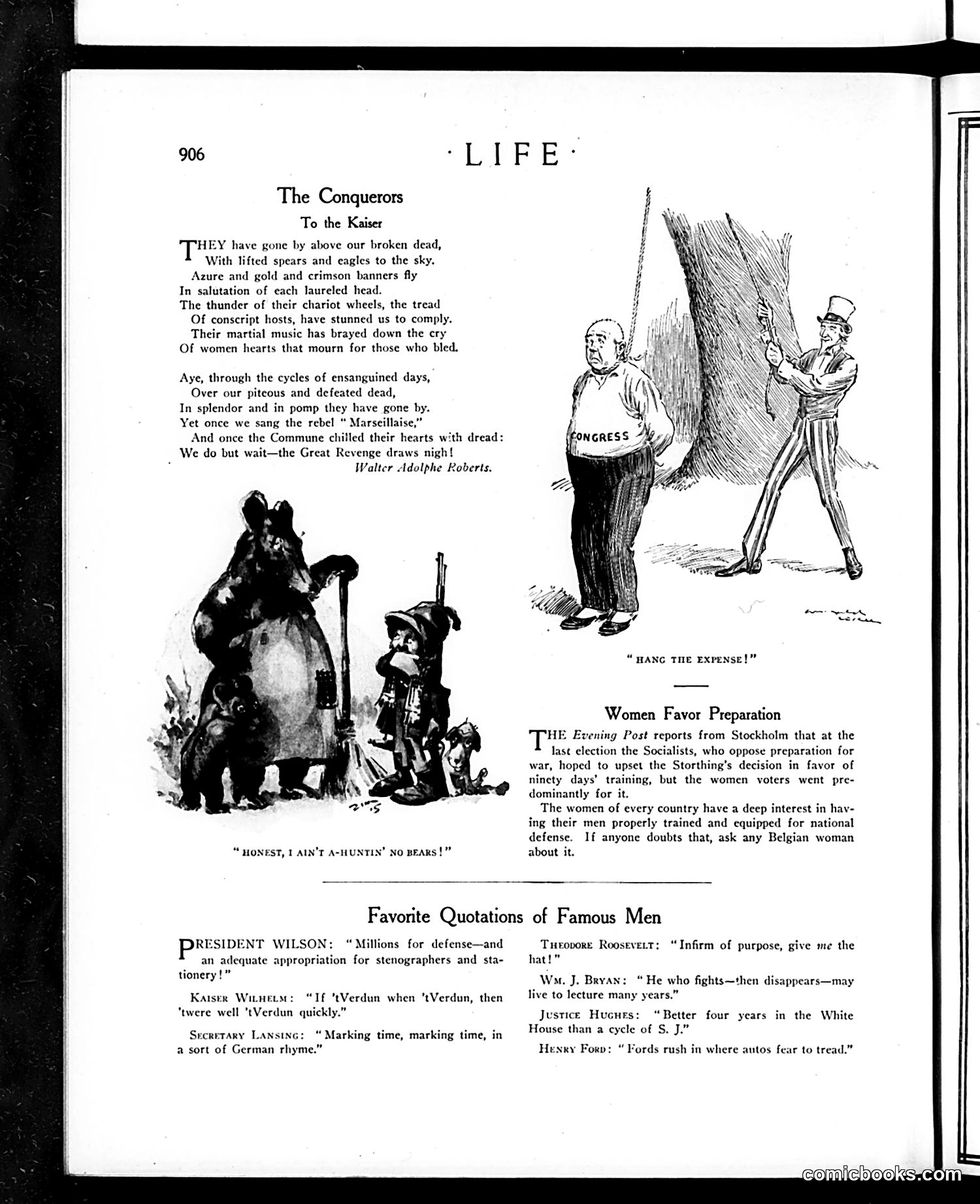
This is a WWI-era satirical page criticizing American political leadership's handling of military preparedness. **The Poetry** ("The Conquerors"): A dramatic verse mourning German military victories in Europe while invoking French revolutionary spirit, suggesting future revenge—reflective of Allied frustration circa 1916. **The Cartoons**: The left sketch shows a bear hunter claiming he's "not hunting bears"—likely mocking American neutrality rhetoric while covertly preparing for war. The right cartoon depicts "Congress" as a skeletal figure being directed by Uncle Sam to "Hang the Expense!"—satirizing military spending debates. **"Women Favor Preparation"**: Reports that Swedish and Belgian women support military training, contrasting with socialist pacifism. The implied criticism: women recognize war's reality while male politicians debate. **"Favorite Quotations"**: Mock quotes attribute absurdist statements to Wilson, Kaiser Wilhelm, Lansing, Roosevelt, Bryan, Hughes, and Ford—ridiculing their actual positions on defense spending, war strategy, and political maneuvering during America's pre-entry period. The page's overall message: American leaders are ineffectual and contradictory about military readiness.
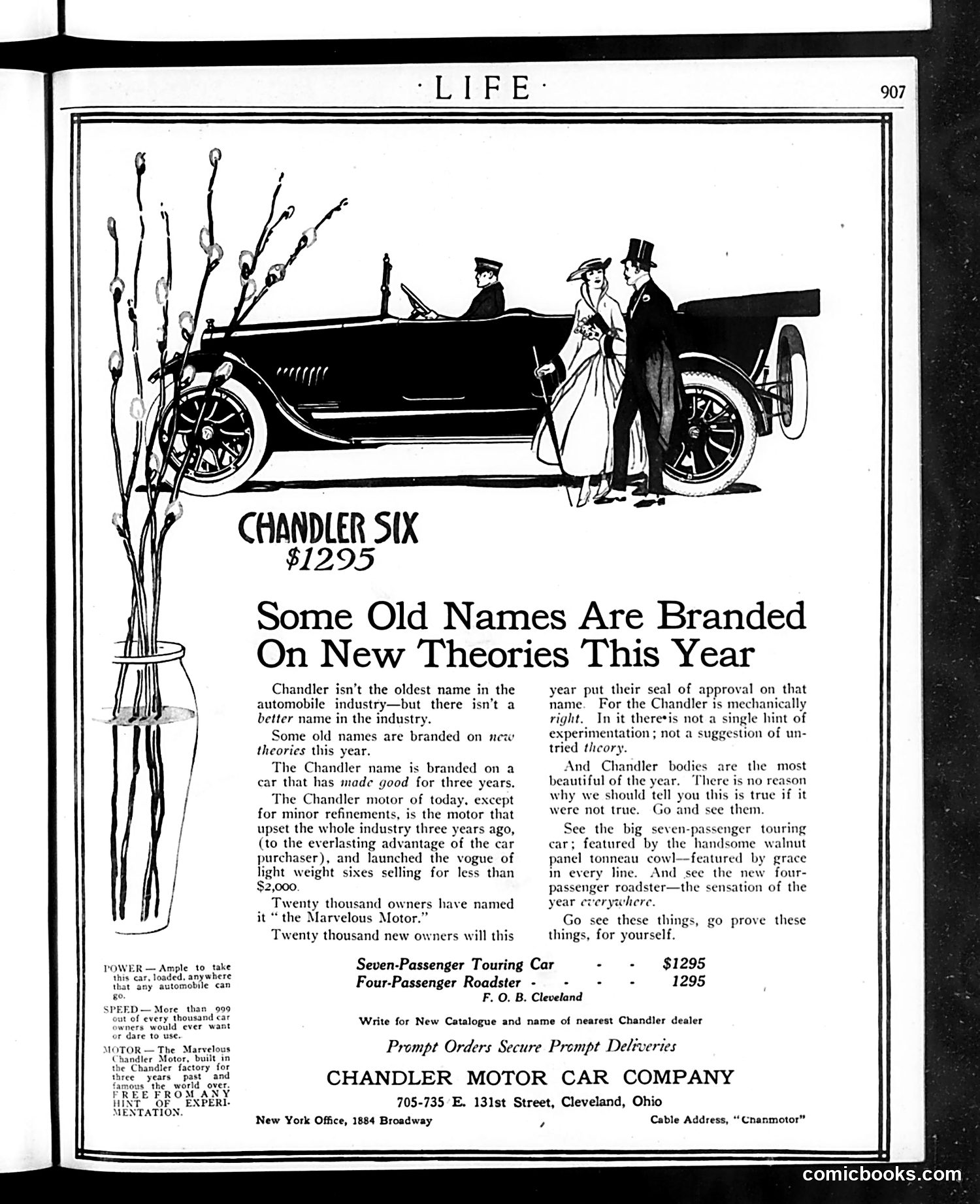
This is primarily a **Chandler automobile advertisement**, not political satire. The page promotes the Chandler Six automobile at $1,295. The headline's sarcastic tone—"Some Old Names Are Branded On New Theories This Year"—is a competitive jab at rival car manufacturers. Chandler argues that while some established automakers are introducing untested innovations, Chandler itself represents proven reliability: the same motor design that "upset the whole industry three years ago" and earned 20,000 owners calling it "the Marvelous Motor." The advertisement emphasizes that Chandler avoids experimentation—it's a refined, established design rather than unproven theory. The illustration shows well-dressed figures admiring the touring car, appealing to middle-class aspirations. This reflects 1920s-era automotive competition, where manufacturers marketed either innovation or dependability. Chandler positioned itself as the latter: tested, mechanically sound, and beautiful—avoiding the risks associated with competitors' new designs.
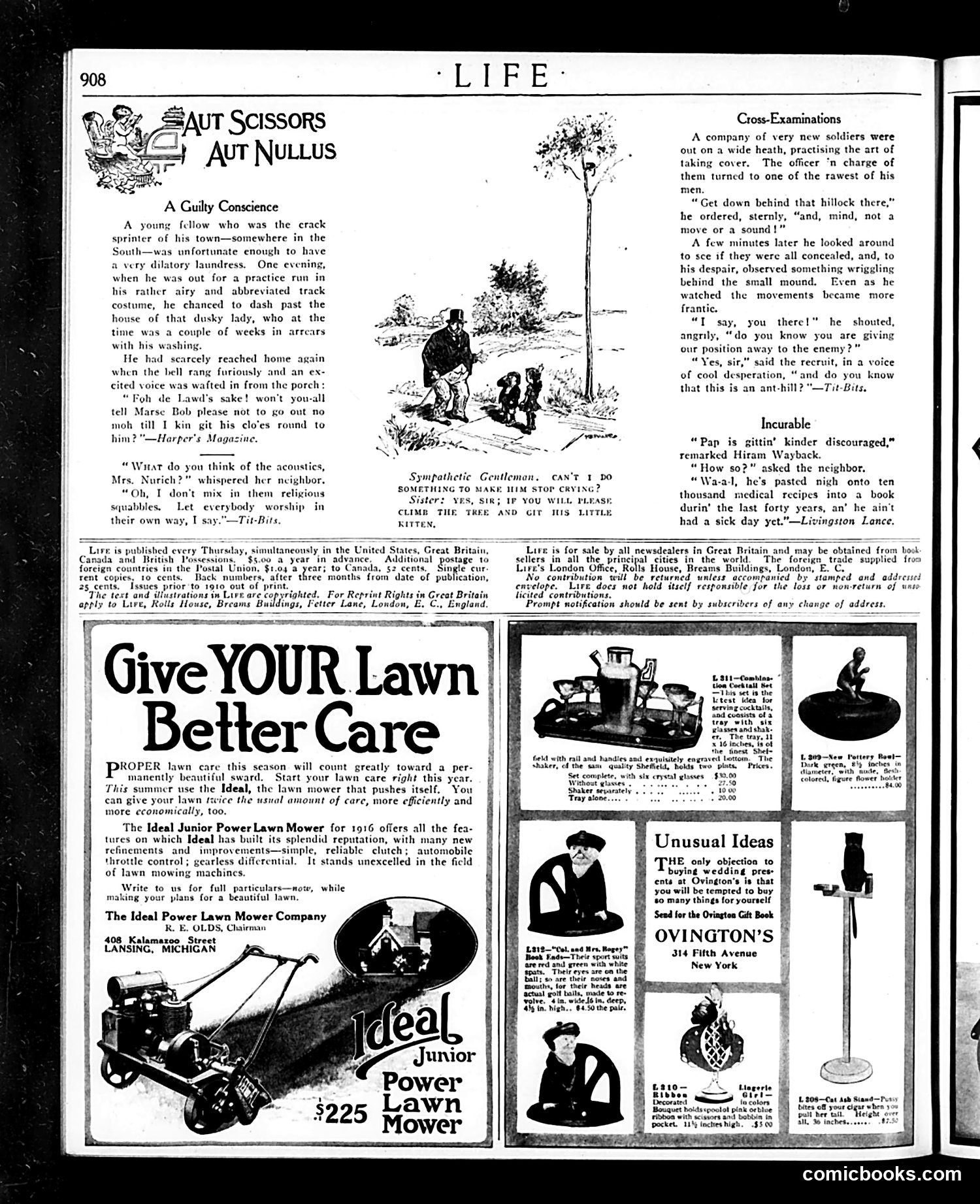
This 1916 *Life* magazine page contains satirical short stories and advertisements typical of the era. **The Cartoons/Stories:** - "A Guilty Conscience": A Black laundress chases a white sprinter for unpaid washing bills—a joke about avoiding responsibility - "Cross-Examinations": A military training scenario where a recruit admits he's hiding behind an ant hill, undermining the officer's orders—humor about military incompetence - "Incurable": A rural farmer complains his father won't stop collecting medical remedies despite never getting sick—gentle humor about folk superstition The stories rely on racial caricature (the laundress speaks in exaggerated dialect), class humor, and simple situational comedy typical of early-20th-century American humor. **The Advertisements:** The bulk of the page promotes lawn mowers and household items, reflecting *Life*'s dual purpose as satirical magazine and consumer publication. The "Ideal Junior Power Lawn Mower" ($225) targets middle-class homeowners—a luxury item suggesting prosperity. The page captures early-1900s American values: aspirational consumerism, military confidence, and humor centered on social hierarchies now considered offensive.
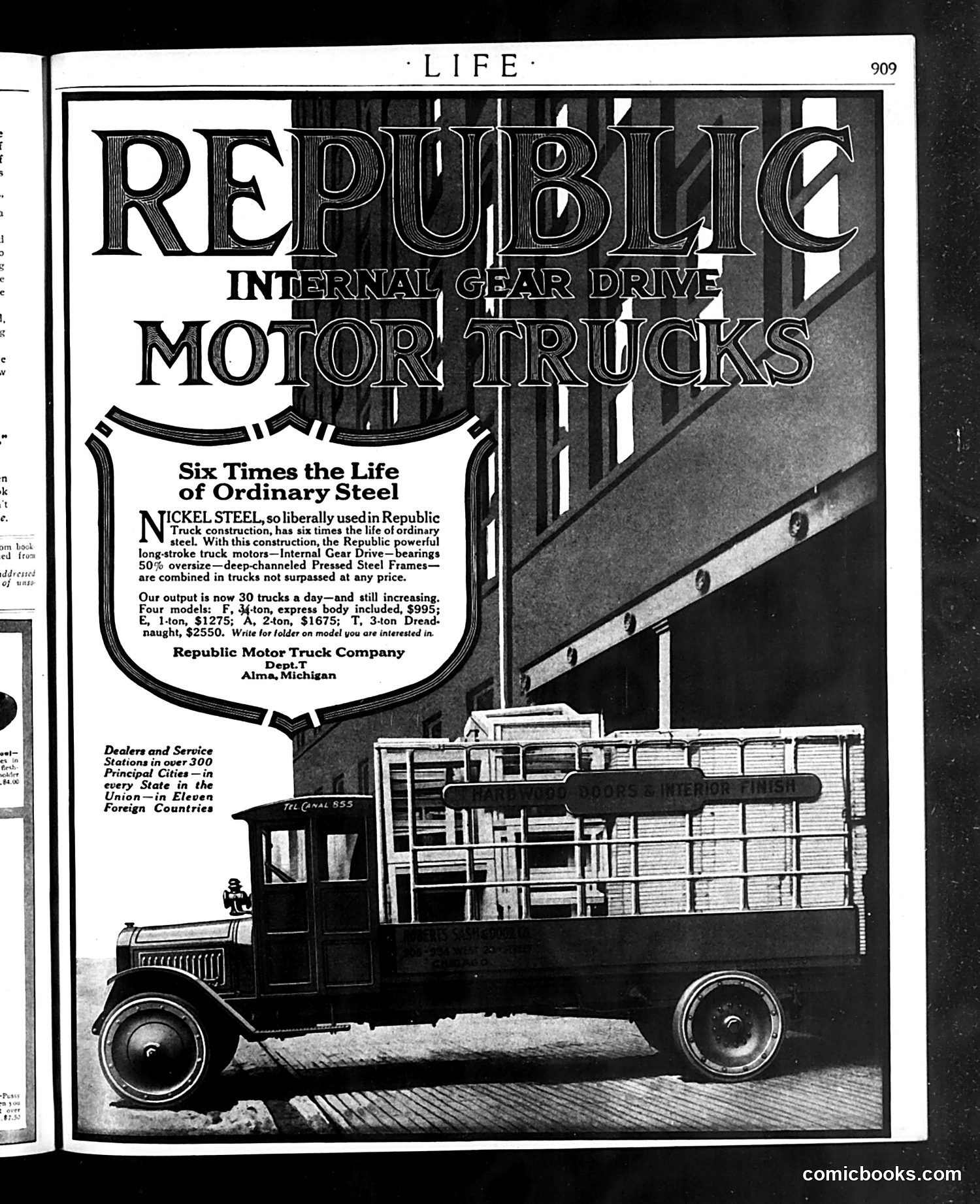
This is a **commercial advertisement**, not political satire. The page features a full-page ad for Republic Motor Trucks, a manufacturer based in Alma, Michigan. The ad highlights the company's durability claims: their trucks use nickel steel with "six times the life of ordinary steel" and feature internal gear drives with oversized bearings and pressed steel frames. The large illustration shows a working truck loaded with cargo, emphasizing industrial utility. The text lists four truck models (F, E, A, and T) with prices ranging from $895 to $2,550, and boasts a dealer network across 300+ American cities plus eleven foreign countries. This represents typical early-20th-century industrial advertising in *Life* magazine—straightforward product promotion aimed at commercial buyers rather than satire or political commentary.
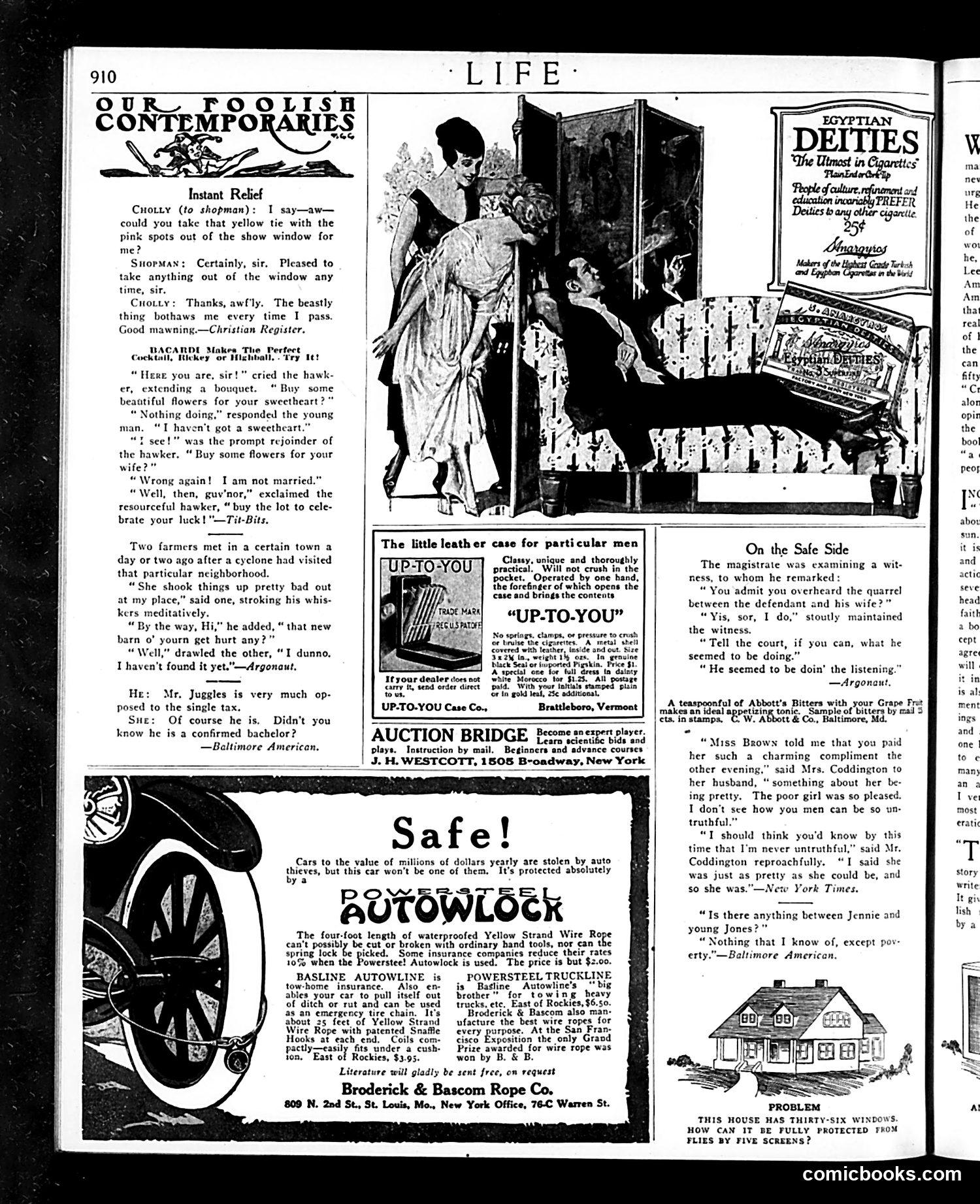
This page from *Life* magazine consists primarily of **humorous anecdotes and advertisements** rather than political cartoons. ## The Humor The jokes satirize **social pretense and marital dynamics** common to the era: - A customer finds a tie so ugly it offends him in a shop window - A street flower vendor persists absurdly, offering flowers to celebrate a bachelor's "luck" when he admits he's unmarried - Married couples trade barbs about compliments and truthfulness - A witness in court admits to merely "listenin'" during a quarrel These reflect **Edwardian-era social comedy**—poking fun at class-conscious shopkeepers, pushy street vendors, bachelor pretense, and marital friction. ## The Advertisements The page is dominated by product ads: leather cases ("UP-TO-YOU"), automobile locks (Autowlock), wire rope (Broderick & Bascom), and auction bridge instruction—typical early 20th-century consumer goods marketed to middle-class readers. The single substantial illustration shows a **well-dressed woman with a man**, likely accompanying one of the domestic humor pieces about marriage and courtship.
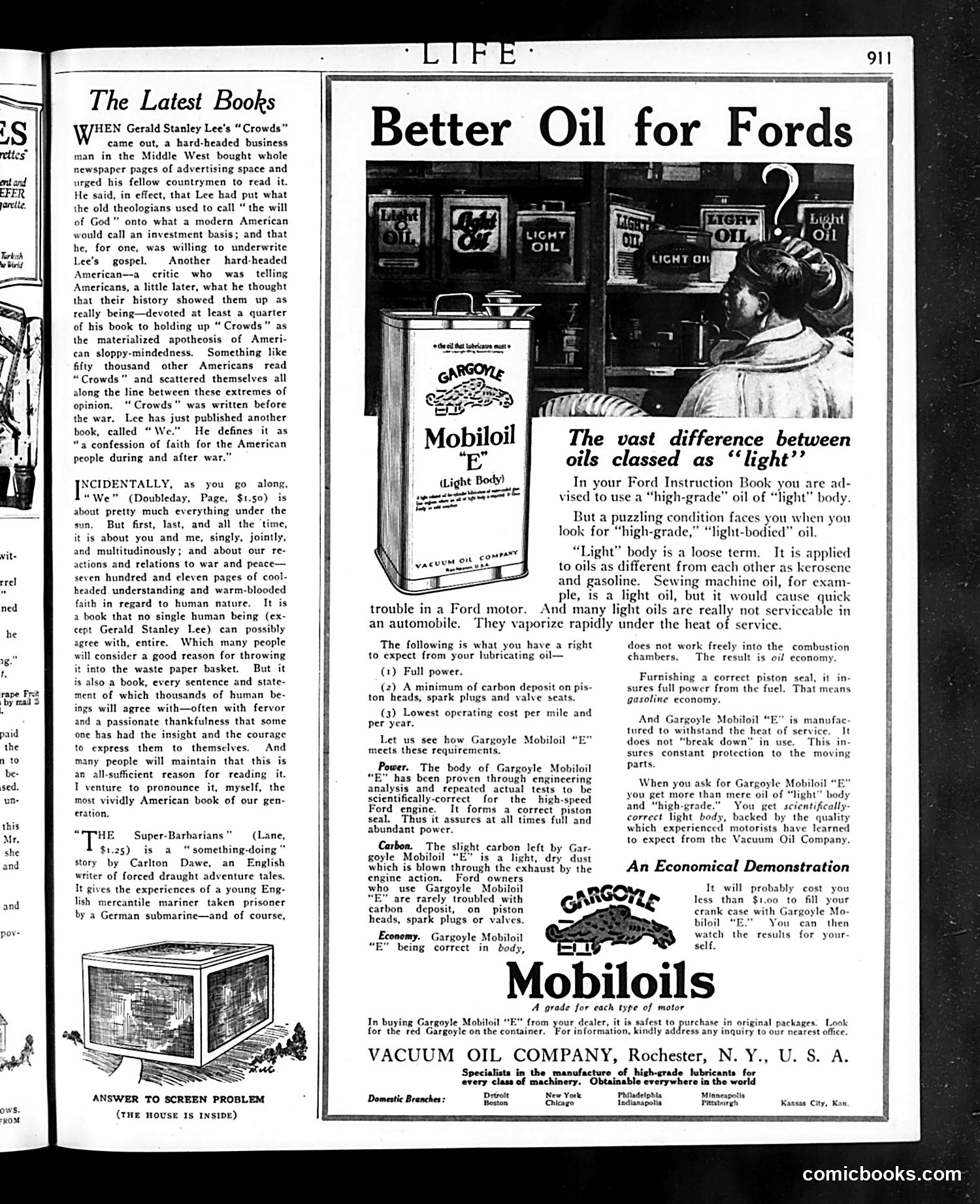
This page contains two distinct sections: a book review and a full-page advertisement. **Book Review Section (Left):** Reviews Gerald Stanley Lee's book "We," described as a 711-page meditation on American character, individual identity, and war/peace. The reviewer notes the book is intentionally comprehensive and contradictory—designed so readers across the political spectrum will find passages to agree with passionately. It's positioned as quintessentially American despite (or because of) its lack of singular coherent argument. **Advertisement Section (Right):** A Vacuum Oil Company ad for Gargoyle Mobiloil "E" motor oil targeted at Ford owners. The ad addresses consumer confusion about "light-grade" oil specifications, explaining that "light" is vague—kerosene is light but would damage Ford engines. The advertisement uses technical language about piston seals, carbon deposits, and heat resistance to position Gargoyle as the scientifically correct choice for Ford automobiles. This reflects early automotive marketing's emphasis on technical credibility during the standardization era of American car manufacturing.
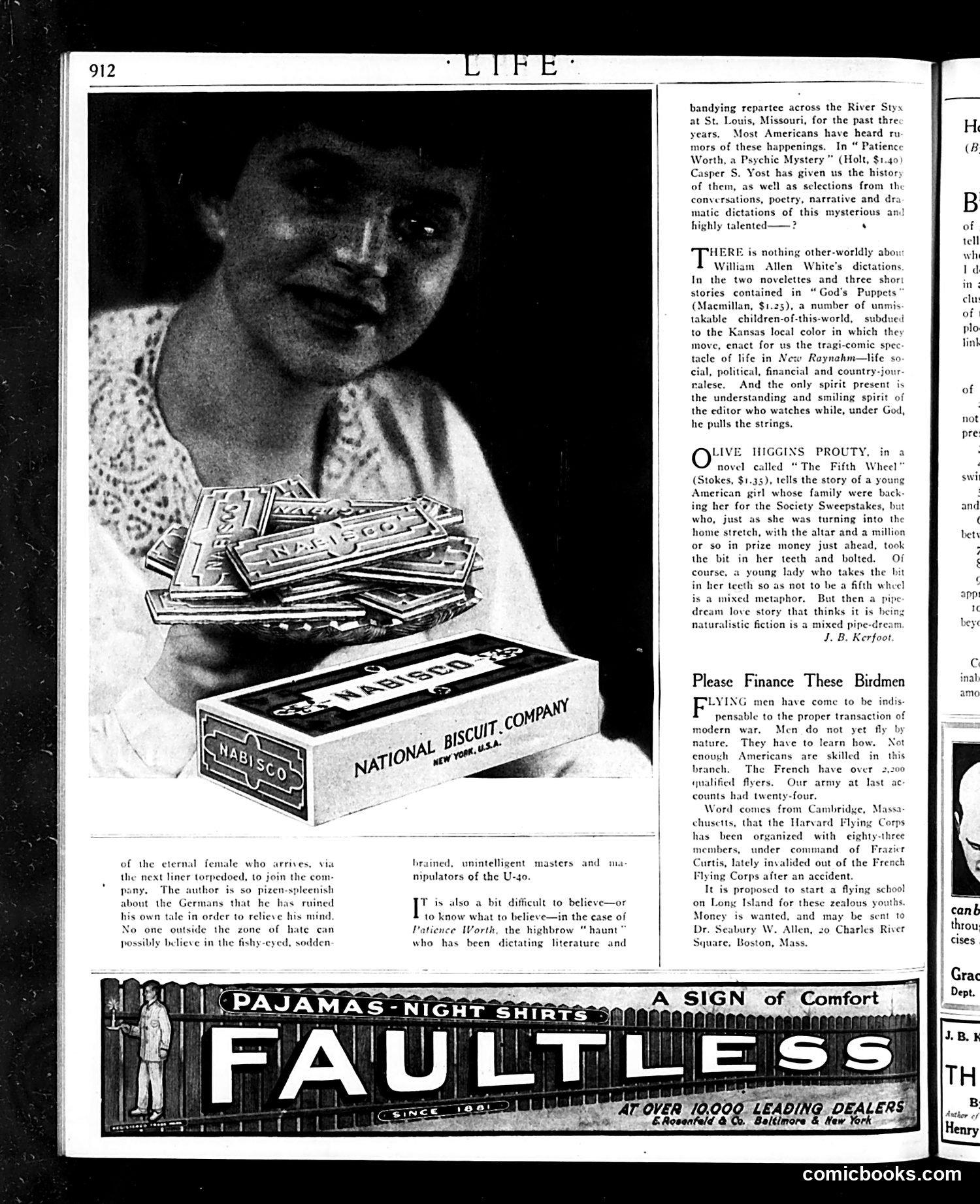
This page features literary reviews and a public service appeal disguised as editorial content. **The Main Image:** Shows a woman holding stacks of cards labeled "NABISCO" biscuits—this illustrates a book review (likely advertising-adjacent content) about a publication. **Book Reviews** discuss works by William Allen White and Olive Higgins Prouty, critiquing their literary merit and social commentary about American life. **"Please Finance These Birdmen"** is the substantive editorial piece: During WWI, the U.S. faced a critical shortage of trained military pilots compared to European powers (France had over 2,000 qualified flyers; America had 24). The editorial advocates establishing a flight training school on Long Island and solicits donations from readers to fund it, providing a contact address in Boston. This represents civilian mobilization for military preparedness during America's WWI involvement. The page reflects early-20th-century Life's mix of literary criticism, consumer advertising, and patriotic advocacy.
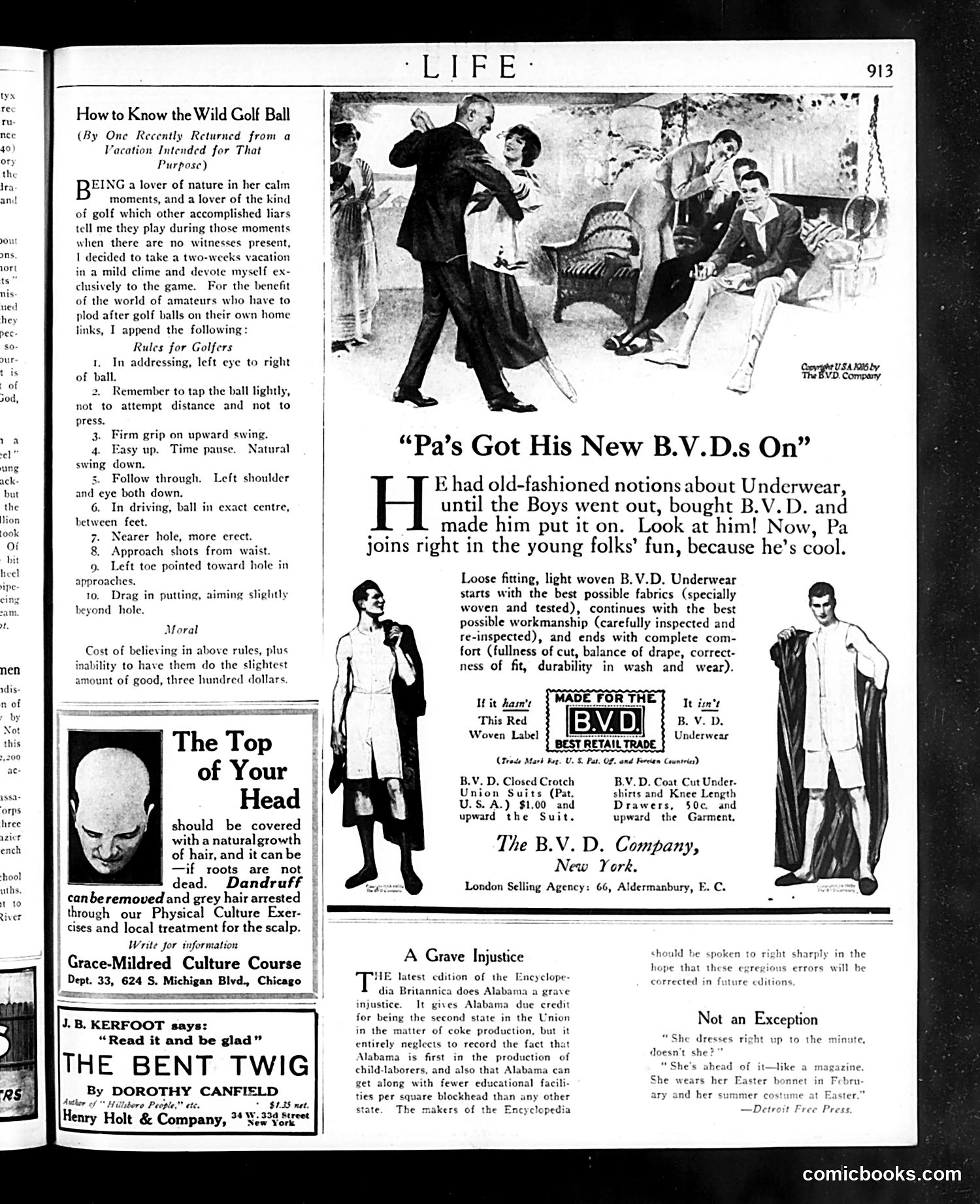
This page contains three distinct sections: **Golf Humor Column**: A satirical piece mocking amateur golfers who claim prowess but struggle in reality. The author humorously lists "rules" for golf, then reveals the actual cost is "three hundred dollars"—the moral being that believing such rules while lacking skill is expensive folly. It's self-deprecating humor about vacation golf. **B.V.D. Underwear Advertisement**: The main visual shows a father ("Pa") joining young people's fun after adopting modern B.V.D. brand underwear. The advertisement satirizes old-fashioned attitudes toward undergarments while promoting the product as making one "cool" and youthful—a common marketing approach of the era. **Three Short Pieces**: "The Top of Your Head" (hair/dandruff treatment ad), "A Grave Injustice" (criticizing an encyclopedia for omitting Alabama's child labor record while crediting it for coke production), and "Not an Exception" (a brief social commentary about women's fashion). The page is primarily advertising-driven with satirical editorial content interspersed—typical of Life magazine's format during this period.
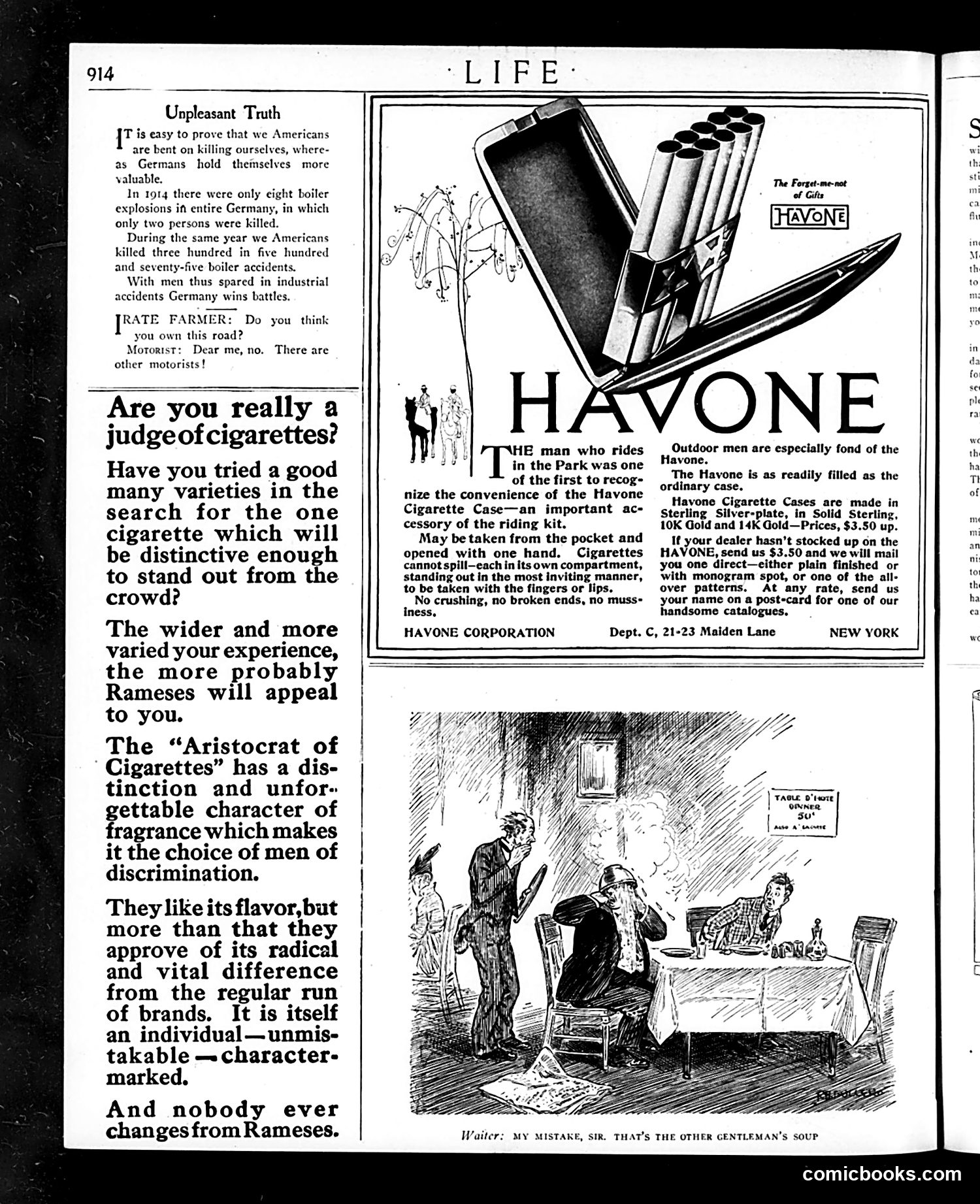
This page mixes editorial commentary with advertisements, typical of early-20th-century Life magazine. **"Unpleasant Truth" essay**: Compares American and German industrial safety records, arguing Germans are more careful with workers' lives. This appears written during or shortly after WWI, using casualty statistics to critique American carelessness—an ironic argument given Germany's military aggression. **"Irate Farmer" joke**: Satirizes motorists' aggressive road behavior, treating roads as personal property. **Bottom cartoon**: A waiter serves soup to the wrong diner—a simple slapstick joke about restaurant mishaps. **Advertisements**: Rameses cigarettes and Havone cigarette cases—luxury products marketed to affluent men. The Havone ad emphasizes convenience for "outdoor men" and wealthy buyers (sterling silver, gold cases). The page reflects the era's consumer culture and pre-automobile etiquette tensions, alongside WWI-era commentary.
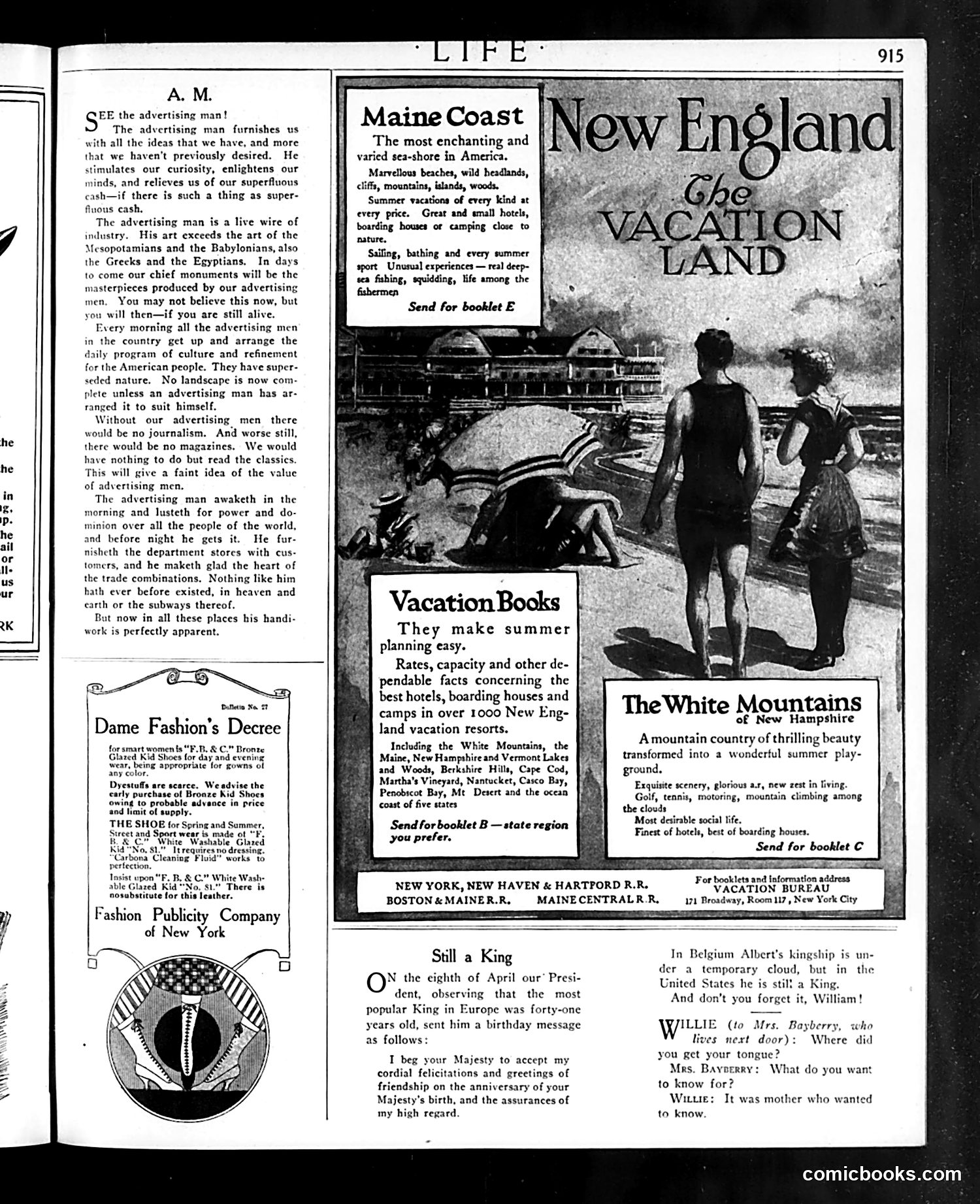
This page combines satirical editorial content with period advertising. **The Main Satire ("A.M." - "See the advertising man!"):** A mock-serious essay praising advertising men as civilization's greatest achievement, surpassing ancient Mesopotamians and Greeks. The satire is heavy-handed: advertising men control public taste, arrange "the daily program of culture and refinement," and their work is now "perfectly apparent" everywhere. The point is clear—this is ironic criticism of advertising's invasive, manipulative power over American life and commerce. The writer suggests Americans have surrendered their judgment to commercial interests. **Supporting Content:** Fashion advertising for "F.R. & C." shoes, and multiple railroad/resort vacation advertisements promoting New England destinations (Maine Coast, White Mountains). These ads ironically prove the satire's point about advertising saturation. **"Still a King":** A brief humorous piece about the President sending birthday greetings to a European king, treating him as superior—likely social commentary on American deference to monarchy.
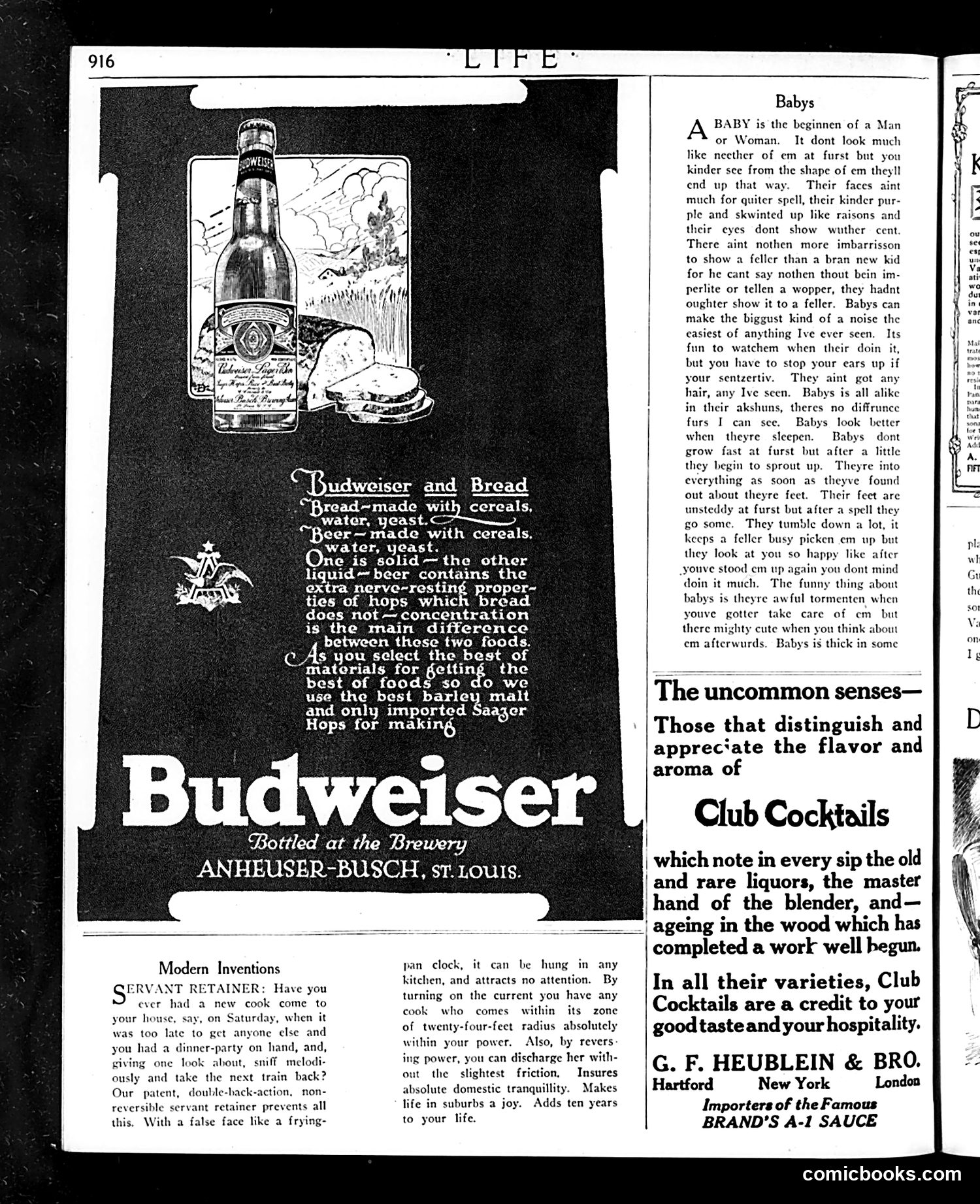
This page combines advertisements with humorous content typical of early 20th-century Life magazine. **Main Content:** A lengthy, colloquial essay on "Babys" written in deliberately misspelled, vernacular dialect (characteristic of Life's satirical style). The piece presents absurdist observations about infants—their appearance, noise-making, development, and emotional effect on caregivers. The humor relies on folksy understatement and the contrast between the subject's apparent simplicity and the essay's overwrought treatment. **Advertisements:** The page features three ads: Budweiser beer (comparing bread and beer's ingredients), Club Cocktails (emphasizing quality and aging), and a "Modern Inventions" satirical piece advertising a fictional "Servant Retainer"—a device to prevent kitchen staff from quitting, presented deadpan as practical domestic technology. **Context:** This reflects Life's dual role as satirical magazine and advertising vehicle. The dialect humor and mock-serious tone typified American humor of this era.
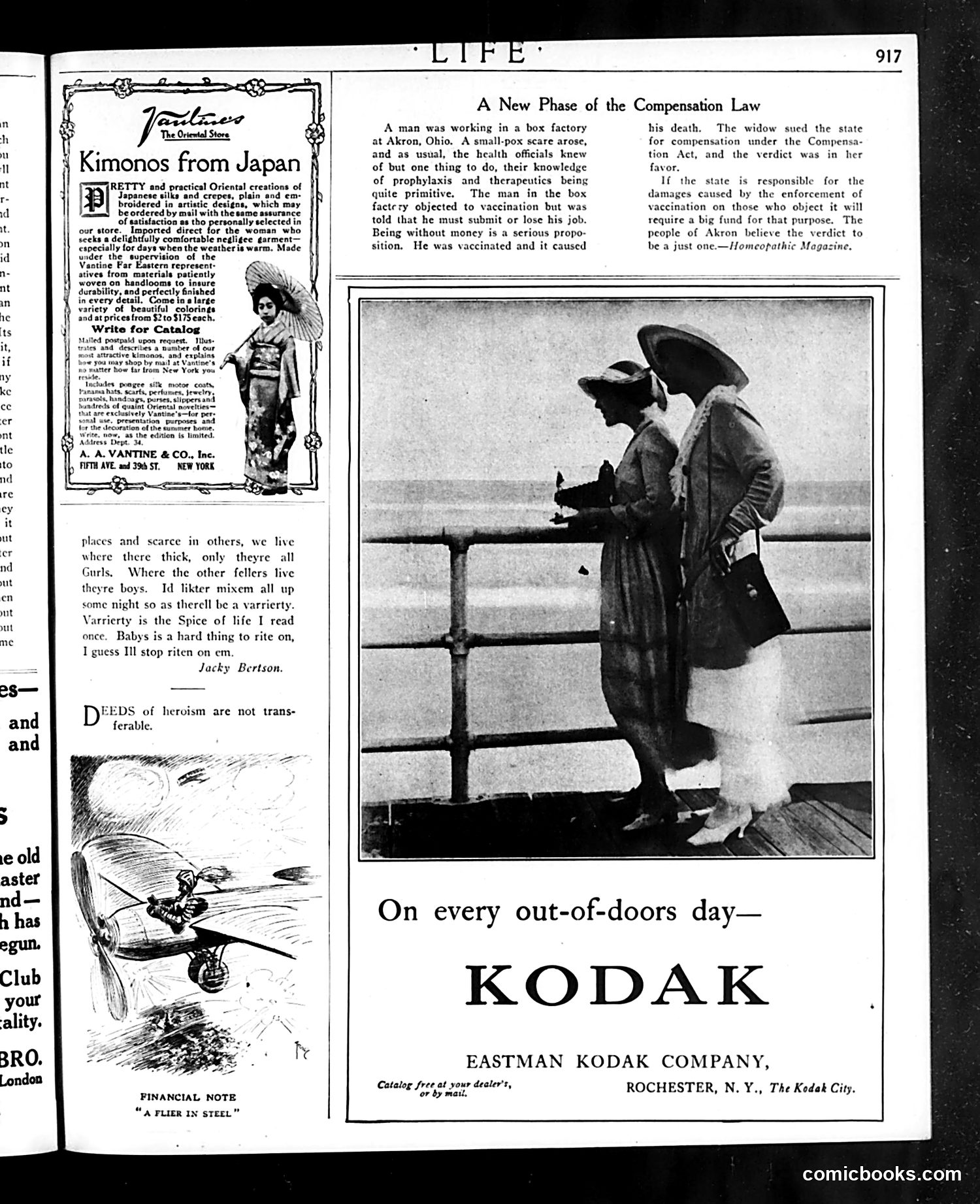
This Life magazine page (917) contains primarily **advertisements** rather than political satire. **Left side:** An ad for A. A. Vantine & Co. selling Japanese kimonos and Oriental goods, with decorative imagery of a woman in traditional Japanese dress. Below is a brief humorous piece by "Jacky Bertson" about wanting variety in life (babies being hard to write about). **Center:** A serious article titled "A New Phase of the Compensation Law" describing an actual legal case: a factory worker in Akron, Ohio died from a mandatory smallpox vaccination he opposed. His widow won a state compensation suit. The article questions whether the state will face large financial liability if forced vaccination causing death becomes compensable—suggesting this case may have significant legal implications. **Right side:** A Kodak camera advertisement showing a woman photographing outdoors, with the slogan "On every out-of-doors day—KODAK." The page mixes commercial advertising with a contemporaneous legal controversy regarding vaccination mandates and workers' rights, reflecting early 20th-century American public health debates.
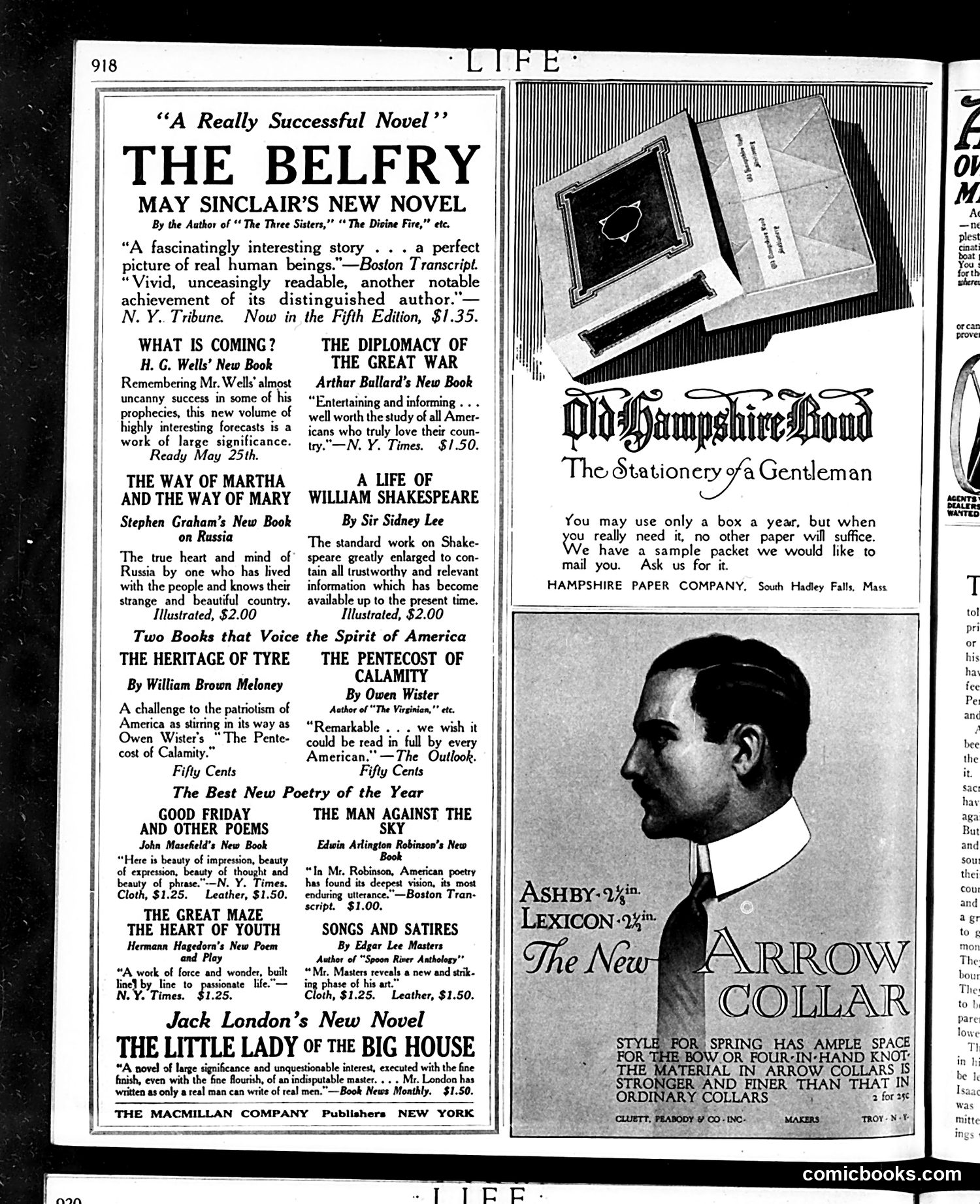
This page is primarily **advertising and book promotions**, not political satire. It features: **Left column:** Publishers' advertisements for new books by major authors of the era—H.G. Wells, Stephen Graham, William Brown Meloney, John Masefield, Jack London, and others. These promote recently published novels and poetry collections with brief critical quotes. **Right column:** Two commercial advertisements: 1. **Hampshire Hood stationery** — promoting quality writing paper for gentlemen 2. **Arrow Collar** — advertising "The New Arrow Collar" with an illustration of a well-dressed man in profile, emphasizing that their collars are "stronger and finer than ordinary collars" and cost 25 cents There is **no political cartoon or satire** on this page. It reflects early 20th-century consumer culture and the literary marketplace, showing what educated Americans were reading and purchasing during this period.
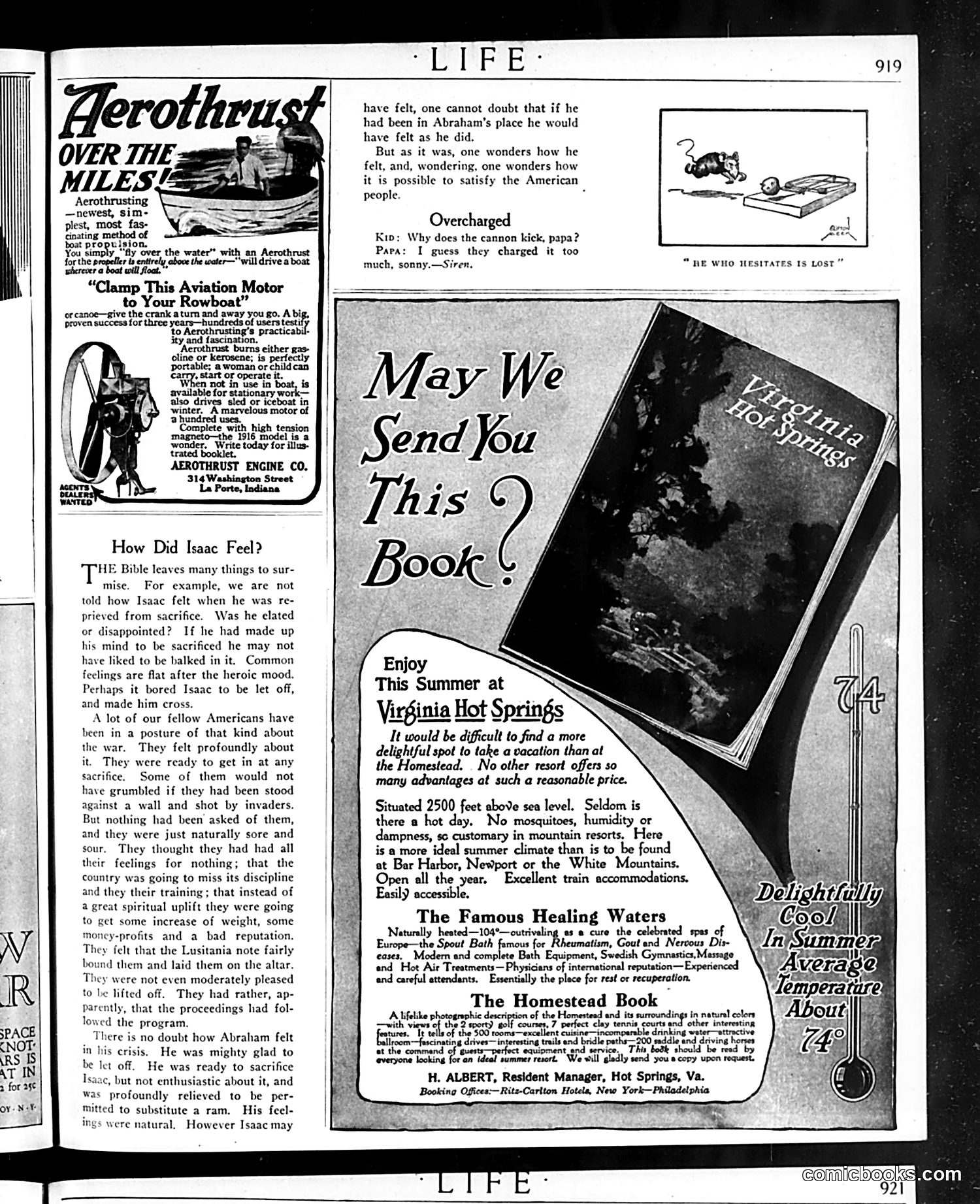
This page contains several distinct elements: **Main Article: "How Did Isaac Feel?"** A satirical essay using the Biblical story of Abraham's near-sacrifice of Isaac as an analogy for American attitudes toward World War I. The author argues that Americans who felt ready to sacrifice for the war effort became frustrated and resentful when the country didn't demand their sacrifice. The comparison suggests these citizens, like Isaac, were disappointed to be "let off" without the heroic experience they anticipated. It's social criticism of American ambivalence about the war. **Small Comic: "Overcharged"** A brief joke about a cannon "kicking" (recoiling) because it was "charged" too much—a pun on military terminology. **Advertisements:** The page is dominated by ads for the Aerothrust motor and Virginia Hot Springs resort—typical early-20th-century leisure and technology marketing. The Isaac essay represents Life's satirical commentary on American psychology regarding wartime sacrifice and national commitment.
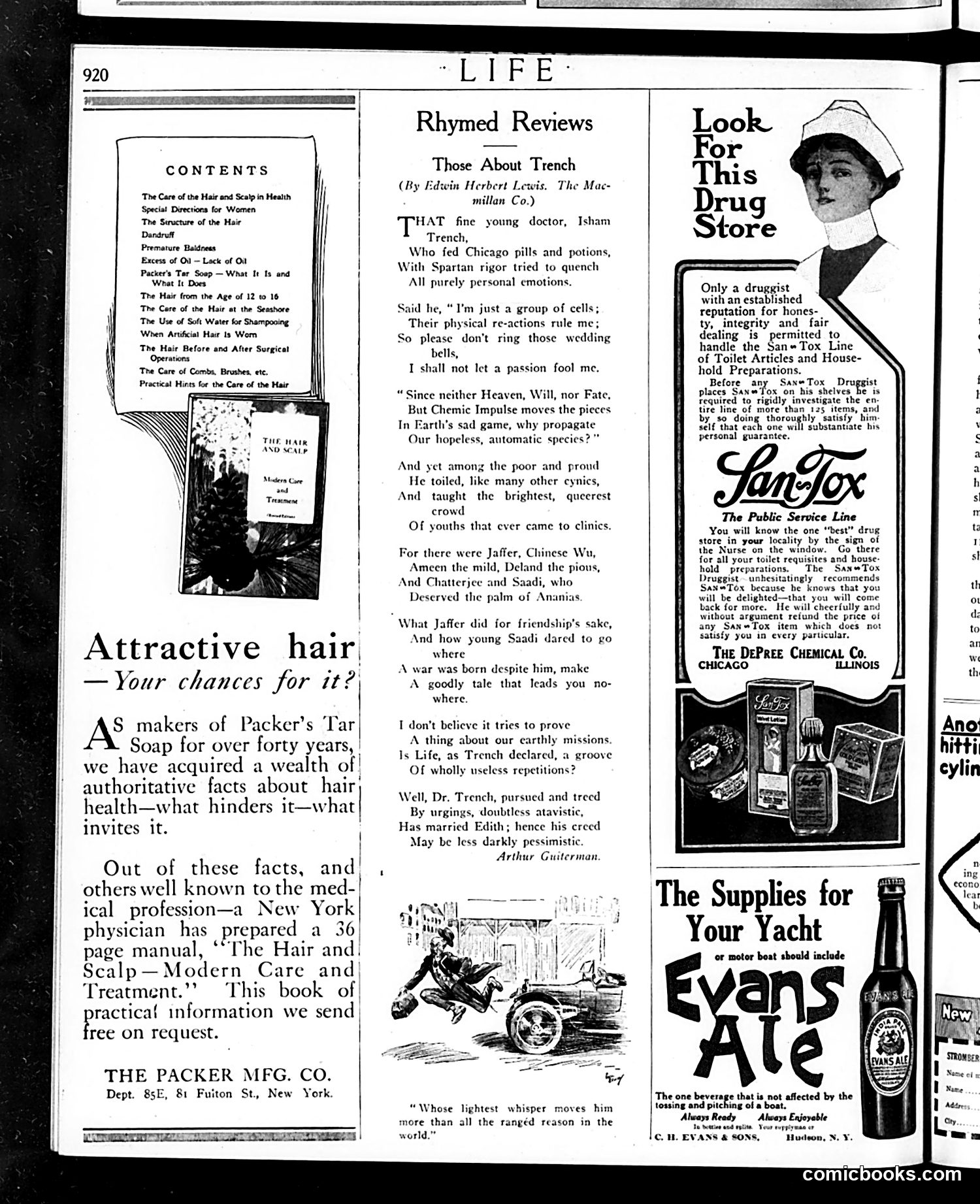
This page is primarily **advertising and editorial content** rather than political satire. The main elements include: 1. **"Attractive Hair" Advertisement** (left): Packer's Tar Soap promotes a 36-page manual on hair care, positioning the product as scientifically authoritative for hair health. 2. **"Rhymed Reviews" (center)**: A poem by Arthur Guiterman reviewing a novel called *Those About Trench* by Edwin Herbert Lewis. The verse summarizes a story about Dr. Isham Trench, a cynical Chicago physician who adopts a mechanistic, deterministic philosophy (dismissing free will and human connection as mere chemical impulses). The satire gentle mocks his extreme pessimism—until he falls in love and marries, undermining his own bleak philosophy. 3. **Three Product Advertisements** (right): San*Tox toiletries, Evans Ale, and yacht supplies—typical early-20th-century magazine advertising. There is **no political cartoon** on this page. The only visual humor is the book review's ironic plot about a cynic undone by romance.
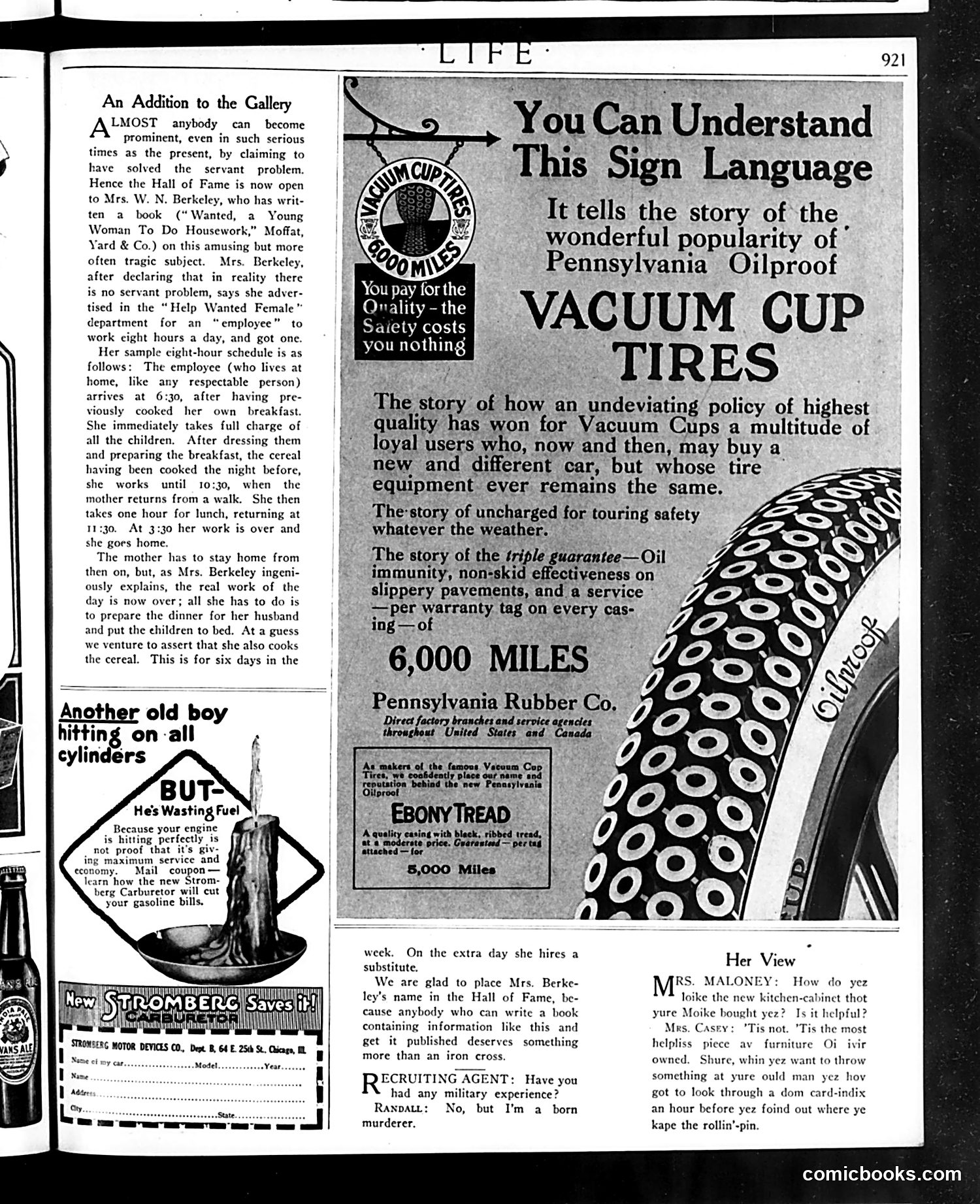
This page contains satirical commentary on domestic labor and gender roles in early 20th-century America. **"An Addition to the Gallery"** mocks Mrs. W.N. Berkeley's book claiming to have "solved the servant problem." The satire exposes the absurdity of her proposed 8-hour workday schedule: a live-in maid arrives at 6:30 after cooking her own breakfast, manages all household tasks until 10:30, takes one lunch hour, then works again until 3:30—six days weekly. Life sarcastically notes the employer still must prepare dinner and put children to bed, suggesting Berkeley merely shifted rather than solved the problem. The piece critiques both the servant shortage (a real postwar labor issue) and the delusional thinking of wealthy employers about domestic work. **"Her View"** offers working-class Irish perspective: Mrs. Casey finds her new kitchen cabinet unhelpful because she can't easily grab a rolling pin to throw at her husband—a darkly humorous comment on domestic conflict. The advertisements for tires and carburetors are period commercial content, unrelated to the satire.
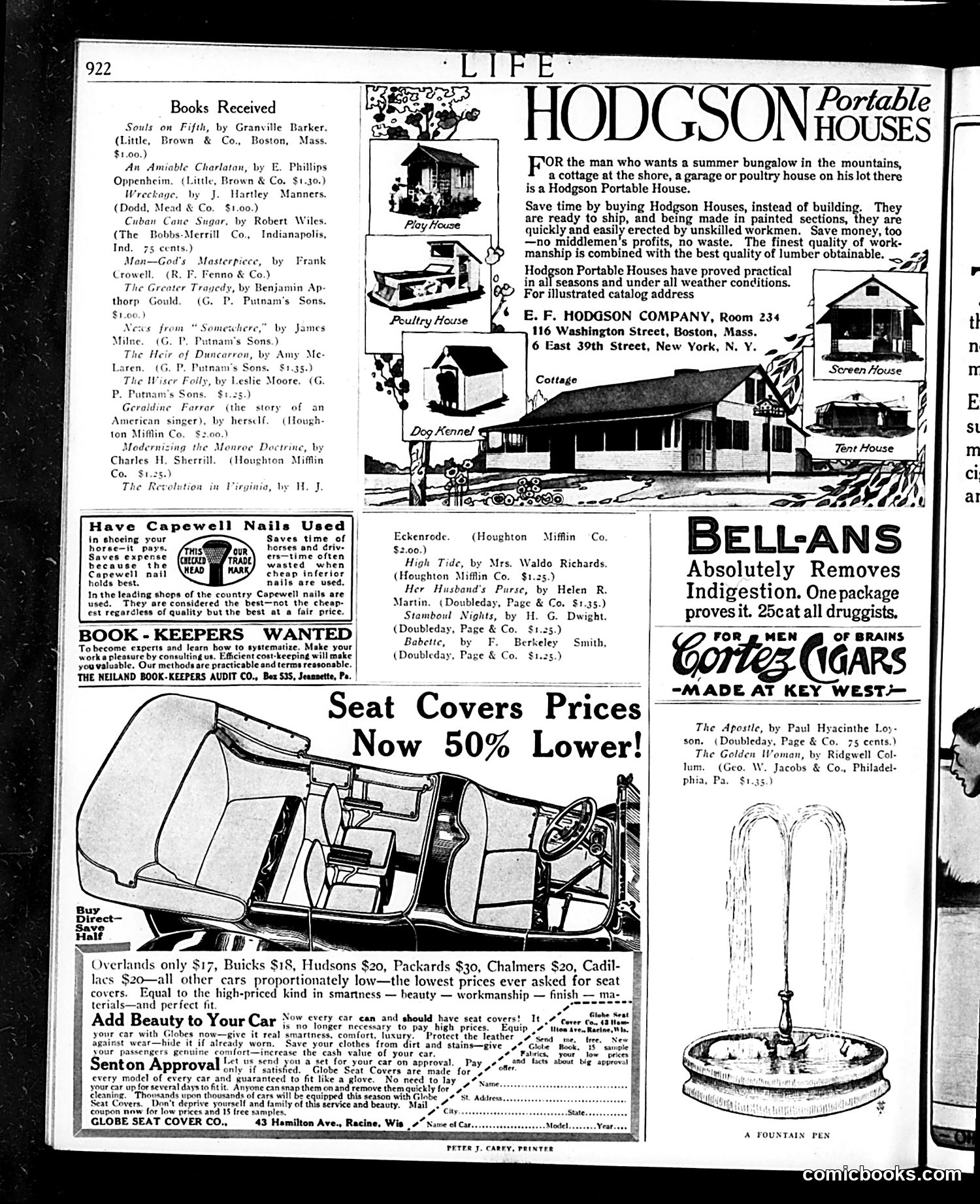
This page is primarily **advertising and book reviews**, not political satire or editorial cartoons. There is no political cartoon present. The content consists of: 1. **Book Reviews** section listing recent publications with titles, authors, and publishers—standard literary coverage for the era. 2. **Multiple advertisements** for consumer products: - Hodgson Portable Houses (prefabricated homes) - Capewell Nails - Bell-Ans indigestion remedy - Oporto cigars - Globe brand automobile seat covers The largest ad features a detailed illustration of car interior seat covers and their installation, emphasizing affordability ("50% Lower!") and protection of vehicle upholstery. Another ad recruits bookkeepers using systematic cost-keeping methods. The page reflects early 20th-century consumer culture, targeting middle-class readers with practical home, automotive, and health products. There is no satirical or political commentary—it is a standard magazine page mixing editorial and commercial content.
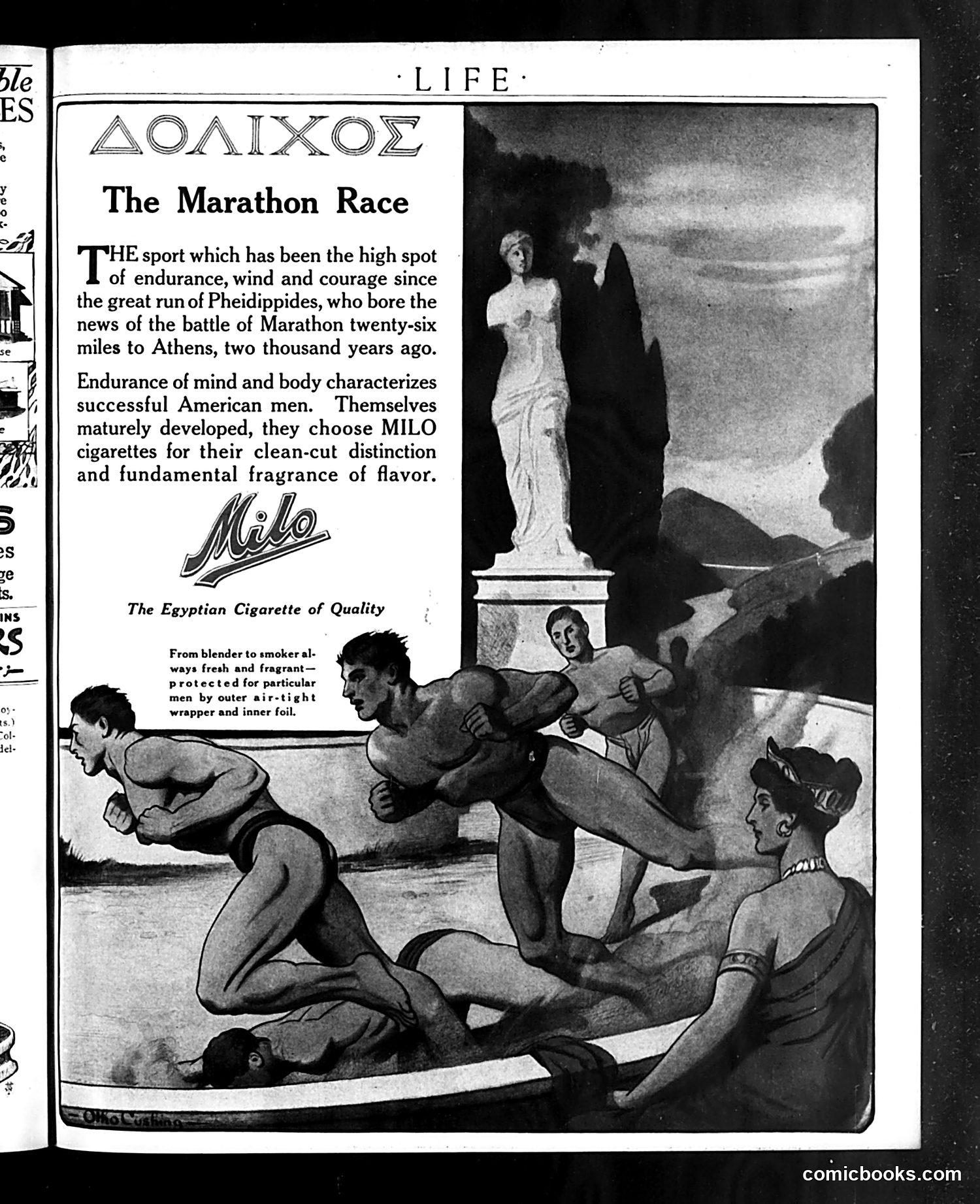
This is a **cigarette advertisement**, not satire. It uses the ancient Greek Marathon legend to market Milo cigarettes to American men. The ad draws a parallel: just as Pheidippides ran 26 miles to announce victory at Marathon, "successful American men" demonstrate endurance and courage—and therefore naturally choose Milo cigarettes for their "clean-cut distinction." The illustration shows classical Greek athletes in various stages of running/exhaustion near a statue, establishing an aspirational connection between athletic vigor and cigarette smoking. **Key context for modern readers:** This reflects an era (pre-1960s) when cigarette advertising could make explicit health/vigor claims and directly target masculine identity. The "air-tight wrapper" detail attempts to suggest freshness and protection, typical of mid-century cigarette marketing before the Surgeon General's warnings.
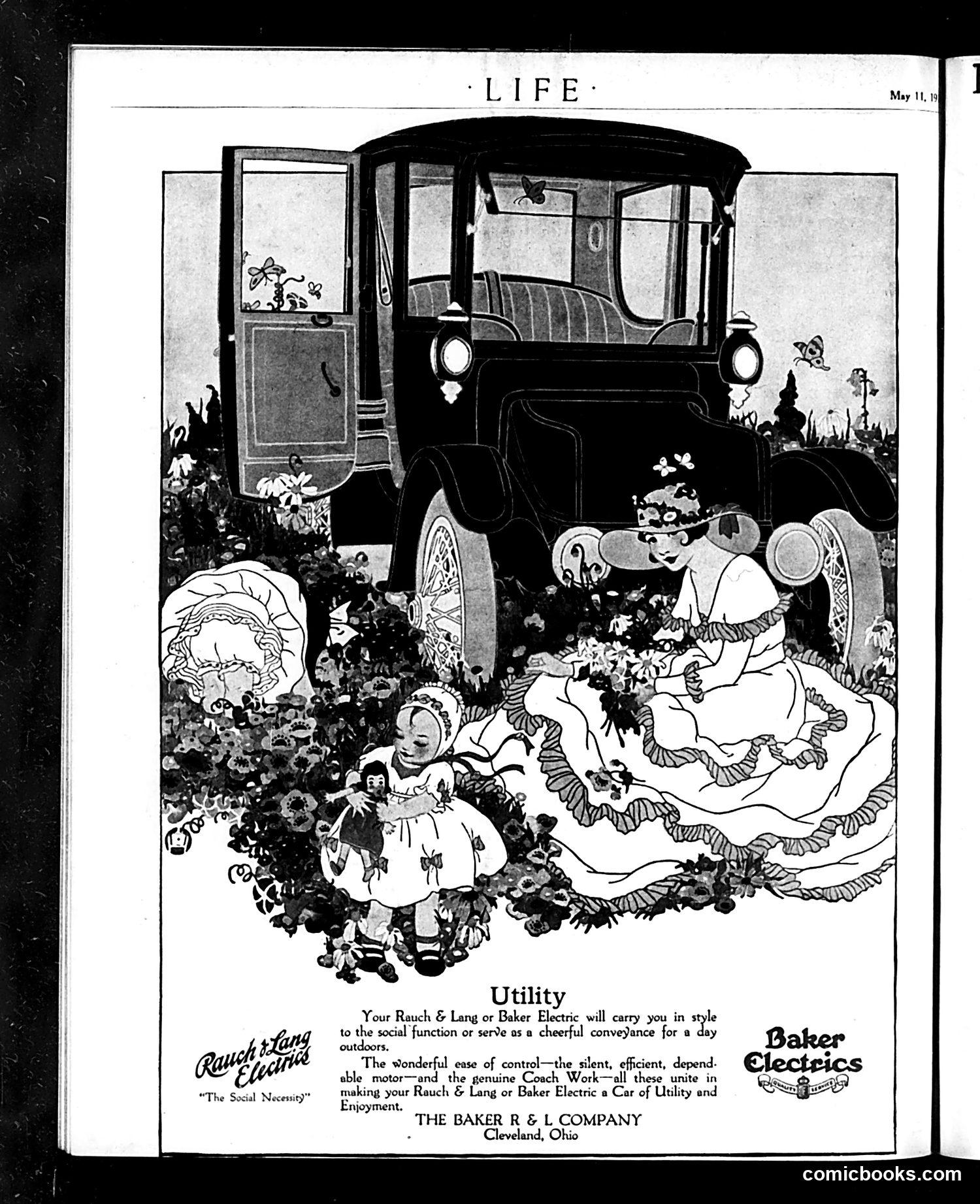
This is primarily an **advertisement**, not political satire. It promotes Baker Electric and Rauch & Lang automobiles to wealthy women circa 1910s. The illustration depicts ladies in elaborate bonnets and flowing dresses gathered around an electric vehicle, with flowers and garden imagery. The advertising copy emphasizes that electric cars offer: - **Stylish transportation** to social events - **Easy control** and silent operation - **Utility and enjoyment** for day trips The satire, if present, is gentle: the image humorously shows women as the primary consumers of electric vehicles, suggesting these cars suit leisurely social outings rather than serious driving—a gendered marketing approach. The title "The Social Necessity" playfully frames automobiles as essential for maintaining one's social calendar. The date (May 11, visible at top) and publisher information confirm this is genuine vintage *Life* magazine advertising, targeting affluent female readers interested in convenient, quiet personal transportation.