
Life, 1916-05-11 · page 26 of 48
Life — May 11, 1916 — page 26: what you’re looking at
What you’re looking at
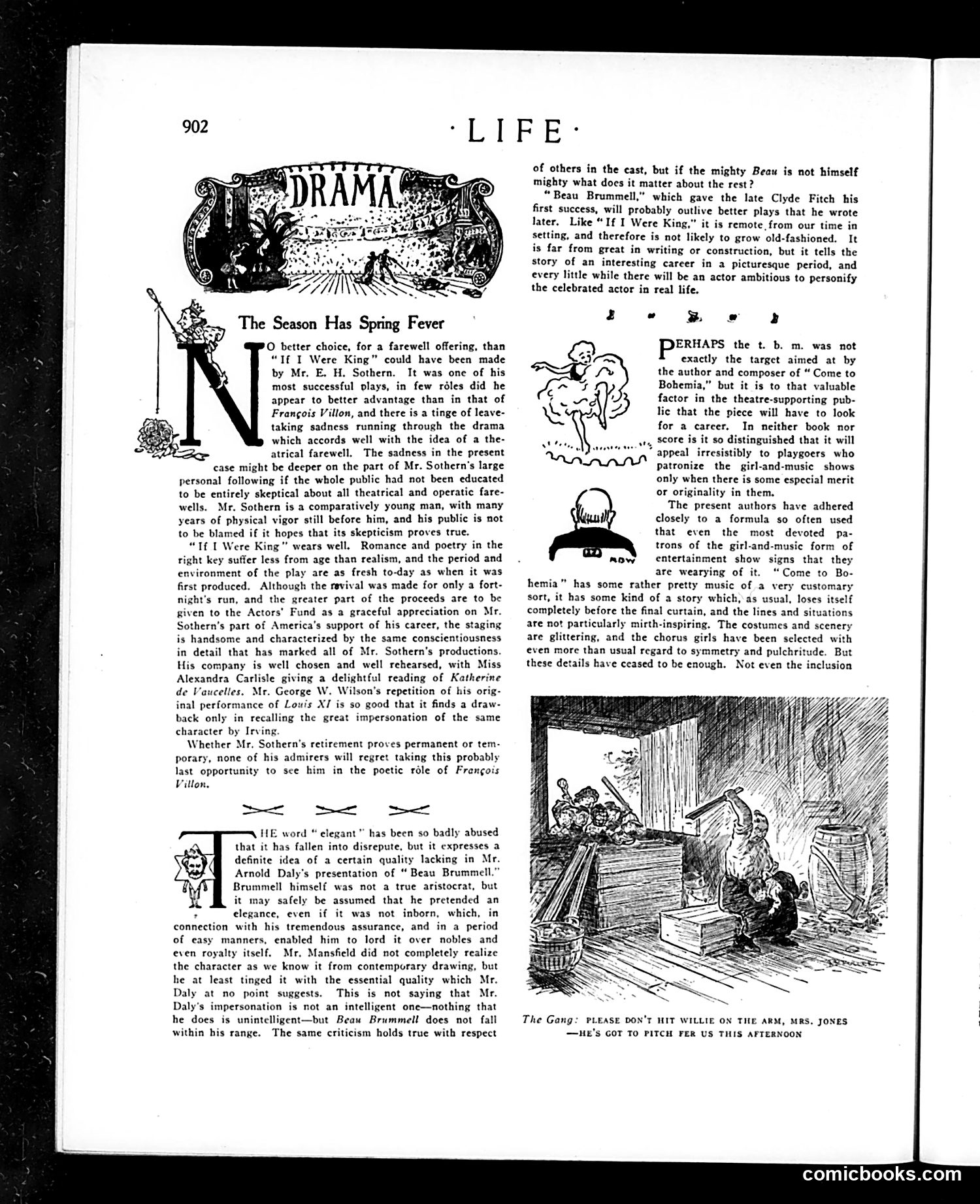
This page reviews theatrical productions from the early 1900s. The main drama section discusses actor E. H. Sothern's farewell performance in "If I Were King," praising the production's romanticism and period setting while noting skepticism about theatrical "retirements" (actors often returned). The lower section critiques Arnold Daly's performance as "Beau Brummell," arguing he lacks the essential quality of "elegance" that defined the historical figure—Brummell's pretended aristocratic refinement and assurance. The critic suggests Daly's intelligent acting simply doesn't suit this particular character, contrasting him unfavorably with an earlier portrayal by (likely) Richard Mansfield. The cartoon at bottom (captioned "The Gang") appears to be unrelated theatrical humor, showing characters in what seems a comedic situation. The satire targets acting choices and character interpretation rather than political content—typical for Life magazine's drama criticism of this era.
📄 Transcribed text from this page (OCR, searchable)
Machine-transcribed from the original scan — historical spelling and the odd misread are preserved.
*LIFE° The Season Has Spring Fever O better choice, for a farewell offering, than “If I Were King” could have been made by Mr. E. H. Sothern. It was one of his most successful plays, in few réles did he appear to better advantage than in that of Frangois Villon, and there is a tinge of leave- taking sadness running through the drama which accords well with the idea of a the- atrical farewell, The sadness in the present case might be deeper on the part of Mr. Sothern’s large personal following if the whole public had not been educated to be entirely skeptical about all theatrical and operatic fare- wells. Mr. Sothern is a comparatively young man, with many years of physical vigor still before him, and his public is not to be blamed if it hopes that its skepticism proves true. “Tf | Were King” wears well. Romance and poetry in the right key suffer less from age than realism, and the period and environment of the play are as fresh to-day as when it was first produced. Although the revival was made for only a fort- night's run, and the greater part of the proceeds are to be given to the Actors’ Fund as a graceful appreciation on Mr. Sothern’s part of America’s support of his carcer, the staging is handsome and characterized by the same conscientiousness in detail that has marked all of Mr. Sothern’s productions. His company is well chosen and well rehearsed, with Miss Alexandra Carlisle giving a delightful reading of Katherine de Vaucelles. Mr. George W. Wilson's repetition of his orig- inal performance of Lowis X/ is so good that it finds a draw- back only in recalling the great impersonation of the same character by Irving. Whether Mr. Sothern’s retirement proves permanent or tem- porary, none of his admirers will regret taking this probably last opportunity to see him in the poetic rile of Francois Villon, >= UC OST i = HE word “ elegant” has been so badly abused that it has fallen into disrepute, but it expresses a definite idea of a certain quality lacking in Mr. Arnold Daly's presentation of “ Beau Brummell. Brummell himself was not a true aristocrat, but it may safely be assumed that he pretended an elegance, even if it was not inborn, which, in connection with his tremendous assurance, and in a period of easy manners, enabled him to lord it over nobles and even royalty itself. Mr. Mansfield did not completely realize the character as we know it from contemporary drawing, but he at least tinged it with the essential quality which Mr. Daly at no point suggests. This is not saying that Mr. Daly's impersonation is not an intelligent one—nothing that he does is unintelligent—but Beau Brummell does not fall within his range. The same criticism holds true with respect of others in the cast, but if the mighty Beau is not himself mighty what does it matter about the rest? “Beau Brummell,” which gave the late Clyde Fitch his first success, will probably outlive better plays that he wrote later, Like “If I Were King,” it is remote,from our time in setting, and therefore is not likely to grow old-fashioned. It is far from great in writing or construction, but it tells the Story of an interesting career in a picturesque period, and every little while there will be an actor ambitious to personify the celebrated actor in real life. ° ss 2 ERHAPS the t. b. m. was not exactly the target aimed at by the author and composer of “ Come to but it is to that valuable factor in the theatre-supporting pub- lic that the piece will have to look for a career, In neither book nor ., Score is it so distinguished that it will “ appeal irresistibly to playgoers who patronize the girl-and-music shows only when there is some especial merit The present authors have adhered closely to a formula so often used that even the most devoted pa- trons of the girl-and-music form of entertainment show signs that they are wearying of it. “Come to Bo- hemia” has some rather pretty music of a very customary sort, it has some kind of a story which, as usual, loses itself completely before the final curtain, and the lines and situations are not particularly mirth-inspiring. The costumes and scenery are glittering, and the chorus girls have been selected with even more than usual regard to symmetry and pulchritude. But these details have ceased to be enough. Not even the inclusion now The Gang: PLEASE DON'T HIT WILLIE ON THE ARM, MRS. JONES —HE's GOT TO PITCH FER US THIS AFTERNOON comicbooks.com RSS WS eS