
Life, 1916-05-11 · page 23 of 48
Life — May 11, 1916 — page 23: what you’re looking at
What you’re looking at
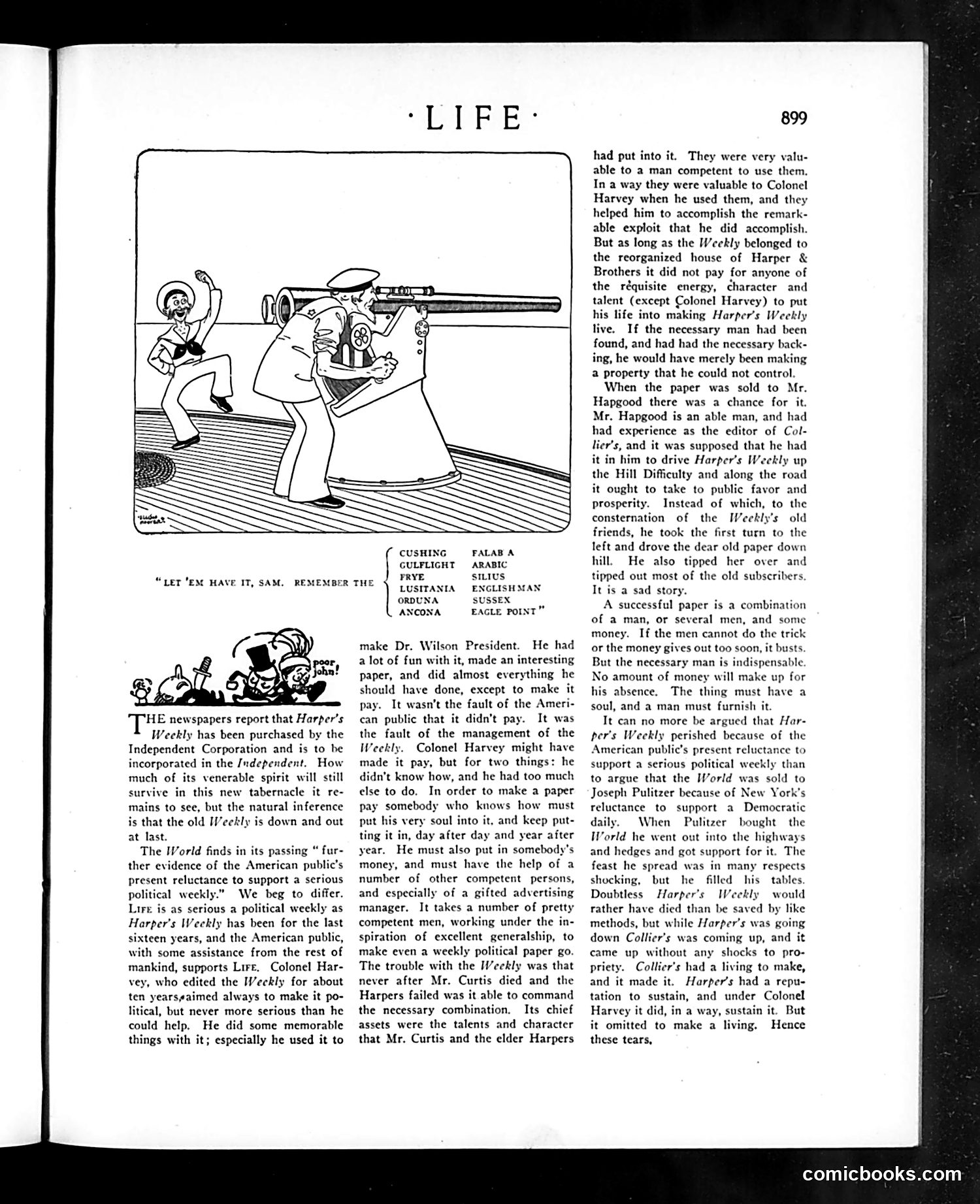
This is **Life magazine's editorial commentary** on Harper's Weekly's demise—not a cartoon but a serious political essay. **The Context:** Harper's Weekly, a venerable 19th-century publication, has been purchased and absorbed by the Independent Corporation. Life argues this represents not public disinterest in serious political weeklies, but rather **management failure**. **Key Arguments:** - Colonel Harvey edited it for ~10 years, making it interesting and even helping elect President Wilson, but couldn't make it financially viable - After Curtis died and the Harper brothers' company declined, no competent manager had the energy and authority to revitalize it - When sold to Hapgood (an editor from Collier's), he mismanaged it, losing subscribers and ultimately driving it "down hill" **The Satire's Point:** Life defends serious political journalism's viability—arguing that **Harper's Weekly failed not because Americans won't support such papers, but because incompetent leadership destroyed it**. The phrase "Let 'em have it, Sam" (accompanying a naval illustration) appears to emphasize the need for forceful, competent direction. This is essentially a postmortem defending political magazines' importance while critiquing specific editorial failures.
📄 Transcribed text from this page (OCR, searchable)
Machine-transcribed from the original scan — historical spelling and the odd misread are preserved.
“Ler "EM HAVE IT, SAM. THe newspapers report that Harper's Weekly has been purchased by the Independent Corporation and is to be incorporated in the /udependent. How much of its venerable spirit will still survive in this new tabernacle it re- mains to see, but the natural inference is that the old IWeekly is down and out at last. The HWorld finds in its passing “ fur- ther evidence of the American public's present reluctance to support a serious political weekly.” We beg to differ. Lirr is as serious a political weekly as Harper's Weekly has been for the last sixteen years, and the American public, with some assistance from the rest of mankind, supports Lire. Colonel Har- vey, who edited the Weekly for about ten yearseaimed always to make it po- litical, but never more serious than he could help, He did some memorable things with it; especially he used it to REMEMBER THE - | ee A s FALAB A ARABIC sILIus LISH MAN SEX EAGLE POINT” CULFLIGHT f CUSHING PRYE LUSITANIA make Dr. Wilson President. He had a lot of fun with it, made an interesting paper, and did almost everything he should have done, except to make it pay. It wasn’t the fault of the Ameri- can public that it didn’t pay. It was the fault of the management of the Weekly. Colonel Harvey might have made it pay, but for two things: he didn’t know how, and he had too much else to do, In order to make a paper pay somebody who knows how must put his very soul into it, and keep put- ting it in, day after day and year after year. He must also put in somebody's money, and must have the help of a number of other competent persons, and especially of a gifted advertising manager. It takes a number of pretty competent men, working under the in- spiration of excellent generalship, to make even a weekly political paper go. The trouble with the Weekly was that never after Mr. Curtis died and the Harpers failed was it able to command the necessary combination. Its chief assets were the talents and character that Mr. Curtis and the elder Harpers 899 had put into it. They were very valu- able to a man competent to use them. In a way they were valuable to Colonel Harvey when he used them, and they helped him to accomplish the remark- able exploit that he did accomplish. But as long as the Weekly belonged to the reorganized house of Harper & Brothers it did not pay for anyone of the réquisite energy, character and talent (except Colonel Harvey) to put his life into making Harper's Weekly live. If the necessary man had been found, and had had the necessary back- ing, he would have merely been making a property that he could not control. When the paper was sold to Mr. Hapgood there was a chance for it. Mr. Hapgood is an able man, and had had experience as the editor of Col- lier’s, and it was supposed that he had it in him to drive Harper's Weekly up the Hill Difficulty and along the road it ought to take to public favor and prosperity. Instead of which, to the consternation of the [Weekly's old friends, he took the first turn to the left and drove the dear old paper down hill. He also tipped her over and tipped out most of the old subscribers. It is a sad story. A successful paper is a combination of a man, or several men, and some money. If the men cannot do the trick or the money gives out too soon, it busts. But the necessary man is indispensable. No amount of money will make up for his absence. The thing must have a soul, and a man must furnish it. It can no more be argued that Har- per’s Weekly perished because of the American public's present reluctance to support a serious political weekly than to argue that the World was sold to Joseph Pulitzer because of New York's reluctance to support a Democratic daily. When Pulitzer bought the World he went out into the highways and hedges and got support for it. The feast he spread was in many respects shocking, but he filled his tables. Doubtless Harper's Weekly would rather have died than be saved by like methods, but while Harper's was going down Collier's was coming up, and it came up without any shocks to pro- priety. Collier's had a living to make, and it made it. Harper’s had a repu- tation to sustain, and under Colonel Harvey it did, in a way, sustain it. But it omitted to make a living. Hence these tears, comicbooks.com