
Life, 1916-05-11 · page 20 of 48
Life — May 11, 1916 — page 20: what you’re looking at
What you’re looking at
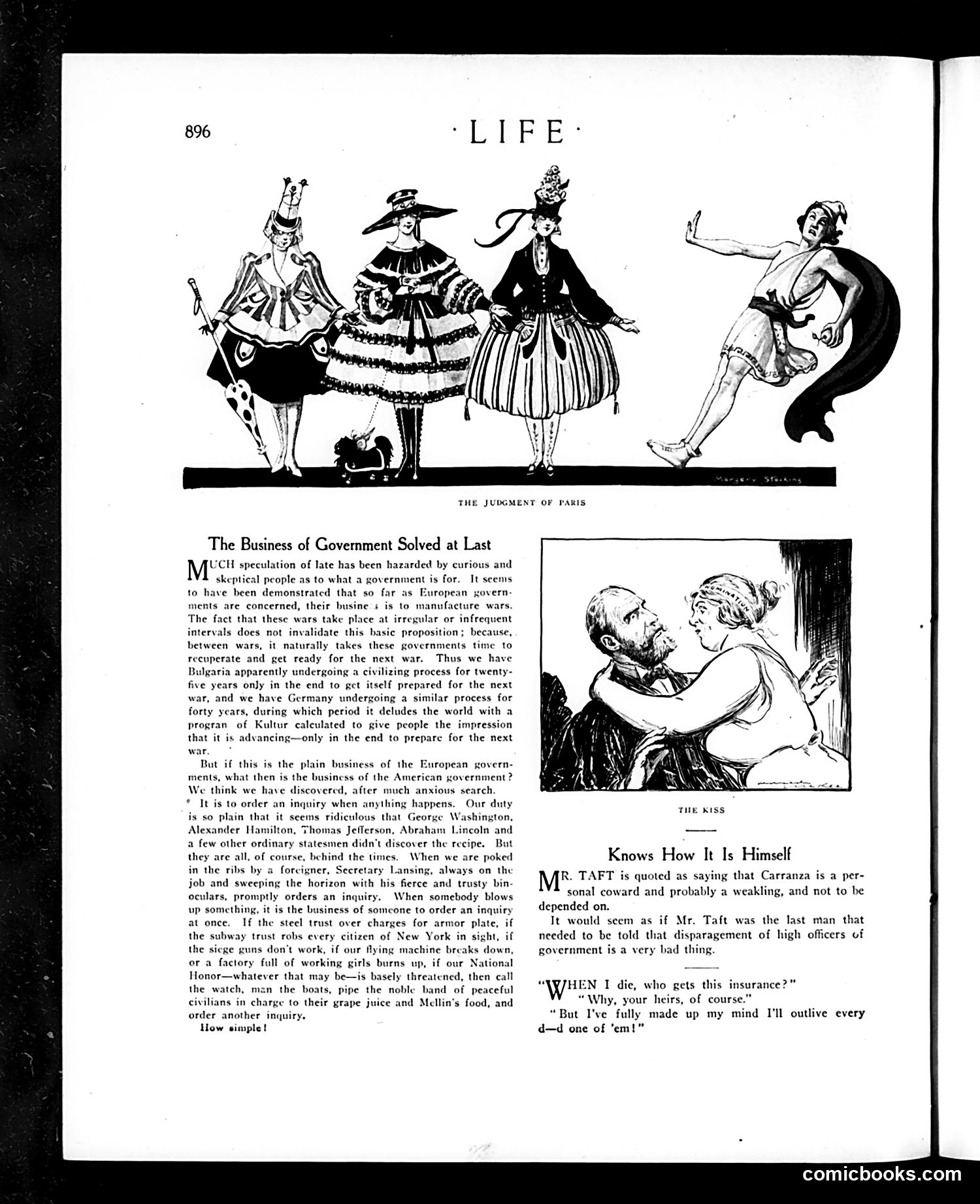
**"The Judgment of Paris" (top cartoon):** This classical allusion depicts four figures in elaborate dress competing for attention—likely representing European nations or their leaders vying for power and influence before World War I. The mythological reference suggests their rivalry will lead to conflict. **"The Business of Government Solved at Last" (main article):** This satire argues that European governments exist solely to manufacture wars, while the American government's actual purpose is merely to order inquiries into problems rather than solve them. It mocks Secretary Lansing and the Taft administration for endless investigations instead of action—whether regarding trusts, infrastructure failures, or diplomatic disputes with Mexico (Carranza is referenced). **"The Kiss" and "Knows How It Is Himself":** A brief jab at former President Taft, suggesting his criticism of Mexican general Carranza is hypocritical given Taft's own questionable leadership record. The page reflects Progressive Era frustration with government ineffectiveness and mounting pre-WWI tensions in Europe.
📄 Transcribed text from this page (OCR, searchable)
Machine-transcribed from the original scan — historical spelling and the odd misread are preserved.
THE JUDGMENT The Business of Government Solved at Last UCH speculation of late has been hazarded by curious and skeptical people as to what a government is for. It seems to have been demonstrated that so far as European govern- ments are concerned, their busine s is to manufacture wars. The fact that these wars take place at irregular or infrequent intervals does not invalidate this basic proposition; because, between wars, it naturally takes these governments time to recuperate and get ready for the next war. Thus we have Bulgaria apparently undergoing a civilizing process for twenty- five years only in the end to get itself prepared for the next war, and we have Germany undergoing a similar process for forty years, during which period it deludes the world with a progran of Kultur calculated to give people the impression that it is advancing—only in the end to prepare for the next war. But if this is the plain business of the European govern- ments, what then is the business of the American government ? We think we have discovered, after much anxious search * It is to order an inquiry when anything happens. Our duty is so plain that it seems ridiculous that George Washington, Alexander Hamilton, Thomas Jefferson, Abraham Lincoln and a few other ordinary statesmen didn’t discover the recipe. But they are all, of course, behind the times. When we are poked in the ribs by a forcigner, Secretary Lansing, always on the job and sweeping the horizon with his fierce and trusty bin- oculars, promptly orders an inquiry. When somebody blows up something, the business of somcone to order an inquiry at once. If the steel trust over charges for armor plate, if the subway trust robs every citizen of New York in sight, if the siege guns don't work, if our fying machine breaks down, or a factory full of working girls burns up, if our National Honor—whatever that may be—is basely threatened, then call the watch, man the boats, pipe the noble band of peaceful civilians in charge to their grape juice and Mellin’s food, and order another inquiry. How simple! OF Paris THE KISS Knows How It Is Himself M® TAFT is quoted as saying that Carranza is a per- sonal coward and probably a weakling, and not to be depended on. It would seem as if Mr. Taft was the last man that needed to be told that disparagement of high officers of government is a very bad thing. “WYJHEN I dic, who gets this insurance?” “Why, your heirs, of course.” But I've fully made up my mind I'll outlive every d—d one of 'em!" comicbooks.com