
Life, 1916-05-11 · page 27 of 48
Life — May 11, 1916 — page 27: what you’re looking at
What you’re looking at
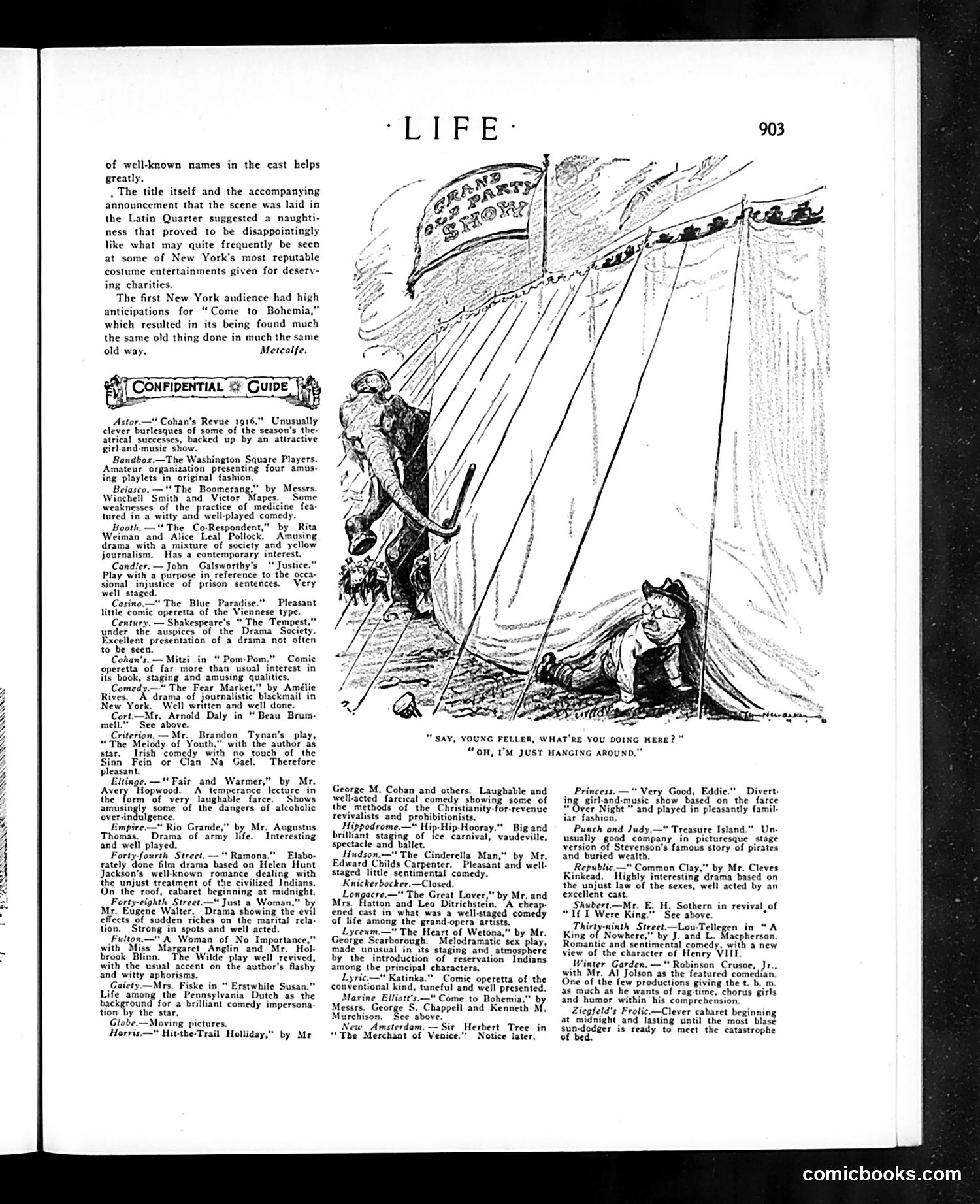
The main illustration depicts a figure clinging to ropes or rigging, apparently from a ship or circus tent. The caption reads: "Say, young feller, what're you doing here?" / "Oh, I'm just hanging around." This is a visual pun—the humor derives from the literal interpretation of "hanging around" (idling about) versus the figure's precarious position literally *hanging* from ropes. It's a simple joke playing on double meaning of the phrase. The page itself is primarily a theater review guide ("Confidential Guide") covering Broadway productions of the era—plays, operettas, and films. The reviews are brief, witty assessments of current shows. The opening text discusses disappointment with "Come to Bohemia," suggesting audiences expected bohemian naughtiness but found conventional entertainment instead. The cartoon functions as light visual humor amid serious theatrical criticism—typical of *Life* magazine's satirical approach.
📄 Transcribed text from this page (OCR, searchable)
Machine-transcribed from the original scan — historical spelling and the odd misread are preserved.
POSES ae of well-known names in the cast helps greatly. . The title itself and the accompanying announcement that the scene was laid in the Latin Quarter suggested a naughti- ness that proved to be disappointingly like what may quite frequently be seen at some of New York's most reputable costume entertainments given for deserv- ing charities. The first New York audience had high anticipations for “Come to Bohemia, which resulted in its being found much the same old thing done in much the same old way. Metcalfe. ia CONFIDENTIAL < GuipeE ye Astor.—" Cohan’s Revue 1916." Unusually clever burlesques of some of the season's the- atrical successes, backed up by an attractive girl-and-music show. Bandbox.—The Washington Square Players. Amateur organization presenting four amus- ing playlets in original fashion. Belasco. —"' The Boomerang.” by Messrs Winchell Smith and Victor Mapes. Some weaknesses of the practice of medicine fea- tured in'a witty and well:played comedy. Booth.—“' The Co-Respondent,” by Rita Weiman and Alice Leal Pollock, Amusing drama with a mixture of society and yellow journalism. Has a contemporary interest. Candler. —John Galsworthy’s “Justice.” Play with a purpose in, reference to the occa- sional injustice of prison sentences. Very well staged. Casino.—" The Blue Paradise.” Pleasant little comic operetta of the Viennese type. Century. — Shakespeare's “The Tempest under the auspices of the Drama Society. Excellent presentation of a drama not often to be seen. Cohen's. — Mitzi in “ Pom-Pom." Comic operetta of far more than usual interest in its book, staging and amusing qualities. Comedy.—" The Fear Market,” by Amélie Rives, A’ drama of journalistic’ blackmail in New York. Well written and well done. Cort.—Mr. Arnold Daly in “Beau Brum- mell.""” See above. Criterion, — Mr, Brandon Tynan’s play, “The Melody of Youth,” with the author as star. Trish comedy with no touch of the Sinn Fein or Clan Na Gael. Therefore pleasant. Eltings, — "Fair and Warmer," by Mr. Avery Hopwood. A temperance’ lecture in the form of very laughable farce. Shows amusingly some of the dangers of alcoholic over-indulgence. Empire-—" Rio Grande,” by Mr. Augustus thomas. Drama of army Ife. Interesting and well played. Forty-fourth Street. —* Ramona.” Elabo- rately done film drama based on Helen Hunt Jackson's well-known romance dealing with the unjust treatment of the civilized Indians. On the roof, cabaret beginning at midnight. Forty-eighth Street.— Just a Woman,” by Mr. Eugene Walter. Drama showing the evil effects of sudden riches on the marital rela- tion. Strong in spots and well acted. Fulton—* A Woman of No Importance,” with Miss Margaret Anglin and Mr. Hol- brook Blinn. The Wilde play well revived, with the usual accent on the author's flashy and witty aphorisms, ‘Gaiety.—Mrs. Fiske in “ Erstwhile Susan. Life among the Pennsylvania Dutch as the backerotsd for a brilliant comedy impersona tion by the star. Globe.—Moving pictures. Horris.—" Hit-the-Trail Holliday," by Mr NG FELLER, WHAT'RE YOU DOING MERE?” “On, I'M JUST HANGING AROUND.” George M. Cohan and others. Laughable and well-acted’ farcical comedy showing some of the. methods of the Christianity-for-revenue revivalists and prohibitionists. Hippodrome.—" Hip-Hip-Hooray.” Big and brilliant staging of ice carnival, vaudeville, spectacle and ballet. Hudson.—" The Cinderella Man,” by Mr. Edward Childs Carpenter. Pleasant and well: staged little sentimental comedy. Knickerbocker. —Closed. Lonpacre—" The Great Lover,” by Mr. and Mrs. Hatton and Leo Ditrichstein, A cheap- ened cast in what was a well-staged comedy of life among the grand-opera artists. Lyceum.—" The Heart of Wetona,” by Mr. George Scarborough. Melodramatic’ sex play, made unusual in its staging and atmosphere by the introduction of reservation Indians among the principal characters, Lyric.—" Katinka.” Comic operetta of the conventional kind, tuneful and well presented, Marine Elliott’s.—" Come to Bohemia.” Messrs. George S. Chappell and Kenneth M. Murchison. See above. New Amsterdam. — Sir Herbert Tree in “The Merchant of Venice.” Notice later. Princess. —* Very Good, Eddie." Divert: ng firland.music, show Based on the farce er Night " and played in pleasantly famil- iar fashion, Punch and Judy.—" Treasure Island.” Un- usually good company in picturesque stage version of Stevenson's famous story of pirates and buried wealth. Republic.—" Common Clay,” by Mr. Cleves Kinkead. Highly interesting’ drama based on the unjust law of the sexes, well acted by an excellent cast. Shubert.—Mr. E. H. Sothern in revival, of “If 1 Were King.” See above. . _Thirtyninth Strect—LouTellegen in A King of Nowhere,” by J. and L. Macpherson. Romantic and sentimental comedy, with a new view of the character of Henry VIII. Winter Garden, —" Robinson Crusoe, Jt with Mr. Al Jolson as the featured comedian. One of the few productions giving the t. b. m as much as he wants of rag-time, chorus girls and humor within his comprehension. Ziegfeld’s Frotic.—Clever cabaret beginning at midnight and lasting until the most blase sundodger is ready to meet the catastrophe of be comicbooks.com