
Life, 1916-05-11 · page 16 of 48
Life — May 11, 1916 — page 16: what you’re looking at
What you’re looking at
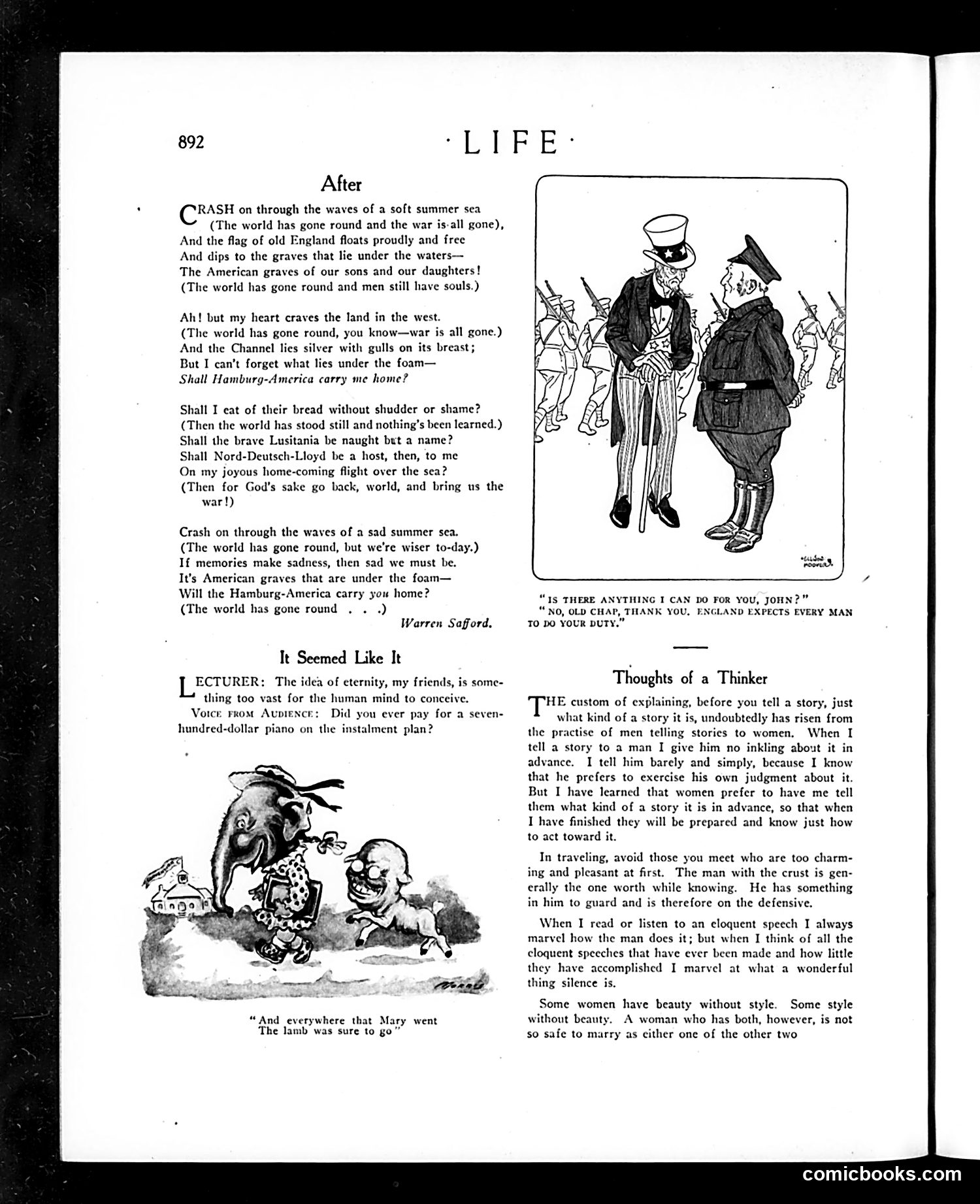
This page contains WWI-era satire addressing post-war reconciliation with Germany. **"After" Poem (Warren Safford):** A bitter meditation on American casualties in WWI. The speaker wrestles with the moral impossibility of reconciliation—specifically, accepting passage home on German shipping lines (Hamburg-America, Nord-Deutsch-Lloyd) after witnessing the sinking of the Lusitania (a British liner torpedoed by Germany in 1915, killing American passengers). The repeated refrain "the world has gone round" suggests the war's end should bring closure, but the poem insists memory and justice matter more than comfort. **Top Cartoon:** Two British military figures converse. One (appearing to be a superior officer) asks John if there's anything he can do. John's response echoes Lord Kitchener's famous WWI recruitment poster: "England Expects Every Man to Do Your Duty"—implying continued sacrifice is expected even after armistice. **Lower Section:** Unrelated humorous pieces about eternity, storytelling conventions, and observations on character and beauty. The page reflects post-WWI American attitudes toward German reparations and the psychological difficulty of moving past wartime atrocities.
📄 Transcribed text from this page (OCR, searchable)
Machine-transcribed from the original scan — historical spelling and the odd misread are preserved.
After CRASH ‘on through the waves of a soft summer sea (The world has gone round and the war is-all gone), And the flag of old England floats proudly and free And dips to the graves that lie under the waters— The American graves of our sons and our daughters! (The world has gone round and men still have souls.) Ah! but my heart craves the land in the west. (The world has gone round, you know—war is all gone.) And the Channel lies silver with gulls on its breast; But I can't forget what lies under the foam— Shall Hamburg-America carry me home? Shall I eat of their bread without shudder or shame? (Then the world has stood still and nothing’s been learned.) Shall the brave Lusitania be naught but a name? Shall Nord-Deutsch-Lloyd be a host, then, to me On my joyous home-coming flight over the sea? (Then for God’s sake go back, world, and bring us the war!) Crash on through the waves of a sad summer sea. (The world has gone round, but we're wiser to-day.) If memories make sadness, then sad we must be. It’s American graves that are under the foam— Will the Hamburg-America carry you home? (The world has gone round . . .) Warren Safford. Tt Seemed Like It ECTURER: The idea of eternity, my friends, is some- thing too vast for the human mind to conceive. Voice From Aupience: Did you ever pay for a seven- hundred-dollar piano on the instalment plan? ee “And everywhere that Mary went The lamb was sure to go” “Is THERE ANYTHING I CAN DO FOR YOU, JOHN?” “NO, OLD CHAP, THANK YOU, ENGLAND EXPECTS EVERY MAN TO DO YOUR DUTY.” Thoughts of a Thinker HE custom of explaining, before you tell a story, just what kind of a story it is, undoubtedly has risen from the practise of men telling stories to women, When I tell a story to a man I give him no inkling about it in advance. I tell him barely and simply, because I know that he prefers to exercise his own judgment about it. But I have learned that women prefer to have me tell them what kind of a story it is in advance, so that when I have finished they will be prepared and know just how to act toward it. In traveling, avoid those you meet who are too charm- ing and pleasant at first. The man with the crust is gen- erally the one worth while knowing. He has something in him to guard and is therefore on the defensive. When I read or listen to an eloquent speech I always marvel how the man does it; but when I think of all the cloquent speeches that have ever been made and how little they have accomplished I marvel at what a wonderful thing silence is. Some women have beauty without style. without beauty, so safe to marry Some style A woman who has both, however, is not s cither one of the other two comicbooks.com