
Life, 1916-05-11 · page 22 of 48
Life — May 11, 1916 — page 22: what you’re looking at
What you’re looking at
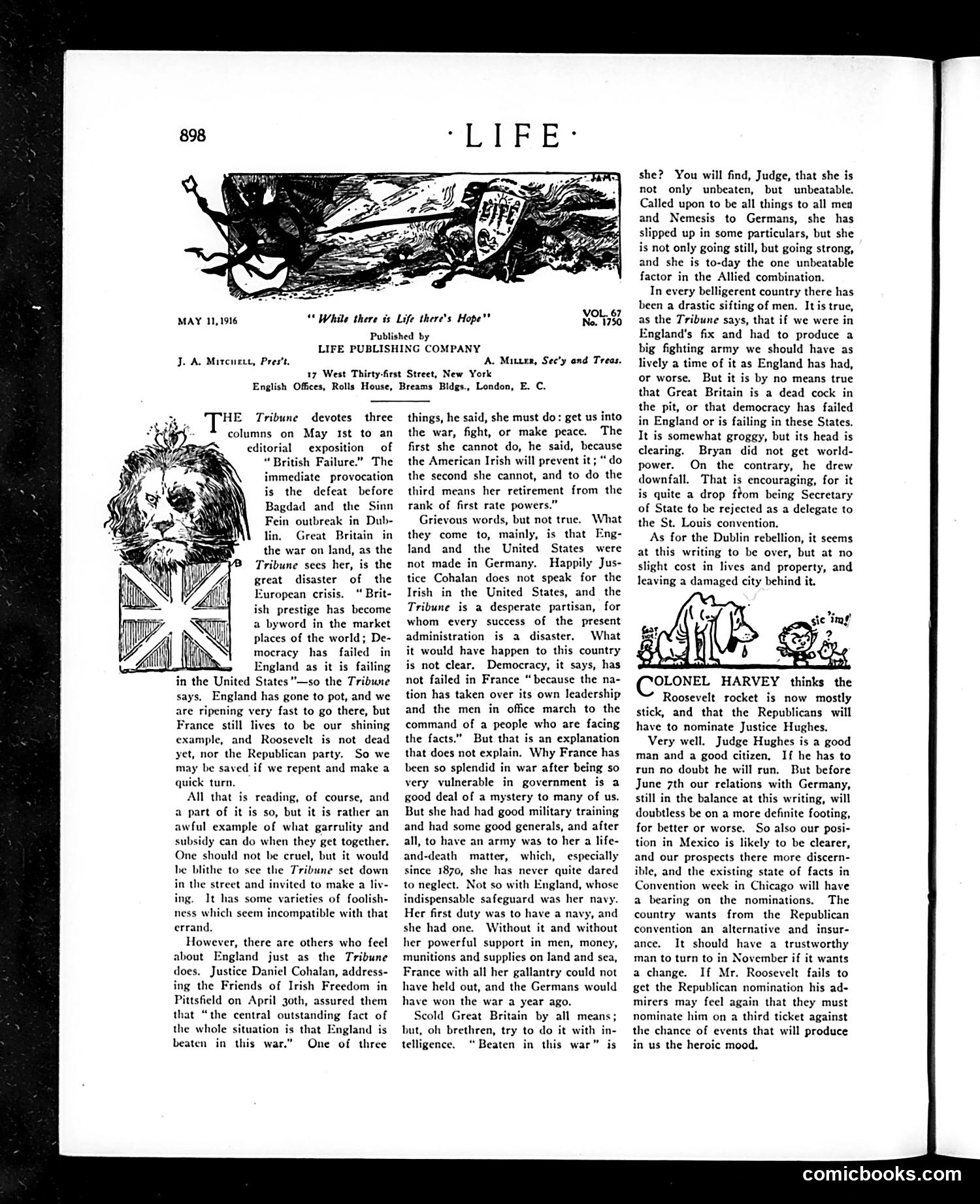
This page critiques Irish-American and anti-British sentiment during World War I. The editorial attacks Justice Daniel Cohalan, who publicly declared Britain was "beaten" in the war and could not win without either entering American involvement or making peace. Life's editors defend Britain, arguing that despite setbacks (the Bagdad defeat, the Easter Rising in Dublin), Britain remains "unbeatable" and crucial to the Allied cause. They mock the *Tribune* newspaper for similar anti-British rhetoric, suggesting such criticism reflects partisan politics rather than clear thinking. The satire targets what the editors see as defeatist propaganda and Irish-American obstruction of U.S. aid to Britain. The page argues Britain's navy remains indispensable and that France could not have survived without British support—therefore, condemning Britain while praising France is logically inconsistent. The editors frame pro-Irish-independence voices as undermining the Allied war effort.
📄 Transcribed text from this page (OCR, searchable)
Machine-transcribed from the original scan — historical spelling and the odd misread are preserved.
MAY 11,1916 “* While there is Life there's Hope" Published by LIFE PUBLISHING COMPANY J. A. Mitcuett, Pres’, HE Tribune devotes three columns on May Ist to an editorial exposition of “British Failure.” The immediate provocation is the defeat before Bagdad and the Sinn Fein outbreak in Dub- lin. Great Britain in the war on land, as the Tribune sees her, is the great disaster of the European crisis.“ Brit- ish prestige has become a byword in the market places of the world; De- mocracy has failed in England as it is failing in the United States ”"—so the Tribune says, England has gone to pot, and we are ripening very fast to go there, but France still lives to be our shining example, and Roosevelt is not dead yet, nor the Republican party. So we may be saved if we repent and make a quick turn. All that is reading, of course, and a part of it is so, but it is rather an awful example of what garrulity and subsidy can do when they get together, One should not be cruel, but it would be blithe to see the Tribune set down in the street and invited to make a liv ing. It has some varieties of foolish- ness which seem incompatible with that errand. However, there are others who feel about England just as the Tribune does. Justice Daniel Cohalan, address- ing the Friends of Irish Freedom in Pittsfield on April 3oth, assured them that “the central outstanding fact of the whole situation is that England is beaten in this war.” One of three A. Mitier, Sec’y and Treas. 17 West Thirty-first Street, New York English Offices, Rolls House, Breams Bldgs., London, E. C. things, he said, she must do: get us into the war, fight, or make peace. The first she cannot do, he said, because the American Irish will prevent it; “do the second she cannot, and to do the third means her retirement from the rank of first rate powers.” Grievous words, but not true. What they come to, mainly, is that Eng- land and the United States were not made in Germany. Happily Jus- tice Cohalan does not speak for the Irish in the United States, and the Tribune is a desperate partisan, for whom every success of the present administration is a disaster. What it would have happen to this country is not clear. Democracy, it says, has not failed in France “because the na- tion has taken over its own leadership and the men in office march to the command of a people who are facing the facts.” But that is an explanation that does not explain. Why France has been so splendid in war after being so very vulnerable in government is a good deal of a mystery to many of us. But she had had good military training and had some good generals, and after all, to have an army was to her a life- and-death matter, which, especially since 1870, she has never quite dared to neglect. Not so with England, whose indispensable safeguard was her navy. Her first duty was to have a navy, and she had one. Without it and without her powerful support in men, money, munitions and supplies on land and sea, France with all her gallantry could not have held out, and the Germans would have won the war a year ago. Scold Great Britain by all means; but, oh brethren, try to do it with in- telligence. “Beaten in this war” is she? You will find, Judge, that she is not only unbeaten, but unbeatable. Called upon to be all things to all mea and Nemesis to Germans, she has slipped up in some particulars, but she is not only going still, but going strong, and she is to-day the one unbeatable factor in the Allied combination. In every belligerent country there has been a drastic sifting of men. Itis true, as the Tribune says, that if we were in England's fix and had to produce a big fighting army we should have as lively a time of it as England has had, or worse, But it is by no means true that Great Britain is a dead cock in the pit, or that democracy has failed in England or is failing in these States. It is somewhat groggy, but its head is clearing. Bryan did not get world- power. On the contrary, he drew downfall. That is encouraging, for it is quite a drop ftom being Secretary of State to be rejected as a delegate to the St. Louis convention, As for the Dublin rebellion, it seems at this writing to be over, but at no slight cost in lives and property, and leaving a damaged city behind it. OLONEL HARVEY thinks the Roosevelt rocket is now mostly stick, and that the Republicans will have to nominate Justice Hughes, Very well. Judge Hughes is a good man and a good citizen, If he has to run no doubt he will run. But before June 7th our relations with Germany, still in the balance at this writing, will doubtless be on a more definite footing, for better or worse. So also our posi- tion in Mexico is likely to be clearer, and our prospects there more discern- ible, and the existing state of facts in Convention week in Chicago will have a bearing on the nominations. The country wants from the Republican convention an alternative and insur- ance. It should have a trustworthy man to turn to in November if it wants a change. If Mr. Roosevelt fails to get the Republican nomination his ad- mirers may feel again that they must nominate him on a third ticket against the chance of events that will produce in us the heroic mood, comicbooks.com