
A complete issue · 44 pages · 1916
Life — March 2, 1916
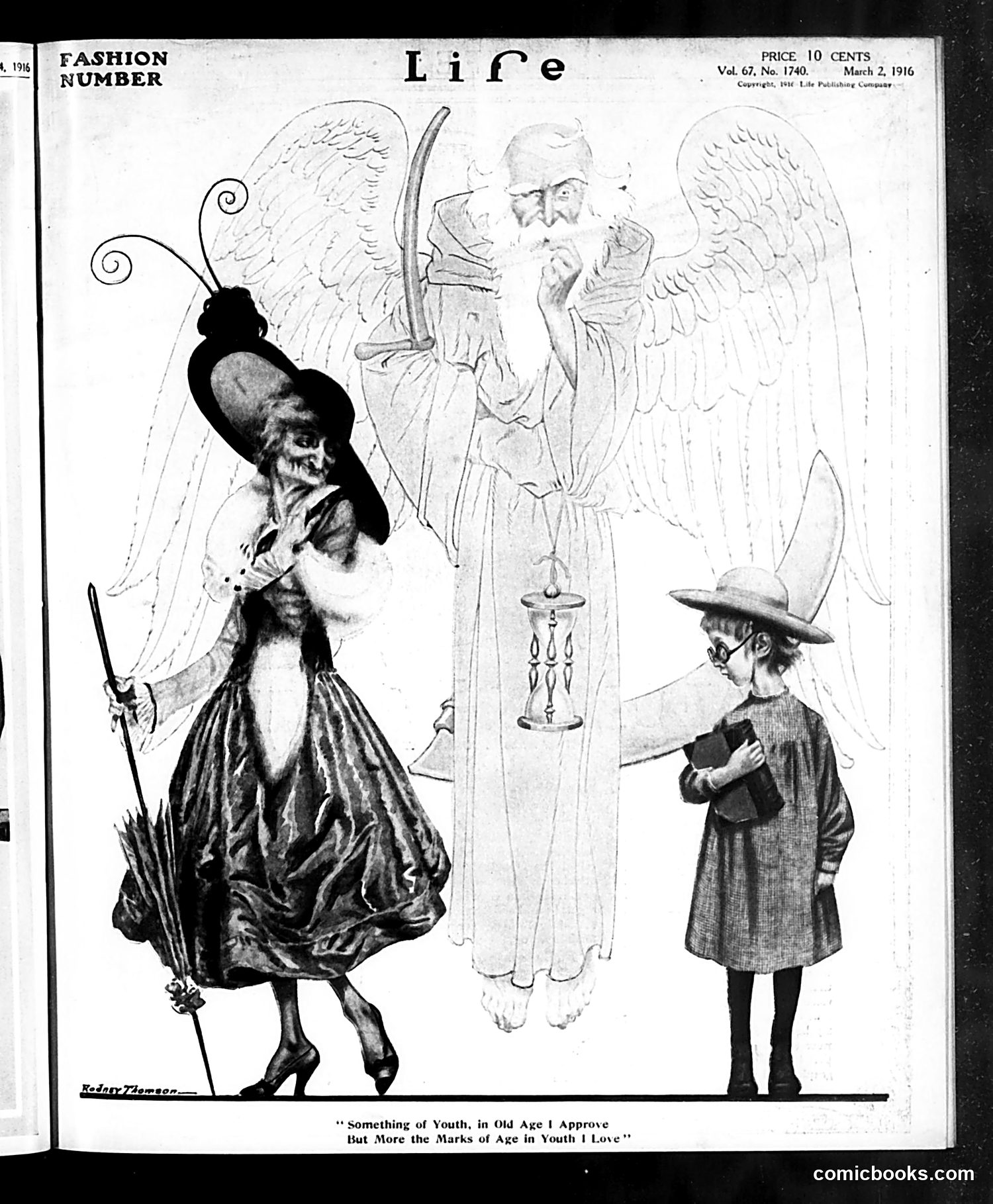
This satirical cartoon contrasts youth and age. On the left, a skeletal Death figure with insect wings and a tall hat holds a sword—representing old age and mortality. In the center stands an elderly angel or spiritual figure. On the right, a young child in a wide-brimmed hat and coat gazes upward innocently. The caption reads: "Something of Youth, in Old Age I Approve / But More the Marks of Age in Youth I Love." The satire criticizes the era's trend of older people trying to appear youthful through fashion and behavior, while simultaneously lamenting that young people seemed prematurely aged or world-weary. This reflects early 20th-century anxieties about generational decline and the corrupting effects of modern life on youth.
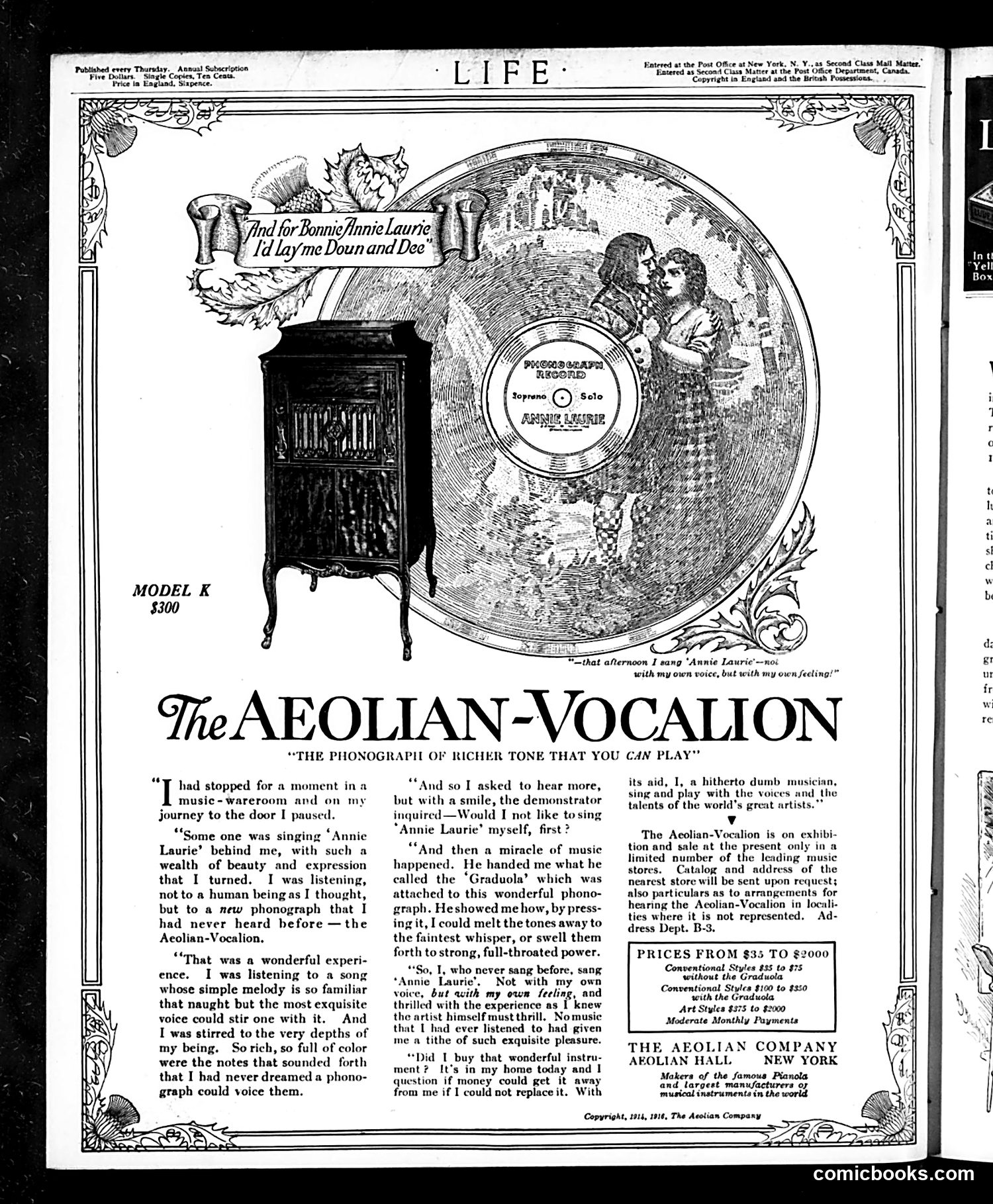
This page is primarily **advertising**, not satire or political commentary. It's a full-page advertisement for the Aeolian-Vocalion phonograph (Model K, priced at $300). The ad uses a narrative frame: a customer describes visiting a music store and hearing "Annie Laurie" played on the device. The text emphasizes the phonograph's superior sound quality—claiming the reproduction is so realistic the customer couldn't distinguish it from live singing. The decorative elements (the record illustration, period artwork) and the Scottish song reference were common marketing tactics to suggest cultural refinement and emotional authenticity. The ad targets affluent buyers by emphasizing the machine's ability to faithfully reproduce professional vocal performances in the home. This represents early phonograph marketing strategy.
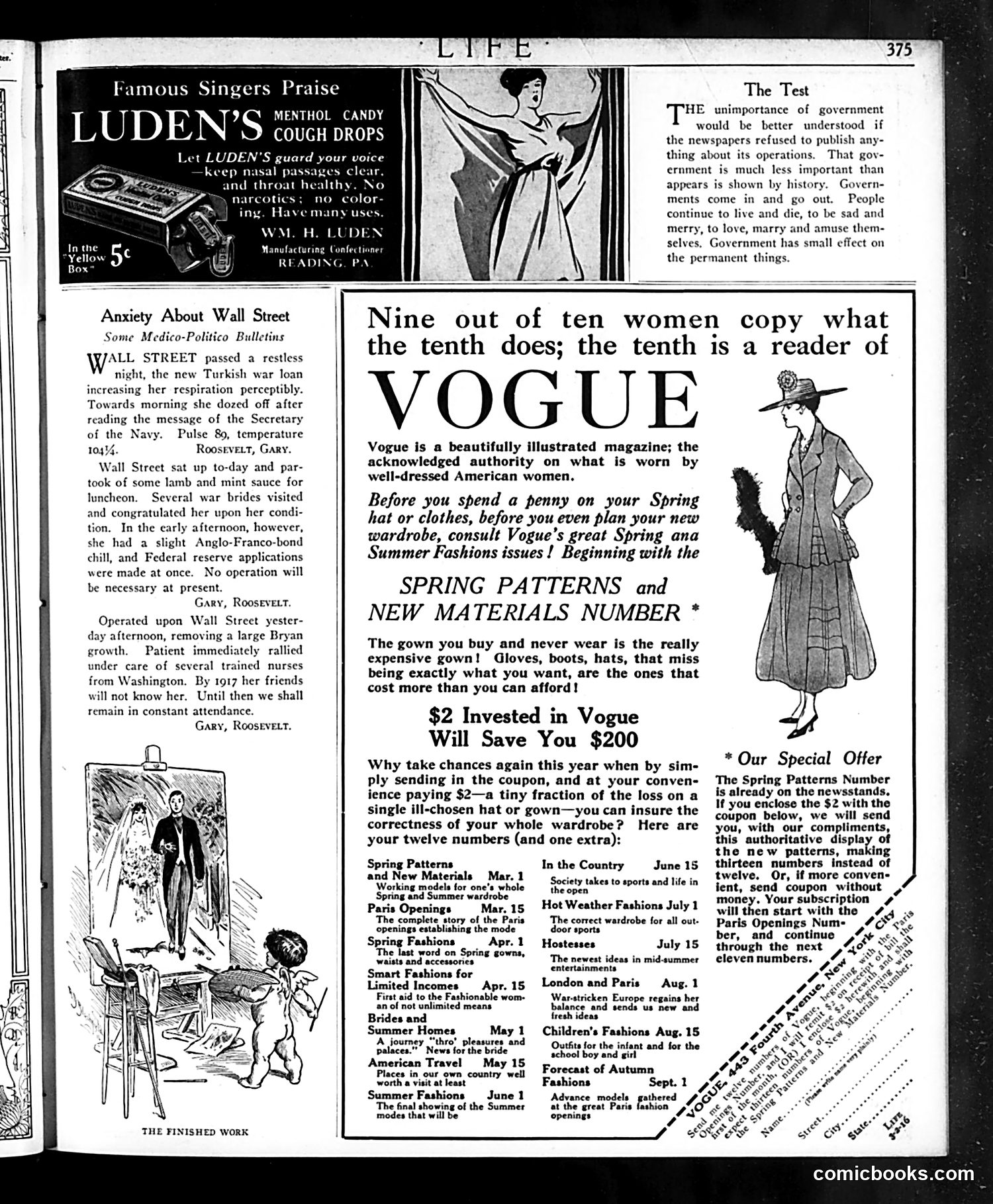
This page is primarily **advertising**, not political satire. The dominant content is a large Vogue magazine advertisement claiming "Nine out of ten women copy what the tenth does" — a pitch asserting that reading Vogue ensures fashionable status. The ad promotes spring fashion patterns and materials, offering a "$2 investment" that will "save you $200" on wardrobe mistakes. The smaller cartoon titled "The Finished Work" (bottom left) appears to depict **sewing or dress-making**, showing figures working on garments — likely accompanying the fashion advertising theme. The page also contains unrelated medical-political commentary about Wall Street anxiety and government operations, but these are minor editorial snippets rather than the page's focus.
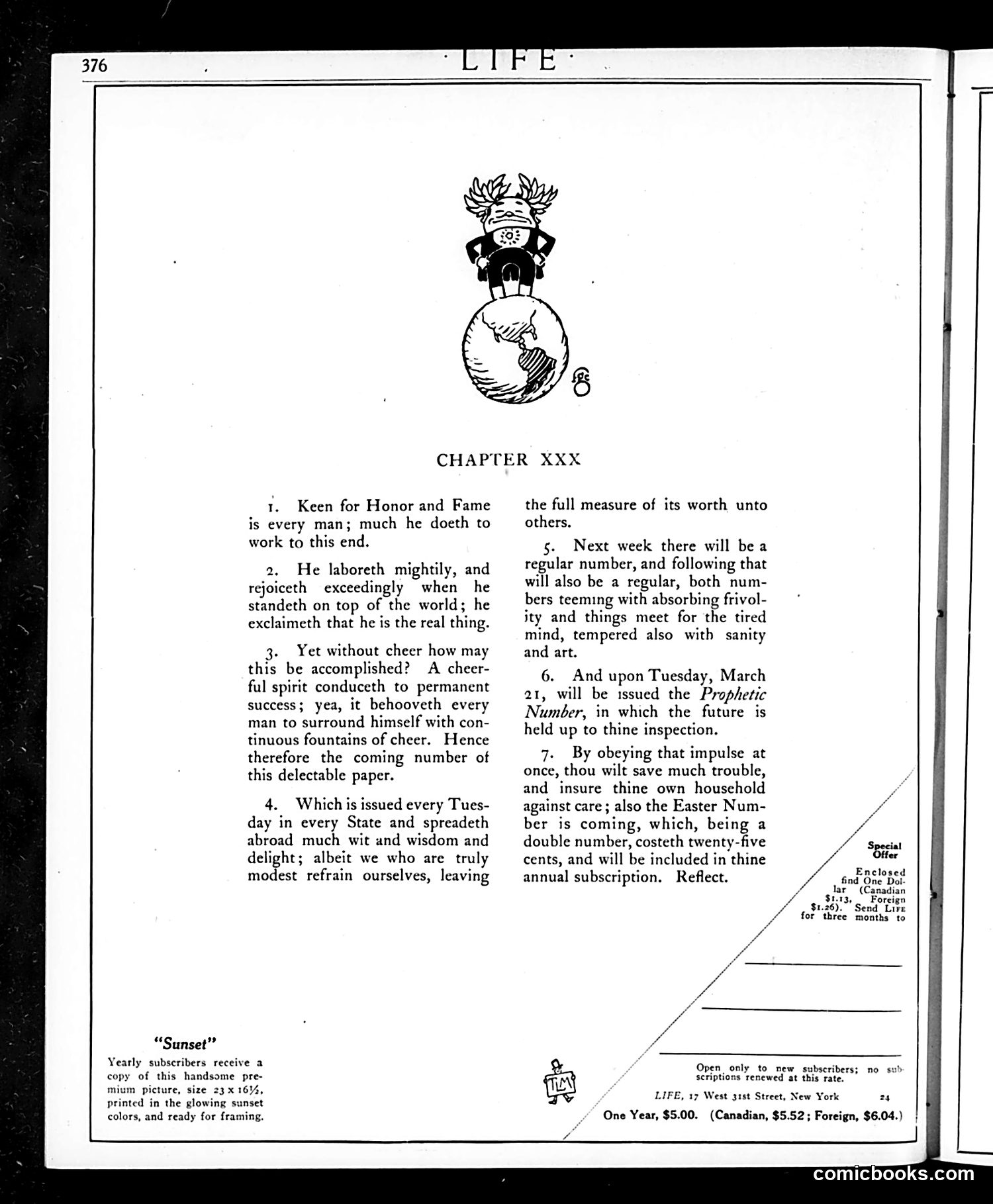
The central illustration depicts a figure with wild hair standing atop a globe, wearing what appears to be a blindfold or mask labeled "1893." This cartoons likely satirizes someone prominent in 1893 who is portrayed as blindly navigating world affairs or public opinion. The accompanying text in "Chapter XXX" celebrates ambition and hard work while emphasizing the need for "cheer" to succeed. It's essentially motivational content promoting Life magazine itself—advertising upcoming issues and subscription offers, including an Easter Number. The "Sunset" box at bottom describes a premium framed print available to yearly subscribers. Overall, this page combines satirical commentary with self-promotional magazine content typical of the era.
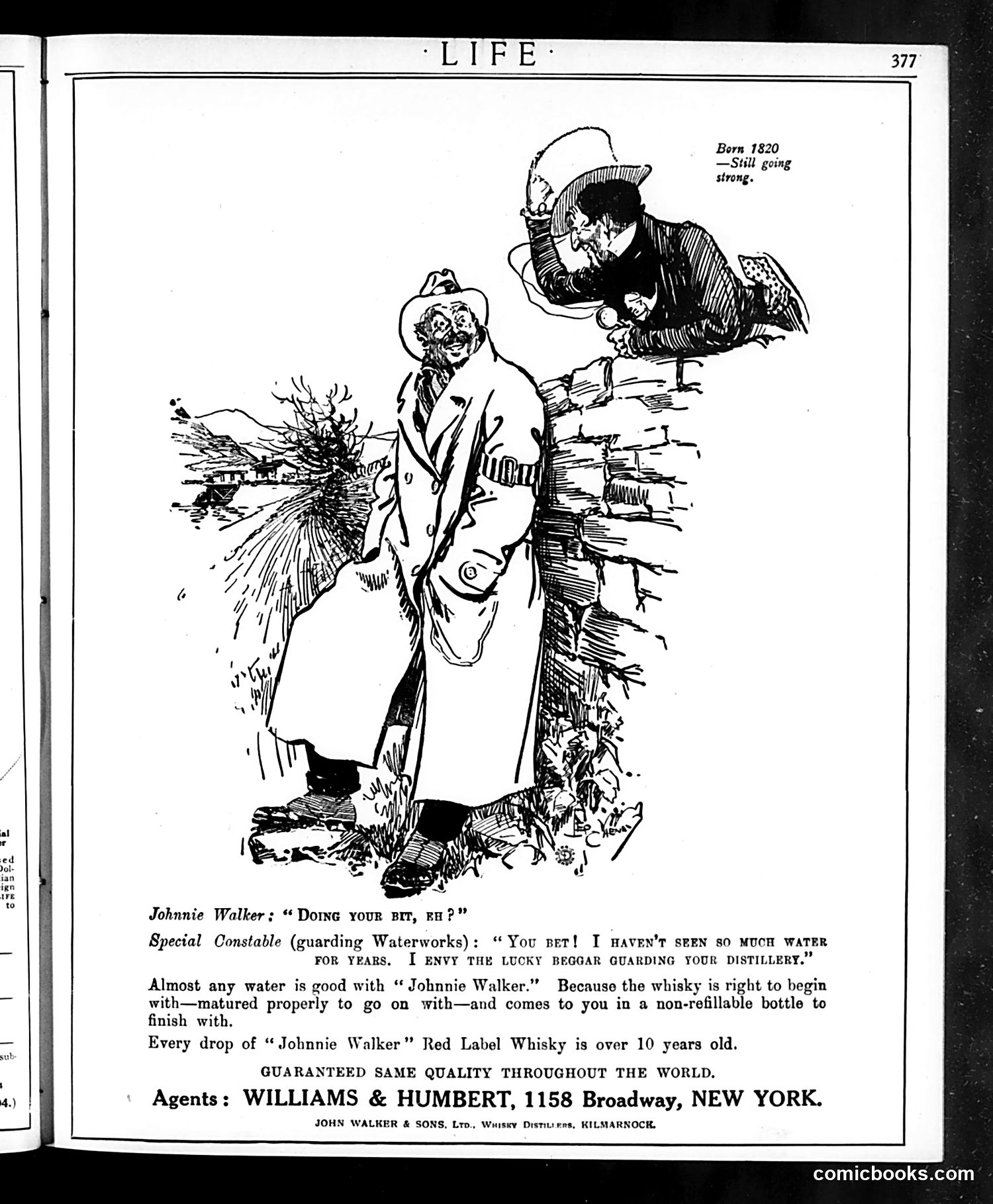
This page is primarily a **whisky advertisement** for Johnnie Walker Red Label, not political satire. The illustration depicts two figures: a beggar or vagrant (labeled "Johnnie Walker") and a "Special Constable" guarding a waterworks. The constable remarks he hasn't seen so much water in years and envies the "lucky beggar" guarding a distillery. The joke plays on the brand name "Johnnie Walker"—a Scottish whisky—by literally depicting a character named Johnnie Walker. The humor relies on the pun and the absurdist scenario of a constable's envy of whisky access rather than water access. The 1820 reference ("Still going strong") emphasizes the product's longevity. This is advertisement-as-entertainment typical of early 20th-century magazine advertising.
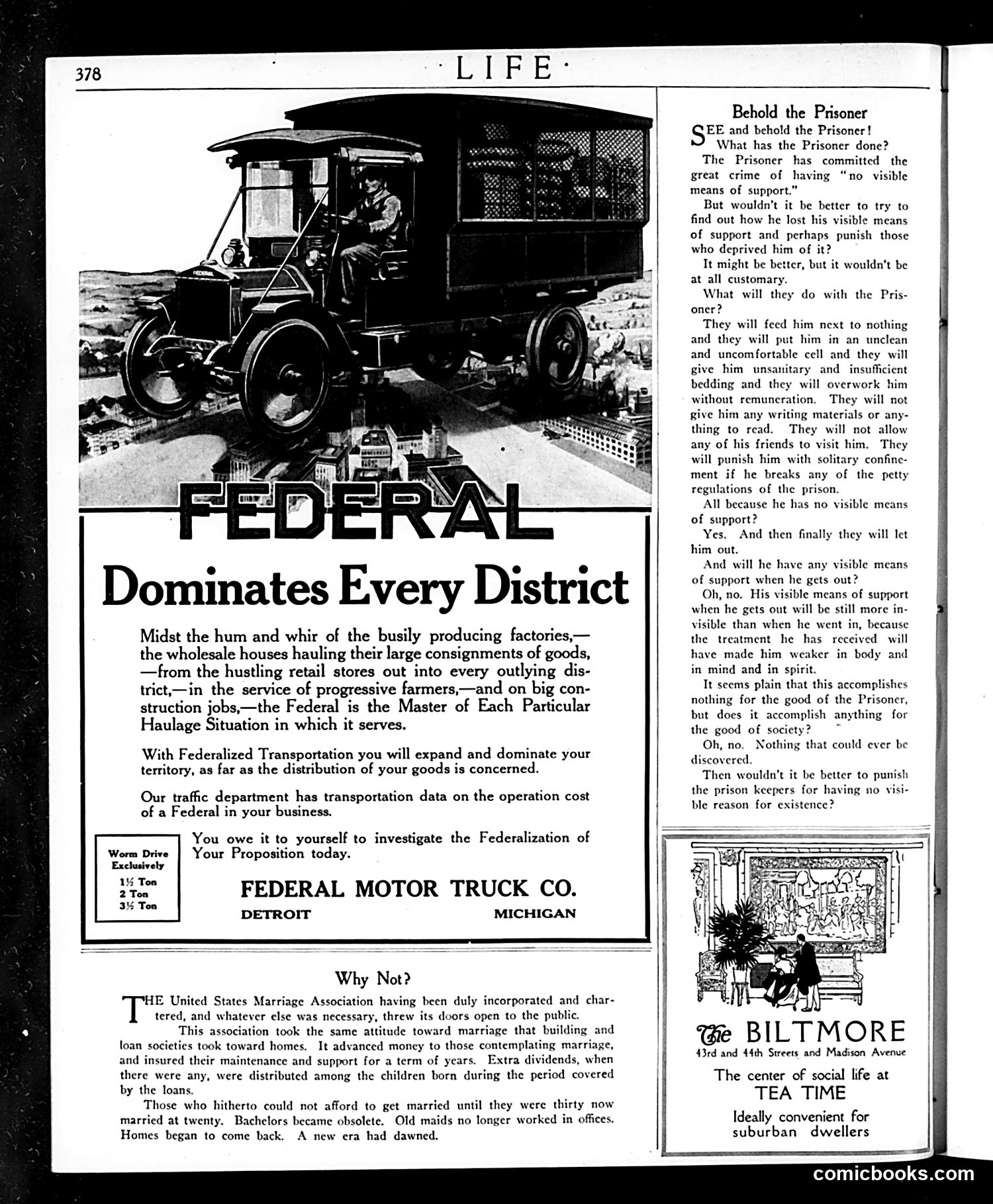
This page contains advertisements rather than political satire. The main ad promotes Federal Motor Truck Company's commercial vehicles, emphasizing their dominance in hauling goods across districts. The marketing language targets business owners, claiming "Federalized Transportation" will expand their territory and distribution reach. On the right side, an unrelated advertisement for the Biltmore hotel promotes "tea time" as a social gathering spot. Above the truck ad runs a serious editorial piece titled "Behold the Prisoner," criticizing the prison system's treatment of inmates—specifically those without visible means of financial support. It argues such prisoners face worse conditions and are released in worse circumstances than they entered, questioning whether imprisonment actually serves society. The page mixes commercial promotion with social commentary.
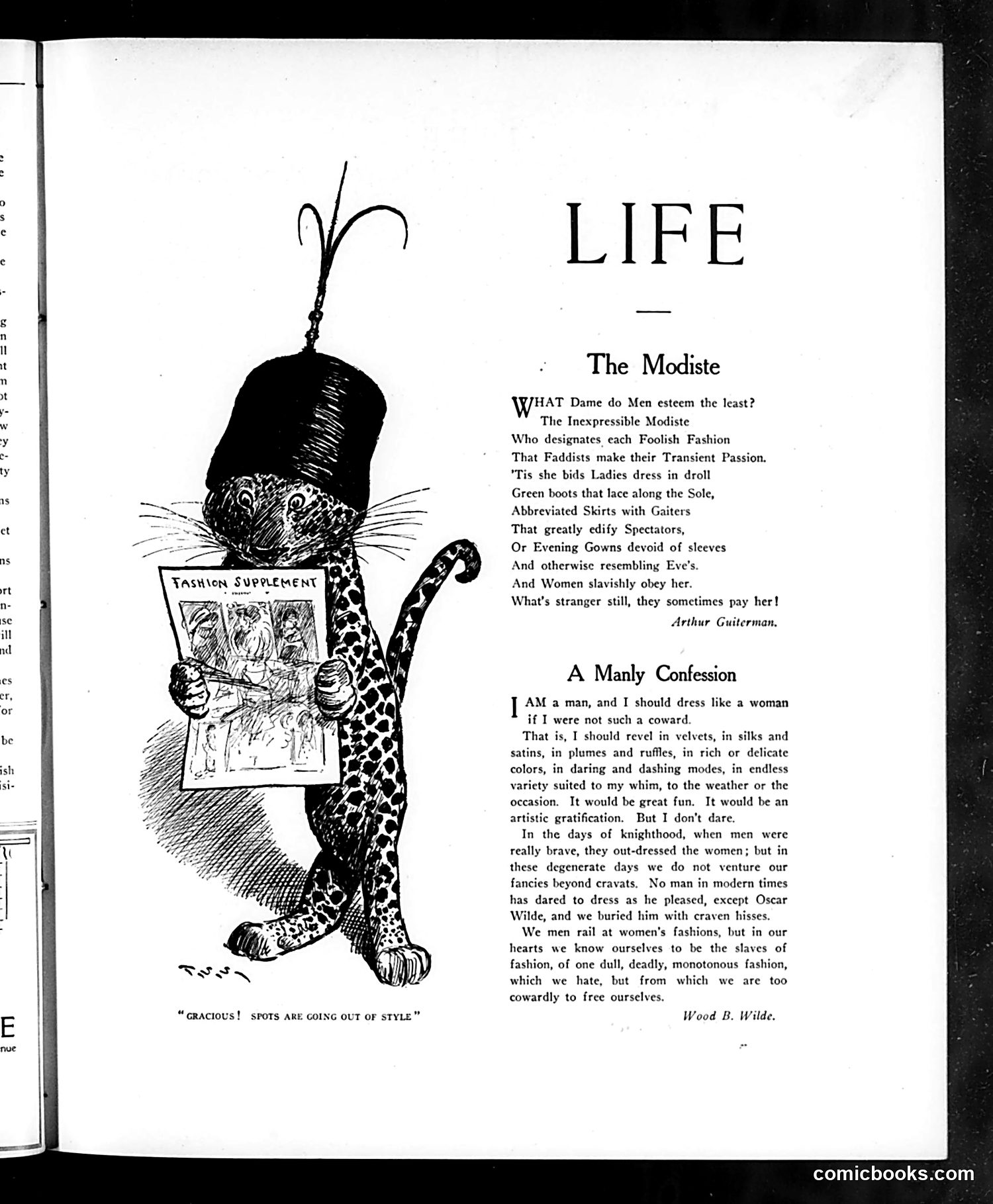
This page satirizes early 20th-century fashion debates, particularly women's evolving styles. The cartoon depicts a leopard in fashionable dress reading a "Fashion Supplement," captioned "Gracious! Spots are going out of style"—a visual joke equating animal patterns with human fashion trends. The poems critique what appears to be the "Modiste" (fashionable dressmaker) promoting increasingly daring women's fashions: shorter skirts, fewer sleeves, and simplified designs. Gutterman's poem mocks these as "Foolish Fashion" and "Transient Passion," while Wood B. Wilde's "A Manly Confession" ironically defends women's right to dress boldly, contrasting modern fashion restrictions with historical male dress freedom. The satire targets both fashion's rapid changes and society's gendered double standards in clothing.
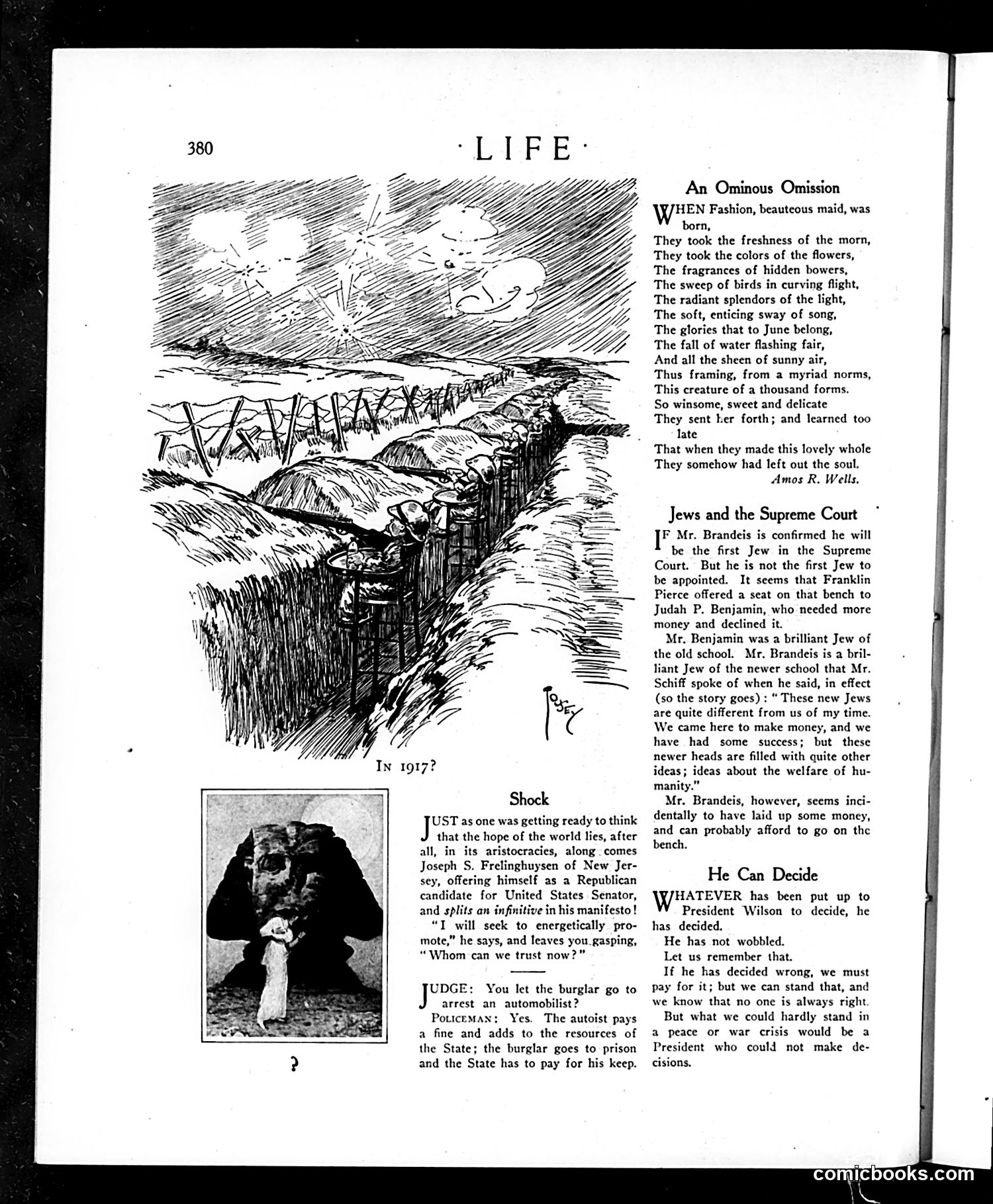
This page contains three distinct pieces: 1. **"An Ominous Omission"** - A poem by Amos K. Wells criticizing Fashion as beautiful but soulless, created from nature's elements without capturing true essence. 2. **"Jews and the Supreme Court"** - Commentary on Mr. Brandeis's potential confirmation as the first Jewish Supreme Court Justice. It notes Judah P. Benjamin previously declined such a position. The piece contrasts Benjamin's old-school approach with Brandeis's modern philosophy, quoting criticism from someone named Schiff about "new Jews" focused on welfare rather than profit. 3. **"Shock"** and **"He Can Decide"** - A cartoon showing Joseph S. Frelinghuysen as a Republican Senate candidate, paired with a joke about judicial inconsistency regarding automobile thieves versus burglars. The final section praises President Wilson's decision-making capacity.
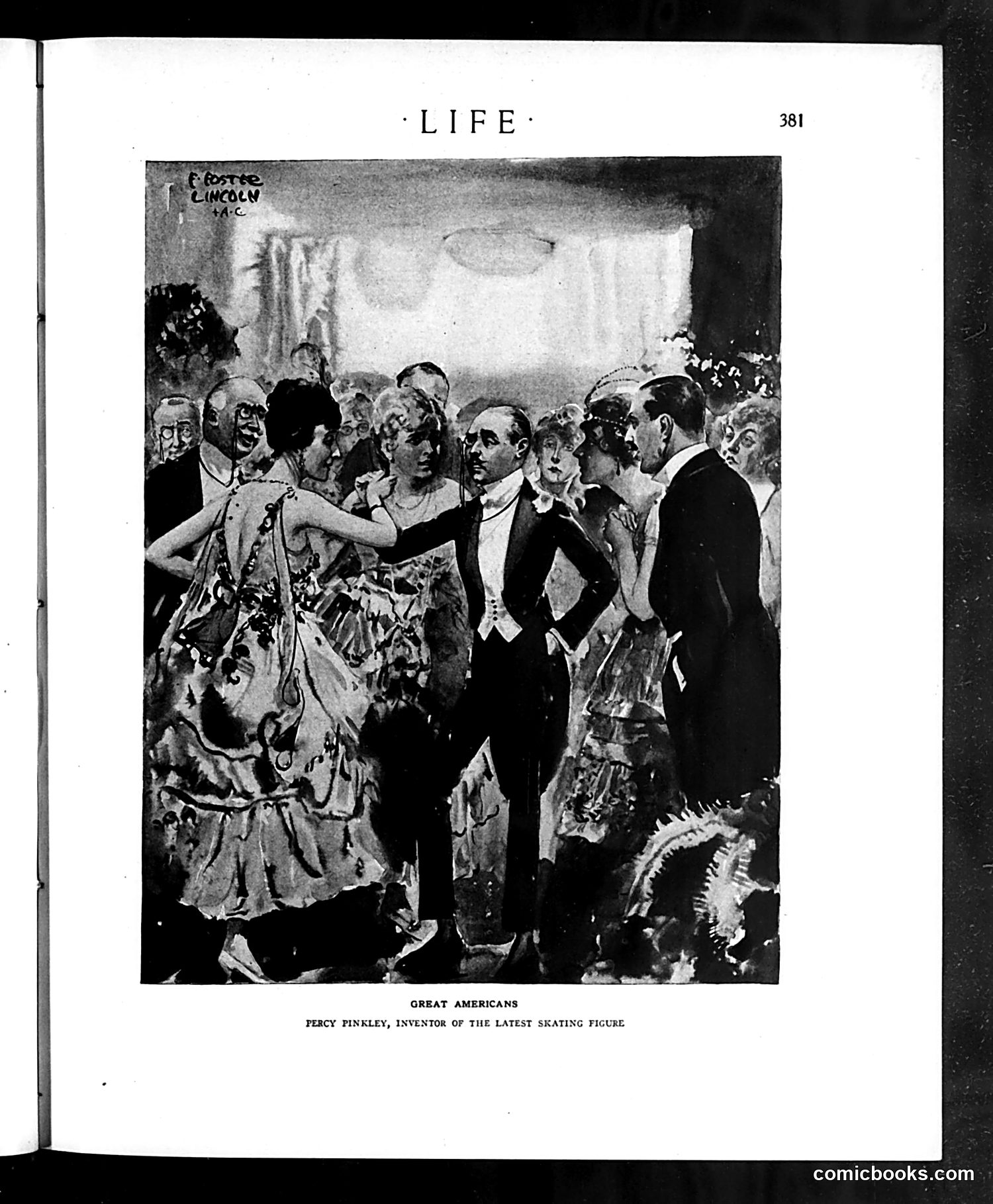
This page from *Life* magazine features a black-and-white photograph labeled "Great Americans: Percy Pinkley, Inventor of the Latest Skating Figure." The image shows a formal social gathering with well-dressed men in tuxedos and elaborately dressed women. The caption identifies Percy Pinkley as an inventor of a new ice skating figure. This appears to be satirical commentary on American society's tendency to elevate minor innovations or trivial inventions to the status of great achievement. By calling Pinkley a "Great American" for inventing a skating figure—a recreational novelty rather than something of genuine importance—*Life* is mocking both Pinkley's inflated status and society's misplaced values. The formal reception scene emphasizes the absurdity of treating such a frivolous accomplishment with such serious pageantry.
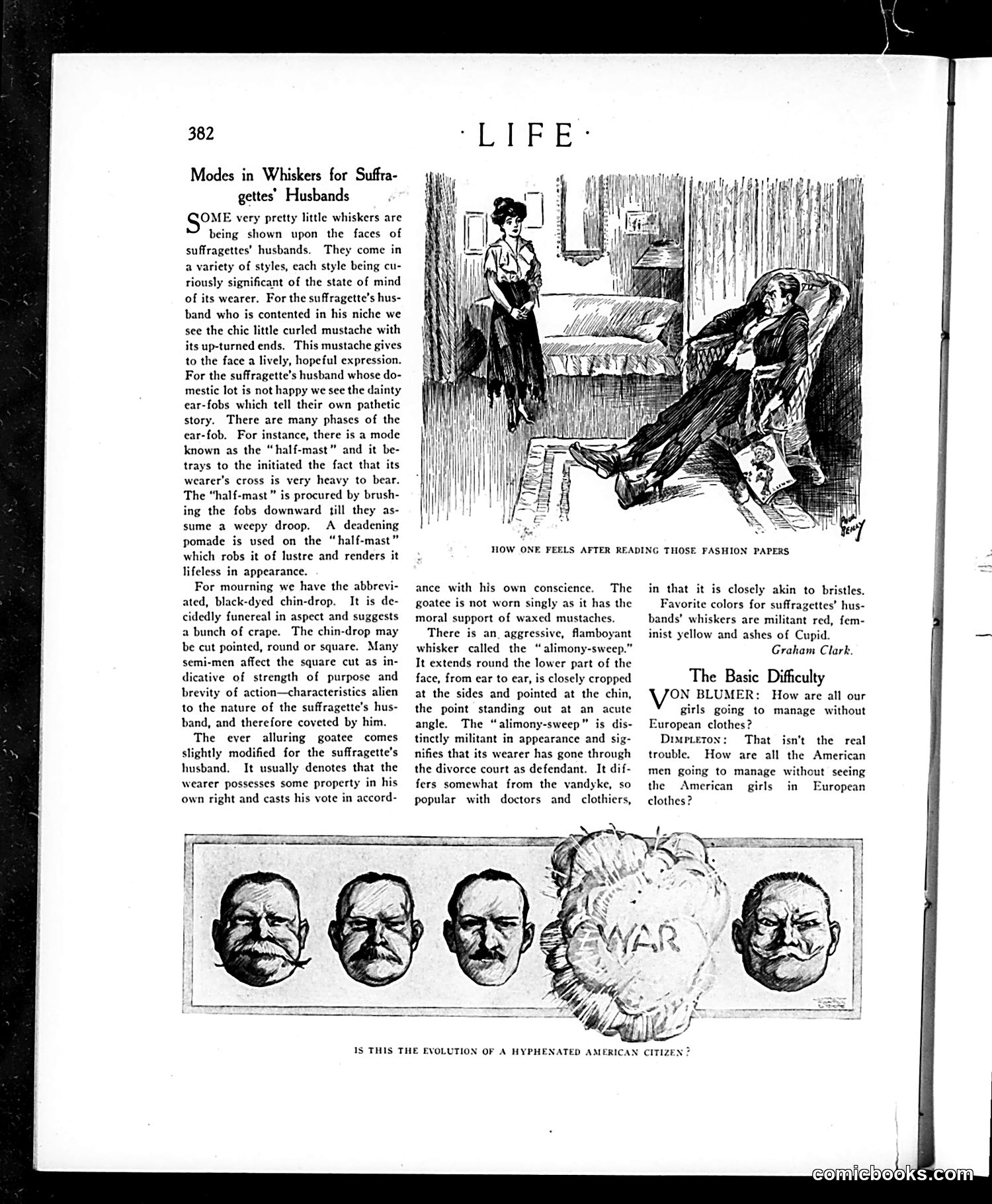
This page satirizes American men adopting European fashion styles, specifically facial hair trends associated with women's suffrage activism. The top article mocks "suffragettes' husbands" and their various mustache styles—the "half-mast," "slimony-sweep," and "goatee"—suggesting these men have become effeminate or weak by supporting their wives' political activism. The bottom cartoon, captioned "IS THIS THE EVOLUTION OF A HYPHENATED AMERICAN CITIZEN?", shows five male faces progressing from stern, traditionally masculine mustaches on the left to increasingly exaggerated styles, ending with a woman's face on the right. This anti-suffrage cartoon ridicules male suffrage supporters as unmanly, implying they're becoming feminized by association with the women's movement. The satire reflects early 20th-century opposition to women's voting rights.
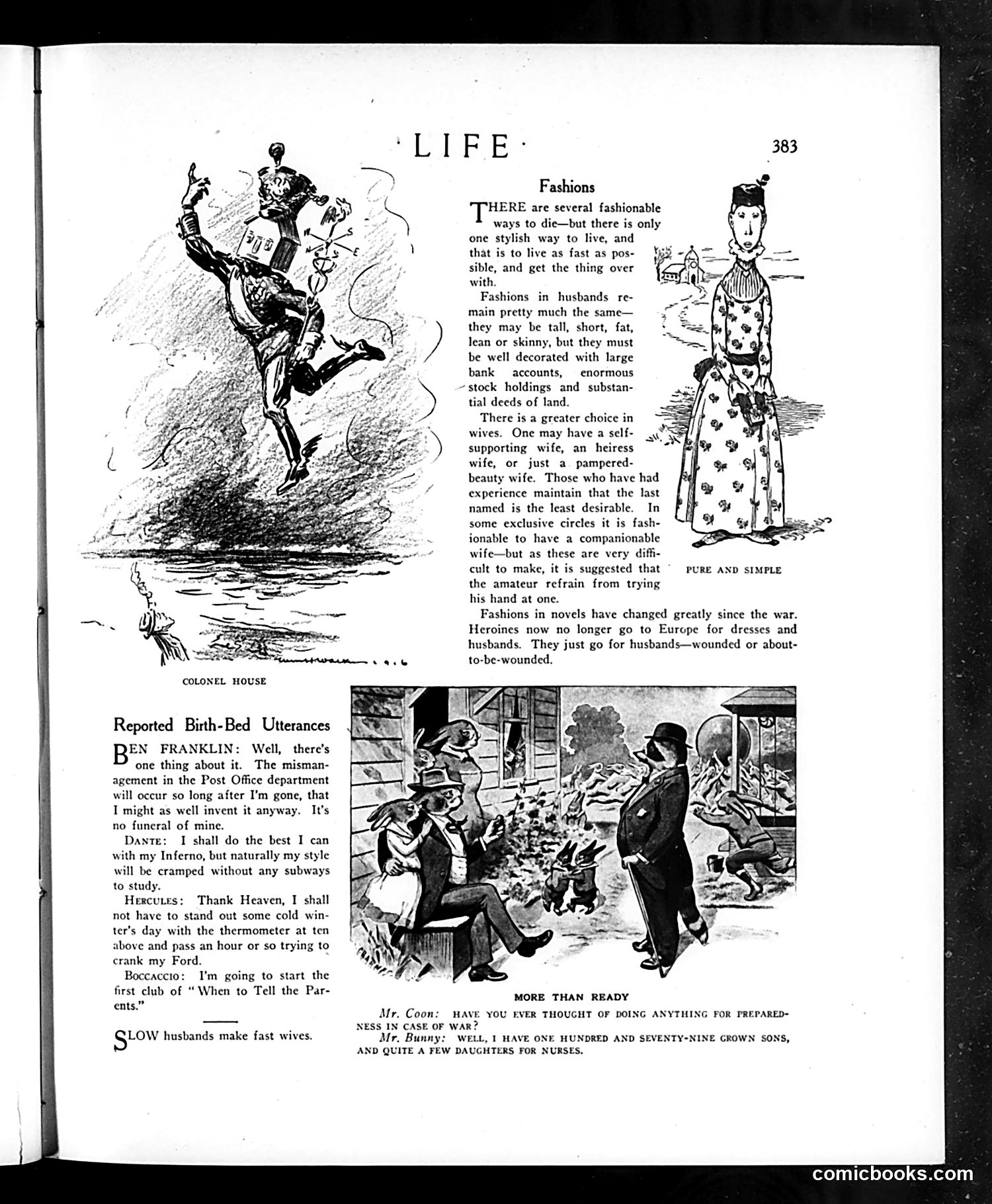
This page contains satirical commentary on early 20th-century social conventions. The "Fashions" essay mocks wealthy husbands' fashion requirements—they must be "well decorated with large bank accounts, enormous stock holdings and substantial deeds of land." For wives, there's commentary on post-war dating: heroines no longer pursue European titled husbands but instead seek "husbands—wounded or about-to-be-wounded." The "Reported Birth-Bed Utterances" section presents humorous dialogue about matrimonial arrangements. The lower cartoon "More Than Ready" depicts a man boasting of having "one hundred and seventy-nine grown sons, and quite a few daughters for nurses"—satirizing large families' patriarchal structures and women's expected domestic roles as caregivers.
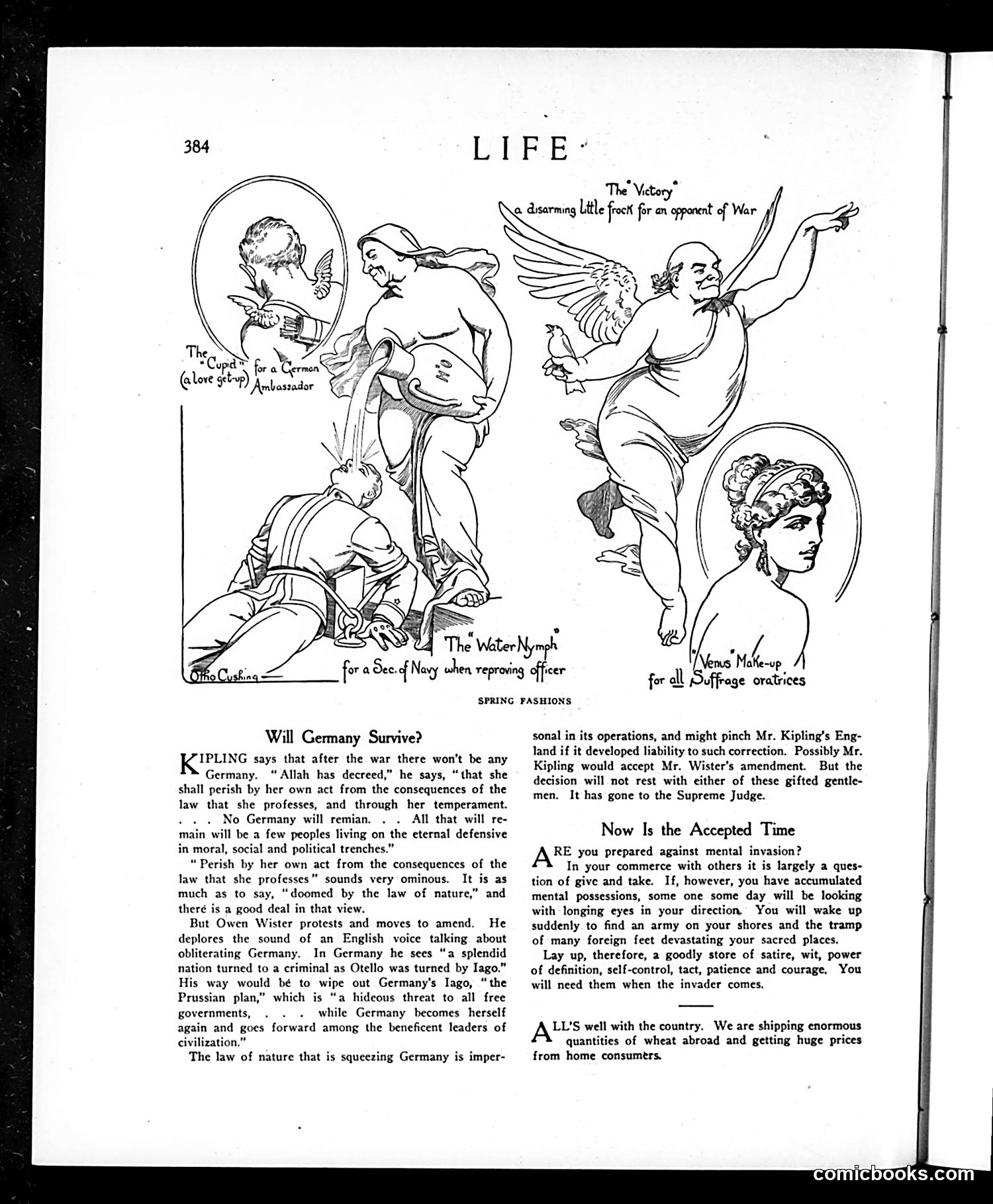
This page contains satirical illustrations labeled as "Spring Fashions," mocking German and British figures during WWI. The cartoons feature: - **"The Cupid" (for a German Love gift-up)**: A cherub holding what appears to be military equipment - **"The Water Nymph"**: A water sprite labeled "for a Sec of Navy when reproing officer" - **"The Victory"**: An angel figure described as "a disarming little frock for an opponent of War" - **"Venus Make-up"**: A classical female head, "for all Suffrage oratrices" Below, the text debates Kipling's statement that Germany cannot survive post-war, with Owen Wister arguing Germany should be eliminated as a threat. The satire ridicules both German militarism and British political figures through absurdist "fashion" commentary.
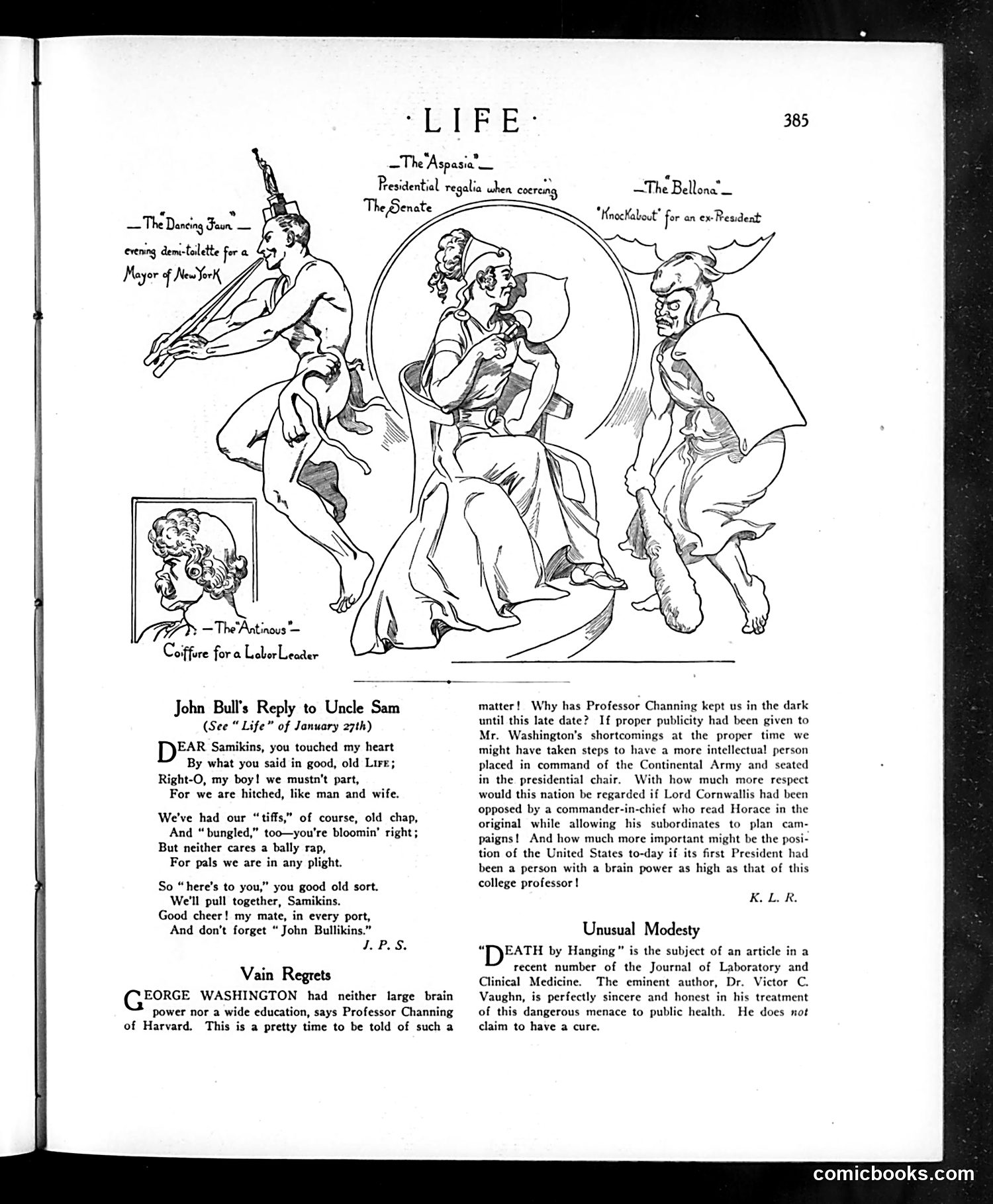
This page satirizes early American politics and government incompetence. The top cartoon depicts three demonic or devilish figures labeled "The Dancing Tarn," "The Senate," and "The Bellona," surrounding what appears to be presidential authority. The accompanying poem "John Bull's Reply to Uncle Sam" mocks American governance. The section titled "Vain Regrets" attacks Professor Channing of Harvard for claiming George Washington lacked intellectual capacity and broad education. The author sarcastically suggests this is poor timing—implying Washington's mediocrity would be dangerous if true, given his historical importance. A separate piece, "Unusual Modesty," discusses a medical journal article about suicide by hanging, praising the author's honest treatment of this dangerous topic. The overall tone critiques both political institutions and intellectual figures.
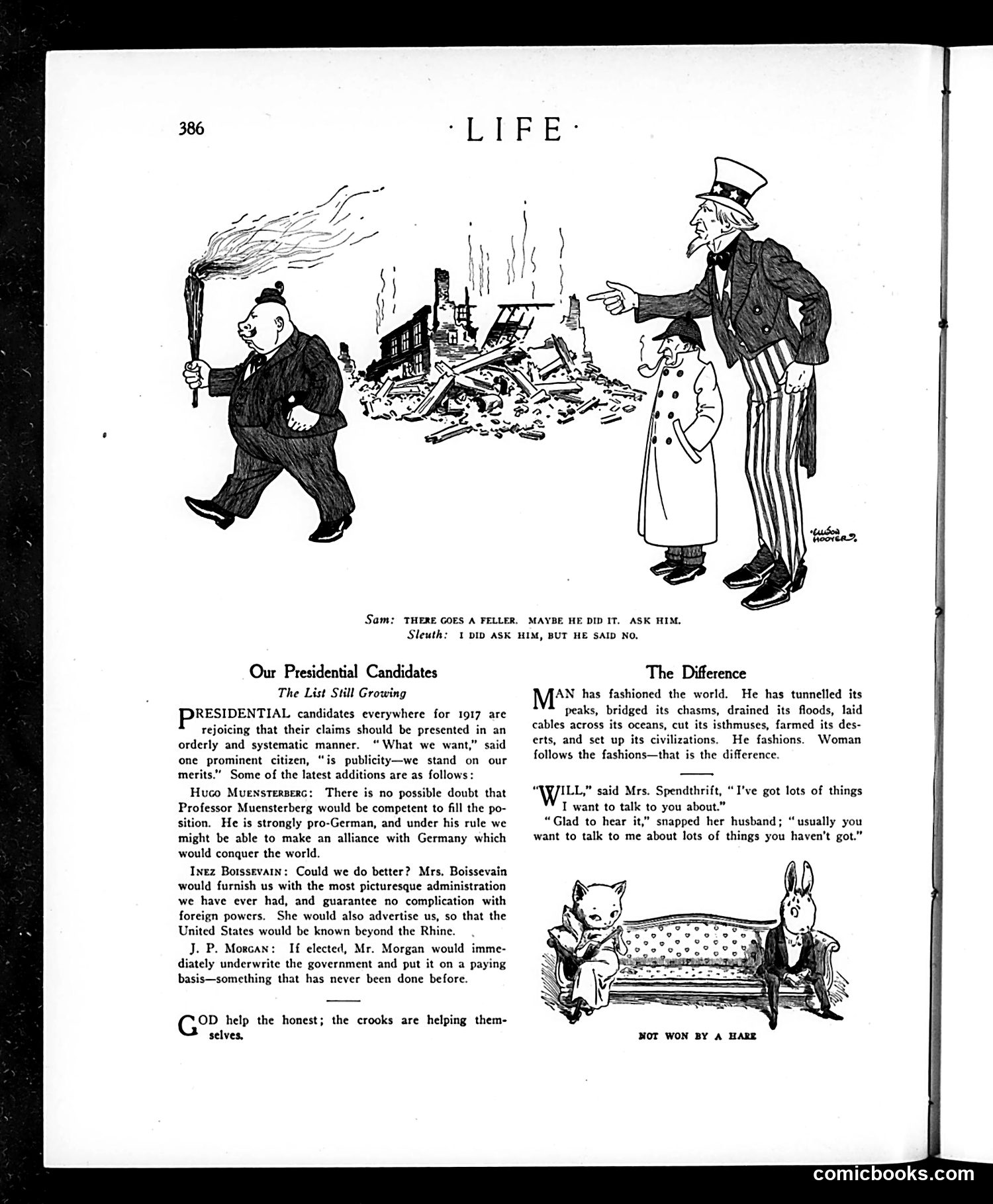
The top cartoon satirizes the 1917 presidential race. A figure carrying a flaming torch (likely representing anarchism or radicalism) runs past burning buildings. An Uncle Sam figure points accusingly while a woman looks on—suggesting candidates are blamed for urban destruction and civil unrest. Below, the text mocks three presidential hopefuls: - **Hugo Muensterberg**: A German-sympathizer whose presidency would allegedly ally America with Germany - **Irez Boissevaln**: Would provide "picturesque administration" but risk foreign complications - **J.P. Morgan**: Would commercialize government on a "paying basis" The closing line—"God help the honest; the crooks are helping themselves"—expresses cynicism that corrupt politicians dominate the race regardless of who wins.
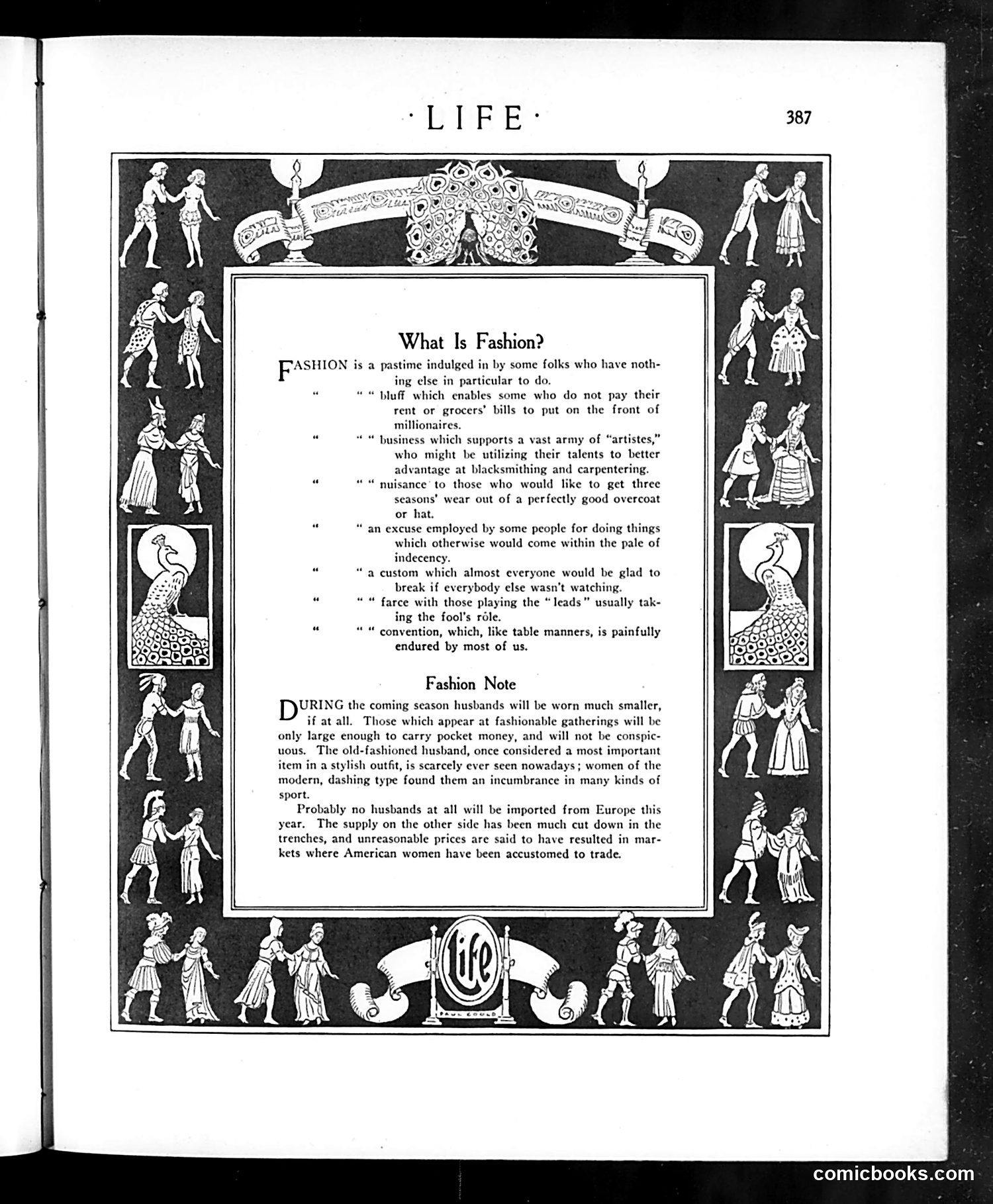
This page contains satirical definitions of fashion, presented as humorous observations rather than traditional dictionary entries. The satire mocks fashion as: - A pastime for idle wealthy people unable to pay bills - A business exploiting artists' talents unnecessarily - A nuisance forcing people to discard perfectly good clothing - An excuse for socially questionable behavior - A custom people break when unwatched - A "farcical" social performance - An unbearable convention The decorative border features classical figures in various poses, suggesting fashion's supposed connection to timeless elegance—ironically contrasting with the text's cynical view that fashion is frivolous waste. The "Fashion Note" section discusses husbands becoming smaller/less visible in fashion, likely satirizing women's liberation or changing gender dynamics of the era.
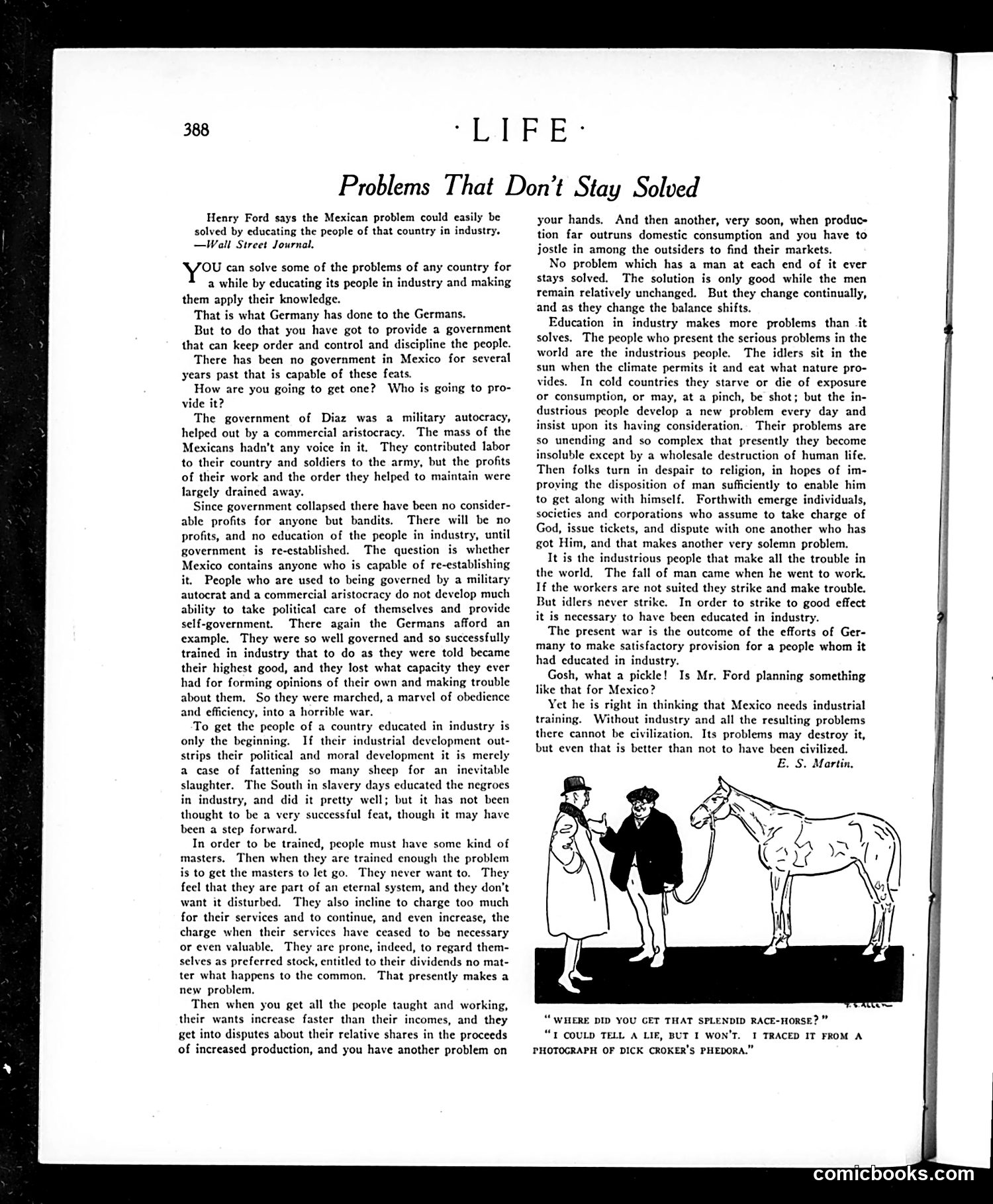
This page satirizes Henry Ford's naive proposal that Mexico's problems could be solved through industrial education. The cartoon (bottom right) depicts a woman admiring a man's horse, with his claim that he traced it from a Dick Croker photograph—a joke about fabricated origins masking inferior reality. The article's central argument: Ford's solution ignores that industrial training without stable government and moral development merely creates new problems. The author uses Germany as a cautionary example—their people became so disciplined through industrial training that they lost independent thinking and marched obediently into World War I. The satire targets the assumption that economic solutions alone fix social problems. The piece argues that once people are educated and prosperous, they demand political power, higher wages, and markets for overproduction—generating endless new conflicts. The real problem isn't education but human nature: masters never voluntarily surrender control, and solving one problem inevitably creates another. It's fundamentally skeptical of technocratic fixes for complex human and political systems.
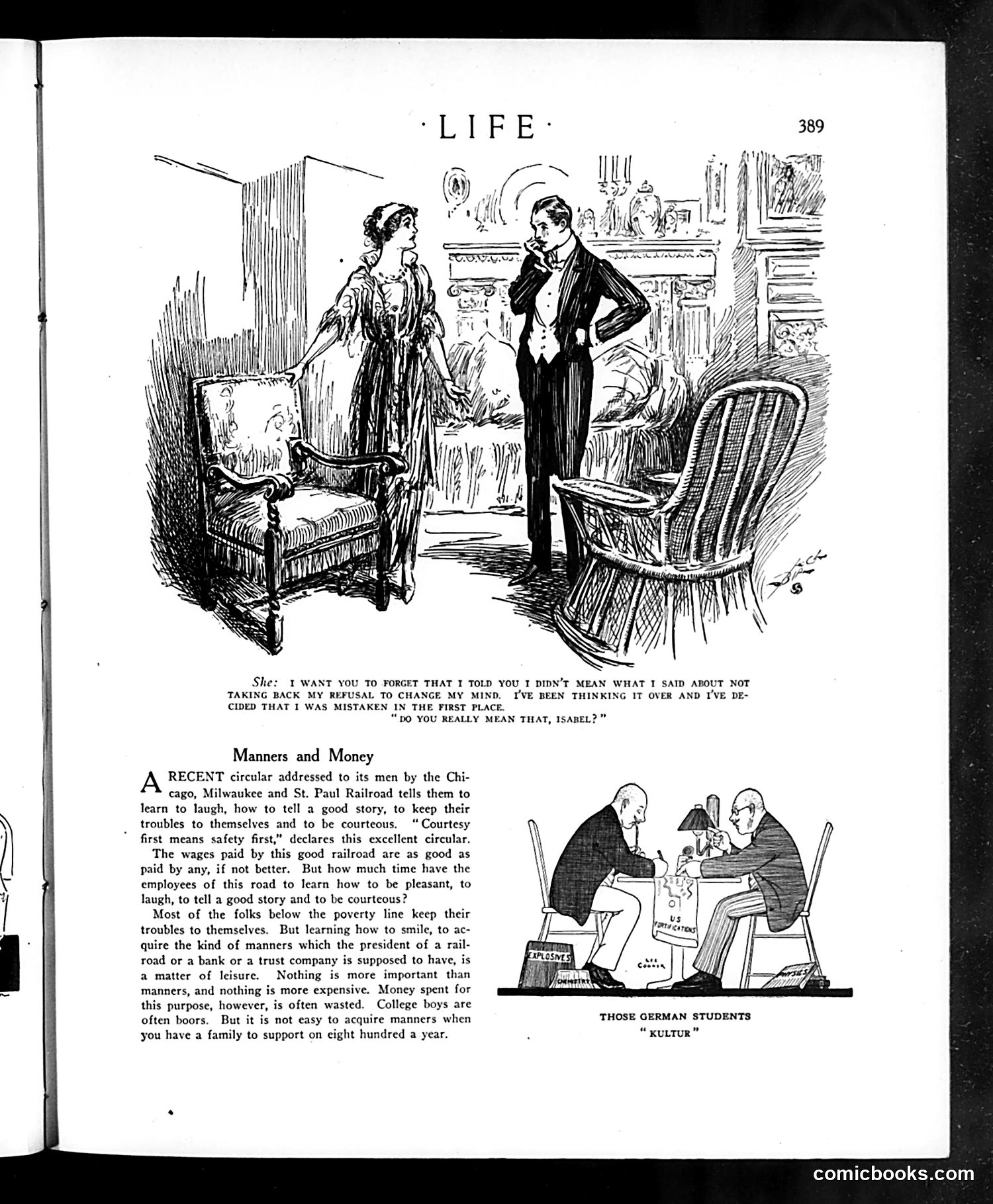
**Top Cartoon:** A domestic humor piece depicting a woman explaining a confusing reversal of her previous refusal to a man (presumably her suitor). The joke relies on the circular logic of her statement—she's asking him to forget contradictory things she said, illustrating female indecisiveness as a satirical trope common to the era. **Article & Bottom Cartoon:** The piece critiques a railroad company's circular instructing employees to be courteous and learn to laugh, arguing this is impractical advice for working-class employees earning minimal wages who must support families. The satire points out that good manners require leisure and money—luxuries the poor lack. The bottom illustration, captioned "Those German Students—'Kultur,'" appears to show two men at a table (likely German university students), sarcastically referencing German "kultur" (culture/refinement). This likely critiques the gap between claimed cultural superiority and actual behavior—echoing the article's theme that manners cannot be purchased or taught without financial means.
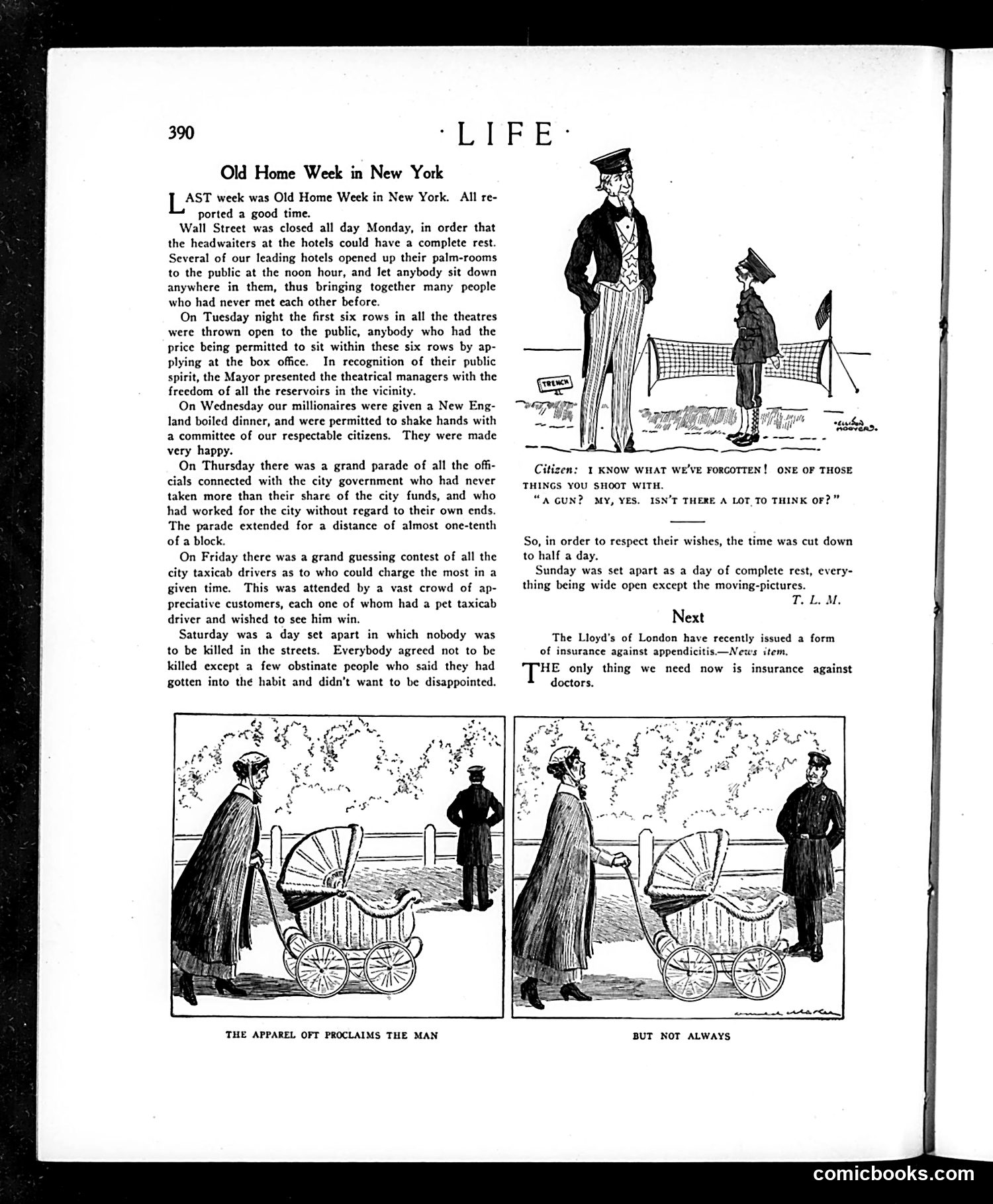
**"Old Home Week in New York"** is a satirical piece mocking both the city's self-congratulatory civic celebration and its endemic corruption and dysfunction. The article uses absurdist humor to expose hypocrisy: Wall Street closes so hotel workers rest; theaters open six rows to common people as "generosity"; officials given a parade are those who *didn't* embezzle (parade lasts "almost one-tenth of a block"—implying almost no honest officials exist); taxicab drivers compete on overcharging; and Saturday's promise of no street deaths is abandoned halfway through because people are "habituated" to dying in traffic. **The two cartoons** illustrate the saying "apparel oft proclaims the man"—a woman's fine clothing suggests respectability in the first panel, but the second shows this tells nothing about actual character ("but not always"). **The "Next" section** jokes that Lloyd's insurance against appendicitis means society's real need is insurance against doctors themselves—a jab at medical incompetence or over-treatment. The satire targets urban corruption, class hypocrisy, and public safety failures.
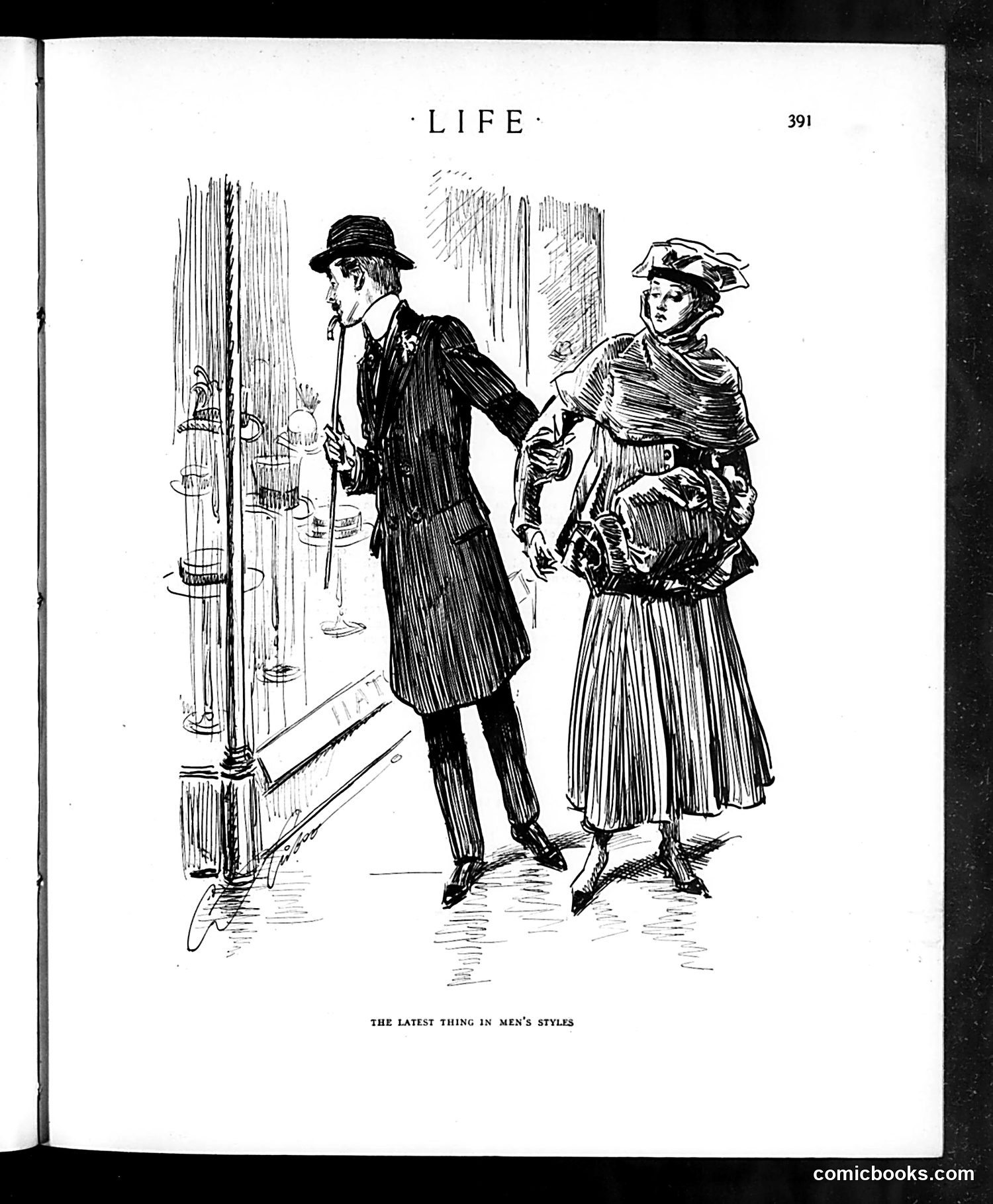
This is a satirical cartoon from *Life* magazine mocking contemporary men's fashion. The illustration shows a man in a pinstriped suit and bowler hat displaying what appears to be an exaggerated or absurd clothing item (visible on the left as a tall, ornate display) to a fashionably dressed woman wearing a hat and coat. The satire targets the fashion industry's promotion of ridiculous or impractical "latest styles" for men. The cartoon suggests that men's fashion trends are becoming increasingly ridiculous or effeminate, with the woman's skeptical expression implying she finds the displayed item ridiculous. This reflects early 20th-century anxieties about evolving masculine fashion standards and satirizes how eagerly fashion-conscious men adopt new, sometimes questionable trends.
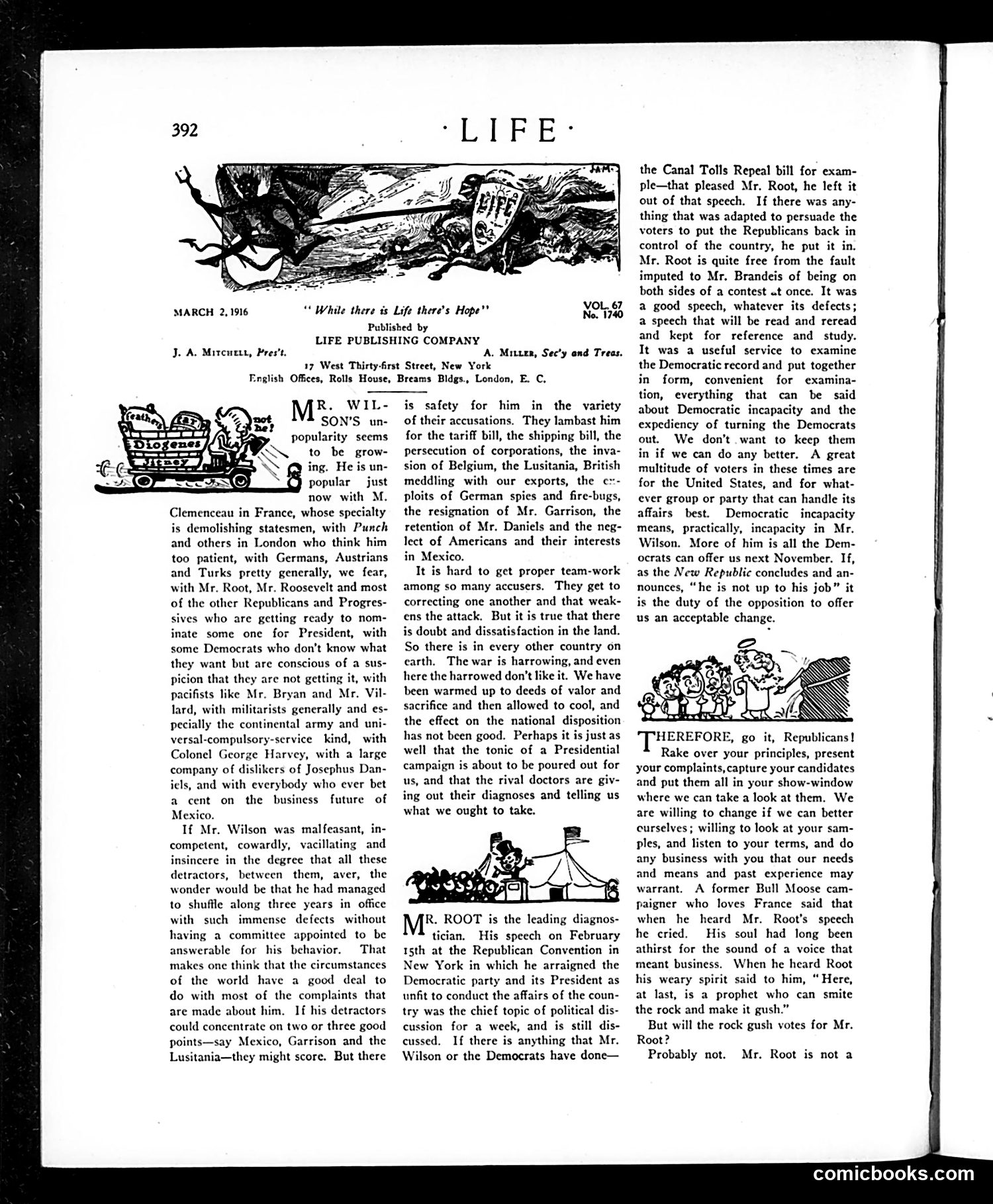
This Life magazine editorial page satirizes President Woodrow Wilson's widespread unpopularity across the political spectrum. The article argues that Wilson faces criticism from incompatible groups—French leaders, British commentators, Germans, American pacifists like Bryan, militarists, Republicans (including Theodore Roosevelt and Elihu Root), discontented Democrats, and those upset over Mexico policy and the Lusitania incident. The satire's point: Wilson's critics are so numerous and contradictory that their attacks actually *protect* him. They cancel each other out, making coordinated opposition difficult. The piece notes Root's recent Republican Convention speech attacking Wilson, but suggests that amid such cacophonous complaints, no single narrative sticks. The cartoons (a figure labeled "Life" and political figures) visually reinforce this theme of chaotic opposition and national anxiety during the pre-WWI period.
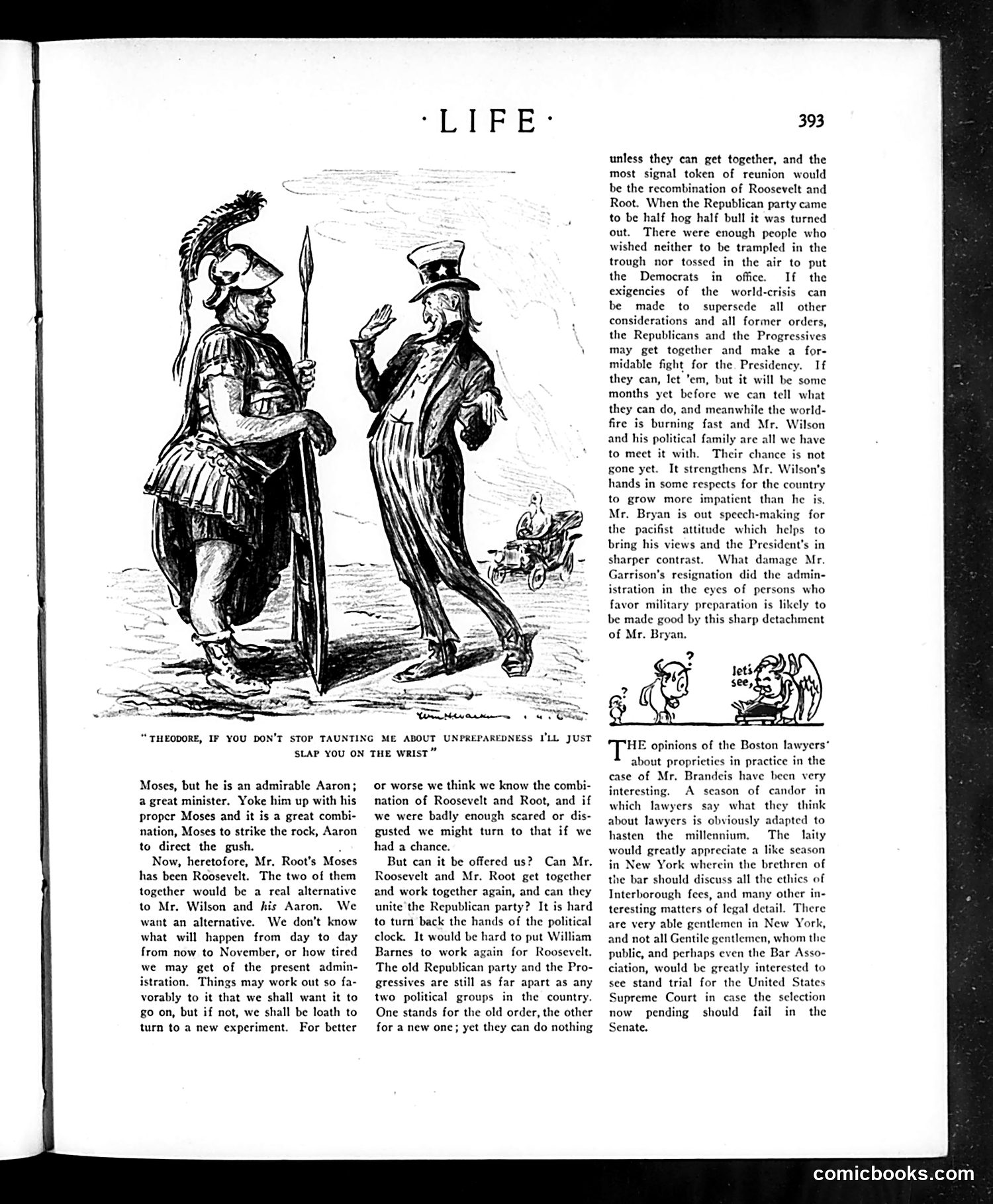
The cartoon depicts **Theodore Roosevelt** (left, in military garb) confronting **Elihu Root** (right, in formal dress), with the caption "THEODORE, IF YOU DON'T STOP TAUNTING ME ABOUT UNPREPAREDNESS I'LL JUST SLAP YOU ON THE WRIST." This satirizes **Roosevelt's aggressive advocacy for military preparedness** versus the **Wilson administration's pacifist stance**. The article discusses whether Roosevelt and Root—former Republican allies—could reunite politically to challenge President **Wilson** in the upcoming 1916 election. The "Moses and Aaron" metaphor compares their complementary leadership styles. The satire mocks Roosevelt's combative rhetoric on preparedness while suggesting reuniting Republicans and Progressives (split since 1912) remains difficult. The page also references **William Jennings Bryan's** pacifist speech-making and **Secretary of War Garrison's resignation**, contextualizing domestic political divisions over America's military readiness as World War I raged in Europe.
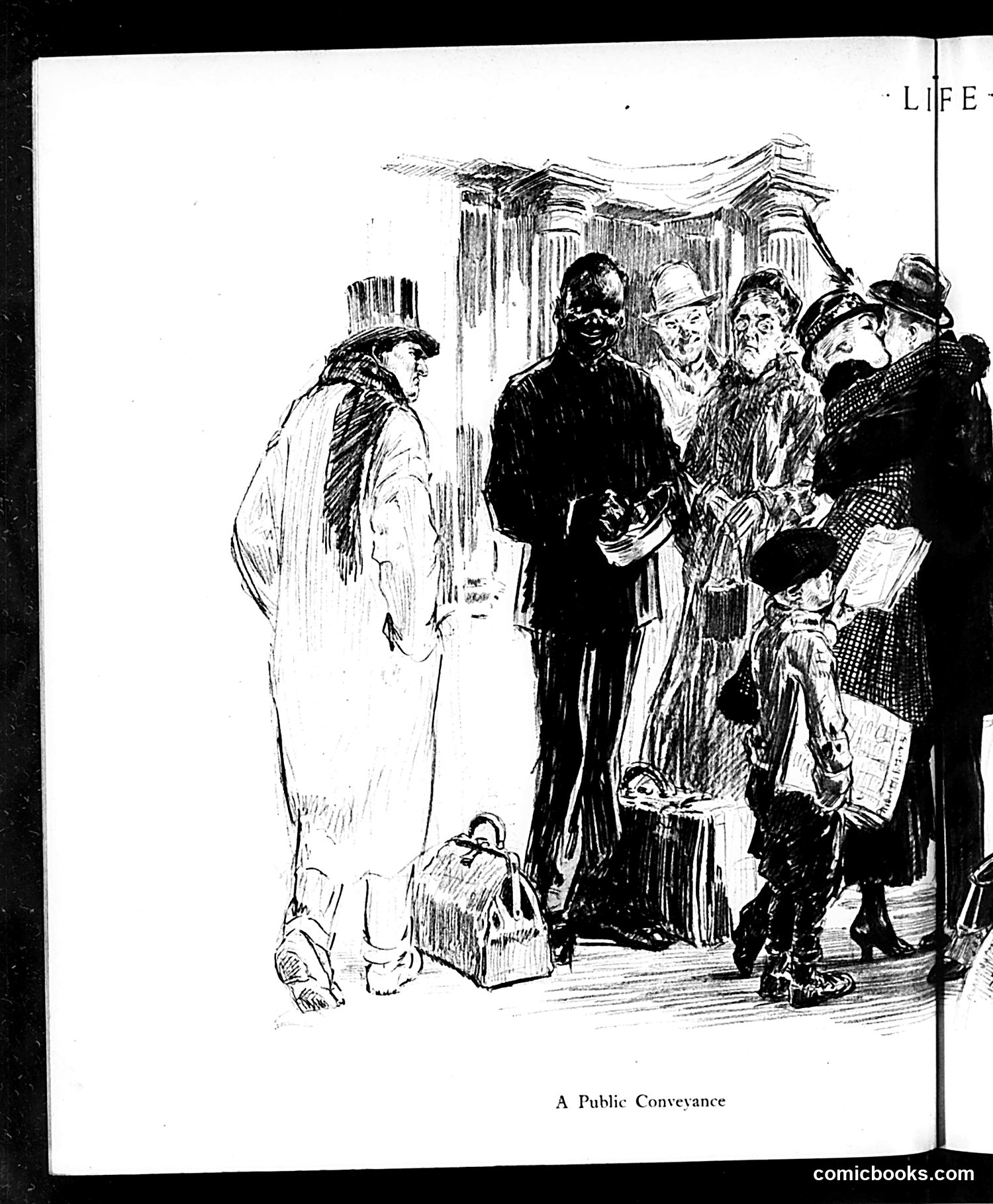
This satirical cartoon depicts a crowded indoor scene—likely a streetcar, train, or similar public transportation—where a well-dressed gentleman in a light overcoat stands apart on the left, observing a group of working-class passengers on the right. The contrast in shading emphasizes their separation: he's rendered in light lines while they're heavily inked, suggesting class distinction. The title "A Public Conveyance" suggests social commentary about urban transportation and class interactions. The cartoon likely satirizes either the discomfort of mingling social classes in shared public spaces, or perhaps critiques the gentleman's evident detachment from ordinary commuters. The sketch style and composition emphasize the psychological or social distance despite physical proximity—a common theme in early 20th-century American satire about urbanization and class dynamics.
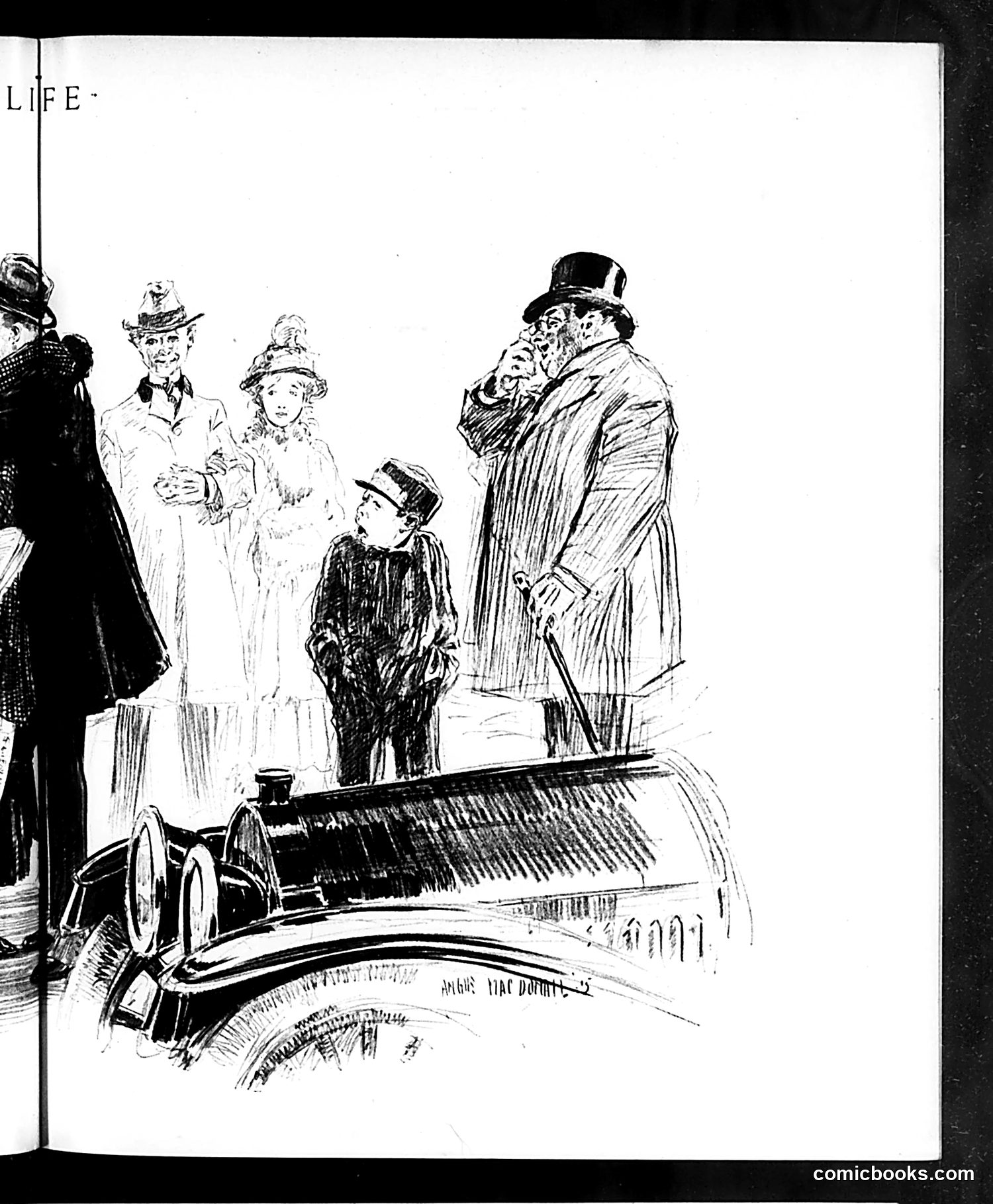
This Life magazine cartoon depicts a wealthy gentleman in a top hat examining a small child next to an expensive racing automobile. Several well-dressed onlookers observe the scene. The satire appears to critique **wealth inequality and child labor or exploitation** during the Gilded Age/early 20th century. The contrast between the opulent car (a luxury item symbolizing excessive wealth) and the small, poorly-dressed child suggests commentary on how the rich enjoyed extravagant pleasures while children suffered poverty or were forced into labor. The gentleman's proprietorial gesture and the onlookers' presence suggest this represents a public commentary on the moral disconnect between the wealthy elite and the vulnerable poor—a common satirical theme in Life magazine during this era.
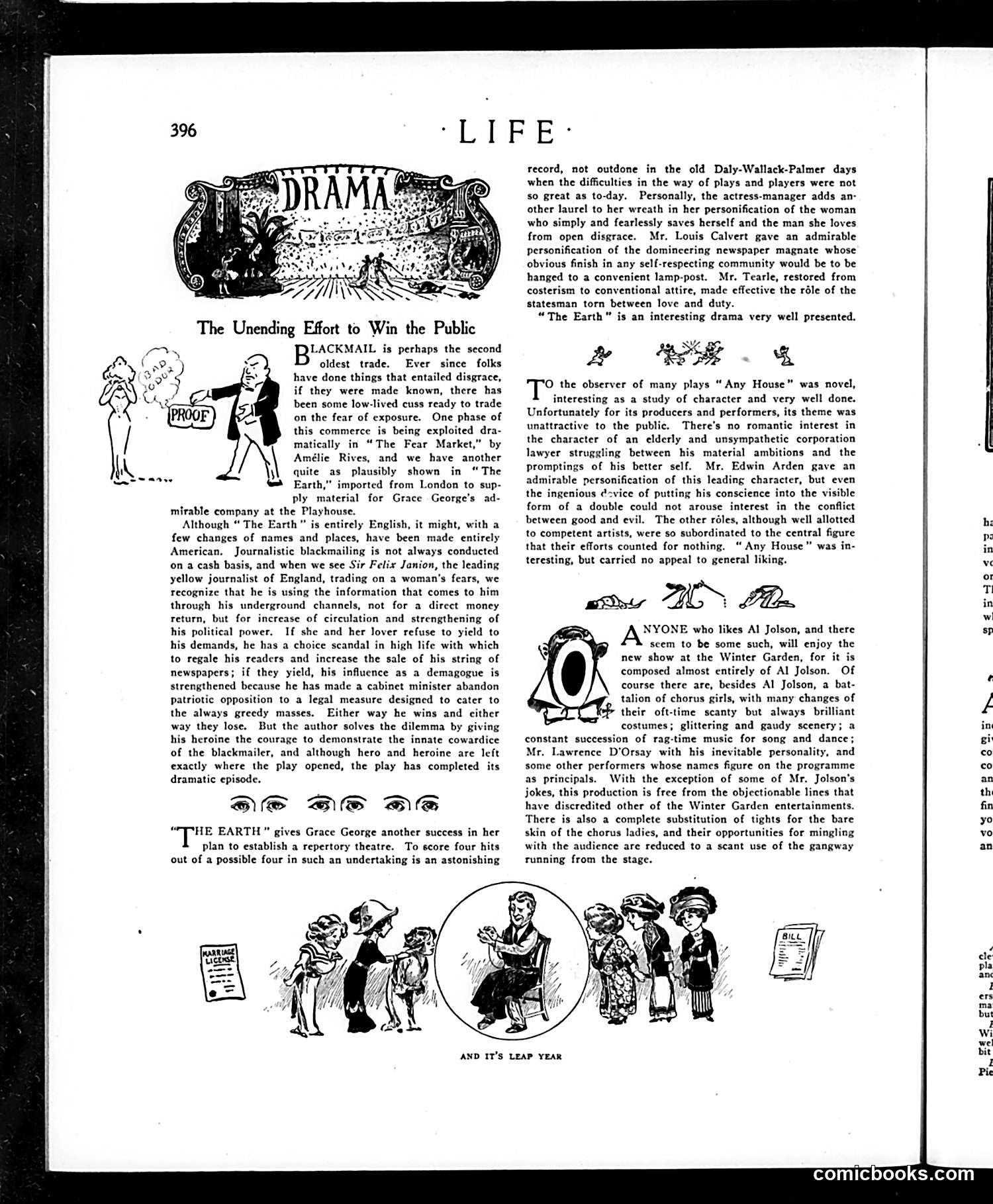
This page reviews three theatrical productions from early 20th-century New York. **"The Fear Market"** and **"The Earth"** are plays about blackmail—specifically, a corrupt newspaper magnate (Sir Felix Janion) exploiting a woman's secrets for political power. The satire targets **journalistic blackmail** as a real commercial practice: editors threaten exposure not for direct payment but to increase circulation and political influence. The review notes this is "entirely English" but applies equally to America, suggesting the practice was recognized on both sides of the Atlantic. **"Any House"** reportedly failed because audiences found its protagonist—an elderly corporate lawyer torn between ambition and conscience—dramatically uninteresting, despite competent acting. The page also previews an **Al Jolson show** at the Winter Garden. The cartoon at top-left illustrates the blackmail theme: a man labeled "PROOF" presents damaging evidence to a woman, symbolizing how journalists weaponized information for leverage.
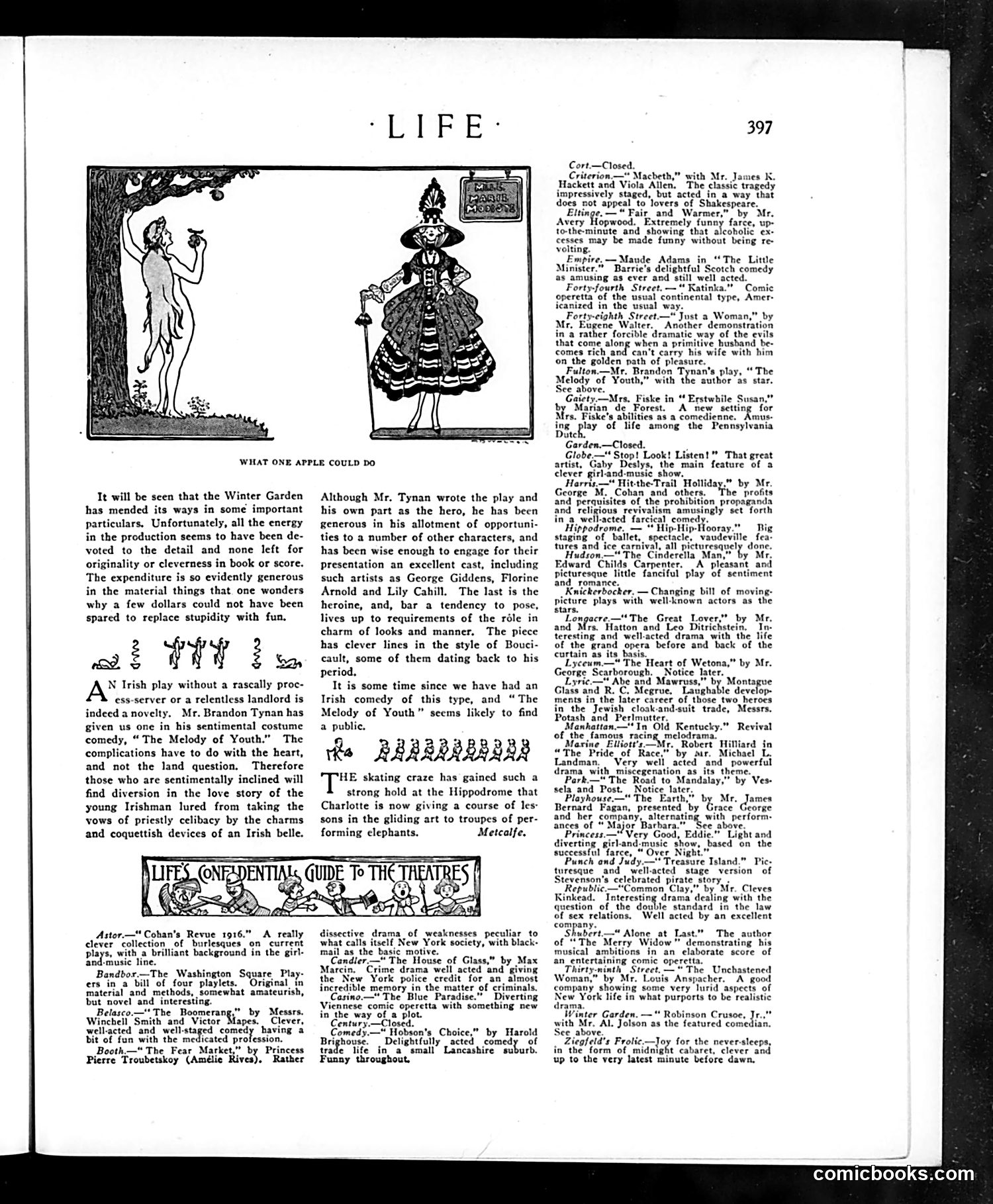
This page features two satirical cartoons and theatre reviews from Life magazine. The main cartoon (top) depicts a classical nude female figure (representing temptation or mischief) beside an elaborate, overdressed lady, illustrating the caption "What One Apple Could Do." This references the Biblical story of Eve and the Apple—suggesting how one small, seemingly innocent thing can cause major consequences or corruption. Below is a separate cartoon showing performing elephants learning to ice skate at the Hippodrome theatre, captioned by artist Metcalfe. This is absurdist humor mocking the era's elaborate theatrical spectacles—the joke being the sheer ridiculousness of training elephants in a refined activity like ice skating. The remainder of the page comprises theatre reviews criticizing various Broadway productions for prioritizing lavish production values over actual quality writing or entertainment, with the opening review particularly harsh: expensive sets cannot compensate for "stupidity" in the script.
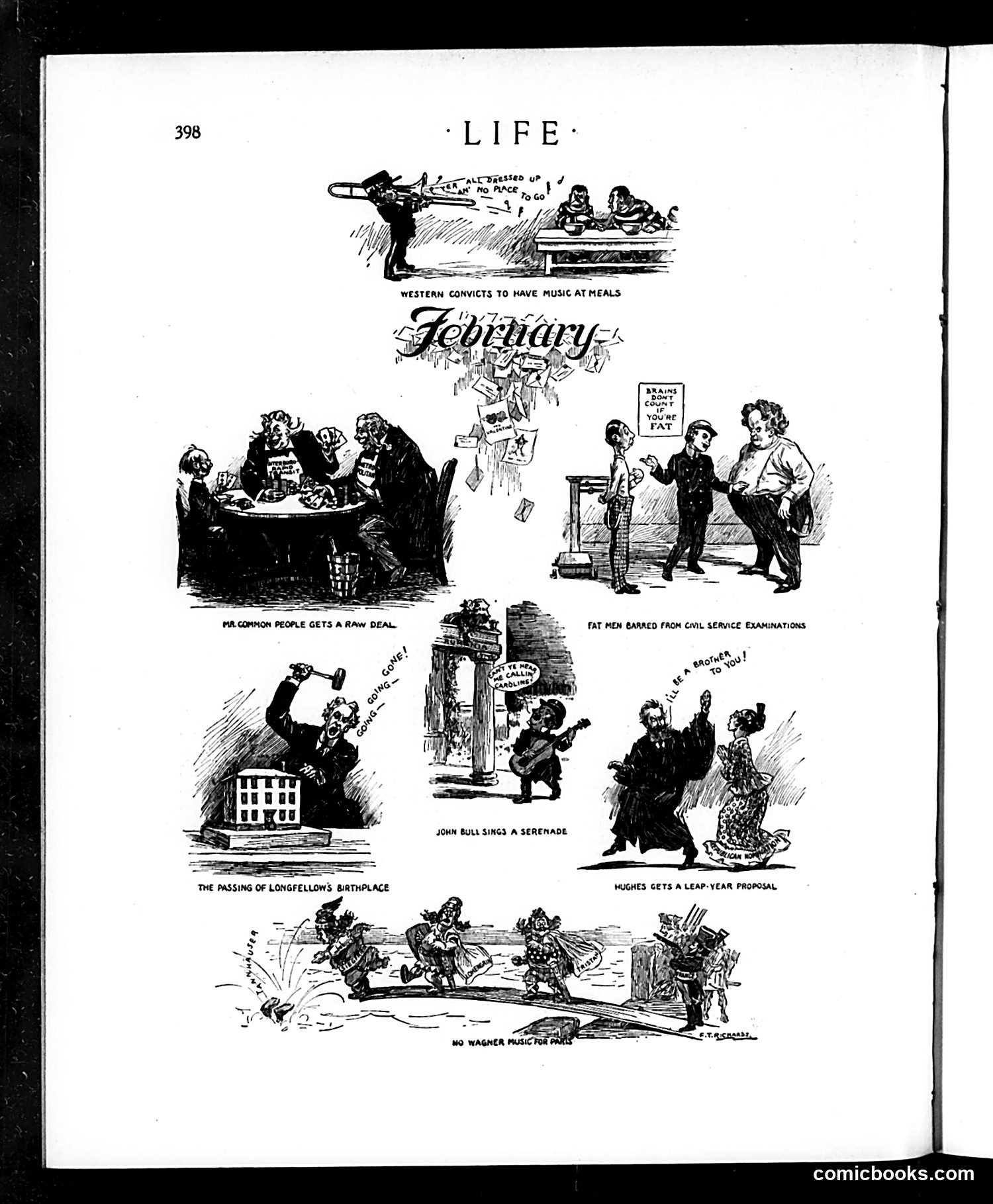
This page contains six separate satirical cartoons commenting on contemporary social issues: 1. **"Western Convicts to Have Music at Meals"** - Mocks prison reform. 2. **"Mr. Common People Gets a Raw Deal"** - Shows ordinary citizens excluded from dining/privileges. 3. **"Fat Men Barred from Civil Service Examinations"** - Satirizes government employment discrimination based on physical appearance. 4. **"The Passing of Longfellow's Birthplace"** - Appears to critique demolition of historical sites. 5. **"John Bull Sings a Serenade"** - References Britain (John Bull as national symbol), likely political commentary. 6. **"Hughes Gets a Leap-Year Proposal"** and **"No Wagner Music for Prose"** - Unclear without fuller context, but involve courtship and cultural references. The cartoons use exaggeration and caricature to criticize government policies, class divisions, and social absurdities of the era.
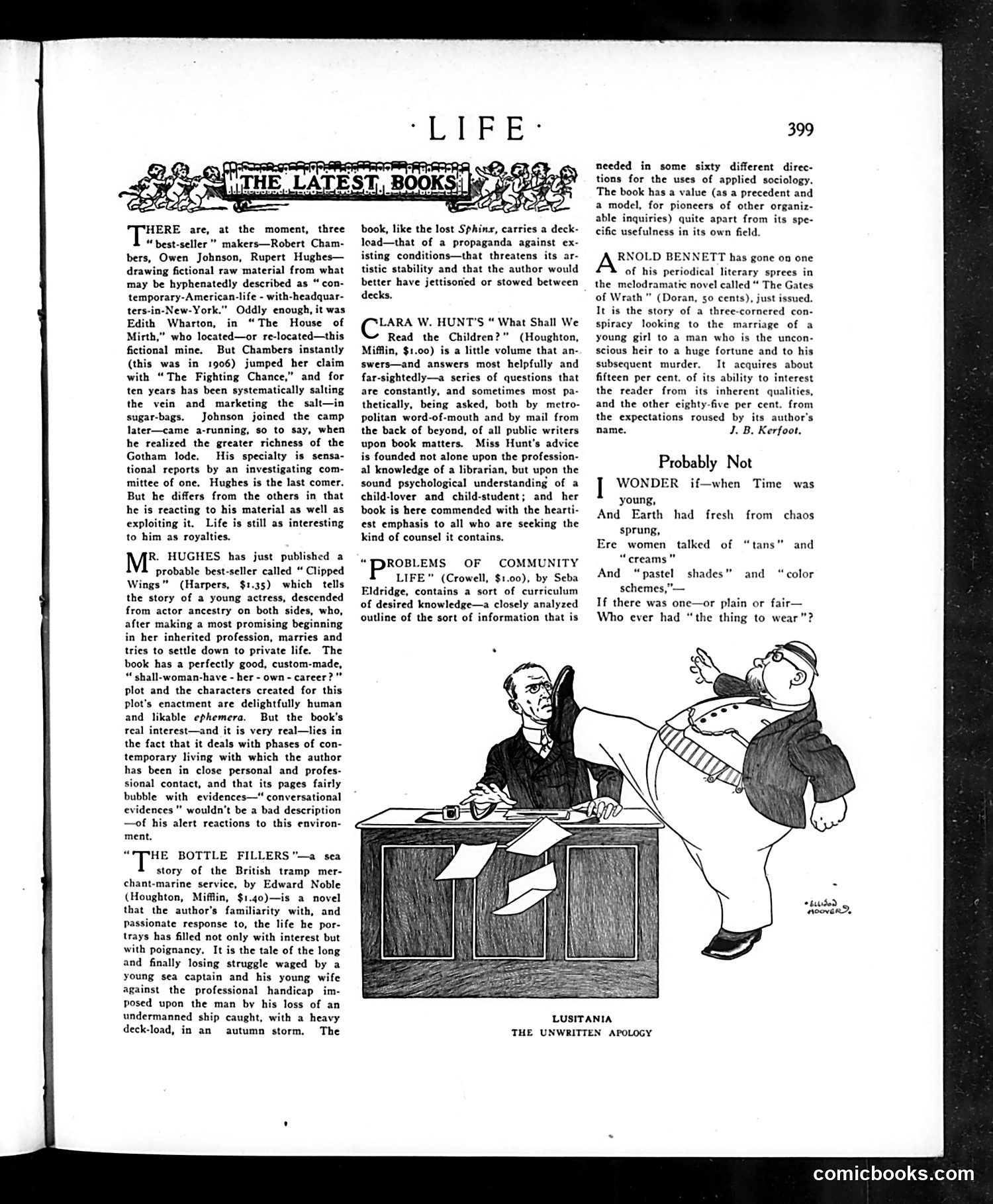
This page reviews contemporary American bestselling authors (Robert Chambers, Owen Johnson, Rupert Hughes) who mined "New York" contemporary life for fiction—a literary trend initiated by Edith Wharton's *The House of Mirth*. The review praises Rupert Hughes' *Clipped Wings* for authentically depicting modern life, particularly regarding women's career versus marriage conflicts. Edward Noble's *The Bottle Fillers* receives mixed reviews for its sea-story authenticity but criticism for heavy-handed social propaganda. Clara W. Hunt's children's book guide and Seba Eldridge's sociology text are also reviewed. The cartoon titled "Lusitania: The Unwritten Apology" depicts a man at a desk (likely representing official authority) with another figure gesturing defensively—likely referencing the 1915 German U-boat sinking of the *Lusitania*, satirizing inadequate diplomatic response or apology for the tragedy.
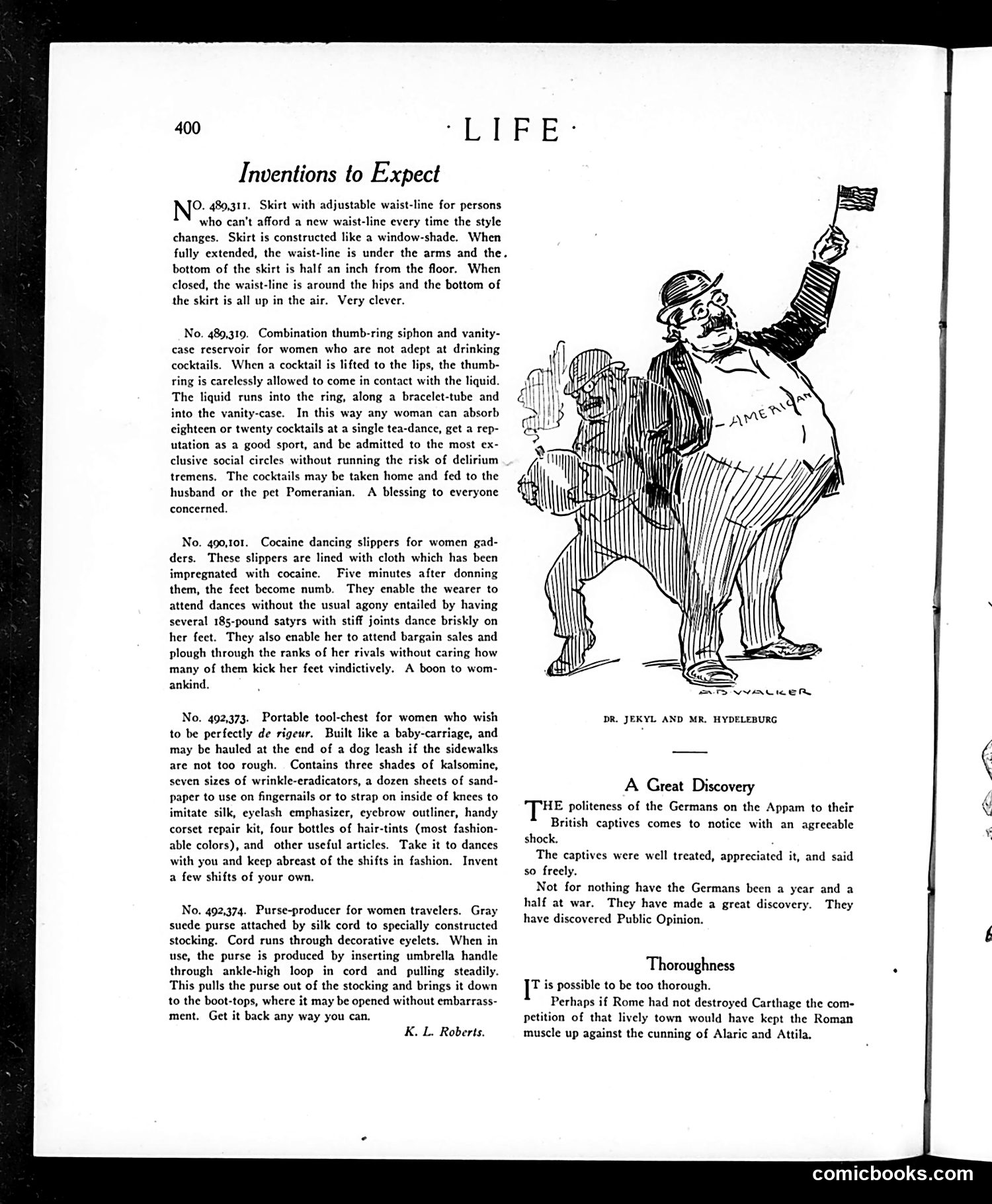
This page satirizes women's fashion, behavior, and social constraints in the early 20th century through absurdist "inventions." The humor targets: **Fashion obsession**: An adjustable skirt mocking women constantly changing waistlines to follow trends. **Drinking culture**: A cocktail device allowing women to consume alcohol secretly at social events while maintaining respectability—satirizing both Prohibition-era hypocrisy and expectations that women shouldn't visibly drink. **Dancing discomfort**: Cocaine-lined slippers for women enduring rough treatment from male dancers at social events, darkly joking about substance use as pain relief. **Vanity**: A portable beauty toolkit women must carry everywhere to maintain appearance. The cartoon of "Dr. Jekyll and Mr. Hyde" (labeled "Hydeleburg") appears to relate to separate articles about German conduct during WWI. The satire exposes the absurd contradictions women faced: fashion demands, social expectations of propriety mixed with pressure to be "good sports," and physical discomfort at entertainment venues—all presented as ridiculous "inventions" that shouldn't be necessary.
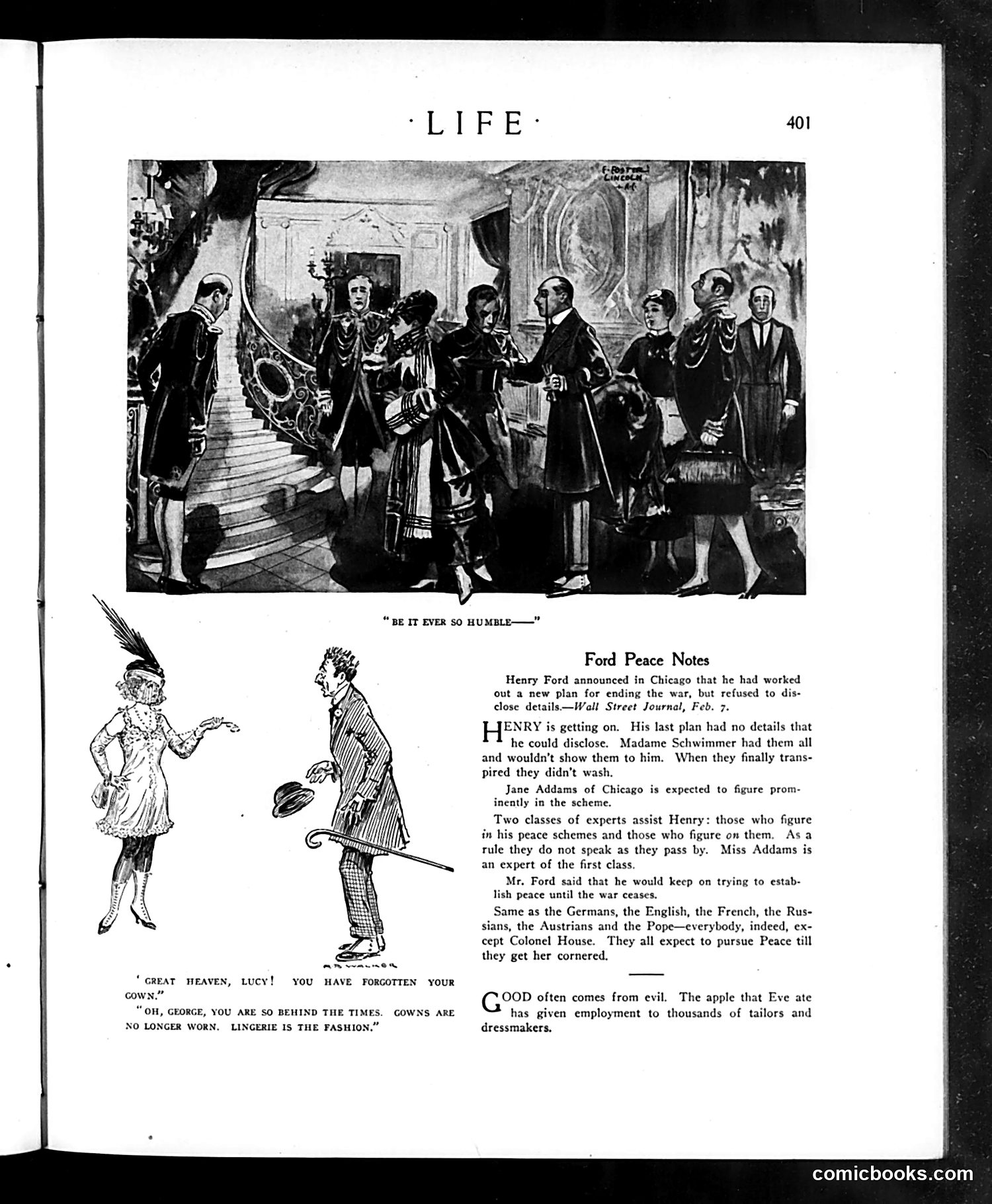
This Life magazine page satirizes Henry Ford's peace initiatives during World War I. The "Ford Peace Notes" section mocks Ford's announced plan to end the war—which he refused to detail publicly. The satire suggests his schemes lack substance and that associates like Madame Schwimmer and Jane Addams of Chicago possessed the actual plans Ford wouldn't disclose. The small cartoon above depicts a couple discussing fashion: a man protests that his wife has abandoned her gown for lingerie, calling her "behind the times." She retorts that gowns are "no longer worn" and "lingerie is the fashion." The cartoon likely satirizes changing social norms post-WWI—women's liberation and shifting gender roles—using fashion as a metaphor. The pairing with Ford's peace efforts suggests broader cultural disruption during wartime. The final paragraph's quip about Eve's apple employing tailors through dress-making reflects period attitudes about women's roles in society.
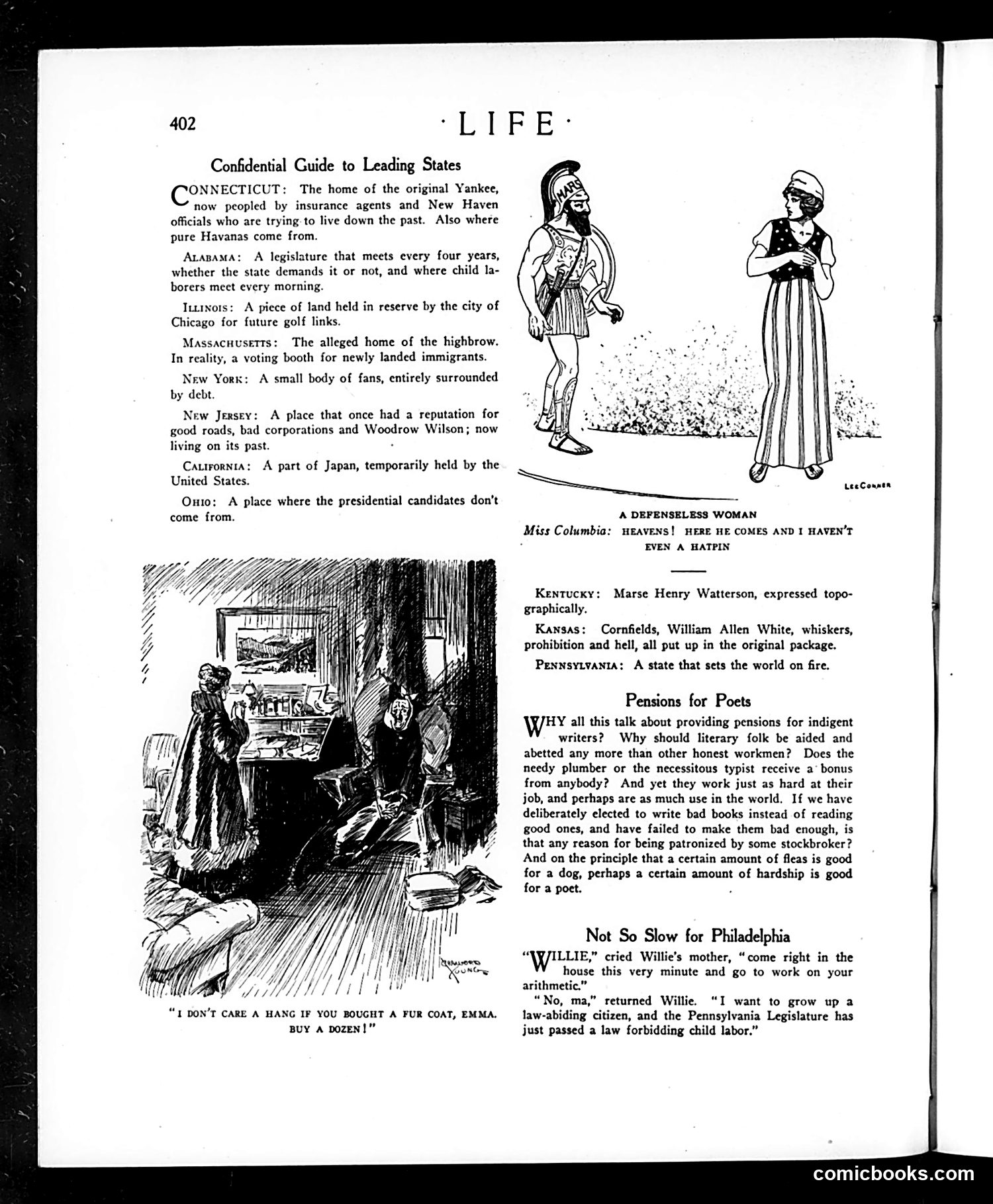
This page contains **state-by-state satirical descriptions** mocking American regional characteristics. Connecticut is criticized for being commercialized; Alabama for infrequent legislatures and child labor; Massachusetts for pretension despite being populated by immigrants; New York for debt; New Jersey for declining from its past reputation. The **cartoon "A Defenseless Woman"** depicts Miss Columbia (personification of America) alarmed at a man's approach, saying she lacks "even a hatpin"—a reference to the contemporary women's self-defense weapon. The accompanying dialogue mocks consumerism and marital dynamics of the era. **"Not So Slow for Philadelphia"** sarcastically celebrates Pennsylvania's new child labor law: Willie refuses to do arithmetic, claiming the law makes him a "law-abiding citizen" by prohibiting work—inverting the law's protective intent into an excuse for laziness. The overall tone reflects early 20th-century progressive critique of American institutions, regional stereotypes, and social contradictions.
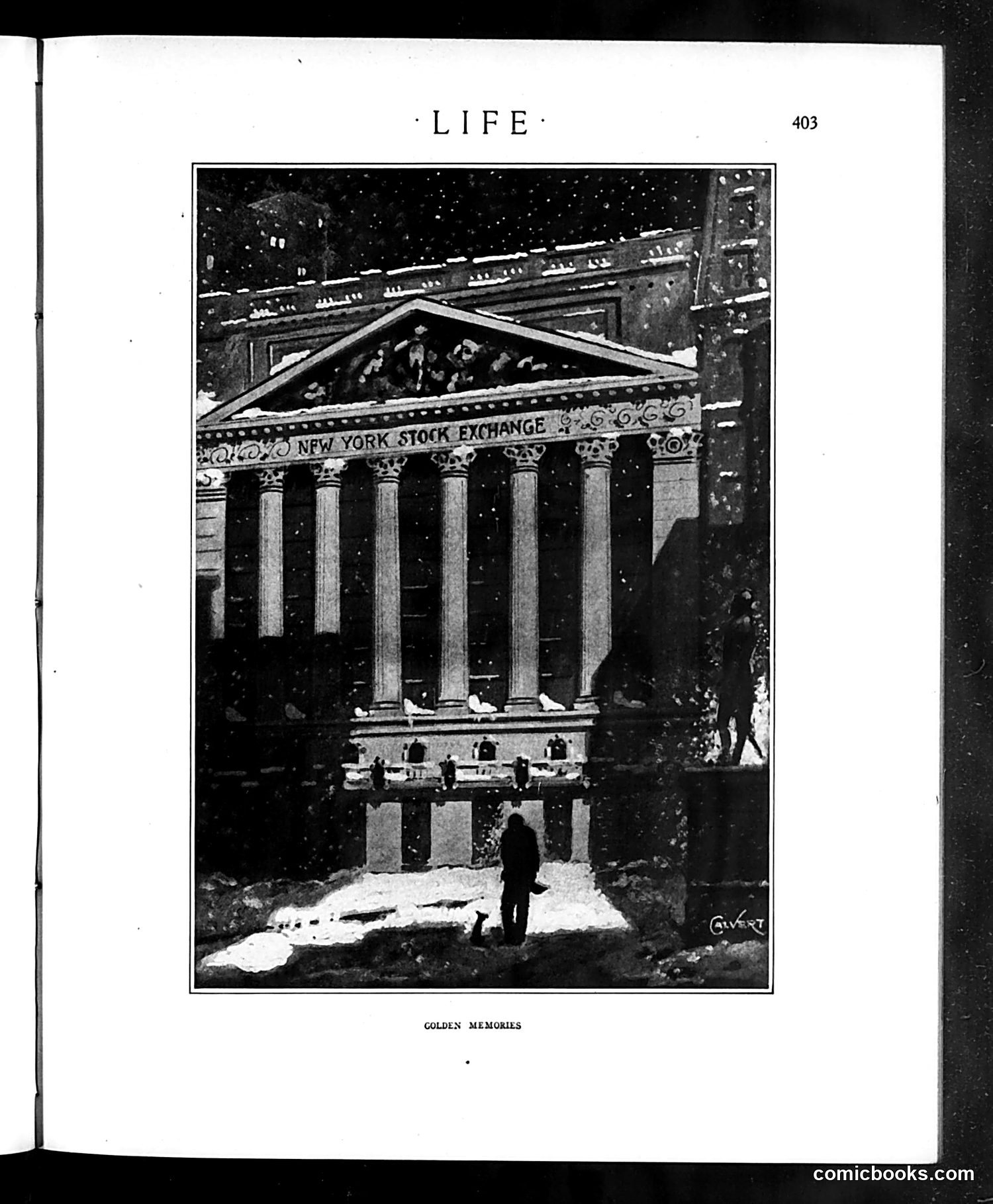
This appears to be a nighttime illustration of the New York Stock Exchange building, illuminated and snow-covered, with a lone figure standing in the foreground. The title "Golden Memories" suggests nostalgic reflection. The image likely satirizes either the glamour of Wall Street finance or, conversely, the hollowness of such "golden memories" during economic hardship. The solitary figure gazing at the grand neoclassical building could represent an ordinary person contemplating the distant world of high finance—either with longing or disillusionment. Without knowing the publication date, the exact satirical intent remains unclear. It could reference stock market crashes, wealth inequality, or the contrast between architectural grandeur and human struggle. The mood appears melancholic rather than celebratory.
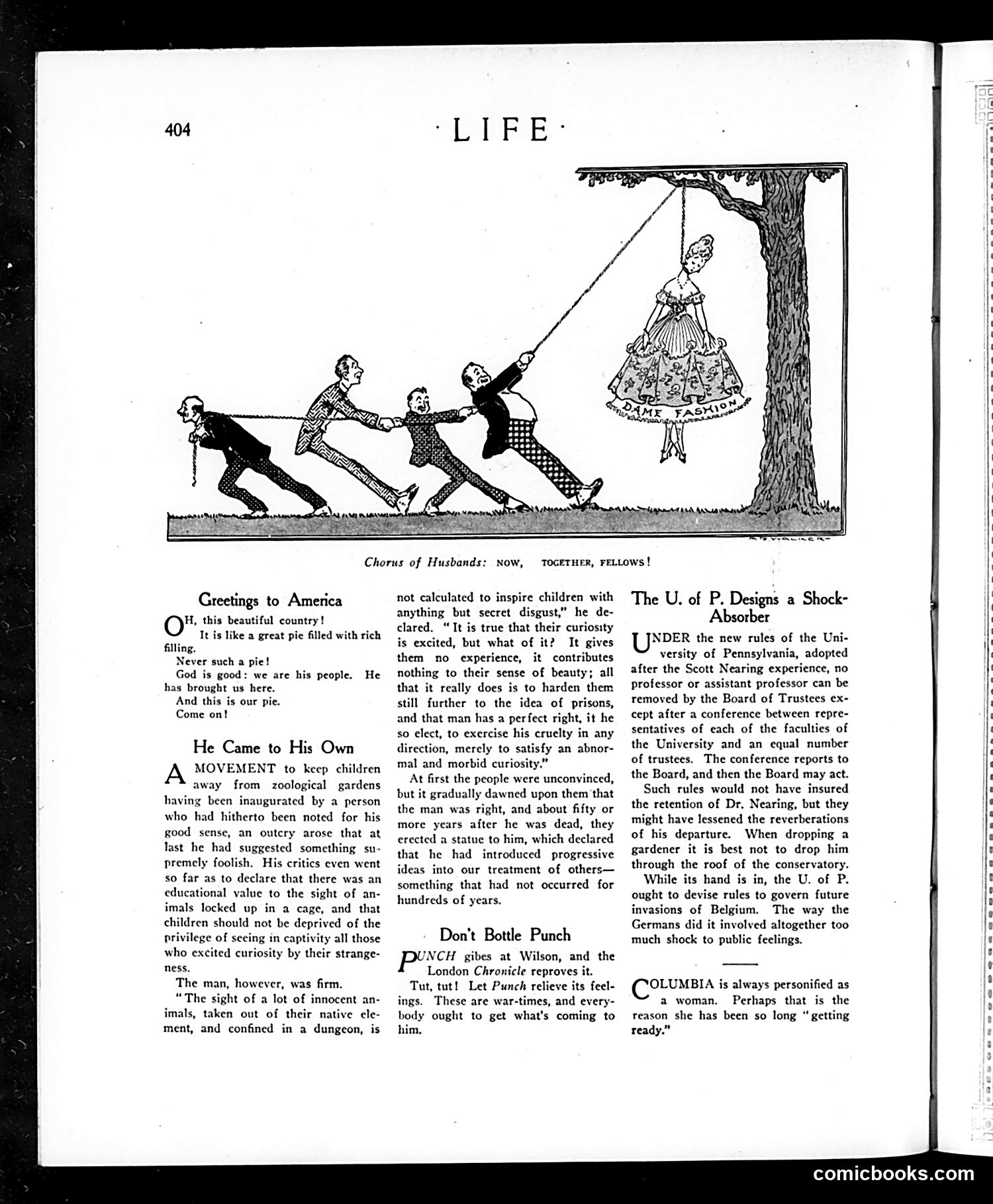
The top cartoon depicts four men in suits pulling on a rope attached to a woman suspended from a tree branch—labeled "Chorus of Husbands: now, together, fellows!" This satirizes male expectations that women should be obedient and controllable, presented as a coordinated effort ("together, fellows"). Below are three separate editorial pieces: **"Greetings to America"** mocks recent immigrants praising America as a "great pie"—satirizing their romanticized, possessive view of the country. **"He Came to His Own"** argues against displaying caged animals in zoos, suggesting confinement teaches children cruelty and disrespect for life—an animal-welfare advocacy piece. **"Don't Bottle Punch"** defends the satirical magazine *Punch* for criticizing President Wilson during wartime, arguing satire should be permitted as social relief. **"The U. of P. Designs a Shock-Absorber"** discusses University of Pennsylvania hiring protections following the Scott Nearing controversy (an academic freedom dispute), ironically suggesting they should also regulate future "invasions of Belgium"—referencing German atrocities in WWI.
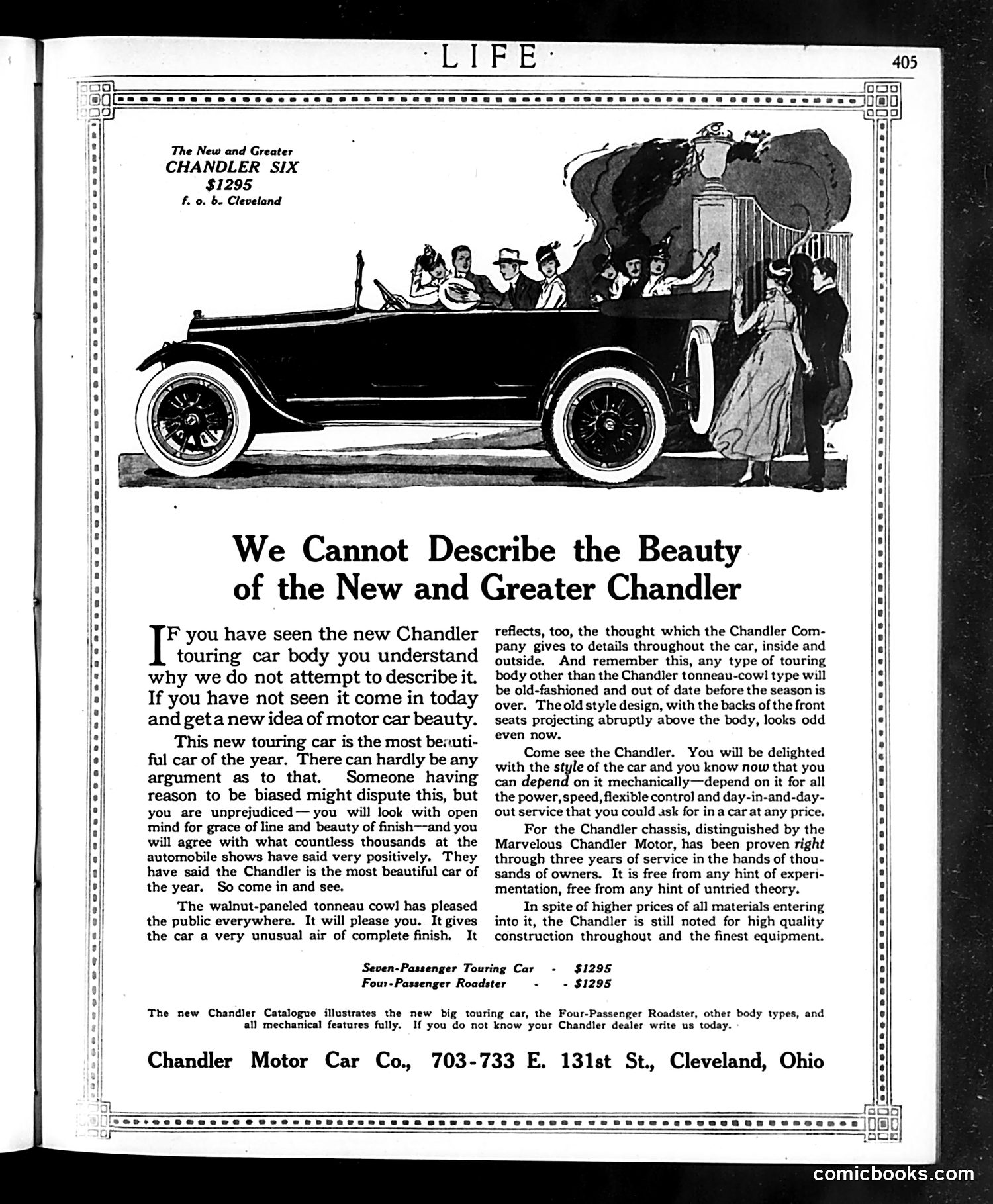
This is a **automobile advertisement**, not political satire or comics content. It occupies the entire page in *Life* magazine (page 405). The ad promotes the "New and Greater Chandler Six" touring car, priced at $1,295 f.o.b. Cleveland. The illustration shows a luxurious open-air automobile with well-dressed passengers and pedestrians admiring it outside what appears to be an elegant building. The copy uses rhetorical persuasion typical of 1920s advertising—claiming the car's beauty is so obvious it "cannot be described," thus requiring readers to see it in person. It emphasizes style (the distinctive walnut-paneled tonneau cowl), reliability (proven through three years of service), mechanical superiority, and quality construction. For modern readers: this represents early automotive marketing targeting middle-to-upper-class consumers, positioning the Chandler as a status symbol and technical achievement. The price (~$20,000 in today's money) reflects its luxury positioning. There is **no satire or political commentary**—it is straightforward period advertising.
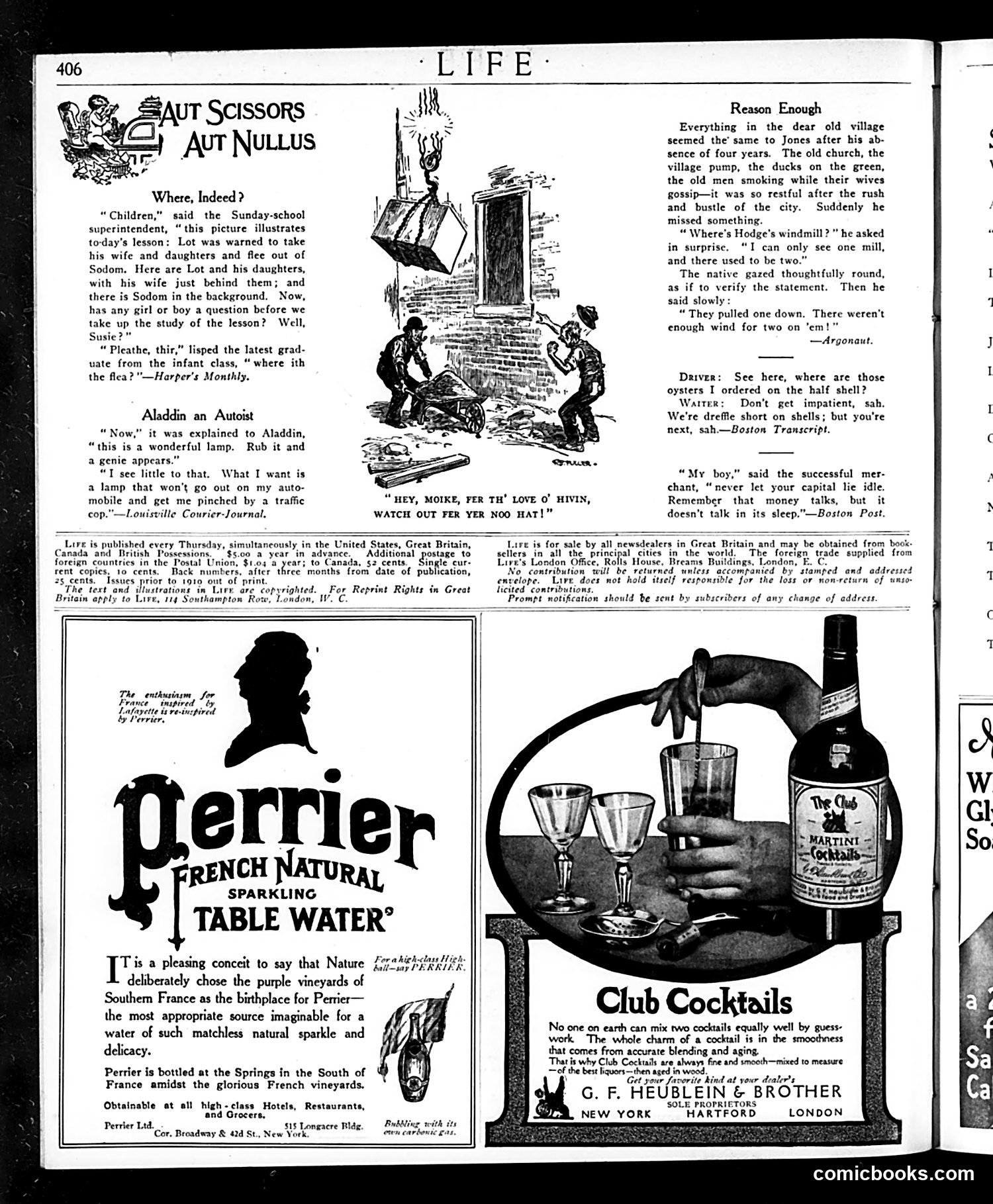
This page from *Life* magazine contains several short humorous pieces and advertisements typical of early 20th-century American satirical journalism. The cartoons present jokes about modernization and social change. "Aladdin an Autoist" mocks the newfangled automobile by suggesting a magical lamp is useless compared to a car headlamp—a common target of early motoring humor. Another piece plays on rural simplicity: a villager explains a missing windmill was demolished because "there weren't enough wind for two on 'em," satirizing country folk logic. A "Sunday-school" joke involves a child mishearing "Sodom" as "flea," creating innocent wordplay. Dialogue snippets between drivers and waiters mock service industry incompetence and racial dialect humor (the latter reflecting period prejudices). The advertisements for Perrier water and Club Cocktails represent luxury goods marketed to upscale readers, typical of *Life*'s affluent audience. The Perrier ad emphasizes French sophistication and natural origins—marketing appeals common to imported products of the era. Overall, the page reflects early 1900s concerns: modern technology disrupting tradition, class differences, and consumer aspirations.
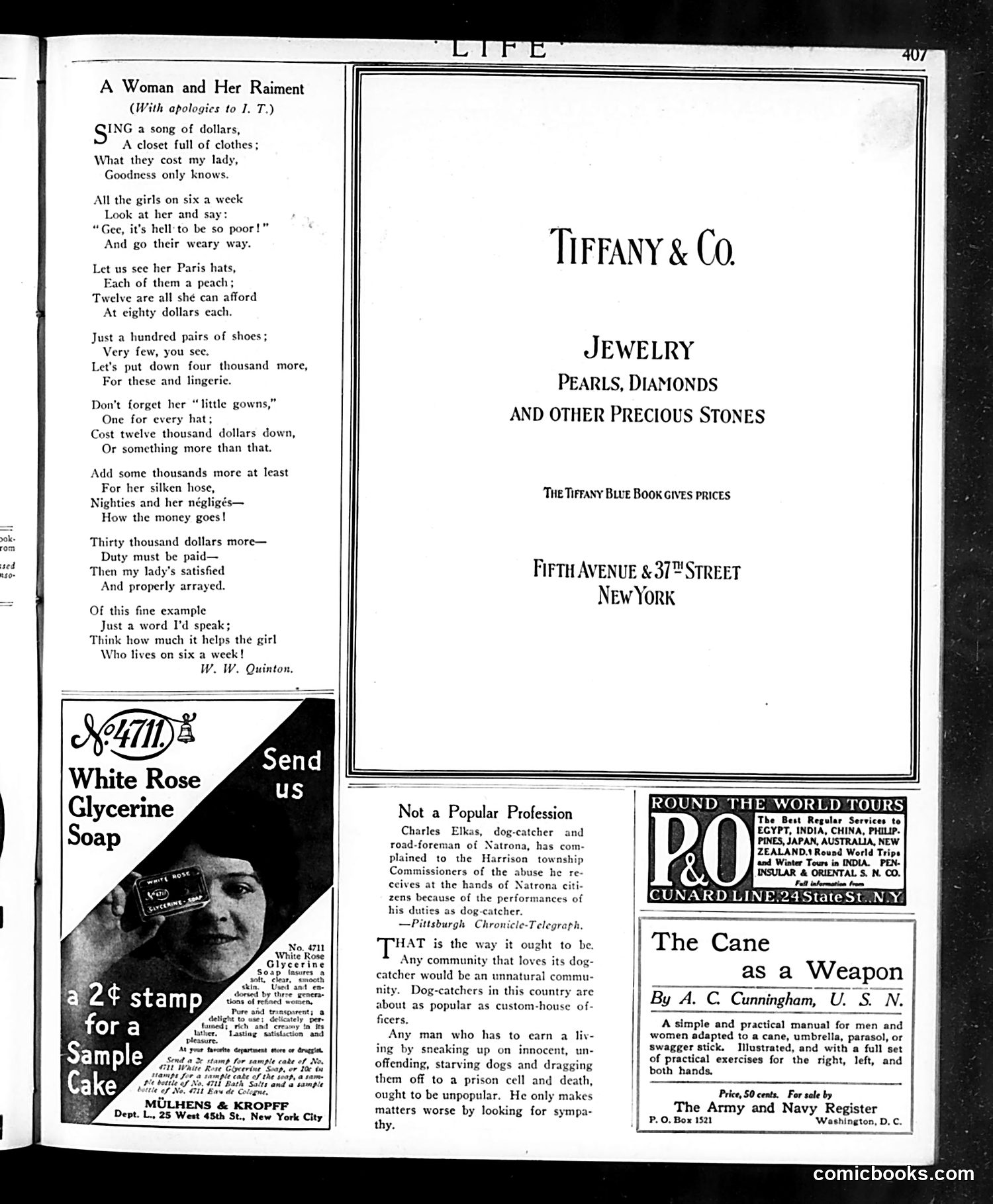
This page is primarily **advertisements and satirical content** rather than political cartoons. The main satire is "A Woman and Her Raiment," a poem by W. W. Quinton mocking wealthy women's extravagant spending. It catalogs absurd expenses—twelve Paris hats at $80 each, hundreds of shoes, $12,000 "little gowns"—totaling roughly $30,000+. The satirical punch: this spending "helps the girl / Who lives on six a week," sarcastically suggesting such ostentatious wealth somehow benefits working-class women earning minimal wages. The poem critiques both female consumerism and the vast economic inequality between wealthy and poor women in early 20th-century America. A secondary item, "Not a Popular Profession," humorously defends dog-catchers as deserving unpopularity—they perform necessary but universally despised work. The page also contains period advertisements for Tiffany & Co. jewelry, White Rose soap, and a manual on cane-fighting technique.
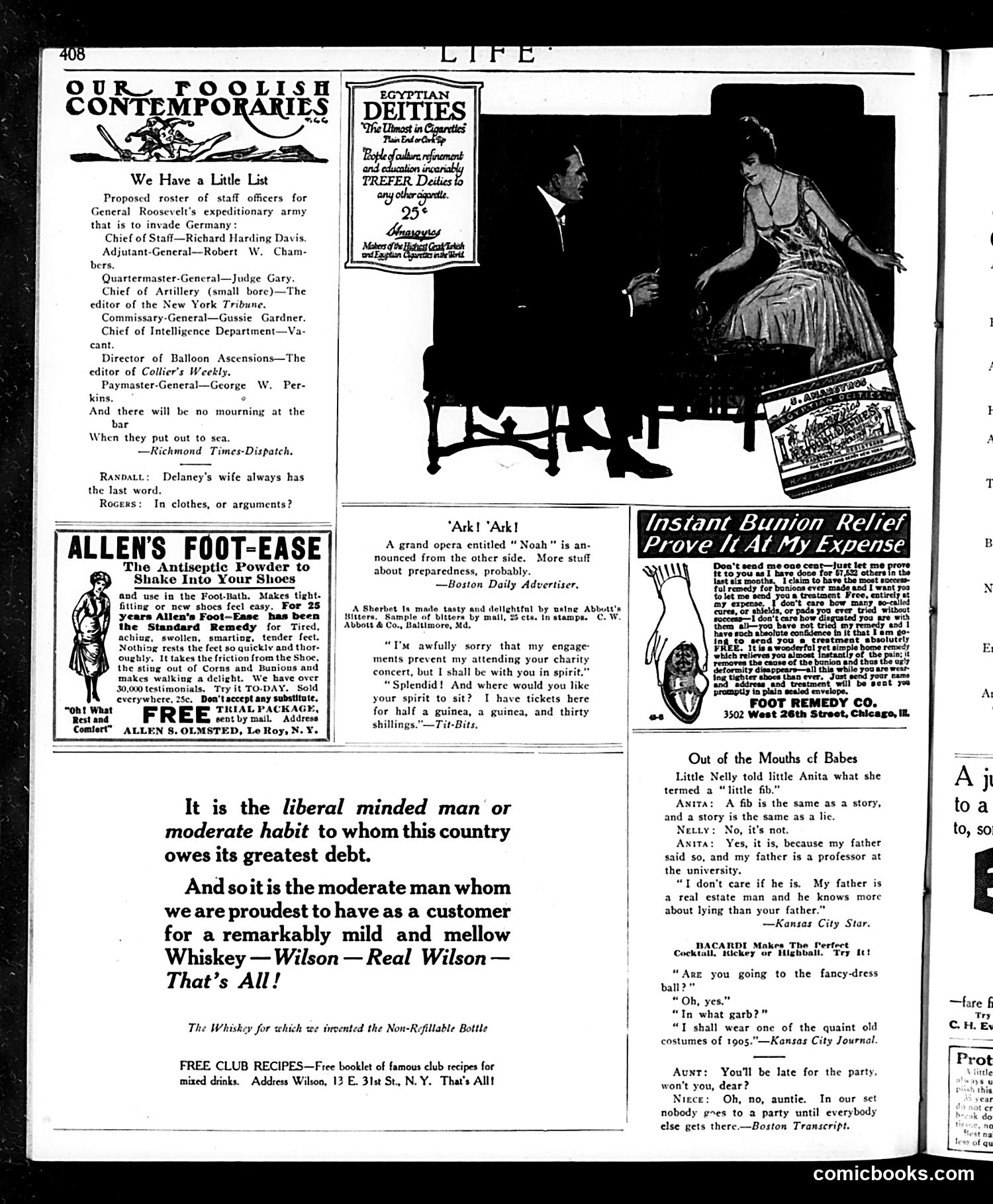
This page primarily contains **satirical commentary on military preparedness** during a period of American debate over potential involvement in World War I (pre-U.S. entry in 1917). The main feature, "We Have a Little List," mocks the idea of General Theodore Roosevelt leading an invasion of Germany by proposing a deliberately absurd roster of civilian leaders and journalists for key military positions—including novelist Richard Harding Davis as Chief of Staff and newspaper editors in military roles. The satire ridicules both Roosevelt's ambitions and the notion that prominent civilians could competently command a military campaign. The closing line references Gilbert & Sullivan's "The Mikado," enhancing the mockery. The remainder of the page contains typical **Life magazine humor**: brief jokes about social etiquette, domestic situations, and advertising for period products (foot powder, whiskey, bunion relief). These snippets reflect early-20th-century concerns and social attitudes but lack specific political content. The satirical point: Life magazine was skeptical of Roosevelt's military adventurism and used humor to delegitimize the proposal.
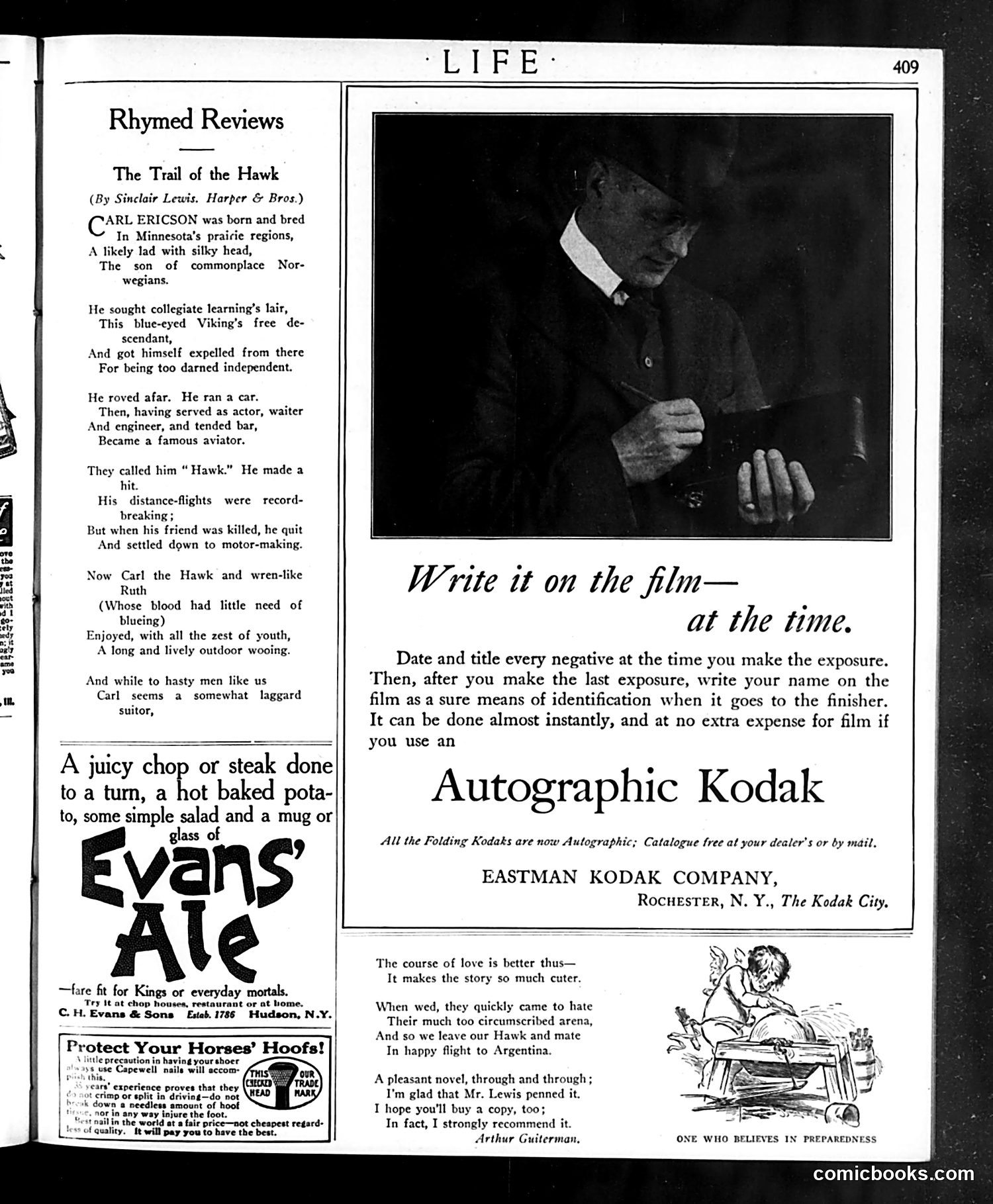
This page contains a **book review in verse** rather than a political cartoon. The review covers Sinclair Lewis's novel *The Trail of the Hawk*, summarizing the protagonist Carl Ericson's journey from a rebellious Midwestern farm boy to aviator to motor manufacturer, eventually settling into married life and emigrating to Argentina. The satirical tone is light: the reviewer gently mocks Carl's leisurely courtship (suggesting even "hasty men" would move faster) and the somewhat predictable romantic narrative. The verse form itself provides mild humor through rhyming couplets summarizing a contemporary bestseller. The page is primarily **advertising**: Evans' Ale, Capewell horseshoe nails, and notably an **Autographic Kodak** camera advertisement emphasizing convenience for amateur photographers. The small illustration at bottom shows preparedness—likely a WWI-era reference given the caption. No political figures or caricatures appear. This is a typical Life magazine hybrid of book criticism and commercial promotion.
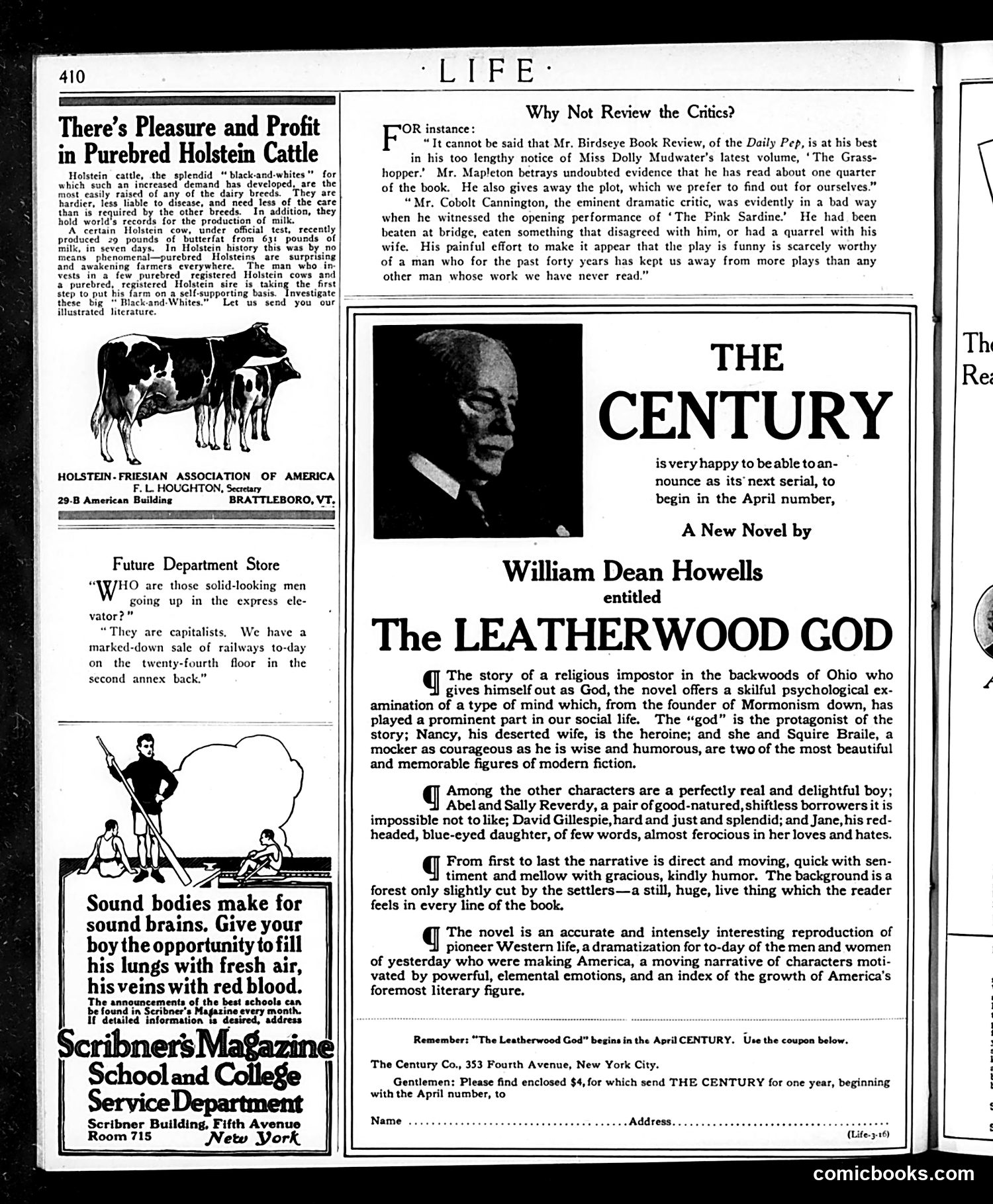
This page combines **advertisements and editorial content** typical of early 20th-century magazines. **"Why Not Review the Critics?"** is a satirical piece mocking literary and theater reviewers. It presents fabricated "reviews of reviewers," exposing their pretentiousness and bias. The examples mock critics who: haven't actually read books (Birdseye), spoil plots while claiming superiority, and let personal grievances (losing at bridge, domestic quarrels) poison their professional judgment. The satire suggests critics wield disproportionate power—keeping audiences away from performances for decades—while their judgments rest on carelessness or spite. **Other content** includes straightforward advertisements: Holstein cattle breeding (farm/agricultural focus), a joke about capitalism and railways being sold as discount goods on upper floors, and a Scribner's Magazine pitch about fresh air for boys. **The Century announcement** promotes William Dean Howells's novel *The Leatherwood God*, a religious-impostor story set in Ohio backwoods, suggesting literary prestige. The page reflects early 1900s American concerns: agricultural modernization, industrial capitalism, literary criticism's social influence, and magazine-driven culture.
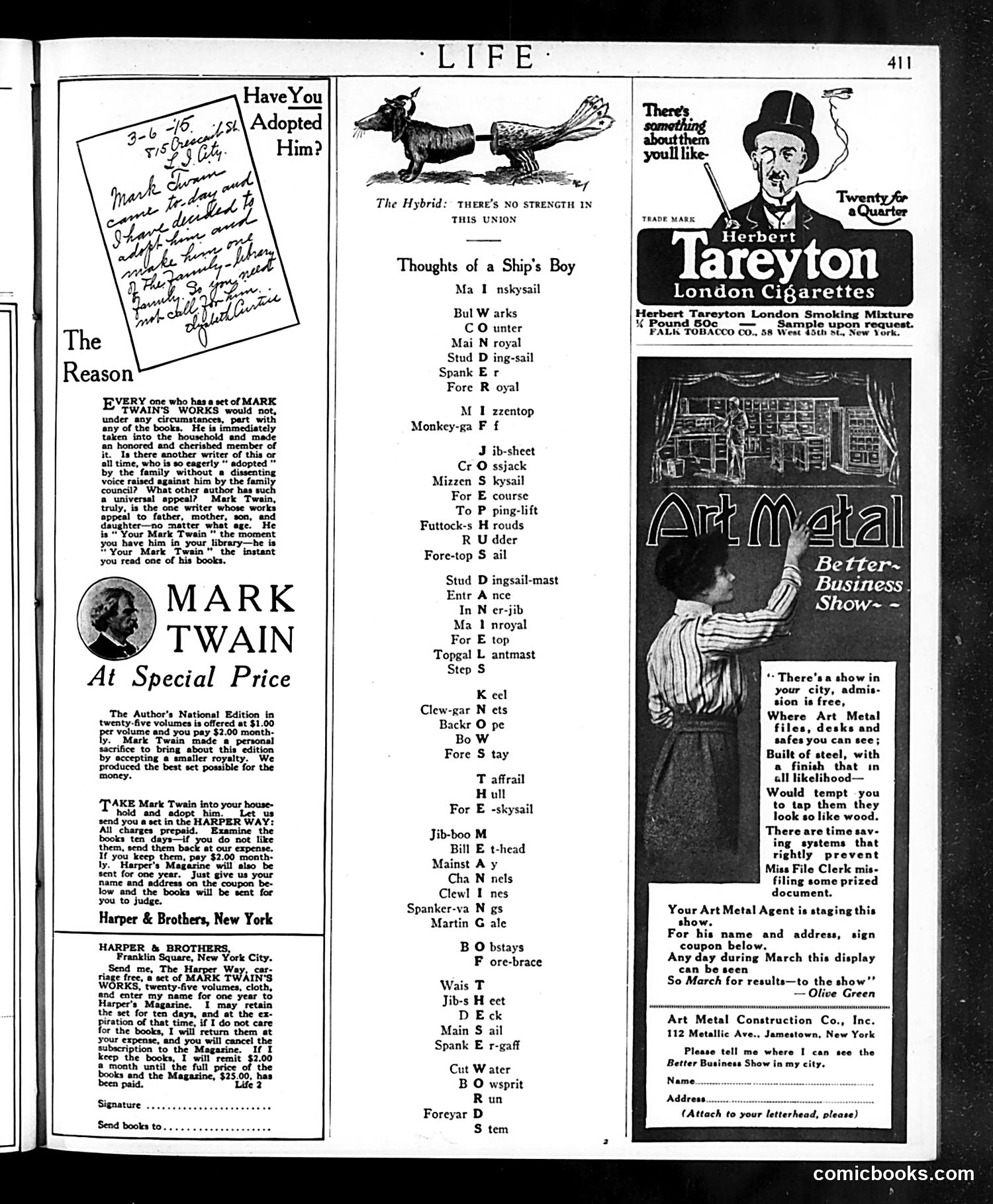
This page is primarily **advertising and promotional content** rather than political satire. The main cartoon, "The Hybrid: There's No Strength in This Union," uses nautical terminology as a visual pun. The illustration shows a creature combining a donkey's front half with a bird's rear—a literal "hybrid." The caption comments on the weakness of this union, likely satirizing **political or business mergers** (unclear which specific event), suggesting that some combinations lack viability. The bulk of the page consists of: - A Mark Twain book promotion (left), emphasizing his universal appeal across American families - "Thoughts of a Ship's Boy"—a word puzzle using nautical terms where letters spell out ship parts (Ma**I**nskysail, Bul**W**arks, etc.) - Advertisements for Herbert Tareyton cigarettes and Art Metal office furniture The page reflects early 20th-century *Life* magazine's blend of light humor, literature promotion, and commercial advertising rather than hard-hitting political commentary.
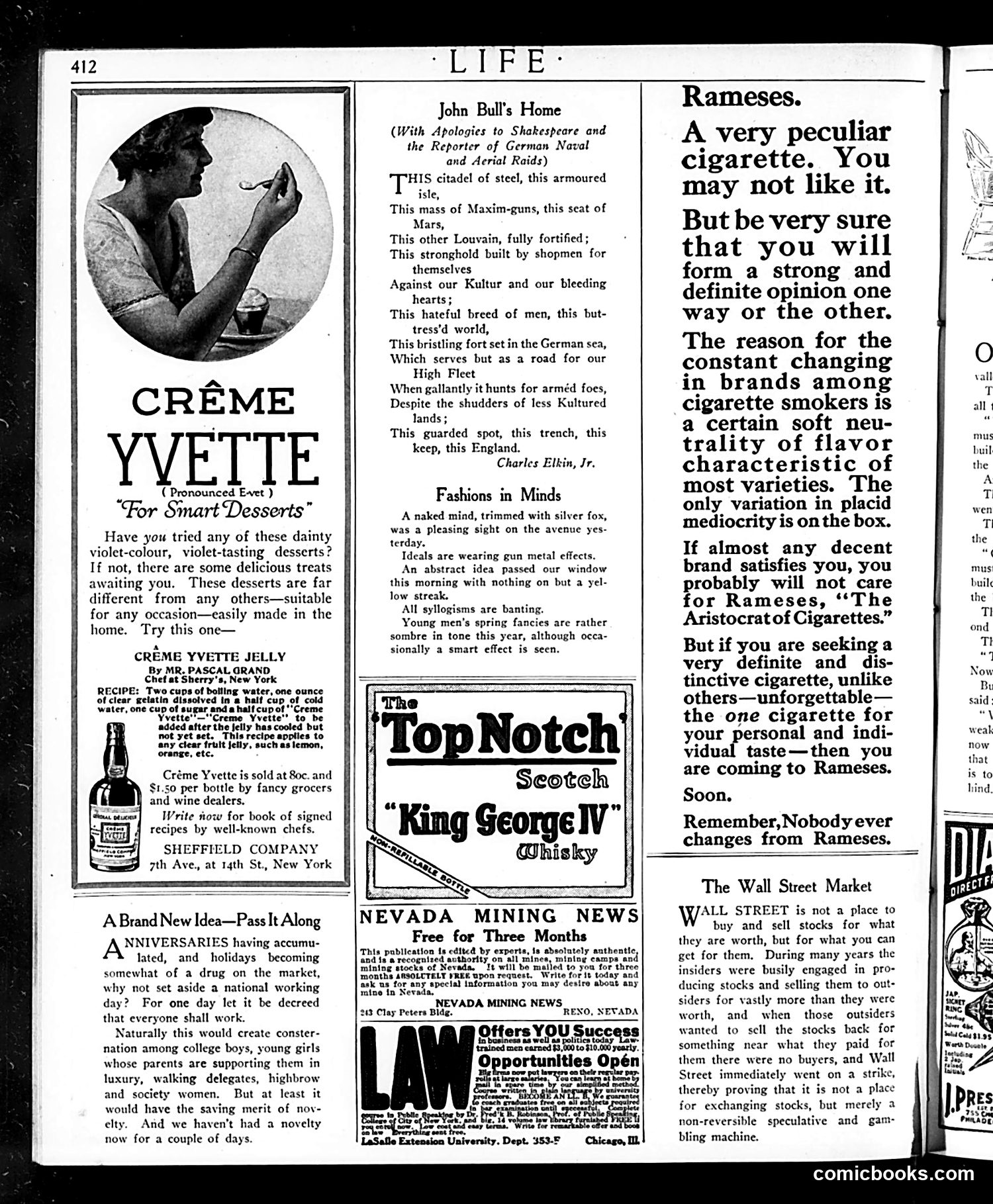
This page mixes advertisements with satirical commentary typical of Life magazine's early 20th-century format. **"John Bull's Home"** is a mock-Shakespearean poem about Britain during World War I, personifying England as a fortified stronghold defended against German attack. It references actual German raids and uses martial imagery ("citadel of steel," "Maxim-guns") to satirize British military preparedness, alluding to the raid on Louvain (a Belgian city destroyed by Germans in 1914). **"Fashions in Minds"** is absurdist social satire, describing abstract concepts as fashion accessories—"naked minds trimmed with silver fox," "ideals wearing gun metal effects." It mocks the superficiality of high society by treating intellectual trends as merely fashionable clothing. The bulk of the page comprises product advertisements (Crème Yvette liqueur, Top Notch Scotch, Rameses cigarettes, mining stocks, and correspondence schools), standard for Life's revenue model. The cigarette ad notably uses reverse psychology, claiming Rameses is "peculiar" but will form "a strong and definite opinion."
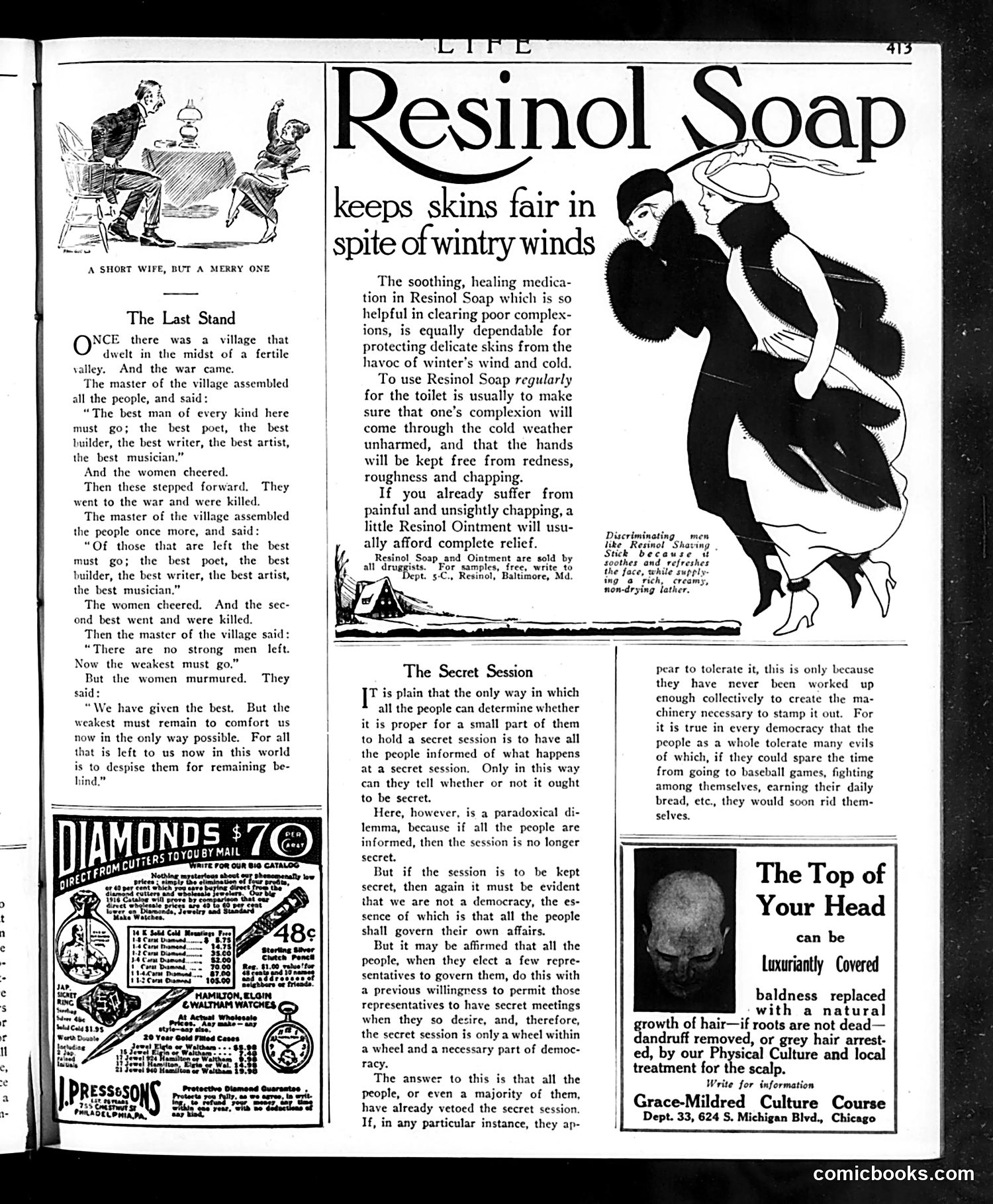
This story uses allegory to critique wartime conscription policy. A village master demands its "best" citizens—poets, artists, builders, musicians—for war, and women cheerfully comply. When these men die, he demands the "second best," whom women again accept. Only when the "weakest" are called do the women object—but then turn on these remaining men with contempt, saying they must be despised *for surviving*. The satire targets the bitter irony of home-front attitudes: society celebrates sacrificial deaths but despises those unfit for combat who remain. The women's final logic—that survivors deserve scorn for not dying—exposes the cruel emotional burden placed on the rejected, and perhaps critiques how societies valorize war deaths while simultaneously devaluing those deemed "weak" enough to stay behind. This reflects genuine WWI-era anxieties about masculinity, conscription, and how civilian populations processed massive casualties.
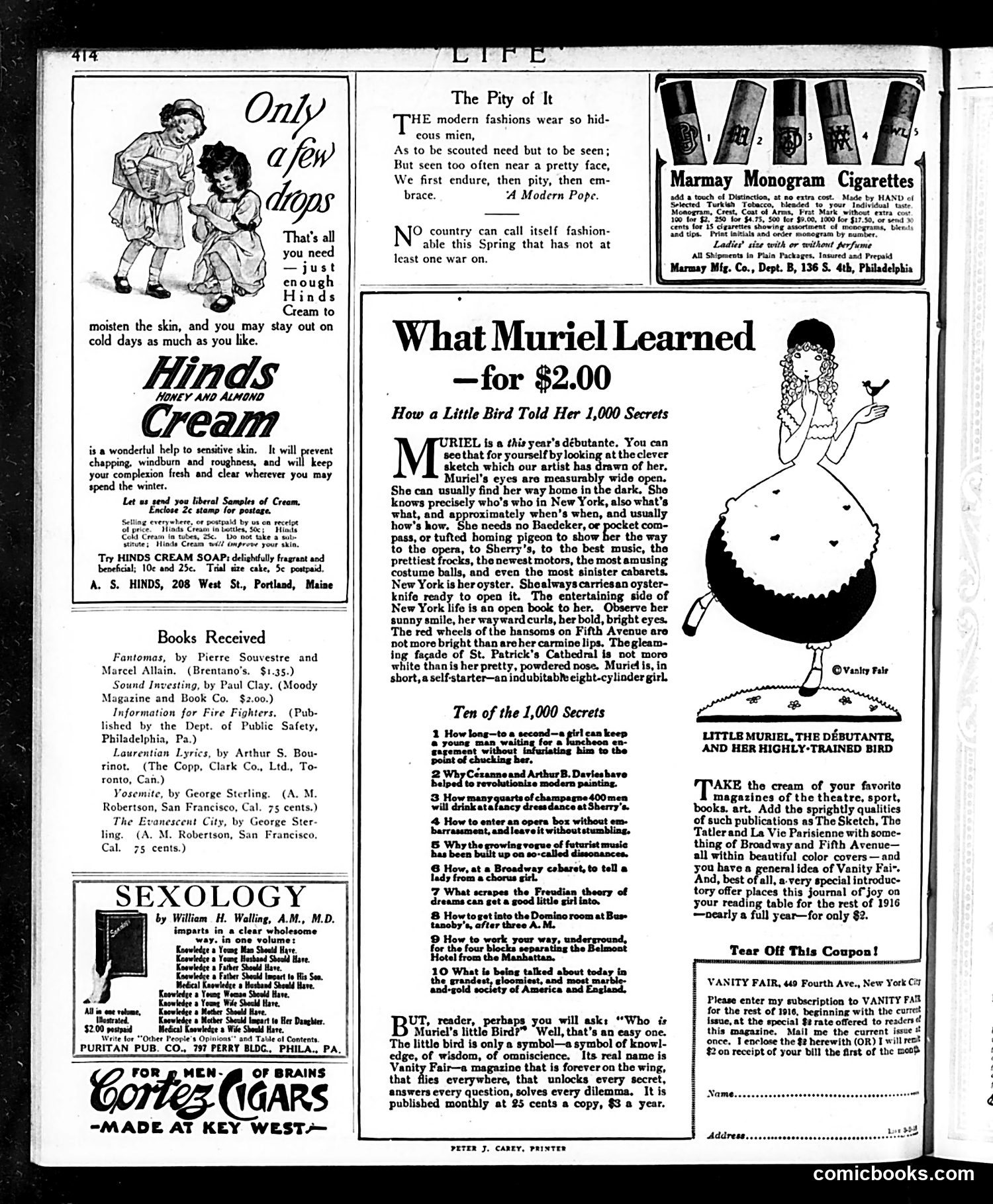
This page features a satirical article about "Muriel," presented as a debutante guidebook. The piece mocks the wealthy, fashionable young woman of 1910s New York society—specifically her superficial knowledge and social preoccupations. The "1,000 Secrets" listed are deliberately trivial: how long to keep a suitor waiting, champagne consumption at fancy parties, distinguishing chorus girls from society ladies, navigating opera boxes, Freudian dream theory "scrapes," and sneaking through Manhattan's underground passages. The satire ridicules both Muriel's shallow worldview and the presumed reader's interest in such trivial social maneuvering. The accompanying illustration depicts her as glamorous but vacuous—"an indubitable eight-cylinder girl," with emphasis on her appearance (lips, nose, curls) rather than intellect. The $2.00 price references *Vanity Fair* magazine, which published this satirical piece poking fun at debutante culture and elite New York social life.
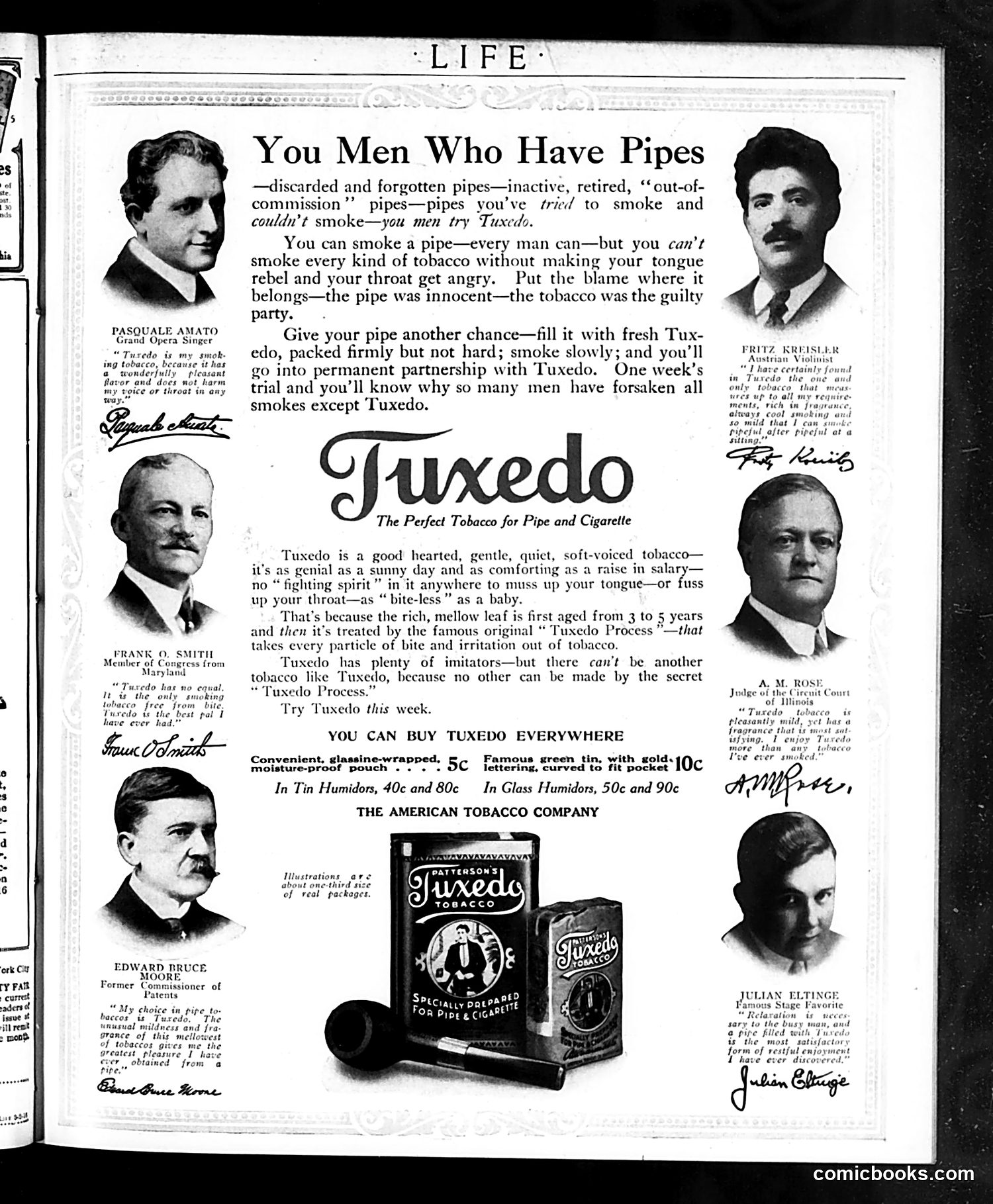
This is primarily a **cigarette/pipe tobacco advertisement**, not political satire. The page features endorsements from seven prominent early-20th-century public figures (opera singer Pasquale Amato, violinist Fritz Kreisler, judge A.M. Rose, and others) praising Tuxedo tobacco as mild and non-irritating. The marketing strategy targets men with "dead" pipes—those who found other tobaccos harsh. The ad emphasizes Tuxedo's special aging and processing ("Tuxedo Process") that allegedly removes bite and irritation, positioning it as uniquely superior to competitors. The celebrities' testimonials were a standard advertising technique of the era, lending prestige and trustworthiness. The product was manufactured by The American Tobacco Company and sold in multiple formats at varying prices (5¢ to 90¢). There is **no political cartoon or satire** on this page—it's straightforward product advertising typical of early Life magazine.
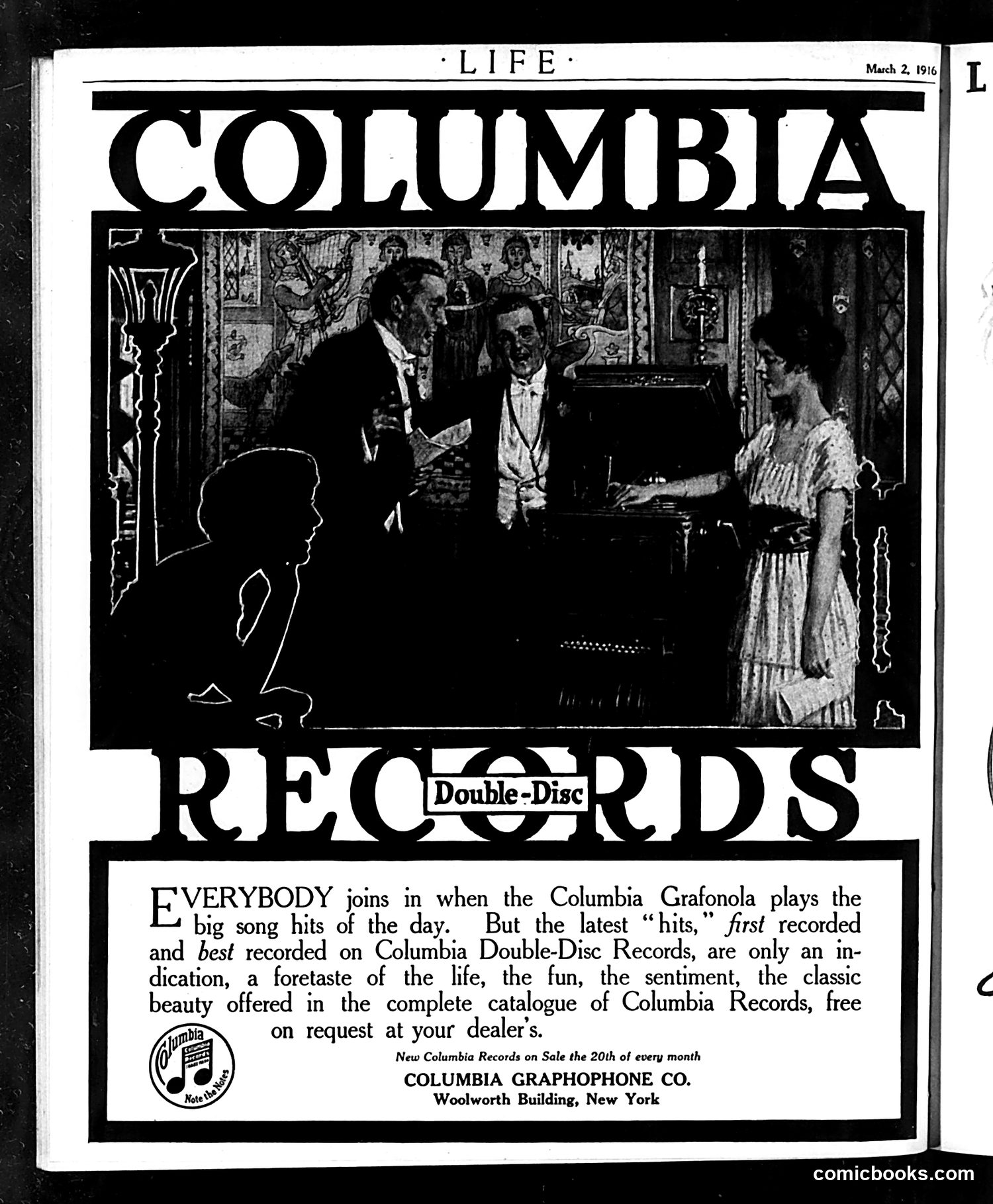
This is primarily a **full-page advertisement** for Columbia Graphophone Company's Double-Disc Records, published March 2, 1916. It's not political satire. The illustration depicts an elegant social scene—a formal gathering in what appears to be a wealthy home, with well-dressed guests enjoying music from a gramophone. The image suggests that Columbia records provide access to quality entertainment ("the life, the fun, the sentiment, the classic beauty") comparable to live performances at upscale social events. The ad's appeal is aspirational: owning Columbia records allows ordinary people to experience the refined entertainment enjoyed by the wealthy elite. The text emphasizes that new records were released monthly (the 20th), encouraging regular purchases and building a complete collection. This represents early 20th-century consumer marketing—using imagery of sophisticated leisure to sell a relatively new domestic technology.