
Life, 1916-03-02 · page 27 of 44
Life — March 2, 1916 — page 27: what you’re looking at
What you’re looking at
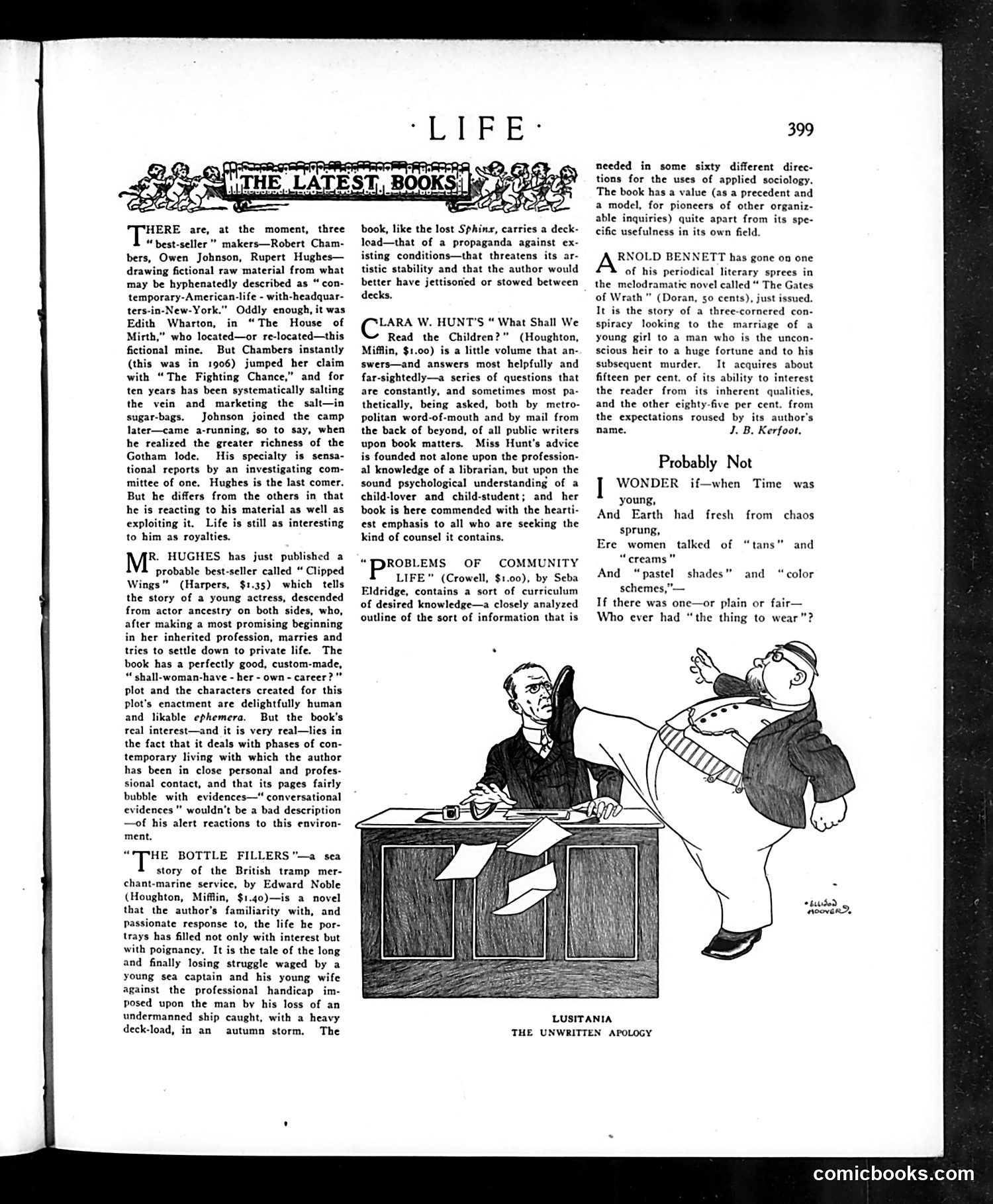
This page reviews contemporary American bestselling authors (Robert Chambers, Owen Johnson, Rupert Hughes) who mined "New York" contemporary life for fiction—a literary trend initiated by Edith Wharton's *The House of Mirth*. The review praises Rupert Hughes' *Clipped Wings* for authentically depicting modern life, particularly regarding women's career versus marriage conflicts. Edward Noble's *The Bottle Fillers* receives mixed reviews for its sea-story authenticity but criticism for heavy-handed social propaganda. Clara W. Hunt's children's book guide and Seba Eldridge's sociology text are also reviewed. The cartoon titled "Lusitania: The Unwritten Apology" depicts a man at a desk (likely representing official authority) with another figure gesturing defensively—likely referencing the 1915 German U-boat sinking of the *Lusitania*, satirizing inadequate diplomatic response or apology for the tragedy.
📄 Transcribed text from this page (OCR, searchable)
Machine-transcribed from the original scan — historical spelling and the odd misread are preserved.
'HERE are, at the moment, three “ best-seller” makers—Robert Cham- bers, Owen Johnson, Rupert Hughes— drawing fictional raw material from what may be hyphenatedly described as “ con- temporary-American-life - with-headquar- ters-in-New-York.” Oddly enough, it was Edith Wharton, in “The House of Mirth,” who located—or re-located—this fictional mine. But Chambers instantly (this was in 1906) jumped her claim with “The Fighting Chance,” and for ten years has been systematically salting the vein and marketing the salt—in sugar-bags, Johnson joined the camp later—came a-running, so to say, when he realized the greater richness of the Gotham lode, His specialty is sensa- tional reports by an investigating com- mittee of one. Hughes is the last comer. But he differs from the others in that he is reacting to his material as well as exploiting it. Life is still as interesting to him as royalties. 'R. HUGHES has just published a probable best-seller called “ Clipped Wings” (Harpers, $1.35) which tells the story of a young actress, descended from actor ancestry on both sides, who, after making a most promising beginning in her inherited profession, marries and tries to settle down to private life. The book has a perfectly good, custom-made, “ shall-woman-have - her - own - career?” plot and the characters created for this plot's enactment are delightfully human and likable ephemera. But the book's real interest—and it is very real—lies in the fact that it deals with phases of con- temporary living with which the author has been in close personal and profes- sional contact, and that its pages fairly bubble with evidences—“ conversational evidences " wouldn't be a bad description —of his alert reactions to this environ- ment. “COHE BOTTLE FILLERS "—a sea story of the Bri tramp mer- chant-marine service, by Edward Noble (Houghton, Mifflin, jo)—is a novel that the author's familiarity with, and Passionate response to, the life he por- trays has filled not only with interest but with poignancy, It is the tale of the long and finally losing struggle waged by a young sea captain and his young wife against the professional handicap im- posed upon the man by his loss of an undermanned ship caught, with a heavy deck-load, in an autumn storm. The book, like the lost Sphinx, carries a deck- load—that of a propaganda against ex- isting conditions—that threatens its ar- tistic stability and that the author would better have jettisoned or stowed between decks. LARA W. HUNT'S “ What Shall We Read the Children?” (Houghton, Mifflin, $1.00) is a little volume that an- swers—and answers most helpfully and far-sightedly—a series of questions that are constantly, and sometimes most pa- thetically, being asked, both by metro- politan word-of-mouth and by mail from the back of beyond, of all public writers upon book matters. Miss Hunt's advice is founded not alone upon the profession- al knowledge of a librarian, but upon the sound psychological understanding of a child-lover and child-student; and her book is here commended with the hearti- est emphasis to all who are seeking the kind of counsel it contains, “DROBLEMS OF COMMUNITY LIFE” (Crowell, $1.00), by Seba Eldridge, contains a sort of curriculum of desired knowledge—a closely analyzed outline of the sort of information that is 399 needed in some sixty different direc- tions for the uses of applied sociology. The book has a value (as a precedent and a model, for pioneers of other organiz- able inquiries) quite apart from its spe- cific usefulness in its own field. RNOLD BENNETT has gone on one of his periodical literary sprees in the melodramatic novel called “ The Gates of Wrath” (Doran, 50 cents), just issued. It is the story of a three-cornered con- spiracy looking to the marriage of a young gitl to a man who is the uncon- scious heir to a huge fortune and to his subsequent murder. It acquires about fifteen per cent. of its ability to interest the reader from its inherent qualities, and the other eighty-five per cent. from the expectations roused by its author's name. J. B. Kerfoot, Probably Not WONDER young, And Earth sprung, Ere women talked of “creams” “ pastel schemes,”— If there was one—or plain or fair— Who ever had “the thing to wear"? if—when Time was had fresh from chaos “tans" and And shades” and “color LUSITANIA THE UNWRITTEN APOLOGY comicbooks.com