
Life, 1916-03-02 · page 25 of 44
Life — March 2, 1916 — page 25: what you’re looking at
What you’re looking at
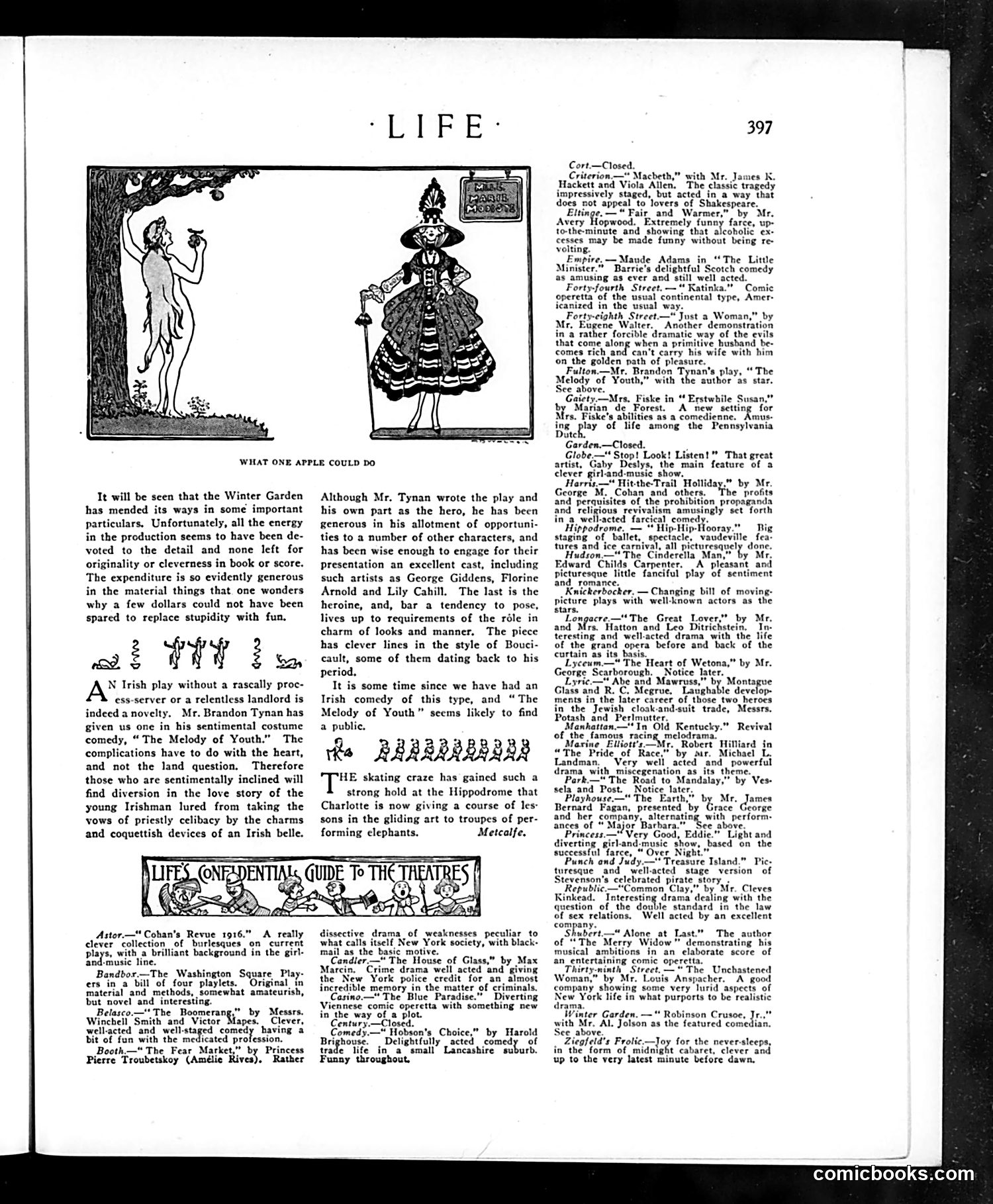
This page features two satirical cartoons and theatre reviews from Life magazine. The main cartoon (top) depicts a classical nude female figure (representing temptation or mischief) beside an elaborate, overdressed lady, illustrating the caption "What One Apple Could Do." This references the Biblical story of Eve and the Apple—suggesting how one small, seemingly innocent thing can cause major consequences or corruption. Below is a separate cartoon showing performing elephants learning to ice skate at the Hippodrome theatre, captioned by artist Metcalfe. This is absurdist humor mocking the era's elaborate theatrical spectacles—the joke being the sheer ridiculousness of training elephants in a refined activity like ice skating. The remainder of the page comprises theatre reviews criticizing various Broadway productions for prioritizing lavish production values over actual quality writing or entertainment, with the opening review particularly harsh: expensive sets cannot compensate for "stupidity" in the script.
📄 Transcribed text from this page (OCR, searchable)
Machine-transcribed from the original scan — historical spelling and the odd misread are preserved.
WHAT ONE APPLE COULD DO It will be seen that the Winter Garden has mended its ways in some important particulars, Unfortunately, all the energy in the production seems to have been de- voted to the detail and none left for originality or cleverness in book or score. The expenditure is so evidently generous in the material things that one wonders why a few dollars could not have been spared to replace stupidity with fun. ai TTF Bs N Irish play without a rascally proc- ess-server or a relentless landlord is indeed a novelty, Mr. Brandon Tynan has given us one in his sentimental costume comedy, “The Melody of Youth.” The complications have to do with the heart, and not the land question, Therefore those who are sentimentally inclined will find diversion in the love story of the young Irishman lured from taking the vows of priestly celibacy by the charms and coquettish devices of an Irish belle. Astor —* Cohan’s Revue 1916." A really clever collection of burlesques on current plays, with a brilliant background in the girl- -musie line. Bandbor.—The Washington Square Pla ers in a bill of four playlets. Original in material and methods, somewhat amateurish, but novel and interesting. Belasco, he Boomerang,” by Messrs. Winchell Smith and Victor Mapes. Clever, well-acted and well-staged comedy having a Bit of fun with the medicated profession. Booth.—" The Fear Market,” b; Pierre Troubetskoy (Amélie Rives). Although Mr. Tynan wrote the play and his own part as the hero, he has been generous in his allotment of opportuni- ties to a number of other characters, and has been wise enough to engage for their Presentation an excellent cast, including such artists as George Giddens, Florine Arnold and Lily Cahill. The last is the heroine, and, bar a tendency to pose, lives up to requirements of the réle in charm of looks and manner. The piece has clever lines in the style of Bouci- cault, some of them dating back to his period. It is some time since we have had an Irish comedy of this type, and “The Melody of Youth” seems likely to find a public, the BEBREREE ARS HE skating craze has gained such a strong hold at the Hippodrome that Charlotte is now giving a course of les- sons in the gliding art to troupes of per- forming elephants, Metcalfe. dissective drama of weaknesses peculiar to what calls itself New York society, with black- mail as the basic motive. Candier.—" The House of Glass," by Max Marcin, Crime drama well acted and the New York police credit for incredible memory in the matter of cr Casino.—" The Blue Paradise.” Diverting Viennese comic operetta with something new in the way of a plot. Century.—Closed. Comedy.—" Hobson's Choice,” by Harold Brighouse. Delightfully acted comedy of trade life in a small Lancashire suburb. Funny throughout, 397 Cort—Closed, Criterion —“ Macbeth,” with Mr. James K. Hackett and Viola Allen. The classic tragedy impressively staged, but acted in a way that does not appeal to lovers of Shakespeare. Eltinge, “Fait and Warmer,” by Mr. Avery Hopwood. Extremely funny farce, up- to-the-minute and showing that alcoholic ex- cesses may be made funny without being re- velting. ire, —Maude Adams in ‘The Little Barrie's delightful Scotch comedy as amusing as ever and still well acted. Forty-fourth Street. —“ Katinka.” Comic operetta of the usual continental type, Amer icanized in the usual way. Forty-eighth Street—" Just a Woman,” by fr, Eugene Walter. Another demonstration in a rather forcible dramatic way of the evils that come along when a primitive busband be- comes rich and can't carry his ‘wife with him on the golden path of pleasure. Fulton.—Mr. Brandon Tynan's play, “ The Melody of Youth,” with the author as star. Sce above. icty.—Mrs, Fiske in Erstwhile Susan,” forest. A new setting for ies as a comedienne. Amus- ing fe among the Pennsylvania Dutel Garden.—Closed. ‘ Globe-—" Stop! Look! Listen!” That great artist, Gaby Deslys, the main feature of a clever girl-and-music_ show. ” by Mr, George ‘BM, Cohan and others. ‘he profits and perquisites of the prohibition propaganda ind religious revivalism amusingly set forth in a well-acted farcical comedy, Hippodrome. — *"HipeHlip-Hooray.” Big staging of ballet, spectacle, vaudeville fea- tures and ice, carnival, all picturesayely done. Hudson.—“ The Cinderella Man,” by Mr. Edward Childs Carpenter. A pleasant and picturesque little fanciful play of sentiment and, romance. Knickerbocker. — Changing bill of moving- picture plays with well-known actors as the stars. Longacre—"The Great Lover.” by Mr. and Mrs, Hatton and Leo Ditrichstein. Tn: teresting and well-acted drama with the life of the grand opera before and back of the curtain as its basis. Lyceum.—" The Heart of Wetona,” by Mr. George Scarborough. Notice later. Lyric—" Abe and Mawruss,"" by Montague Glass and RC. Megrue.” Laughable develope ments in the later career of those two heroes in the Jewish cloak-and-suit trade, Messrs. Potash and Perlmutter, Manhattan.—* In Old Kentucky.” Revival of the famous racing melodrama. Mar t's—Mr. Robert Hilliard in “The Pride of Race.” by sir. Michael L. Landman. Very well acted and powerful drama with miscegenation as its theme. Park.—" The Road to Mandalay,” by Ves- sela and Post. Notice later. Playhouse —“ The Barth,” by Me. James Bernard Fagan, presented ‘by Grace George and her ing, with perform- ances of “ Maj "See above. Princess.—"* Very Good, Eddie.” Light and diverting girland-musie show, based on the successful farce, “ Over Night.” Punch and Judy.—" Treasure Island.” Pic- turesque and well-acted stage version of Stevenson's celebrated pirate, story. . Republic.—"Common Clay," by Mr. Cleves Kinkead. Interesting drama dealing with the question’ of the double standard in the law of sex relati Well acted by an excellent company Shubert— Alone at Last.” The author of ferry Widow” demonstrating his i an elaborate score of an 7 operetta, Thirty-ninth “The Unchastened Woman,” by M ‘Anspacher. A good company showing some very lurid aspects of New York life in what purports to be realistic drama. Winter Garden. —“ Robinson Crusoe, Jr.."" with Mr. Al. Jolson as the featured comedian. See above. _ Ziegfeld’s Frolic.—Joy for the never-sleeps, in the form of midnight cabaret, clever and up to the very latest minute before dawn, comicbooks:com