
Life, 1916-03-02 · page 17 of 44
Life — March 2, 1916 — page 17: what you’re looking at
What you’re looking at
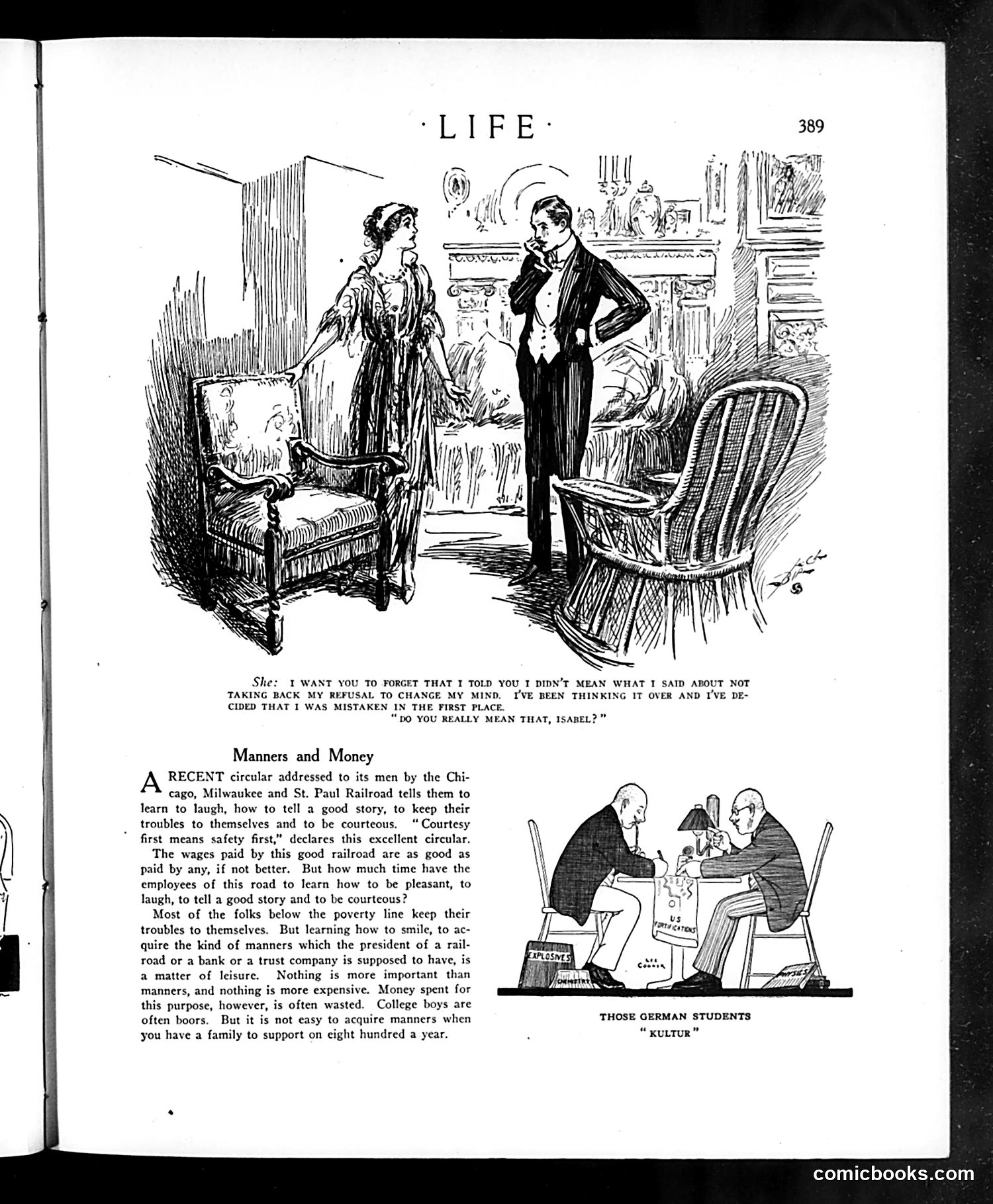
**Top Cartoon:** A domestic humor piece depicting a woman explaining a confusing reversal of her previous refusal to a man (presumably her suitor). The joke relies on the circular logic of her statement—she's asking him to forget contradictory things she said, illustrating female indecisiveness as a satirical trope common to the era. **Article & Bottom Cartoon:** The piece critiques a railroad company's circular instructing employees to be courteous and learn to laugh, arguing this is impractical advice for working-class employees earning minimal wages who must support families. The satire points out that good manners require leisure and money—luxuries the poor lack. The bottom illustration, captioned "Those German Students—'Kultur,'" appears to show two men at a table (likely German university students), sarcastically referencing German "kultur" (culture/refinement). This likely critiques the gap between claimed cultural superiority and actual behavior—echoing the article's theme that manners cannot be purchased or taught without financial means.
📄 Transcribed text from this page (OCR, searchable)
Machine-transcribed from the original scan — historical spelling and the odd misread are preserved.
— | =, x She: 1 WANT YOU TO FORGET THAT I TOLD YOU I DIDN’T MEAN WHAT I SAID ABOUT NOT TAKING BACK MY REFUSAL TO CHANGE MY MIND. I'VE BEEN THINKING IT OVER AND I'VE DE- CIDED THAT I WAS MISTAKEN IN THE FIRST PLACE. “DO YOU REALLY MEAN THAT, ISABEL?” Manners and Money A RECENT circular addressed to its men by the Chi- cago, Milwaukee and St. Paul Railroad tells them to learn to laugh, how to tell a good story, to keep their troubles to themselves and to be courteous. “ Courtesy first means safety first,” declares this excellent circular. The wages paid by this good railroad are as good as paid by any, if not better. But how much time have the employees of this road to learn how to be pleasant, to laugh, to tell a good story and to be courteous? Most of the folks below the poverty line keep their troubles to themselves. But learning how to smile, to ac- quire the kind of manners which the president of a rail- road or a bank or a trust company is supposed to have, is a matter of Ieisure. Nothing is more important than manners, and nothing is more expensive. Money spent for this purpose, however, is often wasted. College boys are often boors. But it is not easy to acquire manners when THOSE GERMAN STUDENTS you have a family to support on eight hundred a year. 4 “ KULTUR” comicbooks.com