
Life, 1916-03-02 · page 24 of 44
Life — March 2, 1916 — page 24: what you’re looking at
What you’re looking at
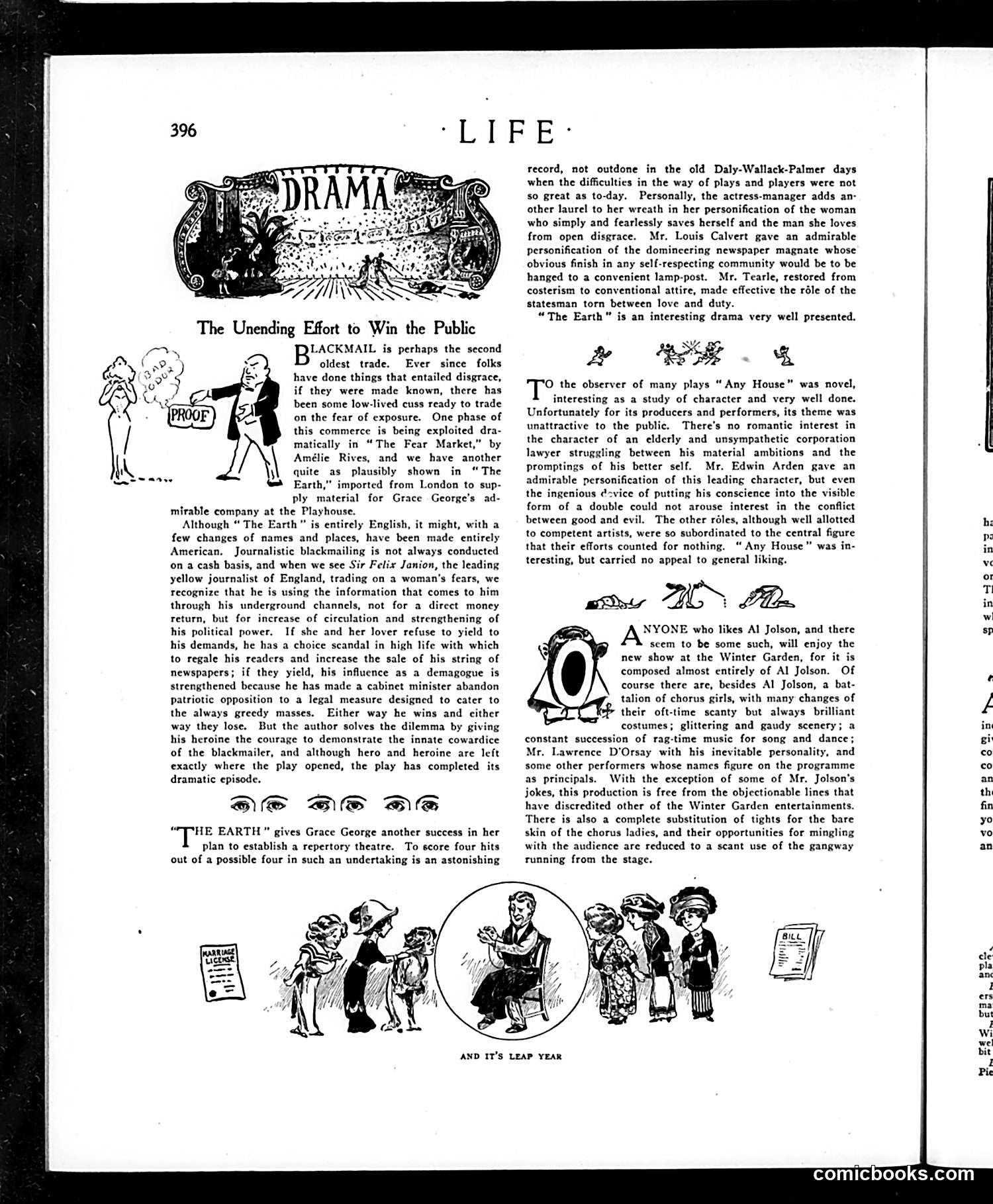
This page reviews three theatrical productions from early 20th-century New York. **"The Fear Market"** and **"The Earth"** are plays about blackmail—specifically, a corrupt newspaper magnate (Sir Felix Janion) exploiting a woman's secrets for political power. The satire targets **journalistic blackmail** as a real commercial practice: editors threaten exposure not for direct payment but to increase circulation and political influence. The review notes this is "entirely English" but applies equally to America, suggesting the practice was recognized on both sides of the Atlantic. **"Any House"** reportedly failed because audiences found its protagonist—an elderly corporate lawyer torn between ambition and conscience—dramatically uninteresting, despite competent acting. The page also previews an **Al Jolson show** at the Winter Garden. The cartoon at top-left illustrates the blackmail theme: a man labeled "PROOF" presents damaging evidence to a woman, symbolizing how journalists weaponized information for leverage.
📄 Transcribed text from this page (OCR, searchable)
Machine-transcribed from the original scan — historical spelling and the odd misread are preserved.
~ LoDE'E * The Unending Effort to Win the Public LACKMAIL is perhaps the second oldest trade. Ever since folks have done things that entailed disgrace, if they were made known, there has been some low-lived cuss ready to trade on the fear of exposure. One phase of this commerce is being exploited dra- matically in “The Fear Market,” by Amélie Rives, and we have another quite as plausibly shown in “The ‘= Earth,” imported from London to sup- ply material for Grace George's ad- mirable company at the Playhouse. Although “ The Earth” is entirely English, it might, with a few changes of names and places, have been made entirely American. Journalistic blackmailing is not always conducted on a cash basis, and when we see Sir Felix Janion, the leading yellow journalist of England, trading on a woman's fears, we recognize that he is using the information that comes to him through his underground channels, not for a direct money return, but for increase of circulation and strengthening of his political power, If she and her lover refuse to yield to demands, he has a choice scandal in high life with which to regale his readers and increase the sale of his string of newspapers; if they yield, his influence as a demagogue is strengthened because he has made a cabinet minister abandon patriotic opposition to a legal measure designed to cater to the always greedy masses. Either way he wins and cither way they lose. But the author solves the dilemma by giving his heroine the courage to demonstrate the innate cowardice of the blackmailer, and although hero and heroine are left exactly where the play opened, the play has completed its dramatic episode. Ae OHS De HE EARTH” gives Grace George another success in her plan to establish a repertory theatre. To score four hits out of a possible four in such an undertaking is an astonishing record, not outdone in the old Daly-Wallack-Palmer days when the difficulties in the way of plays and players were not so great as to-day. Personally, the actress-manager adds an- other laurel to her wreath in her personification of the woman who simply and fearlessly saves herself and the man she loves from open disgrace. Mr. Louis Calvert gave an admirable personification of the domincering newspaper magnate whose obvious finish in any self-respecting community would be to be hanged to a convenient lamp-post. Mr. Tearle, restored from costerism to conventional attire, made effective the réle of the Statesman torn between love and duty. “The Earth” is an interesting drama very well presented. Be BB. © the observer of many plays “Any House” was novel, interesting as a study of character and very well done. Unfortunately for its producers and performers, its theme was unattractive to the public. There's no romantic interest in the character of an elderly and unsympathetic corporation lawyer struggling between his material ambitions and the Promptings of his better self. Mr. Edwin Arden gave an admirable personification of this leading character, but even the ingenious ¢-vice of putting his conscience into the visible form of a double could not arouse interest in the conflict between good and evil. The other réles, although well allotted to competent artists, were so subordinated to the central figure that their efforts counted for nothing. “ Any House” was in- teresting, but carried no appeal to general liking. NYONE who likes Al Jolson, and there seem to be some such, will enjoy the new show at the Winter Garden, for it is composed almost entirely of Al Jolson. Of course there are, besides Al Jolson, a bat- talion of chorus girls, with many changes of their oft-time scanty but always brilliant costumes; glittering and gaudy scenery; a constant succession of rag-time music for song and dance; Mr, Lawrence D'Orsay with his inevitable personality, and some other performers whose names figure on the programme as principals. With the exception of some of Mr. Jolson’s jokes, this production is free from the objectionable lines that have discredited other of the Winter Garden entertainments. There is also a complete substitution of tights for the bare skin of the chorus ladies, and their opportunities for mingling with the audience are reduced to a scant use of the gangway running from the stage. AND IT’S LEAP YEAR comicbooks.com