
Life, 1916-03-02 · page 16 of 44
Life — March 2, 1916 — page 16: what you’re looking at
What you’re looking at
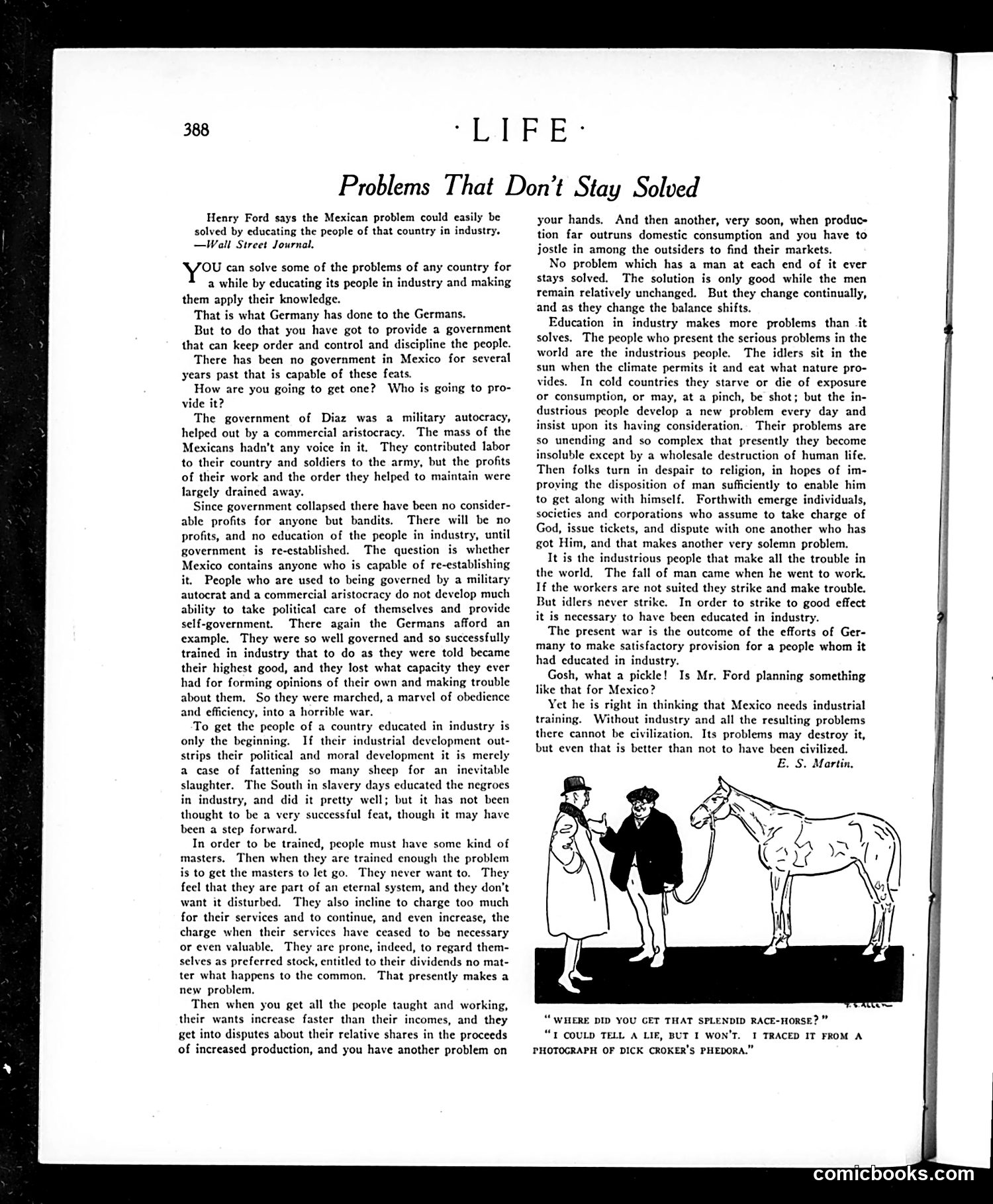
This page satirizes Henry Ford's naive proposal that Mexico's problems could be solved through industrial education. The cartoon (bottom right) depicts a woman admiring a man's horse, with his claim that he traced it from a Dick Croker photograph—a joke about fabricated origins masking inferior reality. The article's central argument: Ford's solution ignores that industrial training without stable government and moral development merely creates new problems. The author uses Germany as a cautionary example—their people became so disciplined through industrial training that they lost independent thinking and marched obediently into World War I. The satire targets the assumption that economic solutions alone fix social problems. The piece argues that once people are educated and prosperous, they demand political power, higher wages, and markets for overproduction—generating endless new conflicts. The real problem isn't education but human nature: masters never voluntarily surrender control, and solving one problem inevitably creates another. It's fundamentally skeptical of technocratic fixes for complex human and political systems.
📄 Transcribed text from this page (OCR, searchable)
Machine-transcribed from the original scan — historical spelling and the odd misread are preserved.
“LIVE E * Problems That Don’t Stay Solved Henry Ford says the Mexican problem could easily be solved by educating the people of that country in industry. —Wall Street Journal. ‘OU can solve some of the problems of any country for a while by educating its people in industry and making them apply their knowledge. That is what Germany has done to the Germans. But to do that you have got to provide a government that can keep order and control and discipline the people. There has been no government in Mexico for several years past that is capable of these feats. How are you going to get one? Who is going to pro- vide it? The government of Diaz was a military autocracy, helped out by a commercial aristocracy. The mass of the Mexicans hadn't any voice in it. They contributed labor to their country and soldiers to the army, but the profits of their work and the order they helped to maintain were largely drained away. Since government collapsed there have been no consider- able profits for anyone but bandits, There will be no profits, and no education of the people in industry, until government is re-established. The question is whether Mexico contains anyone who is capable of re-establishing it. People who are used to being governed by a military autocrat and a commercial aristocracy do not develop much ability to take political care of themselves and provide self-government. There again the Germans afford an example. They were so well governed and so successfully trained in industry that to do as they were told became their highest good, and they lost what capacity they ever had for forming opinions of their own and making trouble about them, So they were marched, a marvel of obedience and efficiency, into a horrible war. To get the people of a country educated in industry is only the beginning. If their industrial development out- strips their political and moral development it is merely a case of fattening so many sheep for an inevitable slaughter. The South in slavery days educated the negroes in industry, and did it pretty well; but it has not been thought to be a very successful feat, though it may have been a step forward. In order to be trained, people must have some kind of masters. Then when they are trained enough the problem is to get the masters to let go. They never want to. They feel that they are part of an eternal system, and they don’t want it disturbed. They also incline to charge too much for their services and to continue, and even increase, the charge when their services have ceased to be necessary or even valuable. They are prone, indeed, to regard them- selves as preferred stock, entitled to their dividends no mat- ter what happens to the common. That presently makes a new problem, Then when you get all the people taught and working, their wants increase faster than their incomes, and they get into disputes about their relative shares in the proceeds of increased production, and you have another problem on your hands. And then another, very soon, when produc- tion far outruns domestic consumption and you have to jostle in among the outsiders to find their markets. No problem which has a man at each end of it ever stays solved, The solution is only good while the men remain relatively unchanged. But they change continually, and as they change the balance shifts. Education in industry makes more problems than it solves. The people who present the serious problems in the world are the industrious people. The idlers sit in the sun when the climate permits it and eat what nature pro- vides. In cold countries they starve or die of exposure or consumption, or may, at a pinch, be shot; but the in- dustrious people develop a new problem every day and insist upon its having consideration. Their problems are so unending and so complex that presently they become insoluble except by a wholesale destruction of human life. Then folks turn in despair to religion, in hopes of im- proving the disposition of man sufficiently to enable him to get along with himself. Forthwith emerge individuals, societies and corporations who assume to take charge of God, issue tickets, and dispute with one another who has got Him, and that makes another very solemn problem. It is the industrious people that make all the trouble in the world. The fall of man came when he went to work. If the workers are not suited they strike and make trouble. But idlers never strike. In order to strike to good effect it is necessary to have been educated in industry. The present war is the outcome of the efforts of Ger- many to make satisfactory provision for a people whom it had educated in industry. Gosh, what a pickle! like that for Mexico? Yet he is right in thinking that Mexico needs industrial training. Without industry and all the resulting problems there cannot be civ ion. Its problems may destroy it, but even that is better than not to have been civilized. E, S. Martin, Is Mr. Ford planning something “WHERE DID YOU GET THAT SPLENDID RACE-HORSE “YT COULD TELL A LIE, BUT I WON'T. I TRACED IT FROM A PHOTOGRAPH OF DICK CROKER'S PHEDORA.” comicbooks.com