
Life, 1916-03-02 · page 38 of 44
Life — March 2, 1916 — page 38: what you’re looking at
What you’re looking at
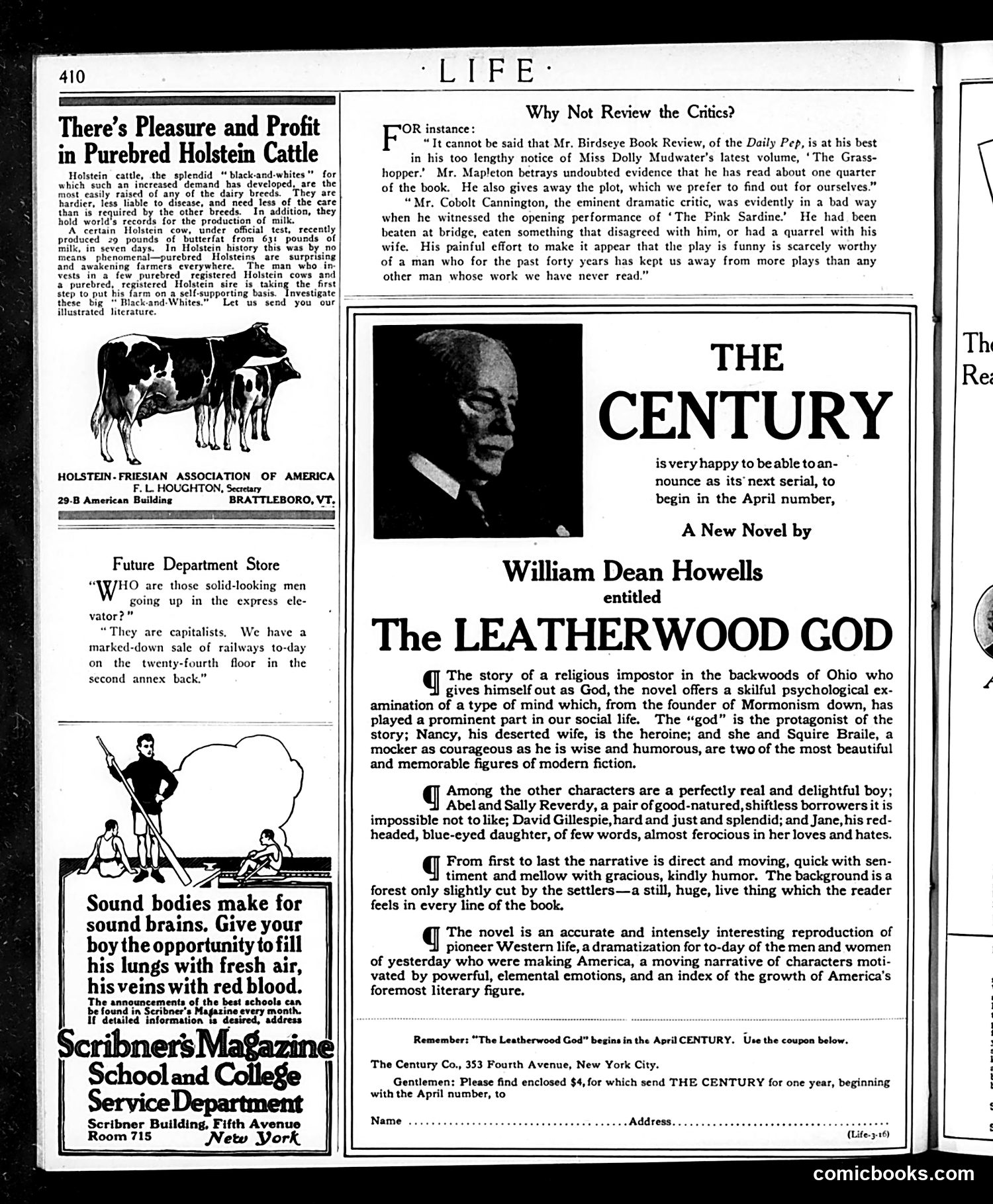
This page combines **advertisements and editorial content** typical of early 20th-century magazines. **"Why Not Review the Critics?"** is a satirical piece mocking literary and theater reviewers. It presents fabricated "reviews of reviewers," exposing their pretentiousness and bias. The examples mock critics who: haven't actually read books (Birdseye), spoil plots while claiming superiority, and let personal grievances (losing at bridge, domestic quarrels) poison their professional judgment. The satire suggests critics wield disproportionate power—keeping audiences away from performances for decades—while their judgments rest on carelessness or spite. **Other content** includes straightforward advertisements: Holstein cattle breeding (farm/agricultural focus), a joke about capitalism and railways being sold as discount goods on upper floors, and a Scribner's Magazine pitch about fresh air for boys. **The Century announcement** promotes William Dean Howells's novel *The Leatherwood God*, a religious-impostor story set in Ohio backwoods, suggesting literary prestige. The page reflects early 1900s American concerns: agricultural modernization, industrial capitalism, literary criticism's social influence, and magazine-driven culture.
📄 Transcribed text from this page (OCR, searchable)
Machine-transcribed from the original scan — historical spelling and the odd misread are preserved.
gil glide eae There’s Pleasure and Profit in Purebred Holstein Cattle Holstein cattle, the splendid “ black-and-whites "for which such an increased demand bas developed, are the most easily raised of any of the dairy breeds. They are hardier, less liable to disease, and need less of the care than is required by the other breeds. In addition, they hold world's records for the production of milk. ‘A certain Holstein cow, under official test, recently produced 29 pounds of butterfat from 631 pounds of milk, in seven days. In Holstein history this was by no means phenomenal—purebred Holsteins are surpri and awakening farmers everywhere. The man who vests in a few purebred registered Holstein cows and a porebred, registered Holstein sire is, taking the first step to put his farm on a self-supporting basis. Investigate these big ‘ Black-and-Whites.” Let us send you our illustrated literature. HOLSTEIN-FRIESIAN ASSOCIATION OF AMERICA F. L. HOUGHTON, Secretary 29.B American Building BRATTLEBORO, VT. Future Department Store “YJHO are those solid-looking men going up in the express ele- vator?" “They are capitalists, We have a marked-down sale of railways to-day on the twenty-fourth floor in the second annex back.” Sound bodies make for sound brains, Give your boy the opportunity to fill his lungs with fresh air, his veins with red blood. Scribner Building, Fifth Avenue Room 715 New York Why Not Review the Critics? ‘OR instance: “Tt cannot be said that Mr. Birdseye Book Review, of the Daily Pep, is at his best in his too lengthy notice of Miss Dolly Mudwater’s latest volume, ‘The Grass- hopper.’ Mr. Mapleton betrays undoubted evidence that he has read about one quarter of the book. He also gives away the plot, which we prefer to find out for ourselves.” “Mr. Cobolt Cannington, the eminent dramatic critic, was evidently in a bad way when he witnessed the opening performance of ‘The Pink Sardine.’ He had been beaten at bridge, eaten something that disagreed with him, or had a quarrel with his wife. His painful effort to make it appear that the play is funny is scarcely worthy of a man who for the past forty years has kept us away from more plays than any other man whose work we have never read.” THE ENTURY nounce as its’ next serial, to begin in the April number, A New Novel by William Dean Howells entitled The LEATHERWOOD GOD The story of a religious impostor in the backwoods of Ohio who gives himself out as God, the novel offers a skilful psychological ex- amination of a type of mind which, from the founder of Mormonism down, has played a prominent part in our social life. The “god” is the protagonist of the story; Nancy, his deserted wife, is the heroine; and she and Squire Braile, a mocker as courageous as he is wise and humorous, are two of the most beautiful and memorable figures of modern fiction. Among the other characters are a perfectly real and delightful boy; Abel and Sally Reverdy, a pair of good-natured, shiftless borrowers it is impossible not to like; David Gillespie, hard and just and splendid; and Jane, his red- headed, blue-eyed daughter, of few words, almost ferocious in her loves and hates. From first to last the narrative is direct and moving, quick with sen- timent and mellow with gracious, kindly humor. The background is a forest only slightly cut by the settlers—a still, huge, live thing which the reader feels in every line of the book. The novel is an accurate and intensely interesting reproduction of pioneer Western life, a dramatization for to-day of the men and women of yesterday who were making America, a moving narrative of characters moti- vated by powerful, elemental emotions, and an index of the growth of America’s foremost literary figure. Remember: “The Leatherwood God” begins in the April CENTURY. Use the coupon below. The Century Co., 353 Fourth Avenue, New York City. Gentlemen: Please find enclosed $4, for which send THE CENTURY for one year, beginning with the April number, to Th Re comicbooks.com