
A complete issue · 44 pages · 1916
Life — January 20, 1916
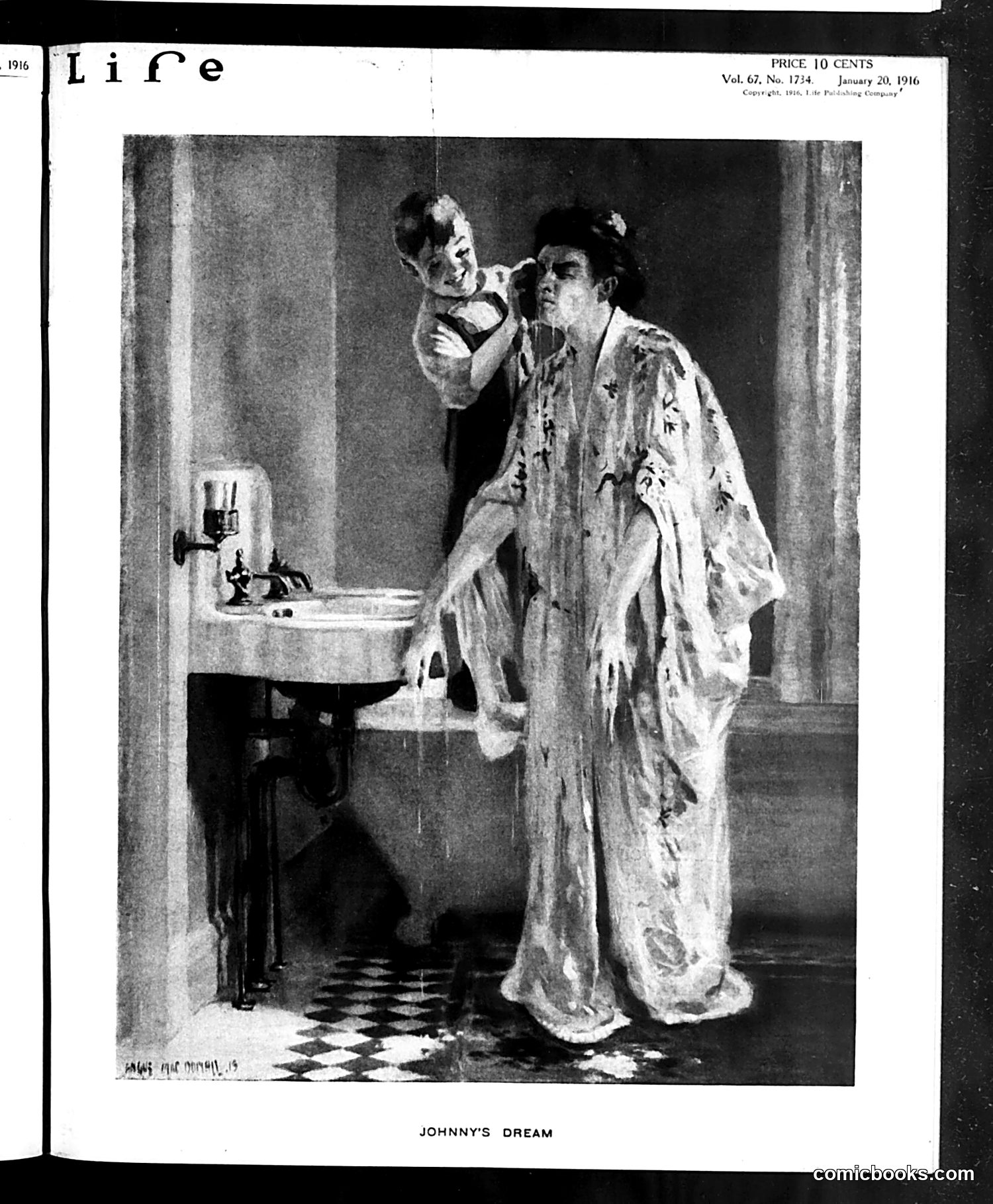
This 1916 Life magazine illustration depicts a domestic scene titled "Johnny's Dream." A man in an ornate, patterned robe stands at a bathroom sink, appearing disheveled or distressed, while holding up what appears to be a small child or infant above his head. The image likely satirizes early 20th-century anxieties about fatherhood, domestic responsibility, or the challenges of childcare. The man's elaborate robe and the dreamlike quality suggested by the title indicate this may represent a fantasy or nightmare scenario rather than reality. The specific social commentary—whether about paternal duties, marital life, or contemporary culture—remains unclear without additional context from the magazine's text or other period sources.
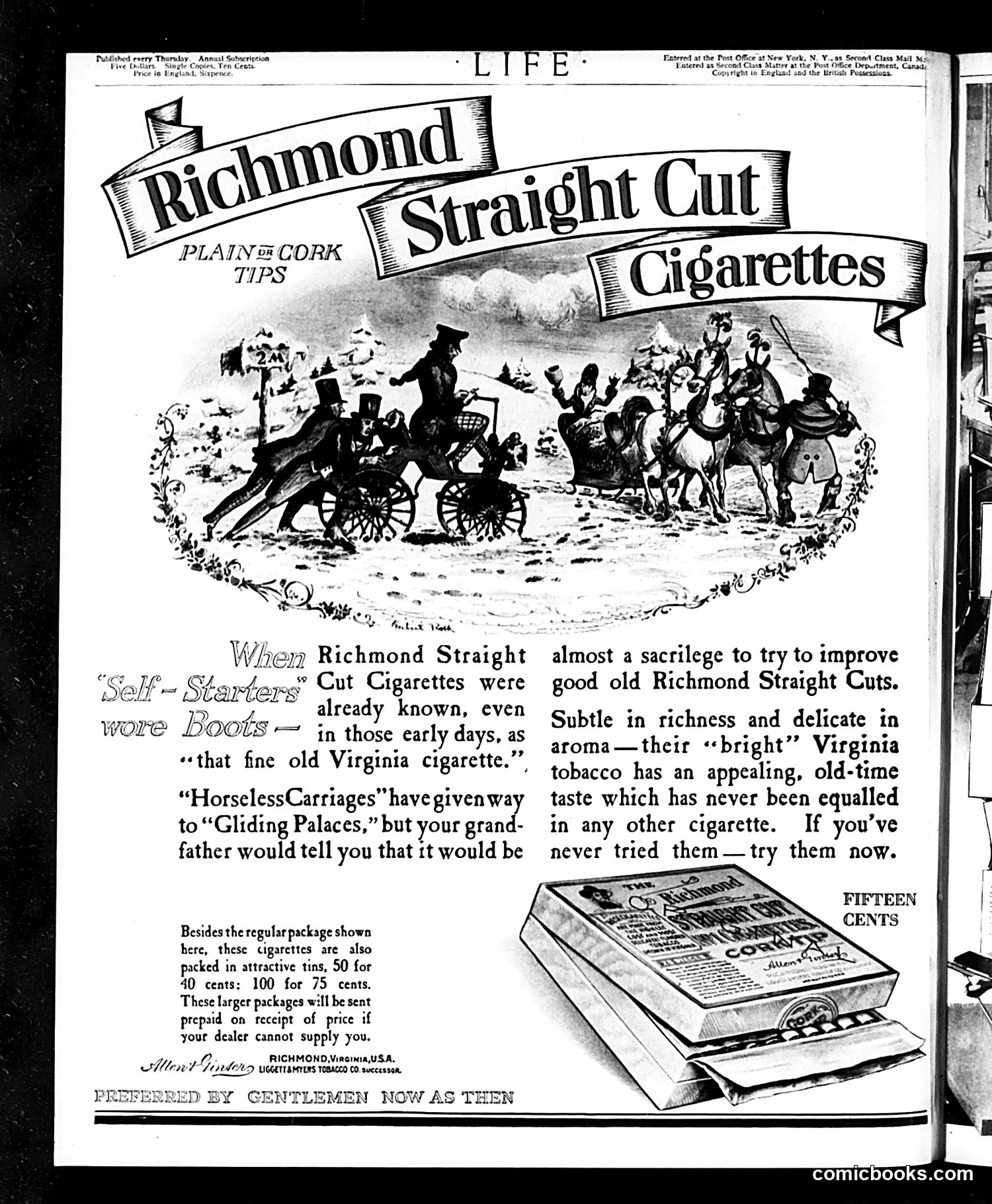
This is primarily a **cigarette advertisement**, not political satire. The page advertises Richmond Straight Cut Cigarettes, priced at fifteen cents. The ad uses nostalgic imagery comparing transportation evolution: "Self-Starters were Boots," "Horseless Carriages have given way to Gliding Palaces," suggesting progress and modernity. The central illustration depicts an old-fashioned carriage scene, evoking tradition and heritage. The marketing pitch emphasizes the product's Virginia tobacco as having an "appealing, old-time taste which has never been equalled in any other cigarette." The tagline "PREFERRED BY GENTLEMEN NOW AS THEN" explicitly markets these cigarettes as a timeless, refined choice for gentlemen—reflecting early 20th-century advertising strategies linking cigarettes to sophistication and masculine identity. This appears to be from an era when tobacco advertising in mainstream publications was entirely legal and common.
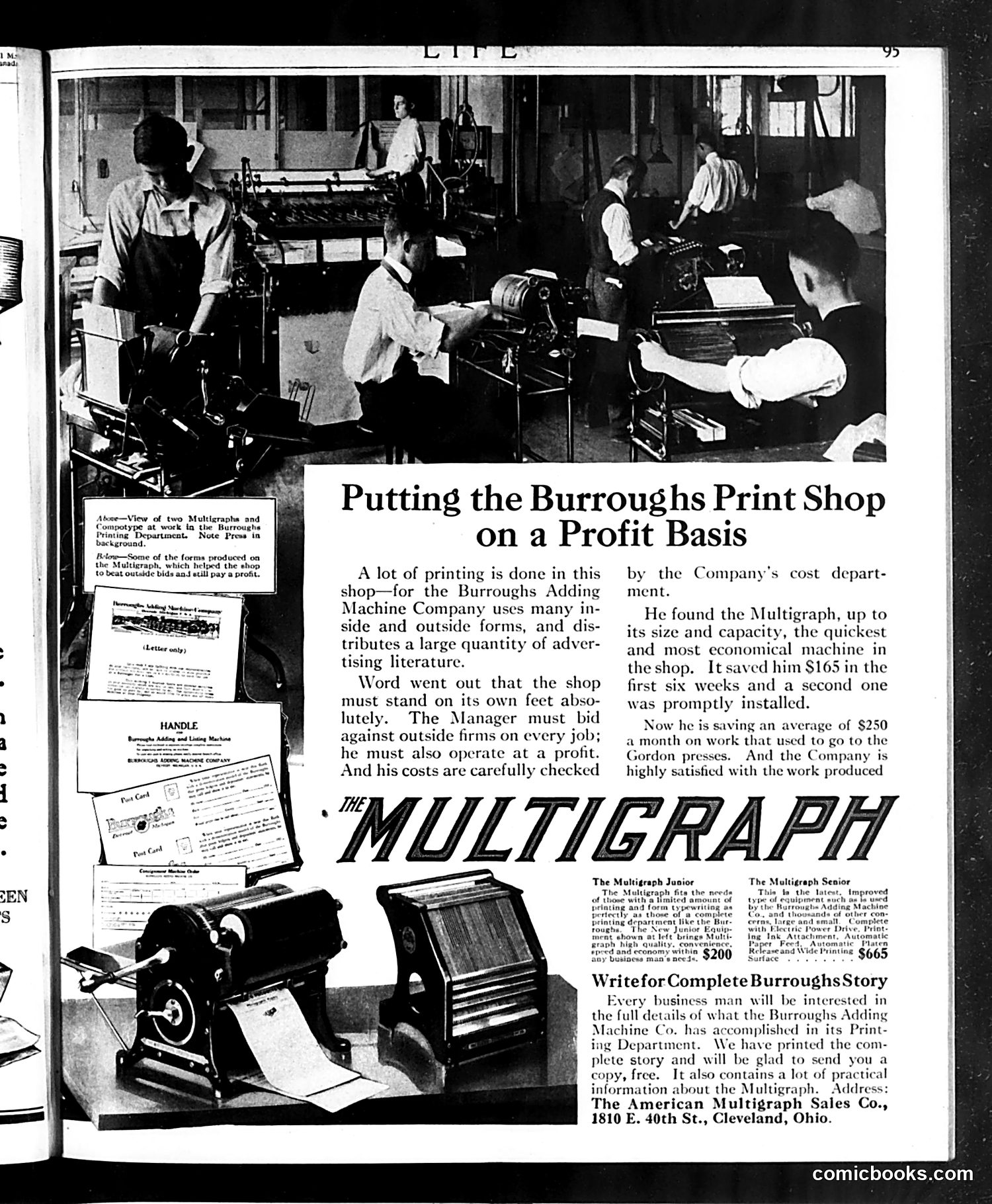
This page is **primarily advertising**, not satire or political commentary. It showcases the Burroughs Adding and Multigraph Company's printing department operations. The top photograph depicts workers operating printing equipment in an industrial shop setting. The accompanying text explains how the company achieved profitability by using Multigraph machines—described as efficient and economical for in-house printing tasks. The manager bid competitively against outside firms while reducing costs, saving approximately $250 monthly. The lower section advertises two Multigraph machine models (Junior at $200, Senior at $665) with technical specifications. A call-to-action invites readers to request the "Complete Burroughs Story" from the American Multigraph Sales Company in Cleveland, Ohio. This represents early 20th-century business-to-business marketing emphasizing operational efficiency and cost savings through mechanization.
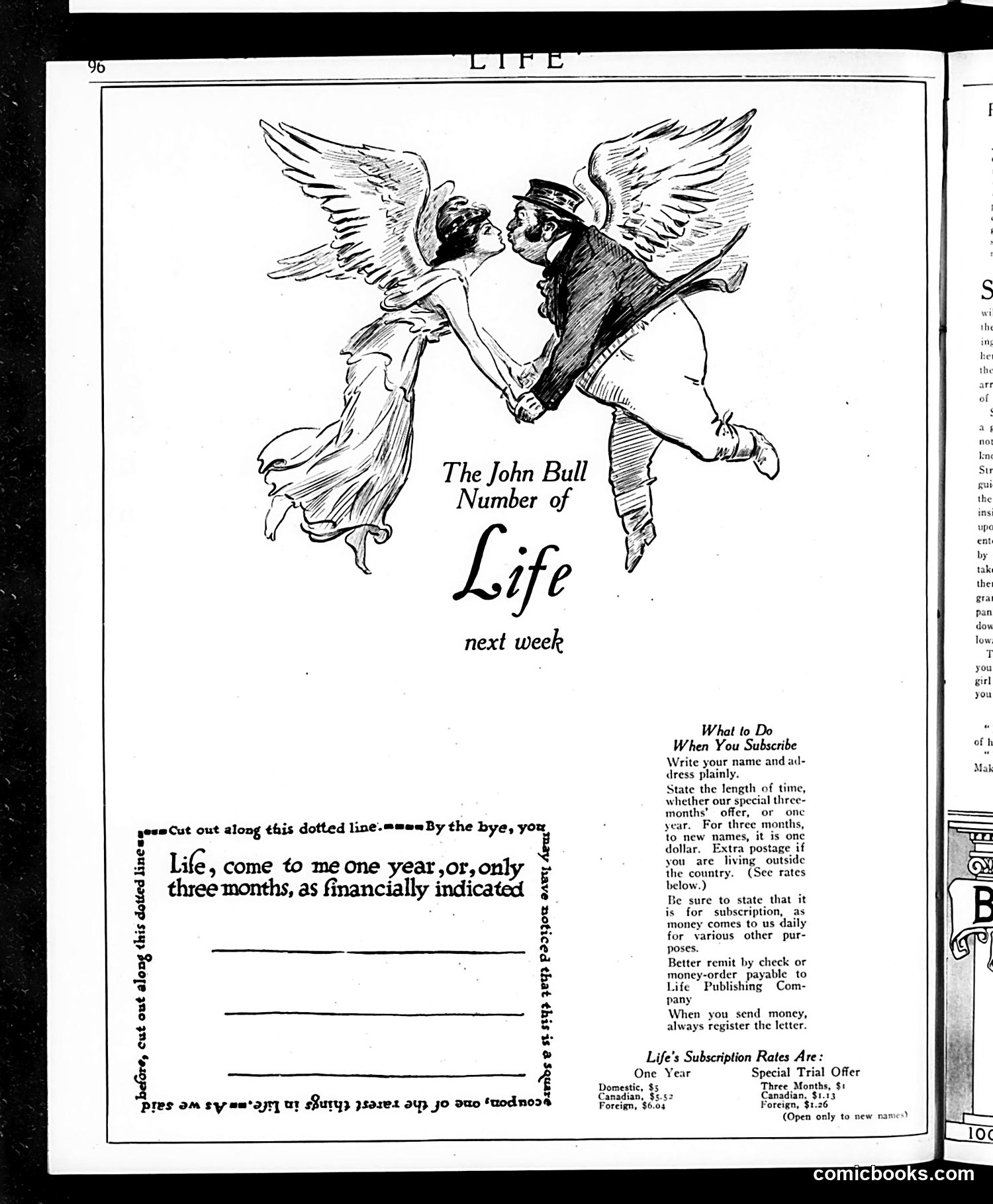
This page is primarily a **subscription advertisement** for *Life* magazine, not a political cartoon. The central illustration shows two winged figures (appearing to represent angels or allegorical characters) in an embrace or dance. One wears formal attire with a top hat; the other wears flowing robes. The image is labeled "The John Bull Number of *Life* next week," suggesting the upcoming issue will focus on British themes or characters—"John Bull" being the traditional personification of England. The page functions as a promotional teaser, encouraging subscriptions with pricing information and instructions. The romantic or celebratory pose of the figures likely conveys that the upcoming issue will be noteworthy or entertaining, though the specific political context of why a "John Bull Number" was anticipated remains unclear from this page alone.
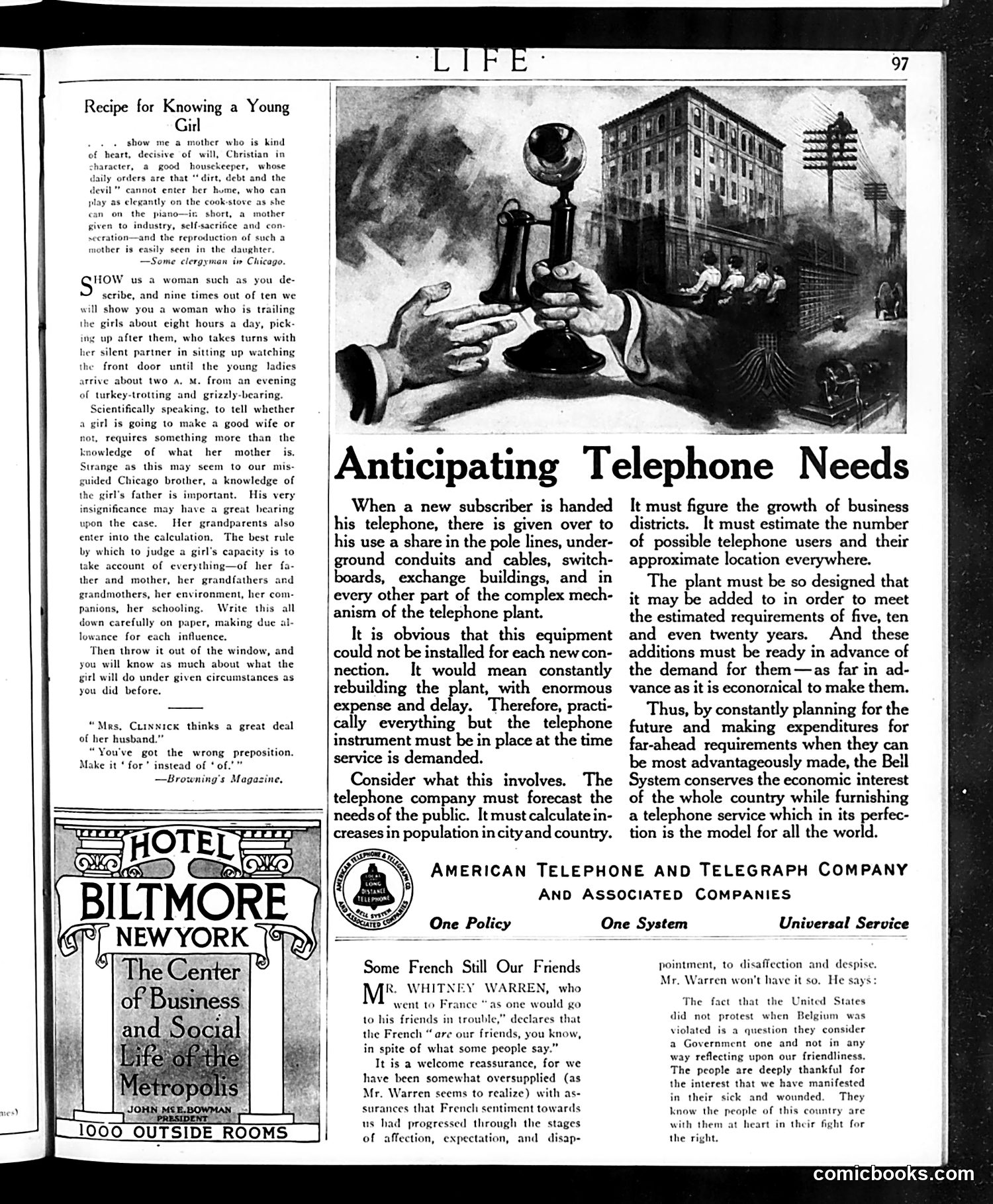
This page contains primarily **corporate advertising and advice columns** rather than political satire. The main visual element is an illustration for American Telephone and Telegraph Company (AT&T) showing telephone infrastructure being installed. The accompanying text explains AT&T's forward-planning philosophy—anticipating future telephone needs by pre-installing equipment before demand requires it. The left side contains two unrelated features: a "Recipe for Knowing a Young Girl" (advice on evaluating potential daughters-in-law based on domestic skills) and a Hotel Biltmore advertisement. Below is an article titled "Some French Still Our Friends" discussing Mr. Whitney Warren's pro-American sentiment during World War I, reassuring readers of French loyalty despite earlier tensions. This is **not satirical content** but rather mainstream magazine editorial and advertising material typical of early 20th-century Life.
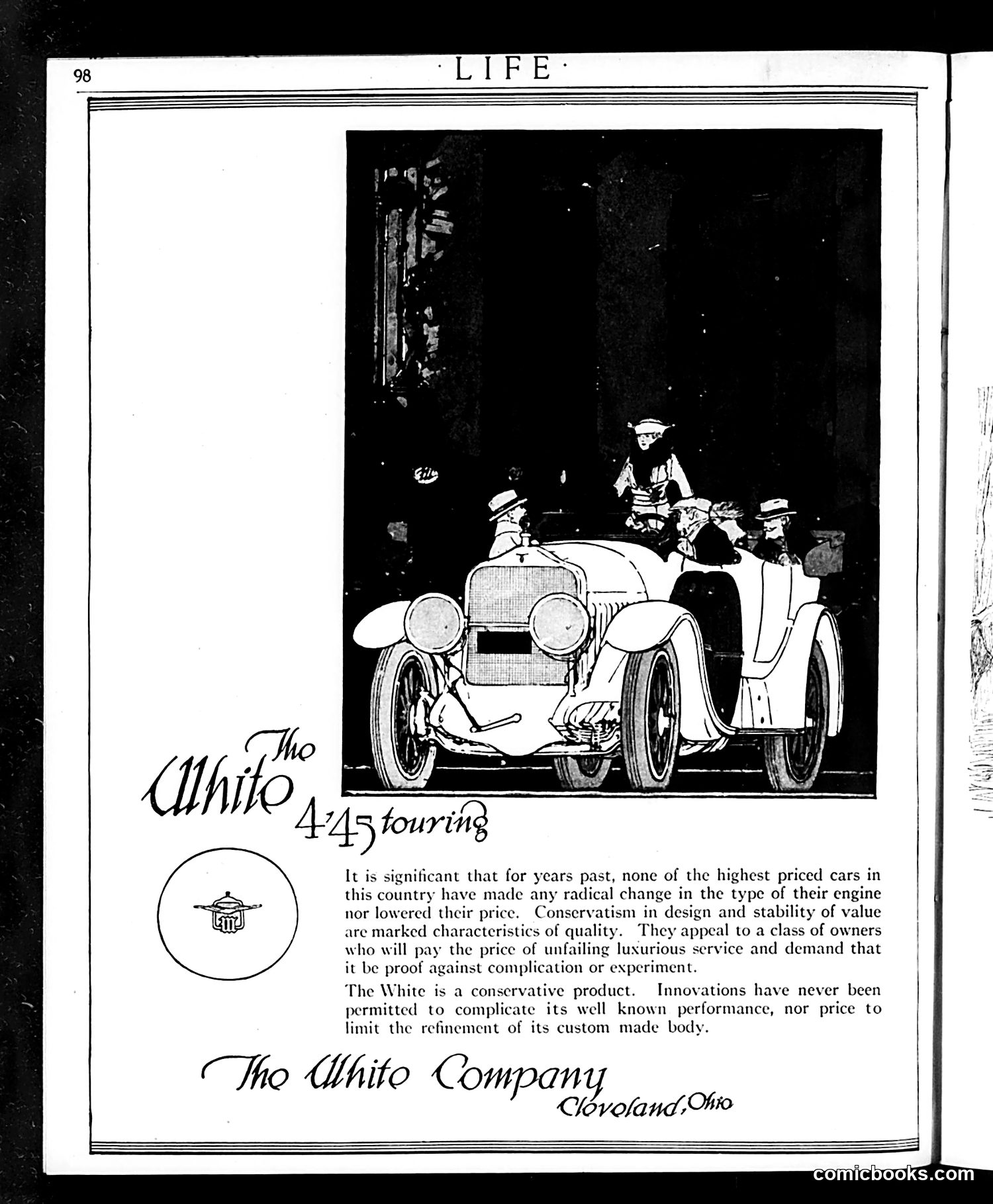
This is primarily an **advertisement for the White Motor Company's 4-45 touring car**, not satire or political commentary. The ad features an illustration of an early 1920s automobile with passengers in period dress, parked before what appears to be a grand building entrance. The accompanying text emphasizes that White cars represent conservative engineering—no radical design changes, reliable performance, and refined craftsmanship. The messaging appeals to wealthy buyers willing to pay premium prices for proven quality and stability rather than experimental innovations. The "satire" in *Life* magazine was typically found elsewhere in the publication. This page represents straightforward luxury automobile marketing, targeting affluent readers of the era who valued tradition and reliability over novelty in their vehicles.
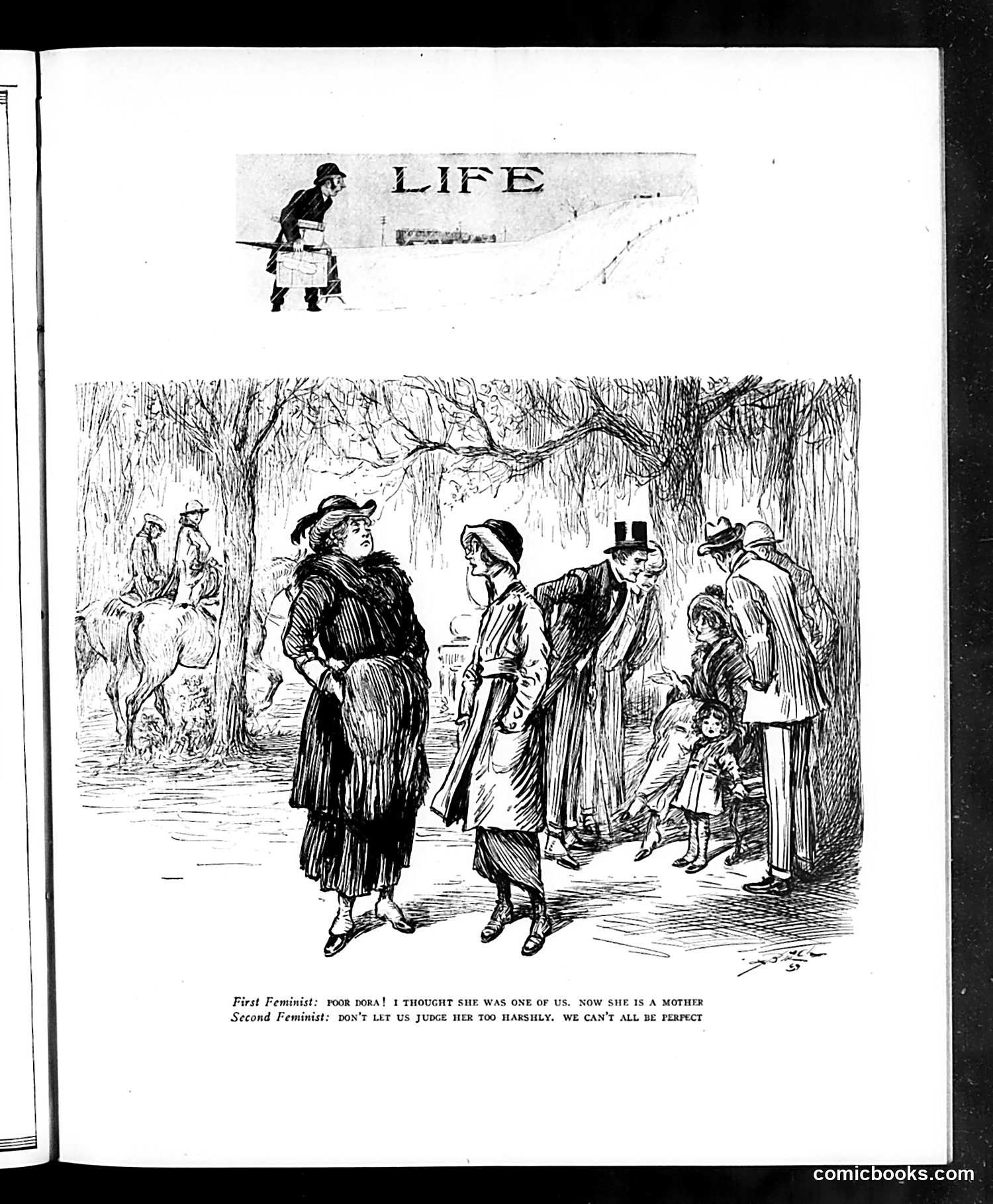
This cartoon satirizes early feminism and women's rights advocates. Two women identified as "feminists" encounter a mother with children in a park setting. The first feminist expresses disapproval ("Poor Dora! I thought she was one of us"), implying the woman has betrayed feminist ideals by becoming a mother. The second feminist's response—"Don't let us judge her too harshly. We can't all be perfect"—delivers the satirical punch: the cartoon mocks feminists as judgmental and intolerant, while implying that motherhood represents women's "natural" role. The joke suggests feminists are hypocritical ideologues disconnected from ordinary women's choices. This reflects anti-feminist sentiment common in early-20th-century American media, portraying women's rights advocates as extreme and out-of-touch.
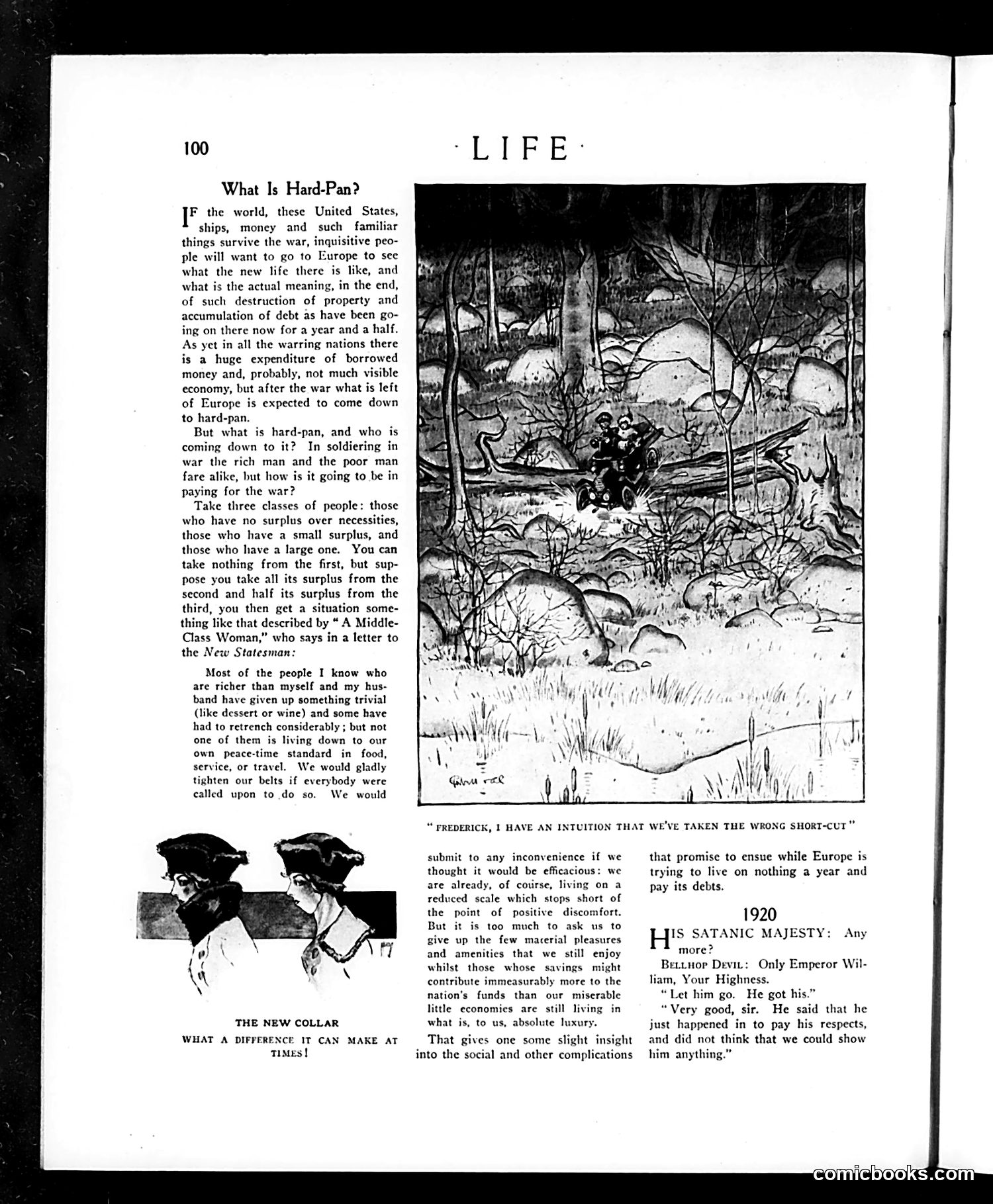
This page discusses "Hard-Pan"—a post-WWI economic concept referring to reduced living standards. The article argues that wealthy nations must accept austerity to pay war debts, with three economic classes facing different sacrifices. The central illustration depicts a WWI trench scene with soldiers, visualizing the war's devastation that created Europe's debt crisis. The lower cartoon shows "The New Collar"—two figures wearing collars, likely representing the middle class forced to economize. The caption's pun ("What a difference it can make at times!") suggests wearing a clean collar despite financial hardship symbolizes maintaining dignity during economic hardship. The dialogue at bottom, dated 1920, appears to be unrelated satirical content about British nobility and the Devil, likely a separate comic sketch.
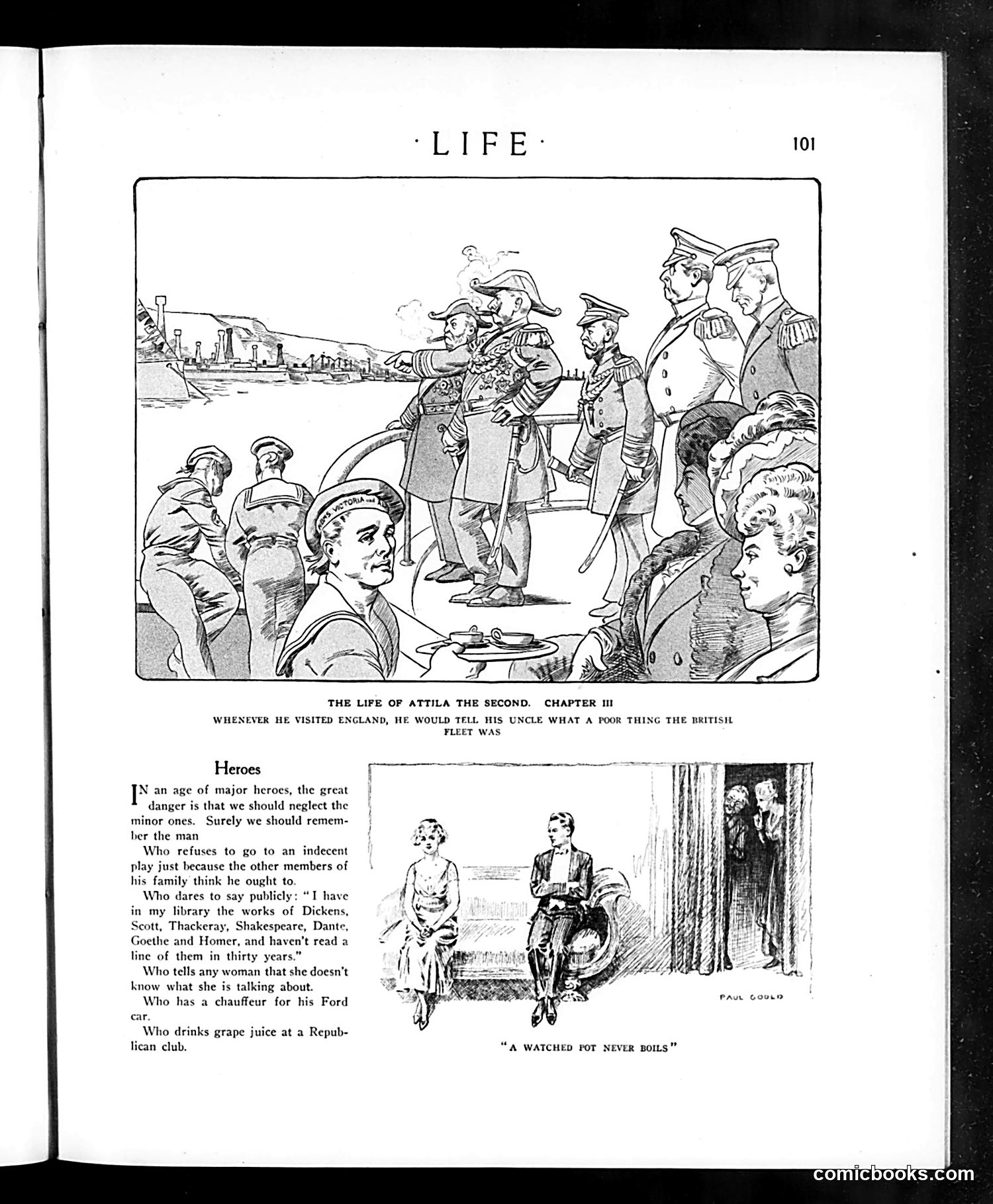
**Main Cartoon (top):** Depicts military or political figures in formal uniforms gathered near a naval vessel. The caption references Attila visiting England and complaining to his uncle about "a poor thing the British fleet was." This appears to be satirizing someone (likely a foreign dignitary or political figure) making disparaging remarks about British naval power—a source of national pride. **"Heroes" Section (left):** A humorous column listing absurd definitions of heroes—people who refuse indecent plays, boast about literary knowledge, ignore conversations, employ chauffeurs, drink grape juice at Republican clubs. This mocks pretentious or self-righteous social attitudes of the era. **"A Watched Pot Never Boils" (bottom right):** A domestic scene by Paul Gould illustrating the proverb.
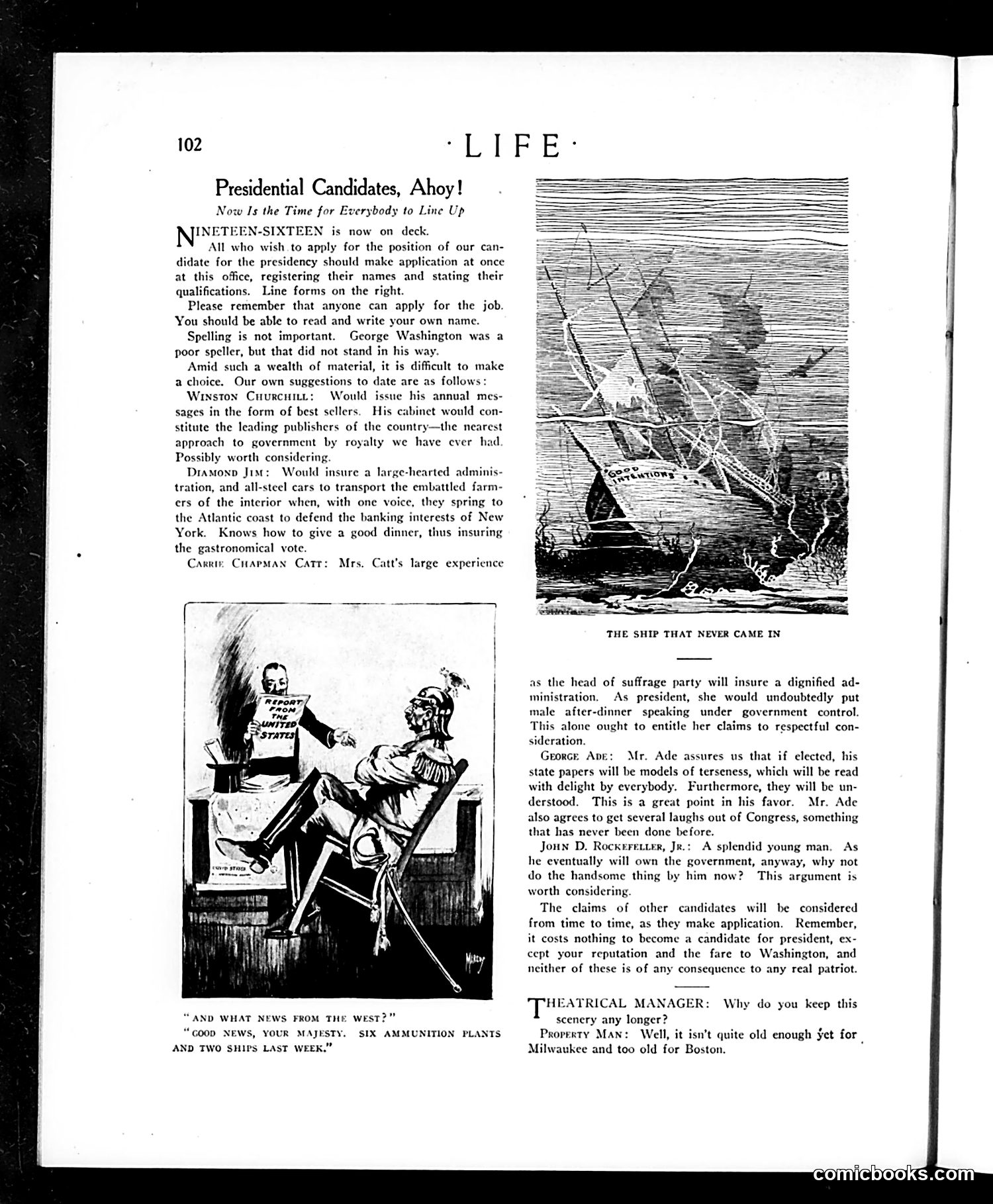
This page satirizes potential 1916 presidential candidates by humorously "accepting applications" for the presidency. The text suggests various prominent figures—Winston Churchill, Diamond Jim Brady, Carrie Chapman Catt, George Ade, and John D. Rockefeller Jr.—as candidates, mocking their qualifications. The cartoon below depicts a figure labeled "GOOD NEWS" receiving what appears to be war-related dispatches ("six ammunition flats and two ships last week"), satirizing how candidates might exploit international conflict for political advantage. The page ridicules how anyone could theoretically run for president, while also jabbing at wealthy industrialists and public figures who might seek the office. The overall tone mocks both ambitious candidates and the electoral process itself.
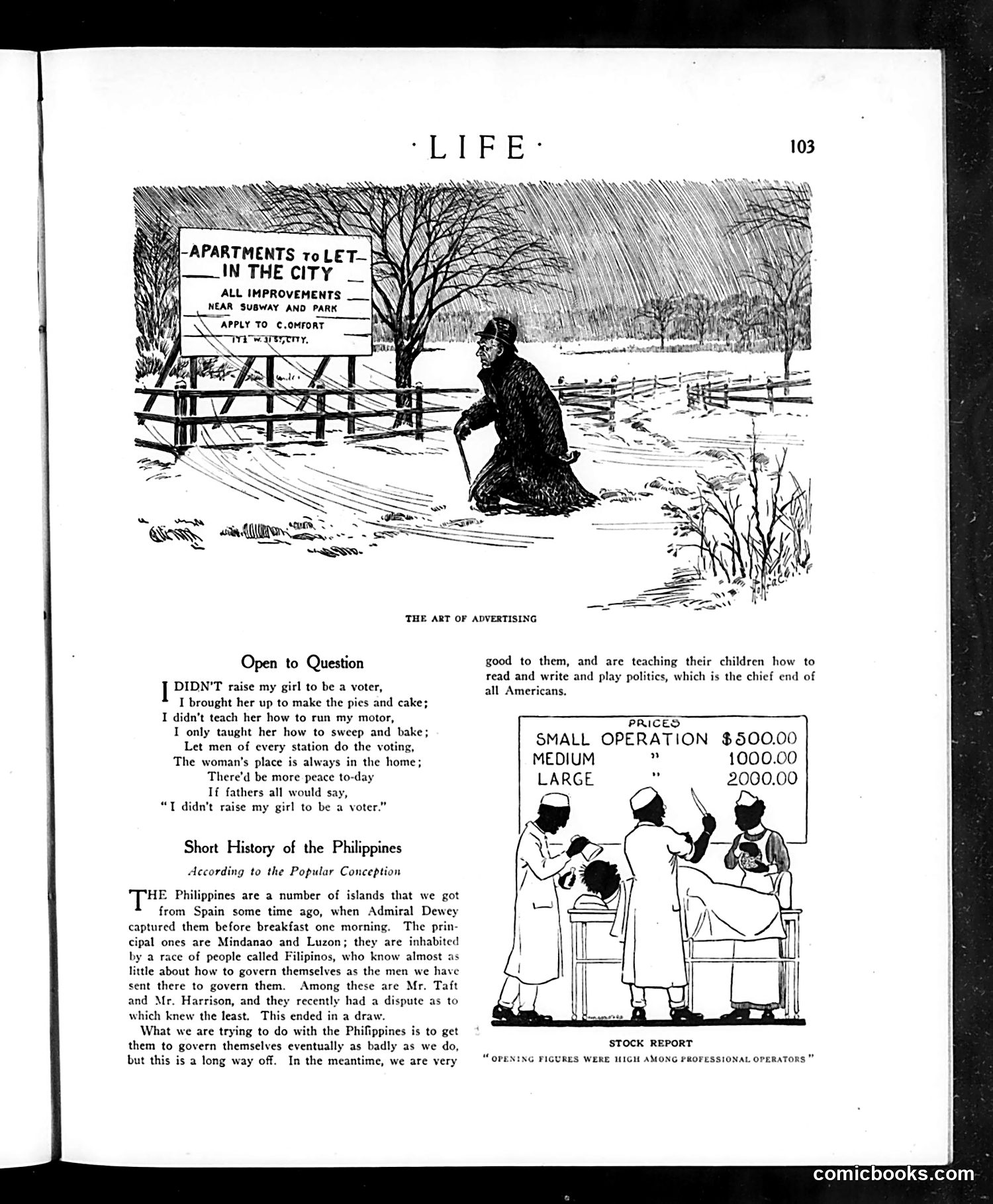
This page contains three distinct elements: 1. **Top illustration**: An advertisement for city apartments, showing a man reading near a sign advertising rentals "near subway and park." This is straightforward commercial advertising with no political content. 2. **"Open to Question"**: A poem criticizing women's suffrage, arguing women's proper place is domestic (making pies, sweeping, baking) rather than voting. This reflects anti-suffrage sentiment, likely from the early 1900s before women gained voting rights. 3. **"Short History of the Philippines"**: A satirical section mocking American ignorance about the Philippines, referencing Admiral Dewey's conquest and mentioning disputes between Taft and Harrison (likely Theodore Roosevelt's Secretary of War William Howard Taft). It critiques U.S. imperial governance of the islands. The "Stock Report" cartoon jokes about business operations being sold like stocks, with humorous pricing.
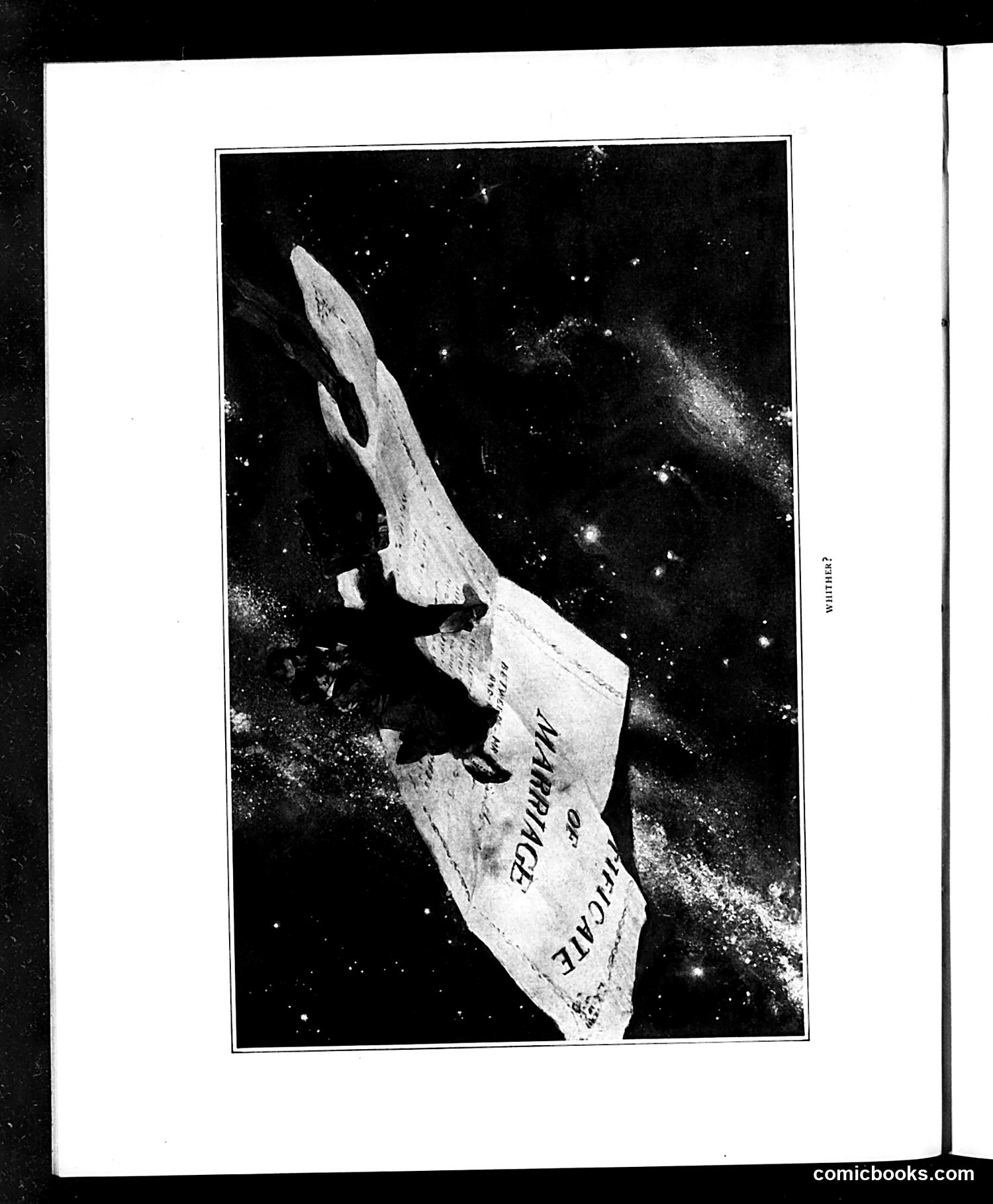
This page shows a black and white photograph of what appears to be a ship or vessel tilted at a dramatic angle against a starry background. The vessel has text written on its hull that reads (when oriented correctly) "BROUGHT TO" and what seems to be additional text, though the exact wording is difficult to read with complete certainty due to the image quality and angle. The image appears to be satirical commentary, likely from early-to-mid 20th century *Life* magazine. Without clearer text visibility or additional context on the page, I cannot definitively identify which specific political or social event this references. The tilted vessel against stars suggests either disaster, failure, or perhaps commentary on ambition gone awry, but the specific target of the satire remains unclear from this image alone.
This page presents two fictional short stories from Life's 1915 contest, not political cartoons or satire. "The Night Nurse" by Will S. Gidley depicts a WWI hospital scene where a nurse named Nydia tends to a wounded English captain, who reveals he's on a secret mission in London seeking revenge against a German lover who betrayed him. "The Advent of the Majority" by Stella Wynne Herron describes Colonel Scipio Bridge observing the Florida Keys and contemplating the presidential election—specifically that Lone Palm Key represents America's "majority" (the 66th precinct), and how this region's voting patterns matter politically. Both are sentimental wartime fiction reflecting early-1910s American literary interests in espionage and electoral politics.
This page contains two distinct pieces of content: **Left column:** A satirical story about Colonel Higgins and a Captain discussing voting intentions before an election. The Colonel struggles with choosing between Republican and Democratic candidates, reflecting turn-of-century political ambivalence. The humor derives from Higgins' inability to make a principled choice and his eventual drunken disappearance before voting day—satirizing indecisive voters and the era's casual political engagement. **Right column:** "Why the Trench Was Lost" by Charles F. Pietsch—a WWI story about a German officer observing French lines from a tree-top position near his home. The narrative emphasizes the war's intimate horror: the officer recognizes his own house below and becomes emotionally compromised, leading to military disaster. The piece critiques war's human cost and the collision between domestic life and combat.
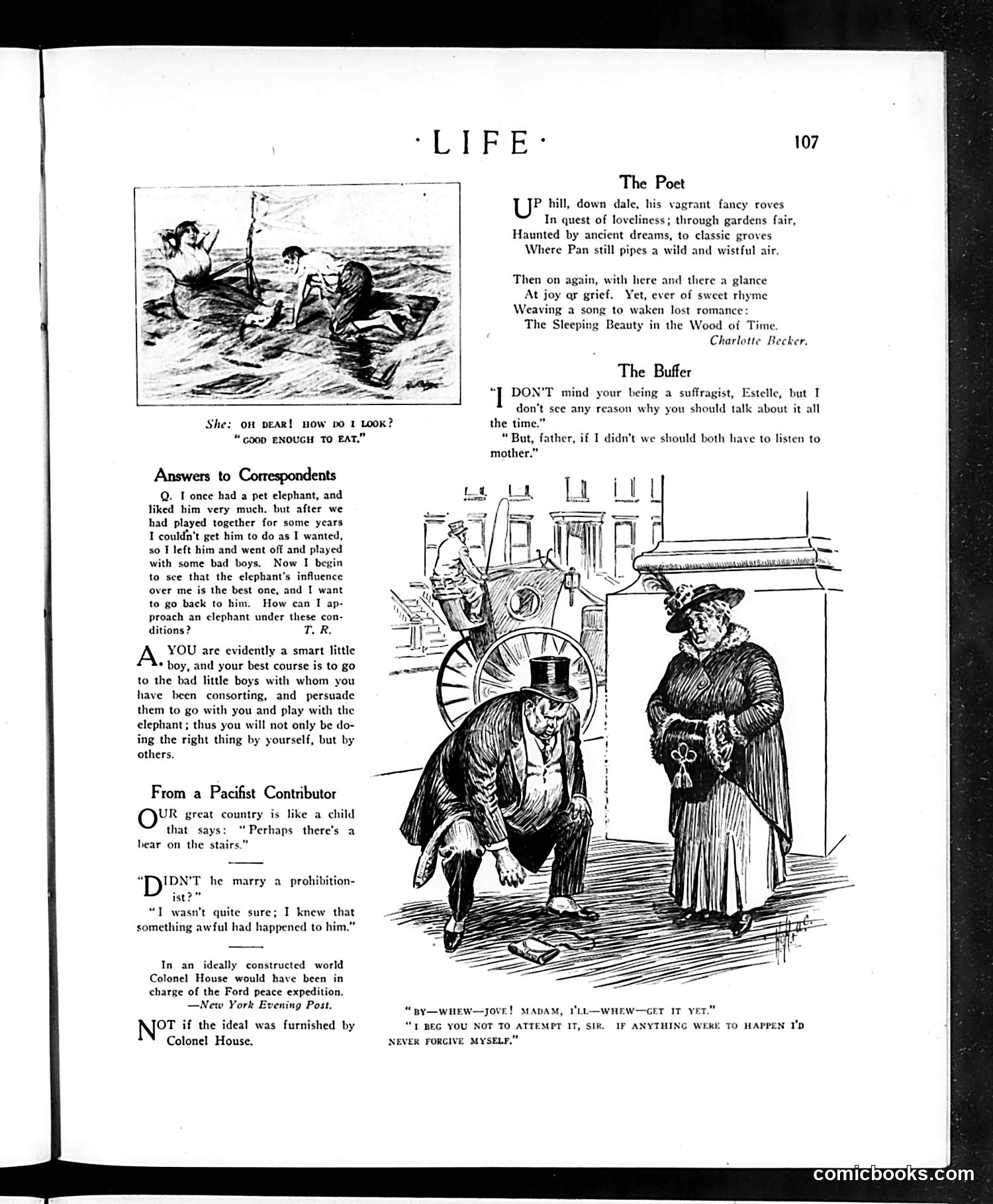
This page contains several distinct pieces: **"The Poet"** — A poem by Charlotte Becker about artistic inspiration and nature. **"The Buffer"** — A cartoon depicting what appears to be a domestic dispute. A man and woman are shown near a carriage, with the woman saying she won't attempt reconciliation if "anything were to happen" and that she'd "never forgive" herself. The term "buffer" likely refers to the man's role as a mediator or intermediary—possibly between the woman and her critical mother, referenced in the dialogue. **"Answers to Correspondents"** — Advice column responses, including one about an elephant's bad influence and another noting that America resembles "a child that says 'Perhaps there's a bear on the stairs.'" The satirical tone throughout mocks both domestic tensions and American anxiety, though specific historical context remains unclear from the visible content alone.
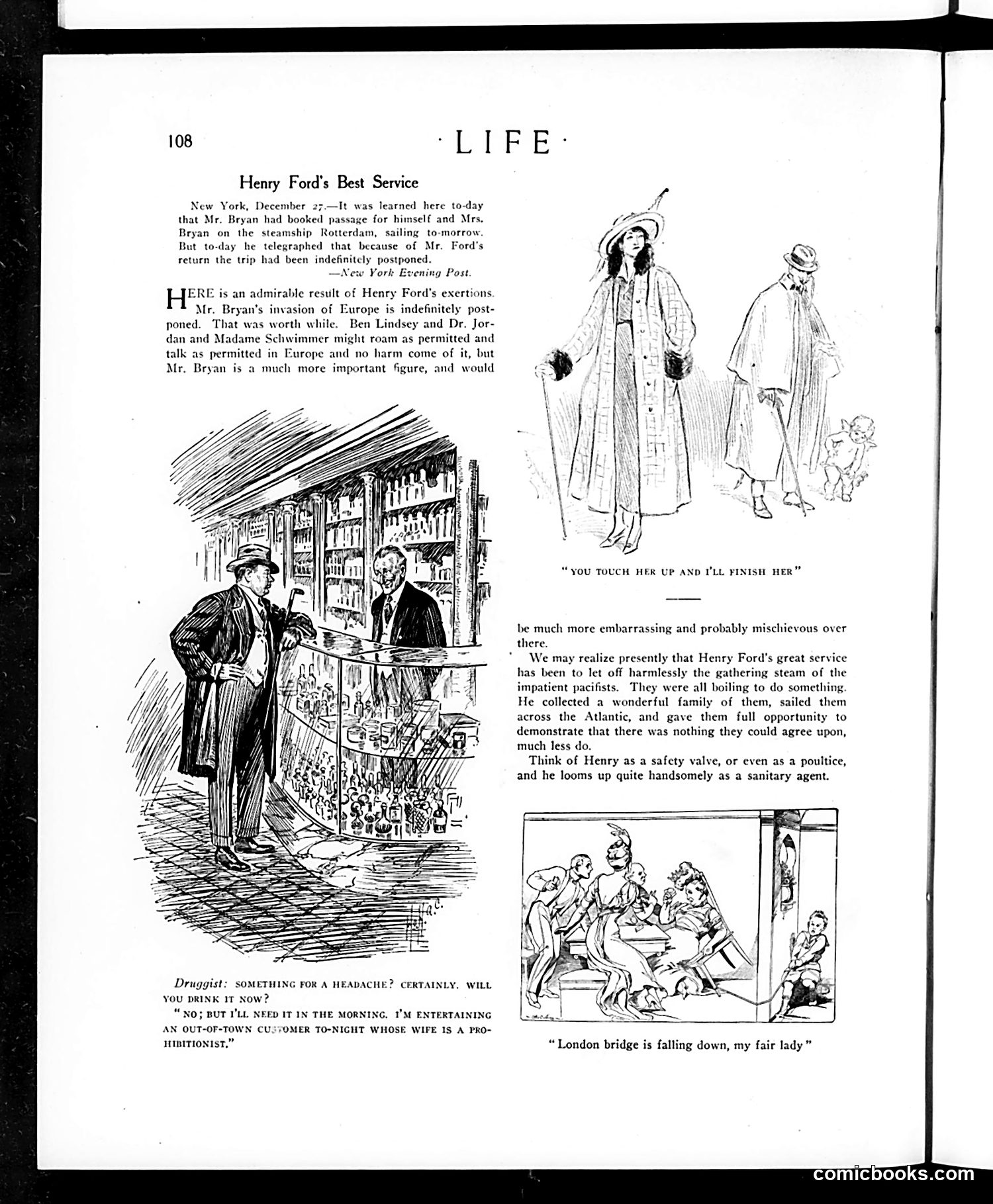
This page satirizes Henry Ford's 1915 "Peace Ship" expedition, which attempted to end World War I. The article mocks William Jennings Bryan (the three-time presidential candidate and prominent pacifist) for canceling his European trip because Ford had returned—suggesting Ford's presence made Bryan's absence unnecessary. The satire's point: Ford's well-intentioned peace mission actually *prevented* more troublemaking by occupying pacifists and demonstrating their inability to agree on anything. By collecting "a wonderful family of them" and shipping them across the Atlantic, Ford inadvertently functioned as a "safety valve" that harmlessly vented their activism without causing real damage. The cartoons illustrate scenes from the peace mission, mocking its ineffectiveness. The satire suggests that pacifists like Bryan were more dangerous when active at home than when neutralized abroad—a cynical commentary on both Ford's idealism and Progressive-era peace movements.
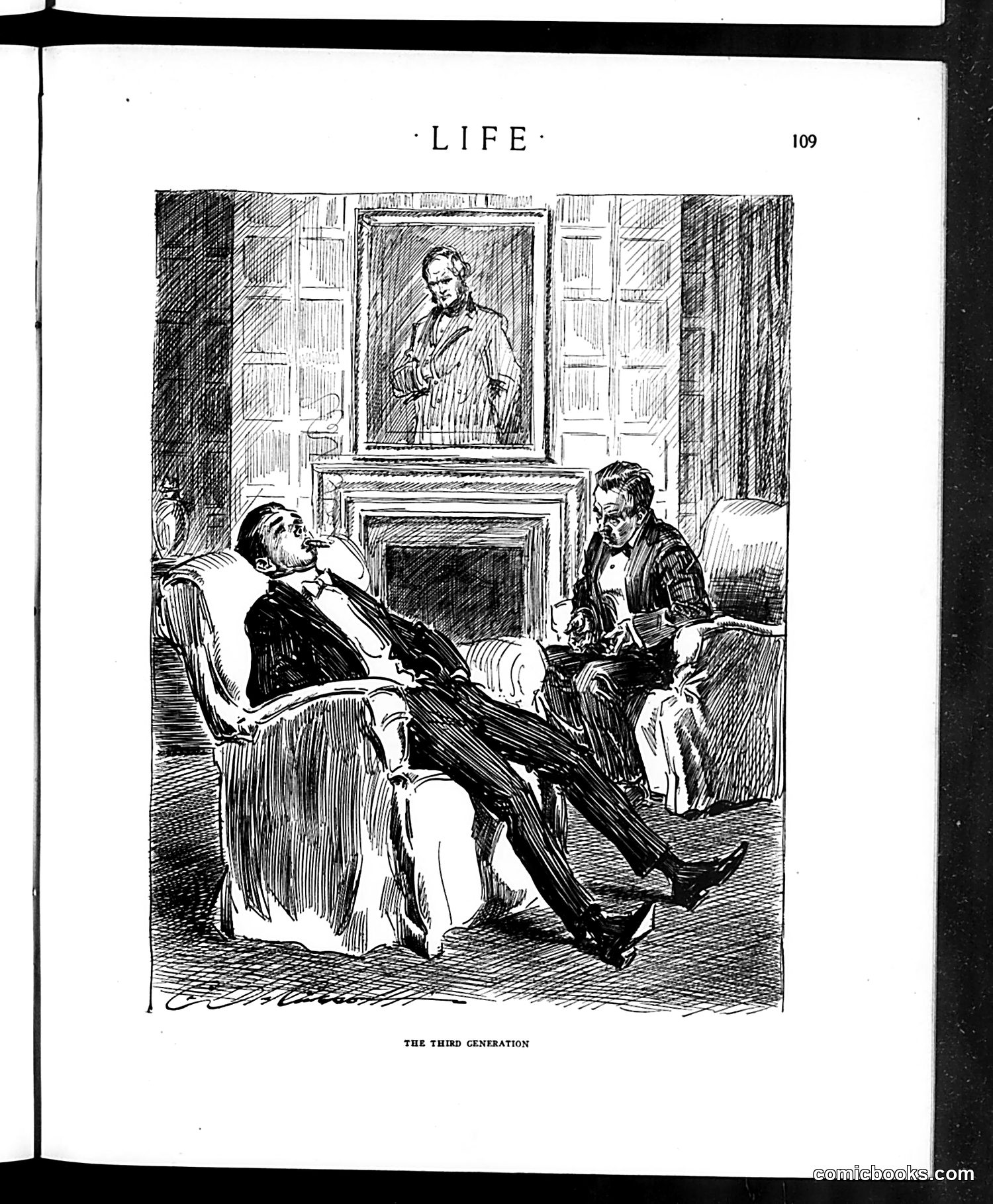
This satirical sketch depicts three generations of men in a Victorian-era parlor. The caption "The Third Generation" suggests commentary on family decline or moral deterioration across generations. The composition shows: an older man (first generation) relaxing in a chair, a middle-aged man (second generation) seated nearby, and a young man (third generation) visible in a mirror or portrait above the fireplace, appearing more refined or affected than his predecessors. The satire likely critiques how successive generations become increasingly idle, effete, or removed from practical values—a common Victorian anxiety about inherited wealth and aristocratic decay. The positioning emphasizes the contrast between the comfortable, recumbent older men and the presumably more "refined" younger generation, mocking both the degeneracy of leisure and affected manners.
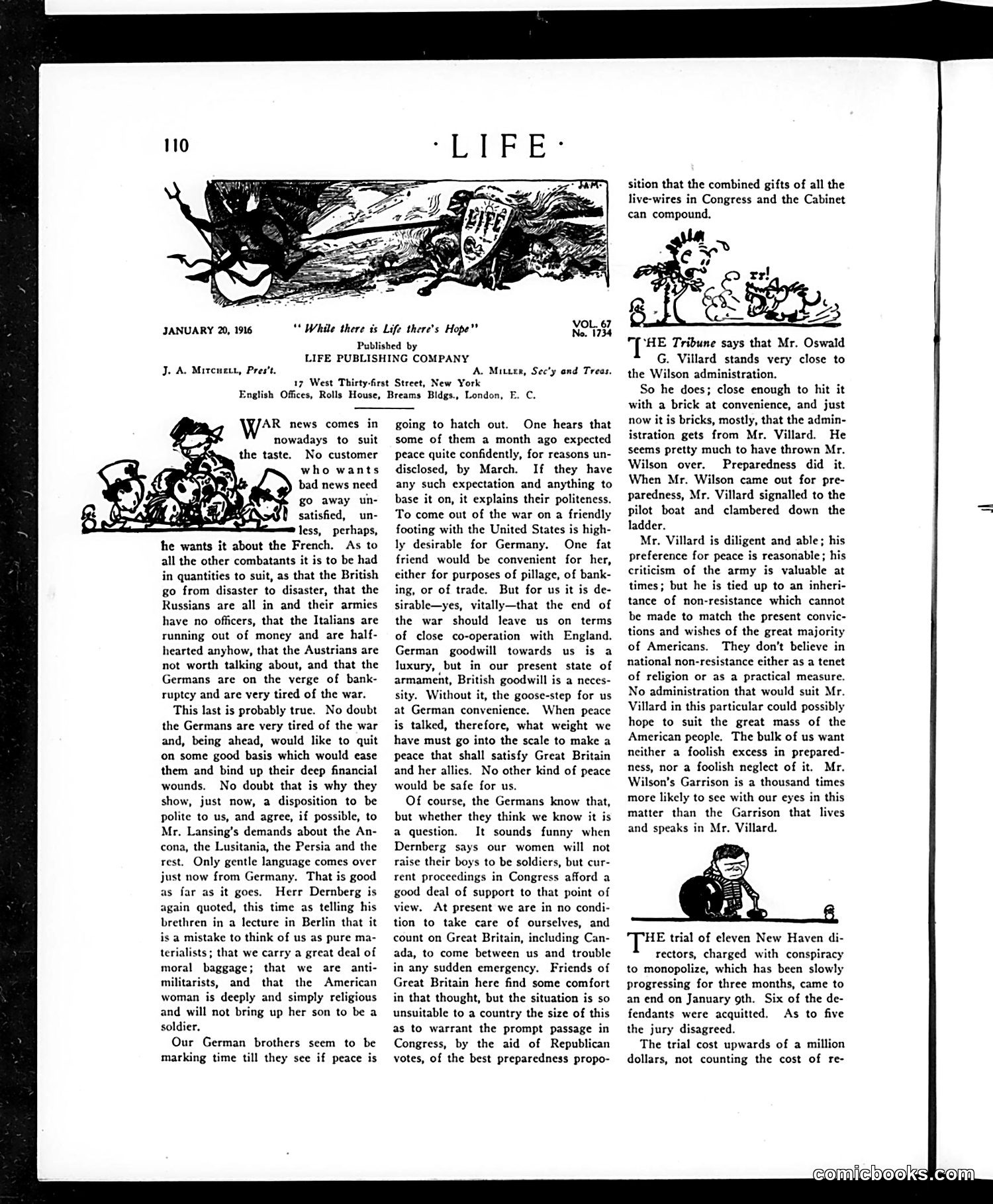
This page critiques American military unpreparedness during World War I. The main editorial argues that Germany is deliberately being polite to the U.S., hoping America will remain neutral or even friendly—a luxury Germany can afford while winning. The author warns this is dangerous strategizing. The key point: America currently depends on British naval protection and cannot defend itself. Therefore, any peace negotiations must prioritize British interests, not German "goodwill." The editorial mocks Congress for lacking preparedness, sarcastically suggesting they should pass whatever military-readiness legislation "the combined gifts of all the live-wires in Congress and the Cabinet can compound." A secondary item mentions Oswald G. Villard (a prominent pacifist editor and Wilson advisor) being close enough to the administration "to hit it with a brick"—implying frustrated criticism of Wilson's cautious approach to preparedness. The crude cartoons accompanying the text mock the absurdity of American weakness amid a global conflict.
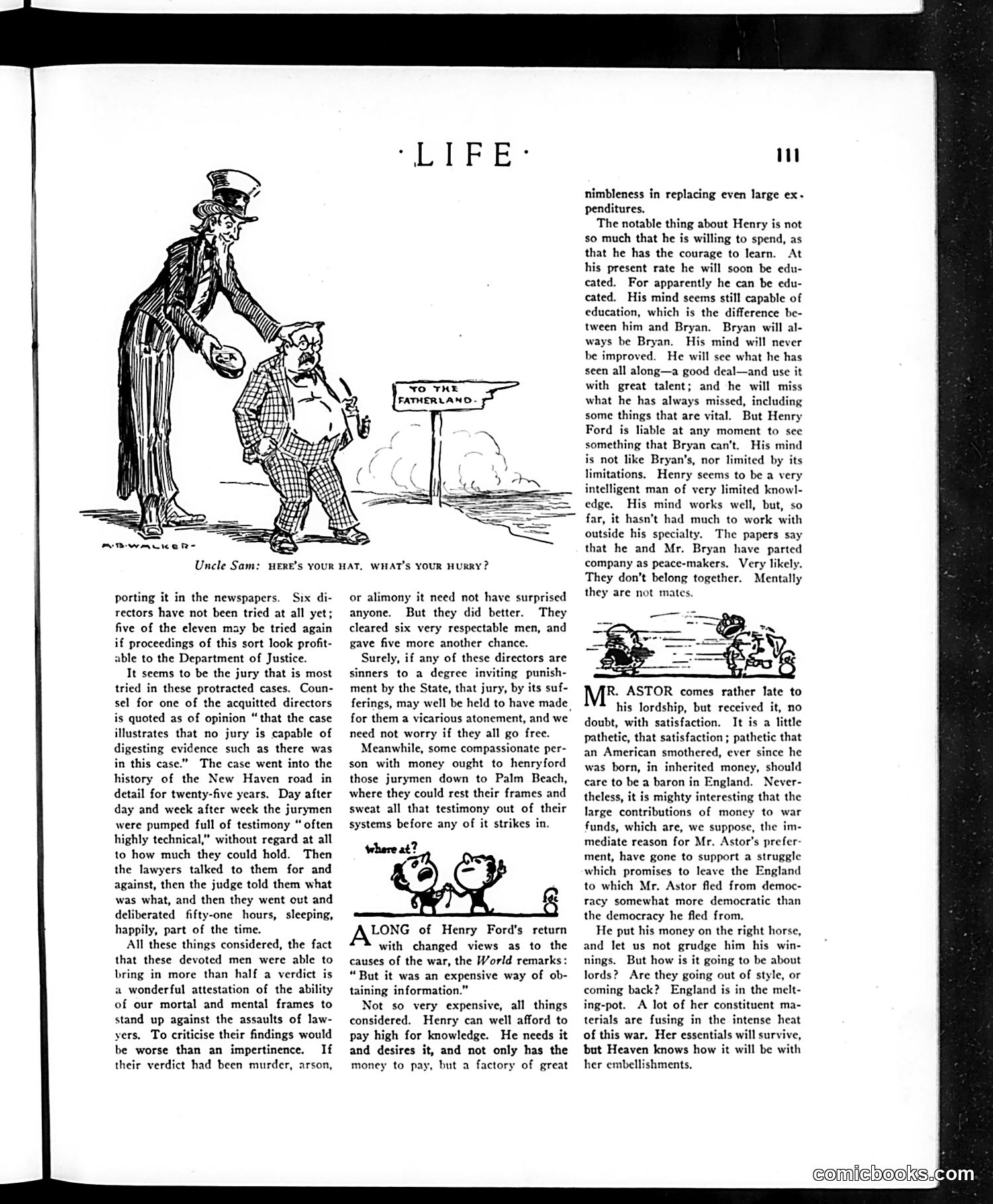
The main cartoon depicts **Uncle Sam** (representing the United States) offering his hat to a small figure labeled "A Firecracker to the Fatherland," who appears to be hurrying away. The caption reads: "Where's your hat, what's your hurry?" This satirizes American neutrality during **World War I**. The "firecracker" figure likely represents either a German agent or American war profiteer—someone engaged in suspicious activity toward Germany ("the Fatherland"). Uncle Sam's casual question suggests Americans are ignoring or enabling questionable wartime activities. The article text discusses **Henry Ford's** recent peace mission to Europe, sardonically noting he gained expensive "education" about war's causes. The piece contrasts Ford's capacity for learning with **William Jennings Bryan**, implying Ford—though limited in knowledge—can grow intellectually, whereas Bryan cannot. A brief note mentions **Lord Astor**, an American inheriting an English title, criticized as pathetically seeking aristocratic status. The overall tone mocks American naiveté regarding European conflict and questions American attitudes toward the war.
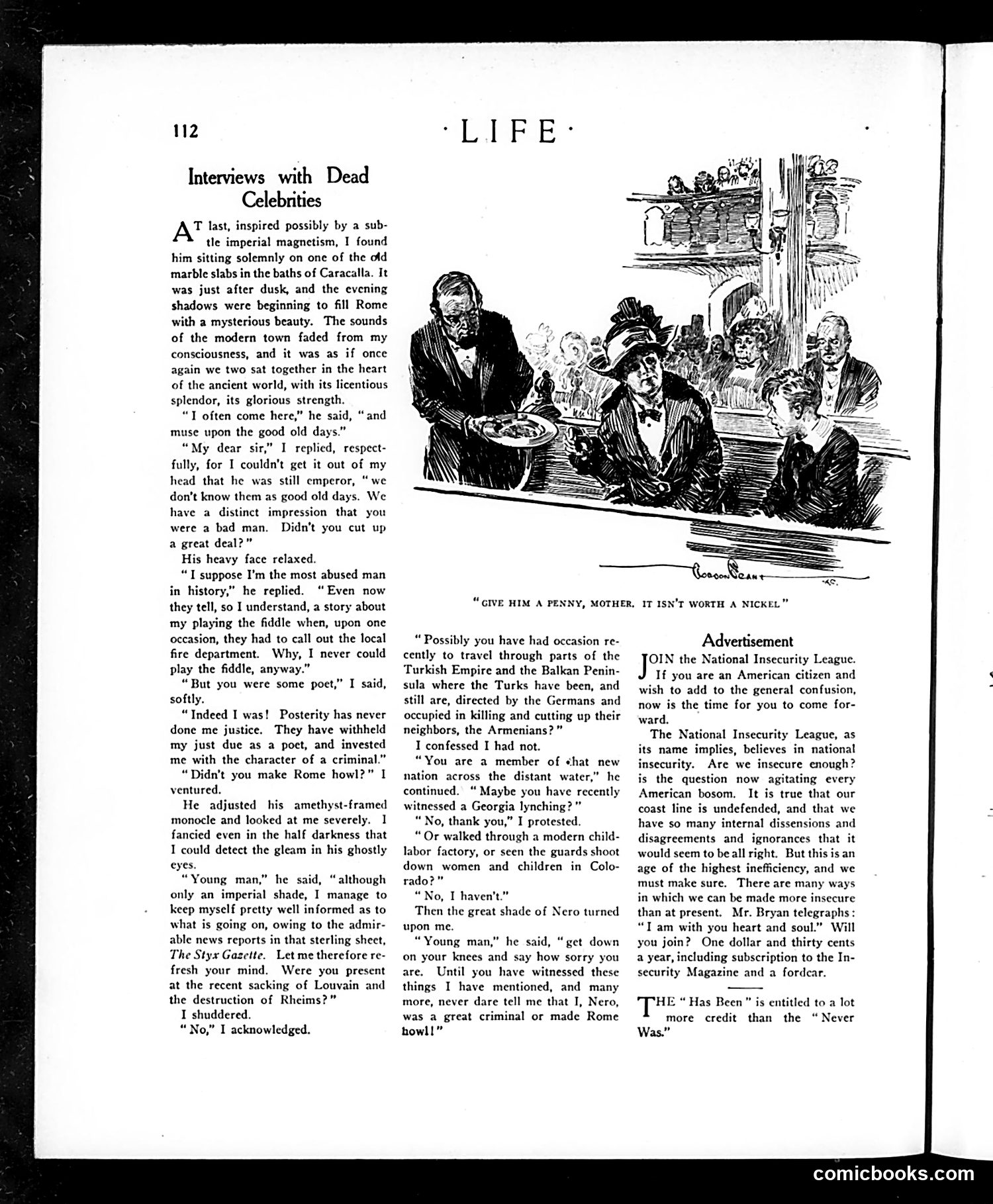
This page features a satirical "interview" with the ghost of **Nero**, the Roman emperor, set among Rome's ancient ruins. The satire's purpose becomes clear in Nero's final rebuttal: he defends his historical infamy by comparing it to contemporary atrocities the author hasn't witnessed—the sacking of Louvain and Rheims (WWI destruction), German-directed Turkish massacres of Armenians, American lynchings, and violence against child laborers and strikers in Colorado. The joke inverts moral judgment: Nero argues that modern civilization commits equally heinous crimes, so posterity shouldn't judge him uniquely evil. This is anti-war satire, likely published during WWI, mocking American complacency about European brutality while ignoring domestic injustices. The adjacent advertisement for the "National Insecurity League" reinforces this: it's mock-serious satire urging Americans to embrace chaos and unpreparedness, indirectly criticizing isolationism and social negligence.
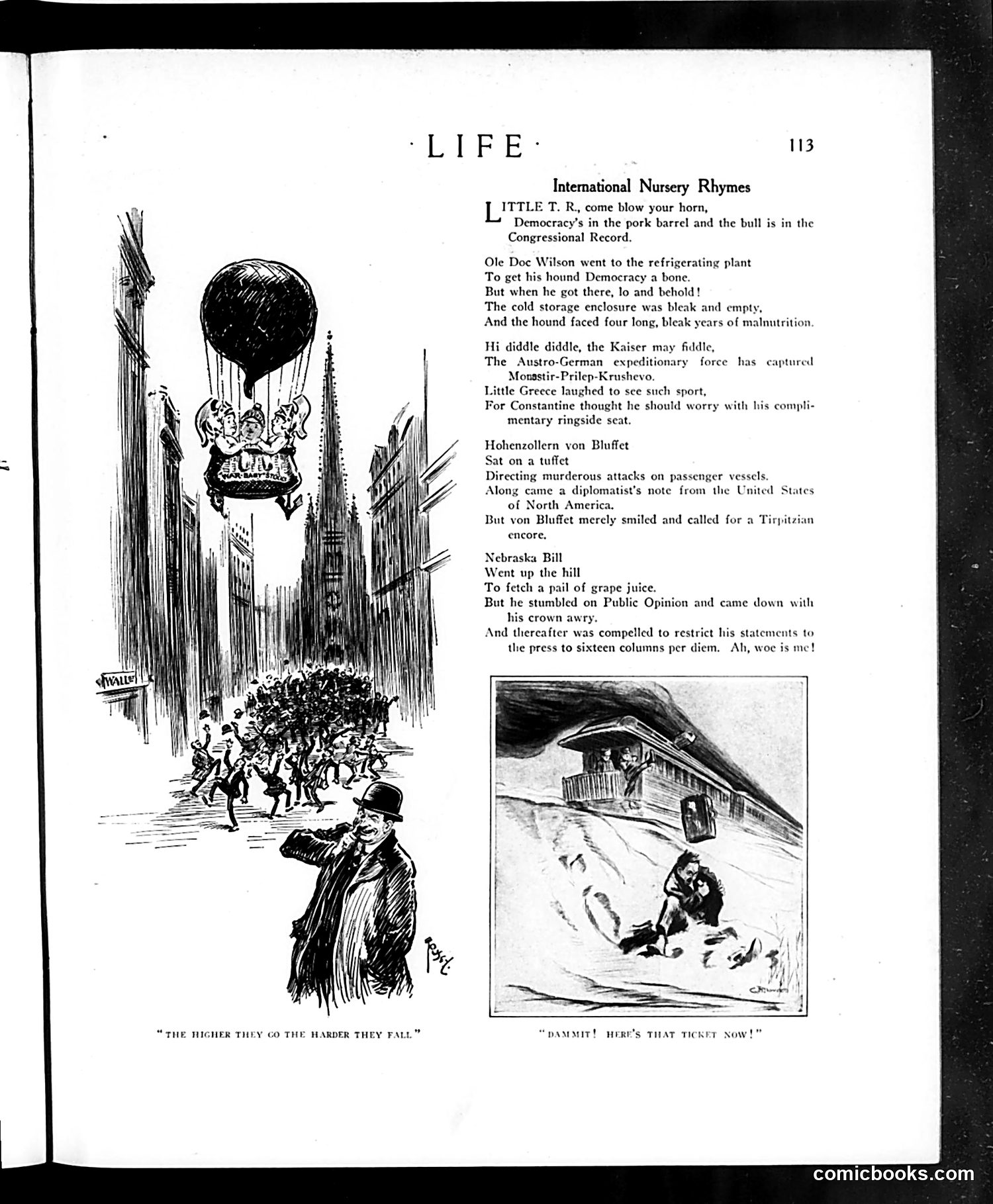
This page satirizes prominent political figures through parodies of nursery rhymes, mocking their policies and public failures: **"Little T.R."** ridicules Theodore Roosevelt's progressive rhetoric about democracy while corruption ("pork barrel") runs rampant in Congress. **"Ole Doc Wilson"** attacks President Woodrow Wilson, suggesting his promises to protect "Democracy" ring hollow—the nation gets nothing ("bleak and empty"). **"The Kaiser may fiddle"** references German military aggression (Austro-German forces capturing territory) while Greece's King Constantine passively watches, implying cowardice or complicity. **"Hohenzollern von Bluffet"** mocks German submarine warfare against civilian ships; U.S. diplomatic protests prove ineffective ("merely smiled"). **"Nebraska Bill"** targets prohibitionist William Jennings Bryan, who lost political power ("crown awry") after championing Prohibition, then faced press restrictions limiting his statements. The cartoons express frustration with American political leadership's apparent impotence during the pre-WWI era.
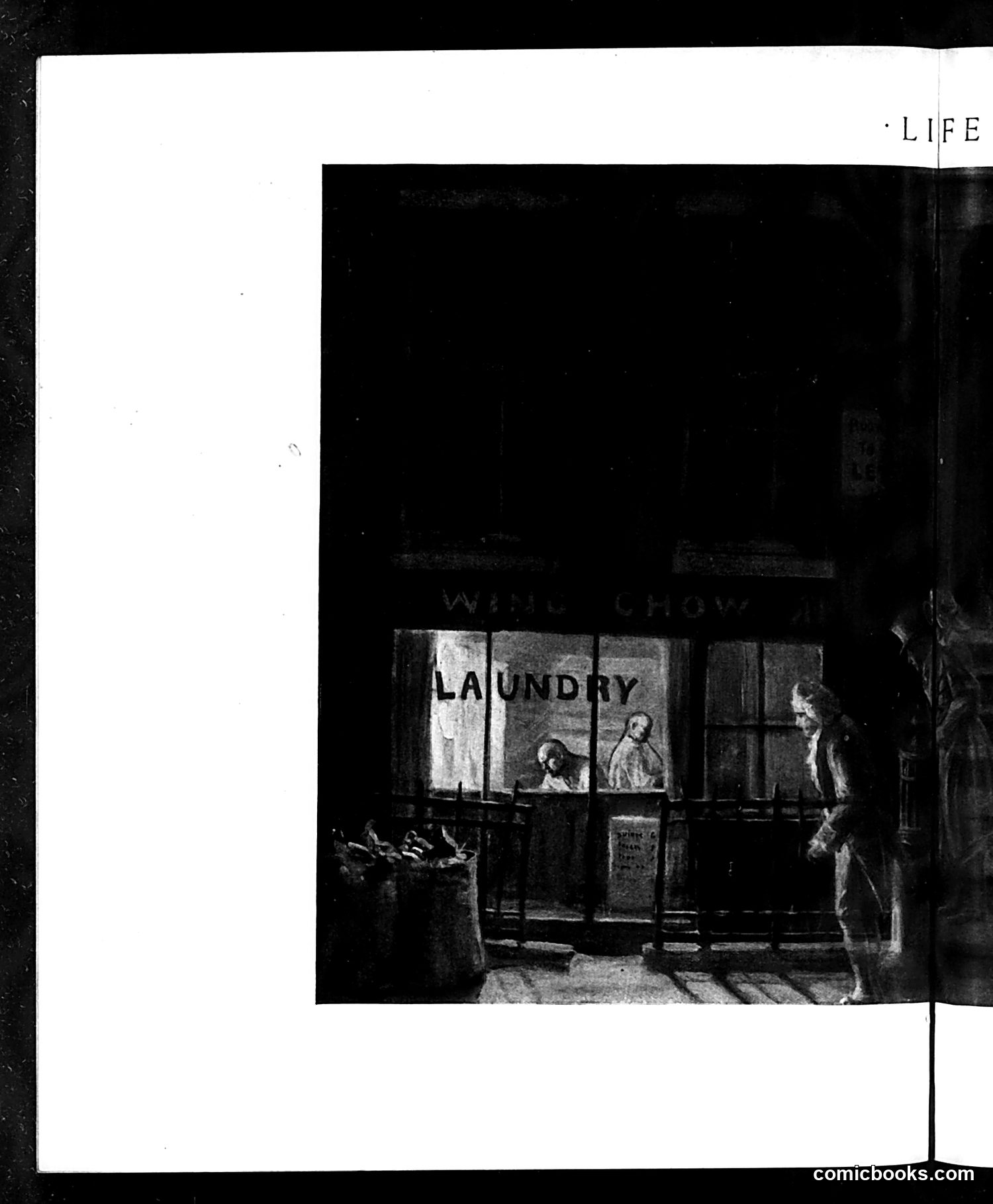
This page from *Life* magazine shows a nighttime street scene with a "LAUNDRY" storefront. Two figures are visible inside the illuminated shop window, while pedestrians pass by on the street outside. The OCR text is illegible, providing no caption or explanation. Without accompanying text, the specific satirical point is unclear. However, the composition—a brightly lit commercial interior observed from the street—suggests social commentary, possibly about urban working conditions, immigrant labor, or the mundane nature of service work during the period when *Life* was active as a satirical publication. The artistic style appears consistent with early-to-mid 20th century illustration. Without readable text identifying the commentary's target, I cannot definitively state what political or social critique this cartoon intends.
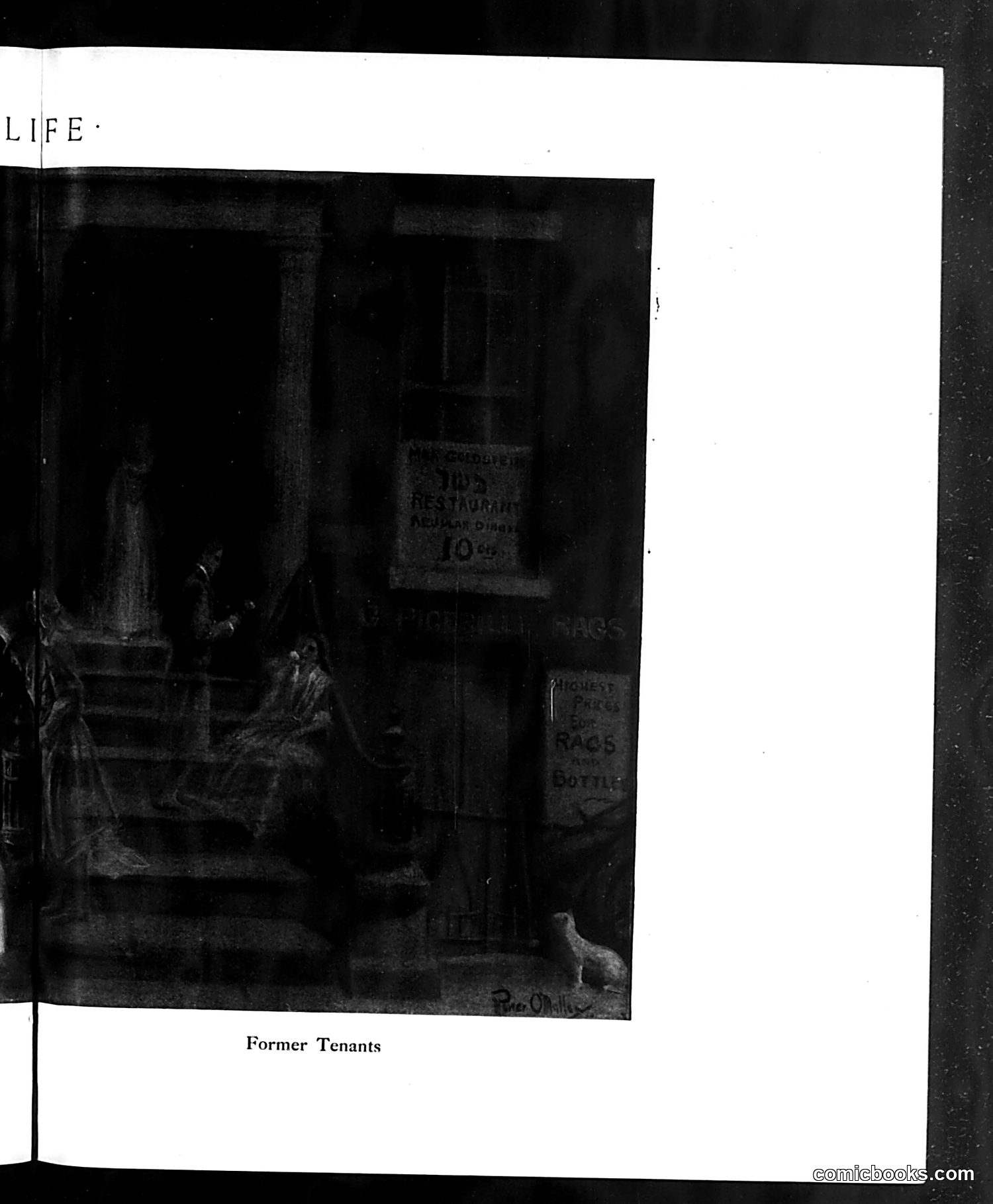
This page appears to be from Life magazine and shows a black-and-white photograph labeled "Former Tenants." The image depicts the storefront of what appears to be a modest restaurant or dining establishment, with signage visible in the window advertising "10¢" meals and "REGULAR DINNERS." The photograph seems to document urban poverty or economic hardship, likely from the Great Depression era based on the visual style and the modest nature of the establishment. The caption "Former Tenants" suggests these individuals may have been evicted or displaced residents. Without additional context or clearer visibility of specific details, this appears to be social documentary photography used by Life magazine to illustrate economic conditions and housing instability affecting ordinary Americans during a period of economic crisis.
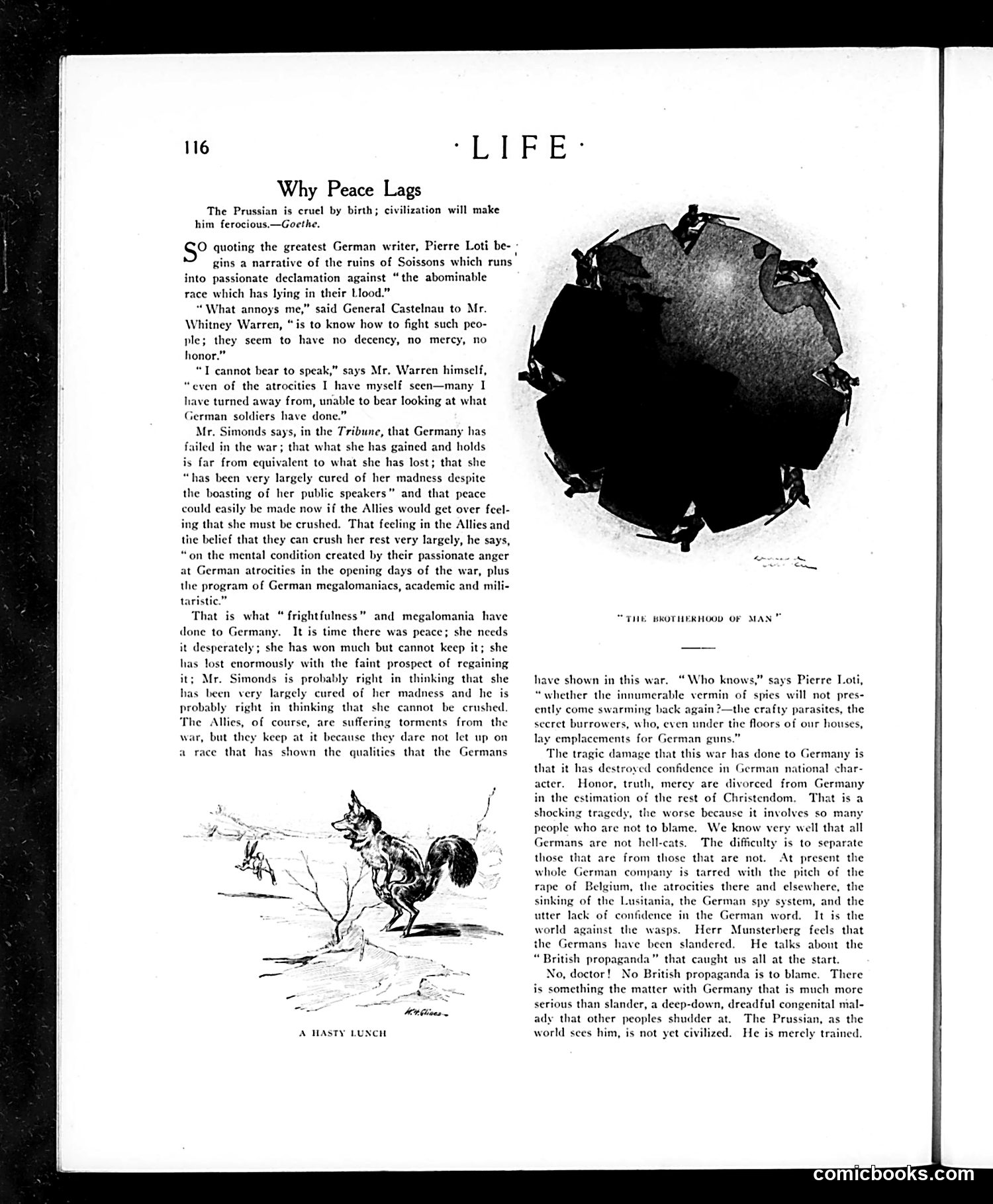
This WWI-era article argues that peace negotiations stall because Germany's wartime atrocities have destroyed international trust in German character itself. **The cartoons illustrate this thesis:** The top image, titled "The Brotherhood of Man," shows a dark silhouette of a human head—likely representing "the German"—filled with scenes of violence and destruction, suggesting inherent brutality rather than individual acts. The bottom cartoon, "A Hasty Lunch," depicts a wolf or jackal eating from a carcass, a traditional symbol for predatory, uncivilized behavior. **The argument:** Writers like Pierre Loti and General Castelnau are quoted condemning German "atrocities" (Belgium's invasion, the Lusitania sinking, spy networks). The author acknowledges not all Germans are "hell-cats," but notes the entire nation is "tarred" by these acts. Peace is impossible because the Allies cannot trust Germany's word—the Prussian is "not yet civilized. He is merely trained." The satire targets German national character as fundamentally dangerous, making reconciliation impossible regardless of military outcome.
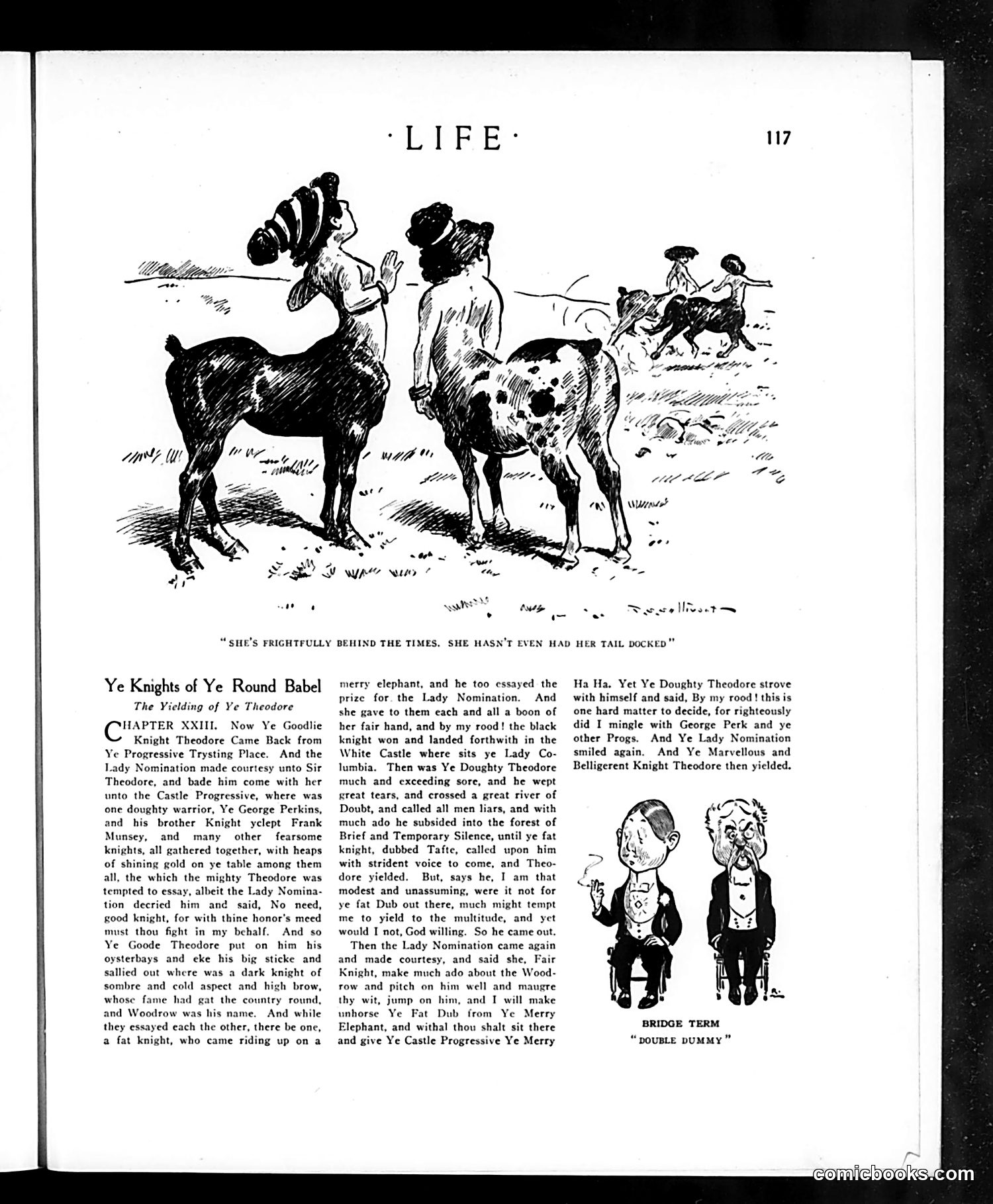
This is a satirical allegory about the 1912 presidential election, written in mock-medieval language. "Ye Theodore" represents Theodore Roosevelt; "Ye Lady Nomination" is the Progressive Party; "Woodrow" is Woodrow Wilson (the Democrat); and "Ye Fat Dub" riding the elephant is William Howard Taft (Republican, the elephant being the GOP symbol). The satire mocks Roosevelt's political maneuvering: he initially resists the Progressive Party's nomination pleas but eventually yields. The story portrays him as conflicted—claiming moral reluctance while ultimately accepting their support against Wilson. The top cartoon shows a woman (Lady Nomination) "frightfully behind the times" because "she hasn't even had her tail docked"—suggesting the Progressive Party is outdated or improperly modernized. The "Double Dummy" bridge cartoon at bottom likely comments on political deception or futility in the campaign negotiations.
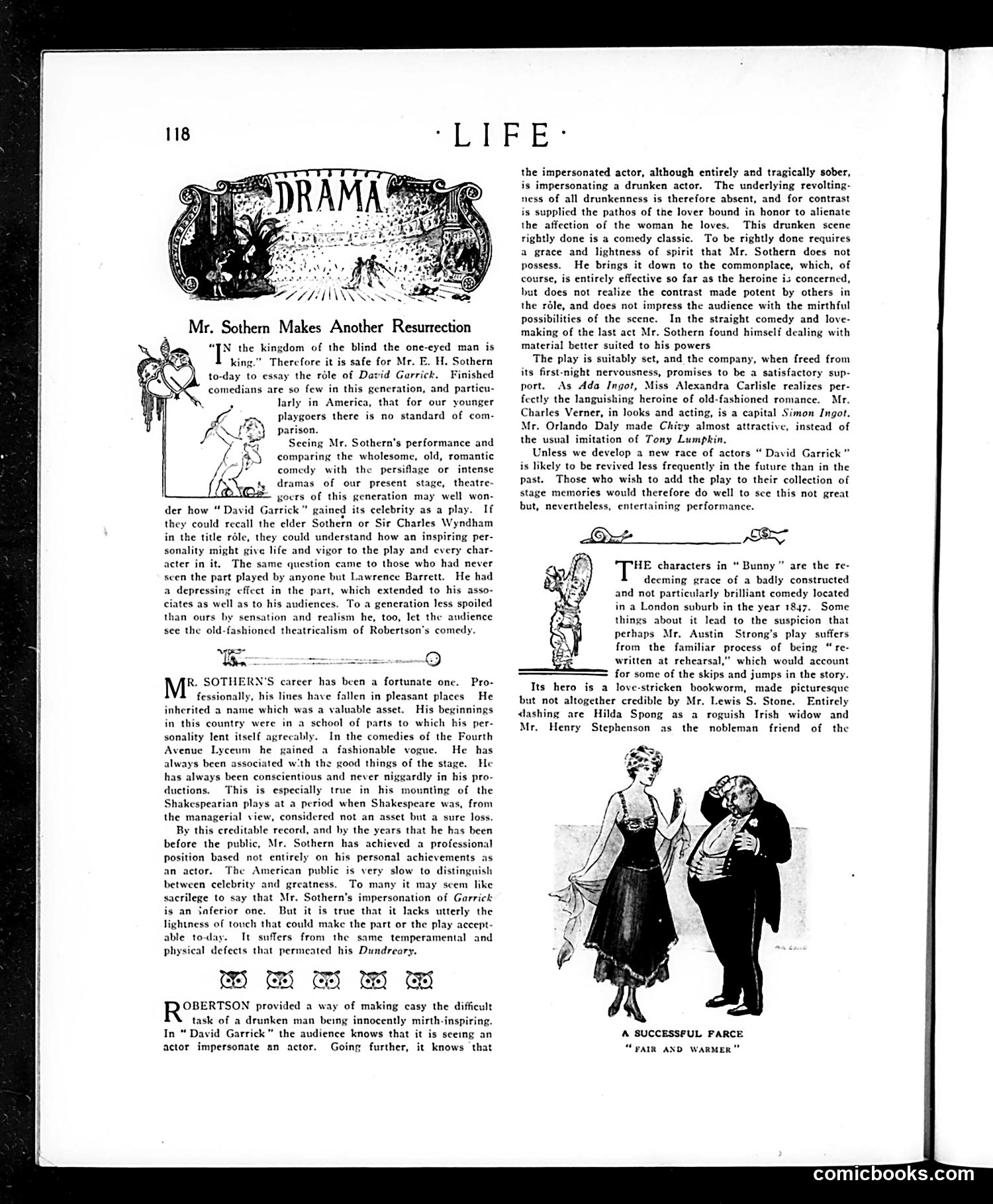
This page reviews actor H. Sothern's performance in "David Garrick," a 19th-century comedy play. The critic argues that Sothern's interpretation lacks the finesse needed for the role—particularly in a famous scene where an actor impersonates a drunk actor impersonating sobriety, a complex comedic feat. The review compares Sothern unfavorably to earlier performers (Lawrence Barrett, the elder Sothern, Sir Charles Wyndham), suggesting his heavy-handed approach undermines the play's subtle humor. The critic suggests Sothern succeeds in straightforward dramatic scenes but cannot deliver the "grace and lightness" required for the comedy's sophisticated layering. The illustration labeled "A Successful Farce: 'Fair and Warmer'" shows a separate theatrical production reviewed on the same page, featuring a man and woman in a comedic interaction.
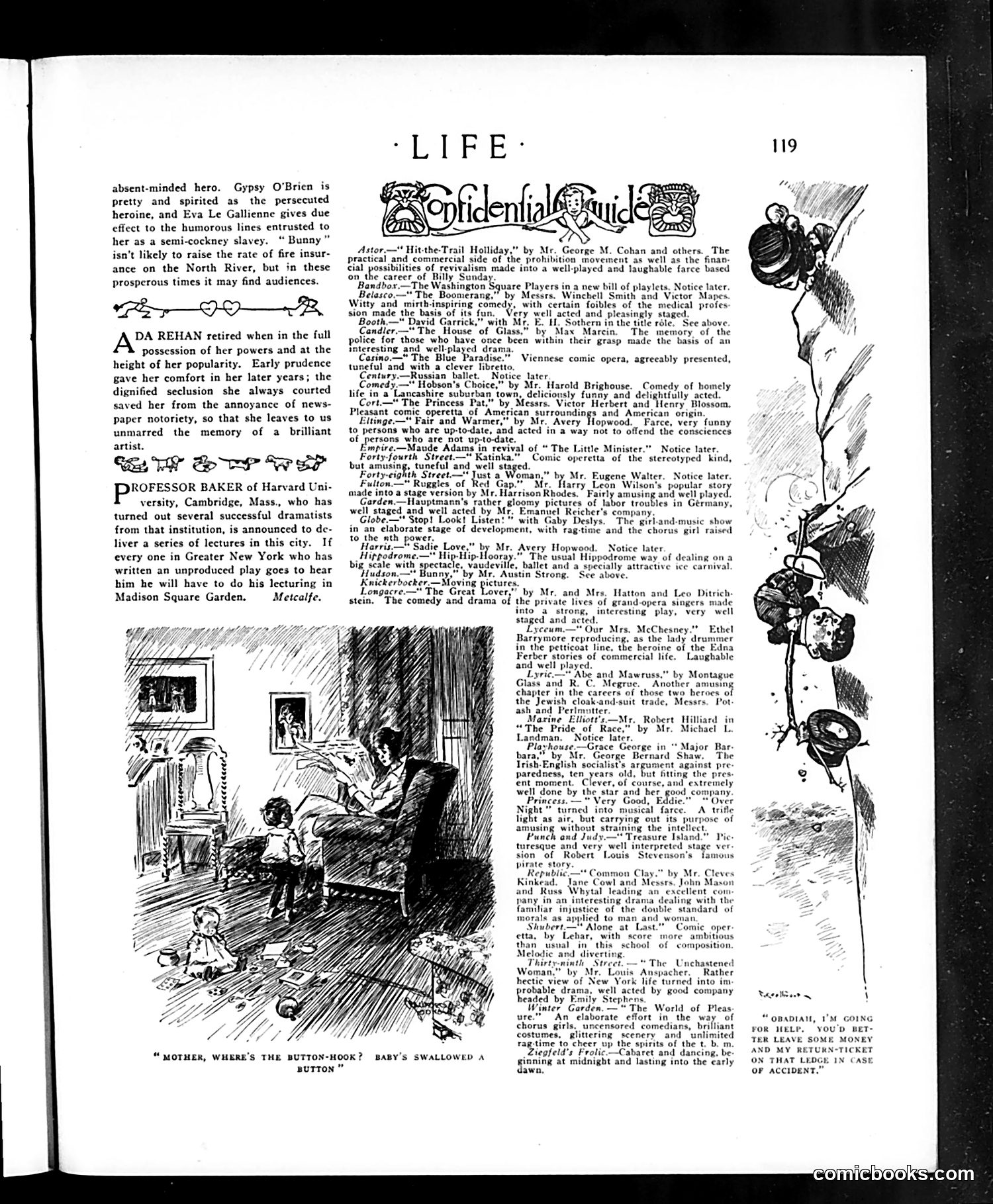
This page contains theatre reviews and a cartoon satirizing absent-mindedness. The main cartoon depicts a mother asking her child "Where's the button-hook?" — the child has apparently swallowed a button, a darkly humorous commentary on parental supervision common to early 20th-century magazine humor. The text discusses Ada Rehan, a celebrated actress who retired gracefully at her peak, contrasted with Professor Baker of Harvard, who lectures on playwriting. The joke suggests that if every aspiring playwright in New York attended his lectures, he'd need Madison Square Garden — satirizing both the prevalence of amateur dramatists and New York's cultural pretensions. The page primarily consists of Broadway theatre reviews covering various productions including George M. Cohan's "Hit-the-Trail Holliday" (about prohibition and revivalism) and Maude Adams's "The Little Minister." The reviews are straightforward critical assessments rather than satirical commentary.
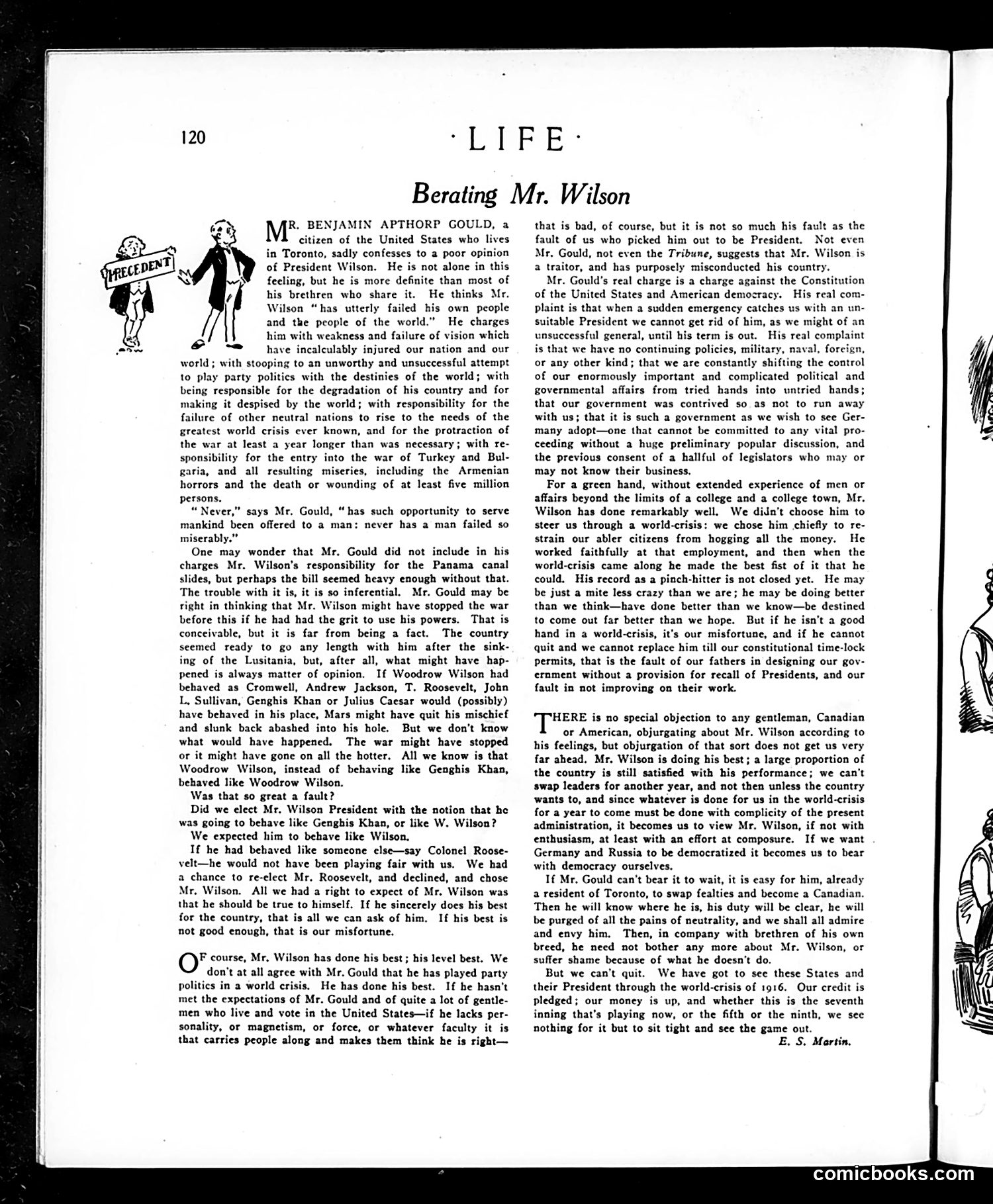
This *Life* magazine article defends President Woodrow Wilson against harsh criticism from Benjamin Apthorp Gould, a Toronto resident who blames Wilson for nearly every Allied failure in World War I—from the war's prolongation to the Armenian horrors. The satirical point is clear: the author (E.S. Martin) argues that Gould's charges are "inferential" (speculative) rather than factual. While acknowledging Wilson's limitations, Martin contends that voters elected Wilson to be *himself*, not to behave like aggressive predecessors like Theodore Roosevelt, Cromwell, or Genghis Khan. The cartoon likely depicts this confrontation between critic and president, though details are unclear from the image. Martin's defense essentially argues: Wilson did his "level best" within his character. If that wasn't good enough, that's America's fault for choosing him, not his fault for being himself. This reflects early WWI-era debates about presidential war powers and American intervention.
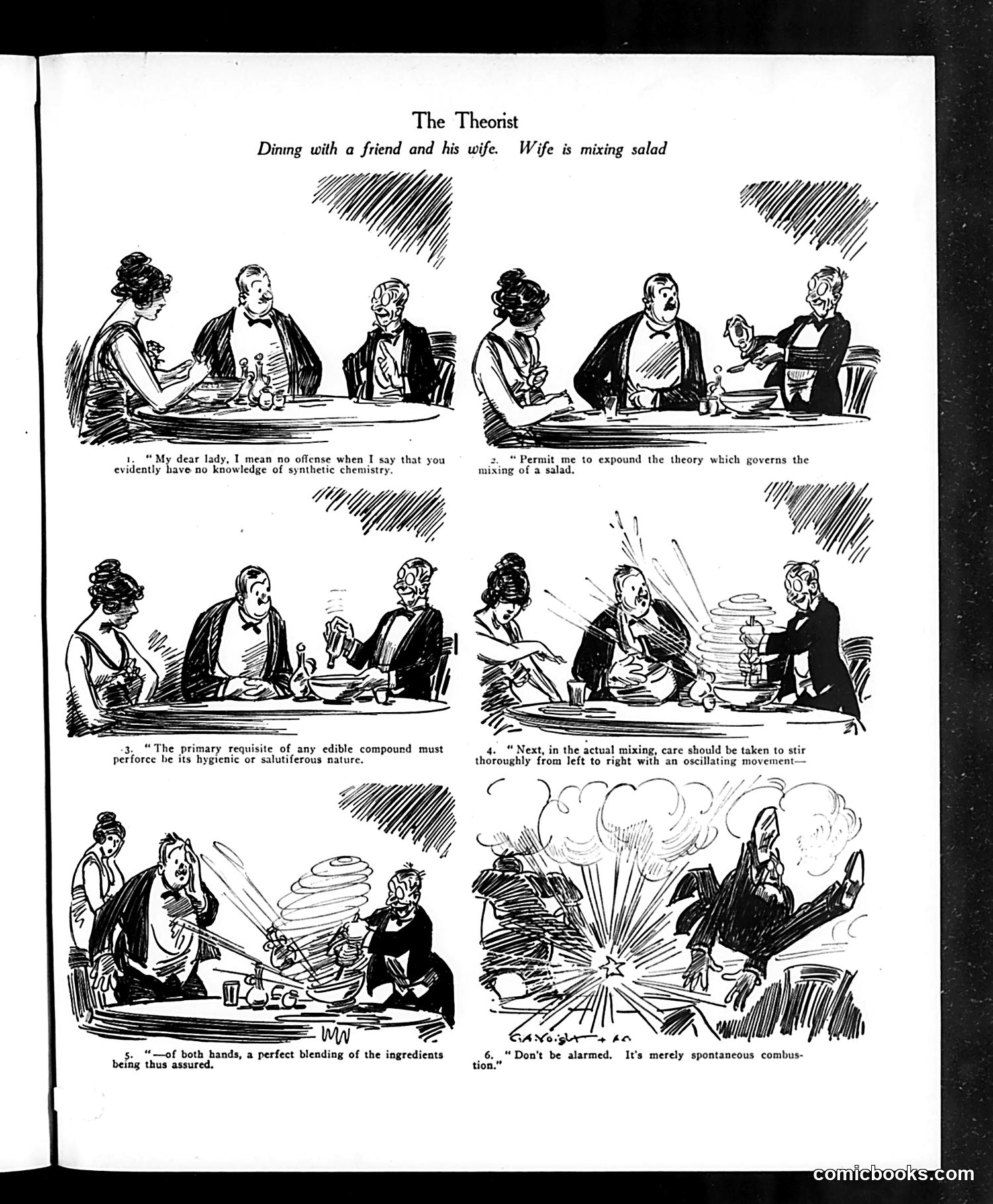
This six-panel comic mocks a dinner guest who pedantically over-theorizes a simple task: making salad. The "theorist" lectures his hostess using pseudo-scientific jargon about "synthetic chemistry" and "salutiferous nature" while explaining salad-mixing with absurdly elaborate hand movements and technical language. The satire targets intellectuals who complicate everyday matters with unnecessary complexity and pretentious vocabulary. The humor escalates when his overwrought mixing technique causes the salad to spontaneously combust (panel 6), proving his theory-laden approach is impractical and counterproductive. The joke reflects early 20th-century American humor about "Mr. Knowitall" types—educated men who weaponize obscure terminology to impress (or bore) dinner companions, only to reveal their theories don't match reality.
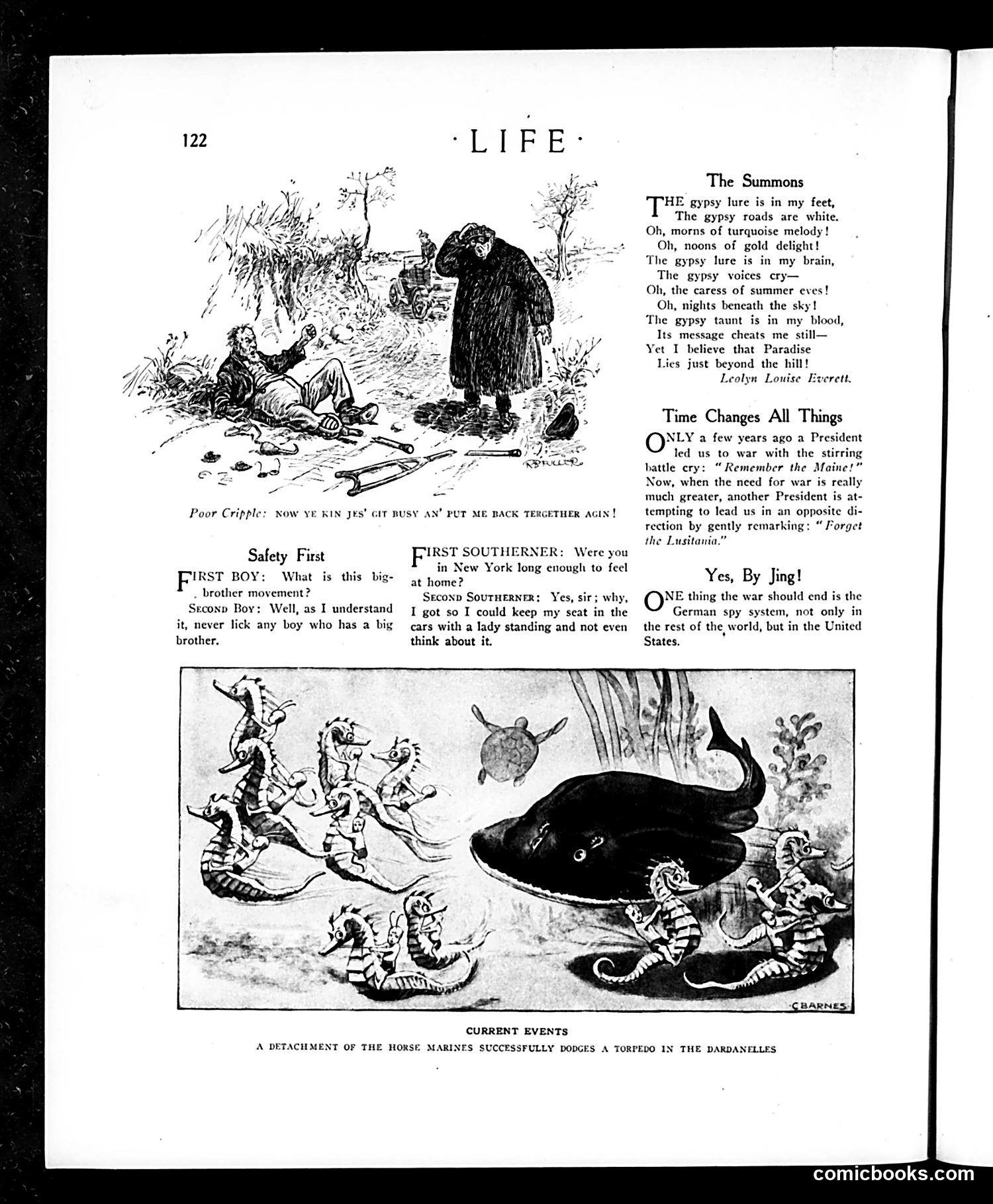
This page from Life magazine contains several satirical pieces referencing World War I era politics and social commentary: **"Time Changes All Things"** contrasts two presidential approaches to war: President McKinley's 1898 rallying cry "Remember the Maine!" (justifying war with Spain) versus the current president's (likely Wilson's) cautious stance toward the Lusitania sinking, urging Americans to "Forget" it. The satire criticizes the inconsistency in wartime rhetoric. **"Yes, By Jing!"** advocates for ending German espionage operations in America, reflecting contemporary anxieties about spy networks. The **cartoon below** labeled "Current Events" mockingly depicts "Horse Marines" dodging a torpedo in the Dardanelles—likely satirizing military incompetence or absurd military solutions. The smaller dialogues mock social conventions: the "Safety First" joke about avoiding boys with older brothers, and a Southerner's comment about public transit etiquette in New York reflect period-specific social norms and regional stereotypes.
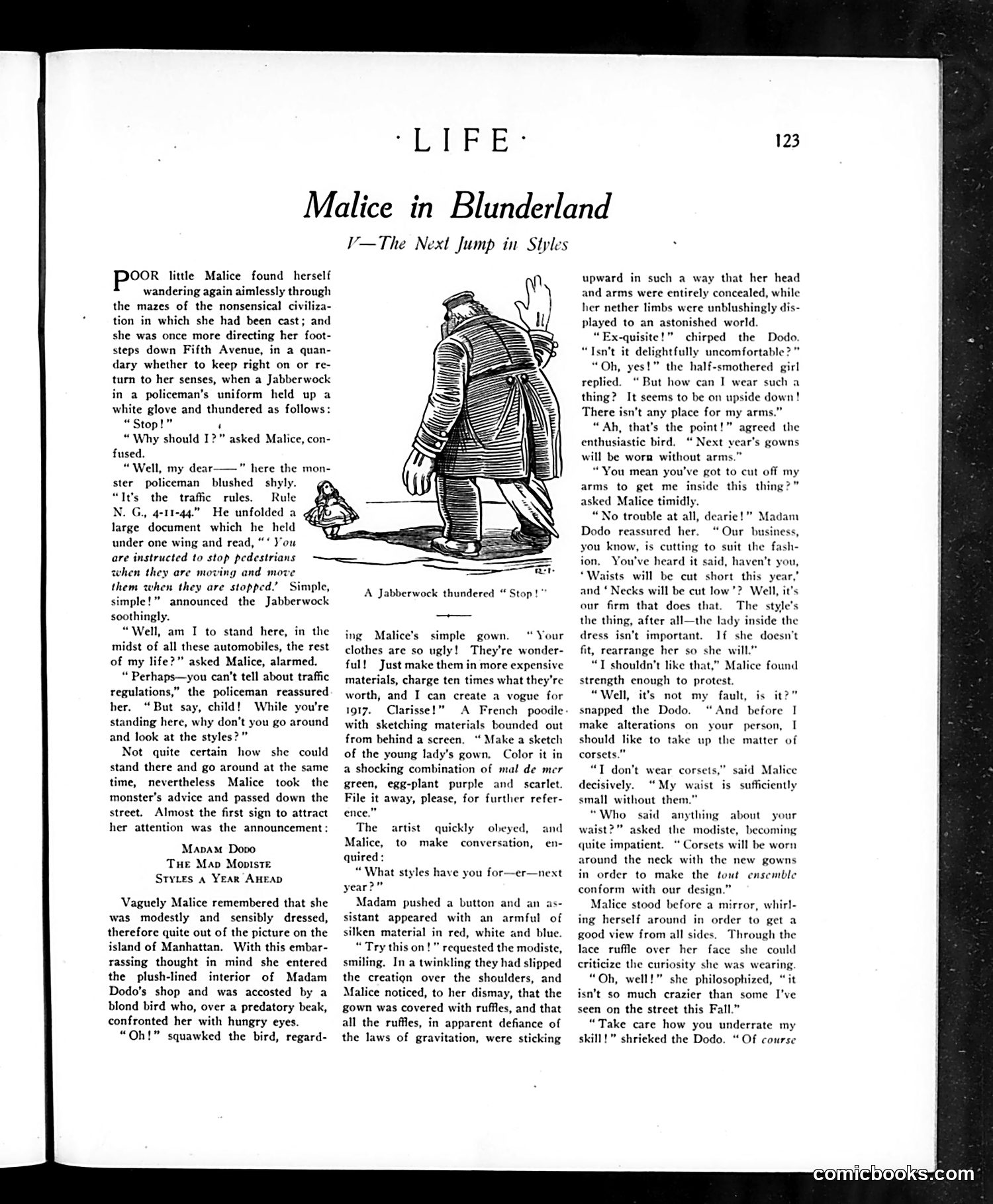
This is a satirical story titled "Malice in Blunderland" (a reference to *Alice in Wonderland*) that critiques early 20th-century fashion absurdity and traffic regulation chaos. **The Setup:** Malice encounters a policeman (depicted as a "Jabberwock"—a nonsensical creature) enforcing illogical traffic rules that contradict each other: stop pedestrians when moving, move them when stopped. **The Fashion Satire:** At "Madam Dodo's" boutique, the proprietor (a predatory bird) promotes wildly impractical 1917 fashion: a gown with ruffles defying gravity, covering the head/arms while exposing legs, designed without arm holes. The joke: fashion designers prioritize visual novelty over wearability, treating women's bodies as mere mannequins. **The Barb:** The designer casually references past fashion ("cuts" in waists and necklines) as precedent for literally "cutting" women's limbs to fit clothes—darkly satirizing how fashion demands women contort themselves unnaturally. This mocks both absurd fashion trends and the illogical bureaucracy of urban life circa 1917.
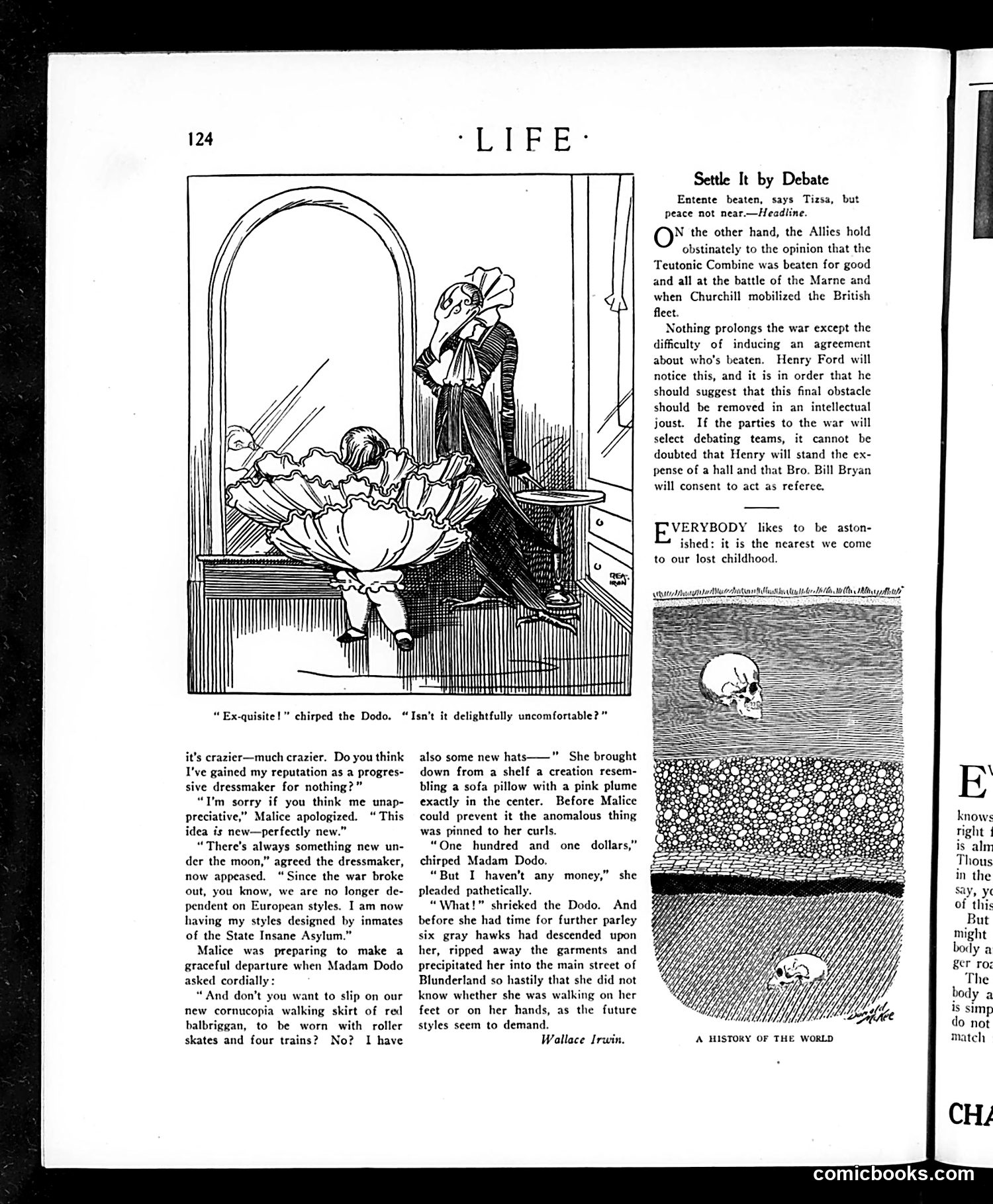
This page contains two satirical pieces from Life magazine during World War I: **Main Cartoon** ("Ex-quisite!"): A humorous story by Wallace Irwin mocking post-war American fashion design. A character visits "Madam Dodo" (a reference to Lewis Carroll's absurd bird), a dressmaker who claims to design styles inspired by inmates of state mental asylums. The satire ridicules absurdly impractical fashions—cornucopia skirts with roller skates and trains, bizarre hats—while suggesting American fashion, now independent from European styles due to the war, has become comically insane. The piece ends with surreal violence typical of Irwin's absurdist humor. **"Settle It by Debate"** (right column): A brief satirical commentary on World War I peace negotiations. It mocks the Entente and Central Powers for endlessly debating who won rather than making peace. The author sarcastically suggests Henry Ford and William Jennings Bryan could resolve the war through formal debate instead of continued fighting—poking fun at both American optimism and the war's apparent futility. Both pieces reflect 1910s American skepticism toward the war and contemporary culture.
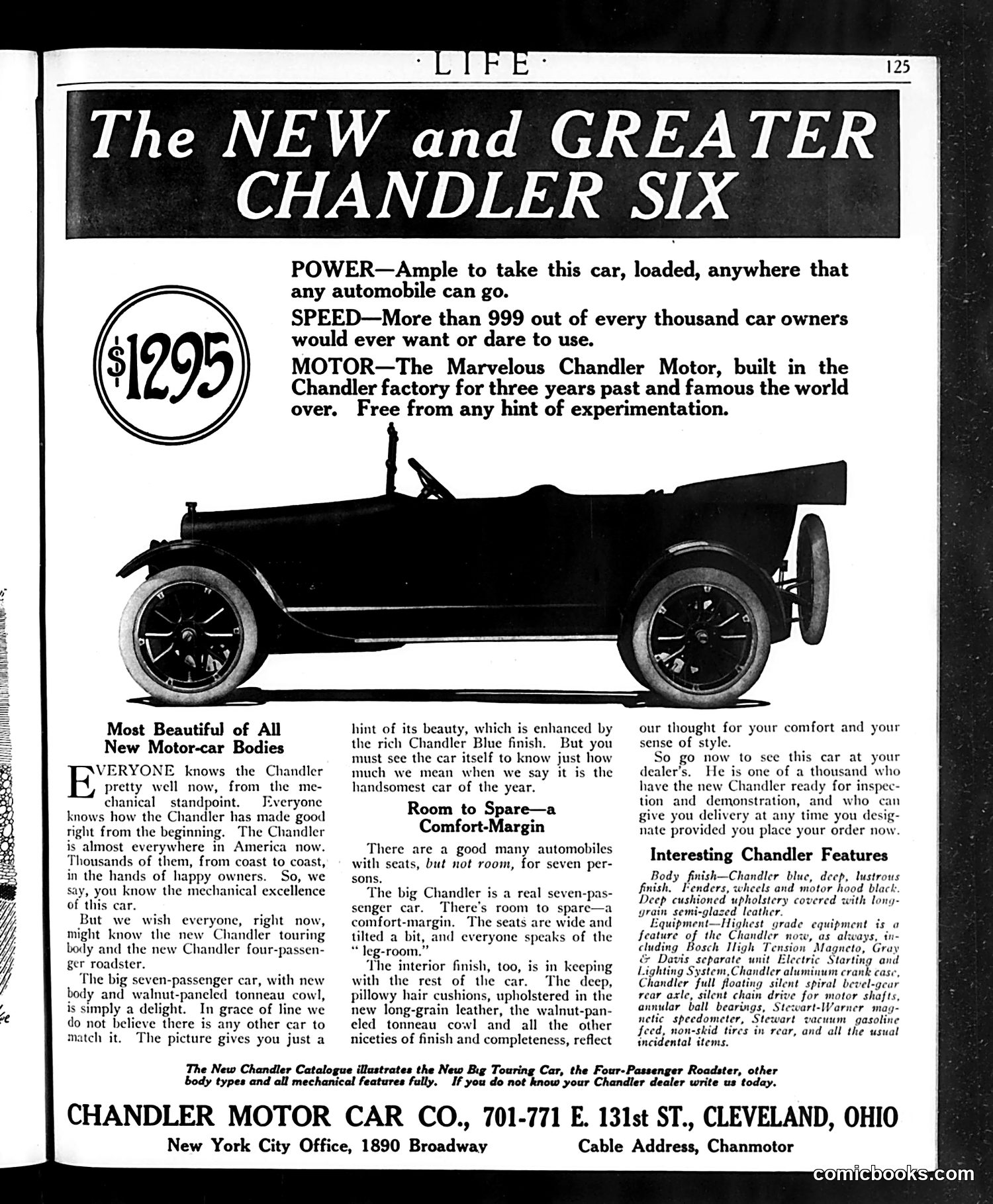
This is **not a political cartoon or satire**—it's a full-page automobile advertisement for the Chandler Motor Car Company, priced at $1,295. The ad promotes the "New and Greater Chandler Six" touring car through conventional marketing claims: ample power, impressive speed ("more than 999 out of every thousand car owners would ever want"), and a reliable motor "famous the world over." The silhouette illustration shows a luxury seven-passenger automobile typical of the 1910s-1920s era. The copy emphasizes comfort features—spacious seating, walnut-paneled interiors, cushioned upholstery, and "leg-room"—targeting affluent buyers who valued both mechanical excellence and aesthetic refinement. The ad encourages readers to visit local dealers for demonstrations. This represents straightforward period advertising rather than editorial satire, using Life magazine's pages (page 125) as a paid commercial space.
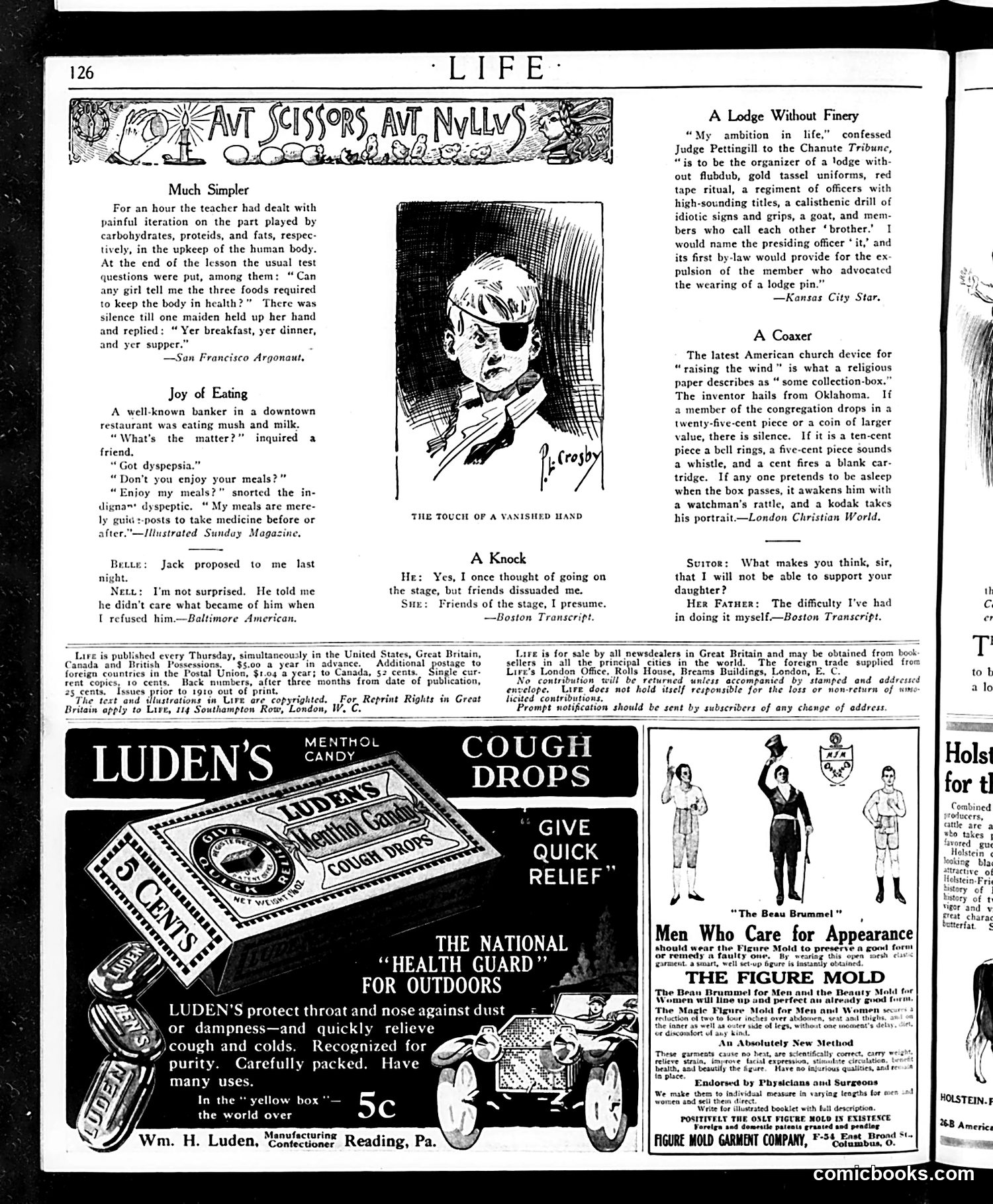
This page from *Life* magazine contains several short humorous anecdotes and advertisements, typical of early 20th-century satirical publications. **Main humor pieces:** - "Much Simpler": A schoolgirl's commonsense answer about nutrition—listing actual meals rather than scientific food categories—mocks overly pedantic education. - "Joy of Eating": A banker with digestive problems views meals merely as vehicles for medicine, satirizing hypochondria. - "A Knock": A man claims friends discouraged his theatrical ambitions; the woman assumes they were protecting the theater itself—a jab at amateur performers. - "A Lodge Without Finery": Judge Pettingill satirizes fraternal organizations' obsession with ritual, uniforms, and hierarchy, preferring simplicity. - "A Coaxer": An Oklahoma church invents a collection box that rewards larger donations with silence but embarrasses small-change givers with noise—mocking manipulative fundraising. The page is primarily **advertising** (Luden's cough drops dominates the lower half) and contains period-appropriate social satire targeting education, health anxiety, social pretension, and institutional practices.
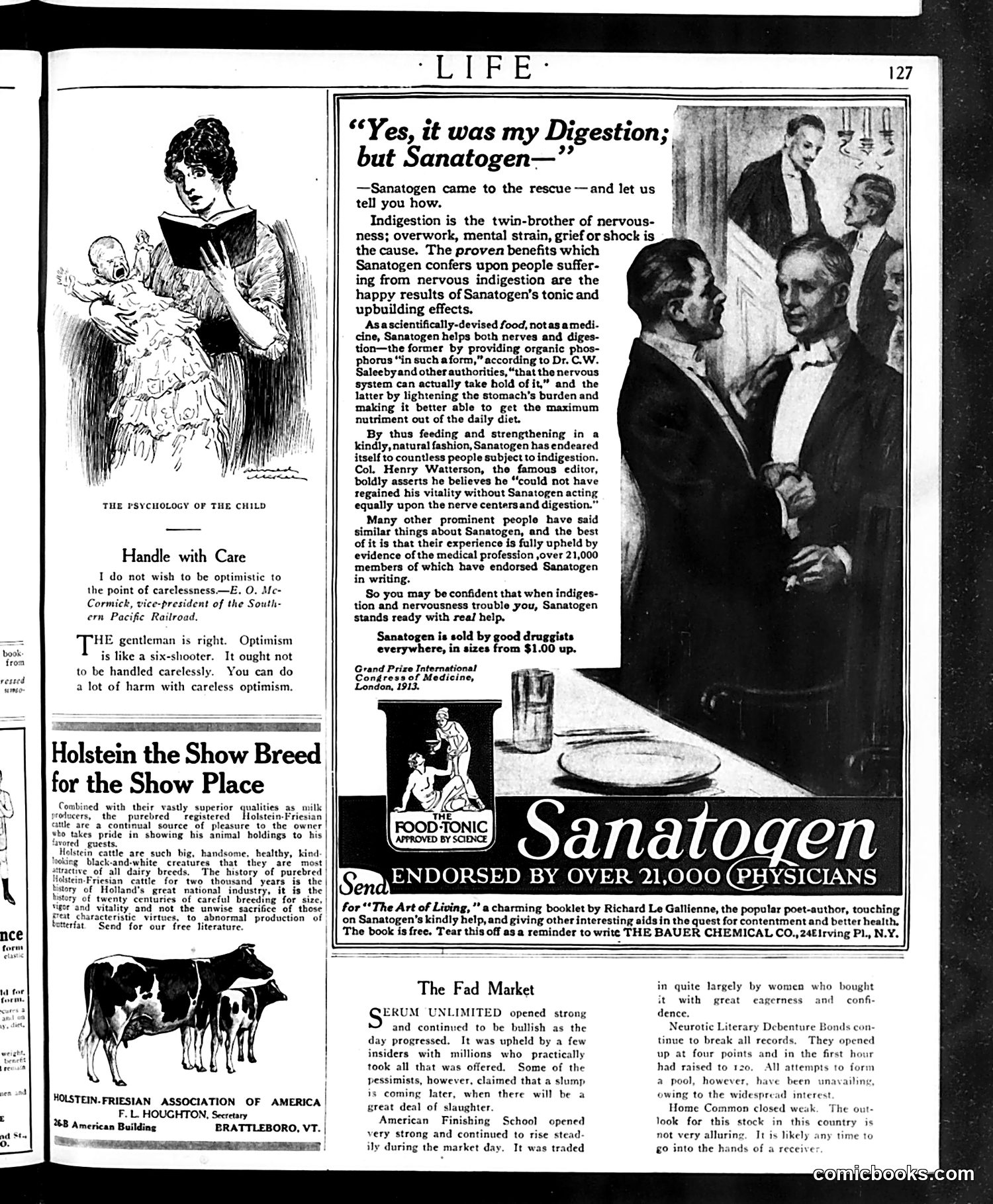
This page mixes satirical commentary with advertising. The opening section titled "Handle with Care" mocks excessive optimism—using a railroad executive's quote to suggest blind positivity causes harm, like a carelessly handled gun. The main content is a **Sanatogen advertisement** claiming the patent medicine cures nervous indigestion. It cites endorsements from 21,000 physicians and prominently features Col. Henry Watterson (a famous newspaper editor) as a satisfied user. This represents classic early-20th-century medical advertising making unsubstantiated health claims. **The satire appears in "The Fad Market"** section below, which ridicules speculative investing crazes. It reports on absurd financial instruments like "Neurotic Literary Debenture Bonds" and "Home Common" stock—clearly fictional parodies of how people invest recklessly in trendy but worthless securities. Together, the page satirizes American gullibility: people believe dubious medicine advertisements and invest in financial fads equally uncritically.
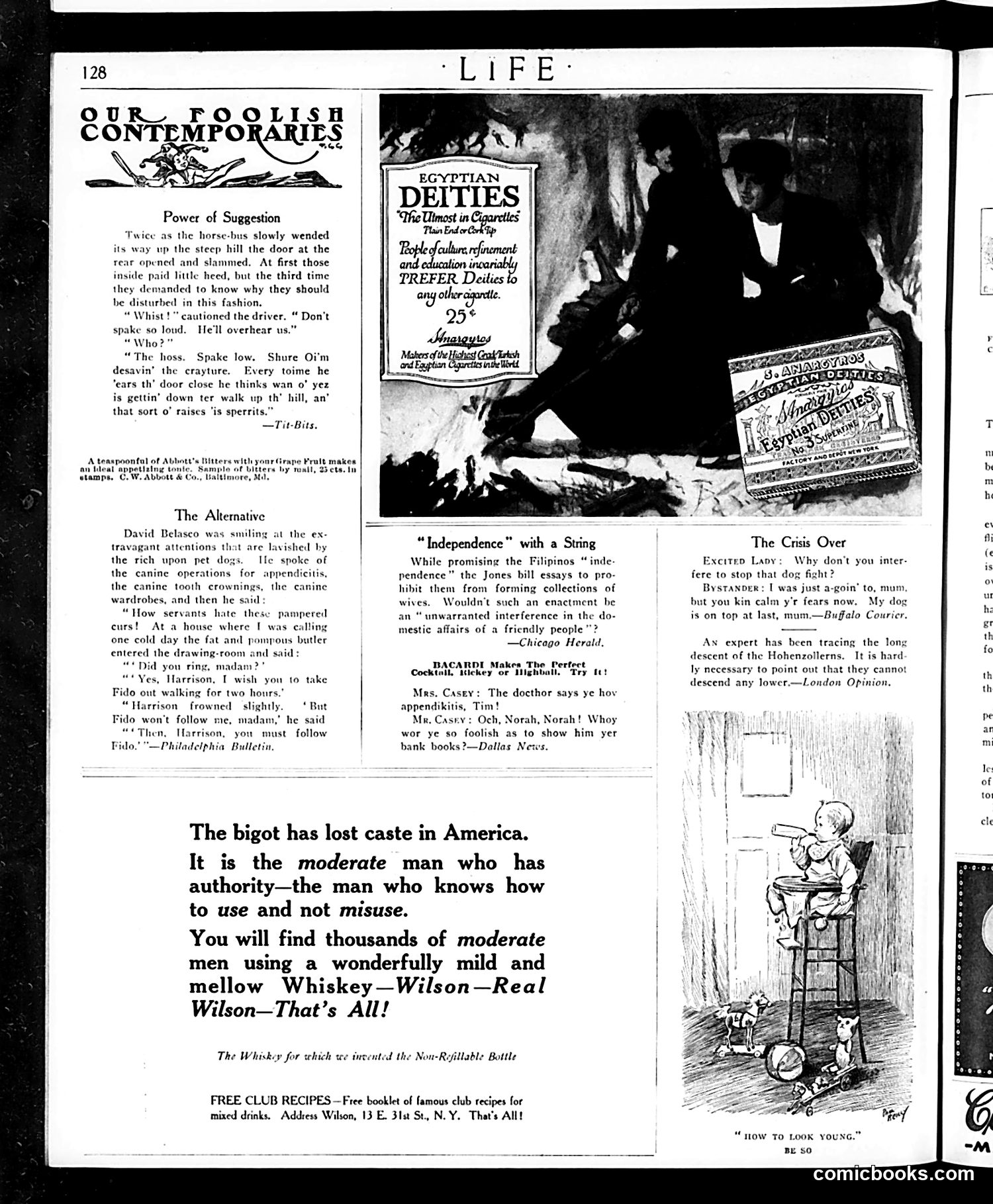
This Life magazine page (page 128) contains several satirical pieces typical of early 20th-century American humor: **"Power of Suggestion"** mocks Irish dialect humor: a horse-bus driver tricks passengers into silence by claiming the horse can hear the door slam and thinks passengers are getting out to walk—so he won't pull harder up the hill. **"Independence with a String"** is political satire on the Jones Bill, which promised Philippine independence while prohibiting polygamy. The Chicago Herald satirizes the hypocrisy: if America claims Filipinos deserve independence as a "friendly people," why interfere in their domestic practices? **"The Crisis Over"** is a working-class joke about a dog fight—a bystander was about to intervene until his own dog gained the upper hand. The **Wilson Whiskey advertisement** uses the prohibition-era argument that "moderate" men use alcohol responsibly, contrasting moderation with "bigotry." The page reflects early 1900s American attitudes: Irish stereotyping, colonial paternalism toward the Philippines, and pre-Prohibition whiskey marketing.
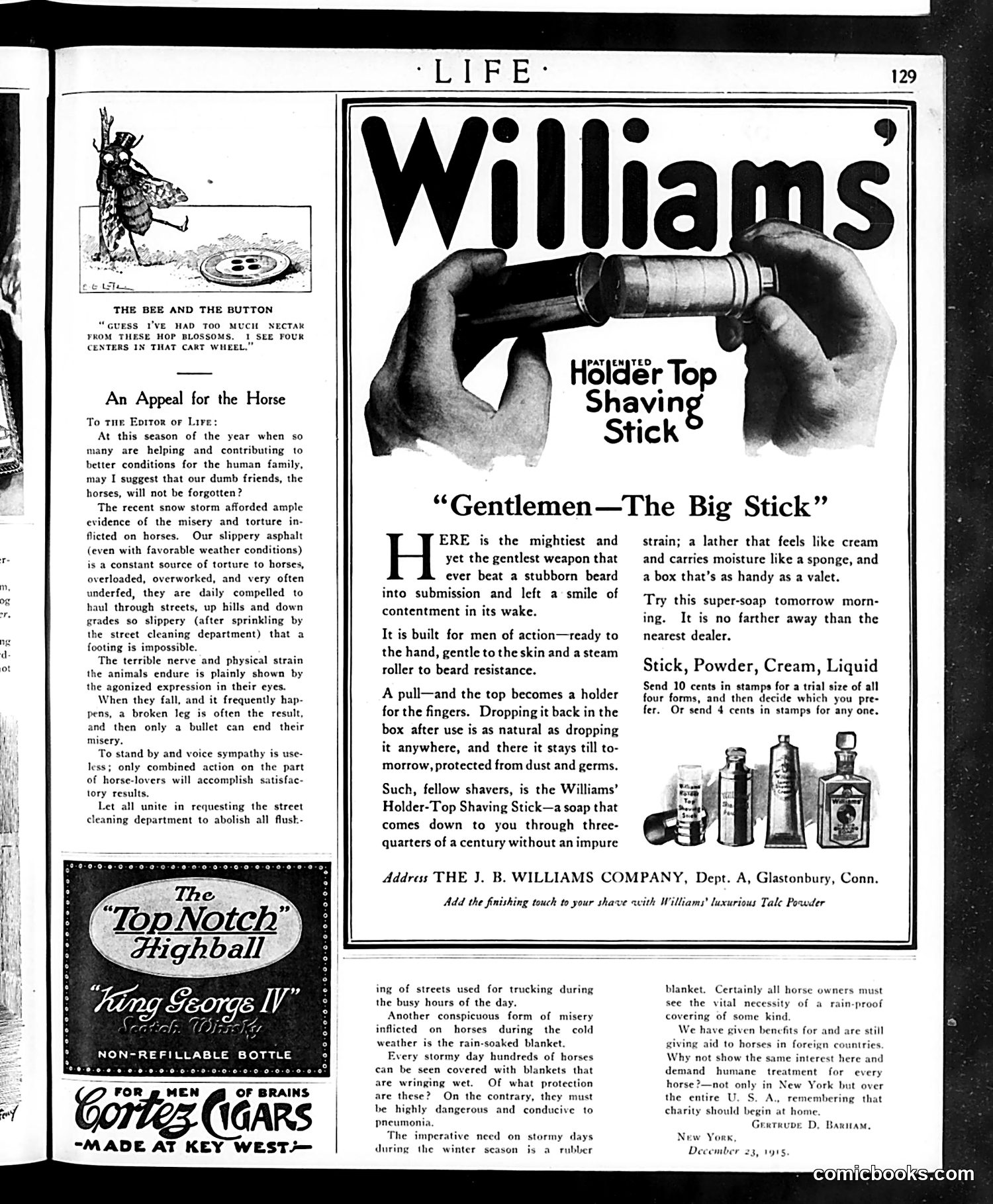
This page contains primarily **advertisements and a letter to the editor**, with minimal satire. The small cartoon at top left, "The Bee and the Button," is a simple visual joke: a drunk bee has consumed too much nectar from hop blossoms and sees four cart wheels instead of one. The main content is **"An Appeal for the Horse,"** a earnest letter to Life's editor advocating humane treatment of working horses. The writer documents specific cruelties: horses forced to haul loads on slippery asphalt streets, resulting in broken legs; inadequate winter blankets that actually worsen conditions. He urges readers to petition city officials to abolish street treatments that create dangerous footing, and to provide rubber rain blankets. This reflects early 20th-century animal welfare concerns—horses were still primary urban transport, and their suffering was visible and daily. The letter's tone is sincere advocacy, not satirical. The remaining content consists of period advertisements for shaving products and cigars, using period-appropriate marketing language ("Gentlemen," "The Big Stick," "men of action").
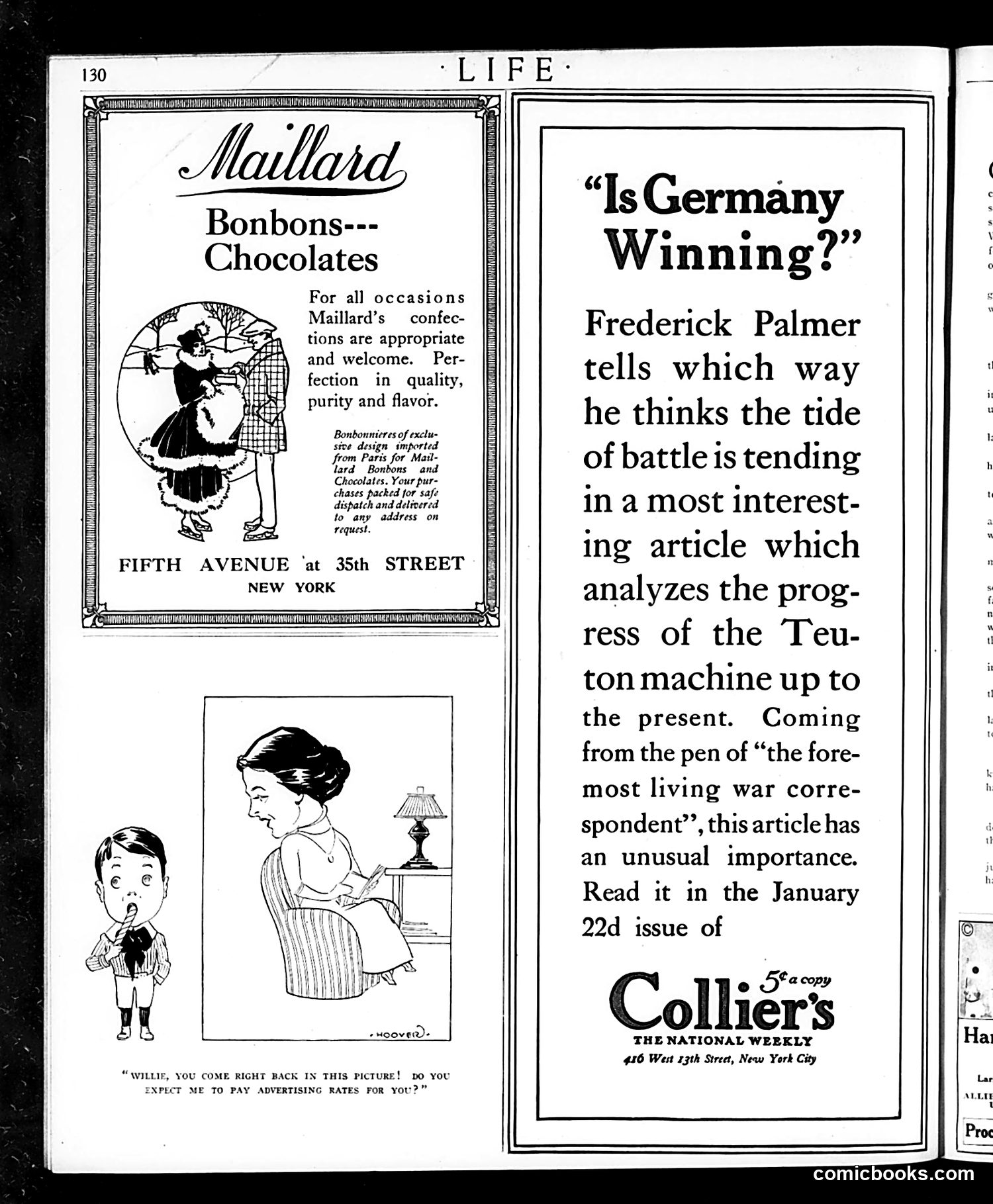
This page contains two distinct elements: a Maillard chocolates advertisement (left) and a Collier's magazine advertisement (right), with a small political cartoon below the candy ad. **The Cartoon:** The sketch by Hoover (signed lower left) depicts a woman scolding a man labeled "Willie," demanding he return to a picture frame, threatening not to pay advertising rates for him. "Willie" likely refers to Kaiser Wilhelm II of Germany. The joke satirizes German military ambitions during World War I—the woman represents either America or Allied interests, demanding the German leader stay contained within his proper sphere rather than expanding influence beyond acceptable bounds. **The Context:** Published during WWI, this mocks German expansionism while using the ironic language of commercial advertising rates. It's dark humor about military conflict framed through a domestic scolding scenario. **The Collier's Ad:** Promotes Frederick Palmer's war correspondence analyzing whether "Germany" is winning—clearly referencing ongoing WWI debates about the conflict's trajectory.
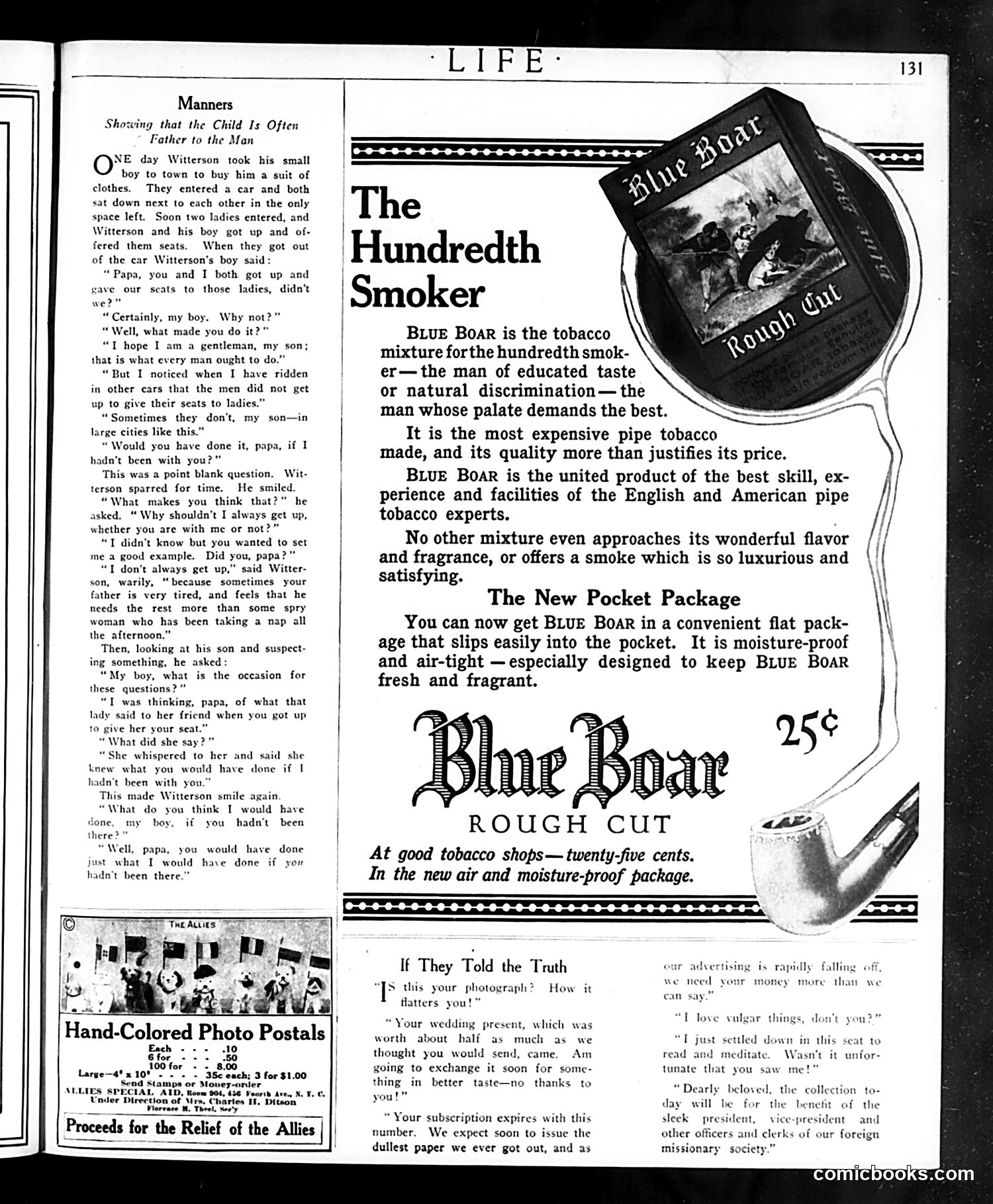
This satirical piece uses a dialogue between father Witterson and his young son to expose hypocrisy in genteel behavior. When Witterson gives up his streetcar seat to ladies, his son asks probing questions that reveal the father acts courteously only when observed by his child—implying his politeness is performative rather than principled. The joke's title suggests the "child is father to the man": the boy's innocent questioning forces the adult to confront uncomfortable truths about his own character. The son catches his father in a contradiction—Witterson claims gentlemen "ought" to surrender seats, yet admits he doesn't always do so, and only performed the act because his son was watching. This critiques the era's genteel middle-class pretense: people adopt proper manners selectively for appearance's sake rather than from genuine conviction. The satire targets masculine vanity and the gap between professed values and actual behavior.
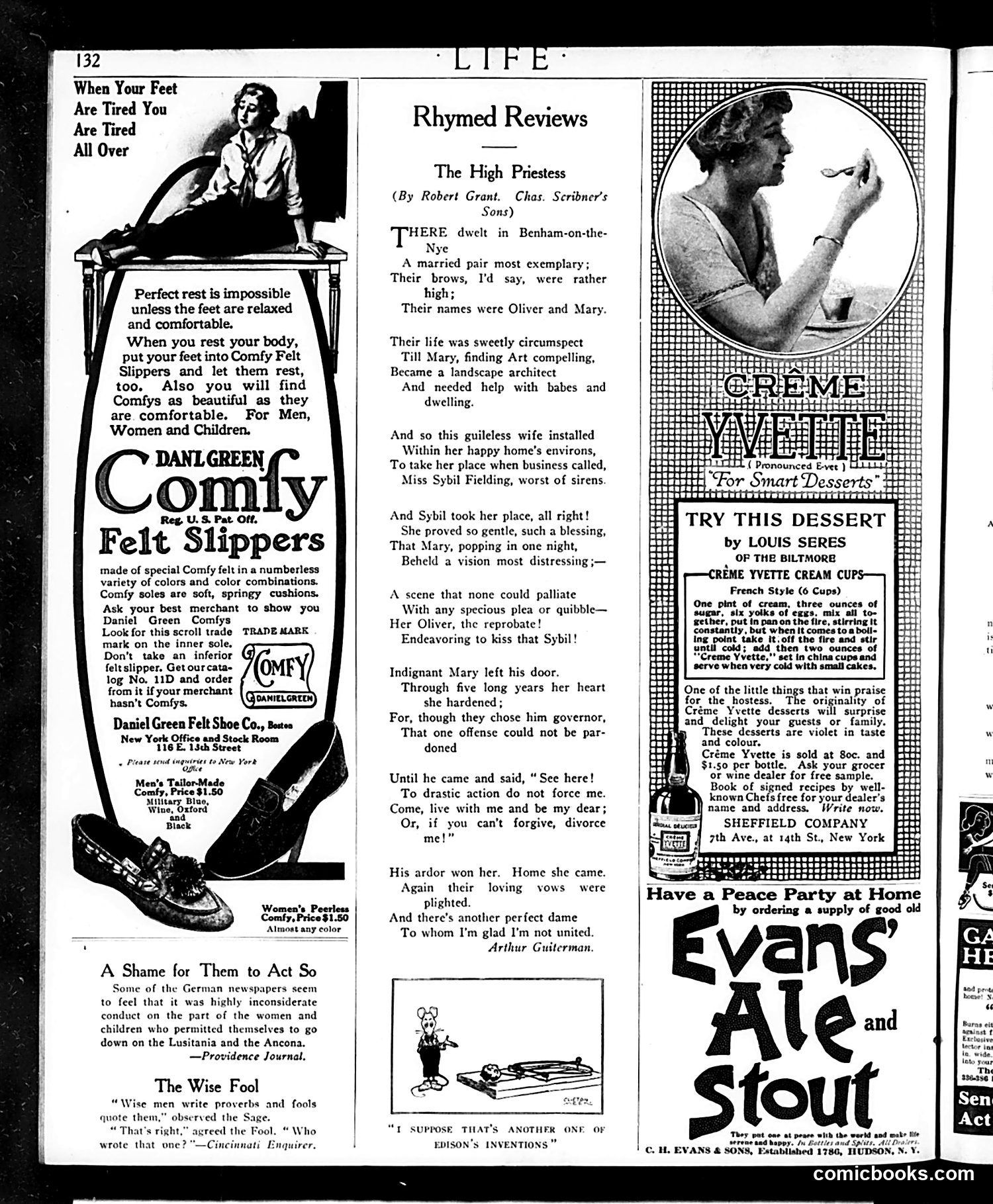
This page mixes advertisements with literary content and social commentary typical of *Life* magazine's satirical format. **Main Content:** The "Rhymed Reviews" section features Arthur Guiterman's poem reviewing Robert Grant's novel *The High Priestess*. The plot concerns Oliver and Mary, a respectable couple whose marriage fractures when Mary discovers Oliver attempting to kiss their hired help, Sybil Fielding. After five years of estrangement, Oliver persuades Mary to reconcile by threatening divorce. Guiterman's final line—"And there's another perfect dame / To whom I'm glad I'm not united"—satirizes the novel's ironic conclusion: the reconciliation produces another "perfect" but ultimately flawed marriage. **Historical Context:** The page also includes brief commentary on the *Lusitania* and *Ancona* sinkings, criticizing German newspapers for blaming women and children aboard these ships, suggesting contemporaneous outrage over civilian casualties. **Advertisements** for Comfy felt slippers, Crème Yvette dessert liqueur, and Evans Ale fill remaining space—standard period advertising.
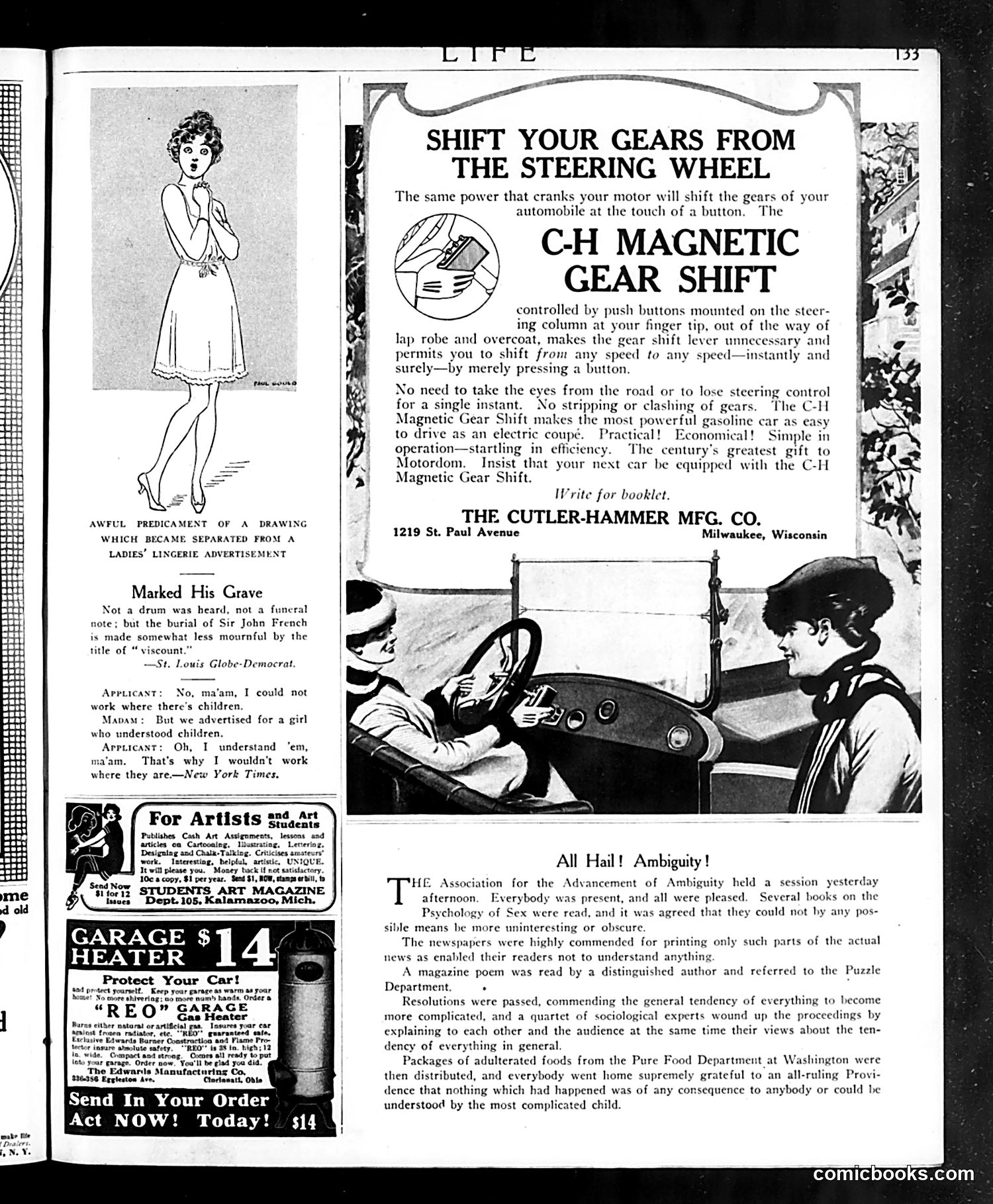
This page primarily consists of **advertisements and satirical short pieces** rather than traditional political cartoons. ## Key Content: **Main Advertisement:** The C-H Magnetic Gear Shift promotes an early automotive innovation—push-button gear shifting controlled from the steering wheel, eliminating the manual gear lever. This appeals to the era's fascination with technological convenience. **Satirical Pieces:** - "Marked His Grave" jokes that Sir John French's burial is "less mournful" because he received the title "viscount"—dark humor about consoling himself with honors. - A dialogue satirizes job applicants who claim to "understand children" while refusing positions with them. - "All Hail! Ambiguity!" mocks contemporary journalism, psychology texts, and government agencies for being deliberately obscure, incomprehensible, and unhelpful—suggesting widespread institutional obfuscation. The page reflects early 20th-century anxieties: technological progress, labor relations, and institutional opacity masquerading as sophistication.
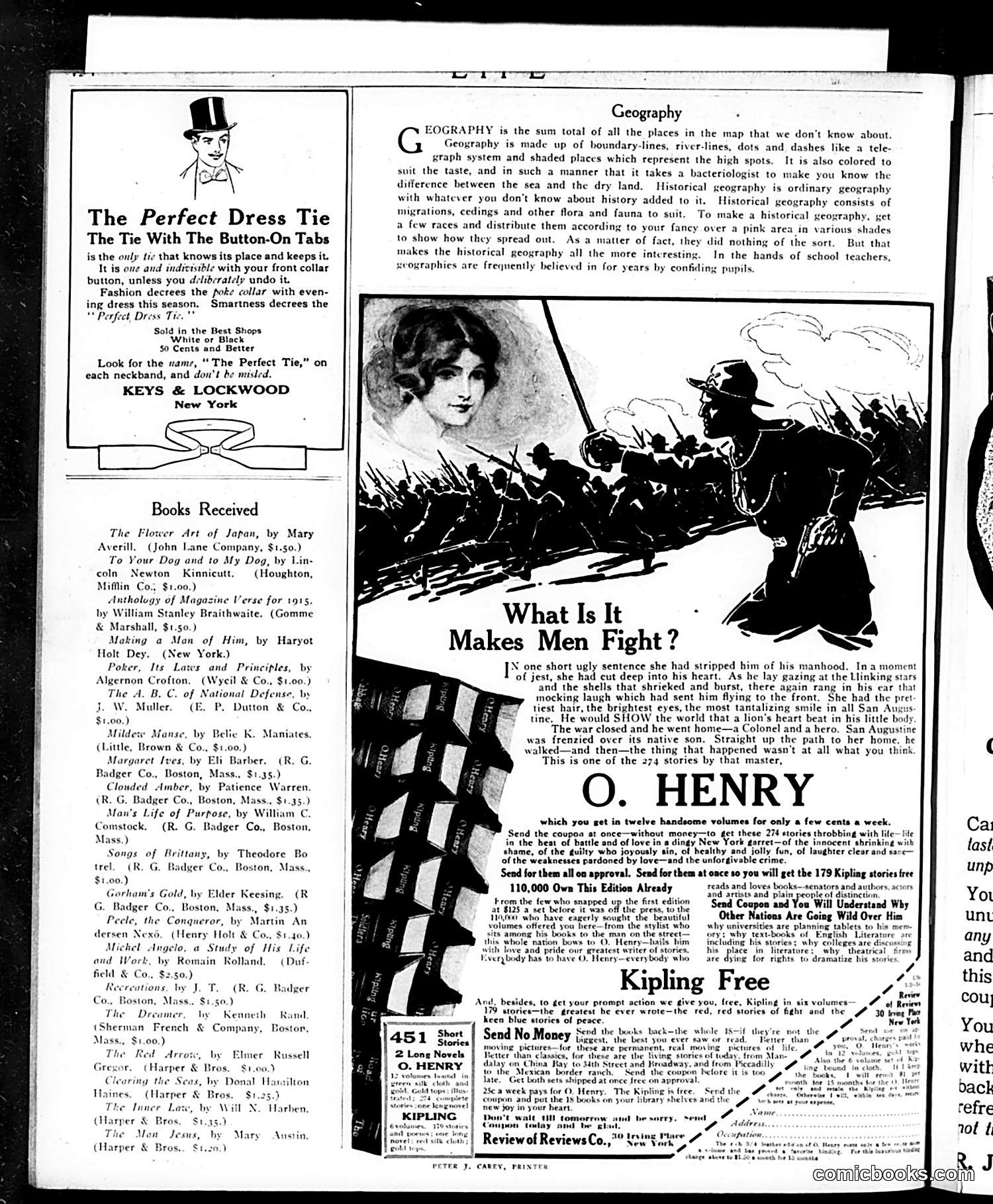
This page combines satirical commentary with advertising. The main cartoon, titled "What Is It Makes Men Fight?," illustrates a O. Henry short story excerpt. It depicts a soldier in silhouette against a battlefield scene, apparently driven to enlist by a woman's mockery of his manhood. The narrative suggests romantic humiliation as motivation for military service—a cynical take on masculine honor and patriotic duty common in early 20th-century satire. The accompanying text promotes a mail-order book collection of O. Henry's 274 stories, using this particular tale (about a man proving himself through war) as marketing hook. The page also includes a satirical definition of "Geography" mocking how the subject is taught—reducing complex knowledge to memorized boundaries and arbitrary colorings. Additionally, there's a dress-tie advertisement emphasizing fashion conformity. Overall, the page reflects prewar American attitudes toward masculinity, consumerism, and education circa 1915.
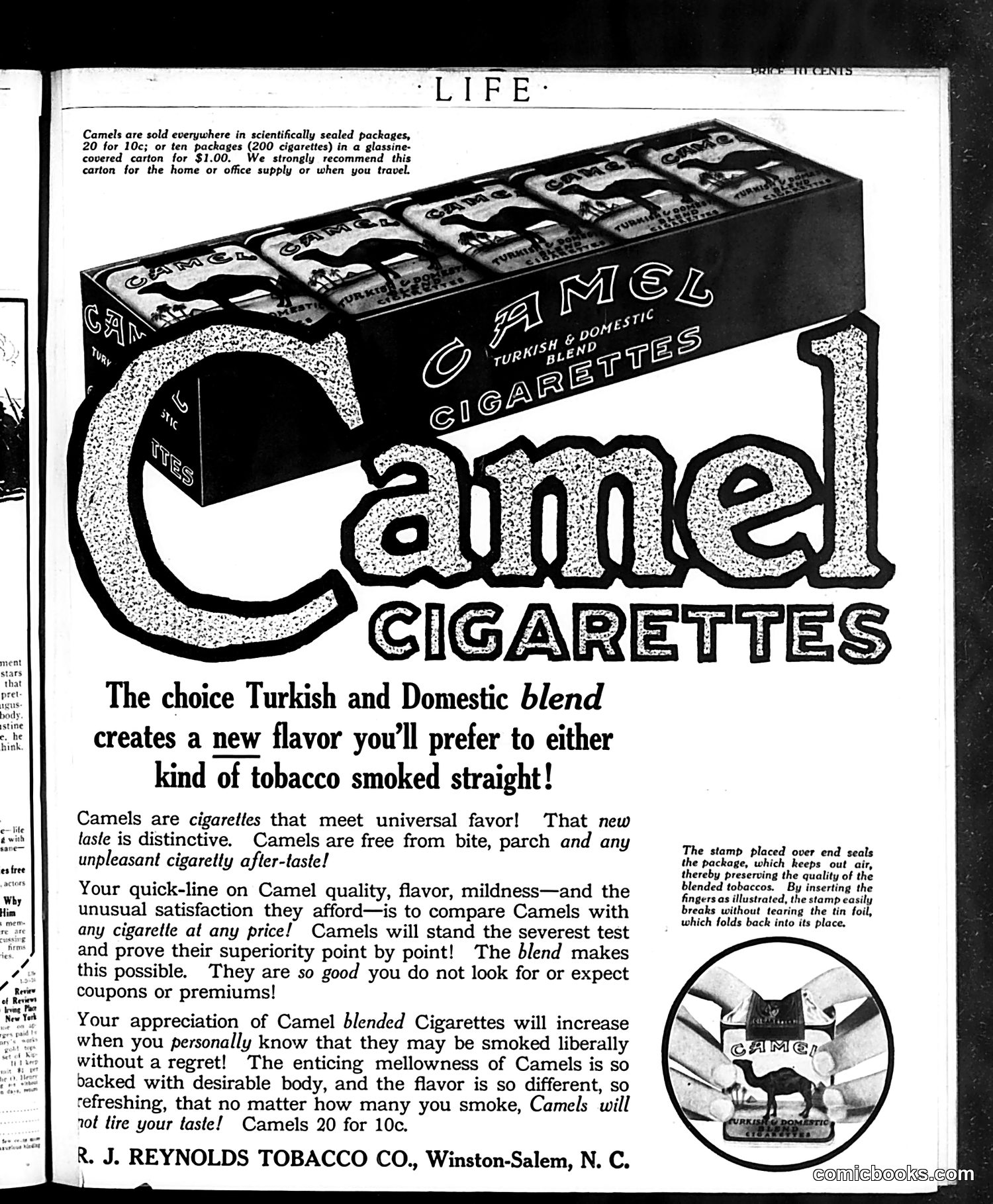
This is a full-page **cigarette advertisement**, not satire or political commentary. It's a 1920s-era Camel brand ad from Life magazine promoting a Turkish-domestic tobacco blend. The ad emphasizes the product's supposed superiority: the blend creates a "new flavor," lacks harshness ("free from bite, parch"), and can be smoked "liberally without a regret." Marketing claims include that Camels won't "tire your taste" no matter consumption volume. The advertisement includes packaging details (20 cigarettes for 10 cents) and a circular inset showing the package's end-seal stamp, highlighting preservation methods. **For modern readers**: This represents an era when cigarettes were marketed without health warnings, using pseudo-scientific language about "quality" and "mildness" to normalize heavy smoking. The casual suggestion that one can smoke "liberally without regret" would be illegal in contemporary advertising.
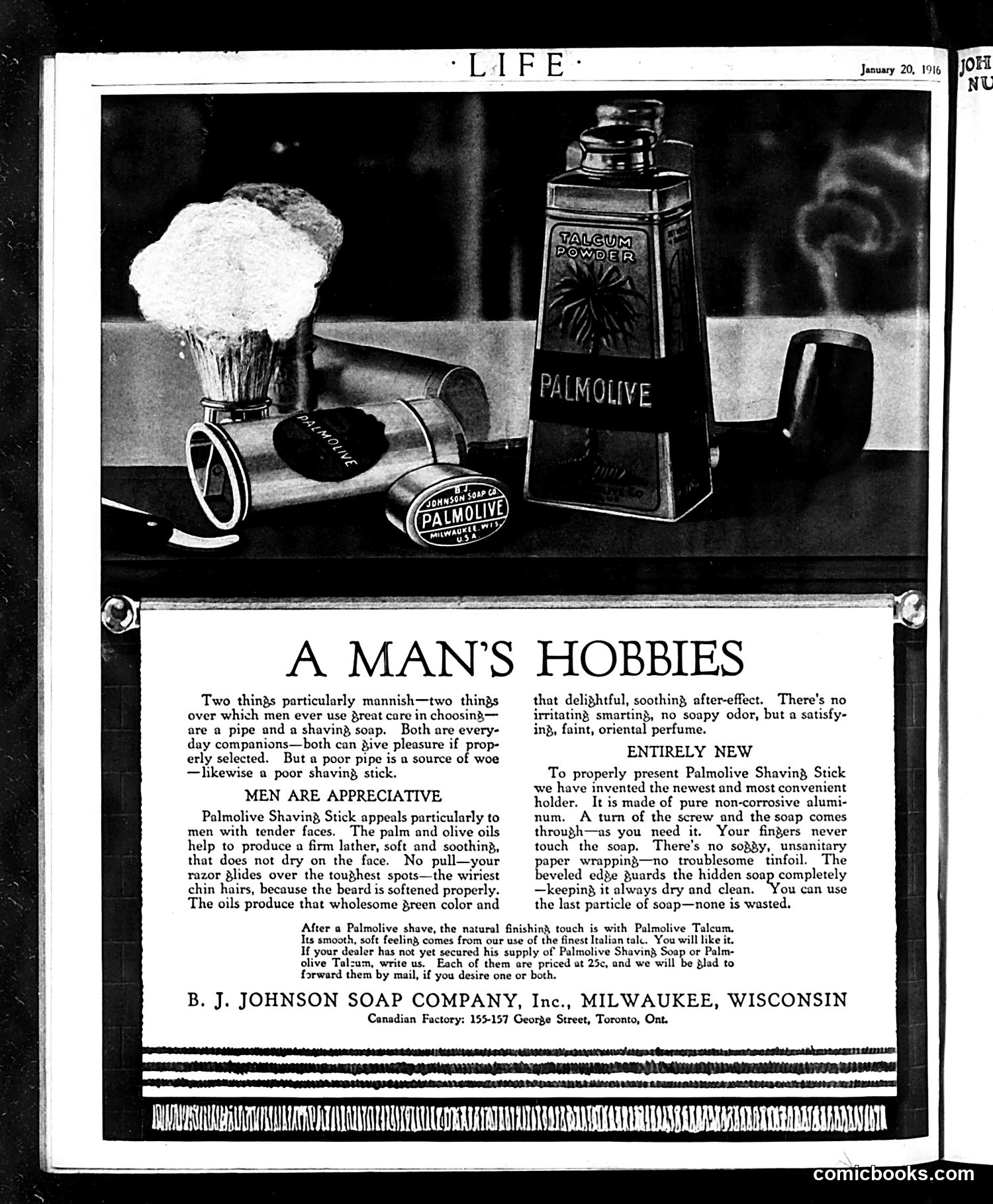
This is **not a cartoon or satire**, but rather a **product advertisement** for Palmolive Shaving products from January 20, 1916. The page markets Palmolive Shaving Stick and Talcum Powder to male consumers by framing grooming as a "manly hobby" alongside pipe-smoking. The ad appeals to traditional masculinity while emphasizing product benefits: the palm and olive oil formulation produces a soft lather suitable for men with sensitive skin, the new aluminum holder is hygienic and convenient, and the accompanying talcum powder provides a finishing touch. The image displays the product lineup—a shaving brush, soap stick in its innovative holder, and talcum powder container—as appealing masculine accessories. The copywriting stresses that quality grooming products deserve careful selection, just as men carefully choose pipes. This represents early 20th-century advertising strategy: selling practical hygiene products by connecting them to masculine identity and lifestyle aspirations.