
Life, 1916-01-20 · page 26 of 44
Life — January 20, 1916 — page 26: what you’re looking at
What you’re looking at
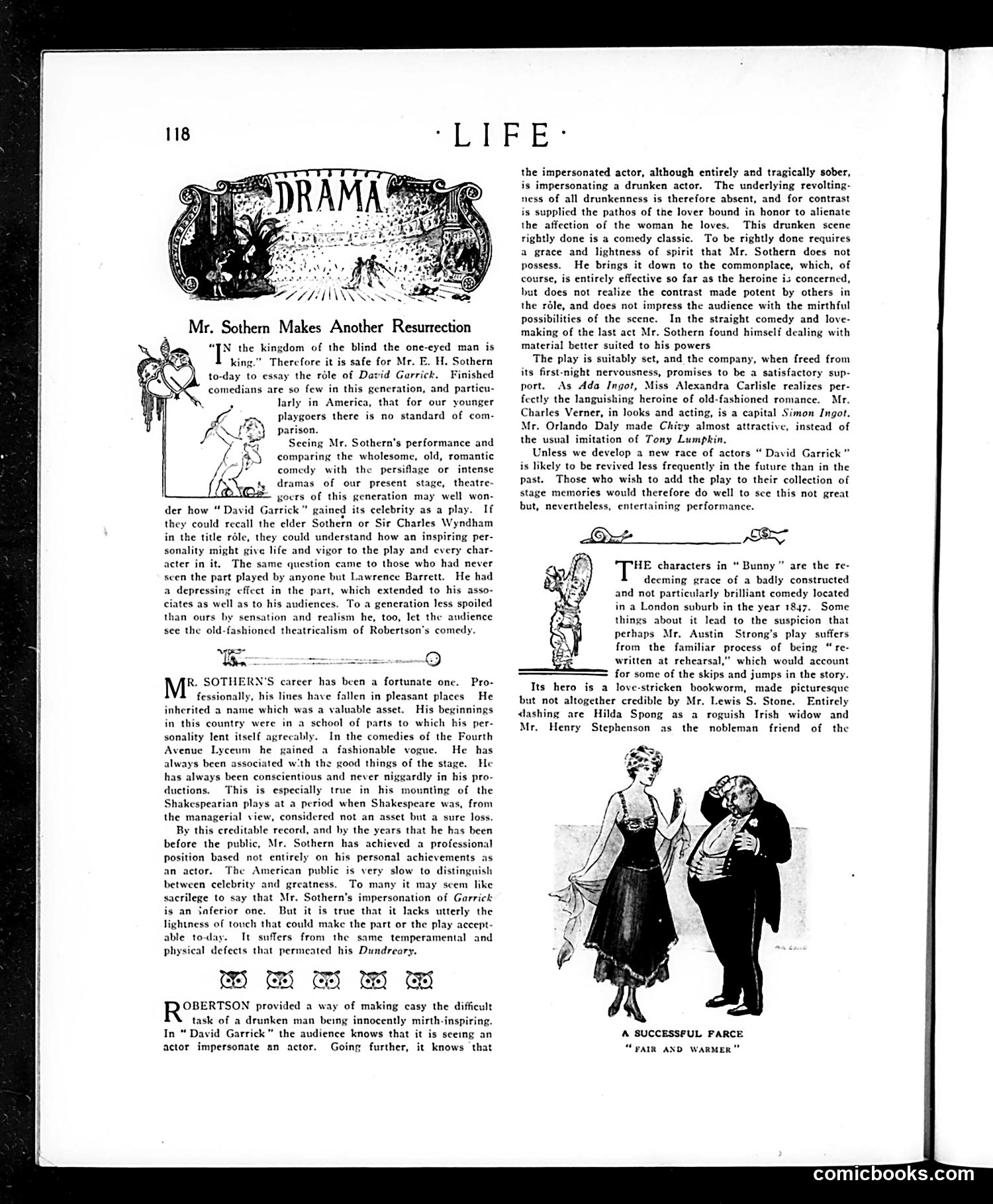
This page reviews actor H. Sothern's performance in "David Garrick," a 19th-century comedy play. The critic argues that Sothern's interpretation lacks the finesse needed for the role—particularly in a famous scene where an actor impersonates a drunk actor impersonating sobriety, a complex comedic feat. The review compares Sothern unfavorably to earlier performers (Lawrence Barrett, the elder Sothern, Sir Charles Wyndham), suggesting his heavy-handed approach undermines the play's subtle humor. The critic suggests Sothern succeeds in straightforward dramatic scenes but cannot deliver the "grace and lightness" required for the comedy's sophisticated layering. The illustration labeled "A Successful Farce: 'Fair and Warmer'" shows a separate theatrical production reviewed on the same page, featuring a man and woman in a comedic interaction.
📄 Transcribed text from this page (OCR, searchable)
Machine-transcribed from the original scan — historical spelling and the odd misread are preserved.
= LANEE SASL ANNO. thee. Mr. Sothern Makes Another Resurrection “IN the kingdom of the blind the one-eyed man is king.” Therefore it is safe for Mr. H. Sothern to-day to essay the rdle of David Garrick. Finished comedians are so few in this gener yn, and particu- larly in America, that for our younger playgoers there is no standard of com- parison. Seeing Mr. Sothern's performance and comparing the wholesome, old, romantic comedy with the persiflage or intense dramas of our present stage, theatre- xocrs of this generation may well won- der how “David Garrick” gained its celebrity as a play. If they could recall the elder Sothern or Sir Charles Wyndham in the title réle, they could understand how an inspiring per- sonality might give life and vigor to the play and every char- acter in it, The same question came to those who had never seen the part played by anyone but Lawrence Barrett. He had a depressing effect in the part, which extended to his asso- ciates as well as to his audiences. To a generation less spoiled than ours by sensation and realism he, too, let the audience see the old-fashioned theatricalism of Robertson's comedy. te ee 9 R. SOTHERN’S cer has been a fortunate one. Pro- f his lines have fallen in pleasant places He me which was a valuable asset. His beginnings in this country were in a school of parts to which his per- sonality lent itself agreeably. In the comedies of the Fourth Avenue Lyceum he gained a fashionable vogue. He has always been associated wth the good things of the stage. He has always been conscientious and never niggardly in his pro- ductions. This is especially true in his mounting of the Shakespearian plays at a period when Shakespeare was, from the managerial view, considered not an asset but a sure loss. By this creditable record, and by the years that he has been before the public, Mr. Sothern has achieved a professional position’ baséd ‘not ‘eatirely'on his. personal ‘achievenients as an actor, The American public is very slow to distinguish between celebrity and greatness. To many it may seem like sacrilege to say that Mr. Sothern’s impersonation of Garrick is an jaferior one. But it is true that it lacks utterly the lightness of touch that could make the part or the play accept- able to-day. It suffers from the same temperamental and physical defects that permeated his Dundreary. OBERTSON provided a way of making casy the difficult task of a drunken man being innocently mirth-inspiring. In “ David Garrick” the audience knows that it is seeing an actor impersonate an actor. Going further, it knows that the impersonated actor, although entirely and tragically sober, is impersonating a drunken actor. The underlying revolting- ness of all drunkenness is therefore absent, and for contrast is supplied the pathos of the lover bound in honor to alienate the affection of the woman he loves. This drunken scene rightly done is a comedy classic. To be rightly done requires a grace and lightness of spirit that Mr. Sothern does not possess. He brings it down to the commonplace, which, of course, is entirely effective so far as the heroine is concerned, but does not realize the contrast made potent by others in the réle, and does not impress the audience with the mirthful possibilities of the scene. In the straight comedy and love- making of the last act Mr. Sothern found himself dealing with material better suited to his powers The play is suitably set, and the company, when freed from its first-night nervousness, promises to be a satisfactory sup- port. As Ada Ingot, Miss Alexandra Carlisle realizes per- fectly the languishing heroine of old-fashioned romance. Mr. Charles Verner, in looks and acting, is a capital Simon Ingot. Mr. Orlando Daly made Chivy almost attractive, instead of the usual imitation of Tony Lumpkin, Unless we develop a new race of actors “ David Garrick” is likely to be revived less frequently in the future than in the past. Those who wish to add the play to their collection of stage memories would therefore do well to sce this not great but, nevertheless, entertaining performance. on HE characters in “Bunny” are the re- deeming grace of a badly constructed and not particularly brilliant comedy located in a London suburb in the year 1847. Some things about it lead to the suspicion that perhaps Mr. Austin Strong’s play suffers from the familiar process of being “ re- written at rehearsal,” which would account for some of the skips and jumps in the story. Its hero is a love-stricken bookworm, made picturesque but not altogether credible by Mr. Lewis S. Stone. Entirely dashing are Hilda Spong as a roguish Irish widow and Mr. Henry Stephenson as the nobleman friend of the A SUCCESSFUL PARCE “PAIR AND WARMER” comicbooks.com