
Life, 1916-01-20 · page 14 of 44
Life — January 20, 1916 — page 14: what you’re looking at
What you’re looking at
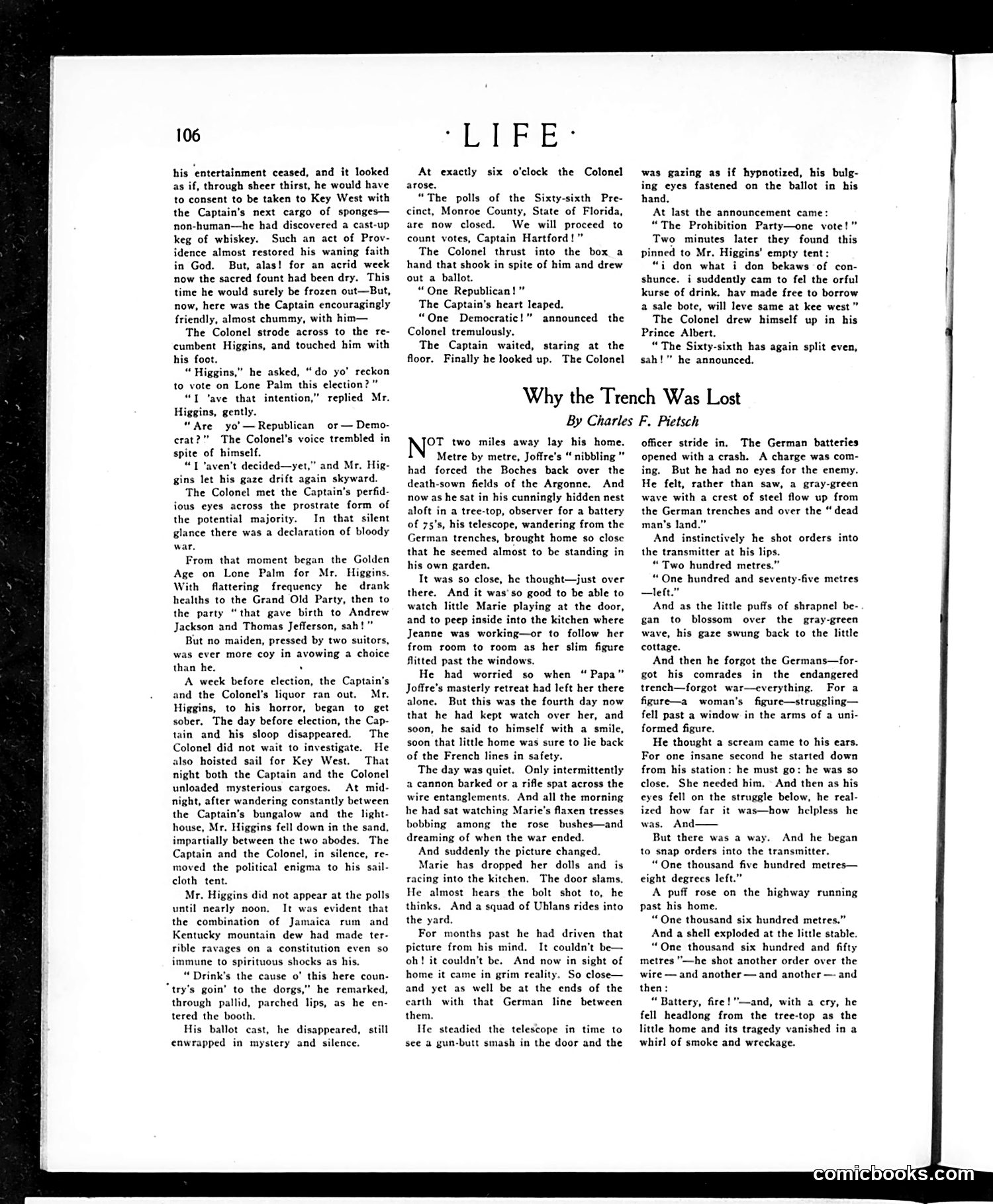
This page contains two distinct pieces of content: **Left column:** A satirical story about Colonel Higgins and a Captain discussing voting intentions before an election. The Colonel struggles with choosing between Republican and Democratic candidates, reflecting turn-of-century political ambivalence. The humor derives from Higgins' inability to make a principled choice and his eventual drunken disappearance before voting day—satirizing indecisive voters and the era's casual political engagement. **Right column:** "Why the Trench Was Lost" by Charles F. Pietsch—a WWI story about a German officer observing French lines from a tree-top position near his home. The narrative emphasizes the war's intimate horror: the officer recognizes his own house below and becomes emotionally compromised, leading to military disaster. The piece critiques war's human cost and the collision between domestic life and combat.
📄 Transcribed text from this page (OCR, searchable)
Machine-transcribed from the original scan — historical spelling and the odd misread are preserved.
106 his entertainment ceased, and it looked as if, through sheer thirst, he would have to consent to be taken to Key West with the Captain's next cargo of sponges— non-human—he had discovered a cast-up keg of whiskey. Such an act of Prov- idence almost restored his waning faith in God. But, alas! for an acrid week now the sacred fount had been dry. This time he would surely be frozen out—But, now, here was the Captain encouragingly friendly, almost chummy, with him— The Colonel strode across to the re- cumbent Higgins, and touched him with his foot. “ Higgins,” he asked, “do yo’ reckon to vote on Lone Palm this election?” “T ‘ave that intention,” replied Mr. Higgins, gently. “Are yo'—Republican or — Demo- crat?" The Colonel’s voice trembled in spite of himself. “1 ‘aven't decided—yet,” and Mr. Hig- gins let his gaze drift again skyward. The Colonel met the Captain's perfid- ious eyes across the prostrate form of the potential majority. In that silent glance there was a declaration of bloody war. From that moment began the Golden Age on Lone Palm for Mr. Higgins. With flattering frequency he drank healths to the Grand Old Party, then to the party “that gave birth to Andrew Jackson and Thomas Jefferson, sah!" But no maiden, pressed by two suitors, was ever more coy in avowing a choice than he. . A week before election, the Captain's and the Colonel's liquor ran out. Mr. Higgins, to his horror, began to get sober. The day before election, the Cap- tain and his sloop disappeared. The Colonel did not wait to investigate. He also hoisted sail for Key West. That night both the Captain and the Colonel unloaded mysterious cargoes. At mid- night, after wandering constantly between the Captain's bungalow and the light- house, Mr. Higgins fell down in the sand, impartially between the two abodes. The Captain and the Colonel, in silence, re- moved the political enigma to his sail- cloth tent. Mr. Higgins did not appear at the polls until nearly noon. It was evident that the combination of Jamaica rum and Kentucky mountain dew had made ter- rible ravages on a constitution even so immune to spirituous shocks as his. “ Drink’s the cause o’ this here coun- “try’s goin’ to the dorgs,” he remarked, through pallid, parched lips, as he en- tered the booth. His ballot cast, he disappeared, still enwrapped in mystery and silence. OW a At exactly six o'clock the arose. The polls of the Sixty-sixth Pre- cinet, Monroe County, State of Florida, are now closed. We will proceed to count votes, Captain Hartford!” The Colonel thrust into the box a hand that shook in spite of him and drew out a ballot. “One Republican!” The Captain's heart leaped. “One Democratic!” announced the Colonel tremulously. The Captain waited, staring at the floor. Finally he looked up. The Colonel Colonel was gazing as if hypnotized, his bulg- ing eyes fastened on the ballot in his hand. At last the announcement came: “The Prohibition Party—one vote!” Two minutes later they found this pinned to Mr. Higgins’ empty tent: “i don what i don bekaws of con- shunce. i suddently cam to fel the orful kurse of drink. hav made free to borrow a sale bote, will leve same at kee west” The Colonel drew himself up in his Prince Albert. “The Sixty-sixth has again split even, sah!" he announced. Why the Trench Was Lost By Charles F, Pietsch [OT two miles away lay his home. Metre by metre, Joffre’s “ nibbling ” had forced the Boches back over the death-sown fields of the Argonne. And now as he sat in his cunningly hidden nest aloft in a tree-top, observer for a battery of 75's, his telescope, wandering from the German trenches, brought home so close that he seemed almost to be standing in his own garden. Tt was so close, he thought—just over there. And it was’ so good to be able to watch little Marie playing at the door, and to peep inside into the kitchen where Jeanne was working—or to follow her from room to room as her slim figure flitted past the windows, He had worried so when “ Papa” Joffre’s masterly retreat had left her there alone, But this was the fourth day now that he had kept watch over her, and soon, he said to himself with a smile, soon that little home was sure to lie back of the French lines in safety. The day was quiet. Only intermittently a cannon barked or a rifle spat across the wire entanglements. And all the morning he had sat watching Marie's flaxen tresses bobbing among the rose bushes—and dreaming of when the war ended. And suddenly the picture changed. Marie has dropped her dolls and is racing into the kitchen. The door slams, He almost hears the bolt shot to, he thinks. And a squad of Ublans rides into the yard. For months past he had driven that picture from his mind. It couldn't be— oh! it couldn't be, And now in sight of home it came in grim reality. So close— and yet as well be at the ends of the carth with that German line between them. He steadied the telescope in time to see a gun-butt smash in the door and the officer stride in. The German batteries opened with a crash. A charge was com- ing. But he had no eyes for the enemy. He felt, rather than saw, a gray-green wave with a crest of steel flow up from the German trenches and over the “dead man’s land.” And instinctively he shot orders into the transmitter at his lips. “Two hundred metres.” “One hundred and seventy-five metres —left.” And as the little puffs of shrapnel be- gan to blossom over the gray-green wave, his gaze swung back to the little cottage. And then he forgot the Germans—for- got his comrades in the endangered trench—forgot war—everything. For a figure—a woman's figure—struggling— fell past a window in the arms of a uni- formed figure. He thought a scream came to his ears. For one insane second he started down from his station: he must go: he was so close. She needed him. And then as his eyes fell on the struggle below, he real- ized how far it was—how helpless he was. And—— But there was a way. And he began to snap orders into the transmitter. “One thousand five hundred metres— eight degrecs left.” ‘A puff rose on the highway running past his home. “One thousand six hundred metres.” And a shell exploded at the little stable. “One thousand six hundred and fifty metres "—he shot another order over the wire — and another — and another —- and then: “ Battery, fire!"—and, with a cry, he fell headlong from the tree-top as the little home and its tragedy vanished in a whirl of smoke and wreckage.