
Life, 1916-01-20 · page 13 of 44
Life — January 20, 1916 — page 13: what you’re looking at
What you’re looking at
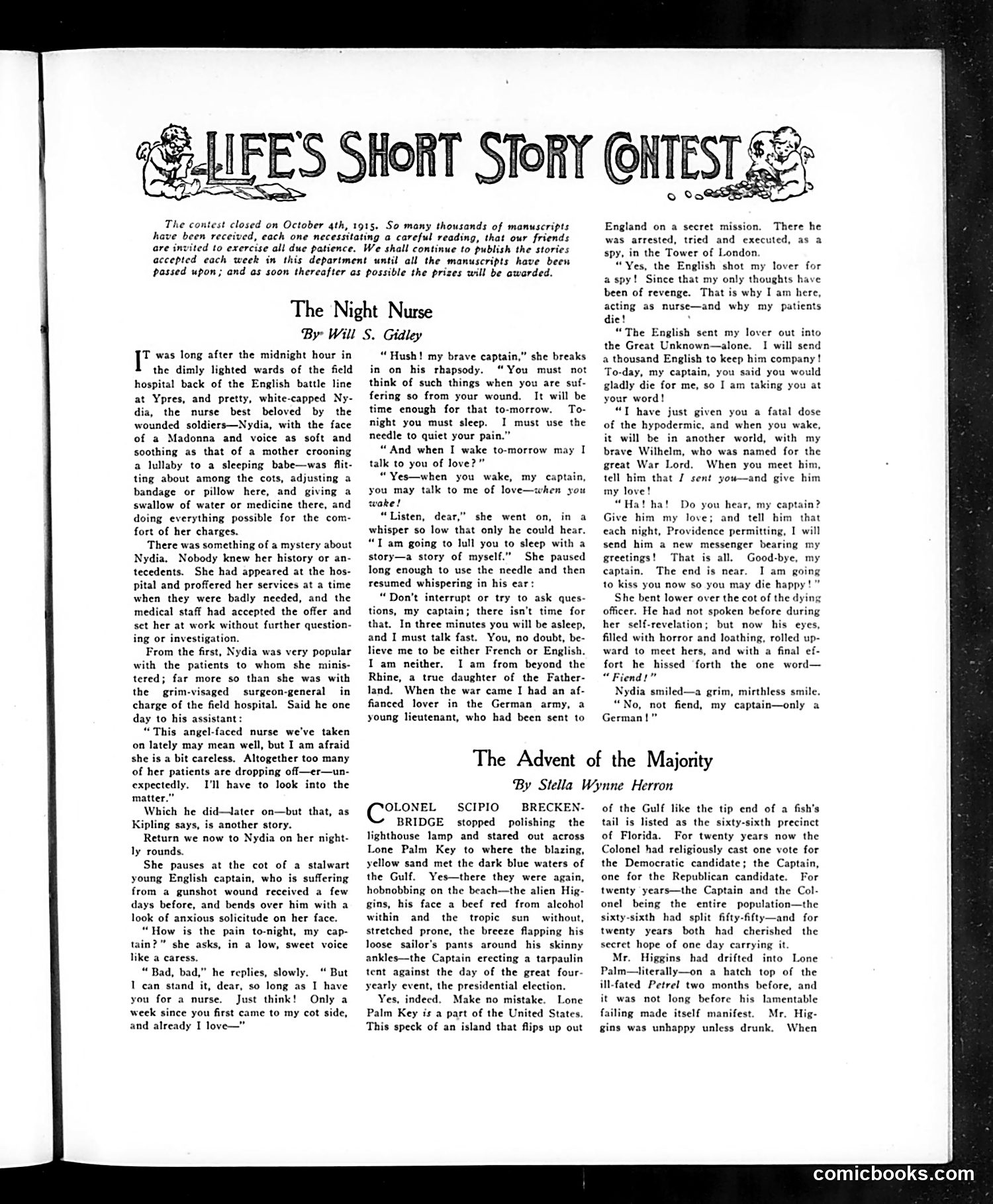
This page presents two fictional short stories from Life's 1915 contest, not political cartoons or satire. "The Night Nurse" by Will S. Gidley depicts a WWI hospital scene where a nurse named Nydia tends to a wounded English captain, who reveals he's on a secret mission in London seeking revenge against a German lover who betrayed him. "The Advent of the Majority" by Stella Wynne Herron describes Colonel Scipio Bridge observing the Florida Keys and contemplating the presidential election—specifically that Lone Palm Key represents America's "majority" (the 66th precinct), and how this region's voting patterns matter politically. Both are sentimental wartime fiction reflecting early-1910s American literary interests in espionage and electoral politics.
📄 Transcribed text from this page (OCR, searchable)
Machine-transcribed from the original scan — historical spelling and the odd misread are preserved.
© LIFES SHORT STORY GNTEST: Se The contest closed on October 4th, 1915. So many thousands of manuscripts have been received, each one necessitating a careful reading, that our friends are invited to exercise all due patience. We shall continue to publish the stories accepted each week in this department until all the manuscripts have been passed upon; and as soon thereafter as possible the prizes will be awarded. The Night Nurse By Will S. Gidley T was long after the midnight hour in the dimly lighted wards of the field hospital back of the English battle line at Ypres, and pretty, white-capped Ny- dia, the nurse best beloved by the wounded soldiers—Nydia, with the face of a Madonna and voice as soft and soothing as that of a mother crooning a lullaby to a sleeping babe—was flit- ting about among the cots, adjusting a bandage or pillow here, and giving a swallow of water or medicine there, and doing everything possible for the com- fort of her charges. There was something of a mystery about Nydia. Nobody knew her history or an- tecedents. She had appeared at the hos- pital and proffered her services at a time when they were badly needed, and the medical staff had accepted the offer and set her at work without further question- ing or investigation. From the first, Nydia was very popular with the patients to whom she minis- tered; far more so than she was with the grim-visaged surgeon-general in charge of the field hospital. Said he one day to his assistant: “This angel-faced nurse we've taken on lately may mean well, but I am afraid she is a bit careless. Altogether too many of her patients are dropping off—er—un- expectedly. I'll have to look into the matter.” Which he did—Jater on—but that, as Kipling says, is another story. Return we now to Nydia on her night- ly rounds. She pauses at the cot of a stalwart young English captain, who is suffering from a gunshot wound received a few days before, and bends over him h a look of anxious solicitude on her face. “How is the pain to-night, my cap- tain?” she asks, in a low, sweet voice like a caress. “ Bad, bad,” he replies, slowly. “ But I can stand it, dear, so long as I have you for a nurse, Just think! Only a week since you first came to my cot side, and already I love—" “Hush! my brave captain,” she breaks in on his rhapsody. “You must not think of such things when you are suf- fering so from your wound. It will be time enough for that to-morrow. To- night you must sleep. I must use the needle to quiet your pain.” “And when I wake to-morrow may I talk to you of love?” “Yes—when you wake, my captain, you may talk to me of love—when you wake! “Listen, dear,” she went on, in a whisper so low that only he could hear. “T am going to lull you to sleep with a story—a story of myself.” She paused long enough to use the needle and then resumed whispering in his ear: “Don't interrupt or try to ask ques- tions, my captain; there isn’t time for that. In three minutes you will be asleep, and I must talk fast. You, no doubt, be- lieve me to be either French or English. I am neither, I am from beyond the Rhine, a true daughter of the Father- land. When the war came I had an af- fianced lover in the German army, a young lieutenant, who had been sent to ° England on a secret mission. There he was arrested, tried and executed, as a spy, in the Tower of London “Yes, the English shot my lover for a spy! Since that my only thoughts have been of revenge. That is why I am here, acting as nurse—and why my patients die! , “The English sent my lover out into the Great Unknown—alone. I will send a thousand English to keep him company! To-day, my captain, you said you would gladly die for me, so I am taking you at your word! “T have just given you a fatal dose of the hypodermic, and when you wake, it will be in another world, with my brave Wilhelm, who was named for the great War Lord. When you meet him, tell him that J sent you—and give him my love! Ha! ha! Do you hear, my captain? Give him my love; and tell him that each night, Providence permitting, I will send him a new messenger bearing my greetings! That is all. Good-bye, my captain, The end is near. I am going to kiss you now so you may die happy!” She bent lower over the cot of the dying officer. He had not spoken before during her self-revelation; but now his eyes, filled with horror and loathing, rolled up- ward to meet hers, and with a final ef- fort he hissed forth the one word— “ Fiend!” Nydia smiled—a grim, mirthless s: “No, not fiend, my captain—only a German!” The Advent of the Majority By Stella Wynne Herron 'OLONEL SCIPIO BRECKEN- BRIDGE stopped polishing the lighthouse lamp and stared out across Lone Palm Key to where the blazing, yellow sand met the dark blue waters of the Gulf. Yes—there they were again, hobnobbing on the beach—the alien Hig- gins, his face a beef red from alcohol within and the tropic sun without, stretched prone, the breeze flapping his loose sailor's pants around his skinny ankles—the Captain erecting a tarpaulin tent against the day of the great four yearly event, the presidential election. Yes, indeed. Make no mistake. Lone Palm Key is a part of the United States. This speck of an island that flips up out of the Gulf like the tip end of a fish's tail is listed as the sixty-sixth precinct of Florida. For twenty years now the Colonel had religiously cast one vote for the Democratic candidate; the Captain, one for the Republican candidate. For twenty years—the Captain and the Col- onel being the entire population—the sixty-sixth had split fifty-fifty—and for twenty years both had cherished the secret hope of one day carrying it. Mr. Higgins had drifted into Lone Palm—literally—on a hatch top of the ill-fated Petrel two months before, and it was not long before his lamentable ing made itself manifest. Mr. Hig- gins was unhappy unless drunk. When comicbooks.com