
Life, 1916-01-20 · page 19 of 44
Life — January 20, 1916 — page 19: what you’re looking at
What you’re looking at
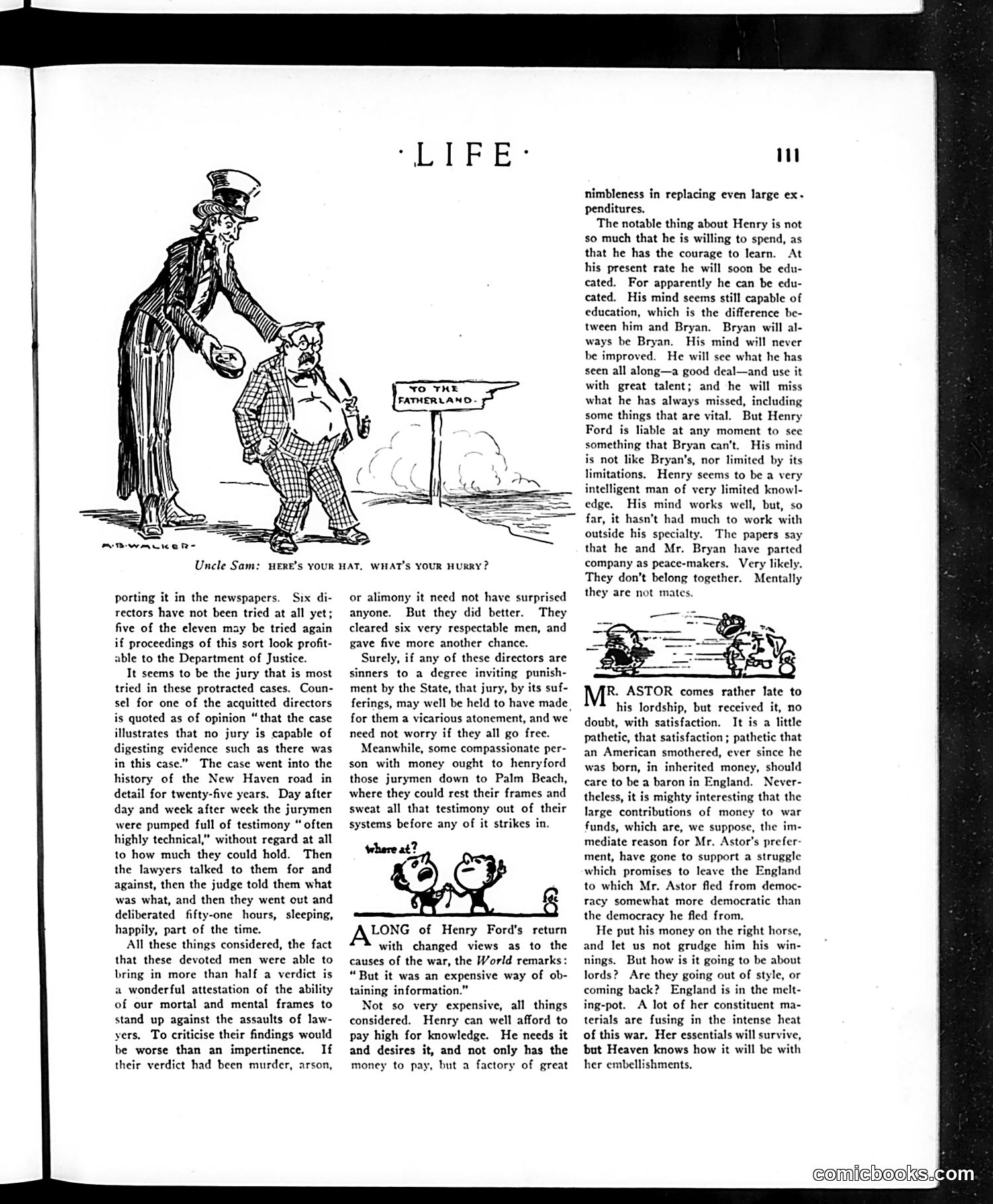
The main cartoon depicts **Uncle Sam** (representing the United States) offering his hat to a small figure labeled "A Firecracker to the Fatherland," who appears to be hurrying away. The caption reads: "Where's your hat, what's your hurry?" This satirizes American neutrality during **World War I**. The "firecracker" figure likely represents either a German agent or American war profiteer—someone engaged in suspicious activity toward Germany ("the Fatherland"). Uncle Sam's casual question suggests Americans are ignoring or enabling questionable wartime activities. The article text discusses **Henry Ford's** recent peace mission to Europe, sardonically noting he gained expensive "education" about war's causes. The piece contrasts Ford's capacity for learning with **William Jennings Bryan**, implying Ford—though limited in knowledge—can grow intellectually, whereas Bryan cannot. A brief note mentions **Lord Astor**, an American inheriting an English title, criticized as pathetically seeking aristocratic status. The overall tone mocks American naiveté regarding European conflict and questions American attitudes toward the war.
📄 Transcribed text from this page (OCR, searchable)
Machine-transcribed from the original scan — historical spelling and the odd misread are preserved.
A RweRcKeR- TO THE FATHERLAND- Uncle Sam: were’s YOUR HAT, WHAT'S YOUR HURRY? porting it in the newspapers. Six di- rectors have not been tried at all yet; five of the eleven may be tried again if proceedings of this sort look profit- able to the Department of Justice. It seems to be the jury that is most tried in these protracted cases. Coun- sel for one of the acquitted directors is quoted as of opinion “that the case illustrates that no jury is capable of digesting evidence such as there was in this case.” The case went into the history of the New Haven road in detail for twenty-five years. Day after day and week after week the jurymen were pumped full of testimony “ often highly technical,” without regard at all to how much they could hold. Then the lawyers talked to them for and against, then the judge told them what was what, and then they went out and deliberated fifty-one hours, sleeping, happily, part of the time. All these things considered, the fact that these devoted men were able to bring in more than half a verdict is a wonderful attestation of the ability of our mortal and mental frames to stand up against the assaults of law- yers, To criticise their findings would be worse than an impertinence. If their verdict had been murder, arson, or alimony it need not have surprised anyone. But they did better. They cleared six very respectable men, and gave five more another chance. Surely, if any of these directors are sinners to a degree inviting punish- ment by the State, that jury, by its suf- ferings, may well be held to have made for them a vicarious atonement, and we need not worry if they all go free. Meanwhile, some compassionate per- son with money ought to henryford those jurymen down to Palm Beach, where they could rest their frames and sweat all that testimony out of their systems before any of it strikes in. where at? LONG of Henry Ford’s return with changed views as to the causes of the war, the World remarks: “But it was an expensive way of ob- taining information.” Not so very expensive, all things considered. Henry can well afford to pay high for knowledge. He needs it and desires it, and not only has the money to pay, but a factory of great nimbleness in replacing even large ex- penditures. The notable thing about Henry is not so much that he is willing to spend, as that he has the courage to learn. At his present rate he will soon be edu- cated. For apparently he can be edu- cated. His mind seems still capable of education, which is the difference be- tween him and Bryan. Bryan will al- ways be Bryan. His mind will never be improved. He will see what he has seen all along—a good deal—and use it with great talent; and he will miss what he has always missed, including some things that are vital. But Henry Ford is liable at any moment to see something that Bryan can't. His mind is not like Bryan's, nor limited by its limitations. Henry seems to be a very intelligent man of very limited knowl- edge. His mind works well, but, so far, it hasn’t had much to work with outside his specialty. The papers say that he and Mr. Bryan have parted company as peace-makers. Very likely. They don’t belong together. Mentally they are not mates. R. ASTOR comes rather late to his lordship, but received it, no doubt, with satisfaction. It is a little pathetic, that satisfaction; pathetic that an American smothered, ever since he was born, in inherited money, should care to be a baron in England. Never- theless, it is mighty interesting that the large contributions of money to war funds, which are, we suppose, the im- mediate reason for Mr. Astor's prefer ment, have gone to support a struggle which promises to leave the England to which Mr. Astor fled from democ- racy somewhat more democratic than the democracy he fled from. He put his money on the right horse, and let us not grudge him his win- nings. But how is it going to be about lords? Are they going out of style, or coming back? England is in the melt- ing-pot. A lot of her constituent ma- terials are fusing in the intense heat of this war. Her essentials will survive, but Heaven knows how it will be with her embellishments, comichooks.ceyn)