
Life, 1916-01-20 · page 28 of 44
Life — January 20, 1916 — page 28: what you’re looking at
What you’re looking at
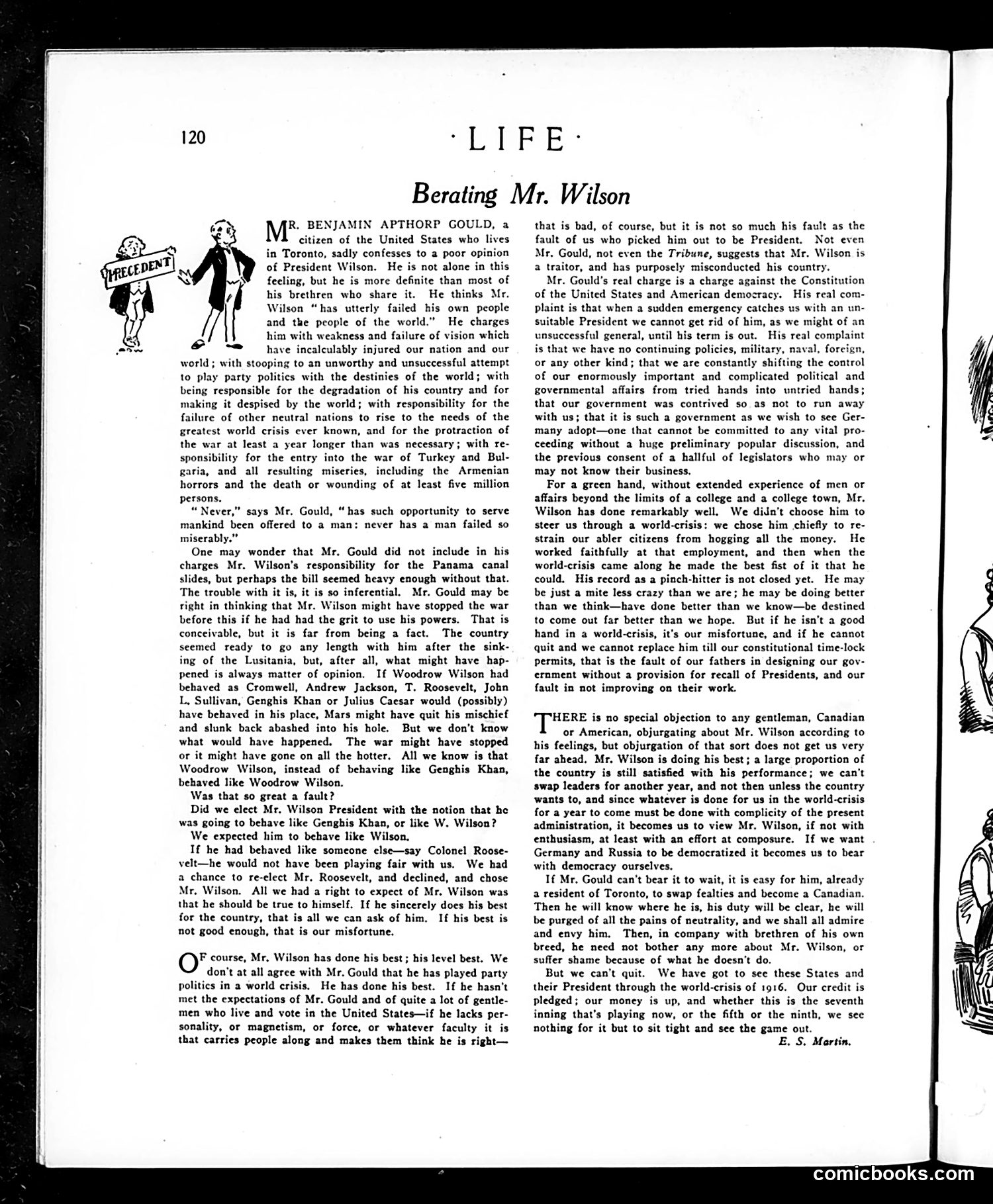
This *Life* magazine article defends President Woodrow Wilson against harsh criticism from Benjamin Apthorp Gould, a Toronto resident who blames Wilson for nearly every Allied failure in World War I—from the war's prolongation to the Armenian horrors. The satirical point is clear: the author (E.S. Martin) argues that Gould's charges are "inferential" (speculative) rather than factual. While acknowledging Wilson's limitations, Martin contends that voters elected Wilson to be *himself*, not to behave like aggressive predecessors like Theodore Roosevelt, Cromwell, or Genghis Khan. The cartoon likely depicts this confrontation between critic and president, though details are unclear from the image. Martin's defense essentially argues: Wilson did his "level best" within his character. If that wasn't good enough, that's America's fault for choosing him, not his fault for being himself. This reflects early WWI-era debates about presidential war powers and American intervention.
📄 Transcribed text from this page (OCR, searchable)
Machine-transcribed from the original scan — historical spelling and the odd misread are preserved.
ge | caso Berating Mr. Wilson M . BENJAMIN APTHORP GOULD, a citizen of the United States who lives in Toronto, sadly confesses to a poor opinion of President Wilson. He is not alone in this feeling, but he is more definite than most of his brethren who share it. He thinks Mr. Wilson “has utterly failed his own people and the people of the world.” He charges him with weakness and failure of vision which P= have incalculably injured our nation and our world; with stooping to an unworthy and unsuccessful attempt to play party politics with the destinies of the world; with being responsible for the degradation of his co making it despised by the world; with respons failure of other neutral nations to rise to the needs of the greatest world crisis ever known, and for the protraction of the war at least a year longer than was necessary; with re- sponsibility for the entry into the war of Turkey and Bul- garia, and all resulting miseries, including the Armenian horrors and the death or wounding of at least five million persons. “Never,” says Mr. Gould, “has such opportunity to serve mankind been offered to a man: never has a man failed so miserably.” One may wonder that Mr. Gould did not include in his charges Mr. Wilson's responsibility for the Panama canal slides, but perhaps the bill seemed heavy enough without that. The trouble with it is, it is so inferential. Mr. Gould may be right in thinking that Mr. Wilson might have stopped the war before this if he had had the grit to use his powers. That is conceivable, but it is far from being a fact. The country seemed ready to go any length with him after the sink- ing of the Lusitania, but, after all, what might have hap- pened is always matter of opinion. If Woodrow Wilson had behaved as Cromwell, Andrew Jackson, T. Roosevelt, John L, Sullivan, Genghis Khan or Julius Caesar would (possibly) have behaved in his place, Mars might have quit his mischief and slunk back abashed into his hole. But we don't know what would have happened. The war might have stopped or it might have gone on all the hotter. All we know is that Woodrow Wilson, instead of behaving like Genghis Khan, behaved like Woodrow Wilson. Was that so great a fault? Did we elect Mr. Wilson President with the notion that he was going to behave like Genghis Khan, or like W. Wilson? We expected him to behave like Wilson, If he had behaved like someone else—say Colonel Roose- velt—he would not have been playing fair with us. We had a chance to re-elect Mr. Roosevelt, and declined, and chose Mr. Wilson. All we had a right to expect of Mr. Wilson was that he should be true to himself. If he sincerely does his best for the country, that is all we can ask of him. If his best is not good enough, that is our misfortune. F course, Mr. Wilson has done his best; his level best. We don’t at all agree with Mr. Gould that he has played party politics in a world crisis, He has done his best. If he hasn't met the expectations of Mr. Gould and of quite a lot of gentle- men who live and vote in the United States—if he lacks per- sonality, or magnetism, or force, or whatever faculty it is that carries people along and makes them think he is right— that is bad, of course, but it is not so much his fault as the fault of us who picked him out to be President. Not even Mr. Gould, not even the Tribune, suggests that Mr. Wilson is a traitor, and has purposely misconducted his country. Mr. Gould’s real charge is a charge against the Constitution of the United States and American democracy. His real com- plaint is that when a sudden emergency catches us with an un- suitable President we cannot get rid of him, as we might of an unsuccessful general, until his term is out. His real complaint is that we have no continuing policies, military, naval, foreign, or any other kind; that we are constantly shifting the control of our enormously important and complicated political and governmental affairs from tried hands into untried hands; that our government was contrived so as not to run away with us; that it is such a government as we wish to see Ger- many adopt—one that cannot be committed to any vital pro- ceeding without a huge preliminary popular discussion, and the previous consent of a hallful of legislators who may or may not know their business. For a green hand, without extended experience of men or affairs beyond the limits of a college and a college town, Mr. Wilson has done remarkably well. We didn’t choose him to steer us through a world-crisis: we chose him chiefly to re- strain our abler citizens from hogging all the money. He worked faithfully at that employment, and then when the world-crisis came along he made the best fist of it that he could, His record as a pinch-hitter is not closed yet. He may be just a mite less crazy than we are; he may be doing better than we think—have done better than we know—be destined to come out far better than we hope. But if he isn’t a good hand in a world-crisis, it's our misfortune, and if he cannot quit and we cannot replace him till our constitutional time-lock permits, that is the fault of our fathers in designing our gov- ernment without a provision for recall of Presidents, and our fault in not improving on their work. 'HERE is no special objection to any gentleman, Canadian or American, objurgating about Mr. Wilson according to his feelings, but objurgation of that sort does not get us very far ahead. Mr. Wilson is doing his best; a large proportion of the country is still satisfied with his performance; we can't swap leaders for another year, and not then unless the country wants to, and since whatever is done for us in the world-crisis for a year to come must be done with complicity of the present administration, it becomes us to view Mr. Wilson, if not with enthusiasm, at least with an effort at composure. If we want Germany and Russia to be democratized it becomes us to bear with democracy ourselves. If Mr. Gould can't bear it to wait, it is easy for him, already a resident of Toronto, to swap fealties and become a Canadian. Then he will know where he is, his duty will be clear, he will be purged of all the pains of neutrality, and we shall all admire and envy him. Then, in company with brethren of his own breed, he need not bother any more about Mr. Wilson, or suffer shame because of what he doesn’t do. But we can’t quit. We have got to see these States and their President through the world-crisis of 1916. Our credit is pledged; our money is up, and whether this is the seventh inning that’s playing now, or the fifth or the ninth, we see nothing for it but to sit tight and see the game out. E. S. Martin, comicbooks.com