
Life, 1916-01-20 · page 18 of 44
Life — January 20, 1916 — page 18: what you’re looking at
What you’re looking at
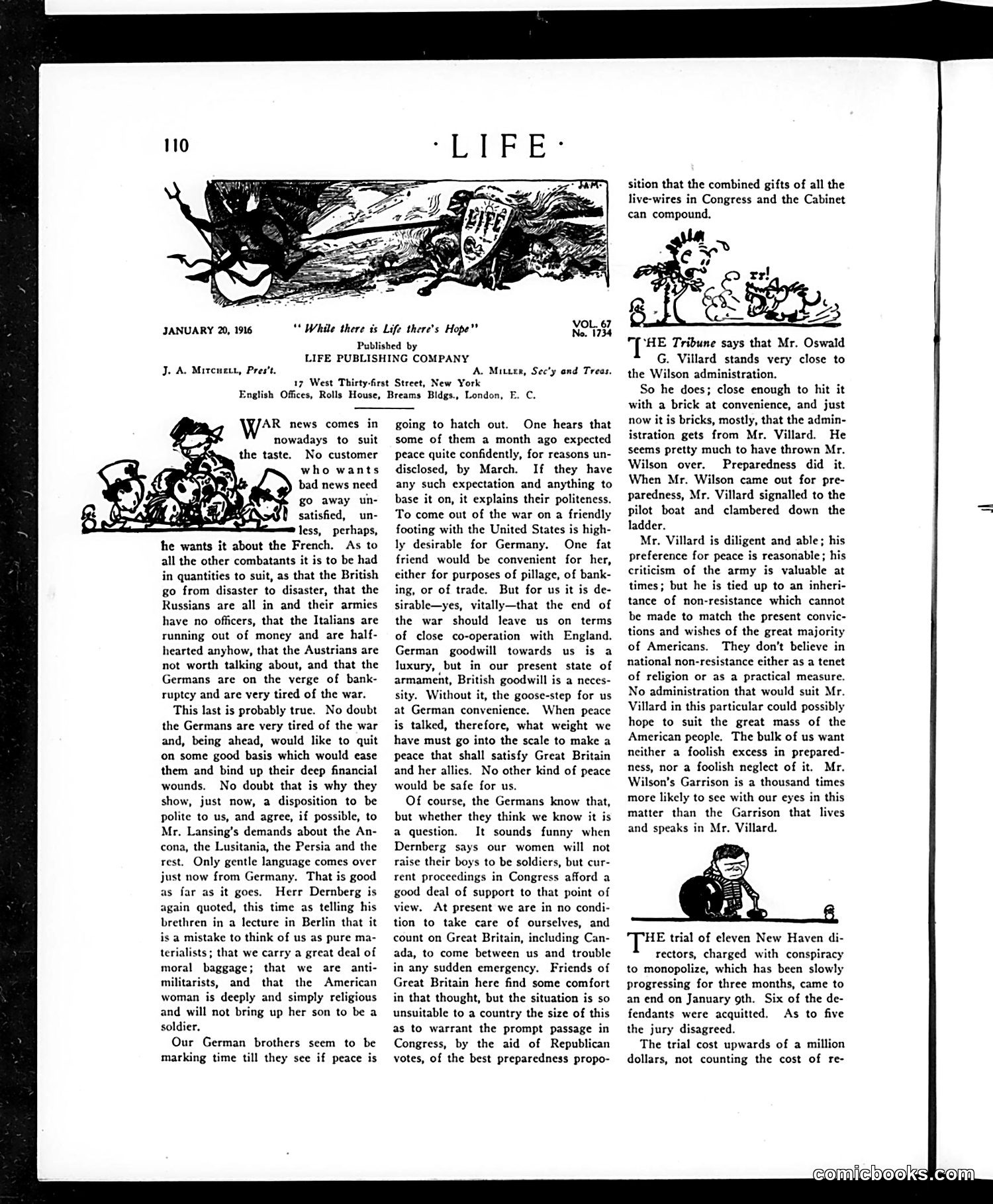
This page critiques American military unpreparedness during World War I. The main editorial argues that Germany is deliberately being polite to the U.S., hoping America will remain neutral or even friendly—a luxury Germany can afford while winning. The author warns this is dangerous strategizing. The key point: America currently depends on British naval protection and cannot defend itself. Therefore, any peace negotiations must prioritize British interests, not German "goodwill." The editorial mocks Congress for lacking preparedness, sarcastically suggesting they should pass whatever military-readiness legislation "the combined gifts of all the live-wires in Congress and the Cabinet can compound." A secondary item mentions Oswald G. Villard (a prominent pacifist editor and Wilson advisor) being close enough to the administration "to hit it with a brick"—implying frustrated criticism of Wilson's cautious approach to preparedness. The crude cartoons accompanying the text mock the absurdity of American weakness amid a global conflict.
📄 Transcribed text from this page (OCR, searchable)
Machine-transcribed from the original scan — historical spelling and the odd misread are preserved.
JANUARY 20, 1916 “* While there ts Life there's Hope" Published by LIFE PUBLISHING COMPANY J. A. Mircuent, Pres’t. we news comes in nowadays to suit the taste. No customer who wants bad news need go away un- satisfied, un- less, perhaps, he wants it about the French. As to all the other combatants it is to be had in quantities to suit, as that the British go from disaster to disaster, that the Russians are all in and their armies have no officers, that the Italians are running out of money and are half- hearted anyhow, that the Austrians are not worth talking about, and that the Germans are on the verge of bank- ruptcy and are very tired of the war. This last is probably true. No doubt the Germans are very tired of the war and, being ahead, would like to quit on some good basis which would ease them and bind up their deep financial wounds. No doubt that is why they show, just now, a disposition to be polite to us, and agree, if possible, to Mr. Lansing’s demands about the An- cona, the Lusitania, the Persia and the rest. Only gentle language comes over just now from Germany. That is good as far as it goes. Herr Dernberg is again quoted, this time as telling his brethren in a lecture in Berlin that it is a mistake to think of us as pure ma- terialists; that we carry a great deal of moral baggage; that we are anti- militarists, and that the American woman is deeply and simply religious and will not bring up her son to be a soldier, Our German brothers seem to be marking time till they see if peace is A. Mutter, Secty and Treas. 17 West Thirty-first Street, New York English Offices, Rolls House, Breams Bldgs., London, E. C. going to hatch out. One hears that some of them a month ago expected Peace quite confidently, for reasons un- disclosed, by March. If they have any such expectation and anything to base it on, it explains their politeness. To come out of the war on a friendly footing with the United States is high- ly desirable for Germany. One fat friend would be convenient for her, either for purposes of pillage, of bank- ing, or of trade. But for us it is de- sirable—yes, vitally—that the end of the war should leave us on terms of close co-operation with England. German goodwill towards us is a luxury, | but in our present state of armament, British goodwill is a neces- sity. Without it, the goose-step for us at German convenience. When peace is talked, therefore, what weight we have must go into the scale to make a peace that shall satisfy Great Britain and her allies. No other kind of peace would be safe for us. Of course, the Germans know that, but whether they think we know it is a question. It sounds funny when Dernberg says our women will not raise their boys to be soldiers, but cur- rent proceedings in Congress afford a good deal of support to that point of view. At present we are in no condi- tion to take care of ourselves, and count on Great Britain, including Can- ada, to come between us and trouble in any sudden emergency. Friends of Great Britain here find some comfort in that thought, but the situation is so unsuitable to a country the size of this as to warrant the prompt passage in Congress, by the aid of Republican votes, of the best preparedness propo- sition that the combined gifts of all the live-wires in Congress and the Cabinet can compound, TH Tribune says that Mr. Oswald. G. Villard stands very close to the Wilson administration. So he does; close enough to hit it with a brick at convenience, and just now it is bricks, mostly, that the admin- istration gets from Mr. Villard. He seems pretty much to have thrown Mr. Wilson over. Preparedness did it. When Mr. Wilson came out for pre- paredness, Mr. Villard signalled to the pilot boat and clambered down the ladder. Mr. Villard is diligent and able; his preference for peace is reasonable; his criticism of the army is valuable at times; but he is tied up to an inheri- tance of non-resistance which cannot be made to match the present convic- tions and wishes of the great majority of Americans. They don’t believe in national non-resistance either as a tenet of religion or as a practical measure. No administration that would suit Mr. Villard in this particular could possibly hope to suit the great mass of the American people. The bulk of us want neither a foolish excess in prepared- ness, nor a foolish neglect of it. Mr. Wilson's Garrison is a thousand times more likely to see with our eyes in this matter than the Garrison that lives and speaks in Mr. Villard. 'HE trial of eleven New Haven di- rectors, charged with conspiracy to monopolize, which has been slowly progressing for three months, came to an end on January gth. Six of the de- fendants were acquitted. As to five the jury disagreed. The trial cost upwards of a million dollars, not counting the cost of re-