
Life, 1916-01-20 · page 24 of 44
Life — January 20, 1916 — page 24: what you’re looking at
What you’re looking at
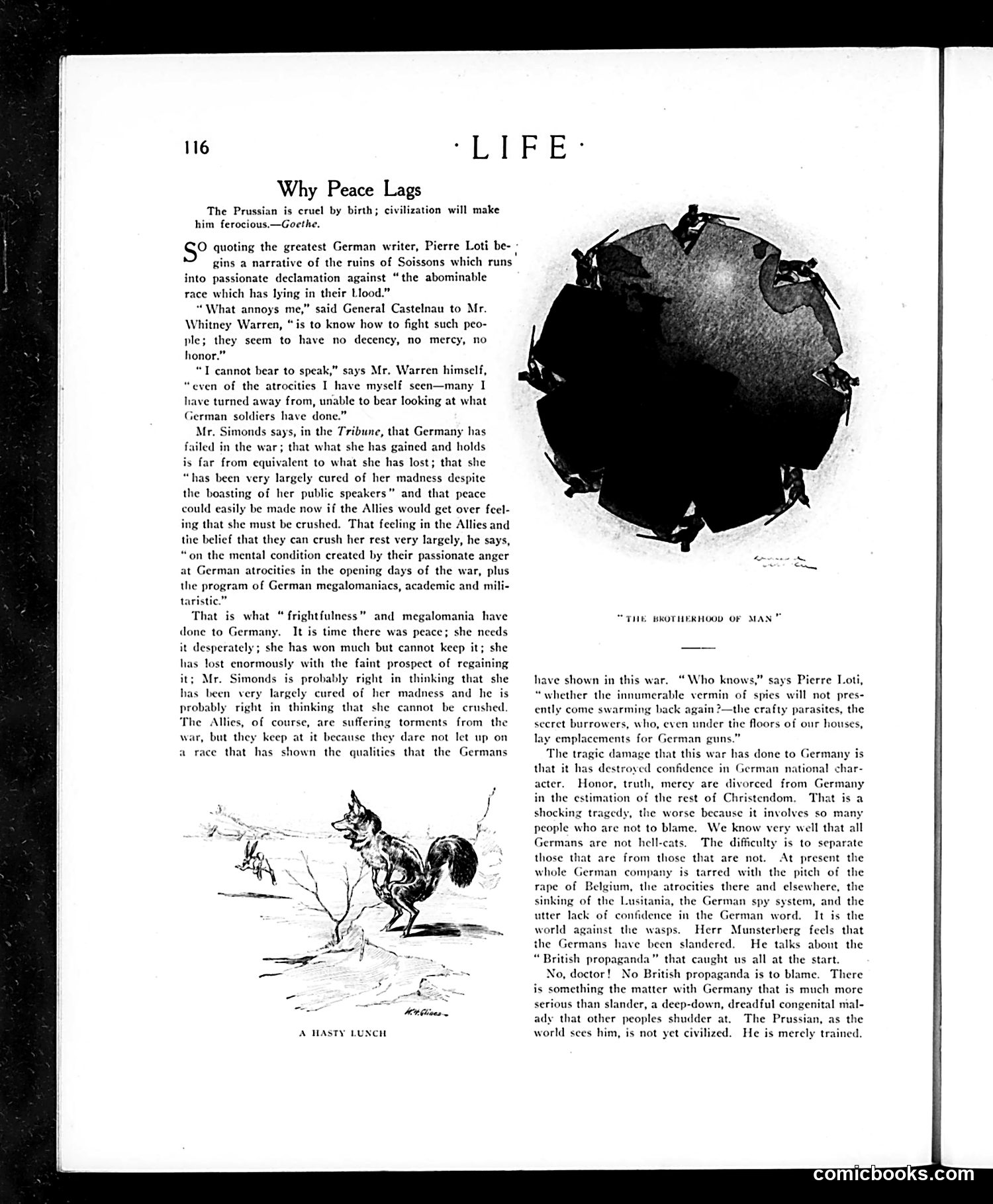
This WWI-era article argues that peace negotiations stall because Germany's wartime atrocities have destroyed international trust in German character itself. **The cartoons illustrate this thesis:** The top image, titled "The Brotherhood of Man," shows a dark silhouette of a human head—likely representing "the German"—filled with scenes of violence and destruction, suggesting inherent brutality rather than individual acts. The bottom cartoon, "A Hasty Lunch," depicts a wolf or jackal eating from a carcass, a traditional symbol for predatory, uncivilized behavior. **The argument:** Writers like Pierre Loti and General Castelnau are quoted condemning German "atrocities" (Belgium's invasion, the Lusitania sinking, spy networks). The author acknowledges not all Germans are "hell-cats," but notes the entire nation is "tarred" by these acts. Peace is impossible because the Allies cannot trust Germany's word—the Prussian is "not yet civilized. He is merely trained." The satire targets German national character as fundamentally dangerous, making reconciliation impossible regardless of military outcome.
📄 Transcribed text from this page (OCR, searchable)
Machine-transcribed from the original scan — historical spelling and the odd misread are preserved.
116 Why Peace Lags The Prussian is cruel by birth; civilization will make him ferocious.—Goethe. S° quoting the greatest German writer, Pierre Loti be- ° gins a narrative of the ruins of Soissons which runs’ into passionate declamation against “the abominable race which lying in their Llood.” “What annoys me,” said General Castelnau to Mr. Whitney Warren, “is to know how to fight such peo- ple; they seem to have no decency, no mercy, no honor. “I cannot bear to speak,” says Mr. Warren himself, “even of the atrocities I have myself seen—many 1 have turned away from, unable to bear looking at what German soldiers have done.” Mr. Simonds says, in the Tribune, that Germany has failed in the war; that what she has gained and holds is far from equivalent to what she has lost; that she “has been very largely cured of her madness despite the boasting of her public speakers” and that peace could easily be made now if the Allies would get over fcel- ing that she must be crushed. That feeling in the Allies and the belief that they can crush her rest very largely, he says, “on the mental condition created by their passionate anger at German atrocities in the opening days of the war, plus the program of German megalomaniacs, academic and mili- taristic.” That is what “ frightfulness” and megalomania have done to Germany, It is time there was peace; she needs it desperately; she has won much but cannot keep it; she lost enormously with the faint prospect of regaining it; Mr. Simonds is probably right in thinking that she has been very largely cured of her madness and he is probably right in thinking that she cannot be crushed. The Allies, of course, are suffering torments from the w but they keep at it because they dare not let up on race that has shown the qualities that the Germans A HASTY LUNCH “LIFE: “THE BROTHERHOOD OF MAN ™ have shown in this war. “Who knows,” says Pierre Loti, “whether the innumerable vermin of spies will not pres- ently come swarming back again ?—the crafty parasites, the sceret burrowers, who, even under the floors of our houses, lay emplacements for German guns.” The tragic damage that this war has done to Germany is that it has destroyed confidence in German national char- Honor, truth, merey are divorced from Germany at is a acter. in the estimation of the rest of Christendom. TI shocking tragedy, the worse because it involves so many people who are not to blame. We know very well that all Germans are not hell-cats. The difficulty is to separate those that are from those that are not. At present the whole German company is tarred with the pitch of the rape of Belgium, the atrocities there and elsewhere, the sinking of the Lusitania, the German spy system, and the utter lack of confidence in the German word. It is the world against the wasps. Herr Munsterberg feels that the Germans have been slandered. He talks about the “British propaganda” that caught us all at the start. No, doctor! No British propaganda is to blame. There is something the matter with Germany that is much more serious than slander, a deep-down, dreadful congenital mal- ady that other peoples shudder at. The Prussian, as the world sces him, is not yet civilized. He is merely trained. comicbooks.com