
Life, 1916-01-20 · page 37 of 44
Life — January 20, 1916 — page 37: what you’re looking at
What you’re looking at
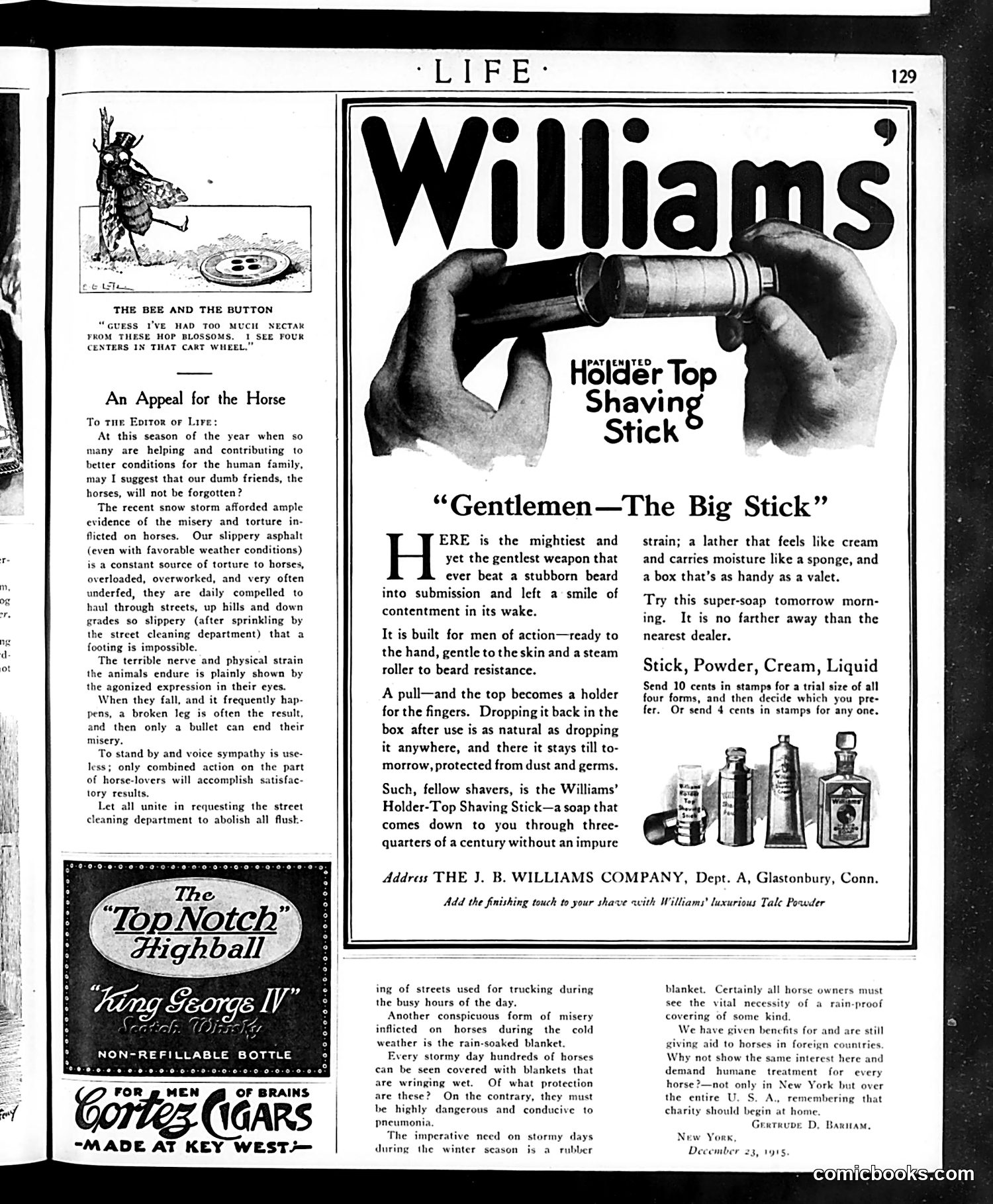
This page contains primarily **advertisements and a letter to the editor**, with minimal satire. The small cartoon at top left, "The Bee and the Button," is a simple visual joke: a drunk bee has consumed too much nectar from hop blossoms and sees four cart wheels instead of one. The main content is **"An Appeal for the Horse,"** a earnest letter to Life's editor advocating humane treatment of working horses. The writer documents specific cruelties: horses forced to haul loads on slippery asphalt streets, resulting in broken legs; inadequate winter blankets that actually worsen conditions. He urges readers to petition city officials to abolish street treatments that create dangerous footing, and to provide rubber rain blankets. This reflects early 20th-century animal welfare concerns—horses were still primary urban transport, and their suffering was visible and daily. The letter's tone is sincere advocacy, not satirical. The remaining content consists of period advertisements for shaving products and cigars, using period-appropriate marketing language ("Gentlemen," "The Big Stick," "men of action").
📄 Transcribed text from this page (OCR, searchable)
Machine-transcribed from the original scan — historical spelling and the odd misread are preserved.
THE BEE AND THE BUTTON “GUESS I'VE HAD TOO MUCH NECTAK HOP BLOSSOMS. 1 SEE FOUR THAT CART WHEEL,” An Appeal for the Horse To tne Eprtor oF Lire: At this season of the year when so many are helping and contributing to better conditions for the human family, may I suggest that our dumb friends, the horses, will not be forgotten? The recent snow storm afforded ample evidence of the misery and torture in- flicted on horses. Our slippery asphalt (even with favorable weather conditions) is a constant source of torture to horses, overloaded, overworked, and very often underfed, they are daily compelled to haul through streets, up hills and down grades so slippery (after sprinkling by the street cleaning department) that a footing is impossible. The terrible nerve and physical strain the animals endure is plainly shown by the agonized expression in their eyes. When they fall, and it frequently hap- pens, a broken leg is often the result, and then only a bullet can end their misery. To stand by and voice sympathy is use- less; only combined action on the part of horse-lovers will accomplish satisfac- lory results. Let all unite in requesting the street cleaning department to abolish all flusk- 0:0-0:0:0°0:0:0:9:0:0:0:9-0:0-0°0°0:0:0:0:0°9 “Top Notch” Highball g.MEN gy OF BRAINS IGARS “MADE AT KEY WEST— "0.0 :0:0:00:0-0:0:0:0:0-0:0-0-0-0-0-6 “Gentlemen—The Big Stick” ERE is the mightiest and yet the gentlest weapon that ever beat a stubborn beard into submission and left a smile of contentment in its wake. It is built for men of action—ready to the hand, gentle to the skin and a steam roller to beard resistance. A pull—and the top becomes a holder for the fingers. Dropping it back in the box after use is as natural as dropping it anywhere, and there it stays till to- morrow, protected from dust and germs. Such, fellow shavers, is the Williams’ Holder-Top Shaving Stick—a soap that comes down to you through three- quarters of a century without an impure strain; a lather that feels like cream and carries moisture like a sponge, and a box that’s as handy as a valet. Try this super-soap tomorrow morn- ing. It is no farther away than the nearest dealer. Stick, Powder, Cream, Liquid Send 10 cents in stamps for a trial size of all four forms, and then decide which you pre- fer. Or send 4 cents in stamps for any one. Addras THE J. B. WILLIAMS COMPANY, Dept. A, Glastonbury, Conn. Add the finishing touch to your shave with Williams’ luxurious Tale Powder ing of streets used for trucking during the busy hours of the day. Another conspicuous form of misery inflicted on horses during the cold weather is the rain-soaked blanket. Every stormy day hundreds of horses can be seen covered with blankets that are wringing wet. Of what protection are these? On the contrary, they must be highly dangerous and conducive to Pneumonia. ‘The imperative need on stormy days during the winter season js a rubber blanket. Certainly all horse owners must see the vital necessity of a rain-proof covering of some kind We have given benefits for and are still aid to horses in foreign countries. Why not show the same interest here and demand humane treatment for every horse?—not only in New York but over the entire U. S. A,, remembering that charity should begin at home Grerrupe D, Barwa, New Yorn December rgrs