
A complete issue · 44 pages · 1916
Life — January 13, 1916
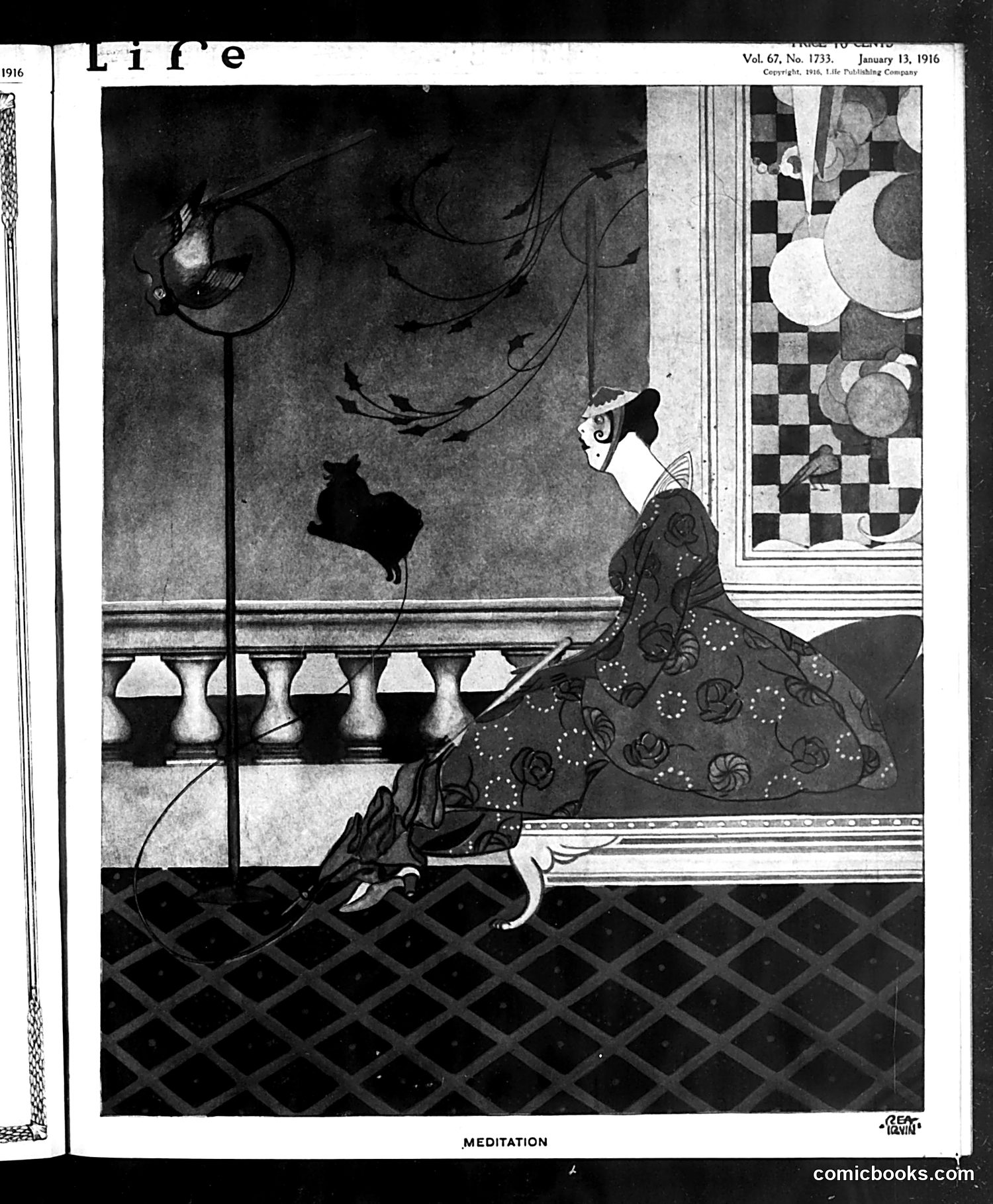
This illustration by A. D. Blashfield depicts a contemplative woman in an ornate, patterned gown gazing out a window at night. The artistic style is typical of Life magazine's aesthetic commentary on high society. The title "Meditation" suggests introspection, though the specific subject of her thoughts remains ambiguous in the image alone. The composition—with its detailed interior furnishings, checkered pattern visible through the window, and the woman's posed elegance—emphasizes refined domesticity and leisure of the upper classes. Without additional text or context from the issue, the precise satirical or social commentary remains unclear, though Life frequently used such scenes to gently critique society's preoccupations, romantic fantasies, or idle pursuits of wealthy Americans during the pre-World War I era.
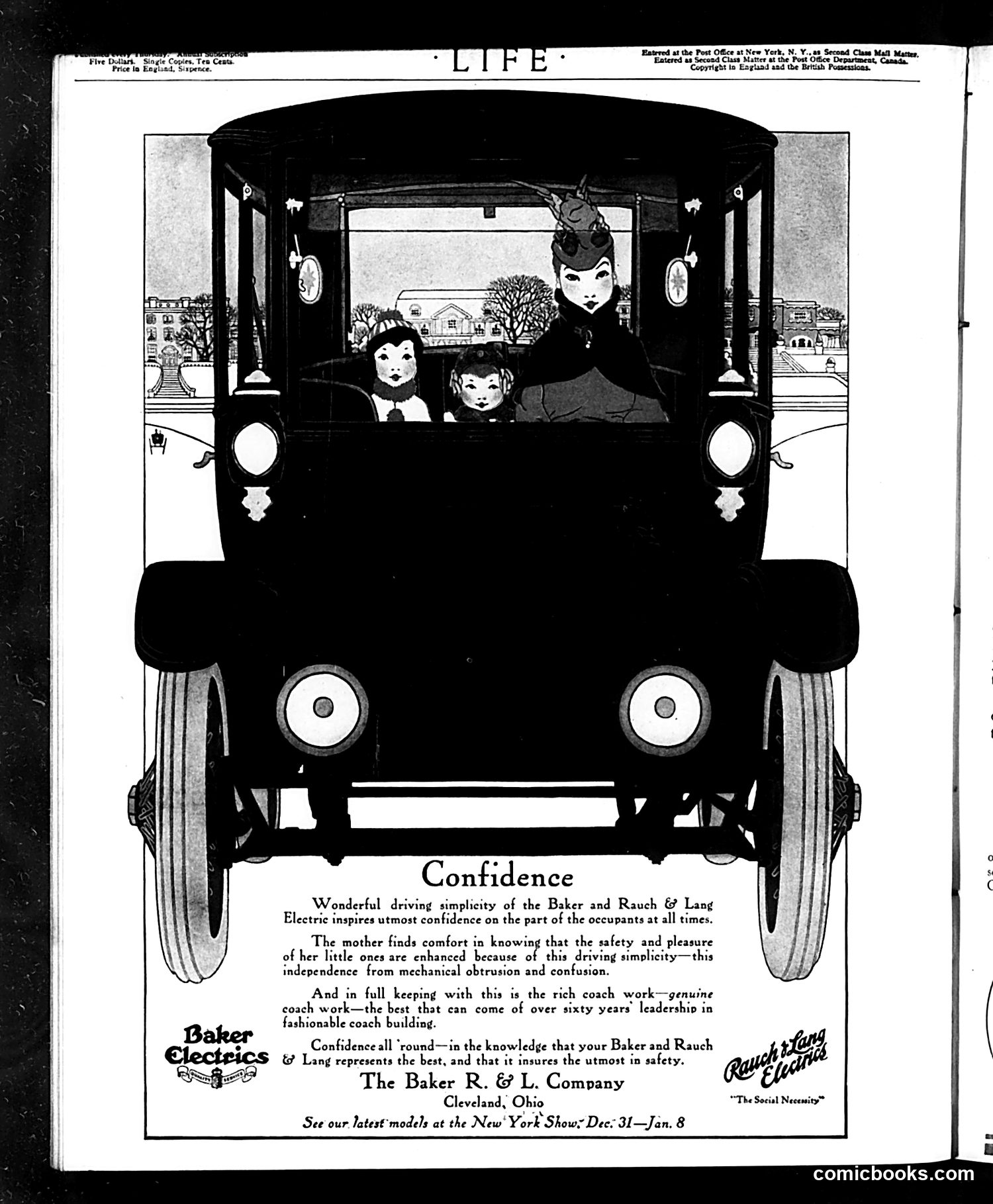
This is primarily **an advertisement**, not satire or political commentary. It's a Baker and Rauch & Lang Electric automobile advertisement from the early 1900s (the New York Show dates Dec. 31-Jan. 8 suggest early January timing). The image depicts a well-dressed mother with two children in an electric car, viewed from above. The ad emphasizes "Confidence" and "driving simplicity" — key selling points for electric vehicles of that era, which were considered safer and easier to operate than gasoline cars. The appeal targets middle-class families concerned with safety. The text stresses that electric cars required no manual gear-shifting or mechanical complexity, making them ideal for women drivers and families with children. This reflects the period when electric vehicles competed seriously with gasoline automobiles before the latter ultimately dominated the market.
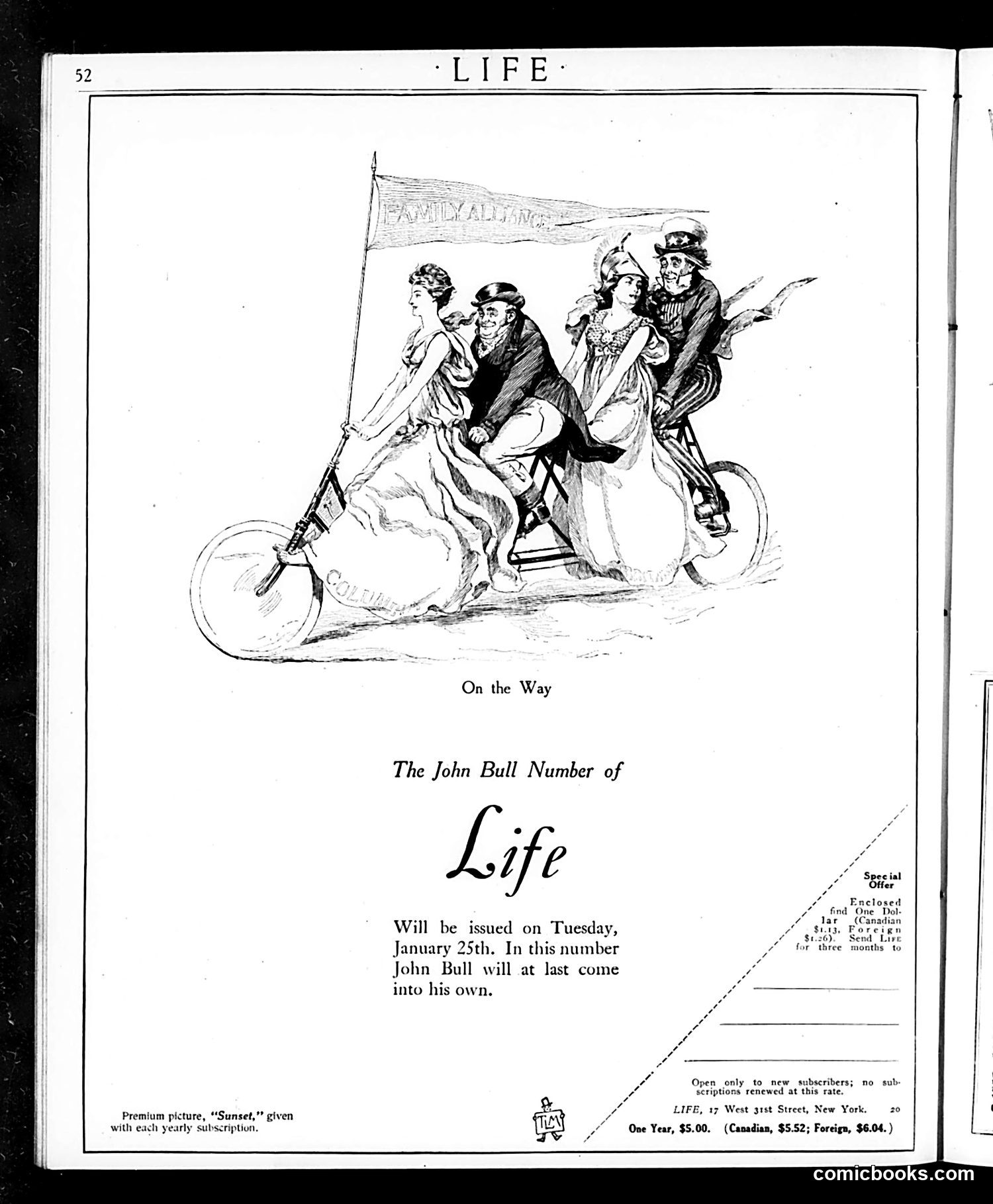
This page is primarily **promotional advertising** for Life magazine's upcoming "John Bull Number" (to be issued January 25th). The illustration titled "On the Way" depicts four figures riding together on a tandem bicycle while holding a banner labeled "JOHN BULL"—likely representing Britain or British interests. The satire appears to reference **Britain's involvement in World War I** (based on the military-style clothing and the patriotic fervor depicted). The cramped, chaotic image of multiple passengers on one bicycle humorously suggests the difficulty of coordinating British war efforts or managing the complexity of wartime governance. The accompanying text promises that "John Bull will at last come into his own," suggesting the issue celebrates British military or political success. This is primarily a circulation-building advertisement rather than standalone political commentary.
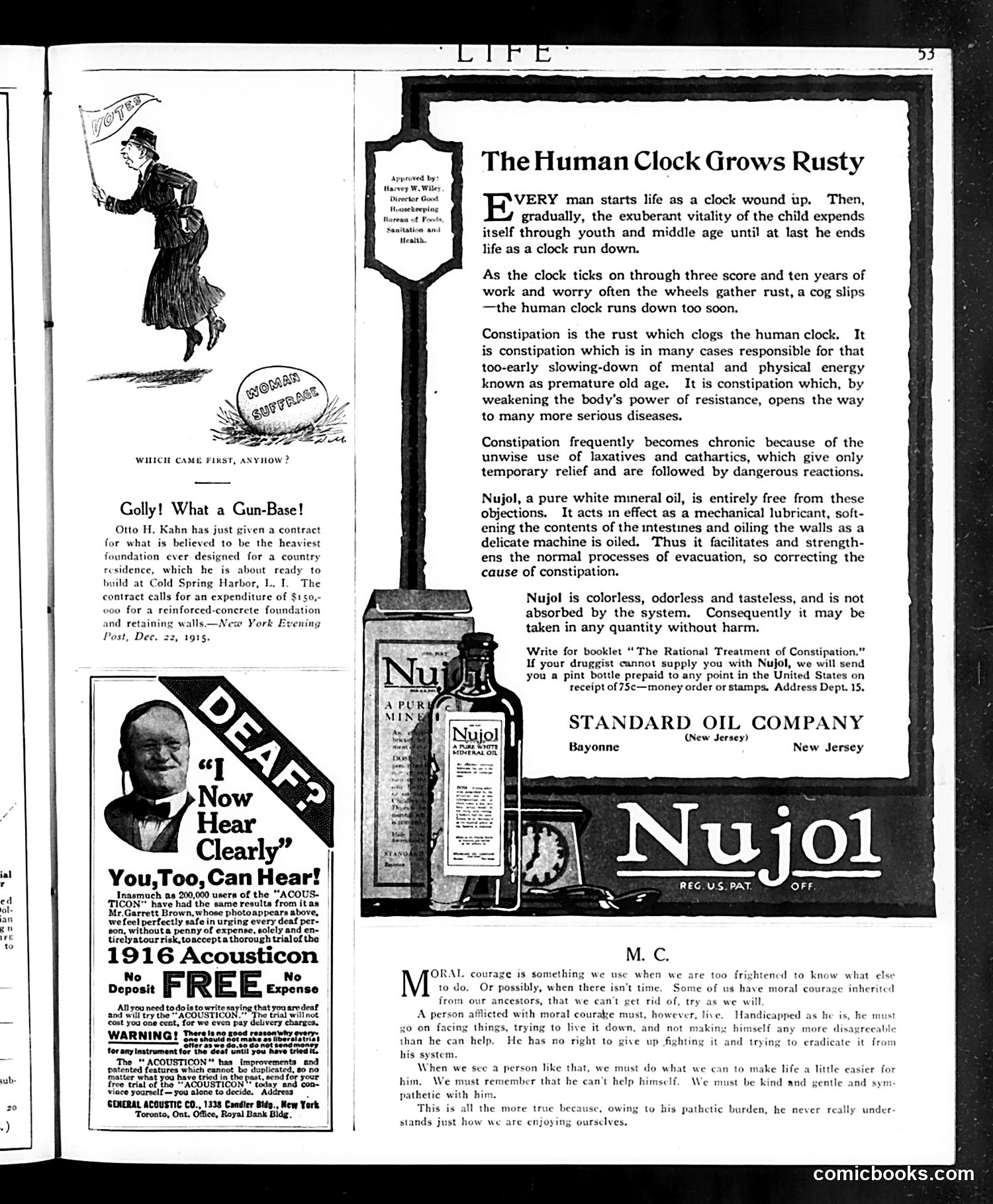
This page contains two distinct elements: **Left side:** A political cartoon titled "Which Came First, Anyhow?" depicts a woman holding a "Votes" flag alongside an egg labeled "Woman Suffrage." The joke plays on the chicken-and-egg paradox, likely referencing the ongoing women's suffrage debate of the 1910s era—whether voting rights or women's empowerment came first. Below is an advertisement for the 1916 Acousticon hearing device, featuring a testimonial claiming users can now "hear clearly." **Right side:** A lengthy advertisement for Nujol mineral oil, promoting it as a constipation remedy that acts as a "mechanical lubricant" for the intestines, positioning it as superior to laxatives. The ad emphasizes its purity and safety. The page reflects early 20th-century concerns with both social reform (suffrage) and health products (digestive aids).
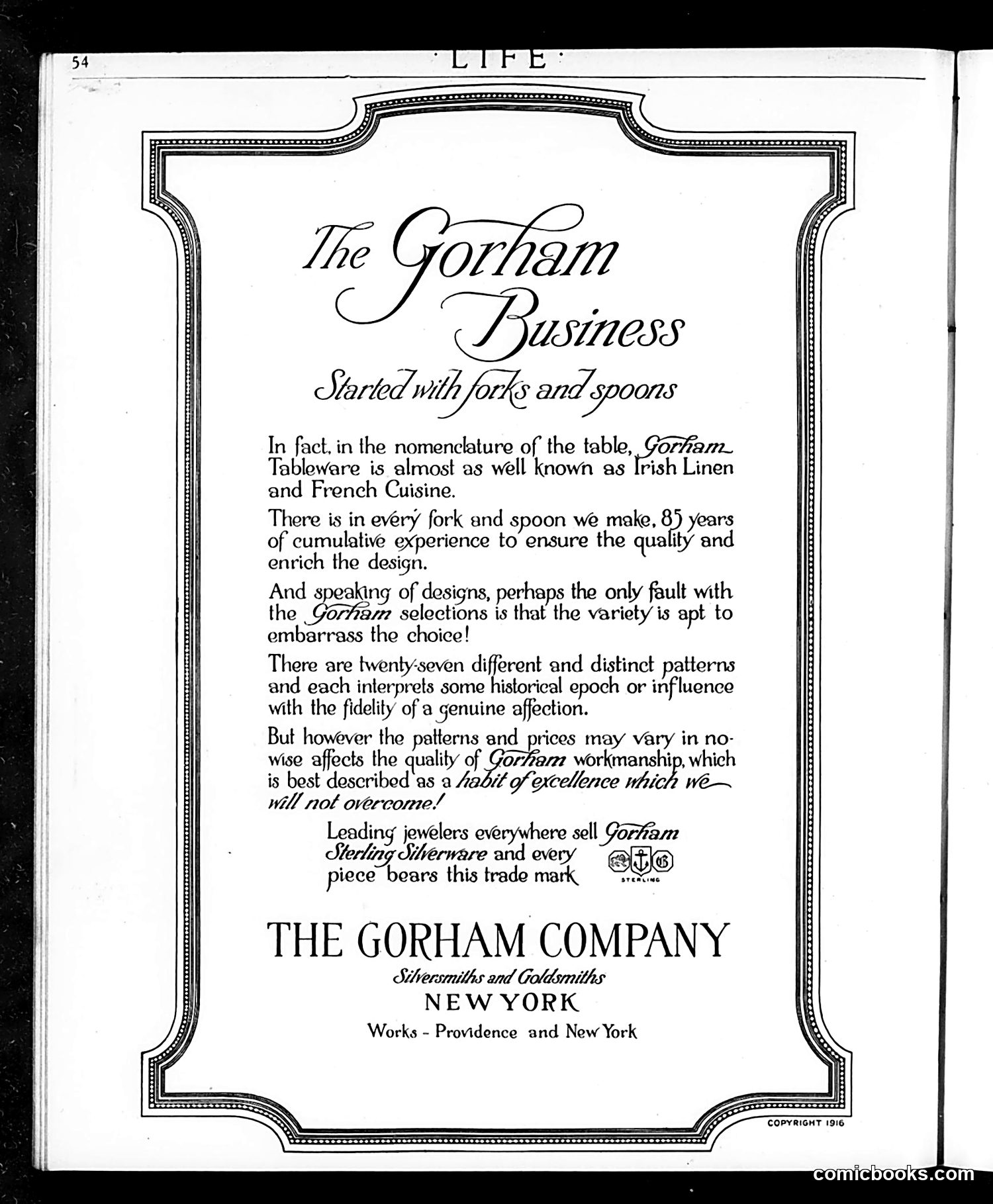
This page is **not a cartoon or satirical content**—it is a **full-page advertisement** for The Gorham Company, a manufacturer of sterling silver flatware and tableware. The ad promotes Gorham's business model: their flatware products began with forks and spoons, and the company emphasizes 85 years of cumulative craftsmanship. It highlights their variety (27 different patterns), each representing historical epochs or design influences. The ad stresses that quality remains consistent regardless of pattern selection, describing their workmanship as "a habit of excellence which we will not overcome." The company identifies itself as "Silversmiths and Goldsmiths" based in New York with manufacturing in Providence and New York. Leading jewelers sold their sterling silverware products bearing the company's trademark. This is straightforward luxury goods marketing, not satire.
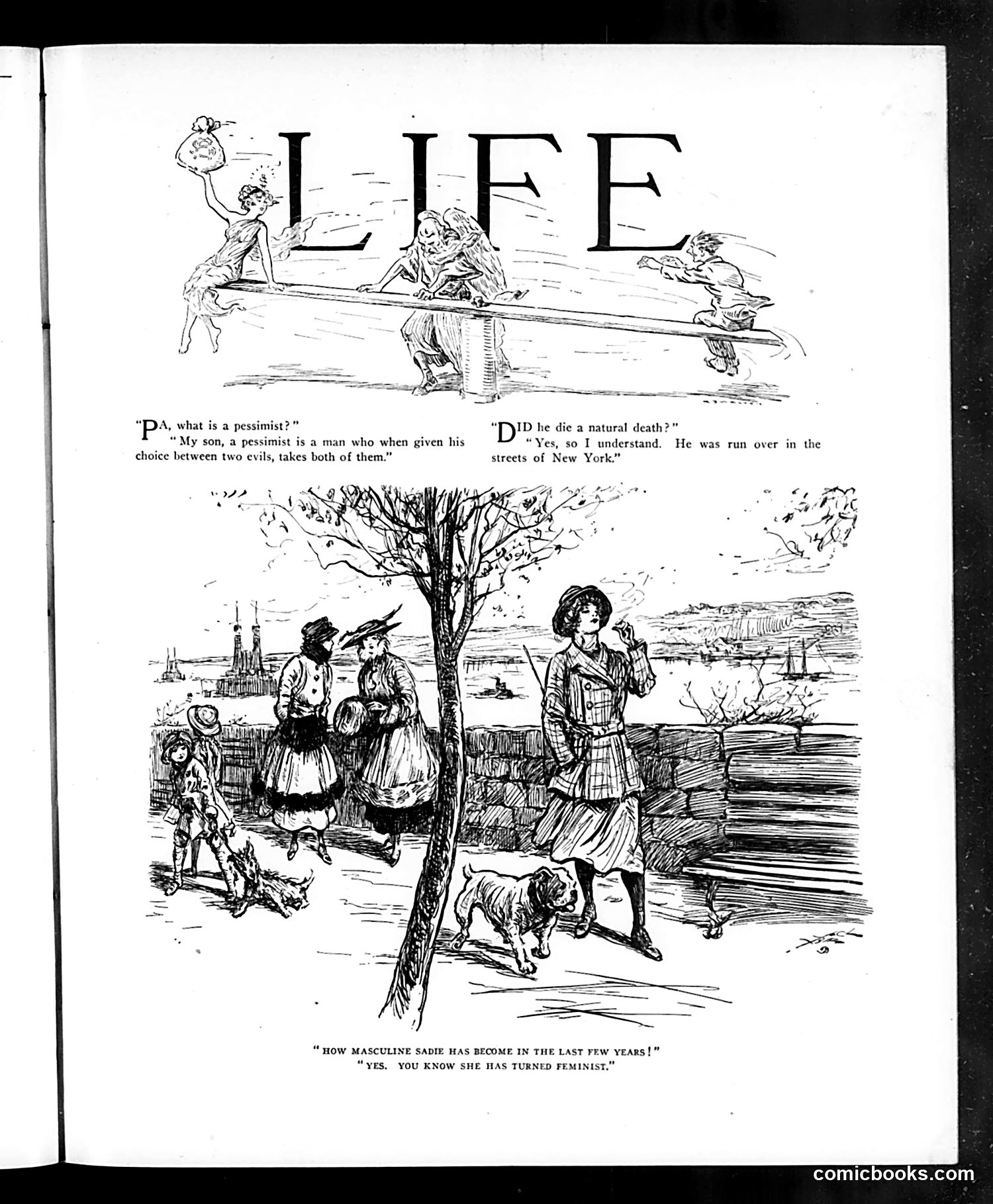
This page contains three separate satirical pieces mocking early 20th-century social attitudes: **Top cartoon**: Depicts children on a seesaw labeled "LIFE," illustrating the definition of pessimism through physical metaphor—choosing both evils rather than one. **Middle cartoon**: Shows an urban riverside scene where someone explains that a pessimist "died a natural death" by being "run over in the streets of New York"—dark humor about urban danger. **Bottom cartoon**: Features a woman walking with a dog, with observers remarking "How masculine Sadie has become in the last few years!" and attributing this to her having "turned feminist." This mocks early feminists, suggesting that women advocating for rights were perceived as unfeminine or masculine—a common anti-feminist trope of the era. The page satirizes both pessimism and emerging feminism.
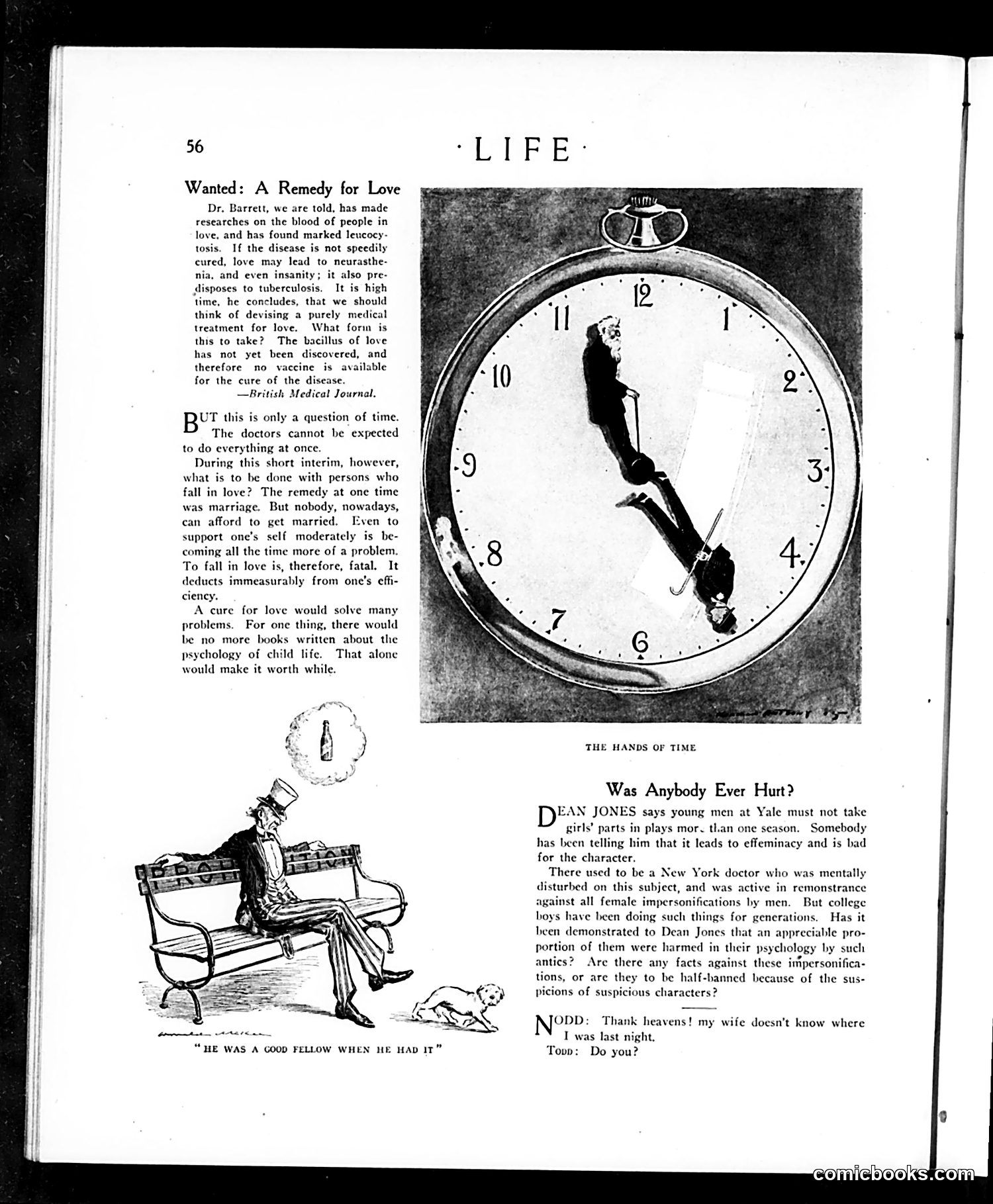
This page contains two satirical pieces on relationships and gender relations: **"Wanted: A Remedy for Love"** (top left) is a mock-scientific commentary referencing Dr. Barrett's research on love as a disease. The piece sardonically suggests love causes neurasthenia and tuberculosis, arguing that in modern times when marriage is financially unaffordable, falling in love is "fatal" because it reduces economic efficiency. **"The Hands of Time"** (center) shows a clock with two figures climbing its hands—likely representing time's passage within a relationship. **"Was Anybody Ever Hurt?"** (bottom) quotes Dean Jones of Yale cautioning against young men performing in theatrical "girl's parts," claiming it leads to "effeminacy." The joke below features "Nodd" and "Todd" discussing infidelity—the ironic implication being that such theatrical performance causes far less harm than actual marital deception.
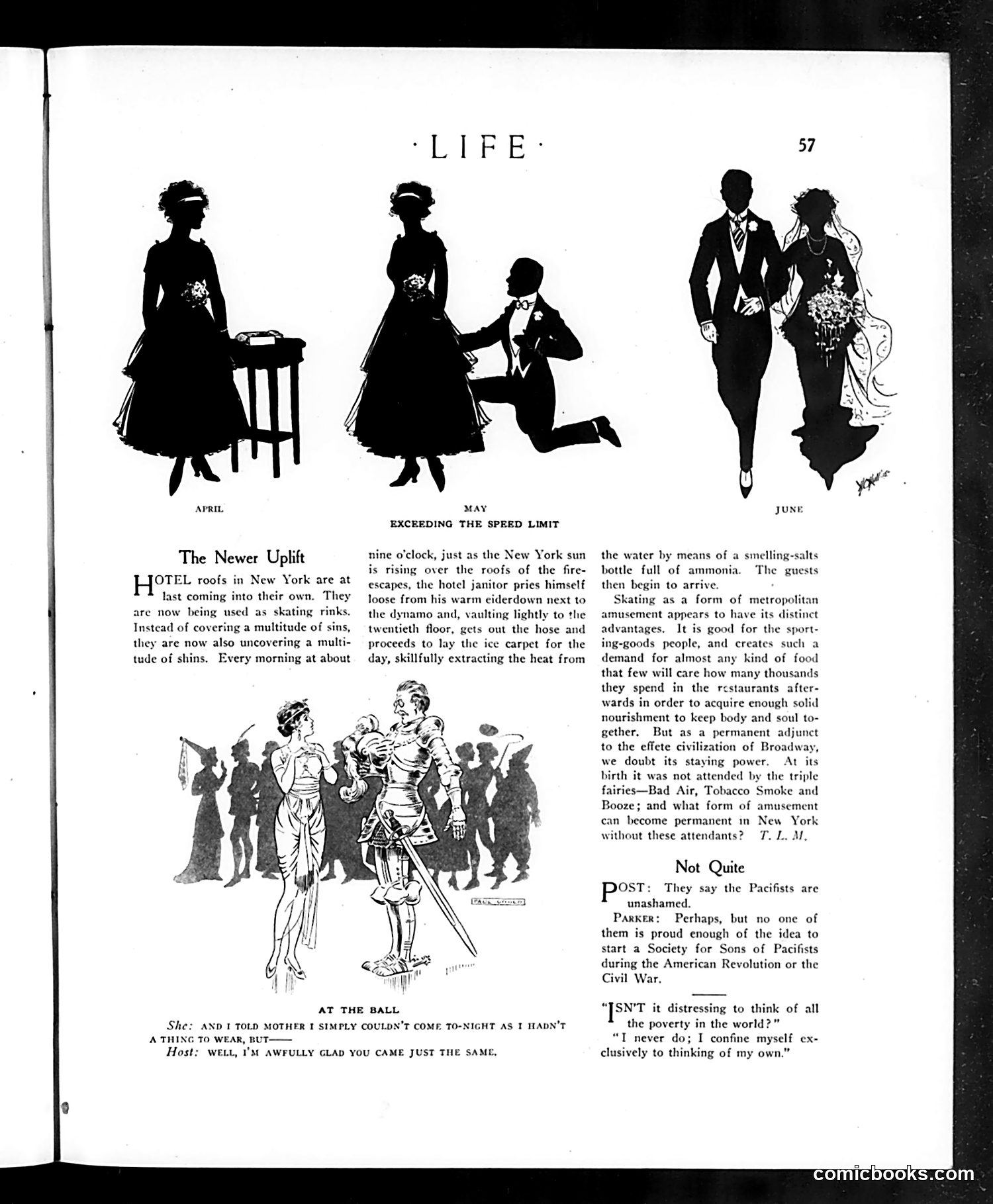
This page satirizes high-society life in early 20th-century New York. The top silhouettes illustrate engagement and wedding progression from April through June. **"The Newer Uplift"** mocks Manhattan's hotel rooftops being converted to social spaces rather than practical infrastructure. The accompanying illustration shows fashionable people at a ball, with dialogue joking about wearing the same dress twice—satirizing both wasteful consumption among the wealthy and their pretense of novelty. **"Not Quite"** is a brief social commentary about Pacifists, suggesting they lack sufficient conviction to formally organize (like a patriotic society during wartime), mocking their perceived half-heartedness about their pacifist principles. The page targets upper-class affectation and social hypocrisy through humor about fashion, leisure, and moral consistency.
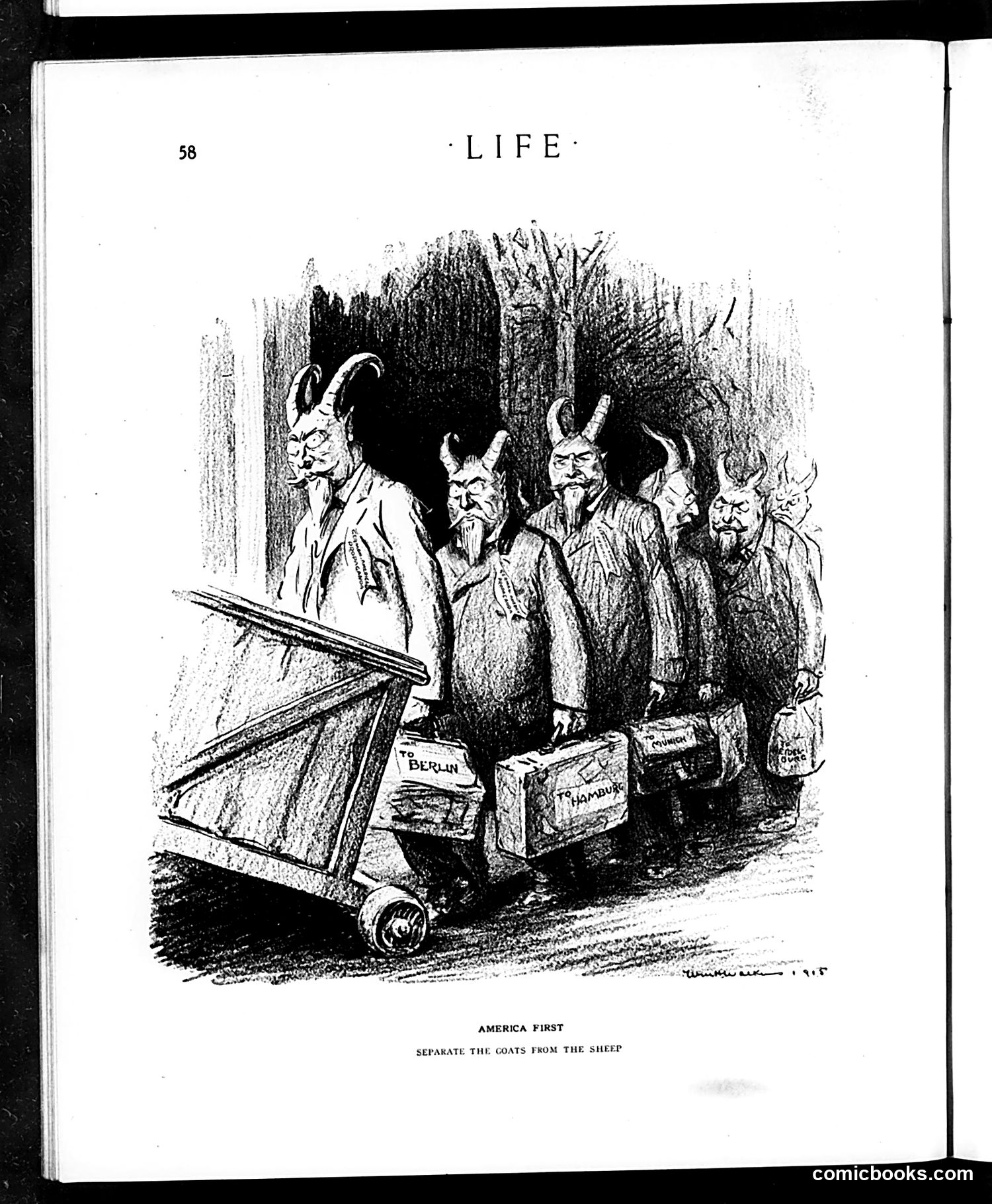
This political cartoon depicts five demonic or devil-like figures with horns, labeled with German city names (Berlin, Hamburg visible on their luggage). They're depicted as "goats" that need separating from "sheep" — using biblical language to frame certain groups as undesirable. The caption "America First / Separate the Goats from the Sheep" suggests a xenophobic critique of German immigration or German-American influence, likely from the World War I era when anti-German sentiment was high in America. The devilish characterization dehumanizes German people or German-Americans as inherently foreign and threatening to American identity. The satire appears to mock nativist "America First" rhetoric that sought to exclude or expel perceived foreign threats.
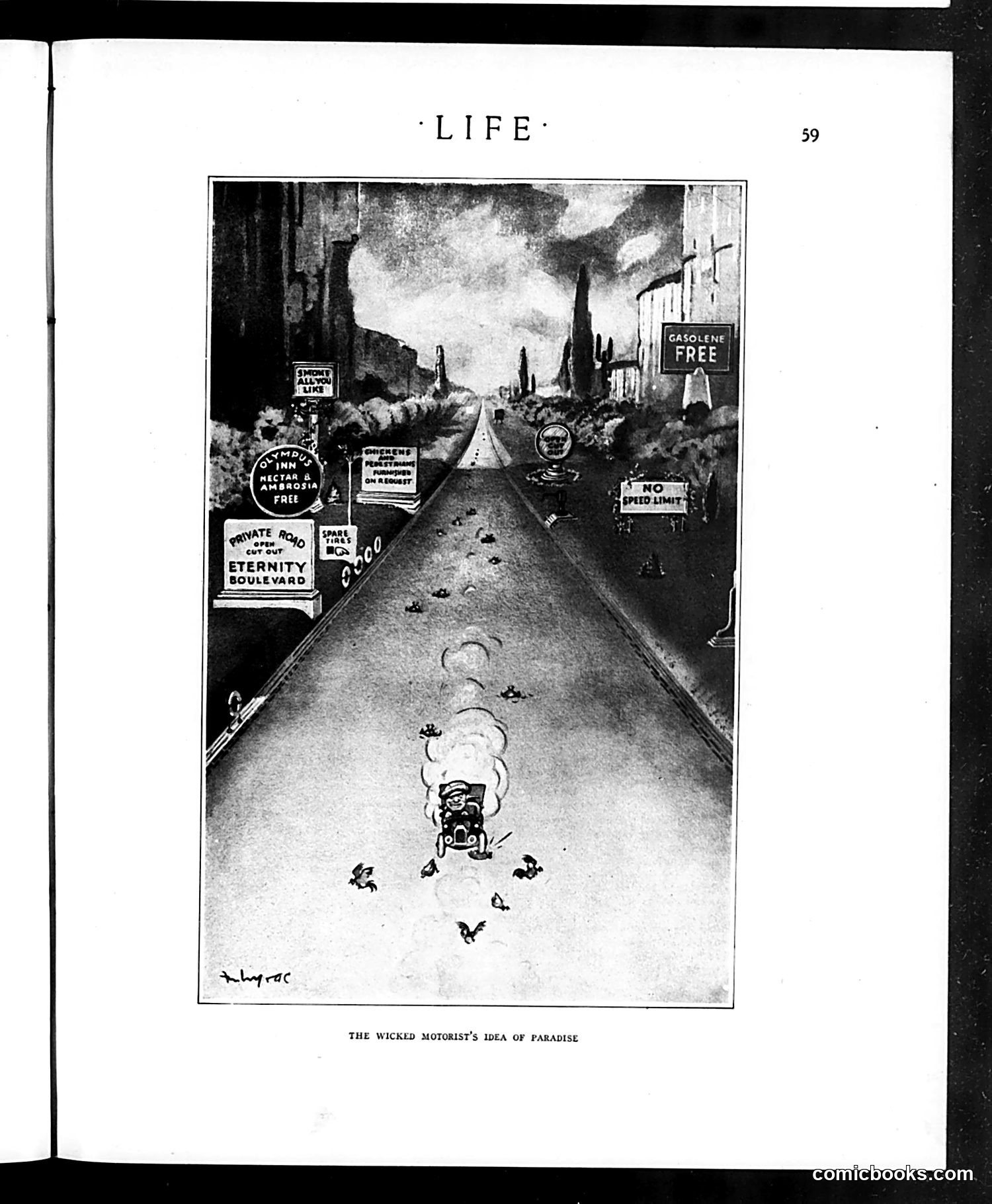
This satirical cartoon depicts a reckless driver's fantasy: an endless highway where traffic laws don't apply. The road stretches toward distant cypress trees and mountains, lined with ironic signs reading "Gasoline Free," "No Speed Limit," "Private Road—Keep Out," "Eternity Boulevard," and "Olympic Inn—Nectar Amnesia Free." The figure in the center appears to be a caricatured motorist speeding down this surreal landscape, surrounded by chaotic imagery suggesting lawlessness and excess. The cartoon satirizes the dangerous attitudes of some early automobile drivers—their disregard for safety regulations, speed limits, and other motorists. It mocks the fantasy that freedom from all constraints represents paradise, while implicitly criticizing reckless driving behavior that endangered public safety.
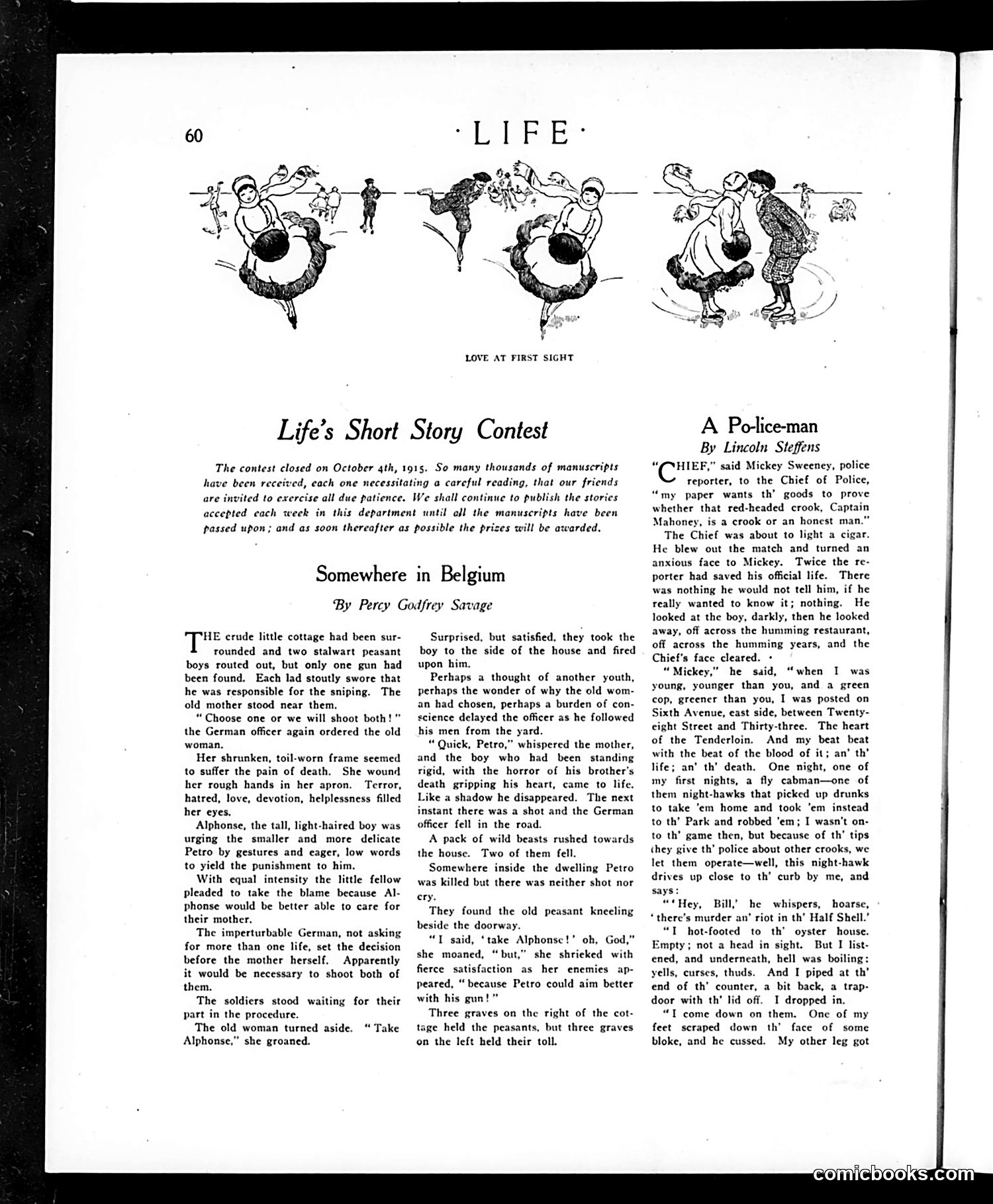
The cartoon at the top depicts a romantic encounter involving couples in various stages of courtship—some dancing, skating, and socializing. The strip's title suggests a humorous take on instantaneous romantic attraction. Below are two short stories: "Somewhere in Belgium" by Percy Golffrey Savage, set during World War I, depicts German soldiers and Belgian civilians during wartime occupation. "A Po-lice-man" by Lincoln Steffens is a police procedural anecdote about a beat cop named Mickey Sweeney. This page represents *Life* magazine's typical blend of satirical humor, romantic comedy, and contemporary fiction reflecting early 20th-century American interests—combining light entertainment with social commentary.
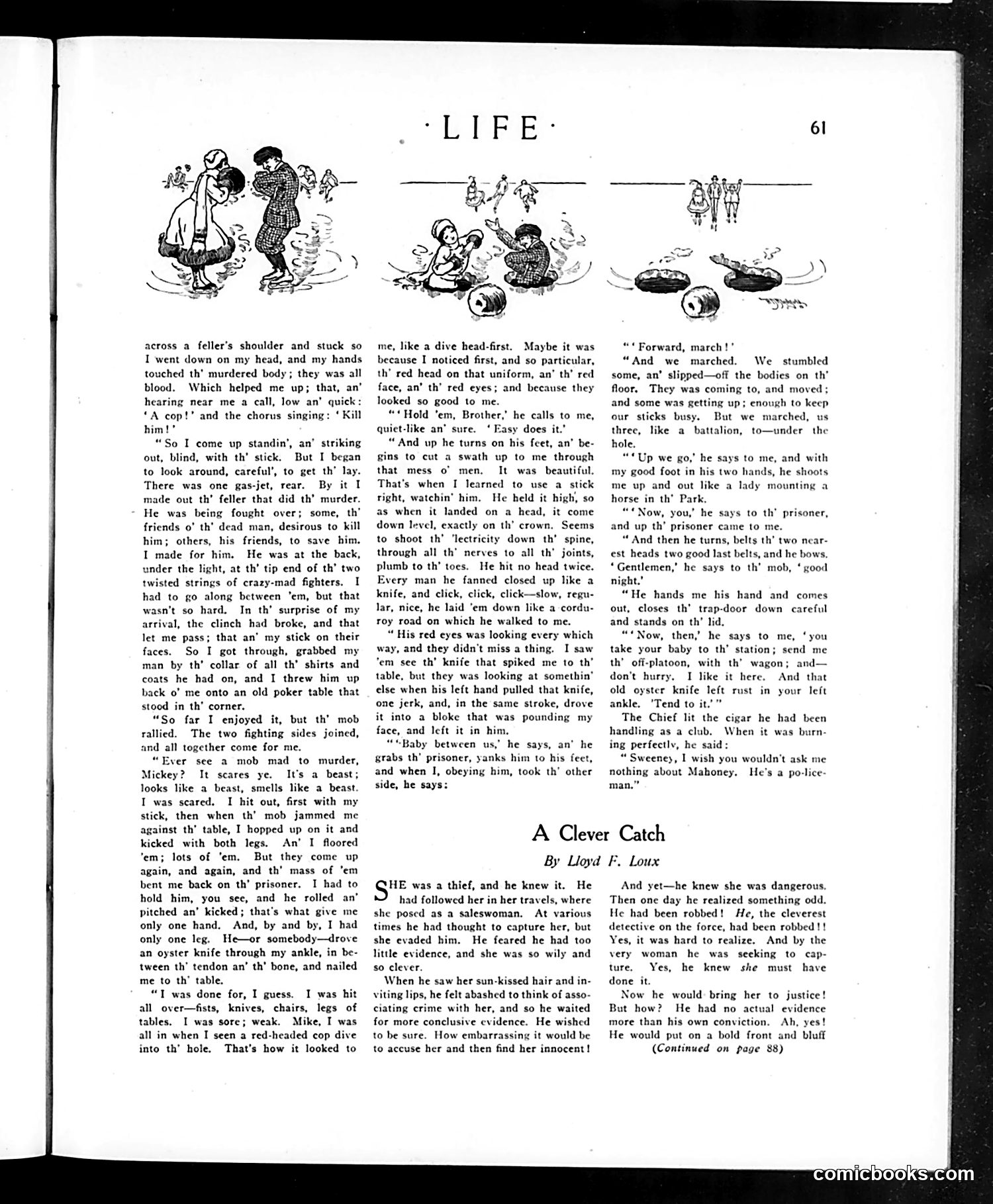
This page contains two distinct sections: **Upper portion:** A sequential comic strip (no clear title visible) depicting what appears to be a street fight or brawl. The illustrations show figures fighting with sticks or clubs, with accompanying narrative text describing violent action in working-class dialect ("'A cop!' an' th' others singin' 'Kill 'im!"). The scene satirizes street violence, possibly gang activity or lower-class urban conflict common to early 20th-century American life. **Lower portion:** "A Clever Catch" by Lloyd F. Loux—a short story about a detective pursuing a female thief posing as a saleswoman. The narrative explores themes of justice, evidence, and deception. Both pieces appear aimed at working-class readers, using humor and action to comment on contemporary urban crime and social dynamics.
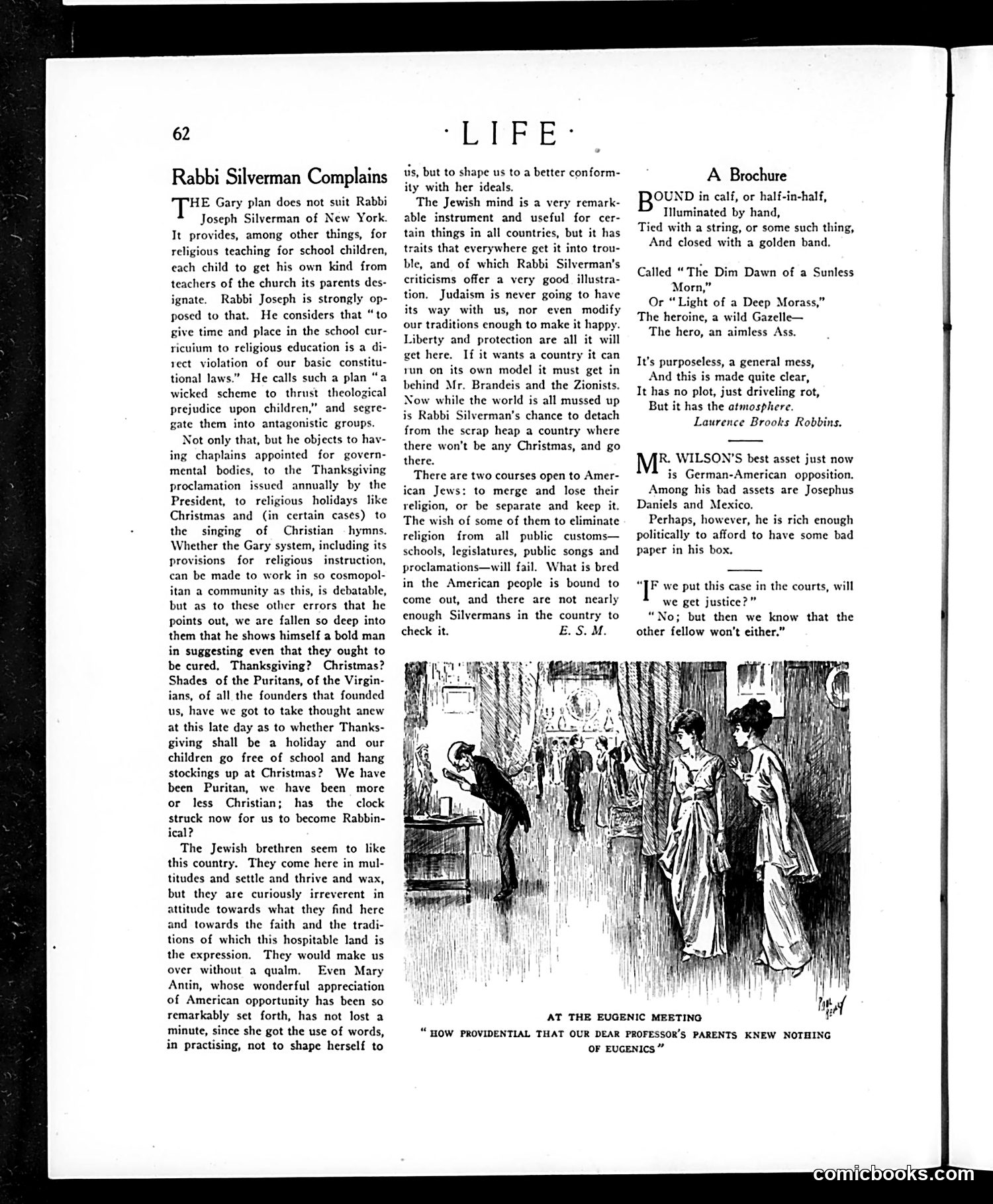
This page contains editorial commentary on Rabbi Joseph Silverman's criticisms of the Gary Plan (a progressive educational model) and broader tensions over religious education in American public schools. The cartoon at bottom depicts a scene labeled "At the Eugenic Meeting," showing what appears to be an awkward social interaction with the caption: "How providential that our dear professor's parents knew nothing of eugenics." The satire targets eugenics advocates—a pseudoscience popular in the early 20th century promoting selective breeding. The joke suggests that if eugenics proponents' own parents had followed eugenic principles, they wouldn't exist, thereby mocking the movement's logical inconsistencies and absurdity. The surrounding text debates whether public schools should teach religious content or remain secular, with Silverman arguing schools shouldn't promote specific religious doctrines.
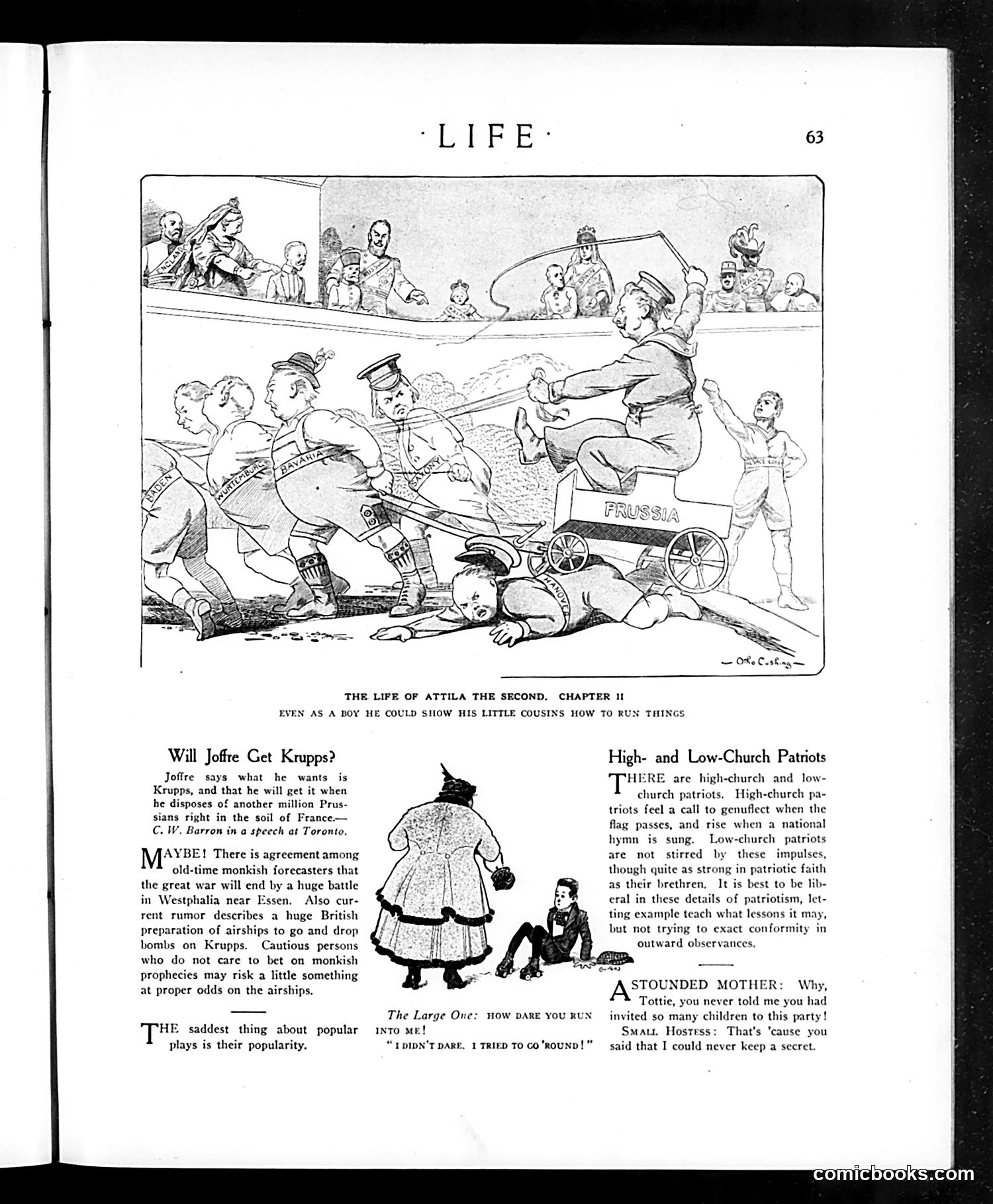
The main cartoon depicts a satirical scene of military figures labeled "Prussia" being kicked by a much larger soldier. The caption references "The Life of Attila the Second, Chapter II," comparing someone to Attila the Hun—a historical figure known for destructive conquest. The cartoon appears to mock Prussian militarism during the World War I era, portraying aggressive Prussian forces being defeated or humbled. Prussian soldiers are caricatured attempting to pull a cart while facing resistance. Below are three brief satirical items about prophecies, popular plays, and social etiquette—typical of Life's format mixing political commentary with lighter humor. The overall page uses historical comparison and visual exaggeration to critique contemporary German military ambitions during wartime.
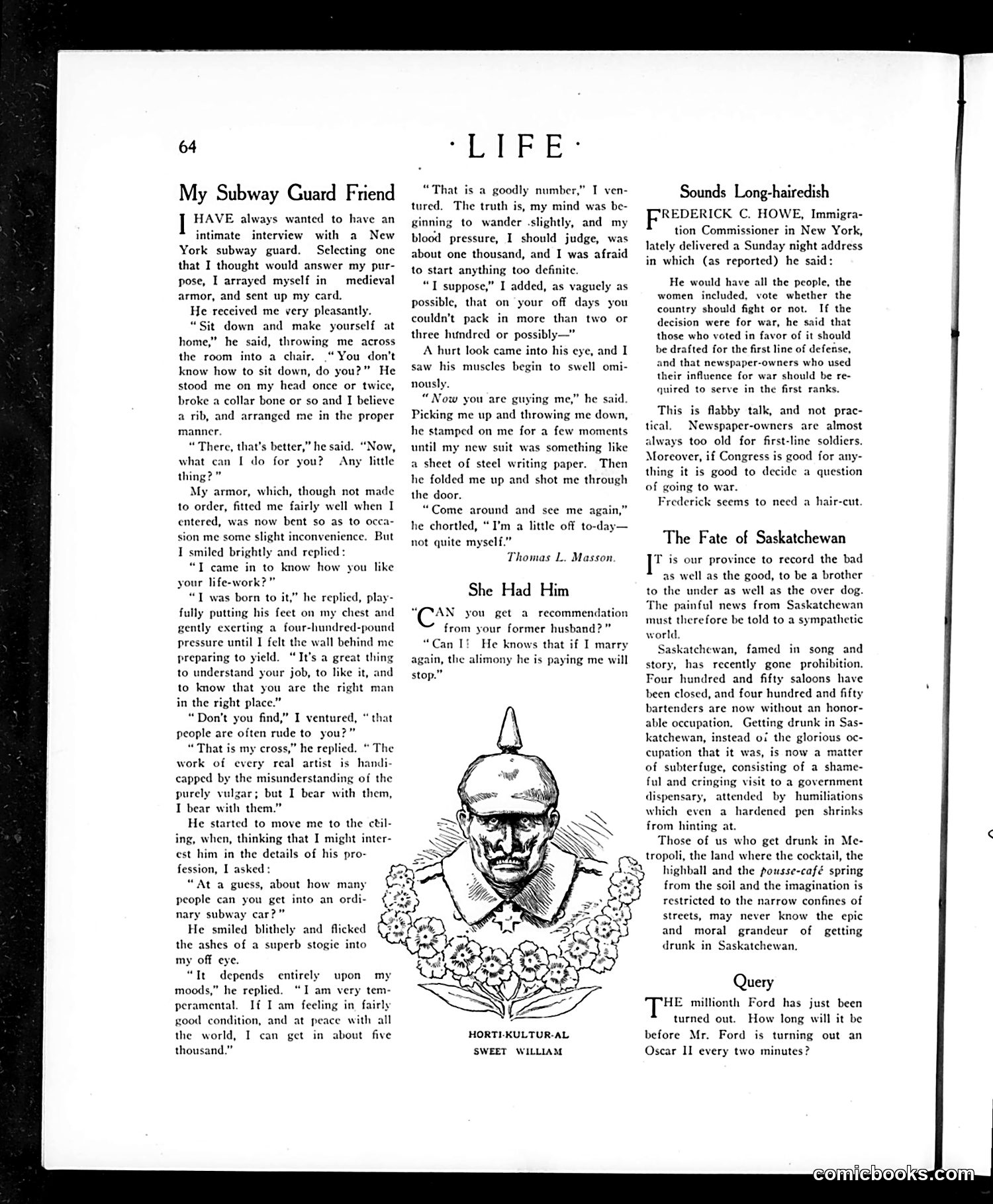
This page contains three separate satirical pieces: **"My Subway Guard Friend"** is a humorous essay about interviewing a New York City subway guard. The joke satirizes both the guard's brutal treatment of passengers (throwing the narrator around, breaking ribs) and his pompous pride in his work. The exaggeration—claiming he can pack 5,000 people into one car depending on his "mood"—mocks the overcrowded conditions of early-20th-century New York subways and the guard's perceived indifference to passenger welfare. **"She Had Him"** is a brief joke about divorce and alimony: a woman confidently states her ex-husband will provide a recommendation because he knows remarriage would end his alimony payments—a practical threat rather than genuine endorsement. **"Sounds Long-hairedish"** critiques immigration commissioner Frederick C. Howe's idealistic proposal that citizens vote on war and that pro-war newspaper owners be conscripted. Life's editors dismiss this as impractical, noting newspaper owners are too old for combat, and suggest Howe needs a "hair-cut"—period slang implying he's an impractical intellectual.
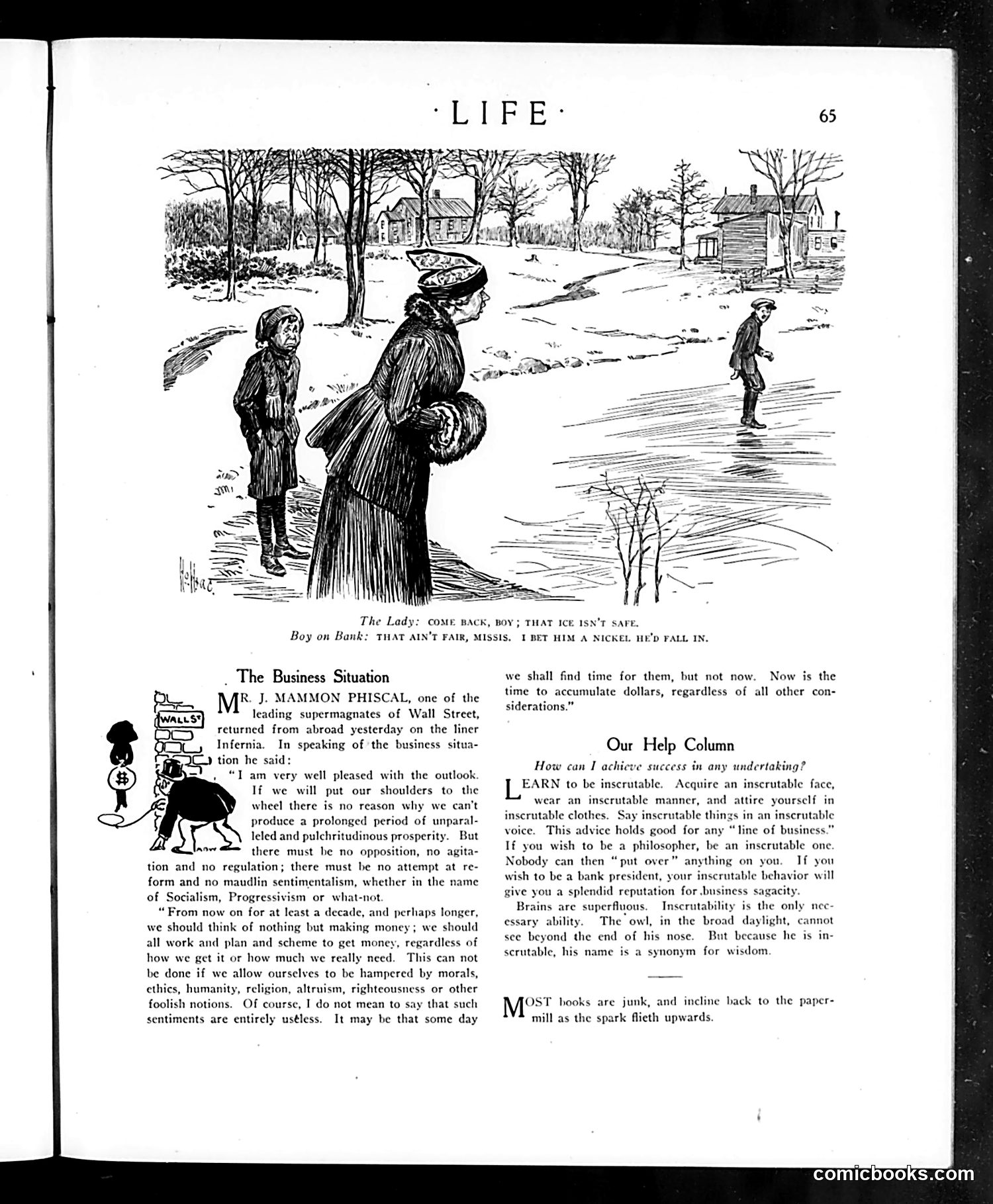
This page contains two satirical pieces mocking American capitalism and business culture circa early 1900s. **Top cartoon:** A woman warns a boy on thin ice that it's unsafe. He replies he bet a nickel with someone ("him") they'd fall in—satirizing working-class desperation and reckless gambling over trivial sums. **"The Business Situation":** A caricatured Wall Street magnate (J. Mammon Phiscal—a transparent pun on "Mammon," biblical symbol of greed) declares that for a decade Americans should pursue *only* moneymaking, abandoning morals, ethics, religion, and altruism as hindrances. This is biting satire: Life presents his philosophy as absurdly greedy while allowing him to expose the era's actual business mentality. **"Our Help Column":** Parodies self-help advice by ironically suggesting that "inscrutability" (mysterious opacity) replaces actual competence for success—whether as philosopher, banker, or businessperson. The owl reference mocks how inscrutability masquerades as wisdom despite actual blindness. Together, these pieces satirize Gilded Age capitalism's amorality and the cult of mysterious authority replacing genuine ability.
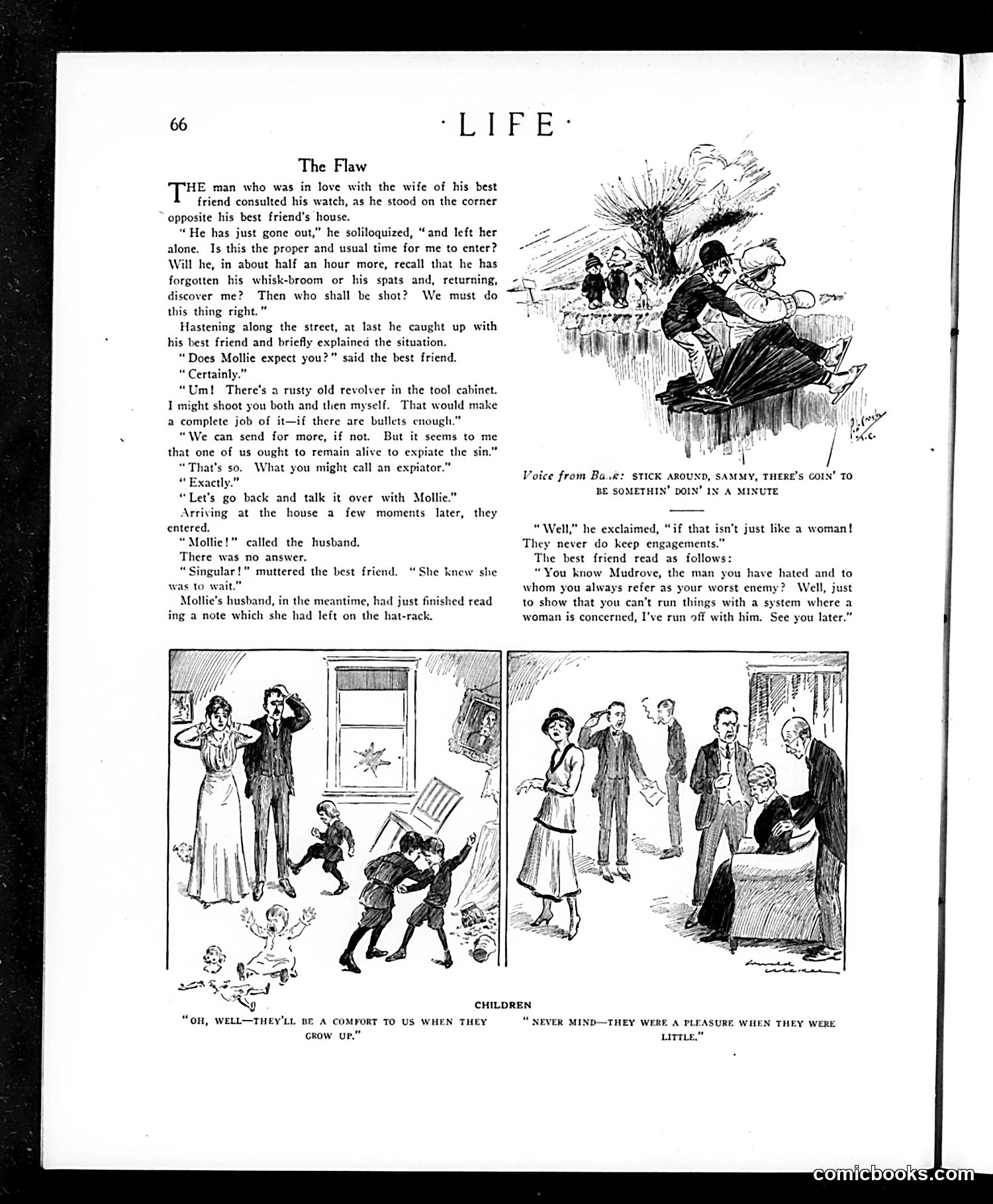
This story satirizes early 20th-century male melodrama and the absurdity of honor codes. A man in love with his best friend's wife (Mollie) consults the husband about the affair with bizarre civility. The two men comically debate logistics—whether to shoot everyone, who should survive to "expiate the sin"—treating infidelity like a philosophical problem requiring proper etiquette. The joke's punchline: Mollie has run off with Mudrove, the husband's supposed "worst enemy," specifically to demonstrate that women won't be controlled by men's systems. She leaves a note mocking the husband's inability to manage her behavior. The accompanying cartoon panels show domestic chaos—children causing destruction—illustrating marriage's messy reality versus romantic fantasy. The satire targets masculine pretension, the performative nature of "honor," and suggests women have agency despite men's elaborate schemes.
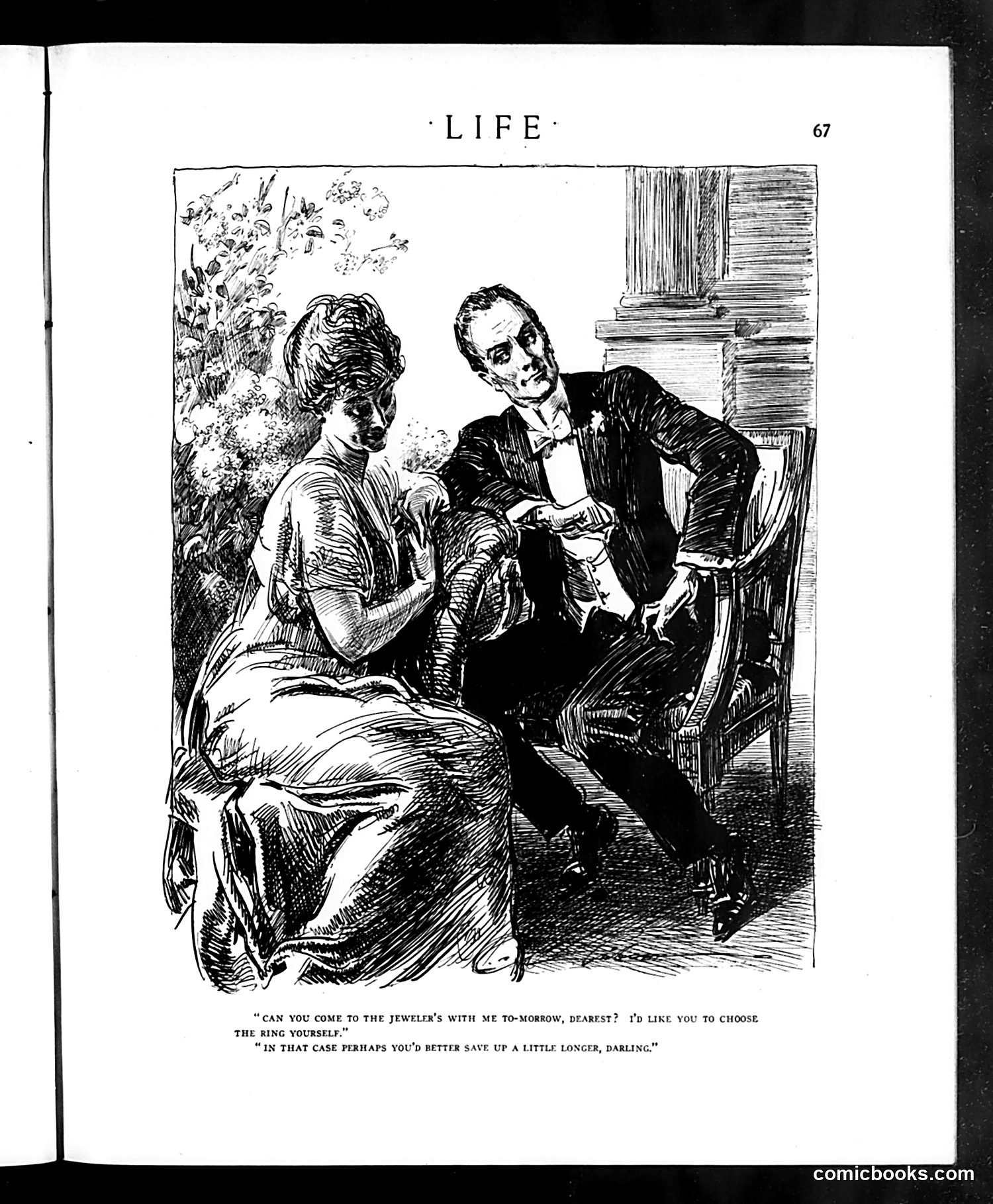
This is a romantic comedy cartoon depicting a marriage proposal scene. A well-dressed man asks his female companion to accompany him to select an engagement ring, intending to let her choose it herself—a gesture meant to be considerate. Her response is a joke about the expense: by allowing her to choose the ring, he's implicitly acknowledging she'll select something expensive, so he should save more money first. The humor lies in the stereotype of women preferring lavish jewelry and the implication that his generosity will cost him significantly. The satire gently mocks both courtship rituals of the era and gender expectations around jewelry and marriage—specifically, the assumption that women's desires for expensive rings are inevitable and powerful. It's lighthearted domestic humor typical of *Life* magazine's satirical approach to middle-class social conventions.
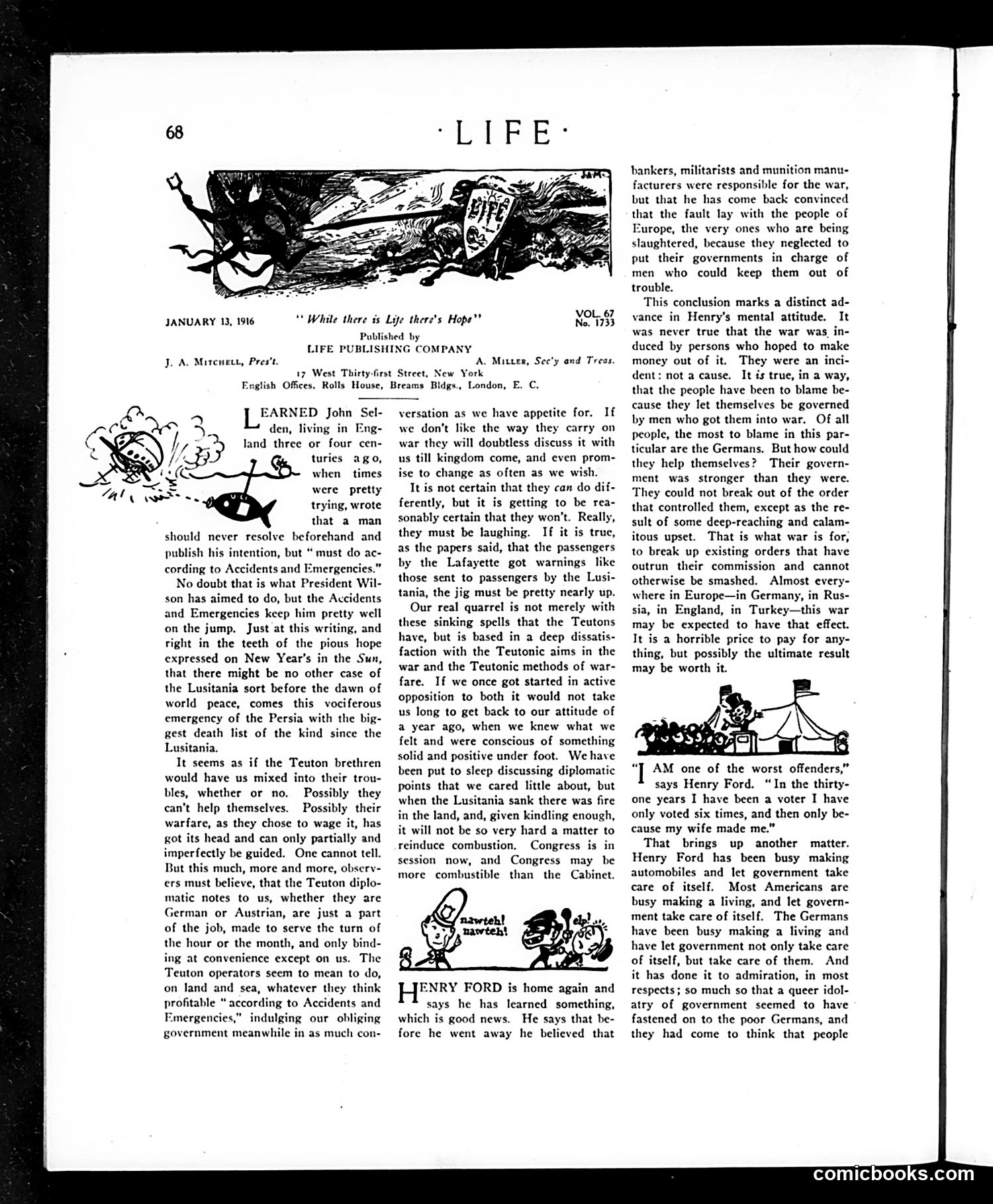
This page critiques President Wilson's cautious WWI policy and comments on Henry Ford's evolving views on war responsibility. **Main Editorial Content:** The article attacks Germany's submarine warfare (referencing the *Lusitania* sinking of 1915 and the recent *Persia* disaster), arguing that German diplomatic promises are meaningless delaying tactics. The writer suggests German military action operates beyond their government's control and criticizes Wilson for passively accepting German explanations rather than taking decisive action. The piece implies Congress might be more willing than Wilson's Cabinet to pursue active opposition to Germany. **Henry Ford Section:** Ford recently returned from a peace mission abroad. The article notes he now blames ordinary Europeans for the war (by neglecting proper governance) rather than bankers and munitions manufacturers—his previous position. The writer presents this as Ford's "advance in mental attitude," though with apparent irony, suggesting Ford's revised blame-the-people conclusion is conveniently less radical than his original industrialist-blame theory. The cartoons (visible but not clearly legible) likely satirize these diplomatic failures and Ford's changed perspective.
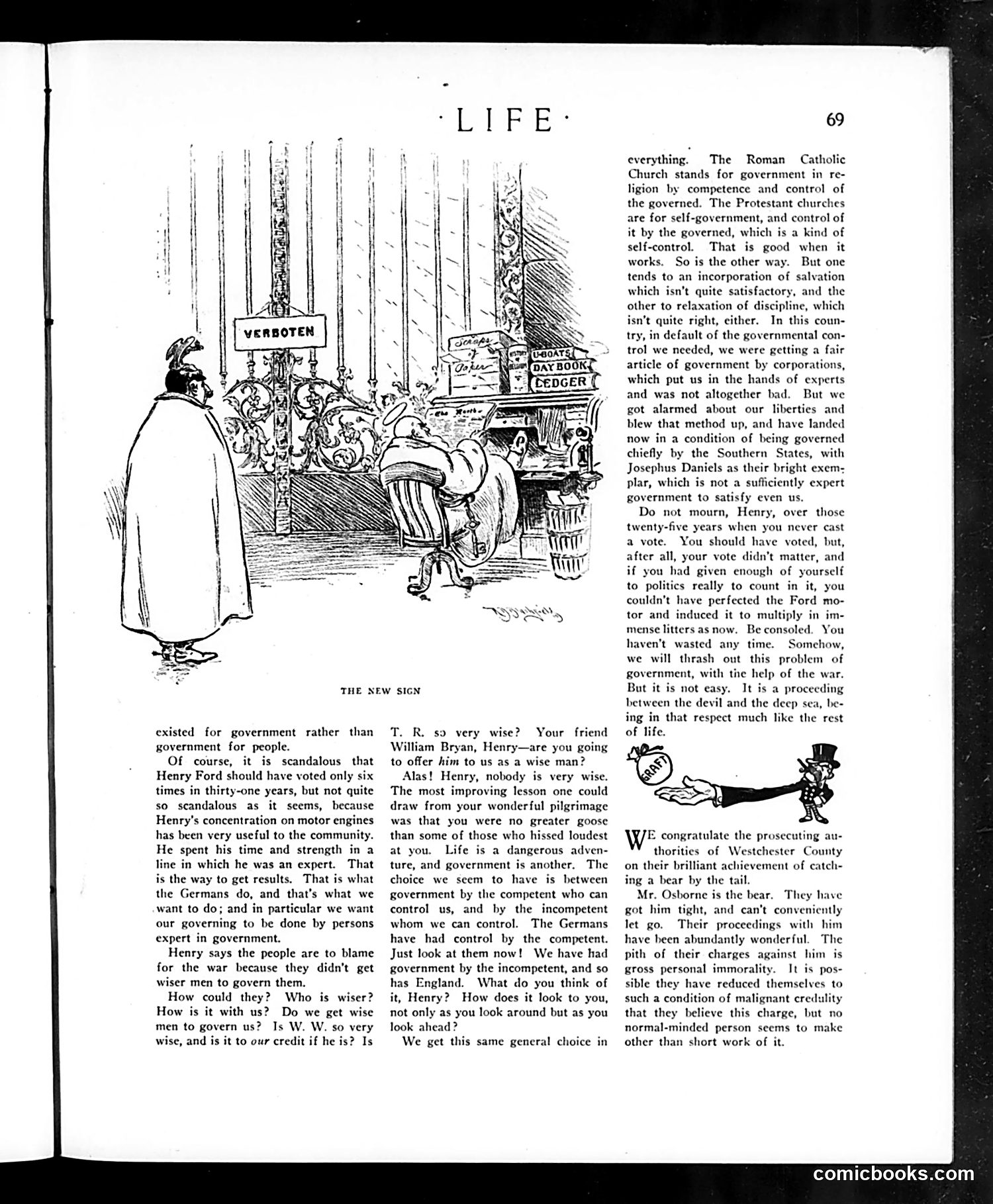
The cartoon depicts a figure (likely representing Henry Ford, based on the text) observing a shop display labeled "VERBOOTEN" (mimicking German signage). The satire critiques Ford's recent pacifist peace mission and his minimal voting record (only 3 times in 31 years). The text argues that while Ford's expertise in manufacturing justified his focus away from politics, society faces an impossible choice: government by competent experts who control citizens (like Germany), or government by incompetent people whom citizens can control (like America and England under Josephus Daniels). The piece satirizes Ford's moral authority to lecture others on governance while dismissing his own civic participation. The "new sign" appears to reference how post-WWI America increasingly copied authoritarian structures despite claiming to value democracy—a darkly ironic observation about choosing between tyranny and incompetence, with no satisfactory option available.
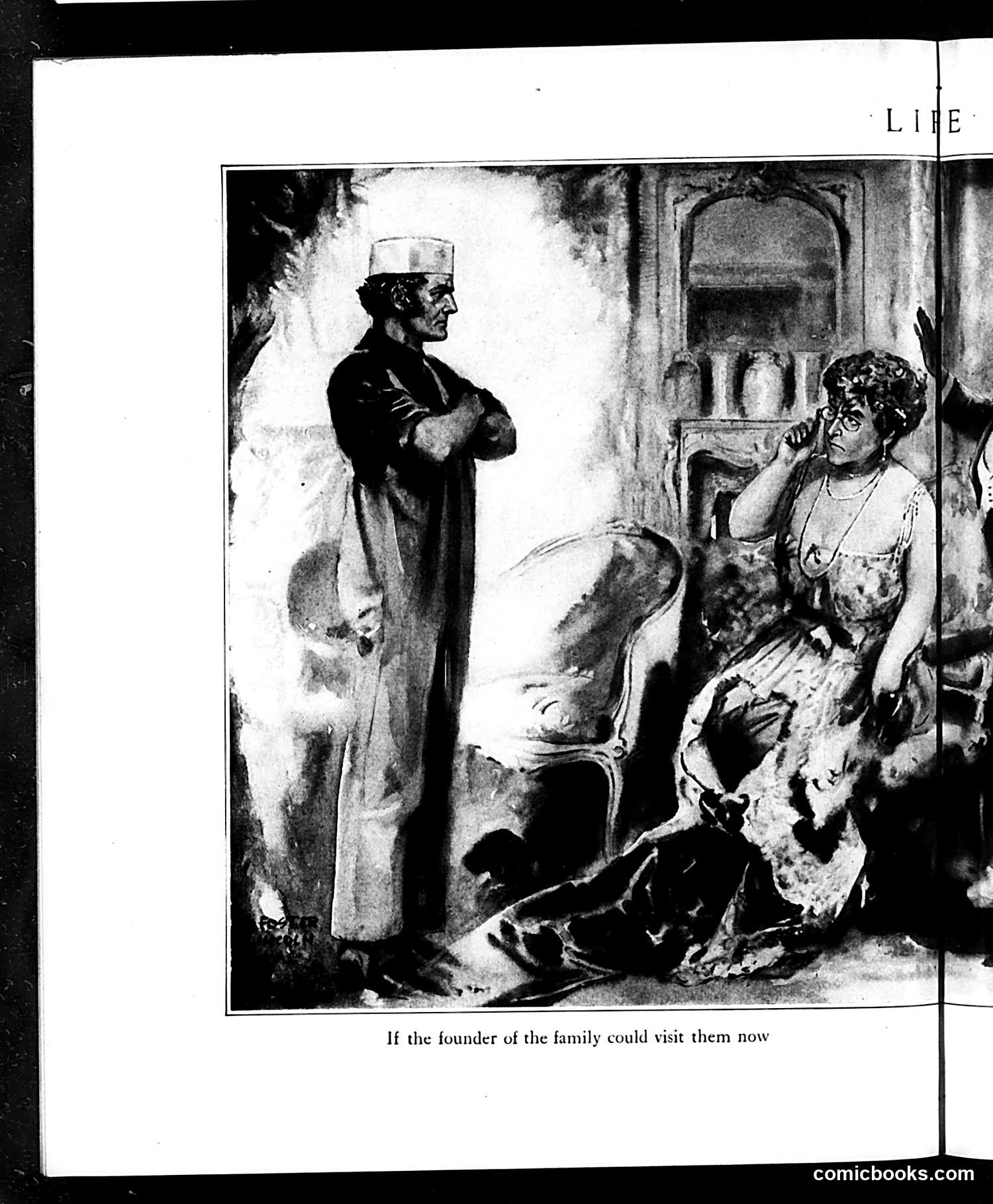
This appears to be a satirical illustration from *Life* magazine depicting social decline or moral decay within a family. The caption "If the founder of the family could visit them now" suggests a contrast between a family's former respectability and its current degraded state. The composition shows a stern-faced man in formal attire (likely representing the family's dignified ancestor or founder) observing the present scene with apparent disapproval. The other figures appear to be engaged in indolent or improper behavior—lounging, drinking, or idle pursuits. The satire critiques generational decline: how subsequent descendants have squandered or abandoned the values, discipline, and respectability established by the family patriarch. It's a commentary on social deterioration and lost family honor across generations.
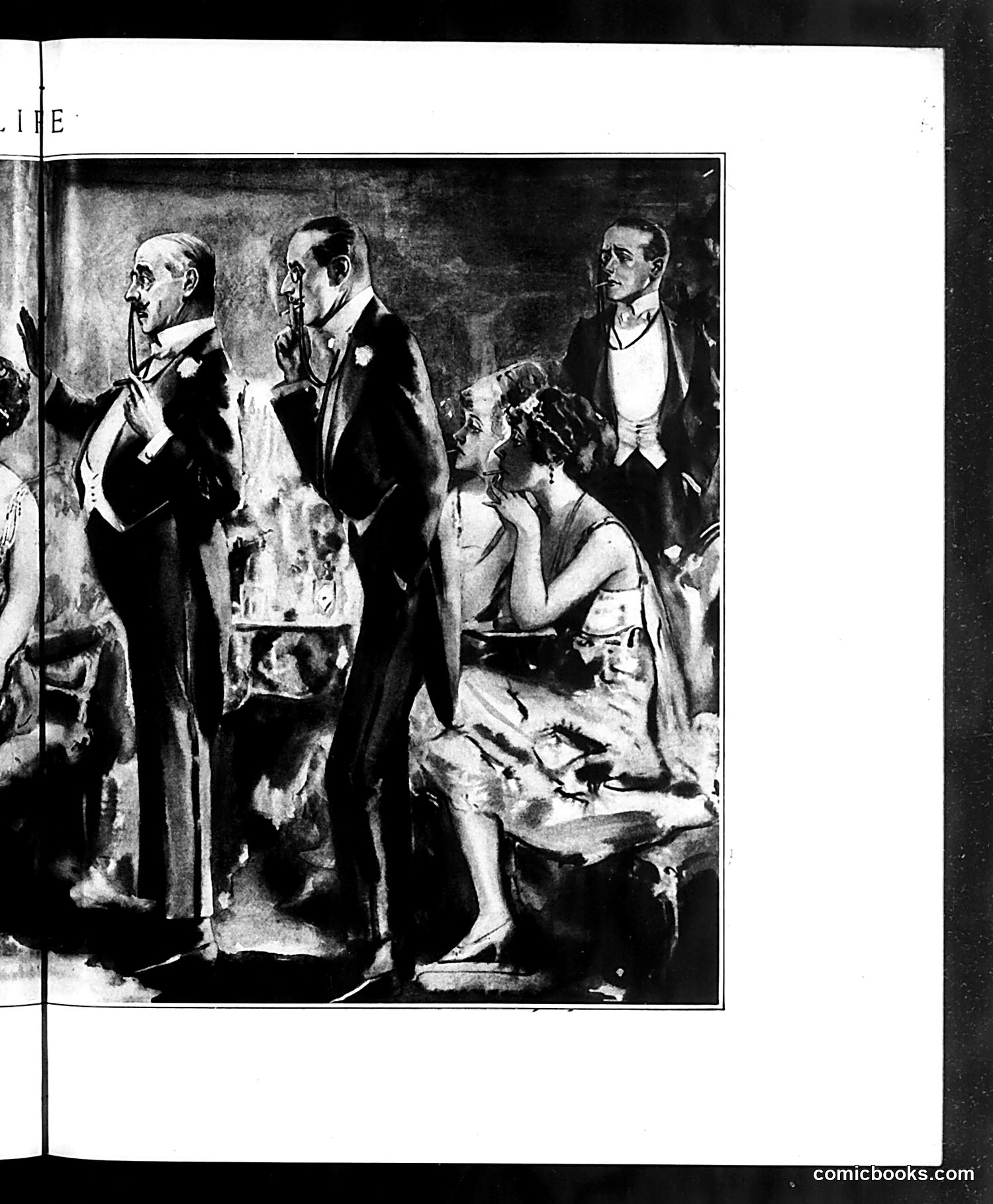
I can see this is a black and white illustration showing a social scene with four well-dressed men in formal attire (tuxedos) and a woman in a dress seated among them. The art style and composition suggest this is satirical commentary on high society or elite social gatherings. However, without visible caption text, character labels, or publication date information in the image itself, I cannot definitively identify the specific figures depicted or explain the particular political or social satire being critiqued. The OCR text provided only shows a website attribution and doesn't contain explanatory content. To accurately explain what this cartoon means to a modern reader, I would need the original caption or title that accompanied this illustration in Life magazine.
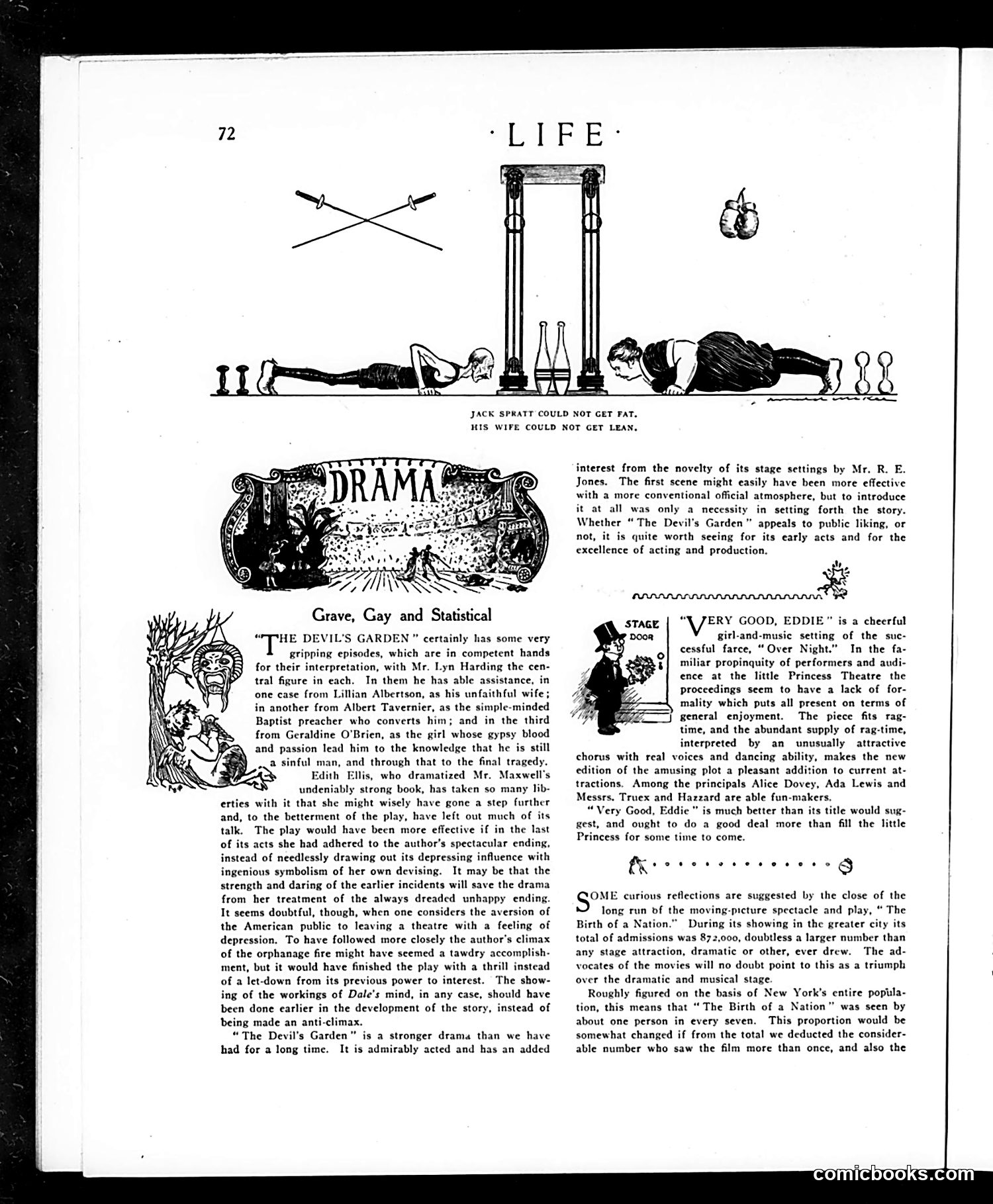
The top cartoon illustrates the nursery rhyme "Jack Spratt" through physical comedy: two figures in contrasting body types performing exercises on a see-saw apparatus, captioned "Jack Spratt could not get fat, his wife could not get lean." This is satirical commentary on body standards and marital discord through exercise. The page reviews three theatrical productions: "The Devil's Garden" (a serious drama with Lyn Harding), "Very Good, Eddie" (a lighthearted musical farce at the Princess Theatre), and discusses "The Birth of a Nation" film's box office success. The reviews critique dramatic versus entertainment value. The critic praises "Devil's Garden" for strong acting and design but faults its depressing ending, arguing American audiences prefer uplifting conclusions. "Very Good, Eddie" receives praise for cheerful ragtime entertainment with capable performers. The final section notes the film "Birth of a Nation" exceeded typical stage attendance numbers—a notable comparison between emerging cinema and traditional theater audiences of the era.
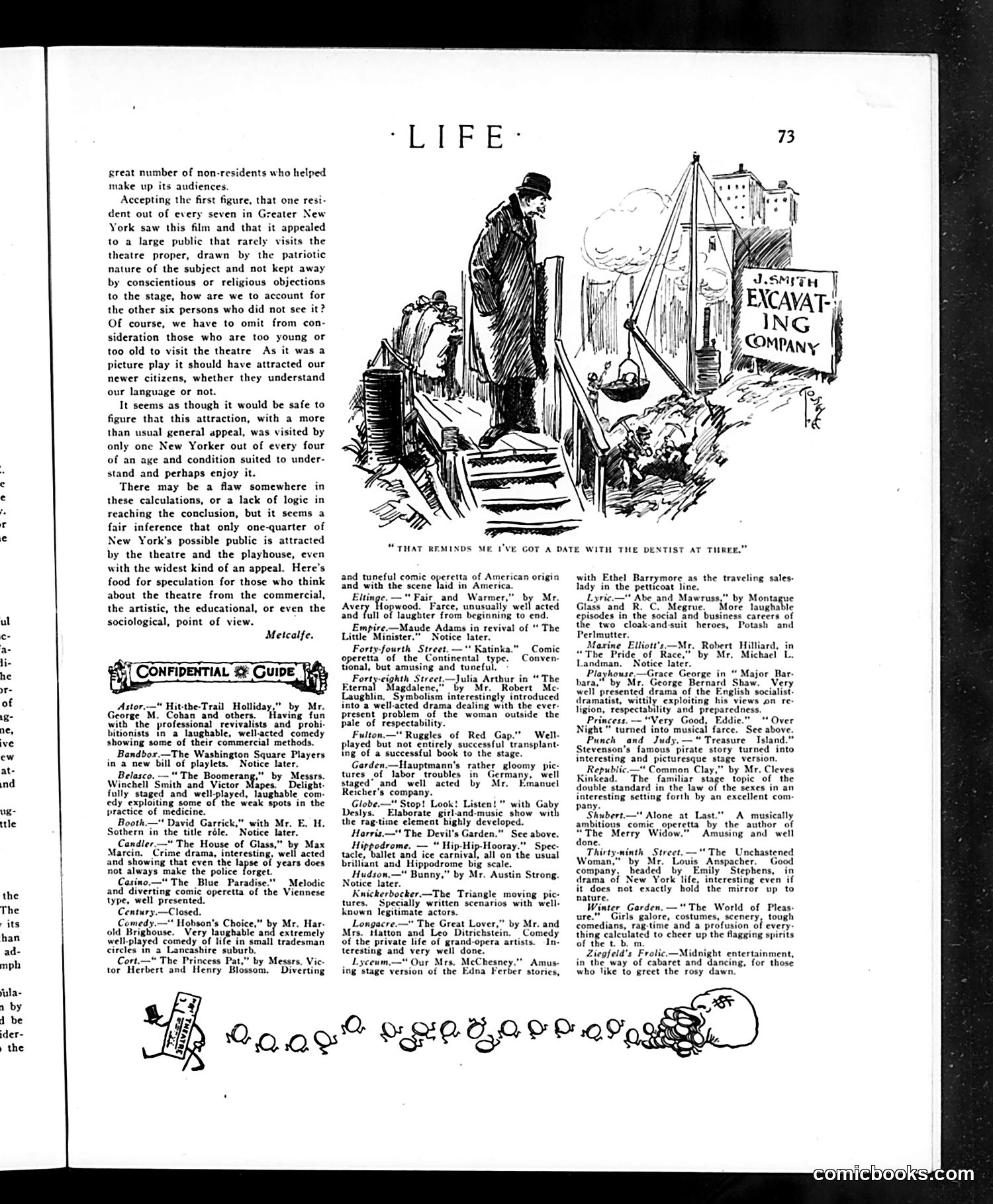
This page from Life magazine contains theater reviews and listings rather than political cartoons. The main illustration shows a man and child outside the "Smith Excavating Company," with the caption "That reminds me I got a date with the dentist at there." The joke is a visual pun: the "excavating company" sign evokes dental work (excavation = drilling/extraction), which the man humorously conflates with an actual dentist appointment. It's gentle, domestic humor typical of early 20th-century American magazines. The bulk of the page is a "Confidential Guide" to New York theaters, listing current productions with brief critical assessments. These include comedies, operettas, and dramas—establishments like the Astor, Belasco, and Empire theaters. The reviews reflect theatrical tastes of the era, favoring accessible comedies and well-acted pieces. This is primarily entertainment journalism, not satire.
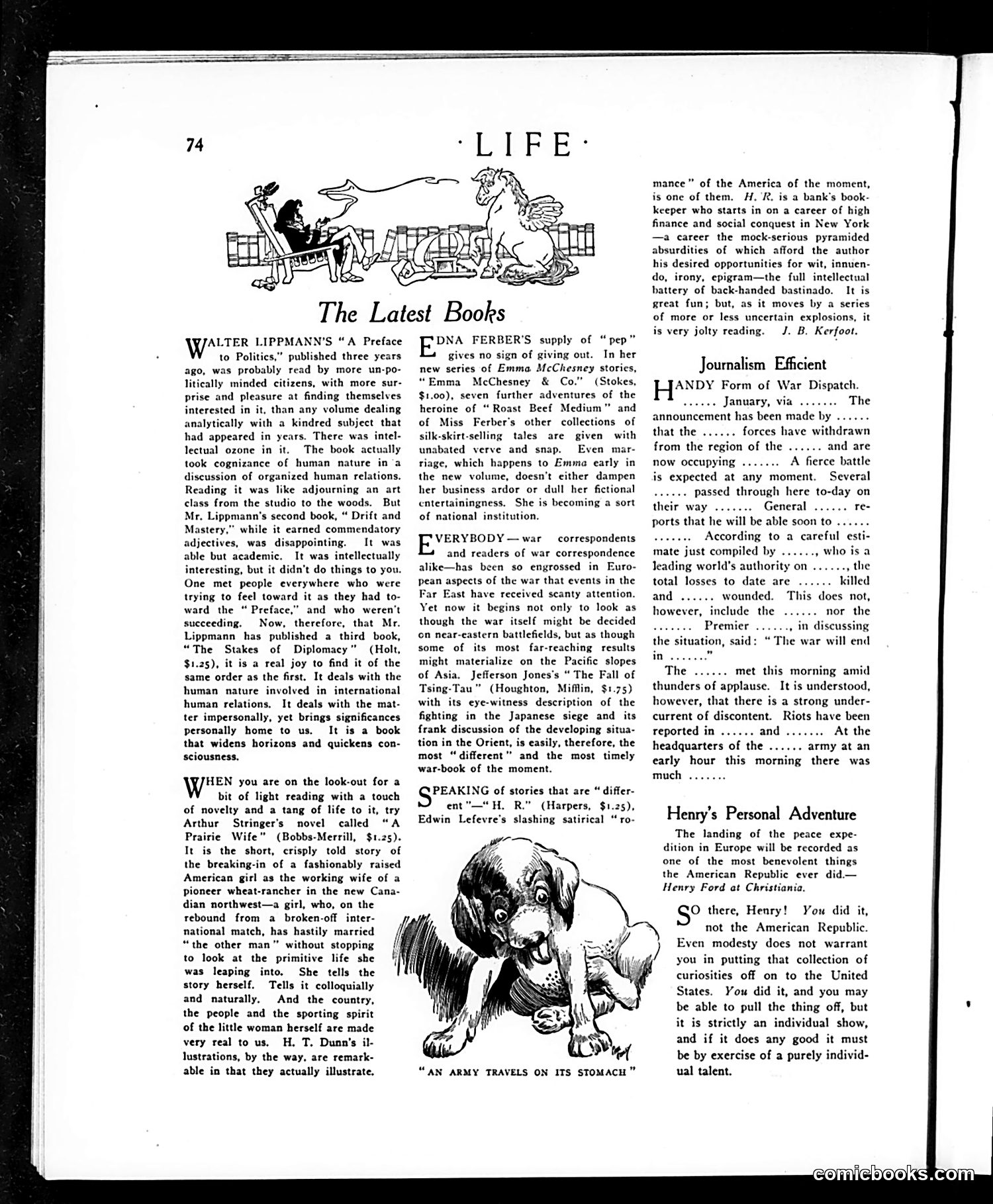
This is a book review section from Life magazine featuring critical commentary on contemporary publications. The main illustration—a dog lying down with the caption "An Army Travels on Its Stomach"—is a visual pun referencing the military aphorism while depicting a literal interpretation. The reviews discuss works by Walter Lippmann (political analysis), Edna Ferber (popular fiction about a saleswoman character), Arthur Stringer (frontier romance), and Jefferson Jones (war reportage about the Russo-Japanese conflict). The satirical edge comes through in the frank assessments: Lippmann's second book "Drift and Mastery" is dismissed as "able but academic" and disappointing compared to his first work. Ferber's commercial success is noted with slight condescension—she's "becoming a sort of national institution." The page reflects Life's role as a publication for intellectually-engaged readers who appreciated both serious analysis and popular culture, with a tone that's sophisticated but accessible.
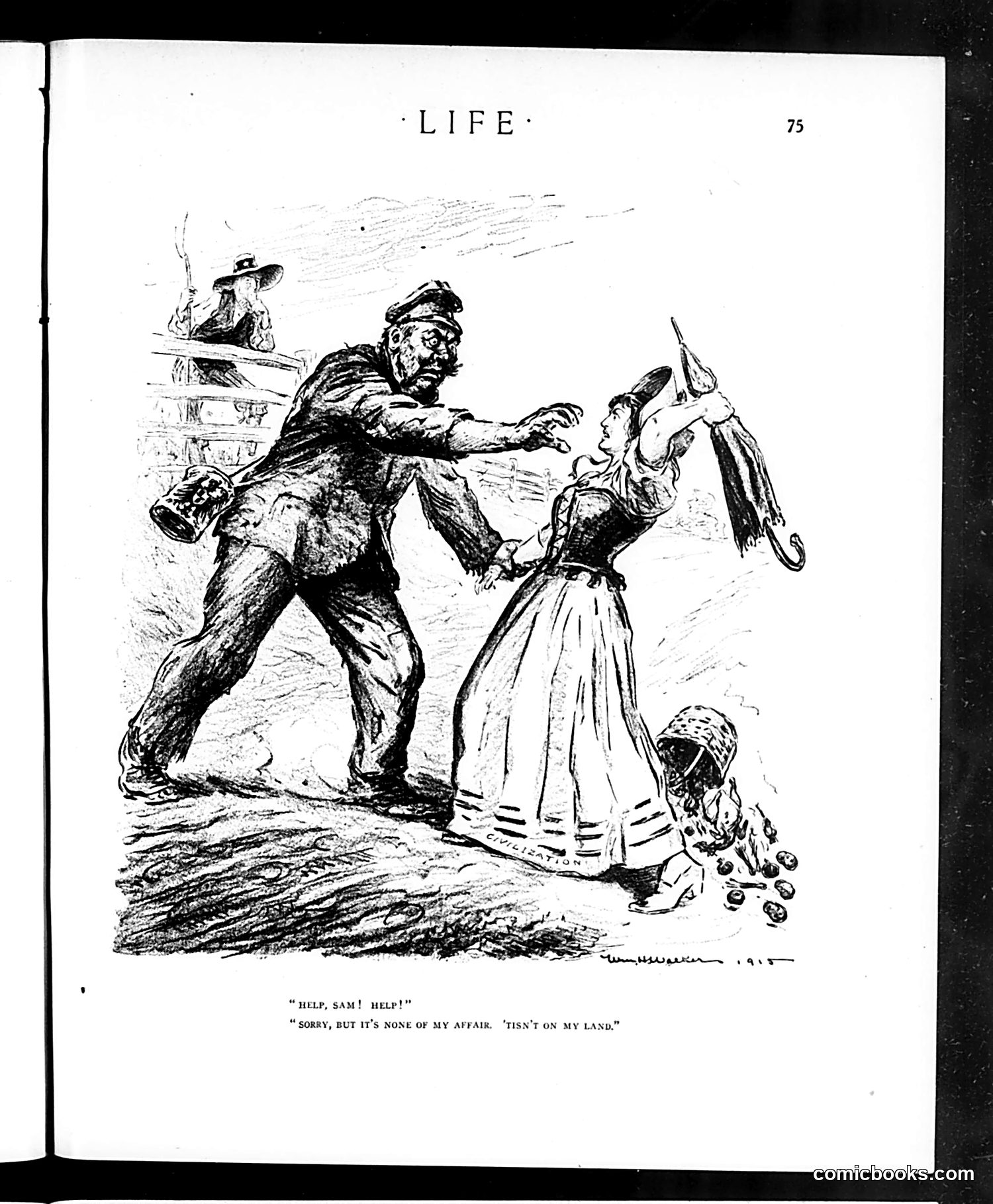
This cartoon depicts a domestic dispute where a man appears to be threatening a woman with a weapon while a child watches. A bystander (labeled "Sam") refuses to intervene, claiming it's "none of my affair" and "isn't on my land." The satire likely critiques a common attitude of non-interference in others' private matters, particularly domestic violence. The phrase "'tisn't on my land" suggests property-based boundaries of responsibility—implying people only care about problems occurring on their own property. The cartoon appears to mock indifference to social problems and the excuse that one needn't help because an incident falls outside one's direct jurisdiction or concern. This reflects broader Progressive Era commentary on civic responsibility and social obligation.
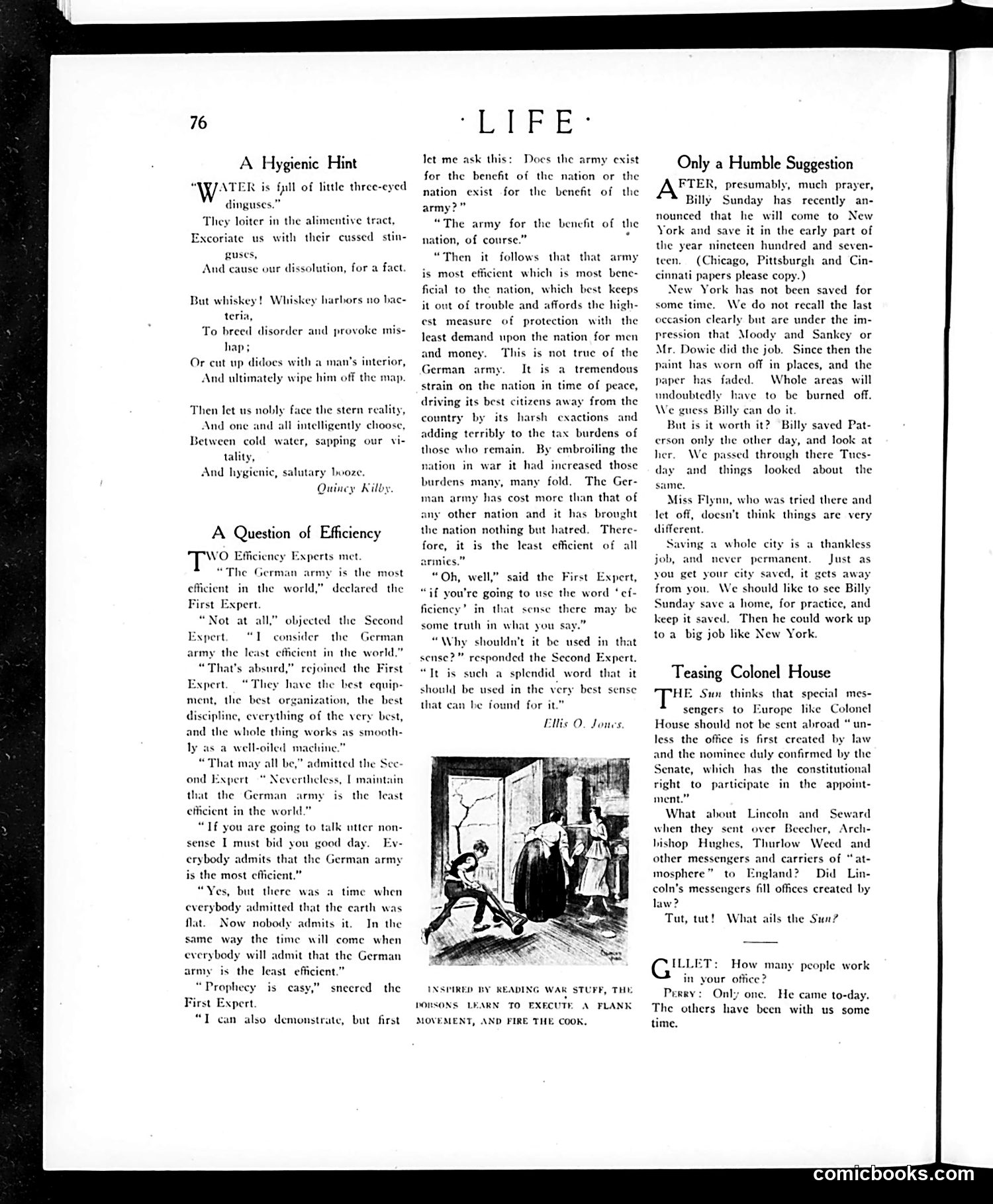
This page contains three satirical pieces targeting early 20th-century issues: **"A Question of Efficiency"**: Two debate whether the German army is most or least efficient. The Second Expert argues it's inefficient because, though militarily organized, it drains the nation economically and diplomatically, producing only "hatred." The joke exposes how "efficiency" depends entirely on one's definition—a critique of Germany's militarism disguised as logical debate. **"A Hygienic Hint"**: A humorous poem mocking those who fear bacteria in water but trust whiskey's safety. It's absurdist satire on public health anxieties. **"Only a Humble Suggestion"**: Mocks evangelist Billy Sunday's announced 1917 revival crusade in New York, sarcastically suggesting the city needs "saving" like Paterson did recently (apparently unsuccessfully). The tone is skeptical of religious salvation campaigns' lasting impact. The page reflects pre-WWI American attitudes toward German expansion and contemporary debates over faith, science, and national efficiency.
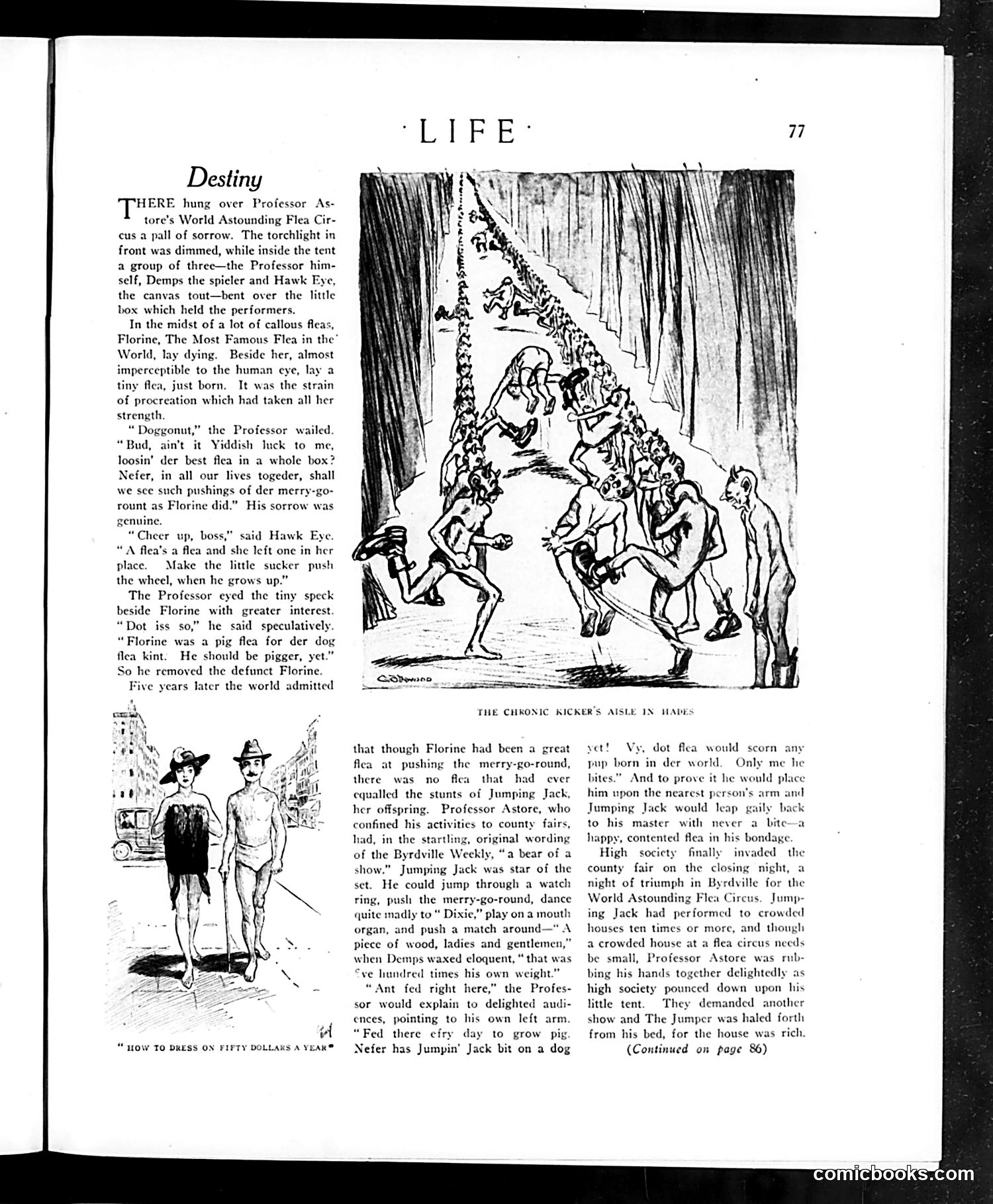
This is a humorous fictional narrative about Professor Astore's traveling flea circus—a real (if bizarre) form of 19th-early 20th-century entertainment. The story follows the rise of "Jumping Jack," a flea trained to perform stunts (jumping through watch rings, pushing a merry-go-round, dancing to "Dixie"). The satire works on multiple levels: it mocks low-class carnival entertainment and the showmen who operate them (note the heavily accented speech of the Professor and his assistants), while simultaneously treating the flea's "destiny" with mock-seriousness—elevating a parasitic insect to dramatic importance. The humor lies in the contrast between the grandiose promotion ("World Astounding Flea Circus") and the pathetic reality of performing fleas. The caption "How to Dress on Fifty Dollars a Year" references a separate, unrelated article about economical fashion.
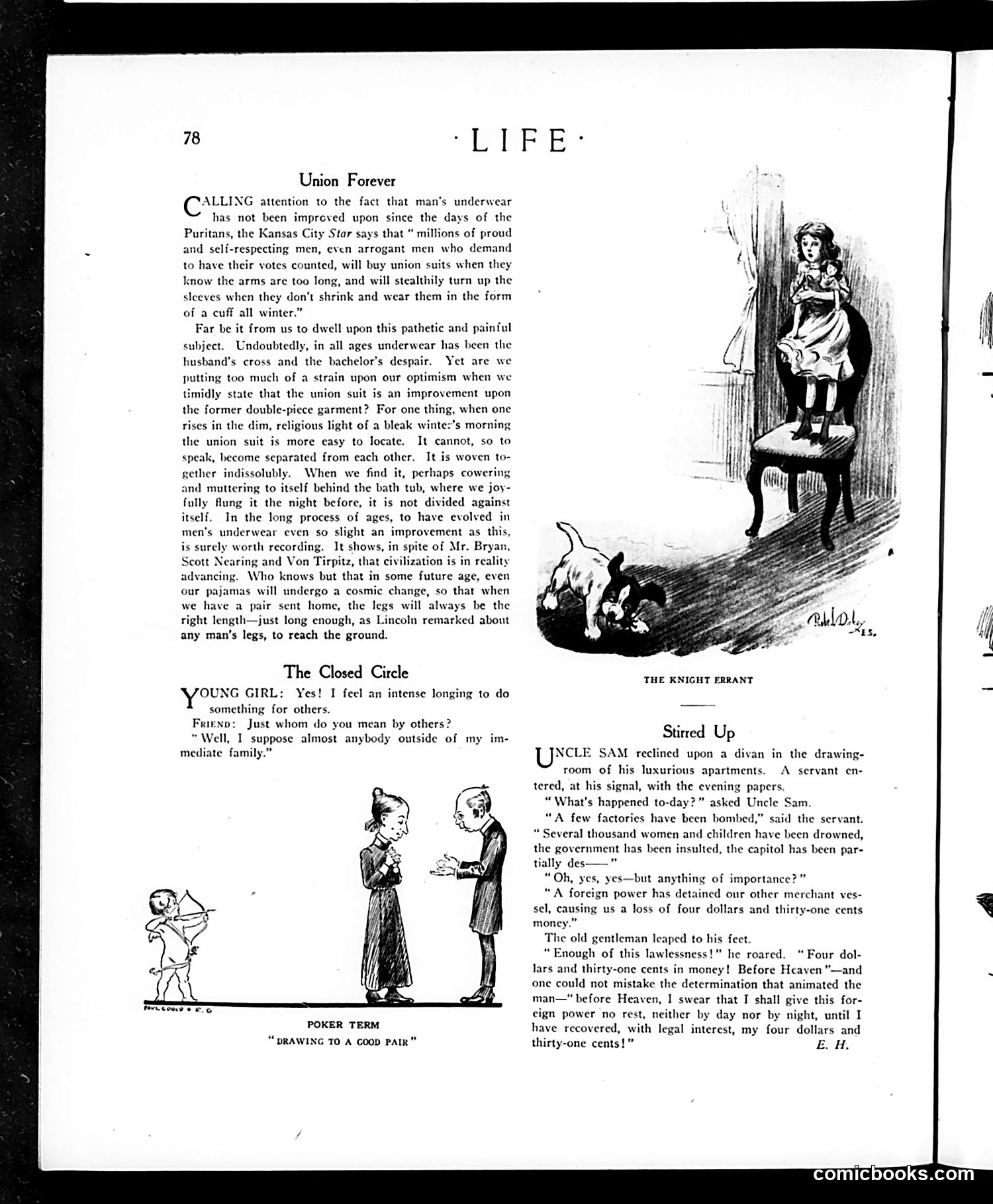
**"Union Forever"** satirizes absurd optimism about minor progress. The article mocks the Kansas City *Star* for celebrating the "union suit" (one-piece underwear) as civilization's advancement, while ignoring that men still buy ill-fitting versions with sleeves too long. The joke: we call this evolution despite the garment remaining impractical. References to Bryan, Scott Nearing, and Von Tirpitz (progressive/anti-war figures) suggest irony—even critics of civilization should acknowledge this tiny improvement. **"The Closed Circle"** depicts a young woman claiming to help "others," then admitting she means "almost anybody outside my immediate family"—satirizing self-centered charity. **"Stirred Up"** criticizes American indifference to foreign aggression. Uncle Sam remains unmoved by factories bombed, thousands drowned, and governmental insults—until a merchant vessel detention costs him $4.31. Then he roars about injustice, exposing that Americans only care about money, not humanitarian crises.
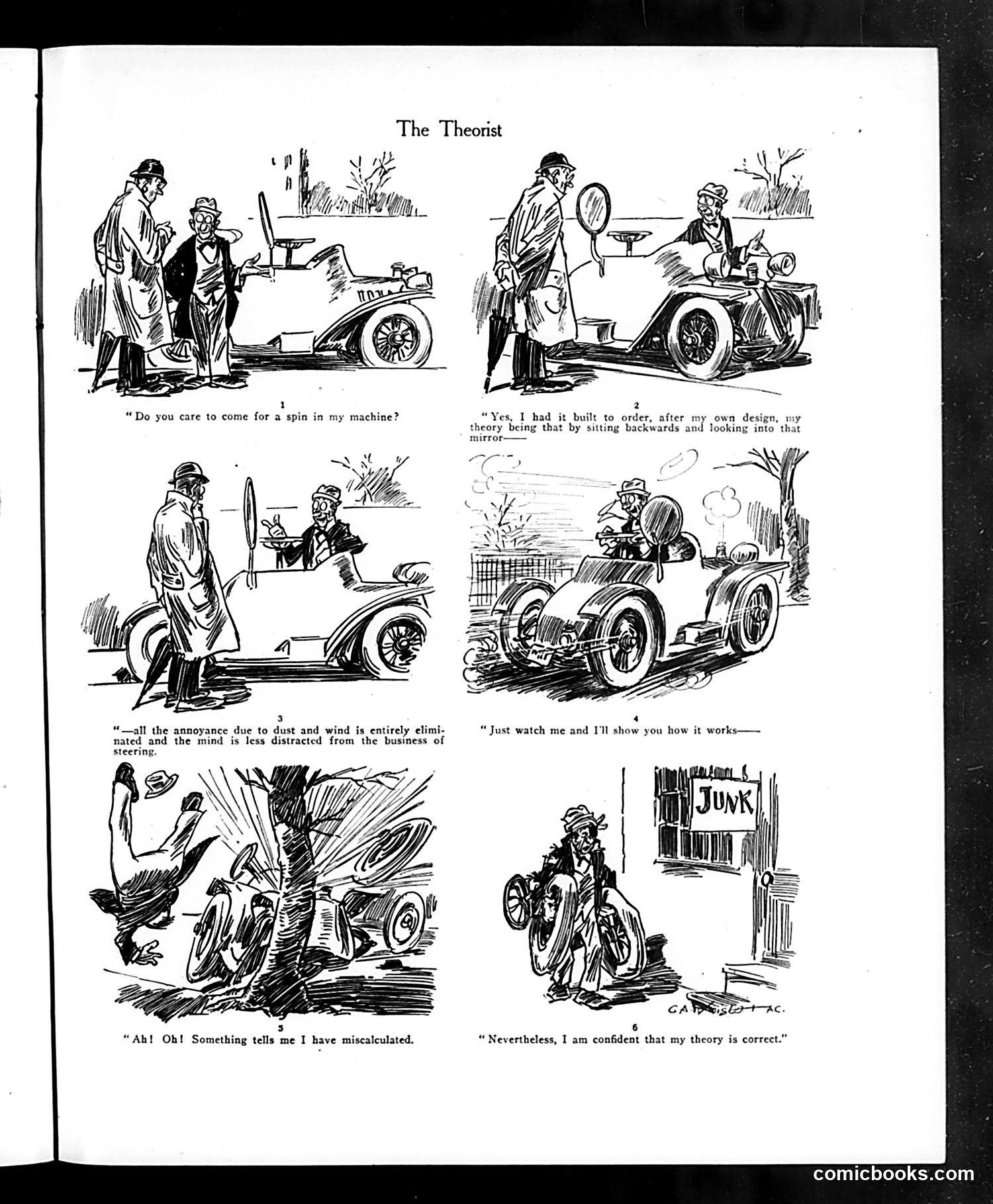
This six-panel comic mocks an automobile enthusiast who designs a car based on impractical theoretical ideas rather than practical experience. **The joke:** The "theorist" invites someone for a ride in his custom-built vehicle, proudly explaining his backwards-facing seat design: by sitting backwards with a mirror, he eliminates wind and dust annoyance while driving. **The satire:** Over the course of the panels, his theory catastrophically fails—the car crashes, he loses control, and a woman is thrown into the air. Yet in the final panel, standing among wreckage near a "JUNK" sign, he remains delusionally confident: "Nevertheless, I am confident that my theory is correct." **The point:** This ridicules people who trust pure theory over real-world testing and evidence—a common target of early 20th-century satire about pseudoscientific thinking and automotive innovation. The humor lies in the theorist's stubborn refusal to acknowledge obvious failure.
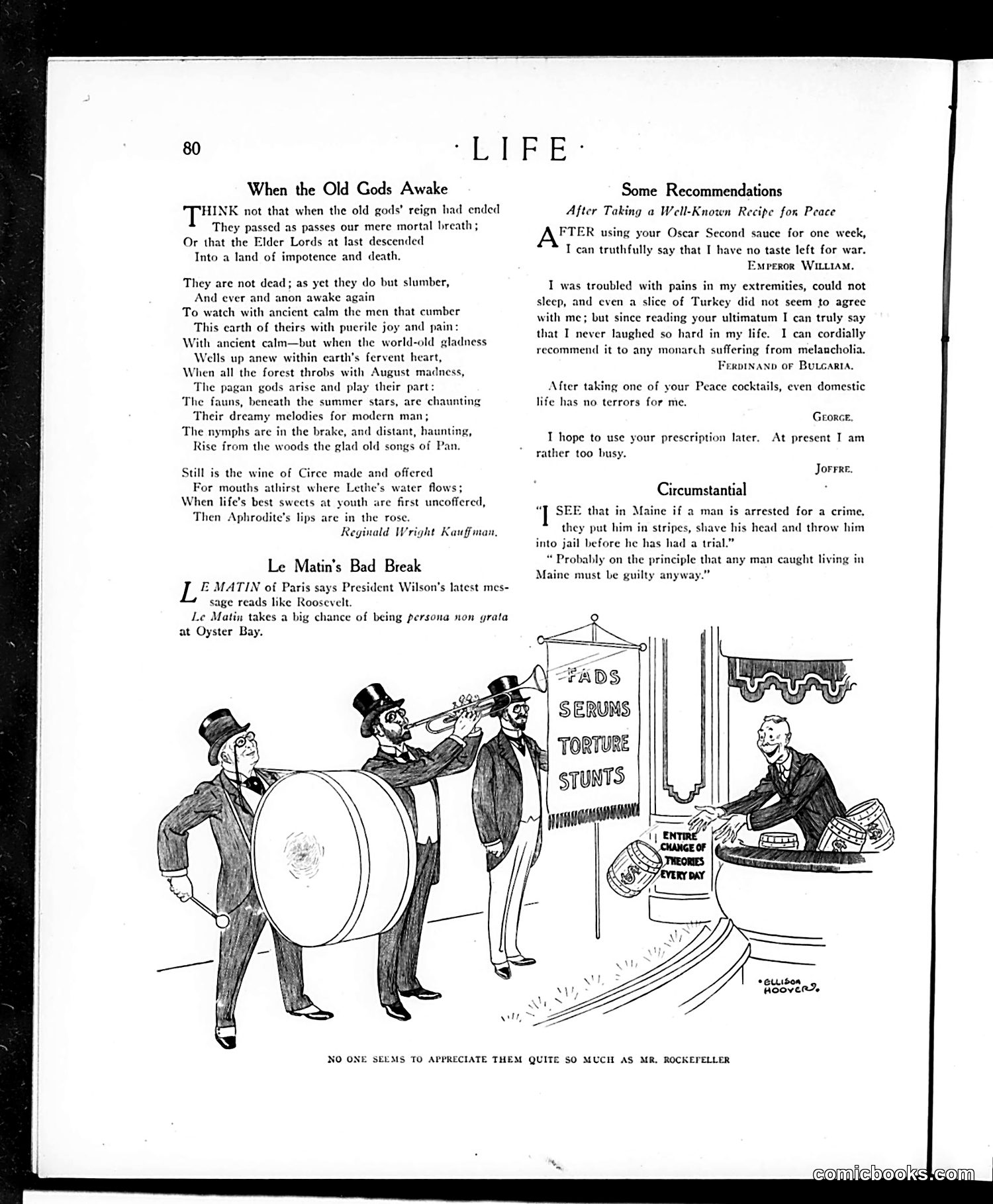
This cartoon satirizes Franco-American diplomatic tensions during World War I. The left panel shows French newspaper *Le Matin* literally amplifying President Wilson's message through a megaphone labeled with negative terms ("Fads, Serums, Torture, Stunts"). The joke: *Le Matin* claims Wilson's recent statement sounds like Theodore Roosevelt's rhetoric—a comparison that could insult Wilson and embarrass France at "Oyster Bay" (Roosevelt's home), potentially straining Franco-American relations. The right panel shows a man calmly reading newspapers indoors, apparently unfazed—likely representing the American public or government's lack of concern about French media criticism. The caption's punchline suggests wealthy industrialists (notably Rockefeller, referenced in the bottom caption) receive more public appreciation than newspapers do for their efforts—a dig at media self-importance during wartime.
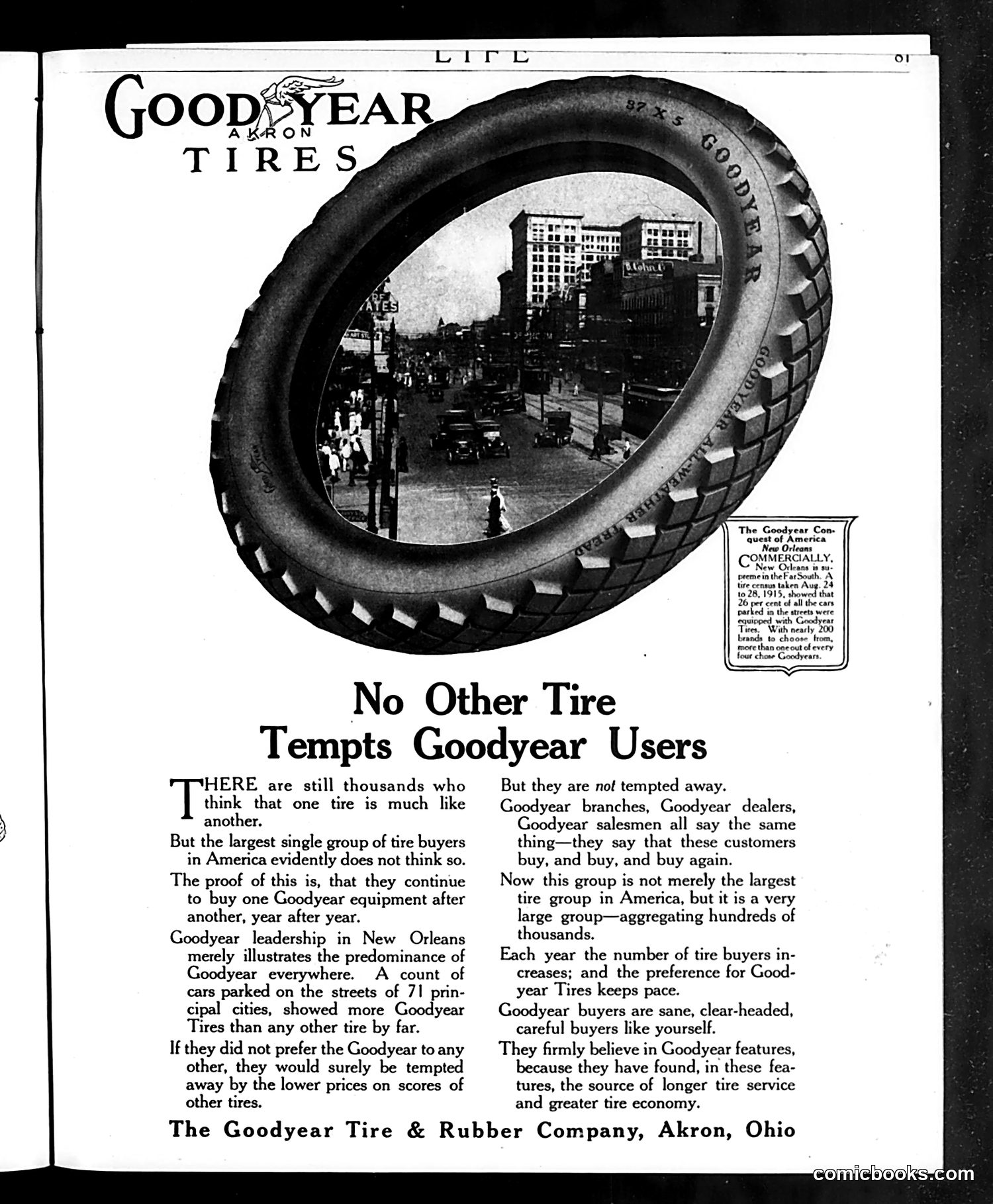
This is a **Goodyear tire advertisement**, not satire or political commentary. The page uses a clever visual metaphor: a giant tire frames a cityscape (appears to be New Orleans, based on the text), creating a "window" effect that suggests Goodyear tires provide clarity and perspective. The ad's argument is straightforward: Goodyear dominates the market not through lower prices, but through superior quality and customer loyalty. It cites a survey of 71 major cities showing Goodyear outsells competitors significantly. The text emphasizes that repeat customers are "sane, clear-headed, careful buyers"—implying that choosing Goodyear demonstrates rational judgment. This represents early 20th-century advertising strategy: building brand prestige through market dominance statistics and appeals to consumer wisdom, rather than price competition. The "conquest of America" framing suggests inevitable market triumph.
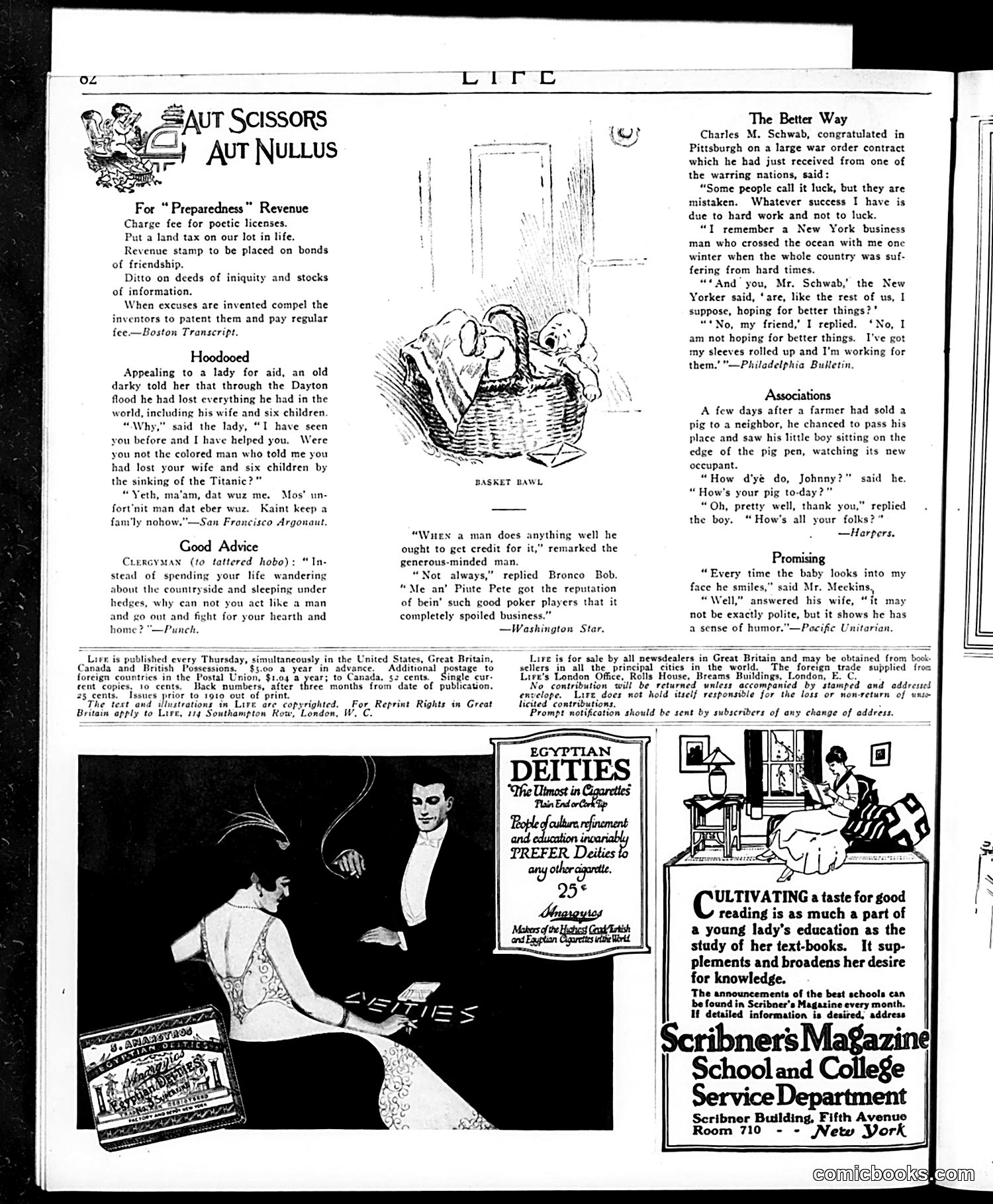
This page contains several short humorous pieces typical of Life's satirical format: **"Aut Scissors Aut Nullus"** satirizes government "Preparedness" revenue schemes by suggesting absurd new taxes—on poetic licenses, friendship bonds, and invented excuses. **"Hoodooed"** is a dialect joke about a Black man who has repeatedly lost family members to disasters (Titanic, then a flood), suggesting he's cursed with misfortune. **"The Better Way"** features industrialist Charles M. Schwab crediting his success to hard work rather than luck—a "bootstraps" narrative common to the era. **"Basket Bawl"** (illustration) appears to show a baby in a basket, likely commenting on infant care or domestic life. The remaining anecdotes—about poker players, a farmer's pig, and a baby's smile—are gentle, conventional humor with no apparent political content. The page is primarily **humorous sketches and short jokes** rather than pointed political satire, reflecting Life's mixed entertainment and commentary approach circa 1910s.
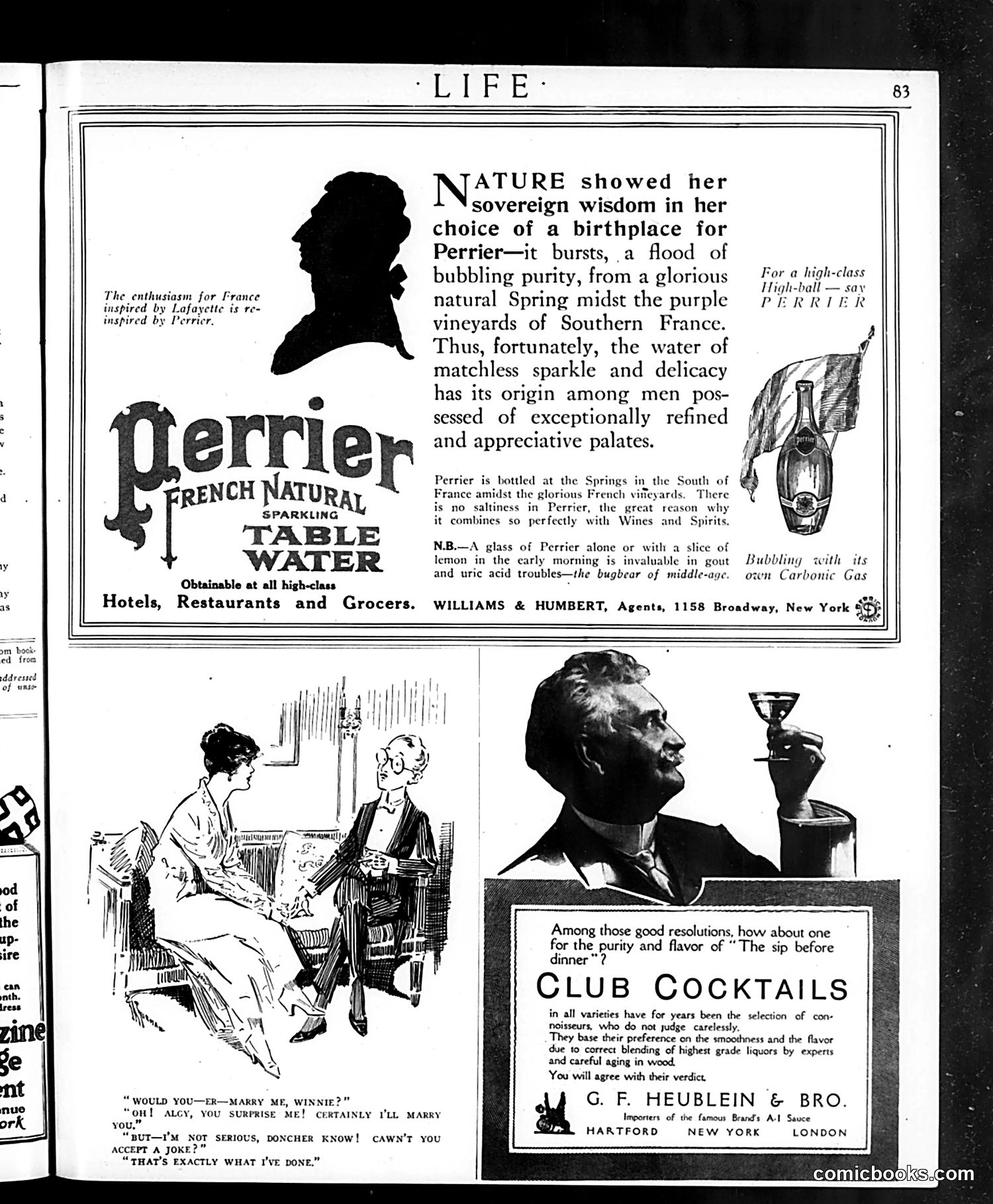
This page is primarily **advertising**, not satire or political commentary. The top half features a Perrier water advertisement emphasizing the product's French origin and purity—marketed as ideal for the refined palate and touted as a health remedy for gout and uric acid problems. Below is a **small cartoon joke** about marriage expectations: A man proposes jokingly to a woman ("Winnie"), claiming he's "not serious" and asking if she can "accept a joke." She agrees to marry him—treating his proposal as the joke itself. The humor relies on early 20th-century gender dynamics: the woman's presumed eagerness to marry, and the man's surprise that she'd accept even a non-serious proposal. The bottom right advertises Club Cocktails by G.F. Heublein & Bro., emphasizing quality ingredients and aging. The page reflects period attitudes about courtship, class consumption (French luxuries), and health remedies now considered dubious.
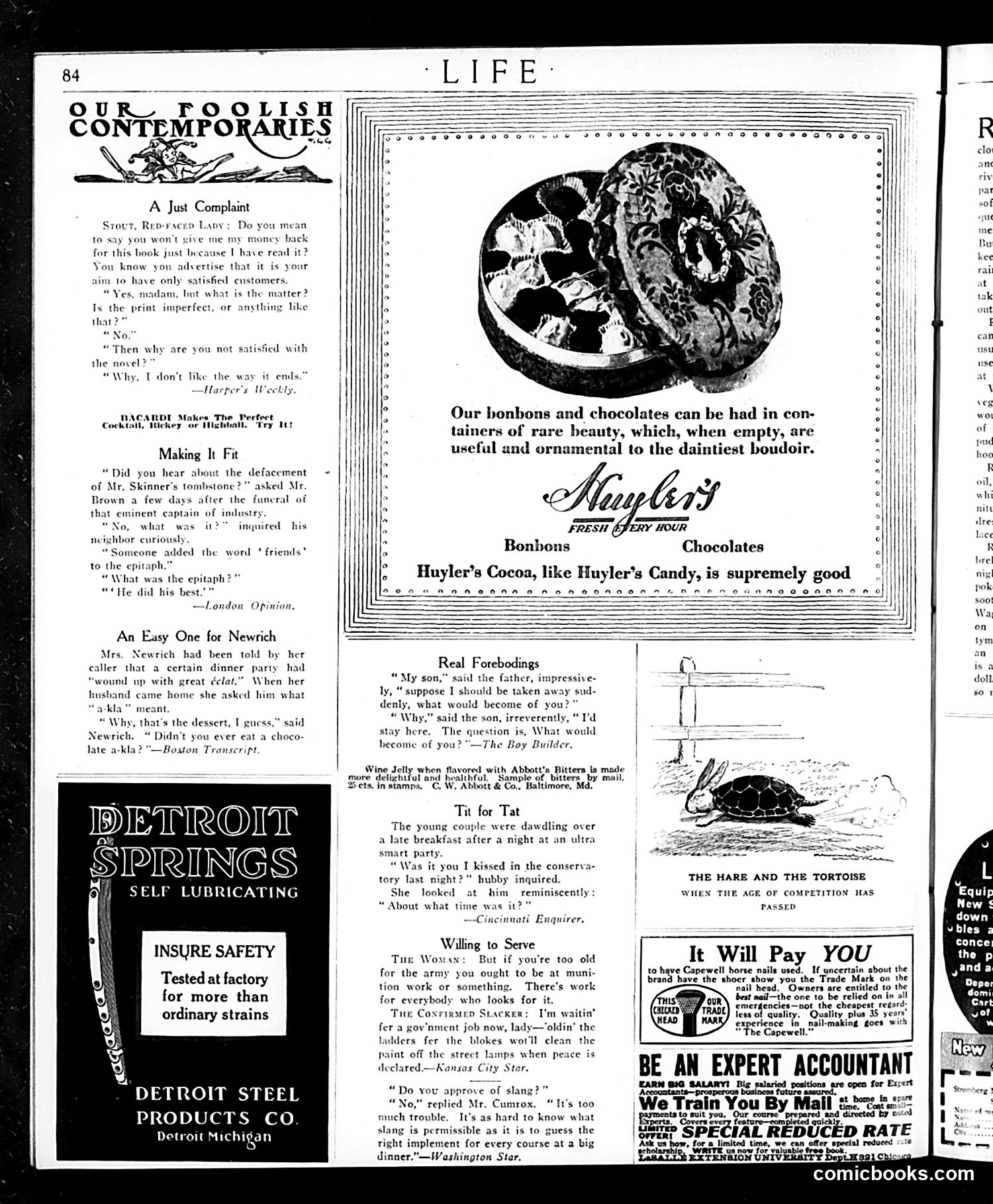
This page contains **satirical humor pieces** rather than political cartoons. The jokes mock social pretension and marital dynamics of early 20th-century American life: **"A Just Complaint"**: A Red-Faced Lady demands her money back for a book she's already read. The shop owner notes his policy guarantees "satisfied customers"—she replies she's unsatisfied because she disliked the ending. The satire targets unreasonable consumer expectations. **"Making It Fit"**: Someone added the word "friends" to a deceased industrialist's epitaph that originally read "He did his best"—mocking how people dishonestly rewrite legacies. **"An Easy One for Newrich"**: A social climber's wife mistakes "éclat" (brilliance) for a dessert, and her husband suggests it's "chocolate à la." This ridicules nouveau riche pretension and malapropisms. **Other pieces** mock marital infidelity ("Tit for Tat") and class anxieties. The advertisements (Huyler's Chocolates, Bacardi, Detroit Springs) anchor this to consumer culture of the era. The tone is gentle mockery of American social aspiration and domestic life.
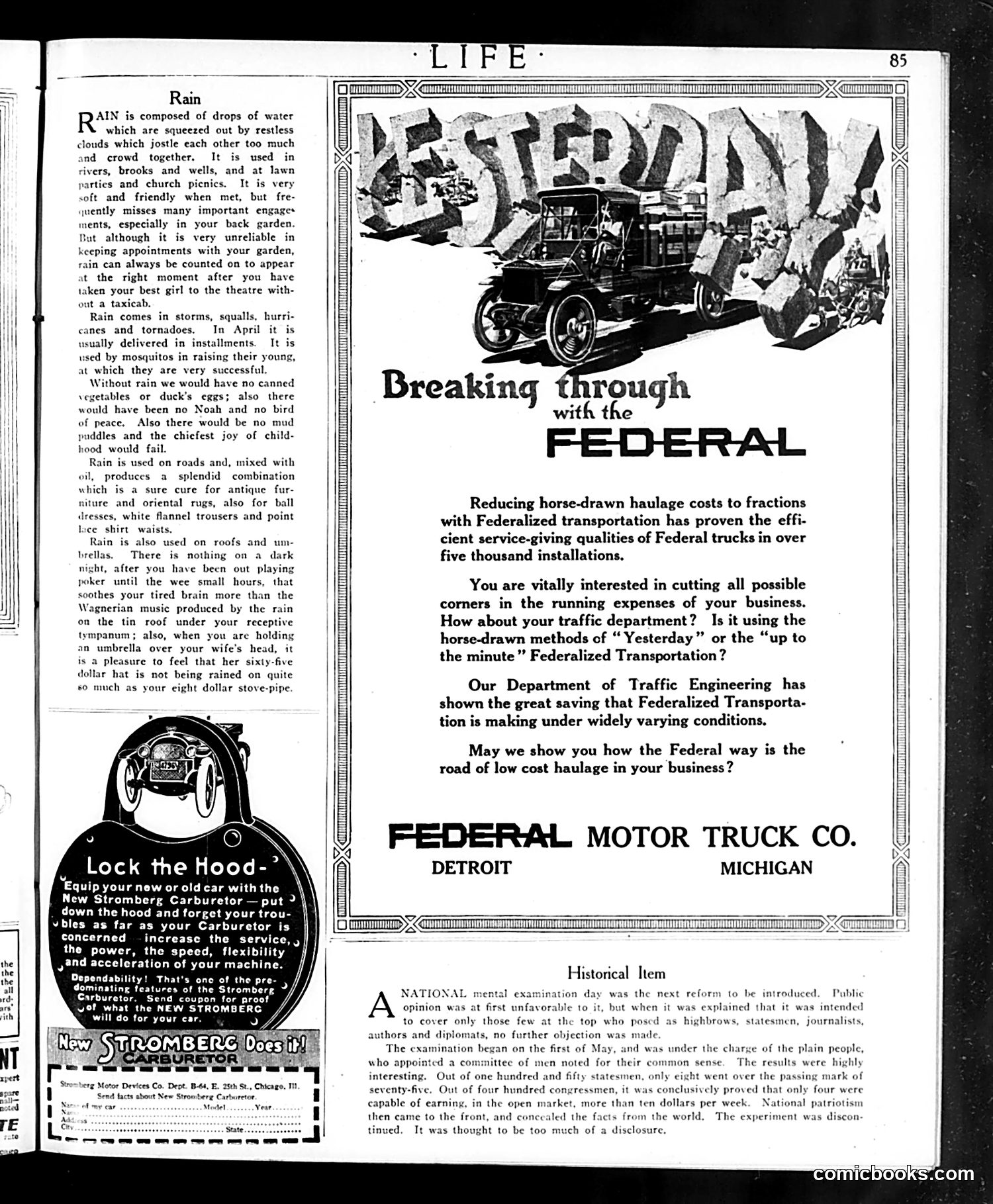
This page combines two distinct elements: a humorous essay and advertising. **The "Rain" Essay (left column):** A whimsical, tongue-in-cheek piece that anthropomorphizes rain as an unreliable but essential natural force. It uses mock-serious language to describe rain's contradictions—soft yet destructive, necessary yet inconvenient. The humor lies in treating weather poetically while acknowledging its annoying practical impacts (ruining dates, muddy clothes, tin-roof noise). **The Advertisements:** Two prominent ads appear: 1. **Federal Motor Truck Co.** (center-right) pitches trucks as replacements for "horse-drawn" transportation, emphasizing cost savings and efficiency—a modernization pitch typical of the 1920s industrial era. 2. **Stromberg Carburetor** (bottom-left) promotes automotive upgrades, similarly appealing to businesses modernizing their vehicles. The page reflects an era when motorized transportation was still relatively new and being aggressively marketed to replace horse-based commerce. The juxtaposition of whimsical nature writing with hard-sell industrial advertising is characteristic of Life's satirical approach to American life and commerce.
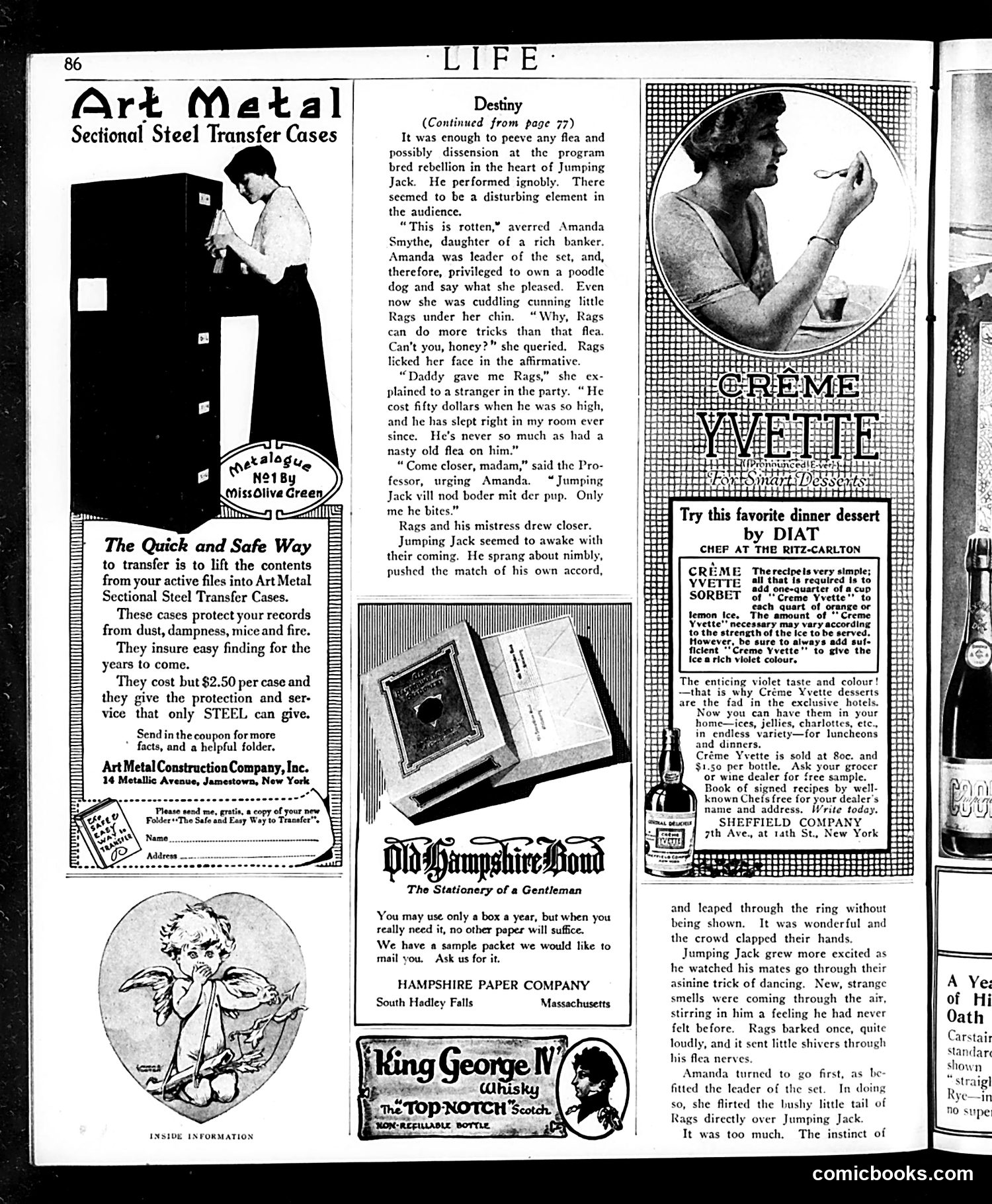
This page is primarily **advertising and serialized fiction**, not political satire. The main content is a continued story titled "Destiny" about a performing flea named Jumping Jack at what appears to be a vaudeville show. A wealthy banker's daughter, Amanda Smythe, attends with her prized poodle, Rags. When Amanda flirts the dog's tail over the performing flea, Jumping Jack loses control and presumably jumps onto the dog—the "instinct" referenced at the page's bottom. **The surrounding advertisements** include office filing cases, Hampshire Paper Company stationery, Crème Yvette dessert liqueur, King George IV Scotch whisky, and other luxury goods targeting affluent readers. The cartoon illustration labeled "Inside Information" (bottom left) appears to be generic decorative art, unrelated to the story. **For modern readers:** This reflects early 20th-century entertainment (trained flea acts were genuine novelties) and the magazine's blend of humor, serialized stories, and upscale advertising targeting wealthy audiences.
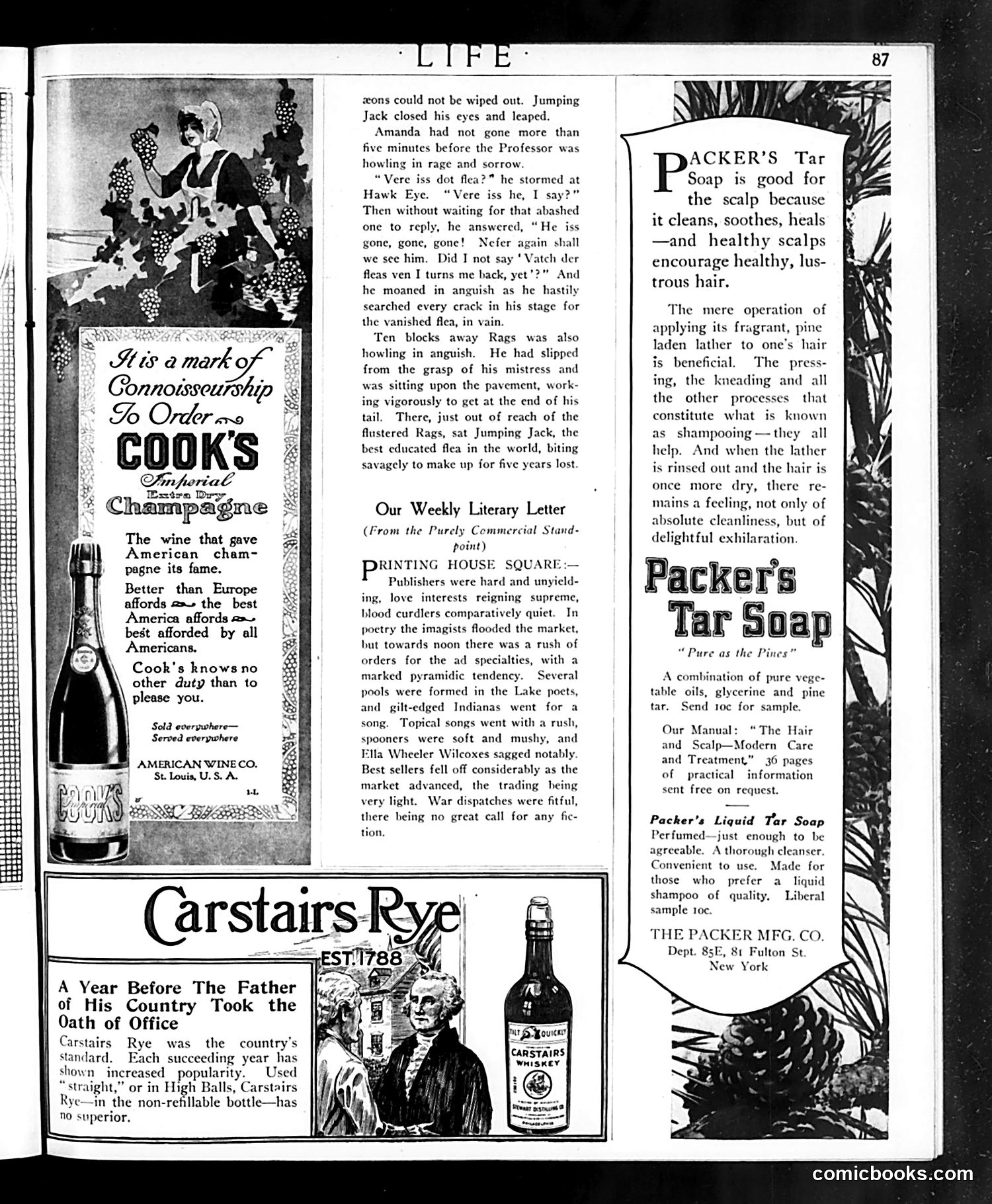
This page mixes fiction and advertising with little overt political content. The main narrative excerpt describes "Jumping Jack," a flea, escaping from a stage professor and ending up biting a dog named Rags—a slapstick comedic scenario typical of Life's humorous storytelling. The "Weekly Literary Letter" section offers satirical commentary on publishing trends circa 1910s-1920s: publishers' hardness, the flood of "imagist" poetry, topical songs replacing serious literature, and weak demand for war dispatches and fiction. This reflects wartime or post-war cultural shifts. The bulk of the page comprises product advertisements: Cook's champagne (positioning American wine against European), Carstairs Rye whiskey (claiming historical prestige), and Packer's Tar Soap (medicinal claims about hair health). These ads typify the era's marketing style—appeals to connoisseurship, patriotism, and pseudo-scientific health benefits. No specific political figures or events are caricatured. The page is primarily commercial.
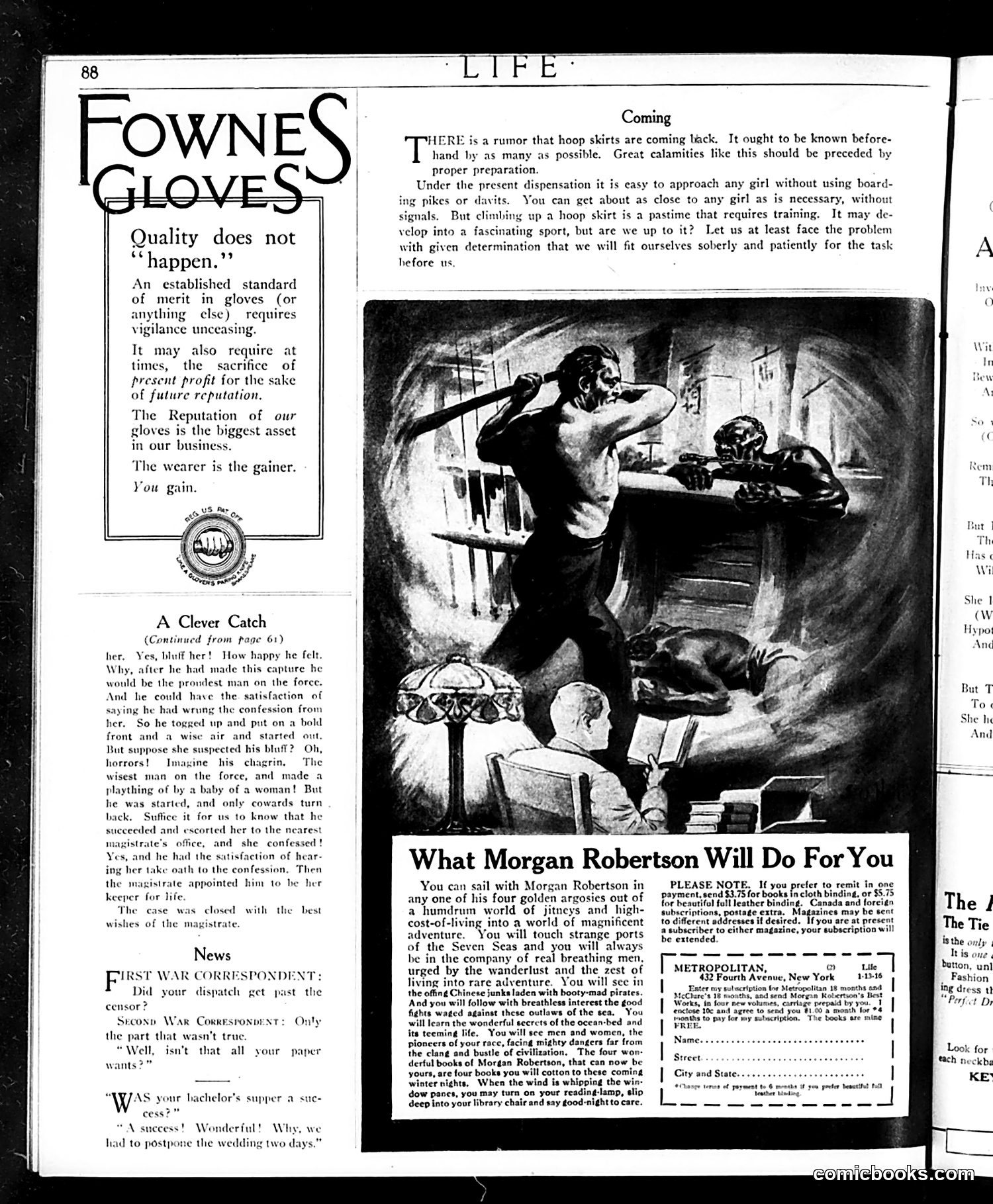
This page contains three distinct elements: **1. Fownes Gloves Advertisement** (left): A straightforward quality-focused ad emphasizing brand reputation and craftsmanship—typical early 20th-century advertising rhetoric. **2. "Coming" Article & Cartoon** (center-right): A satirical piece about the rumored return of hoop skirts. The accompanying illustration shows a man attempting to embrace a woman wearing a large hoop skirt, struggling comically to reach her. The satire mocks both the impracticality of hoop skirts and the physical challenge they posed to courtship/intimacy. The text humorously warns men they'll need "training" to navigate approaching women in these garments—treating fashion as an obstacle course. **3. Morgan Robertson Adventure Story Advertisement** (bottom-right): Promotional text for adventure tales featuring maritime exploits, pirates, and exotic locations—typical pulp fiction marketing of the era. The page is primarily **advertising and light entertainment** rather than political satire. The hoop skirt joke reflects genuine social anxieties about changing women's fashion and its social implications.
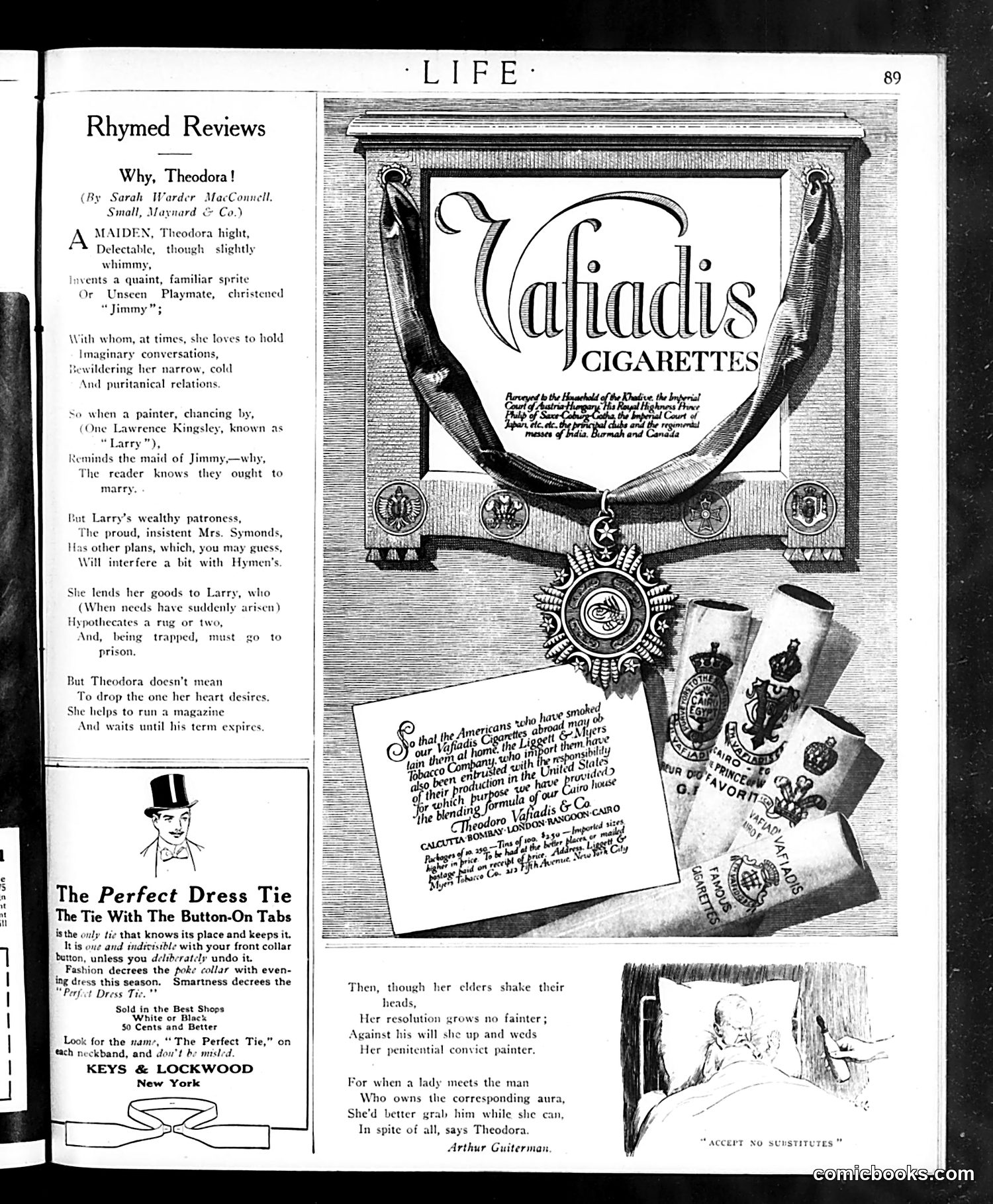
This page combines two unrelated items: a book review in verse and an advertisement. **The Rhymed Review** (left): A satirical poem reviewing what appears to be a novel called "Why, Theodora!" The plot involves a young woman named Theodora who imagines an invisible friend ("Jimmy"). She falls for a poor painter named Larry, but his wealthy patron Mrs. Symonds interferes—Larry even goes to prison after pledging the patron's belongings as collateral. Theodora waits faithfully and marries him anyway. The review mocks this sentimental melodrama, particularly the romantic notion that spiritual compatibility ("corresponding aura") justifies marrying a penniless convict. The satire targets overly romantic, impractical attitudes toward marriage and the trope of the devoted woman waiting for her flawed man. **The Advertisement** (right): A full-page ad for Cafiadius Cigarettes, featuring ornate packaging and imagery. This reflects the era when cigarette advertising was unrestricted and common in mainstream publications.
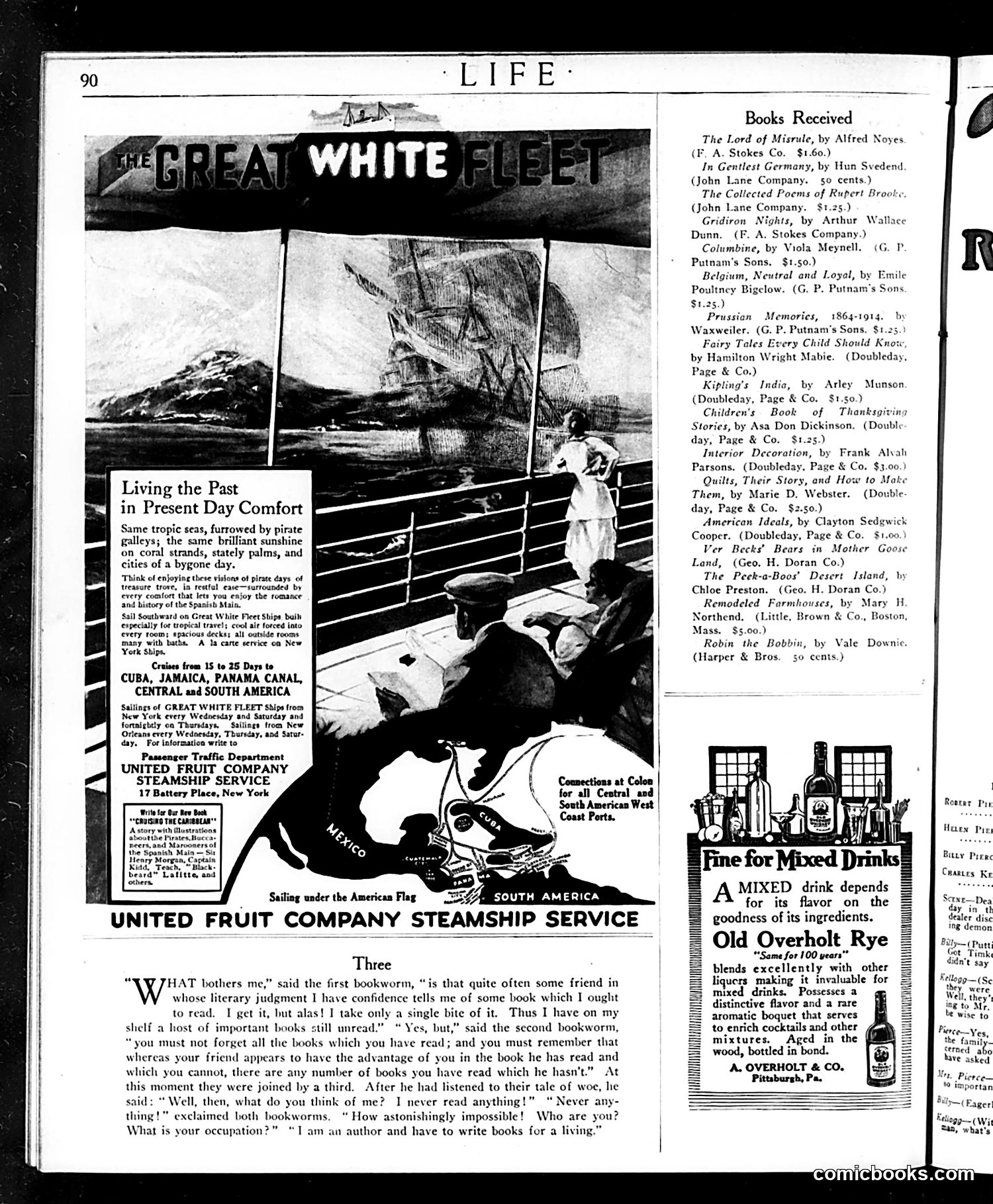
This page combines **travel advertising with humorous editorial content**. ## Main Advertisement The top half features the "Great White Fleet" steamship service of the United Fruit Company, advertising Caribbean and Central American cruises. The imagery romanticizes colonial-era adventure—pirate galleys, the "Spanish Main"—to attract wealthy tourists seeking exotic travel with modern comfort ("cool air forced into every room"). ## "Three" Comic Story The brief dialogue at bottom satirizes literary pretension. Three characters debate reading habits: the first regrets unfinished books, the second defends having read *something*, and the third—revealed as "an author"—confesses he never reads at all, only writes for income. The joke mocks authors as potentially illiterate hacks motivated purely by commercial necessity, deflating literary seriousness. ## Surrounding Content The page includes book reviews (period literature), a whiskey advertisement ("Old Overholt Rye"), and mixed-drink recipe promotion. The "Books Received" section lists contemporary titles, suggesting this is a literary culture magazine mixing serious book discussion with commercial messaging and light satire.
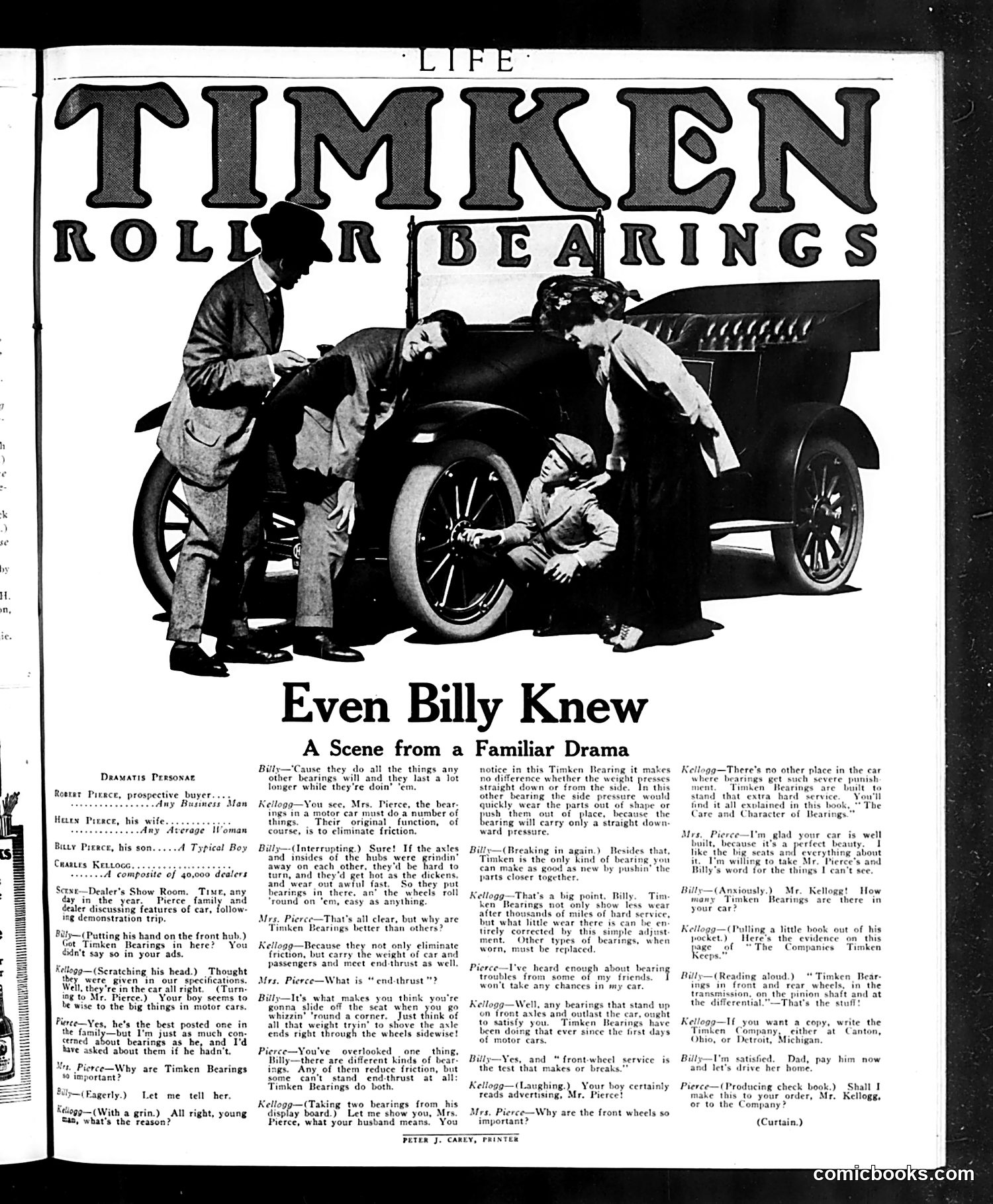
This is a Timken Roller Bearings advertisement disguised as a humorous domestic drama. The "satire" targets not politics but consumer ignorance—specifically, that even a typical boy ("Billy") understands automotive engineering better than most adults. The setup: A prospective car buyer (Mr. Pierce), his wife, and their son Billy visit a dealer (Kellogg) to examine a car. Billy repeatedly demonstrates superior knowledge about bearings—their function in reducing friction, carrying weight, and handling "end-thrust" (lateral force in turns). He even corrects the dealer and his father. The joke's point: Timken Bearings are so obviously superior and widely discussed that a child grasps their importance, shaming adults who don't. This was effective advertising because it flattered readers' intelligence while subtly pressuring them to buy Timken-equipped vehicles to avoid appearing ignorant. This represents early 20th-century advertising strategy: embedding product messaging in relatable, comedic scenarios rather than direct promotion.
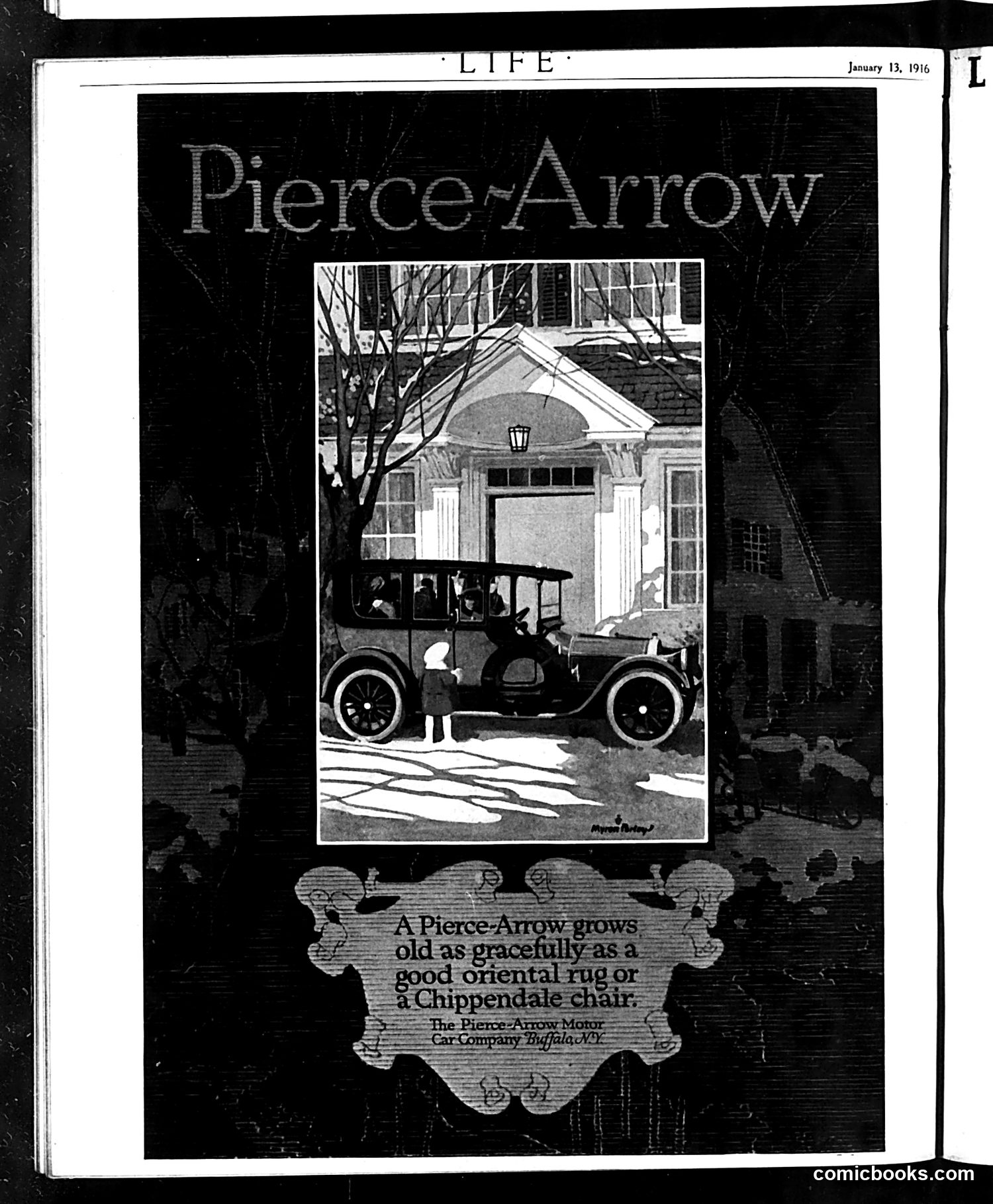
This is an advertisement for Pierce-Arrow automobiles, not political satire. The page features an illustration of an early motorcar parked in front of a residential building, with a figure standing beside it. The ad's tagline claims "A Pierce-Arrow grows old as gracefully as a good oriental rug or a Chippendale chair"—positioning the car as a luxury good that appreciates with age like fine furnishings. The Pierce-Arrow Motor Car Company was based in Buffalo, New York. This appears to be a straightforward luxury marketing appeal to wealthy consumers, emphasizing the vehicle's durability and status as a refined, long-lasting investment rather than disposable transportation. The comparison to oriental rugs and antique furniture suggests an aspirational, upper-class lifestyle.